
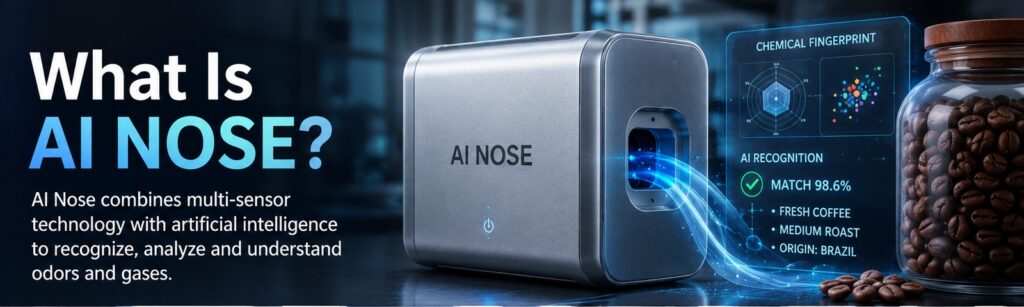
Artificial intelligence can recognize images, understand speech and analyze enormous amounts of data. Increasingly, machines are also learning to interpret another type of information that humans experience every day: smell.
Ein AI Nose, also called an AI-powered electronic nose or intelligent electronic nose, combines multiple chemical or gas sensors with signal processing and artificial intelligence to recognize patterns in odors, gases and volatile organic compounds (VOCs).
Instead of attempting to identify every molecule in the air separately, an AI Nose usually looks at the combined responses of several sensors. Machine-learning algorithms then compare that response pattern with previously collected data.
The result can be thought of as a digital chemical fingerprint.
This makes AI Nose technology particularly interesting for applications where the overall chemical pattern matters more than the concentration of one individual gas, including:
- Food freshness and quality
- Industrielle Prozessüberwachung
- Environmental odor monitoring
- Smart appliances
- Automotive air-quality systems
- Landwirtschaft
- Healthcare research
- Robotik
- Vorhersagewartung
What Exactly Is an AI Nose?
An AI Nose is an advanced form of an electronic nose, commonly abbreviated as an e-nose.
Traditionelle elektronische Nasen gibt es schon seit Jahrzehnten. Ihr Grundkonzept besteht darin, mehrere chemische Sensoren derselben Probe auszusetzen und zu analysieren, wie diese Sensoren gemeinsam reagieren.
Moderne AI Nose-Systeme fügen ausgefeiltere Datenverarbeitungs- und maschinelle Lernalgorithmen hinzu.
Ein typisches System kann Folgendes enthalten:
- Ein Luft- oder Gasprobenahmesystem
- Mehrere Gassensorelemente
- Signalaufbereitungselektronik
- Temperatur- und Feuchtigkeitskompensation
- Datenerfassungshardware
- Software zur Merkmalsextraktion
- Modelle für maschinelles Lernen
- Eine Datenbank bekannter chemischer Muster
Das Sensorarray verhält sich in etwa wie eine Gruppe biologischer Geruchsrezeptoren, während das KI-Modell die resultierenden Signale interpretiert.
Die Bedingungen AI Nose, electronic nose, maschineller Geruchssinn, digitale Geruchswahrnehmung Und künstlicher Geruch sind eng miteinander verbunden, obwohl sie nicht immer auf die gleiche Weise verwendet werden.
Einen tieferen Überblick über die Technologie, die Sensorarchitektur und die Entwicklung der intelligenten Geruchserkennung finden Sie in diesem Leitfaden AI Nose-Technologie.
Wie funktioniert eine KI-Nase?
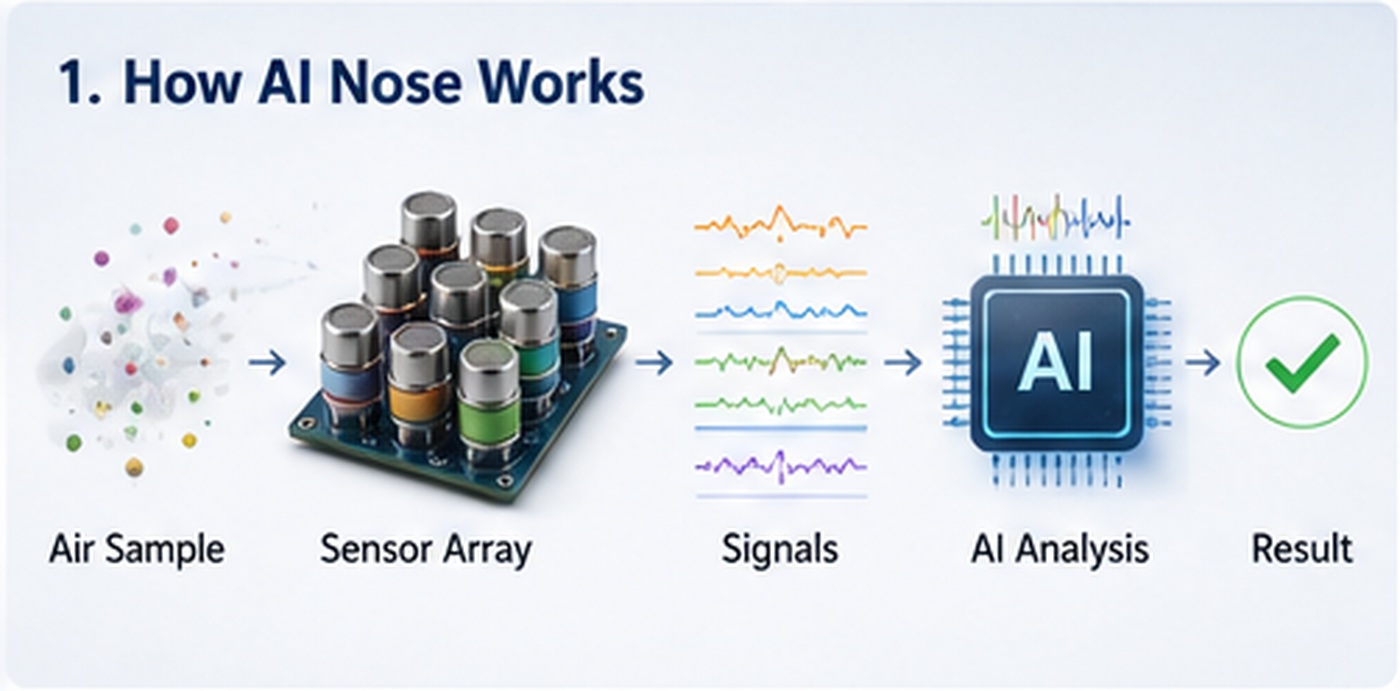

Obwohl die Systemarchitekturen unterschiedlich sind, folgen die meisten AI Nose-Geräte demselben allgemeinen Arbeitsablauf:
Luftprobe → Sensorarray → Elektrische Signale → Signalverarbeitung → KI-Modell → Erkennung oder Vorhersage
1. Das System sammelt eine Luftprobe
Der erste Schritt besteht darin, die Gas- oder Geruchsprobe mit dem Sensorarray in Kontakt zu bringen.
Abhängig vom Gerät kann die Probenahme Folgendes umfassen:
- Natürliche Verbreitung
- Eine Miniaturpumpe
- Kontrollierter Luftstrom
- Headspace-Probenahme
- Schläuche
- Eine spezielle Probenkammer
Das Design der Probenahme ist wichtig, da sich die Sensorreaktionen je nach Luftstrom, Expositionszeit, Konzentration, Temperatur und Luftfeuchtigkeit ändern können.
Aus diesem Grund besteht eine zuverlässige AI Nose aus mehr als nur mehreren an einen Computer angeschlossenen Gassensoren.
Die gesamte Probenahmeumgebung ist wichtig.
2. Mehrere Sensoren reagieren auf die Probe
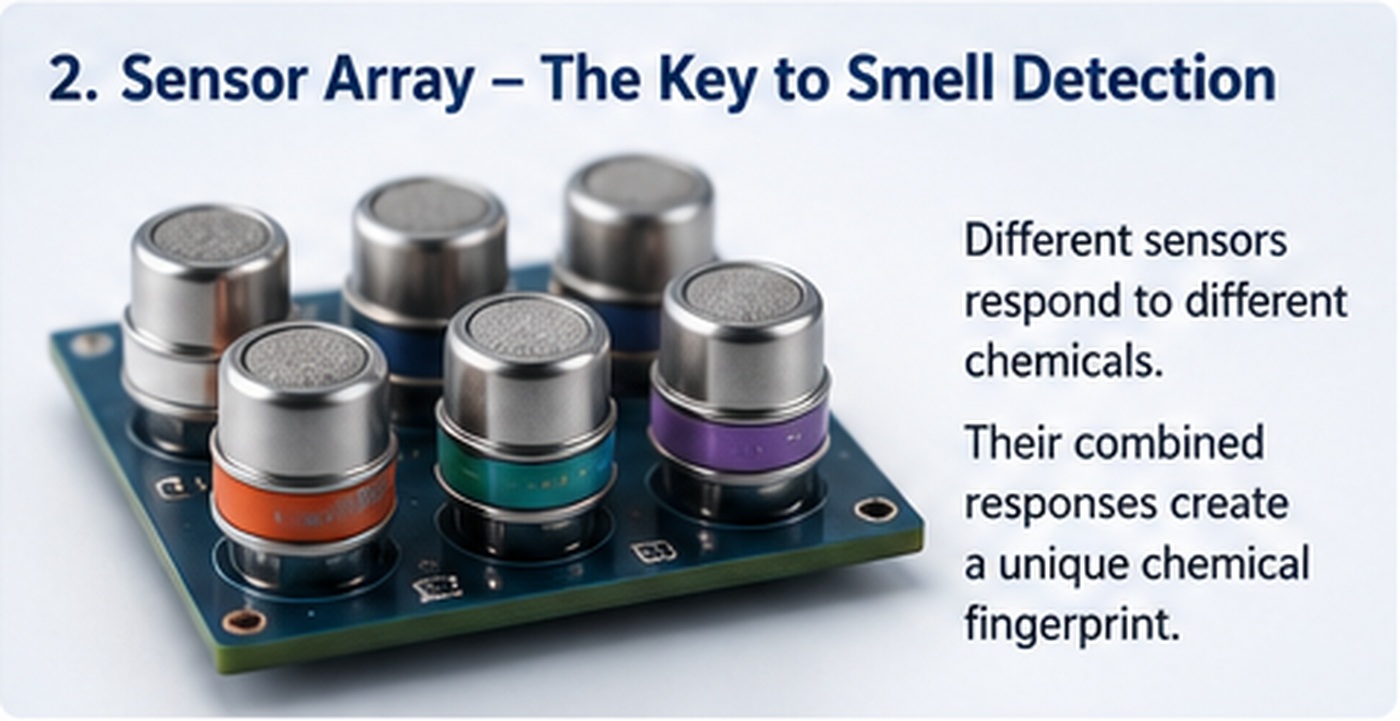

Der zentrale Bestandteil einer AI Nose ist normalerweise a Sensorarray.
Anstatt nur einen hochselektiven Sensor zu verwenden, kann das System mehrere Sensorelemente mit unterschiedlichen Empfindlichkeiten enthalten.
Zu den möglichen Technologien gehören:
- MEMS-Gassensoren
- Metalloxid-Halbleitersensoren
- Elektrochemische Sensoren
- Leitfähige Polymersensoren
- Optische Gassensoren
- Quarzkristall-Mikrowaagensensoren
- Oberflächenwellensensoren
- Kolorimetrische Sensorarrays
Stellen Sie sich vor, dass sechs Sensoren dem gleichen Kaffeearoma ausgesetzt sind.
Die Antwort könnte etwa so aussehen:
- Sensor A: starke Reaktion
- Sensor B: mäßige Reaktion
- Sensor C: schwache Reaktion
- Sensor D: schnelle Reaktion und Erholung
- Sensor E: langsame Reaktion
- Sensor F: fast keine Reaktion
Setzen Sie dieselbe Sensoranordnung verdorbenen Lebensmitteln aus, kann die Kombination völlig anders aussehen.
Kein einzelner Sensor erkennt notwendigerweise den Geruch.
Stattdessen, Das Muster aller Sensoren wird zur nützlichen Information.
Was ist ein chemischer Fingerabdruck?
Wenn mehrere Sensoren unterschiedlich auf dieselbe Probe reagieren, erzeugen ihre kombinierten Signale ein mehrdimensionales Muster.
Dieses Muster wird oft beschrieben als:
- Chemischer Fingerabdruck
- Geruchsfingerabdruck
- Gasfingerabdruck
- VOC-Fingerabdruck
Zum Beispiel:
Kaffee → Muster A
Orangensaft → Muster B
Frischfleisch → Muster C
Verdorbenes Fleisch → Muster D
Das KI-System kann diese Muster aus Trainingsdaten lernen.
Wenn später eine unbekannte Probe gemessen wird, vergleicht die Software den neuen Fingerabdruck mit zuvor gelernten Beispielen.
Dies ähnelt konzeptionell der Art und Weise, wie Bilderkennungssoftware visuelle Muster lernt, anstatt jedes einzelne Pixel manuell zu überprüfen.
Wie KI Sensorsignale in Bedeutung umwandelt


Rohe Sensorsignale werden selten direkt an ein KI-Modell gesendet.
Normalerweise müssen sie zuerst bearbeitet werden.
Zu den üblichen Verarbeitungsschritten gehören:
- Rauschfilterung
- Grundlinienkorrektur
- Signal normalization
- Temperature compensation
- Humidity compensation
- Sensor drift correction
- Feature extraction
- Dimensionality reduction
Once useful features have been extracted, machine-learning algorithms can analyze the data.
Einstufung
The system determines which known category best matches the sample.
Beispiele:
- Fresh vs. spoiled
- Coffee type A vs. coffee type B
- Normal process vs. abnormal process
- Odor A vs. odor B
Regression
The model estimates a continuous value rather than simply assigning a category.
Examples may include:
- Freshness level
- Ripeness
- Process condition
- Estimated concentration
Anomaly Detection
An AI Nose does not always need to know exactly what a smell is.
Instead, it can learn what a normal chemical environment looks like.
If the sensor pattern changes significantly, the system can flag the event as an anomaly.
Dieser Ansatz kann besonders in Fabriken, Lagerhäusern und Anlagenüberwachungsanwendungen wertvoll sein.
Welche KI-Algorithmen können verwendet werden?
Verschiedene AI Nose-Systeme verwenden je nach Komplexität, Datensatzgröße und beabsichtigter Anwendung unterschiedliche Algorithmen.
Zu den gängigen Ansätzen gehören:
- Hauptkomponentenanalyse (PCA)
- Lineare Diskriminanzanalyse (LDA)
- Support Vector Machines (SVM)
- k-Nächste Nachbarn (KNN)
- Zufälliger Wald
- Künstliche neuronale Netze
- Faltungs-Neuronale Netze
- Deep-Learning-Modelle
- Ensemble-Lernmethoden
Eine ausgefeiltere KI bedeutet nicht automatisch eine bessere Leistung.
Ein erfolgreiches System hängt von der Kombination aus Folgendem ab:
Sensorqualität + Probenahmedesign + Trainingsdaten + Umgebungskompensation + geeigneter Algorithmus
Ein einfaches Modell, das mit hochwertigen realen Daten trainiert wird, kann ein komplexes neuronales Netzwerk, das mit einem begrenzten Labordatensatz trainiert wurde, übertreffen.
KI-Nase vs. herkömmlicher Gassensor
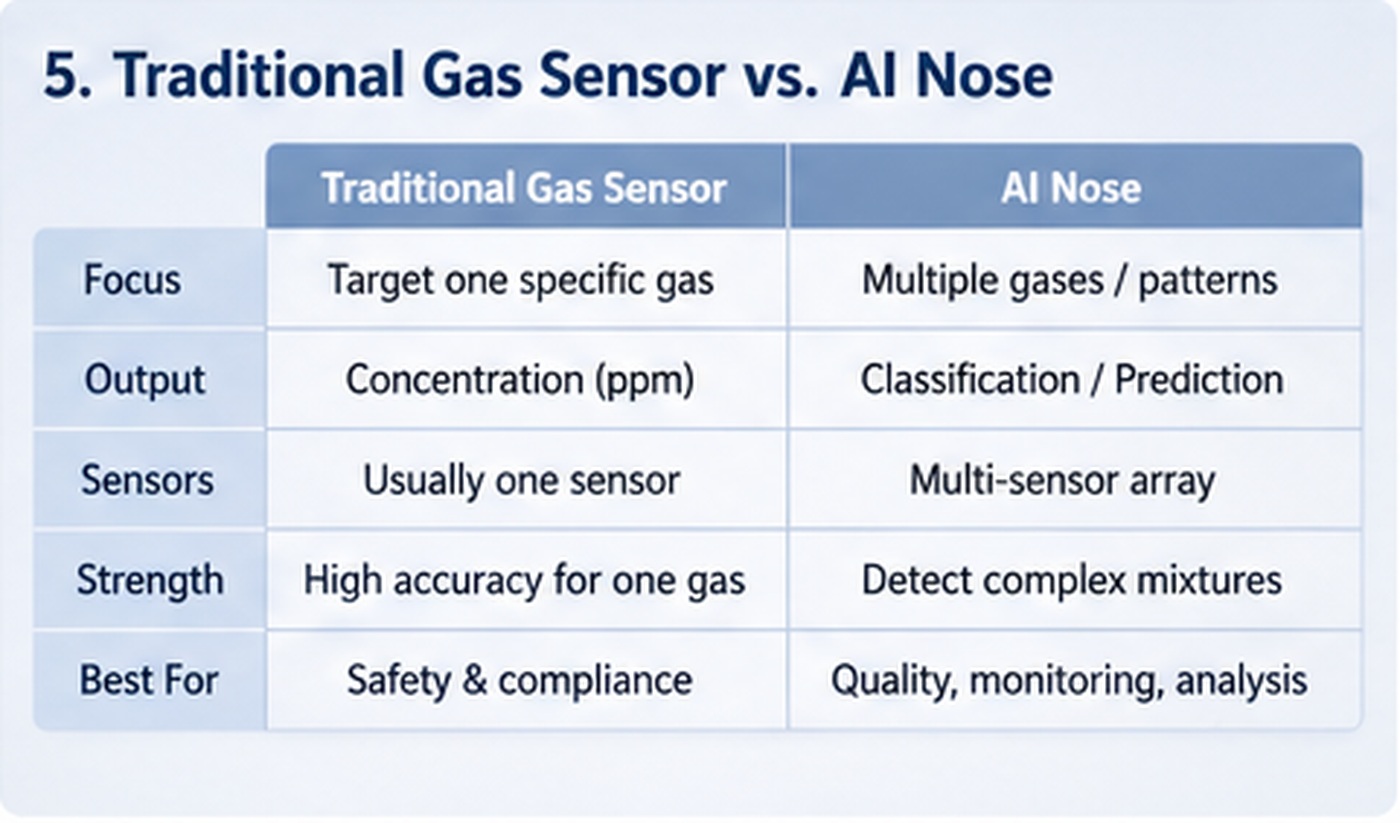

Eine KI-Nase und ein herkömmlicher Gassensor sind verwandte Technologien, aber sie sind darauf ausgelegt, unterschiedliche Fragen zu beantworten.
Traditioneller Gassensor
Ein herkömmliches Gasdetektionssystem konzentriert sich üblicherweise auf ein bekanntes Zielgas.
Beispiele hierfür sind:
- Kohlenmonoxid
- Methan
- Wasserstoff
- Schwefelwasserstoff
- Ammoniak
- Sauerstoff
- Kohlendioxid
- Kältemittel
Die Hauptfrage lautet normalerweise:
Wie viel von diesem Gas ist vorhanden?
Die Ausgabe kann wie folgt ausgedrückt werden:
- ppm
- ppb
- %UEG
- % Volumen
Für die Arbeitssicherheit und die regulatorische Gasdetektion bleibt diese quantitative Messung äußerst wichtig.
AI Nose
Eine KI-Nase stellt normalerweise eine andere Frage:
Wie ähnelt diese Kombination chemischer Signale?
Anstatt sich auf die Reaktion eines einzelnen Sensors zu verlassen, analysiert die KI die Beziehung zwischen mehreren Signalen.
| Traditioneller Gassensor | AI Nose |
|---|---|
| Konzentriert sich oft auf ein Gas | Verwendet mehrere Sensorkanäle |
| Misst die Konzentration | Erkennt chemische Muster |
| Verwendet normalerweise definierte Schwellenwerte | Kann Modelle des maschinellen Lernens verwenden |
| Ausgabe oft in ppm oder % | Die Ausgabe kann Klasse, Wahrscheinlichkeit oder Anomalie sein |
| Eine hohe Selektivität kann wichtig sein | Querempfindlichkeit kann nützliche Musterinformationen liefern |
| Am besten für bekannte Zielgase geeignet | Nützlich für komplexe chemische Mischungen |
Diese Technologien konkurrieren nicht unbedingt.
In vielen Anwendungen können sie einander ergänzen.
Ein System könnte spezielle Sicherheitssensoren verwenden, um gefährliche Gaskonzentrationen zu messen, während eine KI-Nase umfassendere Veränderungen in der umgebenden chemischen Umgebung analysiert.
A Real-World AI Nose Example: Winsen ZM101-A
AI Nose technology is increasingly moving from research prototypes toward practical sensing platforms.
One example is the Winsen ZM101-A AI-Nose, a MEMS gas sensor array designed to support intelligent multi-channel gas analysis.
The ZM101-A incorporates six gas-sensing channels and supports flexible selection of 1 to 6 operating channels.
Its available sensing channels cover:
| Gas | Erfassungsbereich |
|---|---|
| NH₃ | 1–100 ppm |
| VOC | 1–10 ppm |
| NEIN₂ | 0.1–10 ppm |
| H₂S | 0.5–10 ppm |
| CO | 5–200 ppm |
| CH₄ | 100–6000 ppm |
Unlike a conventional single-gas sensing element, the ZM101-A is designed as a multi-channel MEMS gas sensor array.
The module provides signal filtering and temperature/humidity compensation and supports integration with AI algorithm models.
This allows developers to build applications in which several gas responses are collected together and used for subsequent:
- Target gas capture
- Feature analysis
- Model building
- Task identification
ZM101-A Key Specifications
- Sensor type: MEMS gas sensor array
- Gas channels: 6
- Operating modes: Flexible 1–6 channel selection
- Versorgungsspannung: DC 3.3 V
- Operating current: ≤150 mA
- Power consumption: ≤400 mW
- Communication: Uart
- Warm-up time: ≤120 seconds
- Betriebstemperatur: -40°C to 85°C
- Operating humidity: 5%RH–95%RH, non-condensing
- AI support: Supports integration of AI algorithm models
The module is intended for application areas including:
- Smart refrigerators
- Air conditioners
- Microwaves
- Air purifiers
- Range hoods
- Automotive air-quality monitoring
- Industrial gas monitoring
- Leak alarms
- Healthcare-related sensing research
- Smart environmental monitoring
The ZM101-A illustrates an important development in the AI Nose field: manufacturers are increasingly providing multi-channel sensing hardware that developers can combine with their own AI models and application data.
This makes it possible to design application-specific electronic-nose systems rather than starting from individual sensing elements.
Where Can AI Nose Technology Be Used?
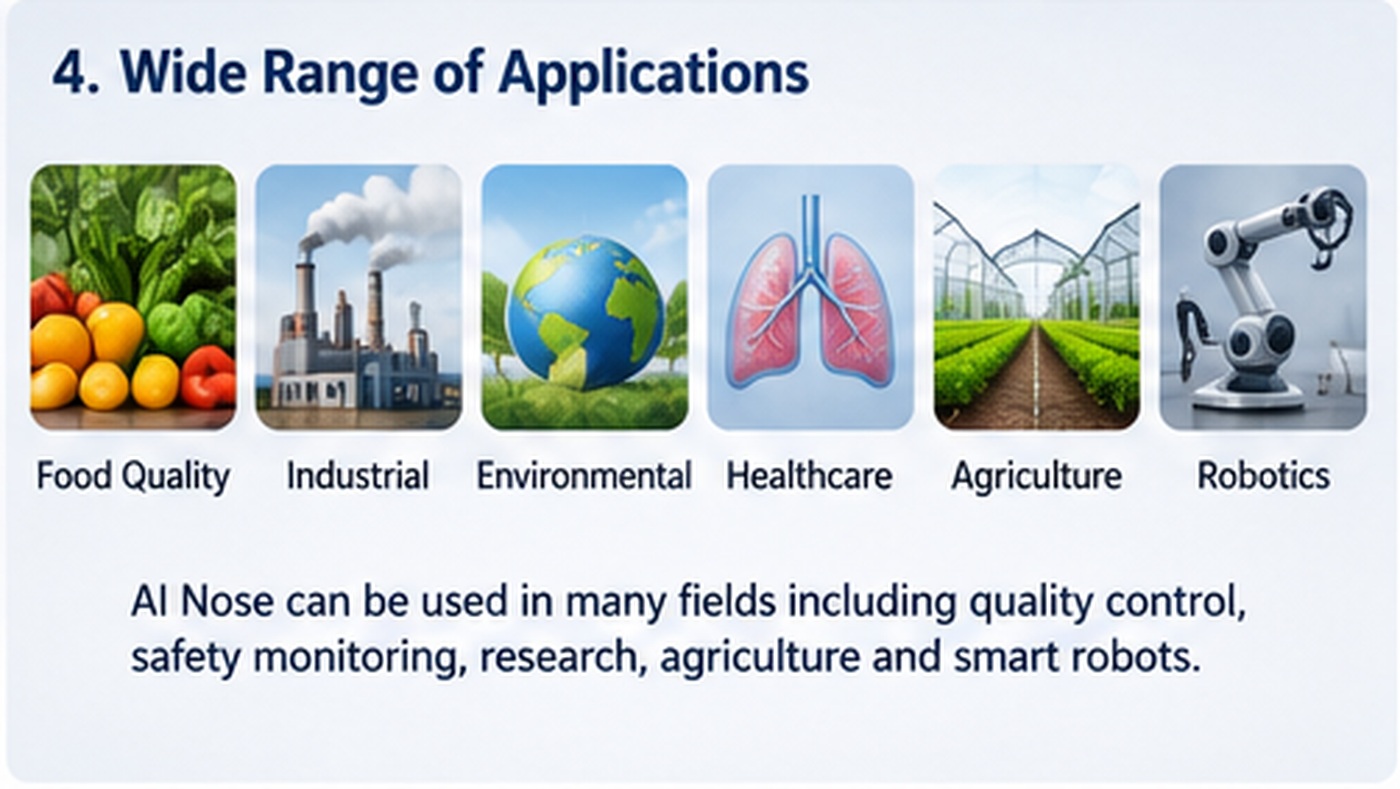

The potential applications of AI Nose technology extend across many industries because nearly every biological, chemical or manufacturing process produces some type of volatile chemical signature.
1. Food Quality and Freshness
Food releases changing mixtures of VOCs as it:
- Ripens
- Ferments
- Oxidizes
- Degrades
- Spoils
An AI Nose can analyze those changing patterns to help evaluate:
- Freshness
- Spoilage
- Ripeness
- Fermentation status
- Product consistency
- Origin
- Adulteration
Possible products include:
- Meat
- Seafood
- Fruit
- Vegetables
- Coffee
- Tea
- Wine
- Dairy products
For example, an AI Nose does not necessarily need to identify every VOC produced by spoiled meat.
It may simply learn that the sensor fingerprint of spoiled meat differs consistently from the fingerprint of fresh meat.
2. Industrial Process Monitoring
Factories often produce characteristic chemical signatures during normal operation.
Changes in these signatures can indicate:
- Process abnormalities
- Material contamination
- Equipment problems
- Leaks
- Overheating
- Chemical degradation
Instead of waiting until one gas reaches a fixed alarm threshold, an AI Nose can potentially identify that the overall chemical environment has changed.
This makes artificial olfaction especially interesting for continuous industrial monitoring.
3. Umweltüberwachung
Many environmental odor problems involve complex mixtures rather than one individual gas.
Mögliche Anwendungen sind:
- Wastewater plants
- Waste-treatment facilities
- Farms
- Industrial parks
- Chemical facilities
- Indoor-air monitoring
- Odor-source identification
Conventional gas sensors remain important when individual pollutant concentrations must be measured.
AI Nose systems can add another layer by recognizing the overall odor or VOC signature.
4. Smart Home Appliances
Artificial olfaction can also be integrated into consumer appliances.
Mögliche Anwendungen sind:
Refrigerators
Detect changes associated with food freshness or abnormal odors.
Range Hoods
Recognize cooking-related gas and odor patterns and automatically adjust ventilation.
Luftreiniger
Evaluate changes in indoor chemical environments instead of relying on one VOC value alone.
Klimaanlagen
Combine chemical sensing with temperature, humidity and particulate measurements for more intelligent air-quality management.
This is one area where compact MEMS arrays such as the ZM101-A can be particularly attractive because appliance manufacturers need small, low-power sensing platforms.
5. Automotive Applications
Modern vehicles already contain increasingly sophisticated environmental sensors.
AI Nose technology could add chemical-pattern recognition for:
- Cabin-air monitoring
- Outdoor pollution detection
- Unusual odors
- Air-quality control
- Personalized ventilation
- Automatic recirculation control
Future intelligent vehicles may combine artificial olfaction with cameras, microphones, temperature sensors and other environmental sensors.
6. Agriculture
Plants, soil, fruit and biological processes release many volatile compounds.
AI Nose systems may therefore support:
- Fruit ripeness monitoring
- Crop disease research
- Product-quality assessment
- Storage monitoring
- Greenhouse monitoring
- Livestock-environment analysis
One of the major potential advantages is detecting chemical changes before a problem becomes visually obvious.
7. Healthcare Research
Human breath contains many volatile compounds associated with metabolic processes.
Researchers are therefore exploring electronic noses for analyzing breath patterns.
Potential research areas include:
- Breath analysis
- Patient monitoring
- Medical-environment monitoring
- Disease-related VOC studies
However, an important distinction must be made.
A research result showing that an electronic nose can distinguish certain breath patterns does not automatically mean that the device is an approved medical diagnostic tool.
Clinical validation, reproducibility, regulatory approval and large representative datasets are necessary before such systems can be used for medical diagnosis.
8. Robotics and Embodied Intelligence
Robots already use several artificial senses:
- Cameras provide vision
- Microphones provide hearing
- Force sensors provide touch
- LiDAR provides spatial awareness
Artificial olfaction could provide another important sense.
A robot equipped with an AI Nose could potentially identify:
- Gas leaks
- Chemical spills
- Smoke-related changes
- Spoiled food
- Hazardous environments
- Odor sources
This could be particularly useful for:
- Industrial inspection robots
- Firefighting robots
- Underground inspection
- Hazardous-environment robots
- Household service robots
As embodied AI develops, chemical sensing could become another important source of environmental information.
AI Nose for Predictive Maintenance
One particularly interesting industrial application is predictive maintenance.
Equipment can sometimes release characteristic VOCs before visible failure occurs.
Possible sources include:
- Overheated components
- Degrading lubricants
- Electrical insulation
- Kunststoff
- Batteries
- Chemical leakage
Rather than setting a threshold for every possible compound, an AI Nose can learn the normal chemical fingerprint around a machine.
If that fingerprint gradually changes, the system may detect the anomaly before a major failure occurs.
This approach could eventually complement:
- Vibration monitoring
- Acoustic monitoring
- Thermal imaging
- Electrical measurements
Sensor fusion may ultimately produce more reliable predictive-maintenance systems than any individual sensing technology alone.
Why Is AI Useful for Smell Detection?
Complex odors rarely consist of one gas.
Consider six sensors responding simultaneously:
| Sensor | Response |
|---|---|
| Sensor A | Moderate increase |
| Sensor B | Strong increase |
| Sensor C | Almost unchanged |
| Sensor D | Rapid peak |
| Sensor E | Slow recovery |
| Sensor F | Small decrease |
A conventional threshold system might struggle to interpret this combination.
Machine-learning algorithms are designed to identify relationships across multiple variables.
This is why artificial intelligence is particularly suitable for electronic noses.
The valuable information is often not:
“Sensor A measured 2.8.”
It is:
“The combined relationship among Sensors A–F closely matches Pattern X.”
What Are the Main Challenges of AI Nose Technology?
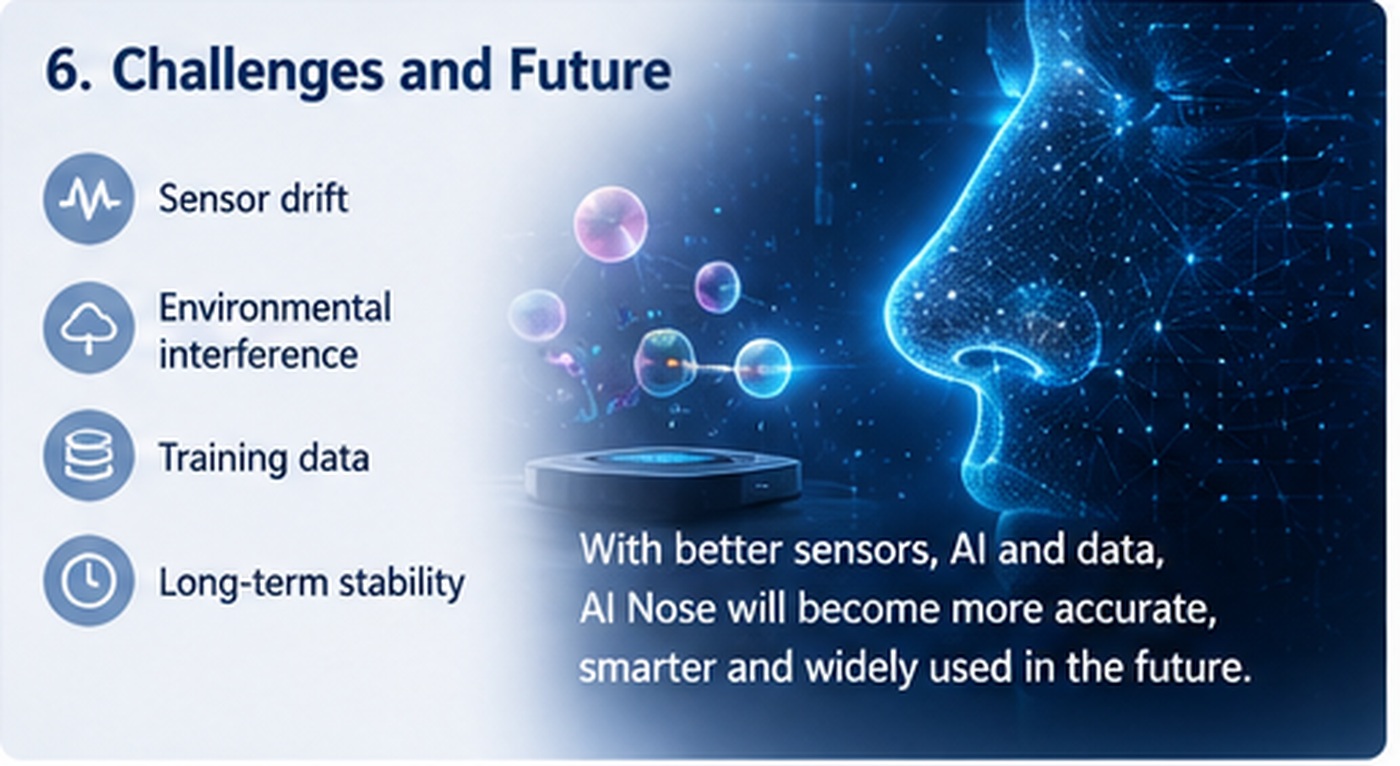

AI Nose technology is promising, but practical deployment remains challenging.
Sensordrift
Gas sensors can gradually change their characteristics because of:
- Aging
- Kontamination
- Long-term chemical exposure
- Umweltbedingungen
- Material changes
A model trained when a sensor array is new may become less accurate after months or years.
Drift compensation is therefore an important part of long-term AI Nose development.
Temperatur und Luftfeuchtigkeit
Many chemical sensors are affected by environmental conditions.
If humidity changes from 30%RH to 80%RH, some sensor signals may change even though the odor itself has not.
A reliable system must distinguish:
Real chemical change
from
Environmental interference
Temperature and humidity compensation are therefore important features in practical sensor arrays.
Trainingsdaten
An AI model is only as useful as the data used to train it.
A system trained under ideal laboratory conditions may perform differently in a factory.
Real-world datasets should contain variation in:
- Temperatur
- Feuchtigkeit
- Background gases
- Sensoralterung
- Product batches
- Concentration
- Airflow
- Seasonal conditions
Sensor Contamination
Some gases or chemicals can temporarily or permanently alter sensing materials.
Sampling systems may therefore require:
- Filters
- Controlled exposure
- Cleaning procedures
- Kalibrierung
- Sensor replacement strategies
Generalization
An electronic nose trained for one environment cannot automatically be expected to perform equally well everywhere.
Zum Beispiel:
Ein KI-Modell, das anhand von Kaffeeproben aus einer Rösterei trainiert wird, erkennt möglicherweise nicht sofort jeden Kaffee aus jedem Land, Röstverfahren oder jeder Lagerumgebung.
Anwendungsspezifische Schulungen und Validierungen bleiben äußerst wichtig.
Ist KI-Nase dasselbe wie digitales Riechen?
Die Terminologie überschneidet sich erheblich.
Elektronische Nase
Bezieht sich normalerweise auf ein physikalisches Sensor-Array-System, das Aspekte der biologischen Geruchswahrnehmung nachahmen soll.
AI Nose
Betont die Integration von maschinellem Lernen oder künstlicher Intelligenz mit Sensorarray-Daten.
Maschinelle Geruchsbildung
Ein weiter gefasster Begriff, der Maschinen in die Lage versetzt, in der Luft befindliche chemische Informationen zu interpretieren.
Digitale Geruchswahrnehmung
Kann den gesamten Prozess umfassen:
- Erfassung geruchsbezogener Informationen
- Es digitalisieren
- Analysiere es
- Übermitteln
- Möglicherweise wird es reproduziert
Da sich dieser Bereich noch in der Entwicklung befindet, variiert die Terminologie zwischen Forschern und Herstellern.
Werden KI-Nasen herkömmliche Gassensoren ersetzen?
NEIN.
Zumindest nicht in absehbarer Zeit.
Spezielle Gassensoren bleiben für Anwendungen, die eine genaue Messung bestimmter Gase erfordern, unerlässlich.
Beispiele hierfür sind:
- CO-Sicherheitsmelder
- Detektoren für brennbare Gase
- Sauerstoffüberwachung
- Erkennung giftiger Gase
- Erkennung von Kältemittellecks
Eine KI-Nase ist besser geeignet, wenn das Problem Folgendes betrifft:
- Komplexe Mischungen
- Geruchserkennung
- Einstufung
- Musteränderungen
- Anomalieerkennung
Die Zukunft dürfte daher beide Technologien umfassen.
Ein hochentwickeltes industrielles Überwachungssystem könnte Folgendes enthalten:
Spezifische Gassensoren + AI Nose + Temperatur-/Feuchtigkeitssensoren + Partikelsensoren + Kameras + Vorhersagesoftware
Together, these technologies can provide a much richer understanding of an environment than any single sensor alone.
The Future of AI Nose Technology
Several developments are accelerating progress in artificial olfaction.
Smaller MEMS Sensors
MEMS manufacturing makes multi-channel sensor arrays increasingly compact and suitable for integration into:
- Appliances
- Fahrzeuge
- Robots
- Portable devices
- IoT equipment
Edge AI
Machine-learning models can increasingly operate directly on local processors.
Benefits include:
- Faster response
- Lower network bandwidth
- Offline operation
- Better privacy
- Real-time processing
Larger Real-World Datasets
As more electronic noses are deployed, engineers can collect larger datasets covering:
- Sensoralterung
- Seasonal variation
- Environmental interference
- Product differences
- Abnormal events
These datasets should help improve model robustness.
Sensor Fusion
Future AI systems may combine smell with other sensing technologies.
Zum Beispiel:
AI Nose + Camera + Temperature + Humidity + Particles + Pressure + Sound
Rather than giving machines only artificial smell, engineers can develop complete multi-sensory systems.
Häufig gestellte Fragen
What does an AI Nose detect?
An AI Nose detects patterns produced by gases, VOCs and odors using multiple chemical sensors. Depending on its training, it may classify odors, detect abnormal conditions or estimate particular properties.
Is an AI Nose the same as an electronic nose?
An AI Nose is generally a type of electronic nose that places greater emphasis on artificial intelligence and machine learning for interpreting sensor-array data.
Can AI identify smells?
KI kann chemische Muster klassifizieren, wenn sie über geeignete Sensordaten und repräsentative Trainingsbeispiele verfügt. Das System „riecht“ nicht genau wie ein Mensch, kann aber lernen, wiederholbare chemische Fingerabdrücke zu erkennen.
Misst eine AI Nose die Gaskonzentration?
Je nach Sensor und Modell ist dies möglich, die Konzentrationsmessung ist jedoch nicht immer ihr Hauptzweck. Viele AI Nose-Systeme konzentrieren sich auf die Klassifizierung, Erkennung oder Anomalieerkennung.
Welche Sensoren werden in einer AI Nose verwendet?
Mögliche Sensortechnologien umfassen MEMS-Metalloxidsensoren, Halbleitersensoren, elektrochemische Sensoren, optische Sensoren, leitfähige Polymere und andere chemische Sensortechnologien.
Kann eine KI-Nase mehrere Gase erkennen?
Yes. Multi-channel AI Nose systems can combine responses from several sensing elements. For example, the Winsen ZM101-A provides six MEMS gas channels covering NH₃, VOC, NO₂, H₂S, CO and CH₄.
Can an AI Nose be integrated into a product?
Yes. Compact MEMS sensor arrays can be integrated into appliances, vehicles, industrial equipment and IoT devices. Communication interfaces such as UART can allow the sensor hardware to exchange data with embedded controllers or AI-processing systems.
Abschluss
Ein AI Nose combines multiple chemical sensors with artificial intelligence to recognize patterns in gases, VOCs and odors.
Its most important advantage is not necessarily identifying every chemical molecule separately.
Stattdessen erstellt das Sensorarray einen einzigartigen chemischen Fingerabdruck, und Algorithmen für maschinelles Lernen lernen, diesen Fingerabdruck einem bekannten Zustand zuzuordnen.
Dieser Ansatz schafft neue Möglichkeiten in:
- Lebensmittelqualität
- Industrielle Überwachung
- Umweltsensorik
- Smart appliances
- Automobilsysteme
- Landwirtschaft
- Robotik
- Healthcare research
- Vorhersagewartung
Produkte wie die Winsen ZM101-A AI-Nose Zeigen Sie außerdem, wie mehrkanalige MEMS-Sensorarrays zu praktischen Hardwareplattformen für Entwickler werden, die echte KI-Geruchsanwendungen entwickeln.
Erfolgreiche KI-Nasensysteme basieren jedoch auf weit mehr als nur der Kombination von Sensoren mit einem KI-Algorithmus.
Sensorauswahl, Probenahmedesign, Temperatur- und Feuchtigkeitskompensation, repräsentative Trainingsdatensätze, Driftmanagement und reale Validierung bestimmen, ob ein künstliches Riechsystem erfolgreich von einer Labordemonstration zu einer zuverlässigen kommerziellen Anwendung übergehen kann.
Da Gassensoren kleiner werden und künstliche Intelligenz immer leistungsfähiger wird, wird die Fähigkeit von Maschinen, die chemische Welt um sie herum zu verstehen, wahrscheinlich ein immer wichtigerer Bestandteil der intelligenten Sensorik.