
Humidity can change a gas detector reading through the sensor response, the composition of the sampled gas, and the physical condition of the sampling path. Those are different problems. A humidity-related baseline shift is not the same as water-vapor dilution, and neither is the same as condensation inside a detector.
The direction of the change is not universal. A reading may rise, fall, become temporarily unstable, recover after stabilization, or remain unreliable because moisture has affected the instrument. The answer depends on the sensing technology, target gas, sensor model, enclosure, sample system and processing algorithm.
For an instrument user, the practical question is therefore not simply whether humidity matters. It is which humidity effect the particular device is designed to handle, under which conditions, and how that is documented.

Conceptual illustration. The components do not represent a specific commercial instrument or a laboratory test.
Start With Three Different Explanations
When a reading changes during a humid event, separate these possibilities before deciding that the sensor has drifted or failed:
| Possible explanation | What changes? | What information helps distinguish it? |
|---|---|---|
| Sensor or measurement-chain response | The relationship between gas reaching the sensor and its electrical or processed output | Raw output, model-specific humidity characterization, compensation configuration |
| Sample composition or reporting basis | The gas mixture reaching the instrument, or the denominator used for a reported concentration | Gas preparation, water content, wet/dry basis and sampling method |
| Moisture in the instrument | Inlet, filter, optical surfaces or other components exposed to liquid water | Dew point, local surface temperature, condensation inspection and device instructions |
More than one can occur at the same time. A detector moved from a cold store into a warm, humid room can undergo an environmental transition while a cold inlet becomes vulnerable to condensation. A logging system that records only the final gas number loses much of the information needed to interpret the event.
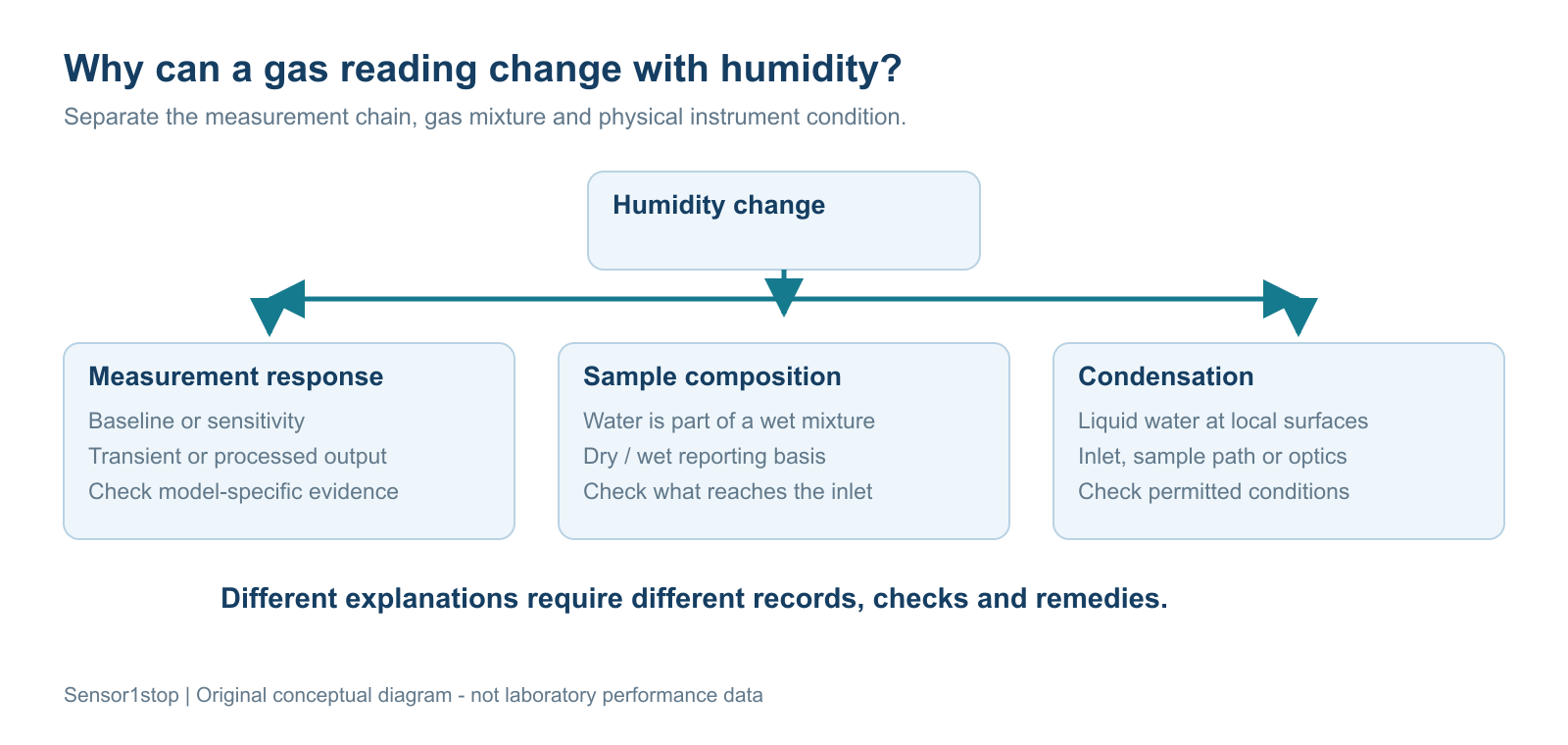

A diagnostic map, not a prediction that every instrument exhibits all three effects.
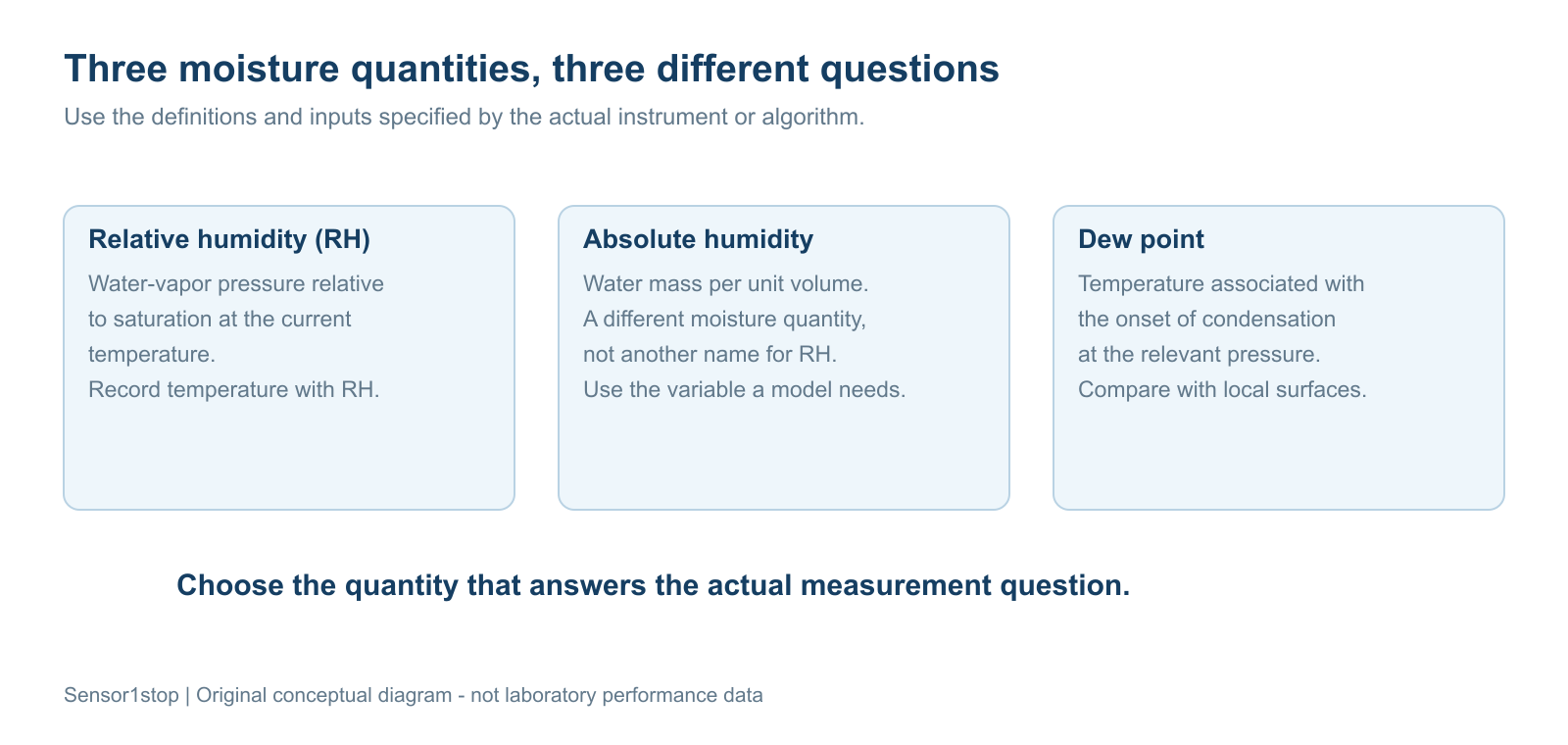
Relative Humidity, Absolute Humidity and Dew Point Are Different
Relative humidity describes how water-vapor partial pressure compares with saturation vapor pressure at the current temperature. Absolute humidity expresses water mass per unit gas volume. Dew point identifies the temperature at which condensation begins under the relevant pressure conditions. Vaisala documents these as distinct measurement quantities in its humidity parameter definitions.
For gas-sensing work, the choice matters:
- Relative humidity and temperature help describe the environment used in many sensor specifications and compensation interfaces.
- Water concentration or absolute humidity can be relevant when comparing conditions with different temperatures or specifying a particular correction model.
- Dew point and surface temperature help determine whether the sample path may encounter liquid water.
A statement such as “tested at 70% RH” is incomplete without its temperature and the rest of the test conditions. Two observations made at the same RH but different temperatures should not automatically be treated as the same moisture exposure.
Related background: relative humidity explained و the relationship between temperature and humidity.
Humidity Can Change Zero and Gas Response Separately
A useful simplified measurement model is:
Output = sensitivity × concentration + baseline
For a humidity-sensitive measurement chain, a conceptual extension is:
Y = S(H, T) × C + b(H, T)
Here, Y is output, C is the concentration represented by the chosen calibration basis, S is sensitivity, b is baseline, H denotes the humidity quantity used by the model, and T is temperature. This is an explanatory model, not a ready-made correction equation for a commercial sensor. Nonlinear instruments may need a different description.
It illustrates two separate questions:
- Does the output change when the target-gas condition used as the baseline is held fixed?
- Does the response to a known gas concentration change when the environment changes?
A zero adjustment alone does not establish that the span or slope is correct. Likewise, one gas challenge at one environmental condition does not prove that the baseline behaves correctly elsewhere. A useful test report states what was held constant, which output was recorded and which conditions were validated.
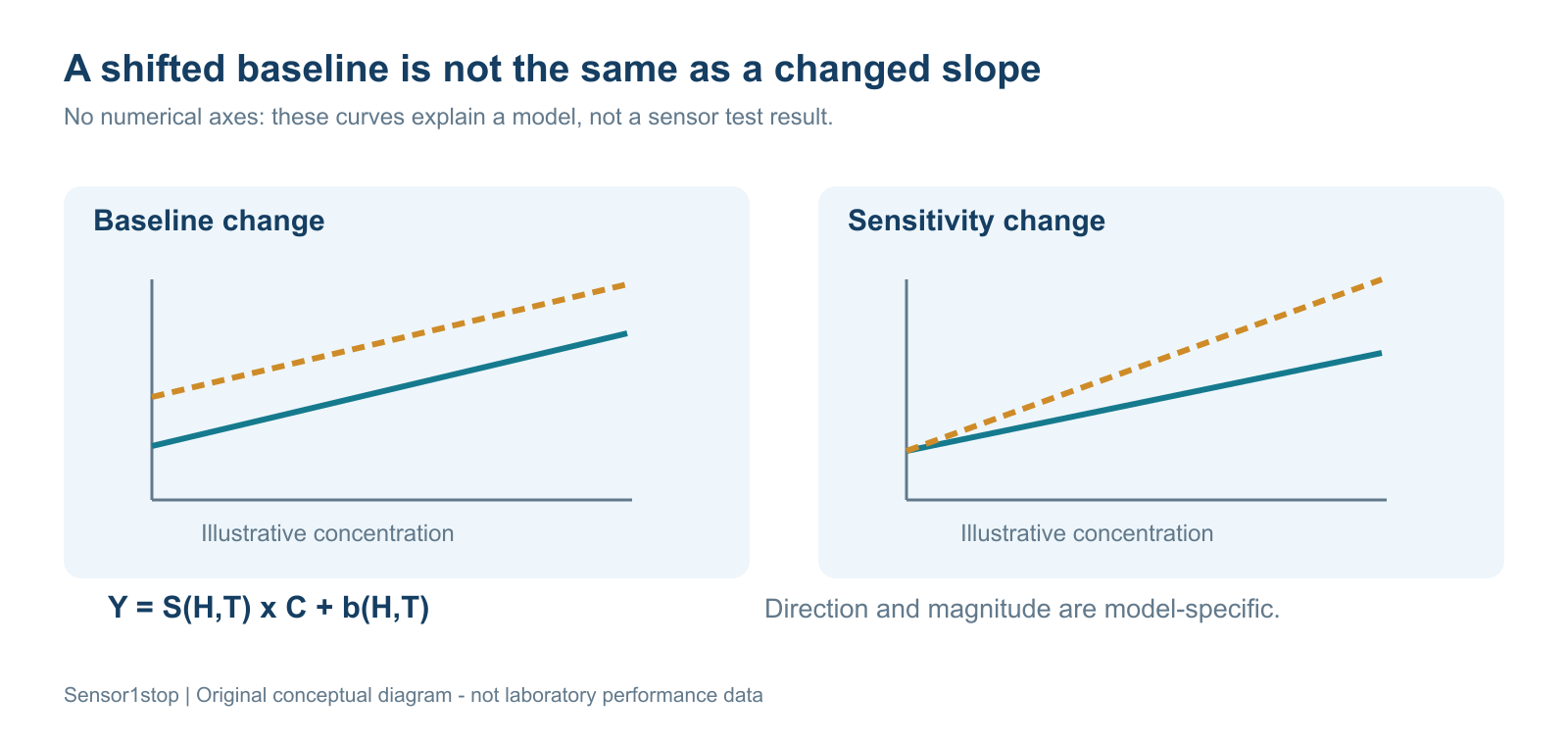
Conceptual curves only. They are not measured data and do not establish the direction or magnitude of any particular sensor's humidity dependence.
A Rapid Humidity Transition Is Not a Long-Term Trend
Compare an instrument that has equilibrated in a steady environment with one that has just passed through an abrupt humidity change. They are not necessarily undergoing the same measurement conditions.
In its AAN 110 application note, Alphasense describes transient currents during humidity steps for the electrochemical sensors discussed, including a NO₂ sensor example. That observation supports treating transition behavior separately from settled behavior; it does not supply a universal recovery time or compensation curve for every instrument. See Alphasense AAN 110.
For investigation, record the change itself rather than just the before-and-after humidity. Note when the instrument was moved, whether its enclosure was colder than the new environment, whether the sample line changed, and whether its prescribed warm-up or stabilization conditions were met.
A repeatable environmental response, a temporary transition effect and persistent رانش سنسور require different interpretations. Do not reset a safety-critical reading merely because it correlates with an RH change.
Electrochemical Sensors: Ask About Transition and Exposure Conditions
For an electrochemical detector, the practical review should distinguish temporary output behavior from the manufacturer's permitted operating and storage conditions. A brief transition test is not a substitute for exposure qualification, and a room-condition calibration does not describe every installation.
Questions to ask when reading the actual sensor and instrument documentation include:
- What humidity range is specified, and is it explicitly non-condensing?
- Is the range associated with continuous operation, short exposure, storage or transport?
- Are transient responses characterized separately from settled readings?
- Does the complete detector apply corrections beyond the bare sensor output?
- What does the manufacturer require after an exposure outside the stated conditions?
These questions are an engineering review checklist, not instructions for recalibrating every electrochemical cell in the same way. An instrument may use a sensor-specific circuit, correction scheme and service procedure. Conclusions from a different target gas or sensor family should remain separate.
MOS Sensors: Read the Reference Conditions Behind Resistance Ratios
Metal-oxide sensor output can depend on the surrounding humidity as well as the target gas. Figaro's TGS2600 product information provides temperature/humidity dependency curves and defines the reference resistance used in those curves. That is a useful example of why a resistance ratio must be interpreted with its reference conditions. See Figaro TGS2600 product information.
The design-review question is not merely whether a curve exists. Ask whether it describes clean-air resistance, response in a particular gas, typical behavior, or a guaranteed tolerance. A typical environmental curve is not automatically a concentration-correction function.
For a module or complete VOC monitor, also ask where raw resistance becomes a processed index or concentration estimate. A change in a reported index cannot be interpreted exactly like a change in raw resistance unless the processing relationship is understood. That distinction is particularly useful when comparing two devices whose displays use different quantities.
A Documented Example: Humidity Compensation Needs Valid Inputs
Sensirion's SGP40 documentation describes humidity compensation that uses temperature and RH values supplied with the measurement command. It also explains the behavior when default input values are used and shows a compensation-optimized environmental region distinct from other specified conditions. See the SGP40 datasheet, sections 2.3 and 3.1.
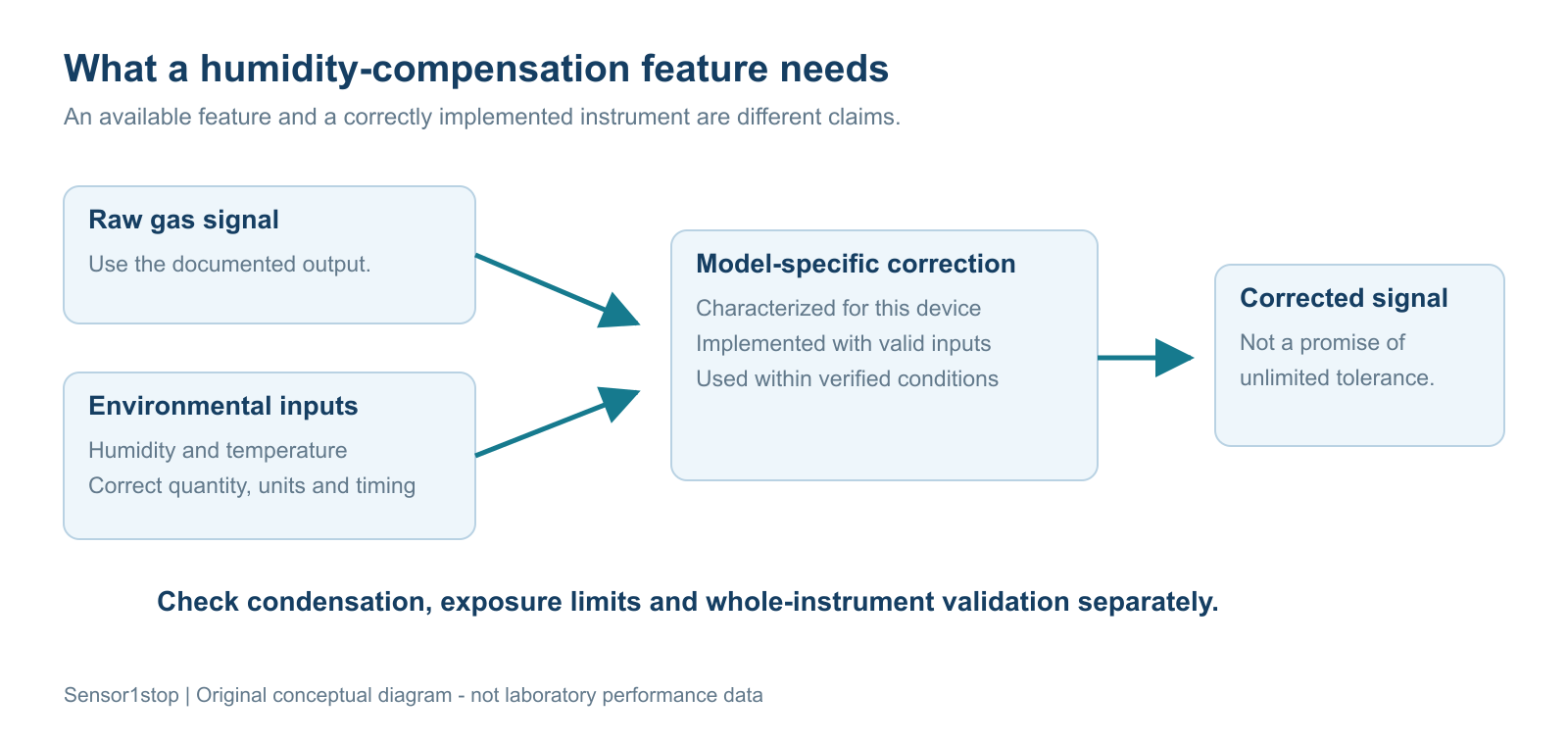
The lesson for reading a module specification is specific: the presence of a compensation feature does not establish that a particular finished instrument supplies the required inputs correctly. That implementation must be documented or verified for the actual device.
Use this example to form questions, not to infer how unrelated products work. Check the environmental input, units, update path, stated validity conditions and the processing stage to which correction applies. A corrected signal and a subsequently calculated VOC Index are different outputs in a measurement chain.
NDIR CO₂ Sensors: Non-Condensing Is a Real Qualification
Using an optical sensing technology does not remove the need to check moisture conditions. The Sensirion SCD30 datasheet, for example, specifies a CO₂-sensor humidity operating condition of 0–95% RH without condensation. This is a qualification for that sensor, not a rating for every assembled monitor. See the SCD30 datasheet, operating conditions.
For instrument selection, keep the sensor specification and the complete equipment specification in separate columns. The enclosure, inlet, sampling arrangement and electronics may have different requirements. A module's listed RH range should not be copied into an instrument specification without confirming the assembled system's validation.
Also distinguish environmental tolerance from accuracy conditions. A device may have an operating range, a more specific set of performance conditions and a service procedure. The strongest selection comparison uses the same kind of specification on both sides rather than comparing one product's operating limit with another product's accuracy test condition.
PID Instruments: Do Not Assume a Universal Humidity Correction
ION Science's technical article on PID operation discusses humidity-related suppression of response, contamination-associated high readings, and design measures used in its own instruments. It makes clear that the sensor design and condition matter. The manufacturer's account should not be read as proof that every PID is affected identically or that one advertised design solves every condensing sample. See ION Science technical article TA-01, humidity discussion.
For a portable or fixed VOC detector, ask for its humidity-interference specification, maintenance conditions and permitted sample environment. Note whether the claimed performance refers to a clean sensor, a complete instrument, a particular test gas or a particular exposure history. Avoid using a correction factor taken from a different model simply because both products use PID technology.
Water-Vapor Dilution Is Not Necessarily Sensor Error
If water vapor is added to a gas mixture, it becomes part of the mixture used as the denominator for a wet-basis mole or volume fraction. The reported fraction of another component can therefore change even if the instrument responds correctly to what actually reaches it.
For an idealized mixture, let x₍dry₎ be a component's fraction excluding water and x₍H₂O₎ the water-vapor fraction in the wet mixture. The relationship is:
x₍wet₎ = x₍dry₎ × (1 − x₍H₂O₎)
This follows directly from the definitions of the two denominators. It is not a manufacturer humidity-compensation formula and should not be applied to an unknown display quantity.
As an illustrative arithmetic example, 1,000 ppm on a dry basis and a wet mixture containing 2% water would correspond to 980 ppm on that wet basis under the stated assumptions. These are invented example values, not measurements, recommended environmental conditions or a sensor tolerance.
Before interpreting a difference, ask which reporting basis each instrument or reference uses and whether the sample was dried or otherwise conditioned. Alphasense separately notes water-vapor dilution when discussing oxygen-sensor readings in its sensor FAQs. A real composition change and an instrument interference effect should not be merged into one label.
Condensation Is Different From High Humidity
A non-condensing RH specification does not mean that liquid water is acceptable at the sensor. Condensation depends on the conditions at the relevant surface, not just an RH value measured somewhere else in the room. Vaisala explains the role of dew point in its humidity, dew point and moisture overview.
An inlet, sample tube or optical chamber that is colder than the surrounding sample can present a different local condition from the logged ambient measurement. This is why a humidity review should include where the temperature and humidity are measured and which parts of the sampling path may be colder.
Treat suspected liquid-water exposure as an instrument-condition issue. Follow the manufacturer's inspection, recovery and service instructions rather than assuming that a software correction can restore a valid measurement. Whether a device is suitable for a condensing environment must be established for that device and configuration.
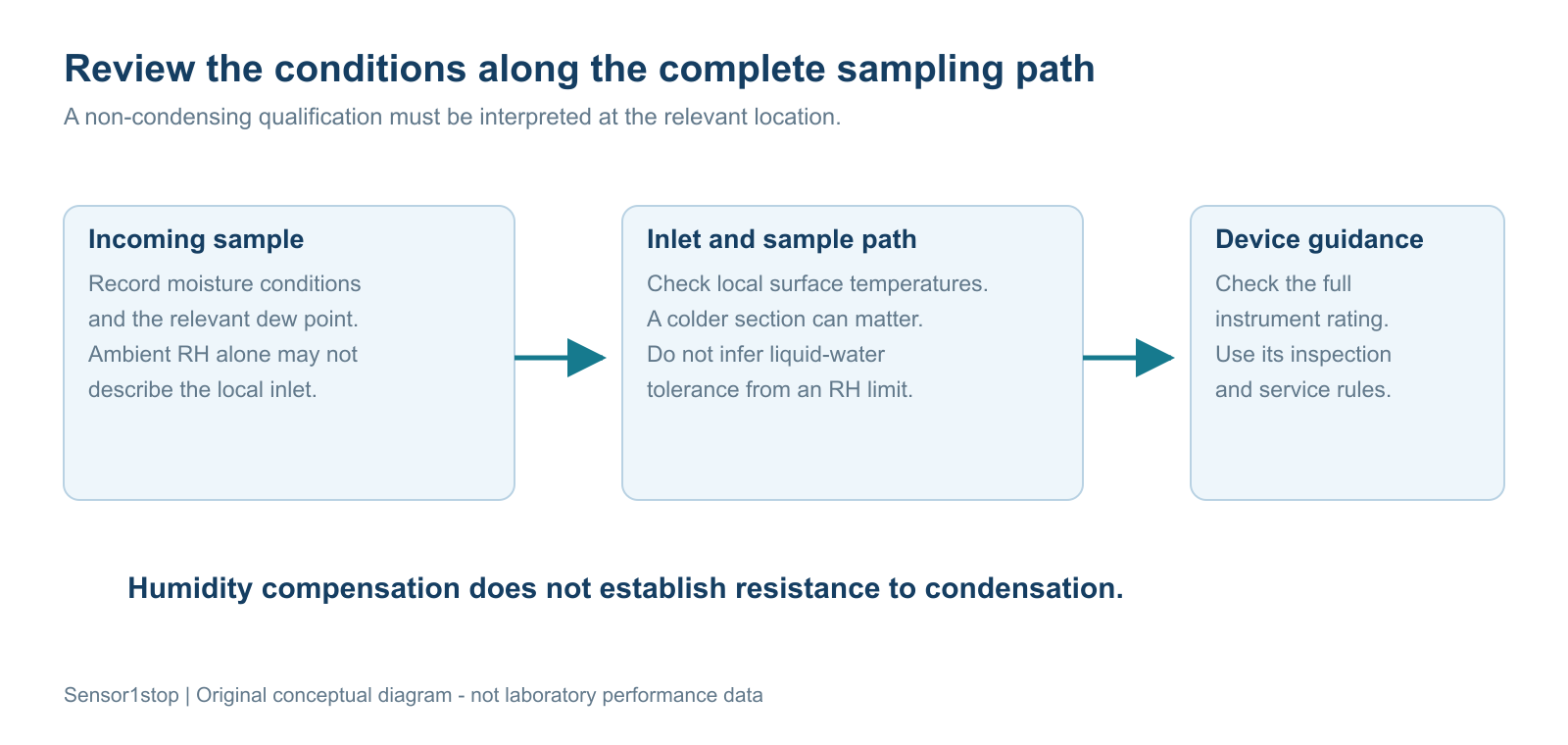
Conceptual installation review. No universal temperature margin or protective design is prescribed.
Compensation, Conditioning and Protection Solve Different Problems
It is helpful to ask a supplier which of three approaches a device uses:
| Approach | Intended role | A limitation to check |
|---|---|---|
| Signal compensation | Adjust a characterized environmental dependence using valid inputs | Validity range, input accuracy and model-specific verification |
| Sample conditioning | Change the sample conditions before measurement | Whether target-gas composition or reporting basis is changed |
| Physical protection | Manage ingress or exposure within the instrument design | Whole-instrument qualification and maintenance requirements |
These are review categories, not interchangeable guarantees. A water-resistant enclosure does not establish immunity to water-vapor interference. A correction algorithm does not establish resistance to condensation. A conditioned sample needs to be interpreted on the documented basis.
A useful purchase question is: “Which problem is this feature intended to solve, and where is that performance demonstrated?” It is more informative than accepting a general description such as “humidity resistant” without its conditions.
What to Record When Investigating an Unexpected Reading
The following is a documentation checklist for non-emergency evaluation. It is not a procedure for dismissing an alarm, deliberately exposing a detector to hazardous gas or restoring a safety-critical device to service.
| مزرعه | Record or check |
|---|---|
| Device identity | Model, sensor configuration, firmware and relevant manual version |
| خروجی | Display quantity, units, raw signal if available and filtering settings |
| محیط | Temperature, RH, measurement location and timing |
| Transition | When the environment changed, how the device was moved and what else changed |
| Sample path | Inlet, tubing, filter, flow settings and known conditioning |
| Instrument state | Warm-up, maintenance history, calibration records and any exposure warning |
| Reference | A suitable, documented comparison method and matching measurement basis |
Record an event timeline. A note saying “the gas value changed in humid weather” is much less useful than synchronized observations of the gas output, temperature, RH, relocation and device state.
Where repeatable evaluation is appropriate, distinguish changes in the environmental inputs from changes in the target-gas condition. The test design should be approved for the actual instrument and application. A device-to-device disagreement by itself does not identify which device is correct.
How to Compare Gas Detectors for a Humid Application
Start with a description of the measurement task, not a preferred sensor family. A handheld instrument moved between environments, a fixed monitor in an equipment room and a sample-pumped analyzer may need different evidence even when they report the same target gas.
Ask each supplier the same questions:
- Is the humidity rating for the sensor element or the complete instrument?
- Which conditions apply to accuracy, operation, storage and transport?
- Does the humidity specification exclude condensation?
- How is a rapid environmental transition handled and characterized?
- What environmental measurements are used by compensation, if any?
- What maintenance or recovery instructions apply after moisture exposure?
- Has the configuration been validated for the intended sample and reporting basis?
Put the answers and their document references in a comparison table. Use “not provided” for missing information. An unspecified condition is not evidence of unlimited tolerance, and a long feature list is not a substitute for a relevant test report.
Common Interpretation Mistakes
Calling Every Correlated Change Drift
An RH change and a gas-reading change occurring together identify a correlation, not a complete cause. Consider measurement response, actual sample change, environmental transition and device condition before selecting an explanation.
Assuming High Humidity Always Raises the Reading
The sign of the effect is not universal. Avoid describing an increase or decrease as a rule across technologies, gases and sensor models. A processed display can also behave differently from its raw input.
Comparing RH Numbers Without Temperature
Write both conditions and the relevant measurement location. A single room RH number does not fully describe the sample reaching the sensor or the conditions at a colder inlet.
Treating Operating Limits as Accuracy Guarantees
Keep permitted operation separate from stated performance conditions and compensation validity. Check how the manufacturer defines each before comparing products.
Assuming Compensation Repairs Moisture Damage
Correction, exposure qualification and service recovery are different questions. Follow the instrument documentation after exposure outside its validated conditions.
سوالات متداول
Does humidity affect all gas sensors in the same way?
No. Environmental behavior must be checked for the specific sensor and instrument. The sensing technology is a starting point for the questions to ask, not a universal correction rule.
Can humidity create a temporary gas reading?
Some sensor families exhibit environmental transition responses, as the cited Alphasense application note illustrates. Whether that explains a particular reading requires the device documentation and other evidence; it is not a reason to disregard a real alarm.
Should I use relative humidity or absolute humidity for compensation?
Use the quantity and conditions specified by the actual algorithm or manufacturer. Do not substitute one humidity variable for another without the required conversion and validation.
Why record temperature as well as humidity?
It helps describe the condition behind an RH value and the relationship between the environment, sample path and dew point. Record where the measurements were taken as well as the values.
Does an NDIR CO₂ monitor tolerate condensation?
Do not infer that from NDIR technology or a high listed RH limit. Check the whole instrument's documentation. The SCD30 example cited here explicitly uses a non-condensing qualification.
Is a humidity-resistant PID completely unaffected by moisture?
Read the particular design claim and its test conditions. Vapor interference, contamination and liquid-water exposure are distinct issues; one feature description does not establish immunity to all three.
Can software compensation replace calibration?
They have different roles. Compensation addresses a characterized environmental dependence; calibration establishes the measurement relationship under defined conditions. Use the instrument manufacturer's required procedures.
Should a gas monitor be recalibrated whenever humidity changes?
There is no universal rule. Follow the actual device's calibration and service instructions, and investigate unexpected readings with the necessary environmental and instrument records.
Can a dryer or filter be added to any sampling line?
No such assumption should be made. The complete sampling configuration needs validation for the target gas, required response and reporting basis. Ask the manufacturer how the proposed conditioning affects the measurement.
What is the most useful first check?
Identify the exact device, its displayed quantity and the applicable environmental specification. Then compare those conditions with the event record. That is more reliable than applying a generic humidity coefficient found for another sensor.
Practical Takeaway
Treat humidity as part of a complete measurement question: what reached the sensor, how the measurement chain responded, and whether the instrument remained inside its validated conditions.
For OEM design, that means model-specific inputs, characterization and system qualification. For detector selection, it means comparing whole-instrument evidence and documented conditions. For troubleshooting, it means preserving an event record rather than changing settings until a number looks familiar.
References and Further Reading
- Alphasense AAN 110 — Environmental Changes: Temperature, Pressure, Humidity — model-specific environmental transition examples.
- Alphasense sensor FAQs — oxygen measurement, water-vapor dilution and sensor-specific guidance.
- Figaro TGS2600 product information — resistance reference and temperature/humidity dependency example.
- Sensirion SGP40 datasheet — compensation inputs and environmental validity conditions.
- Sensirion SCD30 datasheet — non-condensing operating condition for the cited CO₂ sensor.
- ION Science TA-01 — What Is a PID? — humidity and contamination discussion for PID technology.
- Vaisala humidity parameter definitions — definitions of RH, absolute humidity and dew point.
- Vaisala humidity, dew point and moisture overview — selecting and distinguishing moisture quantities.