For gas sensor manufacturers, gas detector brands, and system integrators targeting the North American market, certification is becoming more than a compliance requirement. It is also an important factor in customer trust, project approval, and product selection.
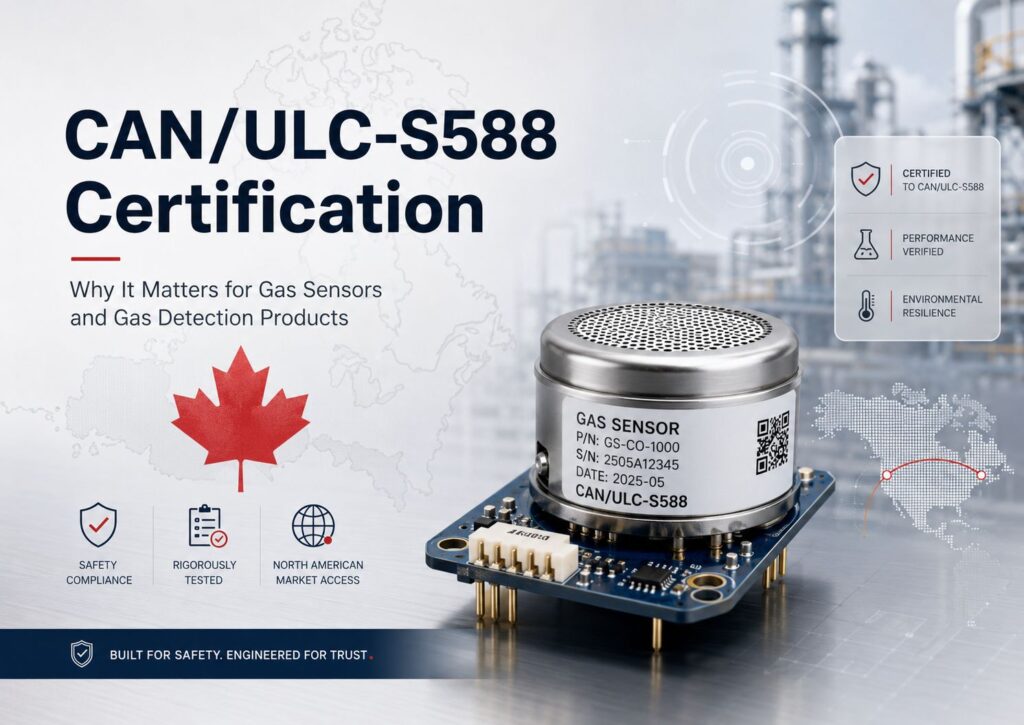
One standard that is receiving increasing attention is CAN/ULC-S588, formally titled Gas and Vapour Detectors and Sensors, Including Accessories. This Canadian standard applies to gas and vapour detectors and sensors used for toxic and combustible gas detection, including permanently installed, portable, and transportable equipment.
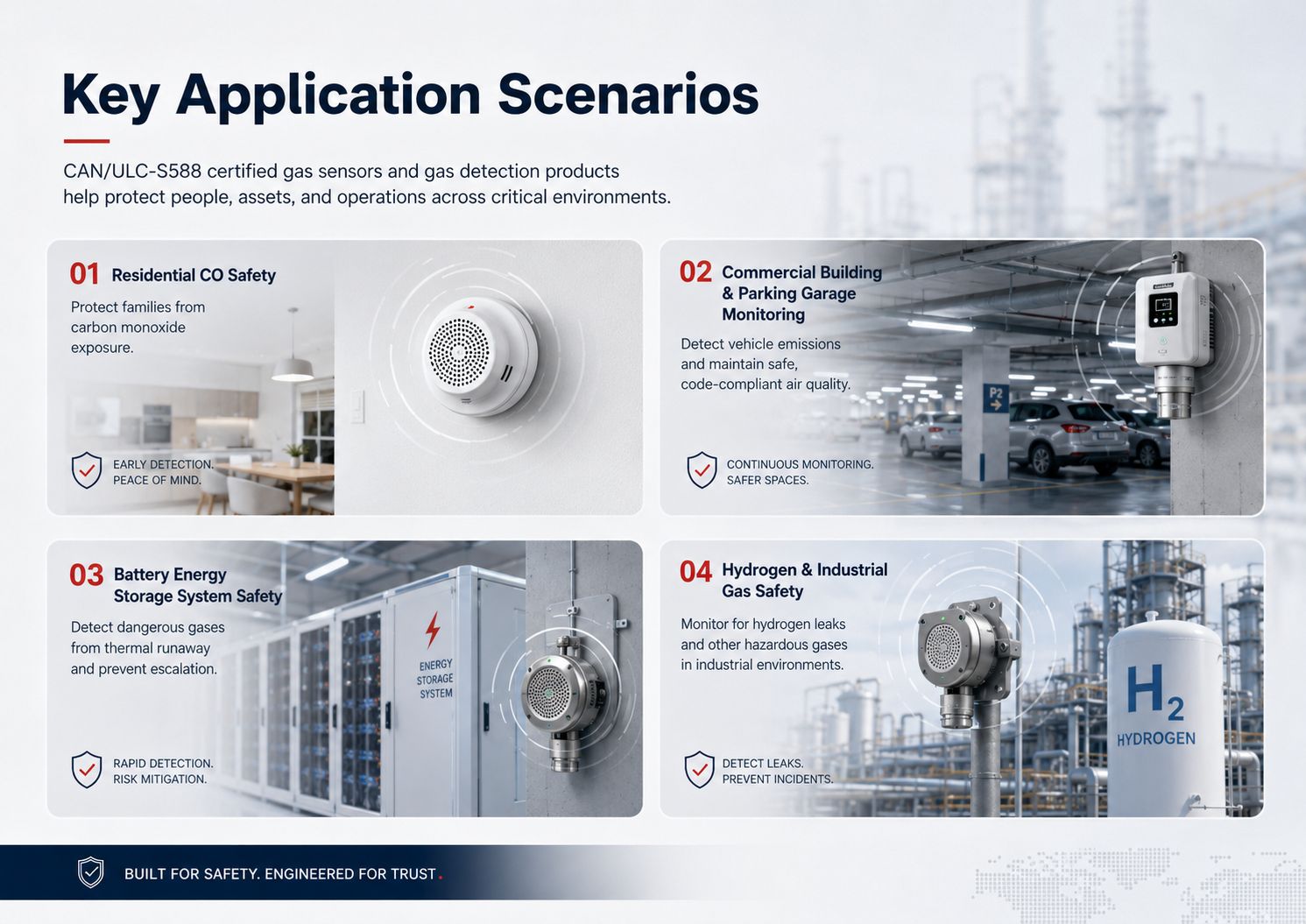
For companies working with carbon monoxide sensors, hydrogen sensors, combustible gas sensors, toxic gas sensors, and gas detection modules, understanding CAN/ULC-S588 is important when developing products for safety-related applications such as residential safety, commercial buildings, energy storage systems, fuel cell systems, HVAC control, and industrial monitoring.
What Is CAN/ULC-S588?
CAN/ULC-S588 is a Canadian standard for gas and vapour detectors and sensors, including accessories. It covers requirements for products used to detect toxic gases, combustible gases, and vapours in ordinary gas detection applications.
In practical terms, CAN/ULC-S588 is highly relevant to products such as:
- Carbon monoxide detectors and CO sensors
- Hydrogen gas detectors and H₂ sensors
- Combustible gas detectors
- Toxic gas detectors
- Appareils de détection multi-gaz
- Modules de détection de gaz utilisés dans les systèmes de sécurité
- Accessoires liés aux produits de détection de gaz
Le champ d'application de la norme comprend les détecteurs et capteurs de gaz et de vapeurs fixes, portables et transportables. Cela est particulièrement important pour les produits utilisés dans des emplacements intérieurs, des applications extérieures ou des environnements non conditionnés où la fiabilité et les performances de sécurité sont essentielles.
Quel est le lien entre la norme CAN/ULC-S588 et la norme UL 2075 ?
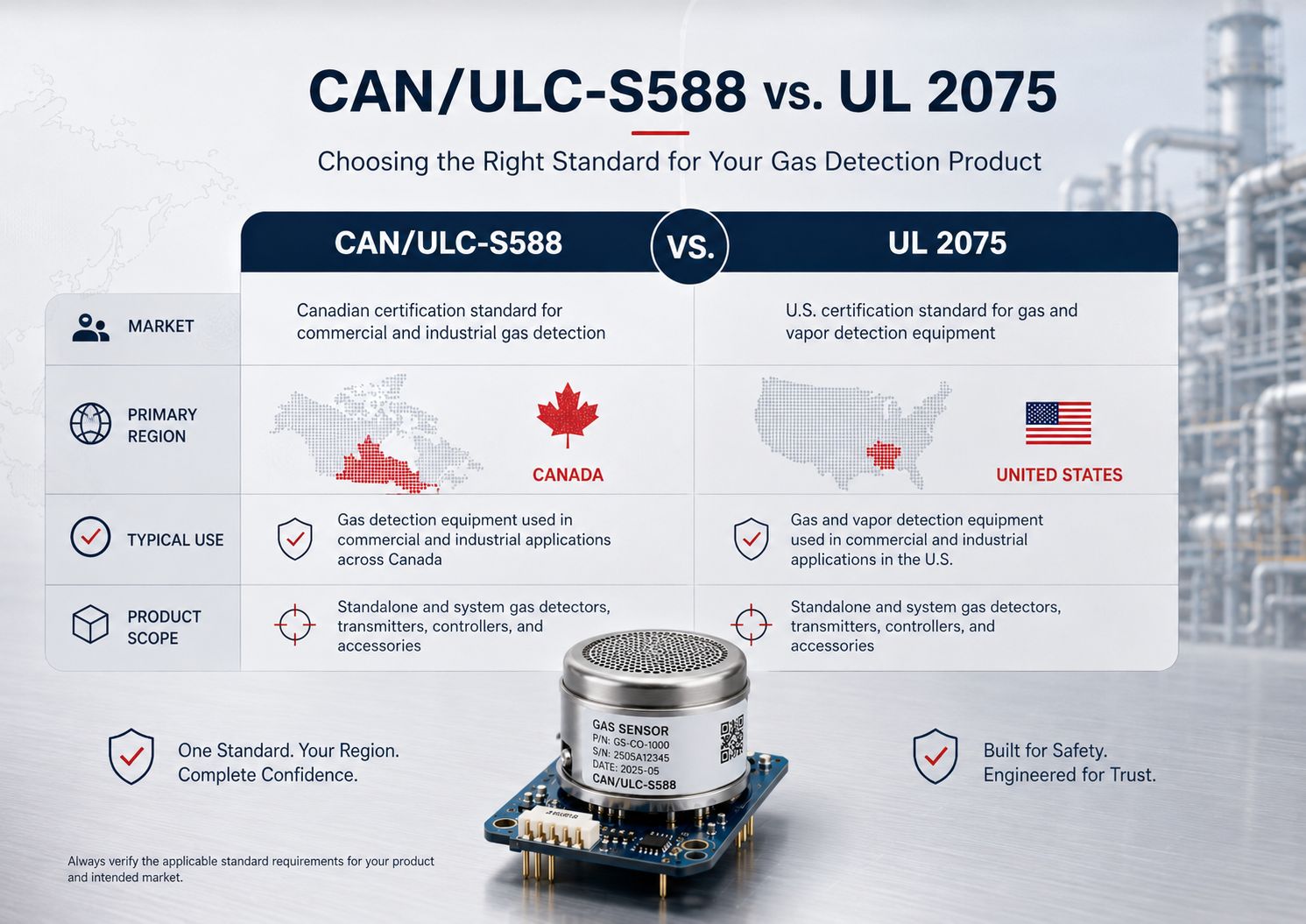
Pour les entreprises entrant en Amérique du Nord, la norme CAN/ULC-S588 est souvent discutée avec UL2075.
UL2075 est la norme américaine pour Détecteurs et capteurs de gaz et de vapeurs. Elle s'applique aux détecteurs et capteurs de gaz et de vapeurs toxiques et combustibles fixes, portables et transportables destinés à être utilisés dans des emplacements ordinaires non dangereux, y compris des zones intérieures et non conditionnées.
Une façon simple de comprendre la relation est la suivante :
| Standard | Marché principal | Focus produit |
|---|---|---|
| UL2075 | États-Unis | Détecteurs et capteurs de gaz et de vapeurs |
| CAN/ULC-S588 | Canada | Détecteurs et capteurs de gaz et de vapeurs, y compris accessoires |
Pour de nombreux projets nord-américains, les fabricants devront peut-être tenir compte des deux normes. Un produit de détection de gaz ou un composant de capteur qui répond aux exigences UL 2075 et CAN/ULC-S588 peut être plus attrayant pour les clients OEM, les intégrateurs de systèmes et les fabricants d'équipements de sécurité.
Intertek has also noted that gas detectors have been removed from the scope of UL 61010-1 and CSA C22.2 No. 61010-1 and are now under the scope of UL 2075 and ULC S588, which shows that gas detector certification has become more specialized in North America.
Why CAN/ULC-S588 Matters for Gas Sensor Manufacturers
For sensor manufacturers, CAN/ULC-S588 is not only about selling a certified detector. It can also affect the competitiveness of the sensor itself when the sensor is used as a key component inside a complete gas detection product.
Gas detector manufacturers often look for sensor suppliers that can help reduce certification risk. If a sensor has already been evaluated according to recognized North American safety and performance requirements, it may help the end-product manufacturer simplify product development and improve confidence during certification planning.
This is especially important in applications where gas detection is directly linked to safety, such as:
- Residential carbon monoxide alarms
- Commercial building gas monitoring
- Parking garage ventilation control
- Battery energy storage system safety
- Hydrogen leakage detection
- Fuel cell system monitoring
- Industrial toxic gas detection
- HVAC and refrigeration safety systems
In these applications, customers do not only ask whether a gas sensor can detect a target gas. They also care about long-term stability, operating temperature range, response performance, failure behavior, end-of-life indication, calibration strategy, and certification support.
Key Technical Areas Behind CAN/ULC-S588 Evaluation
The full CAN/ULC-S588 standard is a paid technical document, so manufacturers should always work with an authorized certification body for formal testing and interpretation. However, based on public information and standards update notices, several areas are especially important for gas detection products.
1. Gas Detection Performance
A gas detection product must demonstrate that it can detect the target gas reliably under specified conditions. This may involve sensitivity, alarm threshold, response time, recovery behavior, and performance after environmental exposure.
For example, products targeting carbon monoxide, hydrogen, methane, propane, nitrogen dioxide, or hydrogen sulfide must show that they can respond to gas concentrations in a predictable and safe way.
2. Environmental Reliability
Gas detectors and sensors may be installed in non-ideal environments. Temperature, humidity, vibration, contamination, and long-term drift can all affect sensor performance.
For North American applications, customers may pay close attention to wide-temperature performance, especially in outdoor, garage, industrial, and energy storage environments.
3. Electrical and Functional Safety
A gas detection product is not only a sensing device. It is also part of a safety system. Therefore, electrical safety, component reliability, signal failure behavior, and abnormal operation conditions may be considered during evaluation.
4. Marking and Installation Instructions
The latest ULC S588 update notice includes revisions related to marking and installation instructions, which means manufacturers must also pay attention to product labeling, user guidance, installation limitations, and application conditions.
5. Combustible Gas Detection Thresholds
For combustible gas products, detection thresholds are especially important because the device may be used to warn users before a dangerous concentration is reached. The Intertek standards update notice for ULC S588 mentions requirements related to combustible gas and vapor detection threshold testing.
CAN/ULC-S588 and Hydrogen Detection
Hydrogen detection is becoming increasingly important because of the growth of battery energy storage systems, fuel cells, hydrogen energy infrastructure, and industrial hydrogen applications.
Hydrogen is a small-molecule, highly diffusive, and flammable gas. In practical systems, hydrogen may appear in battery rooms, fuel cell equipment, charging infrastructure, hydrogen production sites, or enclosed technical spaces.
For hydrogen sensor manufacturers, certification-related performance may include:
- Low-level hydrogen detection capability
- Fast response and recovery
- Large plage de températures de fonctionnement
- Stabilité à long terme
- Resistance to interference gases
- Output reliability for system integration
- Suitability for safety-related monitoring
Because hydrogen safety is becoming a major topic in energy transition projects, gas sensors used in hydrogen detection are increasingly expected to support recognized standards and certification pathways.
CAN/ULC-S588 and Carbon Monoxide Detection
Carbon monoxide remains one of the most important gases in residential, commercial, and industrial safety. CO is colorless, odorless, and toxic, which makes reliable detection essential.
CO sensors are widely used in:
- Residential carbon monoxide alarms
- Commercial building safety systems
- Parking garage ventilation control
- Boiler rooms
- Fire detection and safety systems
- Gas appliances
- Véhicules récréatifs et applications marines
Pour les capteurs de CO, les clients se concentrent souvent sur :
- Longue durée de vie
- Faible dérive
- Sortie stable en fonction de la température et de l'humidité
- Résistance à l'alcool, à l'hydrogène et à d'autres gaz interférents
- Performances fiables sur tout le cycle de vie du produit
- Prise en charge des conceptions de détecteurs sur 10 ans
Pour les fabricants OEM, un capteur de CO bénéficiant d’un solide support de certification peut constituer un avantage majeur lors de la conception d’alarmes de gaz ou de systèmes de surveillance de gaz pour l’Amérique du Nord.
Certification des composants vs certification du produit complet
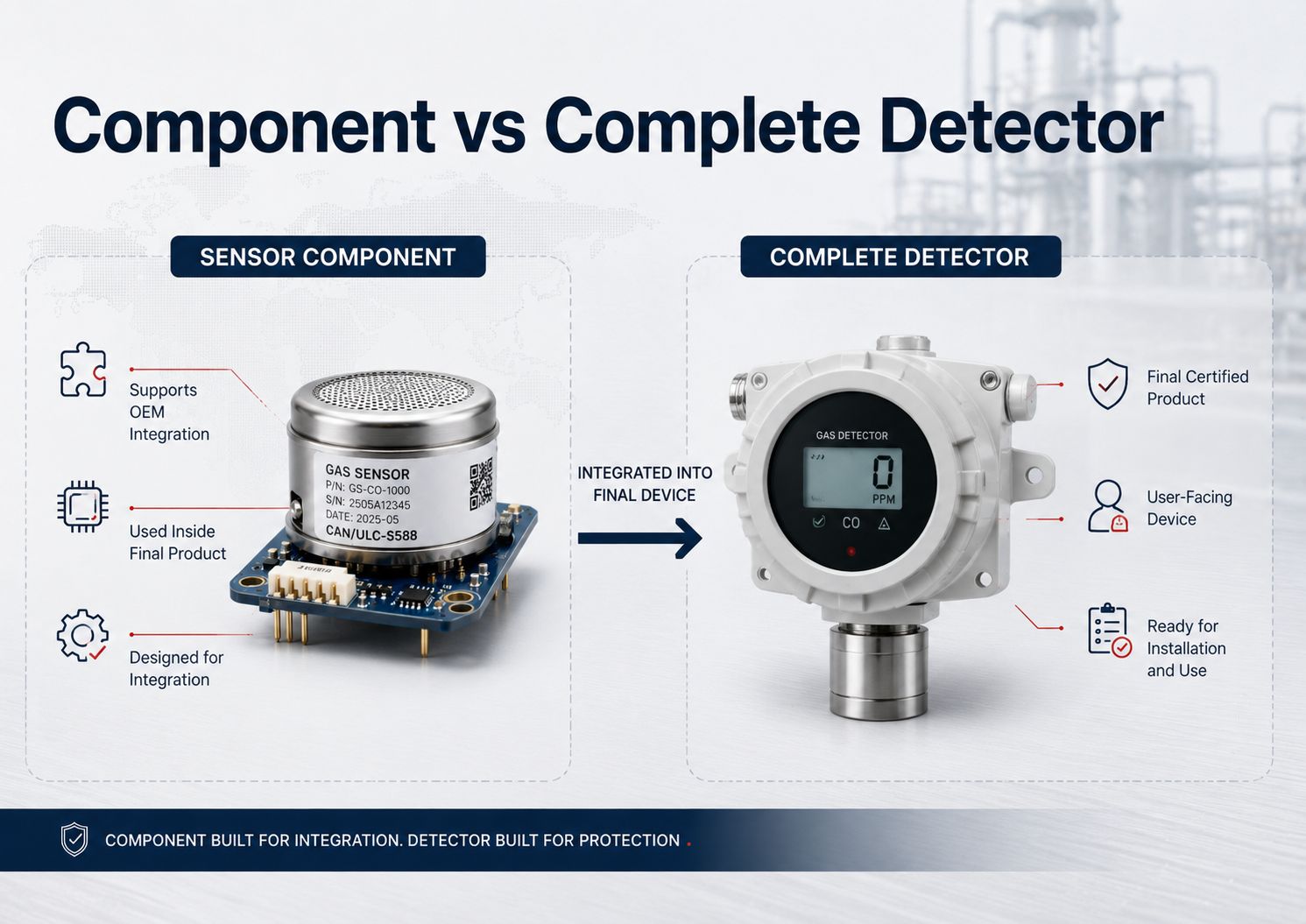
Un point important doit être clairement compris : un composant de capteur certifié n'est pas la même chose qu'un détecteur de gaz complet certifié.
A gas sensor may be evaluated as a recognized component used inside a larger certified product. In this case, the sensor supports the certification of the final product, but the complete detector or alarm still needs its own evaluation based on final design, enclosure, power supply, software logic, alarm output, user instructions, and installation conditions.
This distinction matters because gas detector manufacturers often ask sensor suppliers for documentation that can support their own certification process. A well-prepared sensor supplier should be able to provide:
- Sensor datasheet
- Performance test data
- Lifetime and aging data
- Environmental test data
- Interference gas data
- Calibration information
- Quality control documentation
- Application notes
- Certification-related technical support
Why This Certification Is Becoming a Market Advantage
In the gas detection market, technical performance alone is no longer enough. Customers increasingly want products that are easier to approve, easier to integrate, and easier to certify.
CAN/ULC-S588 can create value in several ways:
For Sensor Manufacturers
It helps show that the product is suitable for serious safety-related applications and can support North American customer projects.
For Gas Detector Brands
It reduces uncertainty when selecting core sensing components and designing products for Canada or the broader North American market.
For System Integrators
It provides confidence when gas detection devices are used in building safety, energy storage, industrial monitoring, and ventilation control systems.
For End Users
It supports safer gas monitoring by encouraging more reliable performance, proper installation, and clear product marking.
Applications Where CAN/ULC-S588 May Be Important
CAN/ULC-S588 is especially relevant to gas detection products used in the following applications:
| Application | Typical Target Gases |
|---|---|
| Residential safety | CO, combustible gas |
| Commercial buildings | CO, NO₂, combustible gas |
| Parking garages | CO, NO₂ |
| Battery energy storage systems | H₂, CO, VOCs, electrolyte vapour indicators |
| Fuel cell systems | H₂ |
| Sécurité industrielle | H₂S, CO, combustible gases |
| HVAC and ventilation control | CO₂, CO, NO₂ |
| Fire safety systems | CO, H₂, combustible gases |
Différentes applications peuvent nécessiter des normes, des codes d'installation et des itinéraires de certification différents. Par conséquent, les fabricants doivent évaluer le marché cible et le scénario d’application avant de commencer la certification.
Ce que les fabricants doivent préparer avant la certification
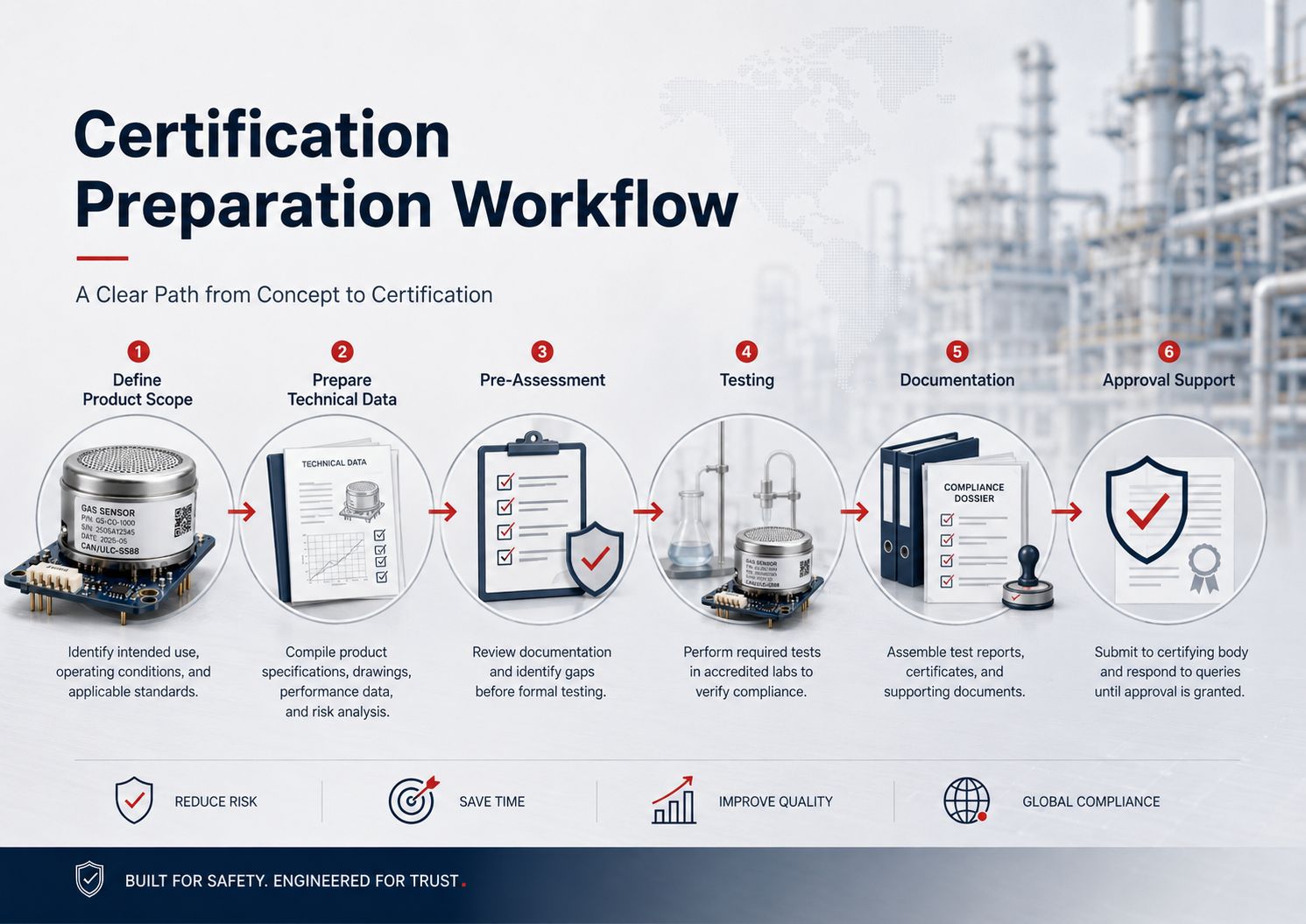
Avant de démarrer un projet de certification CAN/ULC-S588 ou UL 2075, les fabricants de capteurs et de détecteurs de gaz doivent préparer une base technique solide.
Le travail de préparation important comprend :
Définir la portée du produit
Confirmez si le produit est un composant de capteur, un module de détection, un détecteur de gaz, une alarme de gaz ou un dispositif de surveillance complet.Confirmer le gaz cible et l'application
Les gaz liés au CO, H₂, CH₄, propane, NO₂, H₂S et COV peuvent avoir des exigences de test et des attentes des clients différentes.Préparer les données de fiabilité
Les données sur la dérive à long terme, le comportement au vieillissement, les cycles de température, l'exposition à l'humidité et la stabilité au stockage sont importantes.Revoir les spécifications environnementales
La température de fonctionnement, la température de stockage, la plage d'humidité, la plage de pression et l'environnement d'installation doivent être clairement définis.Préparer la documentation de contrôle qualité
Les organismes de certification et les clients OEM peuvent examiner la cohérence de la production, le processus d'étalonnage, les méthodes d'inspection et la traçabilité.Clarifier le parcours de certification
Décidez si l'objectif est la reconnaissance des composants, l'évaluation des modules ou la certification complète du produit.Travailler tôt avec un organisme de certification qualifié
Early pre-assessment can help avoid redesign, documentation gaps, and unexpected testing delays.
Conclusion
CAN/ULC-S588 is an important Canadian standard for gas and vapour detectors and sensors. Together with UL 2075, it plays a key role in North American gas detection product certification.
For gas sensor manufacturers, this standard is not only a regulatory topic. It is also a market signal. Customers in residential safety, commercial buildings, energy storage, hydrogen safety, industrial monitoring, and HVAC systems are increasingly looking for gas sensing products with stronger reliability data and certification support.
À mesure que les applications de détection de gaz deviennent de plus en plus critiques en matière de sécurité, les fournisseurs de capteurs qui comprennent les exigences CAN/ULC-S588 et UL 2075 seront mieux placés pour soutenir les clients OEM et pénétrer des marchés à plus forte valeur ajoutée.
Pour les équipes de projet évaluant des solutions de détection de CO, d’hydrogène, de gaz combustibles ou de gaz toxiques, le choix de la bonne technologie de capteur n’est que la première étape. La planification de la certification, les tests de fiabilité et l'intégration spécifique à l'application deviennent des éléments tout aussi importants du développement réussi de produits de détection de gaz.
FAQ
Qu’est-ce que la CAN/ULC-S588 ?
CAN/ULC-S588 est une norme canadienne pour les détecteurs et capteurs de gaz et de vapeur, y compris les accessoires. Elle couvre les produits utilisés pour la détection de gaz toxiques et combustibles sous forme fixe, portable et transportable.
Is CAN/ULC-S588 the same as UL 2075?
No. UL 2075 is mainly used for the U.S. market, while CAN/ULC-S588 is the Canadian standard. However, they are often discussed together for North American gas detection products.
Which gases are related to CAN/ULC-S588?
The standard may apply to toxic and combustible gas detection products, including products for gases such as carbon monoxide, hydrogen, methane, propane, nitrogen dioxide, hydrogen sulfide, and other gas or vapour hazards depending on the application.
Does a certified sensor mean the complete detector is certified?
Not necessarily. A sensor may be evaluated as a component, but the complete gas detector or alarm usually requires separate evaluation based on the final product design and application.
Pourquoi la norme CAN/ULC-S588 est-elle importante pour les fournisseurs de capteurs de gaz ?
Il aide les fournisseurs de capteurs à soutenir les clients OEM ciblant le Canada ou l'Amérique du Nord. Cela peut améliorer la confiance des clients, réduire l’incertitude en matière de certification et renforcer la compétitivité sur les marchés de la détection de gaz liés à la sécurité.