
A Complete Guide to Motion Sensor
What is a Motion Sensor?
A motion sensor, also known as a motion detector, is a device that detects movement within its designated range. It is commonly used in various applications, including home security systems, lighting control, and automation systems. The motion sensor works by detecting changes in infrared radiation or other physical parameters caused by moving objects.
Types of Motion Sensors:
- Passive Infrared (PIR) Sensors
- Braiteoirí micreathonnach
- Braiteoirí Ultrasonach
- Dual Technology Sensors
How Does a Motion Sensor Work?
A motion sensor works by detecting changes in its surrounding environment caused by moving objects. It operates based on various technologies, such as infrared radiation, microwaves, ultrasonic waves, or a combination of these technologies.

Passive Infrared (PIR) Sensors
Passive Infrared (PIR) sensors are a common type of motion sensor used in various applications, including security systems, lighting control, and home automation. These sensors detect changes in infrared radiation emitted by objects in their field of view. Here’s how PIR sensors work:
Sensor Design
A PIR sensor consists of several components, including a pyroelectric sensor, a lens, and supporting circuitry. The pyroelectric sensor is made of a crystalline material that generates an electrical charge when exposed to infrared radiation.
Infrared Detection
PIR sensors are designed to detect the difference in infrared energy between a stationary background and a moving object. The sensor is typically divided into multiple segments or zones, each with its own pyroelectric sensor.
Sensing Range and Field of View
The sensor's range and field of view depend on factors such as the lens design and the number of sensing elements. The range can vary from a few meters to tens of meters, and the field of view can be narrow or wide, depending on the application.
Detection Process
When a person or object moves within the sensor's range, it causes a change in the infrared energy detected by the pyroelectric sensor. This change is detected as a fluctuation in the electrical charge generated by the sensor.
Próiseáil Comhartha
The supporting circuitry in the PIR sensor processes the electrical signals from the pyroelectric sensor. It analyzes the changes in the electrical charge over time and determines if they indicate the presence of movement.
Comhartha Aschuir
When the PIR sensor detects motion, it outputs an electrical signal, typically in the form of a voltage or digital signal. This signal can be used to trigger various actions, such as activating an alarm, turning on lights, or sending a notification.
Sensitivity and Adjustments
PIR sensors often have adjustable sensitivity settings to fine-tune their response to different environmental conditions. This allows users to optimize the sensor's performance based on their specific needs.

Braiteoirí micreathonnach
Microwave sensors are a type of motion sensor that operates by emitting continuous microwave signals and detecting changes in the reflected signals. These sensors are commonly used in various applications, including security systems, automatic door openers, and occupancy sensing. Here’s how microwave sensors work
Emitting Microwave Signals
Microwave sensors generate and emit continuous microwave signals in the designated area. These signals are typically in the gigahertz range.
Reflection of Microwave Signals
When the emitted microwave signals encounter objects in their path, they reflect off the objects and bounce back towards the sensor.
Éifeacht Doppler
As objects move within the sensor's range, the reflected microwave signals undergo a frequency shift due to the Doppler effect. The frequency increases when objects move closer to the sensor and decreases when they move away.
Detection of Frequency Shift
The microwave sensor's receiver detects the frequency shift in the reflected signals. The presence of a frequency shift indicates that there is movement within the sensor's coverage area.
Motion Detection
Based on the detected frequency shift, the sensor determines the presence of motion. The sensor's sensitivity can be adjusted to accommodate different movement speeds or object sizes.
Comhartha Aschuir
When motion is detected, the microwave sensor generates an electrical signal or triggers a relay switch. This signal is then used to activate alarms, control lighting systems, or initiate other desired actions.
Detection Range and Coverage
The range and coverage area of microwave sensors can vary depending on the specific model. They typically have a wider coverage area compared to other motion sensors, such as PIR sensors.
Braiteoirí Ultrasonach
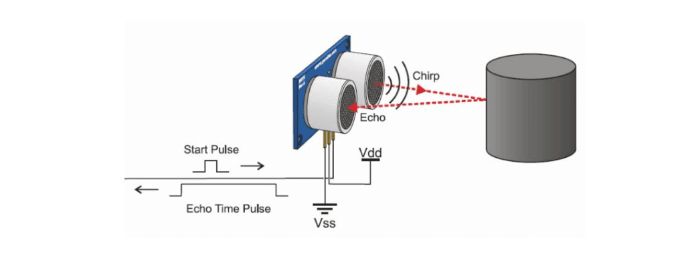
Ultrasonic sensors are a type of motion sensor that use high-frequency sound waves to detect movement and proximity. These sensors are widely employed in applications such as distance measurement, object detection, and motion sensing. Here’s how ultrasonic sensors work:
Sound Wave Emission
An ultrasonic sensor emits high-frequency sound waves, usually in the ultrasonic range (above the human hearing range). The sensor contains a piezoelectric transducer that converts electrical energy into sound waves.
Sound Wave Propagation
The emitted sound waves travel through the air in a cone-shaped pattern from the sensor. The cone's width depends on the sensor's design and can vary from narrow to wide.
Reflection of Sound Waves
When the emitted sound waves encounter an object in their path, they reflect off the object's surface. The reflected sound waves travel back towards the sensor.
Time of Flight Measurement
The ultrasonic sensor measures the time it takes for the sound waves to travel from the sensor to the object and back. This measurement is known as the "time of flight."
Detection of Time of Flight Change
As an object moves within the sensor's range, the time it takes for the sound waves to return changes. The sensor detects this change in the time of flight, which indicates the presence of movement.
Motion Detection
Based on the detected changes in the time of flight, the sensor determines the presence of motion. The sensor's sensitivity and range can often be adjusted to accommodate different distances and movement speeds.
Comhartha Aschuir
When motion is detected, the ultrasonic sensor generates an electrical signal or triggers a relay switch. This signal can be used to activate alarms, control devices, or initiate specific actions.
Table comparing different types of motion sensors (PIR, Microwave, Ultrasonic)
| Gné | Braiteoir PIR | Microwave Sensor | Ultrasonic Sensor |
|---|---|---|---|
| Prionsabal Oibriúcháin | Detects motion by sensing changes in infrared radiation | Detects motion by sensing changes in reflected microwave signals | Detects motion by measuring the time it takes for sound waves to bounce back |
| Raon Braite | Typically shorter distances | Longer distances | Medium to longer distances |
| Uillinn Braite | Limited angle range | Wide angle range | Wide angle range |
| Object Recognition | Recognizes human and animal movement | Detects various objects | Detects various objects |
| Interference Factors | Temperature changes do not trigger false alarms | Wind, rain, light variations may cause false alarms | Temperature, humidity, and sound interference may cause false alarms |
| Installation and Adjustment | Proper installation and angle adjustment are important | Need to adjust sensitivity and range | Need to adjust sensitivity and range |
| Costas | Relatively low cost | Costas níos airde | Moderate cost |
| Réimsí Iarratais | Home security, lighting control, etc. | Security systems, automatic door openers, etc. | Distance measurement, object detection, etc. |
PIR sensors detect motion by sensing changes in infrared radiation. They have a shorter detection range and limited angle range. PIR sensors are commonly used for recognizing human and animal movement, and they are not affected by temperature changes.
Microwave sensors detect motion by sensing changes in reflected microwave signals. They have a longer detection range and a wide angle range. Microwave sensors can detect various objects but may be susceptible to interference from factors like wind, rain, and light variations.
Ultrasonic sensors detect motion by measuring the time it takes for sound waves to bounce back. They have a medium to longer detection range and a wide angle range. Ultrasonic sensors can detect various objects but may be sensitive to interference from factors like temperature, humidity, and sound.
These sensors have their own advantages and suitability in different application areas. The choice of sensor type depends on factors such as the required detection range, angle requirements, tolerance for interference, and cost considerations.
Application of motion sensor
Motion sensors have a wide range of applications across various industries and sectors. Here are some common applications of motion sensors

Córais Slándála
Motion sensors are extensively used in security systems to enhance the protection and surveillance of residential, commercial, and industrial properties. Here’s how motion sensors are applied in security systems:
Intrusion Detection: Motion sensors are the key components of intrusion detection systems. They detect unauthorized movement within the protected area and trigger alarms, alerting the property owner or a security monitoring center. This helps to deter burglars and intruders and provides early warning of potential threats.
Perimeter Protection: Motion sensors can be installed along the perimeter of a property to detect any movement near fences, gates, or entry points. They can differentiate between normal movements, such as wind or small animals, and suspicious activities, triggering alerts when necessary.
Area Coverage: Motion sensors are strategically placed to cover specific areas within a property. They can monitor hallways, staircases, rooms, or outdoor spaces, ensuring comprehensive surveillance. When motion is detected, the system can activate cameras, lights, or sirens to deter intruders.
Integration with Security Systems: Motion sensors are often integrated with other security devices, such as surveillance cameras, access control systems, and alarm systems. This integration allows for a coordinated response, such as capturing video footage when motion is detected or automatically unlocking doors upon authorized movement.
Rialú Soilsiú
Motion sensors are widely used in lighting control systems to automate the operation of lights based on the presence or absence of movement. Here’s how motion sensors are applied in lighting control:
Energy Efficiency: Motion sensors help to conserve energy by ensuring that lights are only active when needed. When no motion is detected in an area, the motion sensor communicates with the lighting control system to turn off or dim the lights automatically. This prevents unnecessary energy consumption and reduces electricity costs.
Occupancy Sensing: Motion sensors detect the presence of occupants in a room or area. When someone enters the space, the motion sensor signals the lighting control system to turn on the lights. This provides convenience and ensures that occupants have adequate lighting upon entering a room.
Vacancy Sensing: Motion sensors can also be used in vacancy sensing mode. In this mode, lights are manually switched on, but if no motion is detected within a specified period, the motion sensor triggers the lighting control system to turn off the lights automatically. This prevents lights from being left on when the space is unoccupied, further optimizing energy usage.
Adaptive Lighting: Motion sensors can be integrated with lighting control systems to provide adaptive lighting solutions. They can adjust the light levels based on detected motion and ambient lighting conditions. For instance, if ample natural light is present, the motion sensor may instruct the system to dim or turn off the lights to maintain optimal lighting levels.


Uathoibriú Baile
Home automation refers to the integration of technology and systems within a residence to automate and control various functions and tasks. Motion sensors play a significant role in home automation systems. Here’s how motion sensors are applied in home automation:
Lighting Control: Motion sensors are used to automatically control the lighting in different areas of a home. When motion is detected, the sensors can trigger lights to turn on, and when there is no motion, they can turn the lights off. This provides convenience, energy efficiency, and enhanced security.
Security Systems: Motion sensors are crucial components of home security systems. They can detect movement and trigger alarms or alert the homeowner or security monitoring center. Integrated with other security devices such as cameras and door/window sensors, motion sensors enhance the overall security and surveillance of the home.
Climate Control: Motion sensors can be used to optimize energy usage in heating, ventilation, and air conditioning (HVAC) systems. They can detect occupancy in rooms and adjust temperature settings accordingly. When no motion is detected for a specified period, the sensors can lower the temperature or activate energy-saving modes.
Voice-Activated Assistants: Motion sensors can work in conjunction with voice-activated assistants, such as Amazon Alexa or Google Assistant. When motion is detected, the sensors can trigger the assistant to wake up, enabling hands-free control of various smart devices, including lights, thermostats, and entertainment systems.
Doirse Uathoibríoch
Automatic doors, also known as automated or sliding doors, are equipped with motion sensors to detect the presence of individuals approaching or passing through the entrance. These motion sensors play a crucial role in the operation of automatic doors by enabling safe and convenient entry and exit. Here’s how motion sensors are applied in automatic doors:
Presence Detection: Motion sensors are installed near the entrance of automatic doors to detect the presence of individuals in the vicinity. They use various technologies such as infrared, microwave, or ultrasonic sensors to sense movement or changes in the surrounding environment.
Activation and Opening: When someone approaches the automatic door, the motion sensors detect their presence and send signals to the door control system. The control system then activates the opening mechanism, such as sliding the door panels apart or swinging the doors open, allowing the person to enter or exit without physical contact.
Safety Features: Motion sensors in automatic doors incorporate safety features to prevent accidents or injuries. They can detect obstructions in the door’s path, such as a person or object, and immediately reverse the door’s movement to avoid collision. This ensures the safety of individuals passing through the door.
Adjustable Sensitivity: Motion sensors in automatic doors often have adjustable sensitivity settings. This allows fine-tuning of the sensor’s response to different environmental conditions, such as wind, rain, or nearby objects, to minimize false activations and ensure reliable operation.

Cén Fáth a Roghnaíonn Cliaint Dhomhanda Linn?
Trí sinn a roghnú, faigheann cliaint dhomhanda rochtain ar chomhcheangal gan sárú de bhaint amach domhanda, cáilíocht den scoth, praghsáil iomaíoch, roghanna saincheaptha, seirbhís eisceachtúil do chustaiméirí, agus seachadadh in am. Déanaimid ár ndícheall ionchais a shárú agus comhpháirtíochtaí fadtéarmacha a bhunú bunaithe ar mhuinín agus sástacht.
Líonra Soláthraithe Leathan
Soláthraíonn ár gcomhpháirtíochtaí láidre le soláthraithe is fearr sa tSín raon leathan roghanna agus táirgí ardchaighdeáin duit.
Dearbhú Cáilíochta
Roghnaímid agus déanaimid tástáil dhian ar gach táirge chun a chinntiú go gcomhlíonann siad caighdeáin cháilíochta agus feidhmíochta déine, rud a thugann suaimhneas intinne duit.
Moltaí Táirgí Saineolaithe
Déanfaidh ár bhfoireann saineolaithe tionscail a bhfuil eolas agus taithí dhomhain acu na táirgí is oiriúnaí do do chuid riachtanas a choimeád agus a mholadh go cúramach, rud a shábháil am agus iarracht duit.
Praghsáil Iomaíoch
Trí chomhoibriú díreach le soláthraithe, cuirimid praghsanna iomaíocha ar fáil, ag cabhrú leat costais a shábháil agus luach níos fearr a sholáthar ar d’infheistíocht.
Seirbhísí Solúbtha Saincheaptha
Cibé an bhfuil sonraíochtaí speisialta, dearaí saincheaptha, nó lipéadú príobháideach ag teastáil uait, oibrímid go dlúth leat chun réitigh shaincheaptha solúbtha a sholáthar a chomhlíonann do riachtanais uathúla.
Tacaíocht den scoth do Chustaiméirí
Tá ár bhfoireann tacaíochta tiomnaithe do chustaiméirí réidh i gcónaí chun cabhrú le haon fhiosrúcháin agus aghaidh a thabhairt orthu, ag cinntiú go mbeidh taithí seirbhíse eisceachtúil agat le linn do thuras ceannaigh.
Custaiméirí Dea Aiseolas
Focail MAITH Ó DAOINE MAITH
Seirbhís Ardchaighdeáin agus Sármhaith do Chustaiméirí
Táimid ag ceannach ón gcuideachta seo le blianta fada, agus ní bhíonn díomá ar a gcuid táirgí. Tá an caighdeán eisceachtúil, agus tá a seirbhís do chustaiméirí den chéad scoth.

Máire R
Comhpháirtí Iontaofa le Seirbhísí Foinsithe den Scoth!
Molaim an chuideachta seo go mór as a gcuid seirbhísí foinsithe den scoth. Bhí siad in ann a fháil go díreach cad a bhí ag teastáil uainn agus a sheachadadh in am. Comhpháirtí iontaofa i ndáiríre!

Eoin L
Roghanna Saincheaptha Go hiontach agus Ionchais Sármhaithe!
Tá an leibhéal saincheaptha a thairgeann siad go hiontach. Bhí siad in ann ár riachtanais shonracha a chomhlíonadh agus táirge a sheachadadh a sháraigh ár n-ionchais. Beidh muid cinnte ar ais le haghaidh orduithe sa todhchaí.

Sarah M
Fágann tú Fiosrúchán
Níl mé cinnte fós cén braiteoir atá ceart? Faigh comhairliúchán tosaigh saor in aisce anois. Déanfaidh ár bhfoireann anailís ar do chuid riachtanas agus molfaidh siad an braiteoir is oiriúnaí duit
Earráid: Níor aimsíodh an fhoirm teagmhála.