
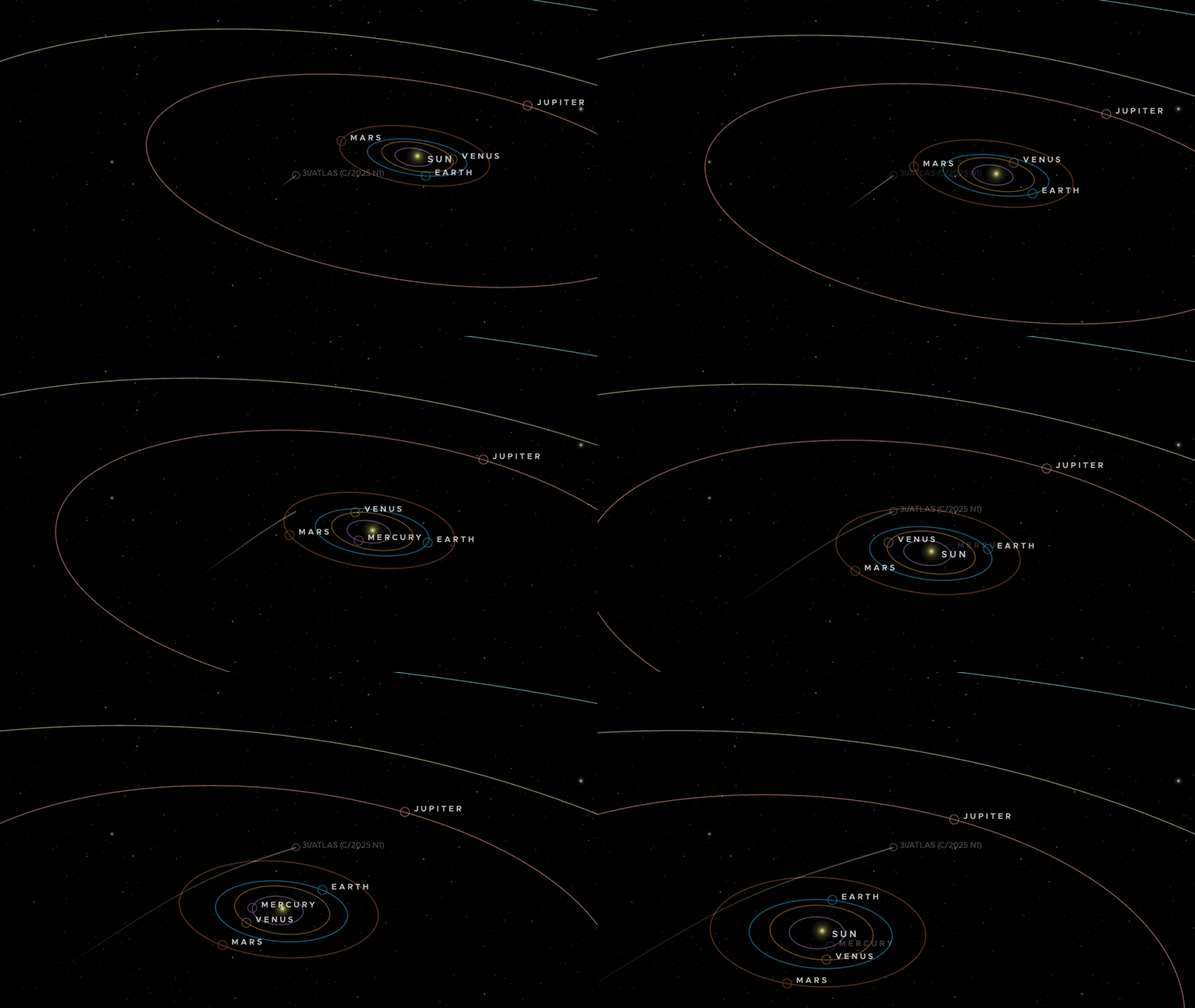
3I/ATLAS (C/2025 N1) is the third confirmed interstellar object ever seen passing through our solar system. Its orbit is hyperbolic, meaning it came from beyond the Sun’s gravity and will leave after its fly-through. NASA confirms it poses no threat to Earth; its closest approach to our planet is about 1.8 AU (~270 million km). It reaches perihelion around Oct 30, 2025 at roughly 1.4 AU from the Sun (just inside Mars’ orbit). Multiple space and ground assets — Hubble, Webb, SPHEREx, Mars orbiters/rovers, Europa Clipper, Lucy, Psyche and more — are gathering data to probe its composition and activity. (NASA Science)
Fast Facts
- Designation: 3I/ATLAS (C/2025 N1) — “3I” = third interstellar object; discovered by the ATLAS survey. (NASA Science)
- Discovery: July 1, 2025 (first report to MPC from ATLAS Chile). Pre-discovery images extend to June 14, 2025. (NASA Science)
- Orbit: Highly hyperbolic; inbound and outbound on a single pass. (NASA Science)
- Perihelion: ~Oct 30, 2025, at ~1.4 AU. (NASA Science)
- Closest to Earth: ~1.8 AU (no hazard). (NASA Science)
- Estimated nucleus size (current constraints): roughly 0.44–5.6 km diameter. (NASA Science)
Why 3I/ATLAS Matters
Interstellar comets are time capsules from other planetary systems. By studying the gases and dust they release (coma and tails), astronomers test how planet-forming ices and organics vary across the galaxy. 3I/ATLAS follows 1I/ʻOumuamua (2017) and 2I/Borisov (2019), but unlike ʻOumuamua’s puzzling, asteroid-like appearance, 3I/ATLAS looks like a “normal” active comet, making it a cleaner laboratory for composition and activity studies. (NASA Science)
Discovery & Naming
ATLAS (Asteroid Terrestrial-impact Last Alert System), a NASA-funded survey, first reported 3I/ATLAS on July 1, 2025 from its Río Hurtado, Chile station and quickly assembled pre-discovery data to refine the orbit. The naming follows standard practice: ATLAS (discovering program), I for interstellar, and 3 for the third such object. (NASA Science)
European teams mobilized rapidly as well: ESA coordinated ground telescopes across Hawai‘i, Chile, and Australia, and is leveraging spacecraft vantage points (Mars Express, ExoMars TGO, JUICE) to complement Earth-based observations. (欧洲航天局)
The Current Timeline (Observation Windows)
- Through September 2025: Viable for ground telescopes; steadily brightening but still a telescopic target. (NASA Science)
- Late October 2025: Solar conjunction—it passes too close to the Sun’s line of sight for Earth-based observing. (NASA Science)
- Early December 2025: Reappears from behind the Sun for renewed tracking. (NASA Science)
- Key flybys (from NASA tracking): passed Mars (Oct 3, 2025); continues outward past Jupiter (March 2026) on its way out of the solar system. (NASA Science)
For a live, interactive view of its path, NASA’s Eyes on the Solar System provides an up-to-date 3D trajectory. (NASA Science)
How Close Does It Get — and Is It Safe?
There is no impact risk. The closest-approach distance to Earth is ~1.8 AU (~270 million km), well beyond the orbit of Earth and even farther than the Sun–Earth distance. NASA’s official page reiterates that 3I/ATLAS poses no threat. (NASA Science)
What Are Scientists Measuring?
Space telescopes:
- Hubble captured detailed imagery on July 21, 2025, showing a teardrop-shaped dust cocoon and helping establish early nucleus size limits. (NASA Science)
- James Webb and SPHEREx acquired spectroscopic data in August, probing ices and dust to constrain composition and outgassing. (NASA lists both as active participants.) (NASA Science)
Mars-based assets:
- NASA notes the Oct 3 Mars pass could be observed by MRO and Mars rovers, offering a side-on view while the comet nears perihelion. (NASA Science)
Possible in-situ ion-tail sampling:
- A peer-reviewed research note (preprint accepted to RNAAS) outlines a window Oct 30–Nov 6 when Europa Clipper may pass through the ion tail, with instrumentation capable of detecting plasma and magnetic signatures. A similar but less instrumented opportunity exists for ESA’s Hera (Oct 25–Nov 1). Whether teams will execute this ad-hoc plan depends on operations constraints, but the geometry is favorable. (ar5iv)
Observing 3I/ATLAS (for Readers)
- Naked eye? No. Even at its best, 3I/ATLAS is a telescopic target, not a spectacle like bright comets of the past. (NASA Science)
- Right now: Around late October, it’s near solar conjunction and effectively hidden in daytime glare. Public skywatching will improve in early December after it reappears from behind the Sun. (NASA Science)
- Follow along: NASA’s “Follow Comet 3I/ATLAS’s Journey” hub aggregates images, videos, and mission updates as they post. (NASA Science)
Science Context: How It Compares to 1I and 2I
- 1I/ʻOumuamua (2017): Small, no coma detected; spurred debate over its nature.
- 2I/Borisov (2019): A classic comet with obvious coma/tail.
- 3I/ATLAS (2025): Clearly cometary, enabling standard coma/tail spectroscopy and activity modeling — ideal for comparing ices and dust formed around another star to comets born in our own solar system. (NASA Science)
FAQ
Q1. What is 3I/ATLAS?
An interstellar comet on a one-time hyperbolic fly-through of our solar system, likely ejected from a distant planetary system long ago. (NASA Science)
Q2. Will it hit Earth?
No. Its closest approach is about 1.8 AU — far outside any danger to Earth. (NASA Science)
Q3. When is it closest to the Sun (perihelion)?
Around Oct 30, 2025, at about 1.4 AU from the Sun. (NASA Science)
Q4. Can I see it with the naked eye?
No — it’s too faint. It’s a target for telescopes and professional observatories. (NASA Science)
Q5. Who is observing it?
A broad campaign: Hubble, Webb, SPHEREx, and multiple NASA/ESA spacecraft (including assets at Mars, Europa Clipper, Lucy, Psyche, SOHO, JUICE), plus major ground telescopes. (NASA Science)
Q6. Could any spacecraft fly through its tail?
A short-notice opportunity exists for Europa Clipper (and possibly Hera) to sample the ion tail remotely as they pass “downwind” of the comet in late Oct/early Nov 2025. This is proposed/forecasted geometry, not a dedicated flyby. (ar5iv)
Further Reading & Press Coverage
- NASA — Comet 3I/ATLAS (overview, timeline, assets, safety). (NASA Science)
- NASA/Hubble — first resolved image & nucleus size constraints. (NASA Science)
- ESA — coordinated European observations & spacecraft vantage points. (欧洲航天局)
- Universe Today — analysis of potential Europa Clipper/Hera ion-tail crossings. (Universe Today)
- arXiv (accepted to RNAAS) — detailed geometry for possible tail immersion. (ar5iv)
- Reuters — discovery news report & early context. (Reuters)
- The Guardian — discovery background & interstellar classification. (卫报)