
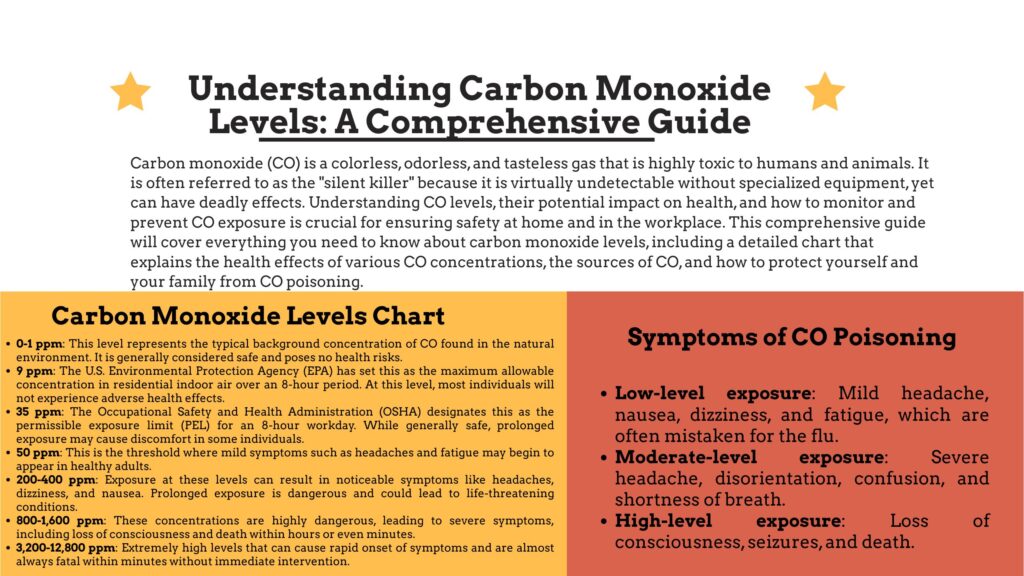
Carbon monoxide (CO) is a colorless, odorless, and tasteless gas that is highly toxic to humans and animals. It is often referred to as the “silent killer” because it is virtually undetectable without specialized equipment, yet can have deadly effects. Understanding CO levels, their potential impact on health, and how to monitor and prevent CO exposure is crucial for ensuring safety at home and in the workplace. This comprehensive guide will cover everything you need to know about carbon monoxide levels, including a detailed chart that explains the health effects of various CO concentrations, the sources of CO, and how to protect yourself and your family from CO poisoning.
What is Carbon Monoxide?
Carbon monoxide is a byproduct of incomplete combustion of carbon-containing fuels. It is produced when fuels such as gas, oil, coal, wood, or charcoal do not burn completely. Common sources of CO include:
- Household appliances: Gas stoves, heaters, and water heaters, especially those that are not properly vented or maintained.
- Automobiles: Running a car engine in an enclosed space, like a garage, can lead to a dangerous buildup of CO.
- Fires: Smoke from fires contains CO, which can be particularly hazardous in enclosed spaces.
- Portable generators: These devices, often used during power outages, can produce significant amounts of CO if operated indoors or in poorly ventilated areas.
Due to its colorless and odorless nature, CO is difficult to detect without a carbon monoxide detector, making it a significant risk in any setting where fuel is burned.
More About CO: What is Carbon Monoxide (CO)
The Dangers of Carbon Monoxide
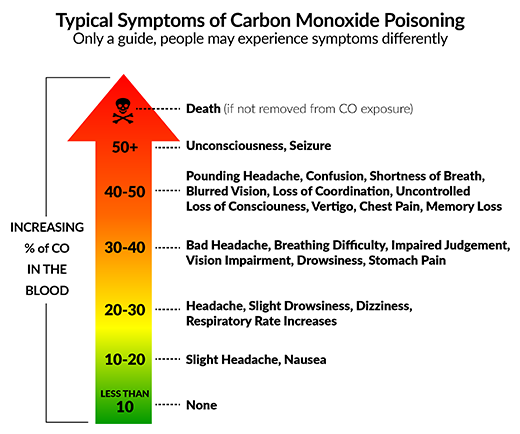
Carbon monoxide is dangerous because it interferes with the body’s ability to use oxygen. When inhaled, CO binds to hemoglobin in the blood, forming carboxyhemoglobin (COHb), which prevents oxygen from being transported to cells and tissues. This oxygen deprivation can lead to severe health effects, including death, depending on the concentration and duration of exposure.
Symptoms of CO Poisoning
The symptoms of CO poisoning can vary depending on the level of exposure but often include:
- Low-level exposure: Mild headache, nausea, dizziness, and fatigue, which are often mistaken for the flu.
- Moderate-level exposure: Severe headache, disorientation, confusion, and shortness of breath.
- High-level exposure: Loss of consciousness, seizures, and death.
Because CO poisoning symptoms are nonspecific and can mimic other conditions, it is often underdiagnosed. Immediate medical attention is necessary if CO poisoning is suspected.
Carbon Monoxide Levels Chart
To better understand the impact of CO on health, it is important to be aware of the specific levels of CO in the air and the corresponding health risks. The chart below provides a detailed overview of various CO concentrations and their potential effects on human health.
| CO Concentration (ppm) | Exposure Duration | Health Effects |
|---|---|---|
| 0-1 ppm | Continuous | Normal, background levels found in the environment. |
| 9 ppm | 8 hours | Maximum allowable concentration in living spaces, according to EPA. |
| 35 ppm | 8 hours | Maximum allowable concentration in the workplace, according to OSHA. |
| 50 ppm | 8 hours | Minor headache, fatigue in healthy adults; threshold limit for workplace. |
| 200 ppm | 2-3 hours | Slight headache, dizziness, nausea after prolonged exposure. |
| 400 ppm | 1-2 hours | Frontal headache, life-threatening after 3 hours. |
| 800 ppm | 45 minutes | Dizziness, nausea, convulsions, unconsciousness; death within 2-3 hours. |
| 1,600 ppm | 20 minutes | Headache, dizziness, nausea; death within 1 hour. |
| 3,200 ppm | 5-10 minutes | Severe headache, dizziness; death within 25-30 minutes. |
| 6,400 ppm | 1-2 minutes | Headache, dizziness, nausea; death within 10-15 minutes. |
| 12,800 ppm | 1-3 minutes | Immediate symptoms; death within 1-3 minutes. |
Key Takeaways from the Chart
- 0-1 ppm: This level represents the typical background concentration of CO found in the natural environment. It is generally considered safe and poses no health risks.
- 9 ppm: The U.S. Environmental Protection Agency (EPA) has set this as the maximum allowable concentration in residential indoor air over an 8-hour period. At this level, most individuals will not experience adverse health effects.
- 35 ppm: The Occupational Safety and Health Administration (OSHA) designates this as the permissible exposure limit (PEL) for an 8-hour workday. While generally safe, prolonged exposure may cause discomfort in some individuals.
- 50 ppm: This is the threshold where mild symptoms such as headaches and fatigue may begin to appear in healthy adults.
- 200-400 ppm: Exposure at these levels can result in noticeable symptoms like headaches, dizziness, and nausea. Prolonged exposure is dangerous and could lead to life-threatening conditions.
- 800-1,600 ppm: These concentrations are highly dangerous, leading to severe symptoms, including loss of consciousness and death within hours or even minutes.
- 3,200-12,800 ppm: Extremely high levels that can cause rapid onset of symptoms and are almost always fatal within minutes without immediate intervention.
What is an Acceptable Level of Carbon Monoxide?

An acceptable level of carbon monoxide varies depending on the context—whether it is a residential, occupational, or public environment. Generally, CO levels are measured in parts per million (ppm), and acceptable levels are defined by how long a person can be safely exposed to a particular concentration.
- 0-1 ppm: This is typically the background level of CO found in outdoor air. It is generally considered safe and poses no health risk.
- 9 ppm: The U.S. Environmental Protection Agency (EPA) has established this as the maximum allowable concentration of CO in residential indoor air over an 8-hour period. Prolonged exposure at this level is generally not harmful.
- 50 ppm: This is the maximum concentration allowed in the workplace for an 8-hour workday according to OSHA standards. While some discomfort may occur, this level is not expected to cause significant health issues for healthy individuals.
Higher concentrations can be dangerous and even life-threatening, depending on the duration of exposure. The following sections will discuss the specific exposure limits set by various health and safety organizations.
CO Exposure Limits and Regulations
Understanding and adhering to CO exposure limits is critical for ensuring safety in both residential and occupational settings. Several organizations have established guidelines for CO exposure:
OSHA Carbon Monoxide Exposure Limits
The Occupational Safety and Health Administration (OSHA) is responsible for ensuring safe and healthy working conditions by setting and enforcing standards. OSHA has established specific limits for carbon monoxide exposure in the workplace:
- Permissible Exposure Limit (PEL): OSHA’s PEL for CO is 50 ppm over an 8-hour workday. This limit is intended to protect workers from the adverse effects of CO exposure during a standard workday.
- Short-Term Exposure Limit (STEL): OSHA does not have a specific STEL for CO, but other organizations like NIOSH provide guidance on shorter exposure periods.
OSHA’s limits are designed to protect the majority of workers, including those who may be more sensitive to CO exposure.
ASHRAE Carbon Monoxide Exposure Limits
The American Society of Heating, Refrigerating, and Air-Conditioning Engineers (ASHRAE) focuses on indoor air quality standards, including acceptable levels of CO. ASHRAE’s guidelines are primarily concerned with maintaining safe indoor air quality in residential and commercial buildings:
- Indoor Air Quality Standard: ASHRAE recommends maintaining indoor CO levels at or below 9 ppm over an 8-hour average, aligning with the EPA’s residential guidelines.
- Short-Term Exposure: ASHRAE advises that CO levels should not exceed 35 ppm over a 1-hour period to prevent acute health effects.
ASHRAE’s standards are widely used in the design and operation of HVAC systems to ensure that indoor environments remain safe and healthy.
NIOSH Carbon Monoxide Exposure Limits
The National Institute for Occupational Safety and Health (NIOSH) is a U.S. federal agency responsible for conducting research and making recommendations for workplace safety. NIOSH has established more conservative limits for CO exposure than OSHA:
- Recommended Exposure Limit (REL): NIOSH recommends a CO exposure limit of 35 ppm over an 8-hour workday.
- Short-Term Exposure Limit (STEL): NIOSH advises that exposure should not exceed 200 ppm for any 15-minute period.
NIOSH also identifies 1,200 ppm as the concentration immediately dangerous to life or health (IDLH), meaning that exposure at this level could cause permanent health damage or death if not promptly addressed.
EPA Carbon Monoxide Levels Exposure Limits
The Environmental Protection Agency (EPA) regulates indoor air quality in residential settings and has established specific CO exposure limits to protect public health:
- 8-Hour Standard: The EPA recommends that indoor CO levels should not exceed 9 ppm over an 8-hour average. This standard is designed to protect vulnerable populations, including children, the elderly, and those with pre-existing health conditions.
- 1-Hour Standard: The EPA also sets a 1-hour CO exposure limit of 35 ppm. Exceeding this level can lead to acute health effects, particularly in sensitive individuals.
The EPA’s guidelines are widely used in residential settings to ensure that indoor air remains safe and healthy.
WHO Carbon Monoxide Levels Exposure Limits
The World Health Organization (WHO) provides global guidance on safe levels of CO exposure. WHO’s recommendations are similar to those of the EPA but are intended for a broader, international audience:
- 8-Hour Guideline: WHO recommends an 8-hour average CO concentration of no more than 9 ppm to minimize the risk of adverse health effects.
- 1-Hour Guideline: WHO also suggests a 1-hour exposure limit of 25 ppm. This lower limit is designed to protect even the most vulnerable populations globally.
WHO’s guidelines are often referenced in countries where national standards for CO exposure may not exist.
ACGIH Carbon Monoxide Exposure Limits
The American Conference of Governmental Industrial Hygienists (ACGIH) is a professional organization that develops guidelines to help protect worker health. ACGIH’s Threshold Limit Values (TLVs) for CO are:
- TLV-TWA (Time-Weighted Average): ACGIH recommends a limit of 25 ppm over an 8-hour workday. This is lower than OSHA’s limit and is aimed at providing a greater margin of safety.
- TLV-STEL (Short-Term Exposure Limit): ACGIH suggests a short-term exposure limit of 200 ppm for 15 minutes.
ACGIH’s TLVs are often used as reference points in industrial hygiene practices and are considered more protective than some regulatory standards.
UL, CSA, ANSI CO Levels Exposure Limits
Several standards organizations, including Underwriters Laboratories (UL), the Canadian Standards Association (CSA), and the American National Standards Institute (ANSI), have established guidelines for carbon monoxide detectors and alarm systems:
- UL 2034: This standard defines the performance requirements for residential CO alarms. It specifies that alarms must sound at 70 ppm within 60 to 240 minutes, at 150 ppm within 10 to 50 minutes, and at 400 ppm within 4 to 15 minutes.
- CSA 6.19-01: This Canadian standard is similar to UL 2034 but may include additional requirements tailored to the Canadian context.
- ANSI/UL 2075: This standard pertains to gas and vapor detectors, including CO detectors used in commercial settings. It provides guidelines for the design, installation, and performance of these devices.
These standards ensure that CO detectors and alarms are reliable and effective in alerting occupants to dangerous levels of CO, allowing for timely evacuation or corrective action.
Sources of Carbon Monoxide
Carbon monoxide can originate from several sources, particularly in environments where fuel is burned. The most common sources of CO include:
1. Household Appliances
- Gas stoves and ovens: These appliances can produce CO if not properly ventilated.
- Furnaces and heaters: Faulty or poorly maintained furnaces can leak CO into living spaces.
- Water heaters: Gas water heaters are another potential source of CO if not correctly vented.
2. Automobiles
- Exhaust fumes: Running a vehicle in an enclosed space like a garage can lead to a dangerous buildup of CO.
- Poorly maintained vehicles: Faulty exhaust systems can leak CO into the cabin of the vehicle.
3. Fires and Combustion Devices
- Fireplaces and wood stoves: Incomplete combustion in fireplaces and stoves can generate CO.
- Portable generators: Using these devices indoors or too close to an enclosed space can result in CO poisoning.
4. Industrial and Occupational Sources
- Factories and workshops: Industries that involve combustion processes, such as steel mills and chemical plants, are potential sources of CO.
- Confined spaces: Workers in confined spaces like tunnels or mines are at higher risk of CO exposure.
Preventing CO Poisoning
Preventing CO poisoning requires a combination of proper appliance maintenance, adequate ventilation, and the use of CO detectors. Here are key steps to protect yourself and your family:
1. Install CO Detectors
- Placement: Install CO detectors on every level of your home, particularly near bedrooms and in areas with fuel-burning appliances.
- Maintenance: Regularly test your CO detectors to ensure they are functioning properly and replace batteries as needed.
2. Ensure Proper Ventilation
- Appliances: Make sure all fuel-burning appliances are properly vented to the outside.
- Vehicles: Never run a car or any fuel-powered engine inside an enclosed space.
3. Regular Maintenance
- Appliance Checkups: Have a qualified technician inspect and maintain your heating system, water heater, and other gas appliances annually.
- Chimney Cleaning: Ensure chimneys and flues are clean and unobstructed to allow gases to escape safely.
4. Use Equipment Safely
- Portable Generators: Always use generators outdoors, away from windows, doors, and vents.
- Grills and Camp Stoves: Never use charcoal grills or portable camp stoves indoors.
Emergency Response to CO Exposure
If you suspect CO poisoning, it is critical to act quickly:
- Move to Fresh Air: Immediately move to an area with fresh air, such as outdoors or near an open window.
- Call Emergency Services: Contact emergency services (911) immediately if you or someone else is experiencing symptoms of CO poisoning.
- Administer Oxygen (if available): In severe cases, medical personnel may administer oxygen to reduce CO levels in the blood.
Prompt action can be the difference between life and death in cases of CO poisoning.
Carbon Monoxide Meters
Carbon monoxide meters are essential tools for detecting and monitoring CO levels in various environments. These devices come in different forms, ranging from portable handheld units to fixed installations that continuously monitor CO concentrations.
Types of Carbon Monoxide Meters
- Portable CO Meters: These handheld devices are commonly used by safety inspectors, emergency responders, and individuals who need to measure CO levels in different locations quickly.
- Fixed CO Detectors: Installed in homes, workplaces, and public buildings, these detectors continuously monitor CO levels and trigger an alarm if dangerous concentrations are detected.
- Multi-Gas Detectors: These devices can measure multiple gases, including CO, making them useful in industrial settings where various gas hazards may be present.
Features to Consider
When selecting a CO meter, consider the following features:
- Detection Range: The meter should be capable of detecting CO levels across a wide range, typically from 0 ppm to at least 1,000 ppm.
- Accuracy: High accuracy is essential for ensuring reliable measurements, particularly in environments where CO levels can fluctuate rapidly.
- Alarm System: A good CO meter should have an audible and visual alarm to alert users when CO levels exceed safe thresholds.
- Battery Life: For portable devices, long battery life is important, especially in field operations.
Popular Brands
Some popular brands of CO meters include:
Conclusion
Carbon monoxide is a deadly gas that poses a significant risk due to its colorless, odorless nature. Understanding the sources, symptoms, and dangers of CO exposure is essential for maintaining a safe environment. By adhering to safety guidelines, using CO detectors, and ensuring proper maintenance of appliances, you can protect yourself and your loved ones from the dangers of carbon monoxide. Stay informed, stay vigilant, and take proactive steps to prevent CO poisoning in your home and workplace.