

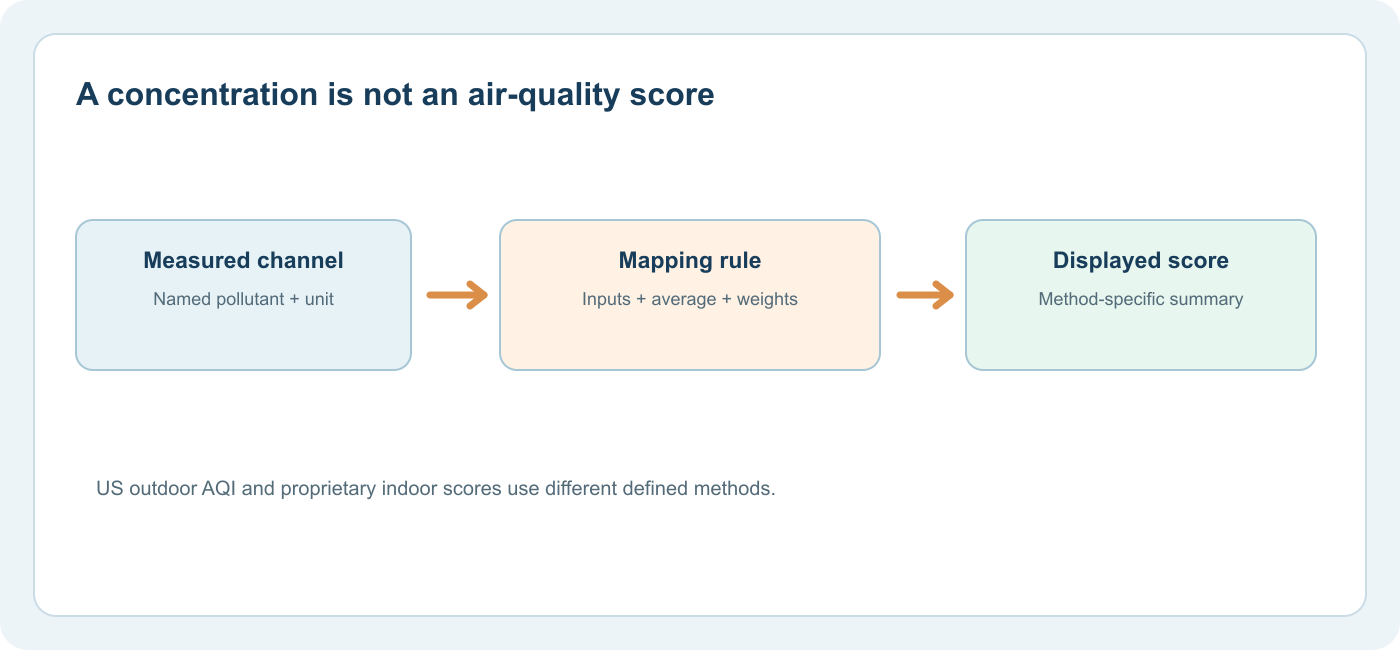
A gas concentration and an air-quality score answer different questions. A sensor may report CO₂ in ppm, CO in ppm, PM₂.₅ in µg/m³, or a different measured quantity. A score is a rule that maps one or more readings into a simplified number, color or label. The rule may be an official outdoor index, a published method, or a manufacturer's private formula. Without its inputs, time averaging and mapping method, a score cannot be reverse-engineered into a gas concentration or treated as proof that all indoor pollutants are acceptable.
This distinction matters when a desk monitor displays a green “air quality” badge beside a rising CO₂ value, or when an app shows “AQI 42” without saying whether it is the US outdoor AQI, an indoor calculation, or a proprietary comfort indicator. The useful response is to identify which pollutant was actually measured, what the score includes, and which decision the user needs to make. EPA explains that low-cost indoor monitors report only the contaminants or environmental factors they are designed to detect.


Concentration Is a Measurement of a Named Substance
Concentration describes how much of a specified substance is present in a specified sample. CO₂ and CO gas instruments often use parts per million of gas fraction; particle instruments may report particulate mass concentration in micrograms per cubic meter. Those numbers are not directly interchangeable. A higher CO₂ ppm figure does not say how much PM₂.₅ is present, and a lower PM₂.₅ value says nothing about CO from a faulty appliance.
Even within one pollutant, the number needs context. A sensor samples at a location and time, may average over an interval, and has a stated range and error under particular conditions. Moving a monitor beside a person's breath, a cooker or an open window can change its reading without changing every part of the room. The EPA guide to siting air sensors emphasizes representative placement and warns that local sources, sinks and changing humidity can affect what a device sees.
The CO₂ measurement guide explains that a measurement chain begins with a defined gas sample, not with the number shown on the screen. That chain is still present when software converts the number into a colored tile.
What the US Outdoor AQI Includes
The US Air Quality Index is an established way to communicate outdoor air-pollution conditions and related health concern. AirNow lists its five major pollutant groups: ground-level ozone, particulate matter (including PM₂.₅ and PM₁₀), carbon monoxide, sulfur dioxide and nitrogen dioxide. CO₂ is not one of those AQI pollutants. The index uses pollutant-specific concentration-to-index relationships and defined reporting conventions. An indoor CO₂ monitor cannot calculate the official US AQI from its CO₂ channel alone.
The fact that CO appears in the US AQI while CO₂ does not is easy to miss. They are different gases. Our CO-versus-CO₂ sensor-channel guide explains why a combined instrument needs separate sensing evidence for each. An “AQI” label printed on a consumer indoor display therefore deserves a specific question: Is it reporting the official outdoor index from a recognized data source, estimating an outdoor pollutant sub-index from measured data, or showing a vendor-defined indoor score? Those are not equivalent outputs.
AirNow's AQI basics describe the six public color categories. Our older AQI-range reference provides background on those bands. This article deals with the more practical problem of interpreting a local sensor and a score together.

Indoor Scores Are Often Device-Specific
Indoor devices may use “IAQ score,” “air quality level,” a face icon or a green-to-red bar. Some combine PM₂.₅, TVOC, CO₂, temperature and humidity; others use just one input. Two devices can show different scores in the same room because their sensor sets, calibrations, averaging periods and weighting formulas differ. Neither score automatically has the status or meaning of the official US outdoor AQI.
There is nothing inherently wrong with a well-explained proprietary score. It can help a user notice a trend. The problem is unqualified interpretation. If the formula is unavailable, a score of 80 cannot tell you what PM₂.₅ concentration was measured, whether the CO channel exists, or how much of the change came from humidity rather than a pollutant. EPA notes that low-cost indoor monitors do not give a complete representation of indoor air quality and that their performance can vary with placement, temperature, humidity and multiple contaminants.
Some consumer products estimate “eCO₂” from a VOC-related signal rather than measuring CO₂ directly. Our direct CO₂ versus eCO₂ guide explains why that proxy must be labeled and interpreted separately. A composite score built partly from eCO₂ has still another layer of inference. The screen should disclose what is measured and what is estimated.
| Display item | What it can mean | What it cannot establish alone |
|---|---|---|
| CO₂ ppm | A reported CO₂ fraction at the device's sample point | CO concentration, PM level, full indoor-air safety |
| PM₂.₅ µg/m³ | A reported particle mass concentration under the device's method | CO₂ or CO level; identity of every particle source |
| CO ppm | A reported CO fraction, if the channel is specified | Ventilation adequacy or CO₂ fraction |
| Official US outdoor AQI | An index for specified outdoor pollutants using the official method and data | Full indoor-air condition at a particular desk |
| Proprietary indoor score | A vendor-defined summary of the inputs it uses | A universal health standard or undisclosed pollutant concentration |
The table is a reading guide, not a ranking of product quality. A good multi-parameter instrument still needs appropriate sensors and clear per-channel specifications.
A Hypothetical Room Comparison
Imagine an office monitor shows CO₂ 1,100 ppm and PM₂.₅ 6 µg/m³, while its app labels the overall condition “good.” These example values are hypothetical; they are not test data or universal limits. The score may be dominated by PM₂.₅, use a generous CO₂ band, average over a longer interval, or omit a channel. With no published method, the exact reason cannot be known.
The proper interpretation is narrower: the device reports a particular CO₂ value and a particular PM₂.₅ value at its location. Investigate the CO₂ trend in relation to outdoor background, occupancy and ventilation; investigate particle sources and movement separately. A single “good” score should not erase either observation. It also says nothing about pollutants the device does not measure, such as radon or carbon monoxide in a PM/CO₂-only model.
Reverse the example: an app gives a poor score because of a cooking-related particle spike while CO₂ is steady. Opening a window might change both, but a particle filter and a ventilation change address different physical processes. A useful dashboard keeps the original channels visible so the user can choose a response matched to the pollutant.
Why CO₂ Can Be Useful Without Being a Universal IAQ Score
People produce CO₂, so a time series in an occupied room can help assess how that room's ventilation and occupancy interact. EPA says indoor CO₂ can provide information about ventilation but must be interpreted carefully. A room's outdoor baseline, occupancy changes, mixing, sensor location and time behavior all affect the interpretation.
CO₂ cannot stand in for every indoor pollutant. EPA's indoor-pollutant overview includes particles, CO, nitrogen dioxide, VOCs, radon and biological sources, among others. Some are linked to occupants; others come from products, cooking, combustion or building materials. A low CO₂ value does not establish that they are absent. Conversely, a CO₂ rise is a specific measurement to investigate, not by itself a complete diagnosis of harm or an automatic instruction to buy a particular device.
For the practical distinction between a sensor channel and the performance of the enclosure, airflow and software around it, read the module-versus-monitor guide.
Five Questions to Ask About an “Air Quality” Display
1. What is directly measured? Look for named channels: PM₂.₅, PM₁₀, CO₂, CO, NO₂ or another analyte. Temperature and relative humidity are environmental measurements, not generic pollutant measurements.
2. What is calculated or inferred? Ask whether a value is eCO₂, a vendor score, an AQI estimate, an external data feed or a direct sensor output. A label should not hide the distinction.
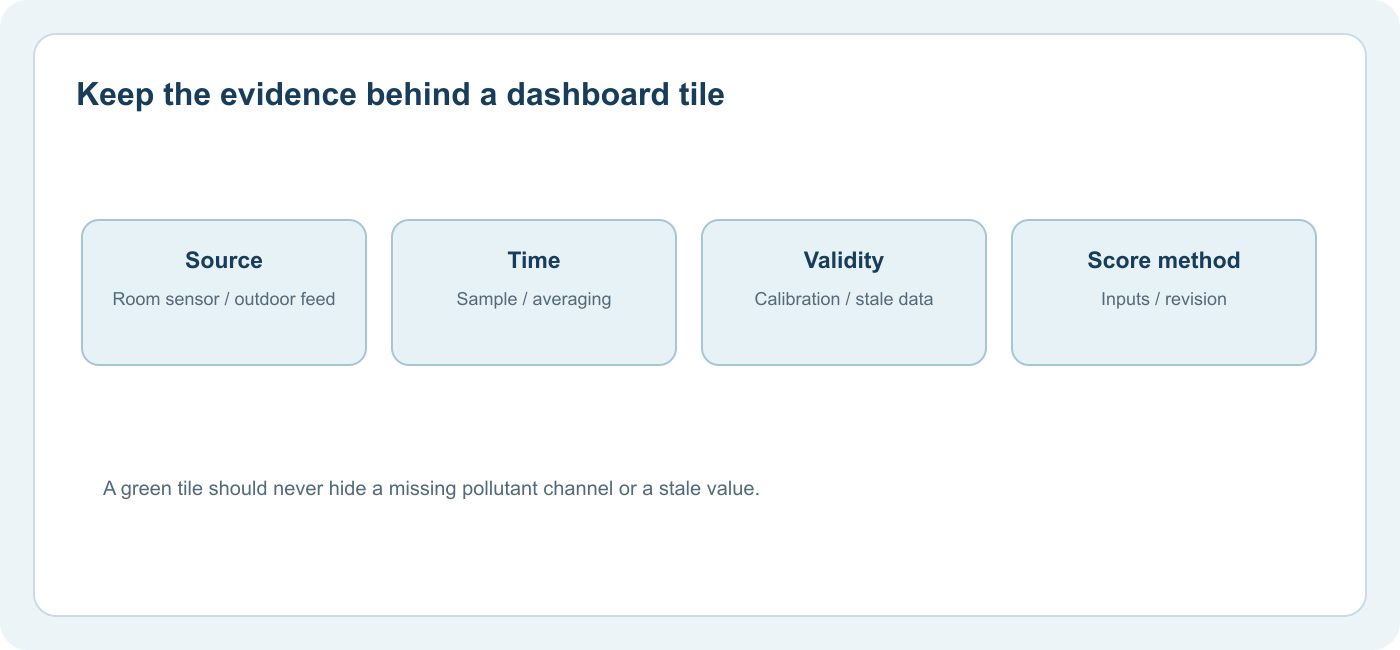
3. What time and place does it describe? Identify the sample inlet, update interval, averaging period and whether the number represents the room, an outdoor station or a remote weather service.
4. What changes the score? Request the score's input list, aggregation rule and revision. If the method is private, treat the score as a device-specific trend while reading the raw channels for decisions.
5. What happens when a sensor fails? A stale PM sensor or a disconnected CO₂ module should not leave a reassuring green tile. Look for validity flags, timestamps and a documented fault indication.
These questions also help compare products. A larger list of sensors is not automatically better if their sample path, accuracy and maintenance are undefined. EPA's enhanced air-sensor guidebook recommends planning measurements around the intended question and interpreting the resulting data with their limitations.
Test Whether the Score Preserves Useful Information
A simple evaluation is to record the raw channels and the score during ordinary changes in the same space, without inventing exposure limits. Note the time, location, occupancy, nearby activities and whether the displayed score follows the measured change. If cooking raises the particle channel but the score stays green, ask whether the score uses a longer average or omits PM. If CO₂ rises during a crowded meeting while the score barely moves, ask how CO₂ is weighted. The point is to learn the score's meaning, not to declare the instrument faulty from one anecdote.
Check what the app does when its data feed is interrupted. A last-known outdoor AQI value can remain on a screen after a room sensor continues updating. The two numbers may then have different timestamps and sources even though they sit side by side. A technically useful interface should identify stale data or missing channels. If it does not, use the raw readings and the official source separately when the distinction affects a decision.
For comparisons between different devices, first place them at the same representative location for a suitable period and compare the same pollutant channel with matching units and averaging. Comparing their overall scores can never isolate a sensor disagreement unless their formulas are known. Even matching channel values should be judged against each product's stated accuracy and conditions rather than an expectation of identical digits.
When an Alarm Is a Different Product Requirement
An indoor-air score is generally a communication layer, not a substitute for an emergency detector. EPA distinguishes low-cost monitor alerts from CO alarms and smoke detectors, which are designed for potentially life-threatening situations and have specific intended-use requirements. If CO risk exists, select and maintain the appropriate alarm as required for the application; do not rely on a green IAQ score or on a CO₂-only trend.
The same separation helps building operators: present pollutant values, location and time alongside any score. If the score changes but no channel seems to explain it, check whether the software uses undisclosed inputs, cached outdoor AQI, changing weights or a sensor fault. A score is most useful when it directs attention back to measurable causes.
Frequently Asked Questions
Does CO₂ count in the US AQI? No. The US outdoor AQI covers specified pollutant groups including CO, but not CO₂.
Can an indoor monitor display “AQI”? It can display an official outdoor AQI feed or an AQI-like calculation, but the source and method must be stated. A private indoor score should not be assumed identical to the official index.
Does a green air-quality score mean no carbon monoxide? No. The device may not even have a CO channel. A score does not replace an appropriate CO alarm.
Is CO₂ a ventilation measurement? It is a CO₂ concentration measurement that can inform a ventilation investigation under suitable conditions. It is not a direct measurement of air-exchange rate by itself.
Why do two monitors disagree on “air quality”? They may measure different pollutants, sample at different locations or times, use different calibrations, and combine readings through different formulas.
What should a buyer request? The raw channel list, sensor specifications, score method, averaging period, maintenance plan, and fault behavior. Those are more informative than a single color badge.