
Introduction
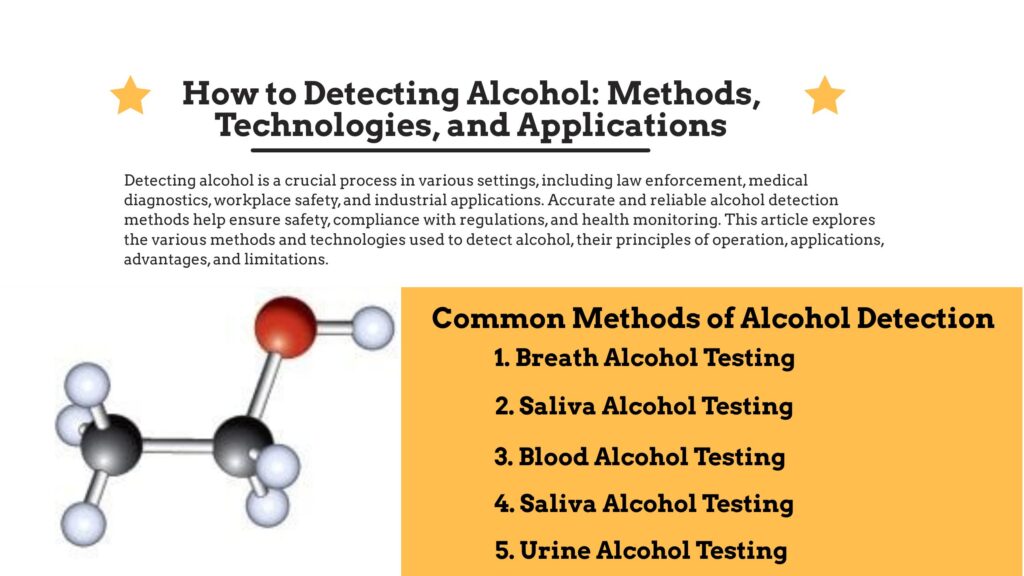
Detecting alcohol is a crucial process in various settings, including law enforcement, medical diagnostics, workplace safety, and industrial applications. Accurate and reliable alcohol detection methods help ensure safety, compliance with regulations, and health monitoring. This article explores the various methods and technologies used to detect alcohol, their principles of operation, applications, advantages, and limitations.
Principles of Alcohol Detection
Alcohol detection is primarily based on identifying and measuring ethanol, the type of alcohol found in alcoholic beverages. Detection methods can be categorized into two main types: chemical-based methods and sensor-based methods.
Chemical-Based Methods
Chemical-based methods involve chemical reactions that produce a detectable signal in the presence of alcohol. These methods are typically used in breathalyzers and field sobriety tests.
Sensor-Based Methods
Sensor-based methods use various types of sensors to detect the presence of alcohol. These sensors can measure alcohol concentration in breath, blood, saliva, or urine.
Realted Read: What is an Alcohol Sensor: Understanding the Technology, Applications, and Implications
Common Methods of Alcohol Detection
Breath Alcohol Testing
Breath alcohol testing is the most widely used method for detecting alcohol consumption. It is non-invasive, quick, and provides immediate results. Breathalyzers, the devices used for breath alcohol testing, can be categorized into three main types based on their operating principles: chemical reaction-based, semiconductor sensor-based, and fuel cell sensor-based.
Chemical Reaction-Based Breathalyzers
- Principle: These breathalyzers use a chemical reaction between alcohol and a chromic acid solution. The reaction changes the color of the solution, which is then measured to determine the alcohol concentration.
- Advantages: Simple and inexpensive.
- Limitations: Less accurate and reliable compared to other methods.
Semiconductor Sensor-Based Breathalyzers
- Principle: These devices use semiconductor sensors that change their electrical resistance in the presence of alcohol vapor. The change in resistance is proportional to the alcohol concentration.
- Advantages: Compact and cost-effective.
- Limitations: Susceptible to interference from other substances and less accurate than fuel cell sensors.
Fuel Cell Sensor-Based Breathalyzers
- Principle: Fuel cell sensors generate an electrical current when alcohol vapor is oxidized at the electrode surface. The current produced is directly proportional to the alcohol concentration.
- Advantages: Highly accurate, reliable, and specific to alcohol.
- Limitations: More expensive than other types of breathalyzers.
Blood Alcohol Testing
Blood alcohol testing is considered the most accurate method for measuring alcohol concentration. It involves drawing a blood sample and analyzing it in a laboratory.
- Principle: Blood samples are analyzed using techniques such as gas chromatography or enzymatic assays to determine the blood alcohol concentration (BAC).
- Advantages: Highly accurate and provides a direct measurement of alcohol in the bloodstream.
- Limitations: Invasive, requires trained personnel, and results are not immediate.
Saliva Alcohol Testing
Saliva alcohol testing is a non-invasive method that provides results more quickly than blood tests but less accurate.
- Principle: Saliva samples are collected and analyzed using chemical reagents or enzymatic assays that react with alcohol.
- Advantages: Non-invasive, easy to administer, and provides rapid results.
- Limitations: Less accurate than blood tests and can be affected by food or drink residue in the mouth.
Urine Alcohol Testing
Urine alcohol testing is used to detect the presence of alcohol and its metabolites in the urine. This method is typically used for longer-term monitoring of alcohol consumption.
- Principle: Urine samples are analyzed using techniques such as gas chromatography or immunoassays to detect alcohol and its metabolites.
- Advantages: Non-invasive and useful for monitoring alcohol consumption over time.
- Limitations: Less accurate than blood tests and can be affected by the time since the last alcohol consumption.
Advanced Technologies in Alcohol Detection
Infrared Spectroscopy
Infrared spectroscopy is a non-invasive method that can detect alcohol in breath or skin.
- Principle: Infrared light is passed through the breath or skin, and the absorption of specific wavelengths by alcohol molecules is measured.
- Advantages: Non-invasive, quick, and provides continuous monitoring.
- Limitations: Expensive equipment and potential interference from other substances.
Raman Spectroscopy
Raman spectroscopy is another advanced method for detecting alcohol in breath or skin.
- Principle: Raman spectroscopy involves scattering of laser light by alcohol molecules, producing a spectrum that is characteristic of the alcohol concentration.
- Advantages: High sensitivity and specificity.
- Limitations: Expensive equipment and requires skilled operation.
Mass Spectrometry
Mass spectrometry is a highly sensitive and accurate method for detecting alcohol and its metabolites in blood, urine, or breath.
- Principle: Mass spectrometry measures the mass-to-charge ratio of ions, allowing precise identification and quantification of alcohol molecules.
- Advantages: Extremely accurate and capable of detecting very low concentrations of alcohol.
- Limitations: Expensive, requires specialized equipment and trained personnel, and is typically used in laboratory settings.
Applications of Alcohol Detection Methods
Law Enforcement
- Roadside Testing: Breathalyzers are commonly used by law enforcement officers for roadside testing to detect impaired drivers.
- Legal Proceedings: Blood and urine tests are used to provide definitive evidence of alcohol consumption in legal cases.
Workplace Safety
- Employee Screening: Employers use breath, saliva, and urine tests to ensure a safe working environment and comply with occupational safety regulations.
- Accident Investigation: Alcohol testing is conducted following workplace accidents to determine if alcohol consumption was a contributing factor.
Medical Diagnostics
- Emergency Care: Blood alcohol testing is used in emergency departments to assess the level of intoxication in patients.
- Chronic Monitoring: Saliva and urine tests are used to monitor alcohol consumption in patients undergoing treatment for alcohol use disorders.
Industrial Applications
- Process Control: Alcohol sensors are used in the production of alcoholic beverages to monitor fermentation and ensure product quality.
- Environmental Monitoring: Detection of alcohol in waste streams and emissions to prevent environmental contamination.
Consumer Products
- Personal Breathalyzers: Portable breathalyzers are available for personal use to help individuals monitor their alcohol consumption and make informed decisions.
- Smart Devices: Integration of alcohol sensors in wearable devices and smartphones for continuous monitoring of alcohol levels.
Advantages and Limitations of Alcohol Detection Methods
Breath Alcohol Testing
Advantages:
- Non-invasive and quick.
- Immediate results.
- Portable and easy to use.
Limitations:
- Less accurate than blood tests.
- Potential interference from other substances.
Blood Alcohol Testing
Advantages:
- Highly accurate and reliable.
- Provides direct measurement of blood alcohol concentration.
Limitations:
- Invasive and requires trained personnel.
- Results are not immediate.
Saliva Alcohol Testing
Advantages:
- Non-invasive and easy to administer.
- Rapid results.
Limitations:
- Less accurate than blood tests.
- Can be affected by food or drink residue in the mouth.
Urine Alcohol Testing
Advantages:
- Non-invasive and useful for long-term monitoring.
- Can detect alcohol metabolites.
Limitations:
- Less accurate than blood tests.
- Time-dependent accuracy based on last alcohol consumption.
Advanced Technologies
Infrared Spectroscopy:
- Advantages: Non-invasive, quick, continuous monitoring.
- Limitations: Expensive, potential interference from other substances.
Raman Spectroscopy:
- Advantages: High sensitivity and specificity.
- Limitations: Expensive, requires skilled operation.
Mass Spectrometry:
- Advantages: Extremely accurate, detects low concentrations.
- Limitations: Expensive, specialized equipment, typically used in labs.
Future Trends in Alcohol Detection
Wearable Technology
Integration of alcohol sensors into wearable devices, such as smartwatches and fitness trackers, for continuous and real-time monitoring of alcohol levels. These devices can provide immediate feedback to users, helping them make informed decisions about their alcohol consumption.
Internet of Things (IoT) Integration
IoT-enabled alcohol sensors can transmit data to centralized systems for monitoring and analysis. This integration can enhance workplace safety, medical diagnostics, and personal health management by providing real-time data and alerts.
Improved Sensitivity and Specificity
Advancements in sensor technology and materials science are leading to the development of more sensitive and specific alcohol detection methods. These improvements can reduce false positives and negatives, providing more accurate and reliable results.
Portable and Cost-Effective Devices
Ongoing research aims to develop portable, cost-effective alcohol detection devices that are easy to use and accessible to a broader population. These devices can be used in various settings, including law enforcement, workplaces, and personal monitoring.
Integration with Mobile Applications
Mobile applications that integrate with alcohol detection devices can provide users with detailed reports, trends, and recommendations based on their alcohol consumption patterns. These apps can also offer educational resources and support for individuals seeking to reduce their alcohol intake.
Conclusion
Detecting alcohol accurately and reliably is essential for ensuring safety, health, and compliance in various settings. From law enforcement and workplace safety to medical diagnostics and industrial applications, the methods and technologies for alcohol detection play a critical role in managing the effects of alcohol consumption. Understanding the principles, applications, advantages, and limitations of these methods enables us to make informed decisions and leverage advancements in technology for better outcomes. As research and innovation continue to evolve, we can expect even more effective and accessible solutions for alcohol detection in the future.
Reatled Read:
Health Impacts of Alcohol: A Comprehensive Analysis
What is Alcohol: Understanding the Science, Uses, and Impacts of Alcohol