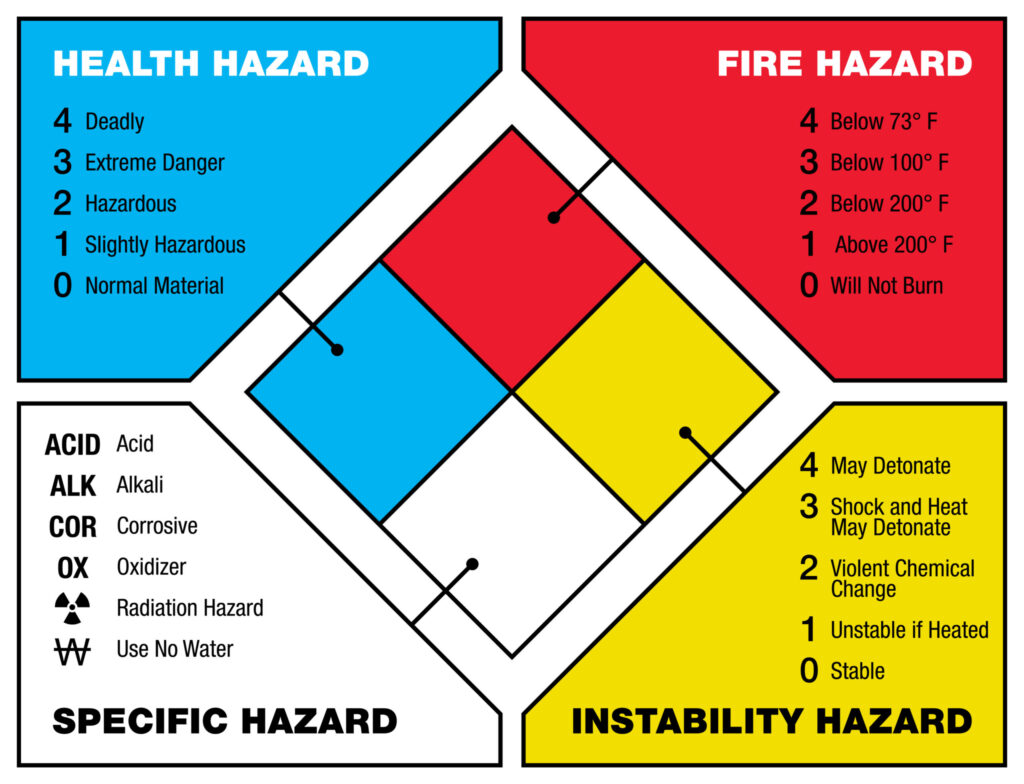
NFPA 704 is the
National Fire Protection Association’s Standard System for the Identification of the Hazards of Materials for Emergency Response. It uses the familiar
hazard diamond or
fire diamond to give firefighters, hazmat teams, and other emergency responders a fast visual summary of a material’s health, flammability, instability, and special hazards. Both
NFPA and OSHA describe it as a simple, readily recognized, easily understood marking system intended to communicate hazard severity for emergency response.
Many people know NFPA 704 by its shape rather than its formal name. The system is built around a
diamond-shaped “square-on-point” placard divided into four smaller sections. That visual layout is one of the reasons it remains so widely used in facilities that store, handle, or process hazardous chemicals. NFPA explains that the symbol is designed to provide an immediate general sense of hazard severity during an emergency, not a long technical explanation.
Why NFPA 704 Matters
NFPA 704 matters because emergency responders often need to make decisions within seconds. During a fire, spill, leak, or other incident, responders may not have time to review a full Safety Data Sheet before choosing extinguishing methods, isolation distances, or protective actions. The NFPA hazard diamond helps communicate key risks at a glance. NFPA’s own description emphasizes that the system is meant to identify the hazards of a material and the
severity of those hazards for emergency response.
This emergency-response focus also explains why NFPA 704 is different from many workplace labeling systems. OSHA’s Hazard Communication framework is aligned with GHS and is designed to provide standardized label elements and SDS information for workers, while NFPA 704 is built around rapid hazard recognition in emergency conditions.
How to Read the NFPA 704 Diamond
The NFPA 704 placard has four color-coded areas:
| Color |
Position |
Meaning |
| Blue |
Left |
Health hazard |
| Red |
Top |
Flammability hazard |
| Yellow |
Right |
Instability / reactivity hazard |
| White |
Bottom |
Special hazards |
NFPA and OSHA both describe the color positions this way, and NFPA notes that the white section is used for special hazards when applicable.
The three main numeric sections use a
0 to 4 scale, where
0 indicates minimal hazard and
4 indicates severe hazard. NFPA’s public explanations consistently describe the number scale in these terms.
What the NFPA 704 Numbers Mean
Although the same 0–4 scale is used in the blue, red, and yellow sections, the meaning depends on the hazard type.
Blue: Health Hazard
The
blue quadrant represents health hazard. OSHA training materials summarize this scale from
0 = no hazard to
4 = fatal, which reflects the emergency-severity concept behind NFPA 704 rather than a full toxicological profile for every possible exposure scenario.
Red: Flammability Hazard
The
red quadrant shows flammability hazard. OSHA training materials describe the red scale from
0 = will not burn to
4 = extremely flammable, while university safety references based on NFPA 704 explain that the highest ratings are used for materials that ignite very easily under normal conditions.
Yellow: Instability / Reactivity Hazard
The
yellow quadrant identifies instability or reactivity hazard. In general terms, the scale runs from
0 = normally stable to
4 = capable of explosion or detonation. Safety references based on NFPA 704 commonly explain that higher yellow ratings indicate stronger potential for violent chemical change, explosive decomposition, or dangerous reactivity under heat, shock, pressure, or water contact.
What the White Section Means
The
white quadrant is reserved for
special hazards. NFPA’s public guidance notes that special hazards commonly shown in this section include
W,
OX, and
SA. NFPA explains that
W indicates unusual reactivity with water,
OX indicates an oxidizer, and
SA indicates a simple asphyxiant gas. NFPA committee materials also note that OX and W are the required NFPA 704 special symbols, while SA is an optional symbol used inside the white quadrant.
This part of the diamond is especially important because it alerts responders to hazards that may affect firefighting strategy. For example, a
W marking warns that water may worsen the incident rather than help control it.
NFPA 704 Is Not the Same as GHS
One of the most important points for readers is that
NFPA 704 and GHS labels are not interchangeable. OSHA’s Hazard Communication Standard is aligned with the
Globally Harmonized System (GHS) and requires shipped-container labels to include elements such as signal words, pictograms, hazard statements, and precautionary statements. OSHA’s NFPA comparison materials make clear that NFPA 704 serves a different purpose and uses a different logic.
A major source of confusion is the use of numbers. OSHA specifically warns users
not to copy GHS hazard category numbers from Section 2 of the SDS onto an NFPA 704 label. The numbering systems are different and are designed for different labeling purposes.
Another important difference is hazard scope. OSHA’s NFPA/GHS comparison states that NFPA 704 focuses on
acute, short-term health hazards that are relevant to emergency response, while chronic health effects are not covered by the NFPA 704 label in the same way GHS-based workplace communication can cover them.
Common Uses of NFPA 704
NFPA 704 is commonly used wherever responders need quick hazard recognition for chemicals stored or handled on-site. High-ranking guidance pages and institutional safety references repeatedly show the system being used for chemical storage areas, facility hazard identification, and emergency planning contexts where responders need immediate awareness of health, flammability, instability, and special hazards.
In practice, that means NFPA 704 often appears in industrial plants, laboratories, chemical storage rooms, utility areas, warehouses, and other facilities that maintain hazardous materials inventories. The exact posting rules can depend on local fire code, facility type, and jurisdictional adoption.
Common Mistakes When Using NFPA 704
A common mistake is assuming NFPA 704 is a complete replacement for OSHA HazCom or GHS labeling. It is not. OSHA makes clear that workplace hazard communication requires labels, SDSs, and training, while NFPA 704 is a fast-response marking system.
Another mistake is treating the NFPA number as a general-purpose consumer safety score. NFPA 704 is not designed to summarize every possible hazard detail for routine daily handling. It is specifically intended to help emergency responders understand the
relative severity of hazards during an incident.
A third mistake is copying SDS Section 2 category numbers directly into the diamond. OSHA’s comparison guidance explicitly warns against this because GHS category numbers and NFPA 704 ratings are not equivalent.
How to Determine the Correct NFPA 704 Rating
The correct NFPA 704 rating should be based on appropriate hazard data rather than guesswork. OSHA comparison guidance points users toward the NFPA rating system and information available in the SDS, and institutional safety guidance typically maps relevant SDS sections to health, flammability, instability, and special hazard determination.
For SEO readers looking for a practical takeaway, the safest rule is this:
use the SDS and the NFPA methodology, not informal internet charts alone. That is especially important for mixtures, process chemicals, and site-specific materials where emergency conditions may differ from ordinary handling conditions.
Current Edition of NFPA 704
As of March 2026, NFPA’s product page lists
NFPA 704 (2022 edition) as the current purchasable standard. At the same time, NFPA has publicly posted materials tied to technical interim amendment activity and the
proposed 2027 edition, which shows that revisions are in progress even though the currently available edition remains 2022.
Conclusion
NFPA 704 is one of the most recognizable chemical hazard identification systems in the world because it communicates critical information fast. The blue, red, yellow, and white sections help responders quickly assess health hazards, flammability, instability, and special firefighting concerns. The 0–4 rating system provides a simple way to communicate relative severity during emergencies.
FAQ
What does NFPA 704 mean?
NFPA 704 refers to the National Fire Protection Association standard for identifying the hazards of materials for emergency response. It is commonly called the
hazard diamond or
fire diamond.
What do the NFPA 704 colors mean?
Blue means health hazard, red means flammability, yellow means instability/reactivity, and white means special hazards.
What do the numbers on NFPA 704 mean?
The numbers generally range from
0 to 4, with
0 indicating minimal hazard and
4 indicating severe hazard. The exact meaning depends on whether the number appears in the health, flammability, or instability quadrant.
Is NFPA 704 the same as GHS?
No. NFPA 704 is primarily for emergency response, while OSHA HazCom/GHS labels are standardized workplace and shipped-container labels with required pictograms, signal words, and hazard statements.
What does W mean on an NFPA diamond?
W indicates unusual reactivity with water, meaning water may create additional danger in an emergency.
What does OX mean on an NFPA diamond?
OX indicates an oxidizer.
Does NFPA 704 include chronic health hazards?
OSHA’s comparison guidance says NFPA 704 is focused on
acute short-term health hazards relevant to emergency response rather than chronic health effects.
What is the current NFPA 704 edition?
As of March 2026, NFPA’s site lists the
2022 edition as the current edition available for purchase, while proposed 2027 update materials are publicly visible.