Sensor One Stop – The Best Value China Sensor Supplier and Supply Chain

Relative Humidity: A Comprehensive Guide

Relative Humidity A Comprehensive Guide

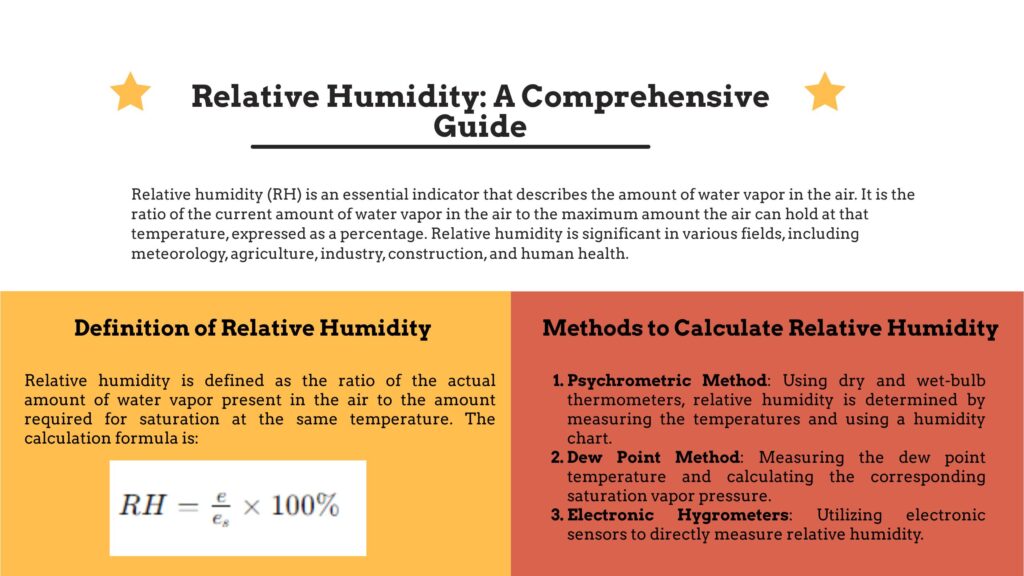
Relative humidity (RH) is an essential indicator that describes the amount of water vapor in the air. It is the ratio of the current amount of water vapor in the air to the maximum amount the air can hold at that temperature, expressed as a percentage. Relative humidity is significant in various fields, including meteorology, agriculture, industry, construction, and human health.

1. Definition and Calculation of Relative Humidity

1.1 Definition of Relative Humidity

Relative humidity is defined as the ratio of the actual amount of water vapor present in the air to the amount required for saturation at the same temperature. The calculation formula is:
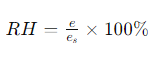
where ( e ) is the actual vapor pressure and ( e_s ) is the saturation vapor pressure at a given temperature. Relative humidity is dimensionless and typically expressed as a percentage.

1.2 Saturation Vapor Pressure

Saturation vapor pressure is the pressure exerted by water vapor in equilibrium with liquid water at a given temperature. As temperature increases, the saturation vapor pressure increases, meaning warmer air can hold more water vapor.

1.3 Methods to Calculate Relative Humidity

Calculating relative humidity involves measuring or estimating the actual and saturation vapor pressures of the air. Common methods include:

  1. Psychrometric Method: Using dry and wet-bulb thermometers, relative humidity is determined by measuring the temperatures and using a humidity chart.
  2. Dew Point Method: Measuring the dew point temperature and calculating the corresponding saturation vapor pressure.
  3. Electronic Hygrometers: Utilizing electronic sensors to directly measure relative humidity.

2. Factors Influencing Relative Humidity

2.1 Temperature

Temperature significantly affects relative humidity. As temperature rises, the saturation vapor pressure increases; if the water vapor content remains constant, relative humidity decreases, and vice versa.

2.2 Water Vapor Content

The amount of water vapor in the air directly influences relative humidity. An increase in water vapor raises relative humidity, while a decrease lowers it.

2.3 Atmospheric Pressure

Atmospheric pressure has a minor impact on relative humidity. In extreme cases, such as high altitudes or low-pressure systems, pressure changes can affect water vapor content and indirectly influence relative humidity.

3. Applications of Relative Humidity

3.1 Meteorology

Relative humidity is a crucial parameter in meteorology, impacting weather forecasting, climate studies, and disaster warnings. High relative humidity can lead to fog, frost, and dew formation, while low humidity can contribute to droughts and wildfires.

3.2 Agriculture

Relative humidity significantly affects agricultural production. Different crops have specific humidity requirements. Proper humidity levels promote growth and help prevent pests and diseases, while inappropriate humidity can harm crops.

3.3 Industry

Controlling relative humidity is vital in industrial processes. For instance, high humidity can cause moisture damage in electronics manufacturing, while low humidity can lead to fiber breakage and static electricity in textiles.

3.4 Building and Indoor Environment

Relative humidity affects building durability and indoor comfort. High humidity can cause mold, corrosion, and material degradation, while low humidity can lead to wood cracking and deformation. Maintaining appropriate indoor humidity is crucial for comfort and health.

3.5 Human Health

Relative humidity impacts human health. High humidity promotes the growth of bacteria, mold, and dust mites, leading to respiratory illnesses and allergies. Low humidity can cause dry skin, eye discomfort, and respiratory tract dryness. Maintaining optimal indoor humidity is essential for health.

4. Methods to Control Relative Humidity

4.1 Increasing Relative Humidity

  1. Humidifiers: Devices that add moisture to the air, adjustable to desired humidity levels.
  2. Plants: Plants release water vapor through transpiration, increasing indoor humidity.
  3. Water Evaporation: Placing water containers indoors can increase humidity through evaporation.
  4. Wet Cloths: Wiping surfaces with wet cloths can temporarily boost indoor humidity.

4.2 Decreasing Relative Humidity

  1. Dehumidifiers: Devices that remove moisture from the air, essential in damp environments.
  2. Ventilation: Opening windows to increase air flow and remove excess moisture.
  3. Air Conditioners: These also function as dehumidifiers while cooling the air.
  4. Desiccants: Materials like silica gel that absorb moisture from the air.

5. Instruments for Measuring Relative Humidity

5.1 Psychrometer

A psychrometer consists of two thermometers: a dry-bulb thermometer measuring air temperature and a wet-bulb thermometer with a wetted cloth covering its bulb. The temperature difference helps determine relative humidity using a humidity chart.

5.2 Dew Point Hygrometer

This instrument measures the dew point temperature, indicating the temperature at which air becomes saturated with moisture. The saturation vapor pressure at this temperature is used to calculate relative humidity.

5.3 Electronic Hygrometers

Modern electronic hygrometers use sensors to measure air’s water vapor content directly, displaying relative humidity digitally. These devices are accurate, quick, and widely used in various applications.

5.4 Data Loggers

Data loggers continuously monitor and record relative humidity over time. They store data for analysis and are used in environmental monitoring, research, and industrial processes.

6. Relative Humidity and Humidity Index

6.1 Concept of Humidity Index

A humidity index describes the moisture level in the air. Common indices include the Heat Index and the Temperature-Humidity Index (THI). These indices consider temperature and relative humidity to reflect human perceptions of humidity.

6.2 Heat Index

The heat index represents the perceived temperature in high heat and humidity conditions, indicating human heat stress levels. The calculation involves a complex formula often determined using charts or calculators.

6.3 Temperature-Humidity Index (THI)

THI is used in agriculture and animal husbandry to evaluate the suitability of environmental conditions for livestock and crops. The formula is:

where ( T ) is the air temperature in degrees Celsius and ( RH ) is the relative humidity percentage.

7. Impact of Climate Change on Relative Humidity

7.1 Global Warming

Global warming raises atmospheric temperatures, increasing the saturation vapor pressure. If water vapor content remains constant, relative humidity decreases, leading to drier conditions in some regions and affecting ecosystems and human activities.

7.2 Extreme Weather Events

Climate change exacerbates extreme weather events like heatwaves, heavy rainfall, and droughts, significantly impacting relative humidity. Heatwaves can decrease relative humidity, increasing heat stress and drought risk, while heavy rainfall raises humidity, posing flood and pest risks.

7.3 Ecosystem Impacts

Changes in relative humidity affect ecosystems by altering plant transpiration rates and water and carbon cycles. Sensitive species, such as amphibians and insects, may face increased survival pressures due to humidity fluctuations.

8. Relative Humidity and Sustainable Development

8.1 Energy Conservation

Controlling relative humidity promotes energy conservation. Optimal humidity enhances energy efficiency, reducing the need for air conditioning and humidification, lowering energy consumption and carbon emissions.

8.2 Sustainable Agriculture

Managing relative humidity is crucial for sustainable agriculture. Scientific humidity management boosts crop yield and quality, mitigates pest and disease risks, and minimizes environmental impact. Smart agriculture technologies enable real-time monitoring and precise humidity control.

8.3 Climate Adaptation and Disaster Mitigation

Monitoring and managing relative humidity are vital for climate adaptation and disaster mitigation. Early warnings based on humidity changes help prepare for extreme weather events, reducing disaster impacts. Adjusting agricultural and water management strategies based on humidity data enhances climate resilience.

9. Future Research Directions in Relative Humidity

9.1 Advanced Measurement Technologies

Advancements in technology will improve high-precision humidity measurement. Innovations in sensors and new materials will enhance accuracy and reliability in humidity monitoring.

9.2 Health Impacts

Further research is needed to understand the impact of humidity on human health. Investigating the effects of humidity changes on respiratory diseases, allergies, and mental health is critical for public health policy.

9.3 Humidity Control Technologies

Future humidity control technologies will become more intelligent and efficient. IoT and smart control systems will enable real-time monitoring and automatic regulation of indoor and outdoor humidity, providing more comfortable and healthier environments.

9.4 Long-term Climate Impact

Researching the long-term impact of climate change on humidity is essential. Climate models predicting humidity changes under various scenarios and assessing their effects on ecosystems, agriculture, and human society will inform climate adaptation and mitigation policies.

10. Conclusion

Relative humidity, as a crucial indicator of water vapor content in the air, holds extensive applications and research significance. It influences meteorology, agriculture, industry, construction, human health, and environmental sustainability. Accurate measurement and management of relative humidity enhance productivity, improve quality of life, and promote sustainable development. With technological advancements and in-depth research, the applications and management of relative humidity will continue to evolve, contributing to a more sustainable future.

[post-views]
Exit mobile version