
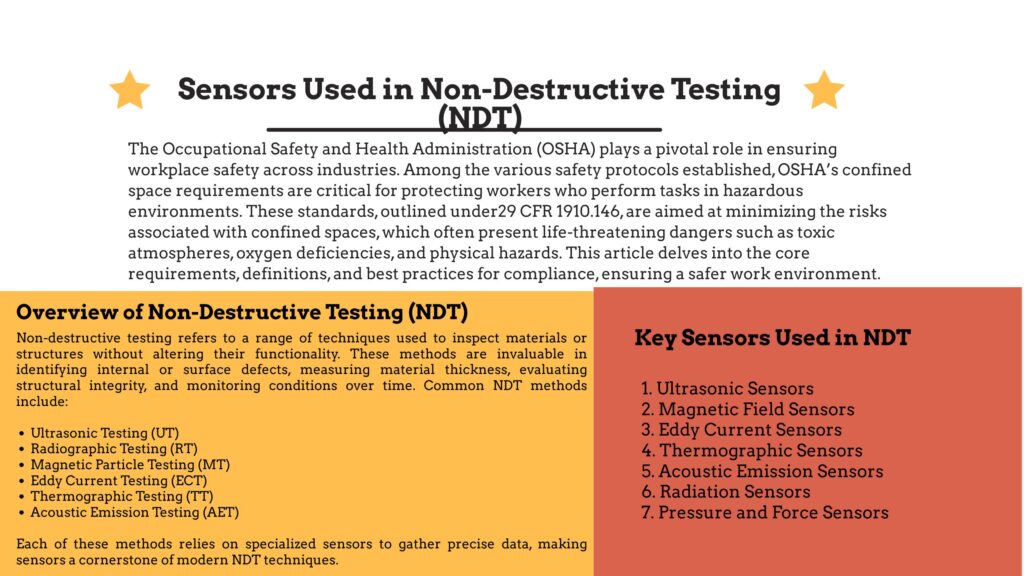
Non-destructive testing (NDT) is an essential technique in industries such as aerospace, construction, automotive, and energy, where ensuring the integrity and quality of materials, components, and structures is critical. Sensors play a pivotal role in NDT, providing accurate and reliable data for assessing defects, stress levels, or material properties without causing damage. This article explores the various types of sensors used in NDT, their working principles, applications, and advancements in sensor technology for enhanced NDT capabilities.
Overview of Non-Destructive Testing (NDT)
Non-destructive testing refers to a range of techniques used to inspect materials or structures without altering their functionality. These methods are invaluable in identifying internal or surface defects, measuring material thickness, evaluating structural integrity, and monitoring conditions over time. Common NDT methods include:
- Ultrasonic Testing (UT)
- Radiographic Testing (RT)
- Magnetic Particle Testing (MT)
- Eddy Current Testing (ECT)
- Thermographic Testing (TT)
- Acoustic Emission Testing (AET)
Each of these methods relies on specialized sensors to gather precise data, making sensors a cornerstone of modern NDT techniques.
Key Sensors Used in NDT
1. Ultrasonic Sensors
Working Principle
Ultrasonic sensors use high-frequency sound waves to detect material defects. They transmit sound waves into the material and measure the reflected waves to determine inconsistencies such as cracks, voids, or inclusions.
Types of Ultrasonic Sensors
- Contact Sensors: Directly coupled to the surface with a coupling medium like gel.
- Immersion Sensors: Operate in a liquid medium for high-precision inspections.
- Array Sensors: Feature multiple elements for simultaneous scanning over a larger area.
Applications
- Weld inspections in pipelines and structures.
- Thickness measurements of metallic and non-metallic materials.
- Detection of internal flaws in composites or metals.
2. Magnetic Field Sensors
Working Principle
Magnetic field sensors detect variations in a material’s magnetic field to identify surface and subsurface cracks. They are widely used in magnetic particle testing and magnetometry-based inspections.
Types of Magnetic Sensors
- Hall Effect Sensors: Measure changes in magnetic flux density.
- Magneto-Resistive Sensors: Provide high sensitivity for detecting small magnetic field variations.
- Fluxgate Sensors: Suitable for detecting deep-seated cracks.
Applications
- Inspection of ferromagnetic materials in automotive or railway components.
- Detecting fatigue cracks in aircraft landing gears.
3. Eddy Current Sensors
Working Principle
Eddy current sensors induce a magnetic field in conductive materials and measure the resulting eddy currents. Variations in these currents indicate flaws or changes in material properties.
Advantages
- No need for direct contact or coupling media.
- Suitable for inspecting materials with complex geometries.
Applications
- Inspection of non-ferrous materials like aluminum or copper.
- Crack detection in aircraft fuselages and turbine blades.
- Coating thickness measurement on metallic substrates.
4. Thermographic Sensors
Working Principle
Thermographic sensors detect temperature variations on a material’s surface using infrared technology. Defects such as delaminations or cracks disrupt heat flow, creating detectable thermal patterns.
Sensor Types
- Infrared Cameras: Capture detailed thermal images of the inspection area.
- Thermal Arrays: Provide high-resolution, real-time imaging for dynamic inspections.
Applications
- Inspection of composite materials in aerospace.
- Monitoring weld quality in pipelines.
- Structural health monitoring in buildings and bridges.
5. Acoustic Emission Sensors
Working Principle
Acoustic emission sensors detect high-frequency sound waves generated by sudden energy releases within materials. These waves indicate crack propagation or material deformation.
Advantages
- Capable of detecting real-time structural changes.
- Effective for monitoring large structures.
Applications
- Monitoring pressure vessels and pipelines.
- Evaluating fatigue and fracture in metallic and composite materials.
6. Radiation Sensors
Working Principle
Used in radiographic testing, radiation sensors capture X-rays or gamma rays passed through materials to create images that reveal internal defects.
Types of Radiation Sensors
- Film Detectors: Traditional method for high-resolution imaging.
- Digital Radiography Sensors: Provide faster, more versatile imaging.
- Scintillation Detectors: Convert radiation into visible light for real-time analysis.
Applications
- Inspection of welds in critical infrastructure.
- Detection of voids and inclusions in castings.
- Quality control in high-pressure components.
7. Pressure and Force Sensors
Working Principle
Pressure sensors measure changes in pressure within a material or system, often used in hydrostatic and pneumatic testing.
Applications
- Testing the structural integrity of pipelines.
- Ensuring the durability of pressure vessels.
Advancements in NDT Sensor Technology
1. Smart Sensors
- Integration of IoT capabilities for remote monitoring.
- Self-calibrating sensors for enhanced accuracy.
2. Miniaturization
- Development of microelectromechanical systems (MEMS) for portable and precise NDT equipment.
3. AI and Machine Learning Integration
- Advanced algorithms for interpreting sensor data and identifying defects with greater accuracy.
4. Multi-Modal Sensors
- Sensors capable of combining multiple NDT methods (e.g., ultrasonic and thermographic) for comprehensive inspections.
Future Trends in NDT Sensors
- Sustainability: Eco-friendly sensors that reduce energy consumption during inspections.
- Autonomous Systems: Integration with drones and robots for remote inspections of hazardous or inaccessible areas.
- Higher Sensitivity: Development of sensors capable of detecting microscopic defects.
Conclusion
Sensors are at the heart of non-destructive testing, enabling precise and reliable evaluations of material integrity without causing damage. From ultrasonic and magnetic field sensors to thermographic and acoustic emission sensors, each plays a crucial role in ensuring safety, quality, and longevity in various industries. Advances in sensor technology, such as IoT integration, miniaturization, and AI-powered analytics, continue to enhance NDT capabilities, making inspections faster, more accurate, and more versatile. As industries evolve, the demand for innovative NDT sensors will only grow, driving further advancements in this indispensable field.