
An overnight bedroom CO₂ log is a record of people adding carbon dioxide to a changing air volume while air moves through the room. To make sense of it, read the level before bedtime, the sustained rise after occupants settle, any late-night leveling, and the response when a door, window or designed ventilation system changes. Keep the monitor away from direct breath and document who slept there, the state of the openings and the logger's clock. The peak alone cannot establish a ventilation rate, diagnose a sleep problem or prove that a particular device worked. ASHRAE's 2025 indoor CO₂ position stresses both the value and the limits of the measurement.

This article treats the bedroom as a room-air measurement task. It is for a household trying to understand a repeatable pattern, not a substitute for a carbon monoxide alarm, a combustion-safety assessment or a medical diagnosis. The most productive question is often narrower than “Is this number safe?”: under our usual sleeping conditions, does the room continually accumulate occupant-generated CO₂, and what change actually alters that pattern?
What the log represents—and what it leaves out
Occupants exhale CO₂ throughout the night. Lower-CO₂ air may enter from outdoors through an opening or a ventilation system, or from adjacent parts of the home through a doorway or transfer path. Room air leaves somewhere else. The monitor samples at one point; its graph is shaped by the generation of CO₂, mixing, outdoor concentration, exchange with other rooms, and the instrument's response and averaging. A night with two occupants cannot be fairly compared with a night with one unless the difference is noted. A warm, still night with a closed window cannot be compared casually with a windy night with the same opening position.
Carbon dioxide can be a useful tracer of occupant-related ventilation, but it is not an all-purpose bedroom air-quality score. A low CO₂ trace does not measure humidity, particulate matter, allergens, cooking emissions drifting through the home, carbon monoxide, outdoor smoke or the quality of sleep. The ASHRAE review says the evidence for direct effects of CO₂ on sleep at commonly observed indoor levels is inconsistent. Field studies of ventilation conditions sometimes show sleep differences; they do not mean an individual can diagnose poor sleep from one CO₂ graph.
Our home CO₂ trend guide develops the general room-air balance. Here the focus is the special case of a long, mostly stable occupancy period: the sleeping hours.
Prepare the logger before the first night
Use a device that measures actual CO₂, with a clear manual, known logging interval, stable power and accessible historical data. “eCO₂” estimated from a VOC sensor is a different quantity; our direct CO₂ versus VOC-derived eCO₂ explanation describes the difference. A graphing app is convenient only if its timestamps and gaps can be trusted. Before bed, confirm the device clock, time zone, battery, storage and whether a lost connection creates missing samples or silently repeats the last value. Write down the display-averaging and log intervals if the manual provides them.
Position the logger in the occupied bedroom, with open access to room air, but away from pillows and a sleeper's direct exhalation. Also keep it clear of the window stream, a supply diffuser, fan jet, radiator and obstructing furniture. A device on a bedside table beside one sleeper may track a local breath plume more than the mixed room. At the other extreme, a monitor placed in a window may read incoming air while the bed area remains different. The UK HSE guidance on CO₂ monitors is written for workplaces but offers sound measurement precautions: avoid direct breath and supply openings; record occupancy and ventilation; repeat readings as conditions vary. A bedroom may need a second location check before one spot is assumed representative.
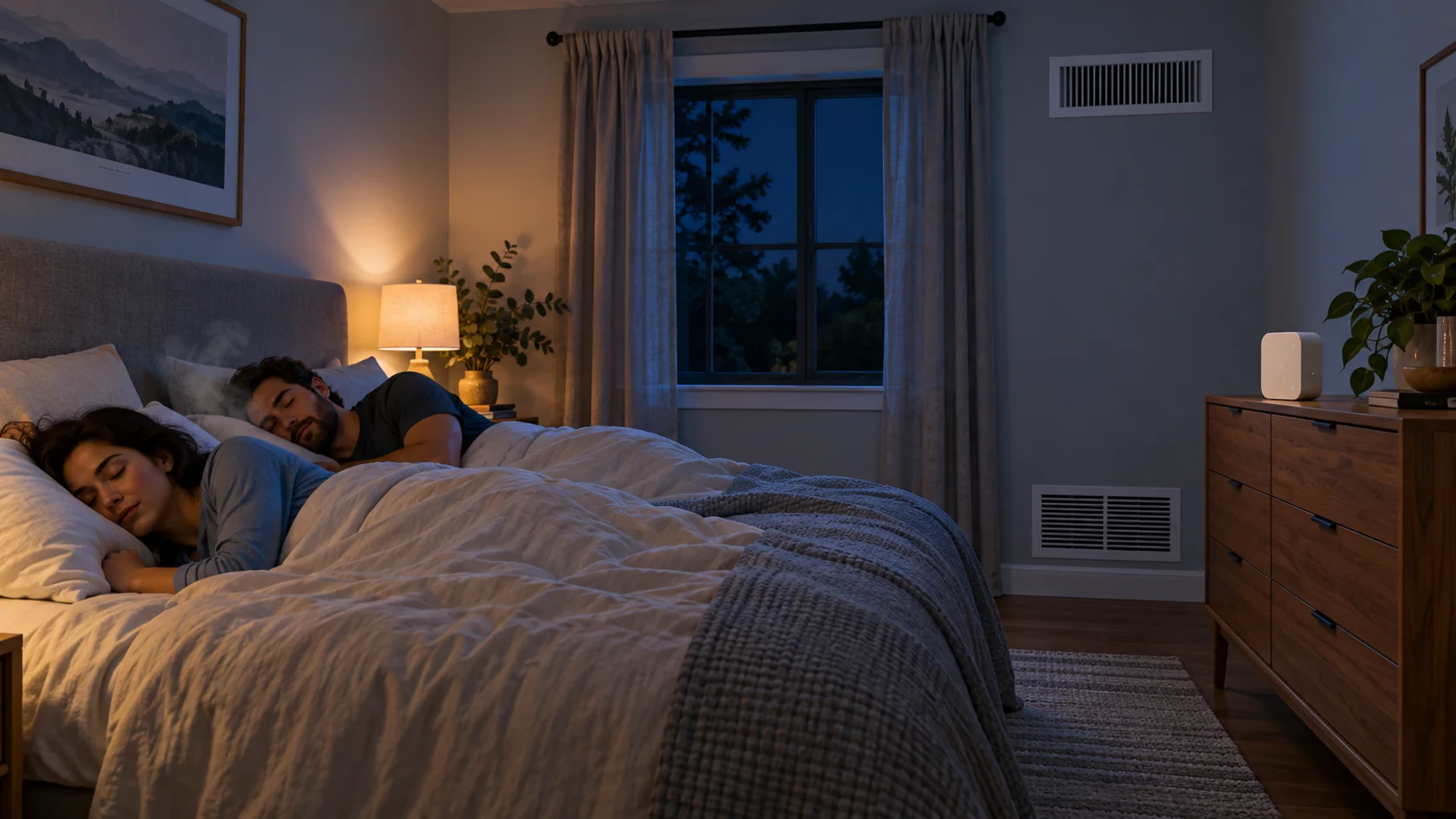
Record the position so you can repeat it. If you later move the monitor, treat the following trace as a new measurement setup rather than proof of a room improvement. Instruments also have warm-up, response, accuracy and automatic-calibration behavior. The finished product's documentation governs those details. Do not force a “fresh-air calibration” to a guessed outdoor number or disable a feature merely because another brand's manual recommends it. Health Canada's professional IAQ guidance highlights location, calibration and sampling frequency as material to interpretation.
For each night, note the number of sleepers, approximate bedtime and wake time, door position, window position, outdoor-air ventilation mode, any room fan or recirculating purifier setting, and unusual events such as cooking, candles, visitors or an opening changed at 03:00. If the room has a gas heater or other combustion source, investigate its safety with the appropriate professional and alarms; a CO₂ graph alone is not a combustion-safety check.
Establish the pre-sleep starting point
Read the first part of the trace before occupants settle. Was the bedroom empty and aired, or did people spend the preceding evening in it? Was the door open to a busy hallway? Was the heating or ventilation system already running? A room that starts high can finish high even if its overnight rise is modest. A room that begins near an outdoor baseline can still climb steeply once occupied. Peak comparisons without the starting point confound these two situations.
Use an outdoor check only as context, following the monitor's instructions and avoiding your own breath, exhaust or an enclosed balcony. Outdoor CO₂ is not an exact fixed calibration gas. If the device has not reached a stable state after being moved or powered on, record the uncertainty instead of treating the first displayed number as an authoritative baseline. When possible, observe the room unoccupied long enough to see whether the trace is stable, then mark the occupancy start. There is no need to wake or disturb occupants to create a test condition.
If the bedroom belongs to a multi-room home, note whether adjacent rooms were occupied. An open interior door exposes the monitor to the larger house air volume. A lower bedroom level with the door open can be a mixing effect. It does not automatically mean the whole home gained outdoor air. The US Department of Energy Building America ventilation field test illustrates that bedroom-door state can change room-to-room mixing under particular systems. A household should interpret its own floor plan and equipment rather than borrow another building's result.
Read the curve as a sequence, not a color badge
The first stable rise after people settle is the build-up phase. An upward trend is expected if generation exceeds the removal occurring at that moment. The steepness depends on the number and activity of sleepers, effective room volume, how well air mixes and how much outdoor or lower-CO₂ air replaces it. A steeper line on one night is not, by itself, proof of a worse fan. It may simply be an additional occupant or a more closed transfer path.
ㅏ late-night plateau can suggest that generation and removal have approached a balance for that occupancy and air path. It may also reflect changed sleep occupancy, a window drifting open, a device averaging heavily, or a logger stuck at one value. The plateau level is useful when conditions are known; the label “plateau” is not a quality certificate. A log that remains mathematically identical for hours, especially through known activity changes, deserves a data-integrity check.
ㅏ sharp step can be informative if it aligns with an event. Opening a window to outside, changing an outdoor-air fan, opening an internal door, moving the device or a sleeper leaning close to it can all change the local reading. Mark the event first and then watch whether the new direction persists. If the line briefly dips when a door opens and then returns, the event may have mixed air around the sensor without changing the longer-term balance. A very short spike at the bedside is especially vulnerable to direct breath.
그만큼 morning decline often begins when people leave or when a window or system changes, or both. Those mechanisms should be separated in the notes. A decline after occupants depart is not proof that the same air exchange was available during occupied hours. A decline after a window opens is consistent with dilution, but its exact slope is sensitive to outdoor concentration, mixing and weather. Treat the display as a useful comparison unless a formal tracer-gas method has been designed. 아쉬래 warns that using CO₂ to infer a ventilation rate requires assumptions and accurate inputs.
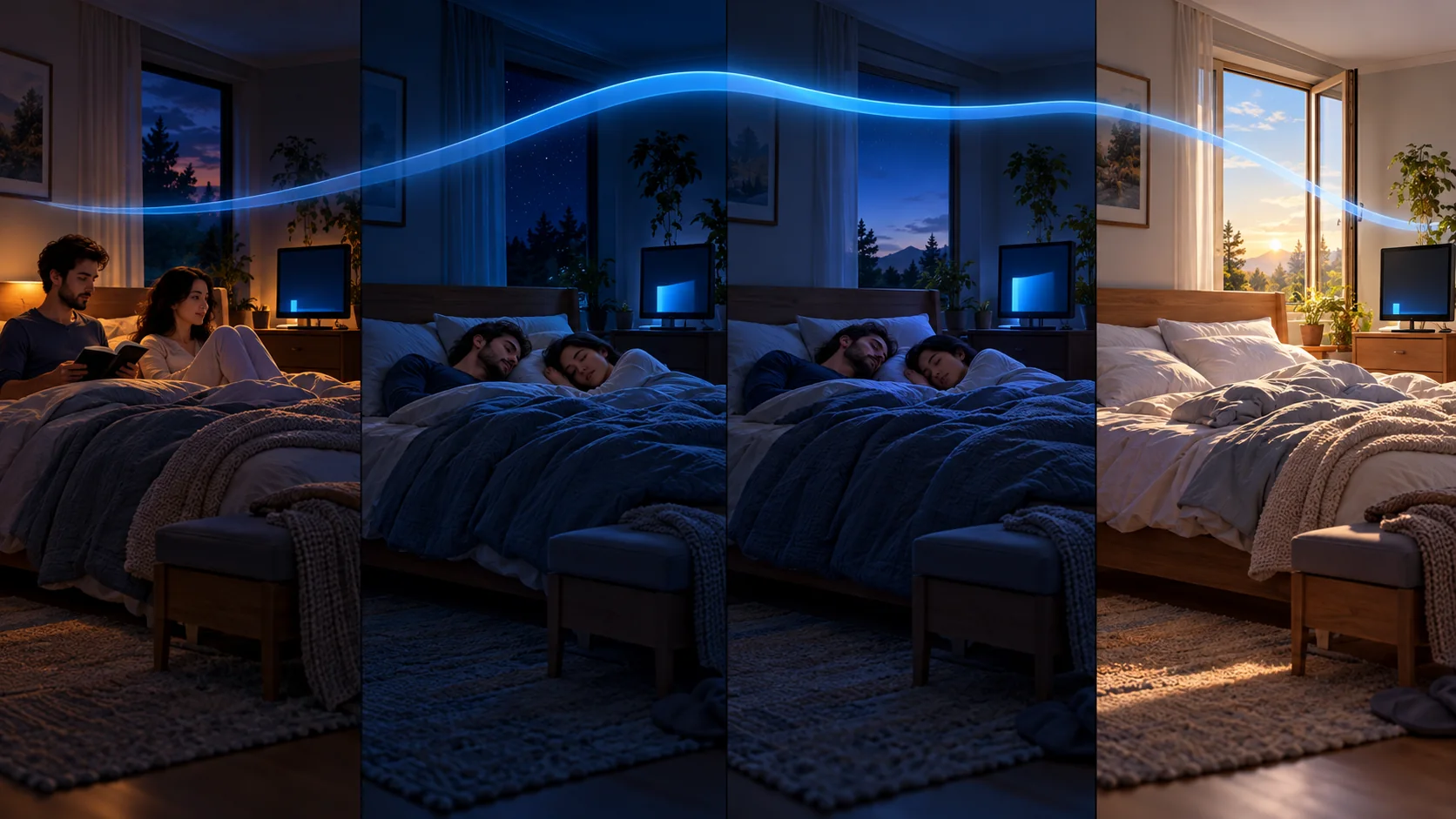
Consider an illustrative pattern rather than a fabricated measurement: the room starts moderately elevated after an occupied evening, rises while two people sleep behind a closed door, becomes less steep later, and falls after both wake and a window opens. The fall cannot be assigned solely to the window because occupancy also changed. To isolate the question, compare another occupied period with a planned air-path change while keeping other conditions as similar as possible. The event record makes the graph interpretable.
Compare nights without fooling yourself
One convenient night is rarely enough. First observe the normal arrangement for multiple nights, with no deliberate changes. Then choose one intervention that is safe and realistic: for example, use the existing designed outdoor-air ventilation setting as intended, or compare a permitted window arrangement under acceptable outdoor conditions. Keep the same monitor position, sleepers and typical sleeping hours as far as life allows. Note differences you cannot control rather than hiding them. Weather, wind direction, temperature, outdoor air quality and household activity elsewhere can all alter the trace.
| Comparison element | Hold steady or record | If it changes, interpretation changes because… |
|---|---|---|
| 사람들 | Number, approximate sleep hours and unusual activity | Occupant CO₂ generation changes |
| 감지기 | Device, position, power, log interval and clock | Local sampling and data processing change |
| Room | Door, window and transfer-opening state | Effective mixed volume and air path change |
| 통풍 | Outdoor-air fan, supply/exhaust schedule and filter state | Actual outdoor-air exchange may change |
| Adjacent rooms | Other occupants, kitchen/exhaust use | Air moving through the bedroom can change |
| Outdoor conditions | Wind, temperature, smoke or pollution | Natural exchange and advisability of opening vary |
| Trace | Starting point, rise, plateau and morning decline | A peak alone obscures when the difference occurred |
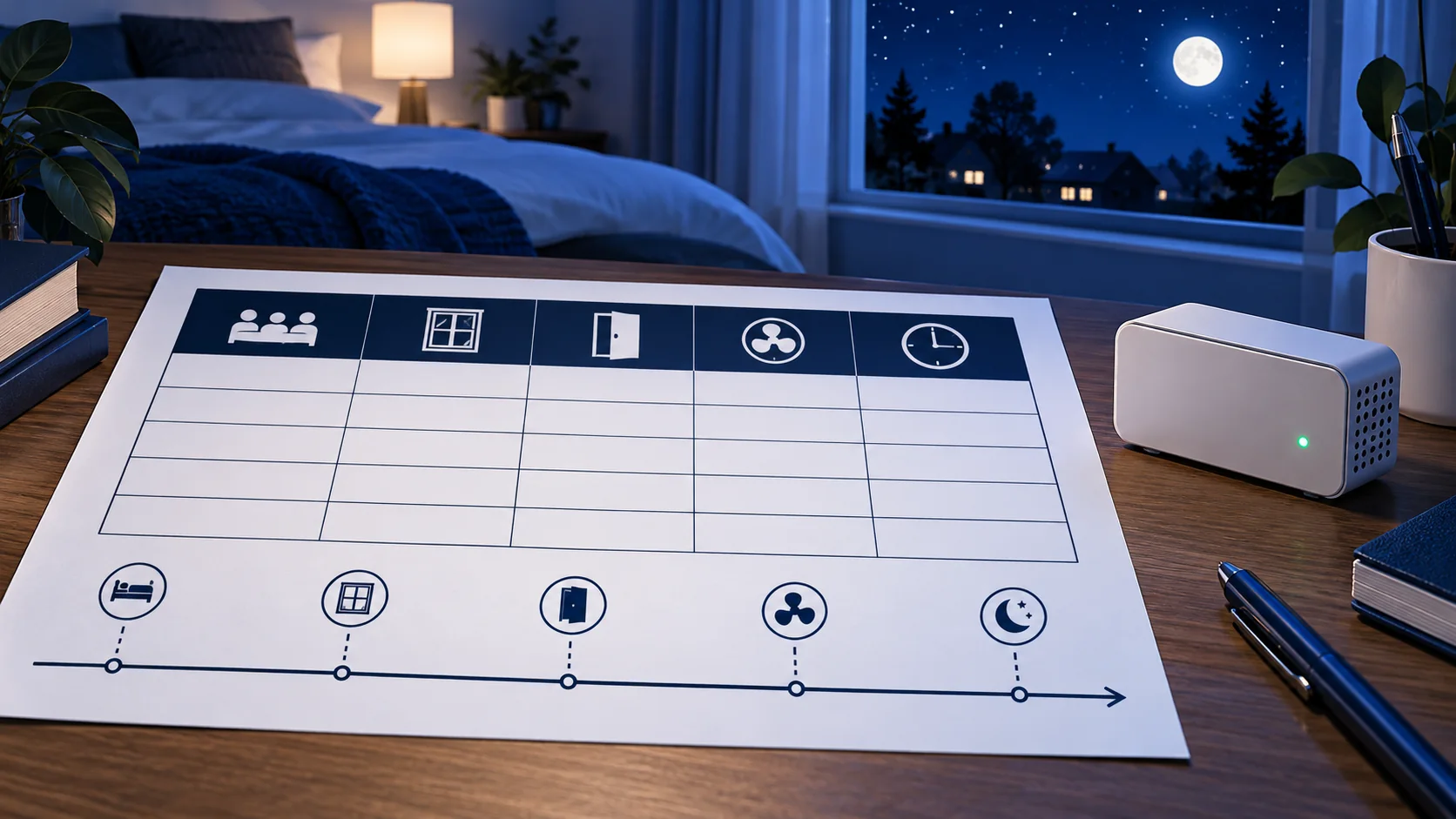
Compare the same phase across nights. If the starting levels differ substantially, comparing final peaks can exaggerate or hide the effect of a ventilation change. Look at whether the rise under similar occupancy is less persistent, whether a plateau appears at a different level, and whether the change repeats. Avoid declaring a precise air-change rate from this comparison. For a numerical airflow estimate or a building-code question, ask a ventilation professional to specify the method and measurements.
An A/B plan also needs a clear answer to “What would count as a failed observation?” If the logger lost power, someone moved it, a person stayed elsewhere, a window was opened unexpectedly, or the clock skipped an hour, label that night not comparable. Do not remove such nights silently from a published result or average them with complete nights. Retain the raw trace and the notes; both are part of the evidence. Our logger versus display guide explains why a numeric screen and a trustworthy historical record solve different problems.
Distinguish a room-air problem from a logging problem
A sudden line break followed by the exact same value can mean a disconnected sensor or a dashboard repeating the last valid sample. A sharp change at a daylight-saving or time-zone transition may be a clock problem. Battery-powered devices may stop recording before the display fully fails, while cloud apps can show gaps after a network outage. Export timestamps where possible and check whether each point is a raw sample, average, interpolated line or cached last value. A beautiful smooth chart can conceal missing observations.
If two devices are available, place them side by side in an ordinary stable room for a comparison period before moving one to another location. This does not make either a calibrated reference, but it can reveal a large offset, timing mismatch or unit confusion. Then place them at different bedroom positions, keeping their identities and locations recorded. A location difference may be real spatial variation. A device difference may be response time, averaging, calibration or specified accuracy. Avoid subtracting two uncertain readings and treating the tiny remainder as a precise ventilation signal.
The most useful statistic is often a repeatable pattern under known conditions, not a precise nightly maximum. Record the start at an agreed clock time, the direction of change during occupied hours, whether the slope moderates, and the timing of any intervention. If a night has only a few scattered points, its apparent plateau may be an artifact of sparse sampling. Choose a logging interval that resolves the event of interest according to the instrument manual; do not assume a display that refreshes often stores equally frequent records.
Closed doors, open windows and the actual air path
An internal bedroom door changes inter-room mixing. It may connect the room to a larger volume with a lower current CO₂ concentration. That is useful context, but it is not identical to a direct outdoor-air supply. An open window can provide outdoor exchange, yet airflow depends on wind, temperature difference, opening geometry and a path for air to leave. A partly opened window on a calm night can behave differently from the same opening on a windy one. A mechanical supply/exhaust system has its own controls, commissioning and maintenance; an audible fan is not proof that the intended outdoor flow reaches the bedroom.
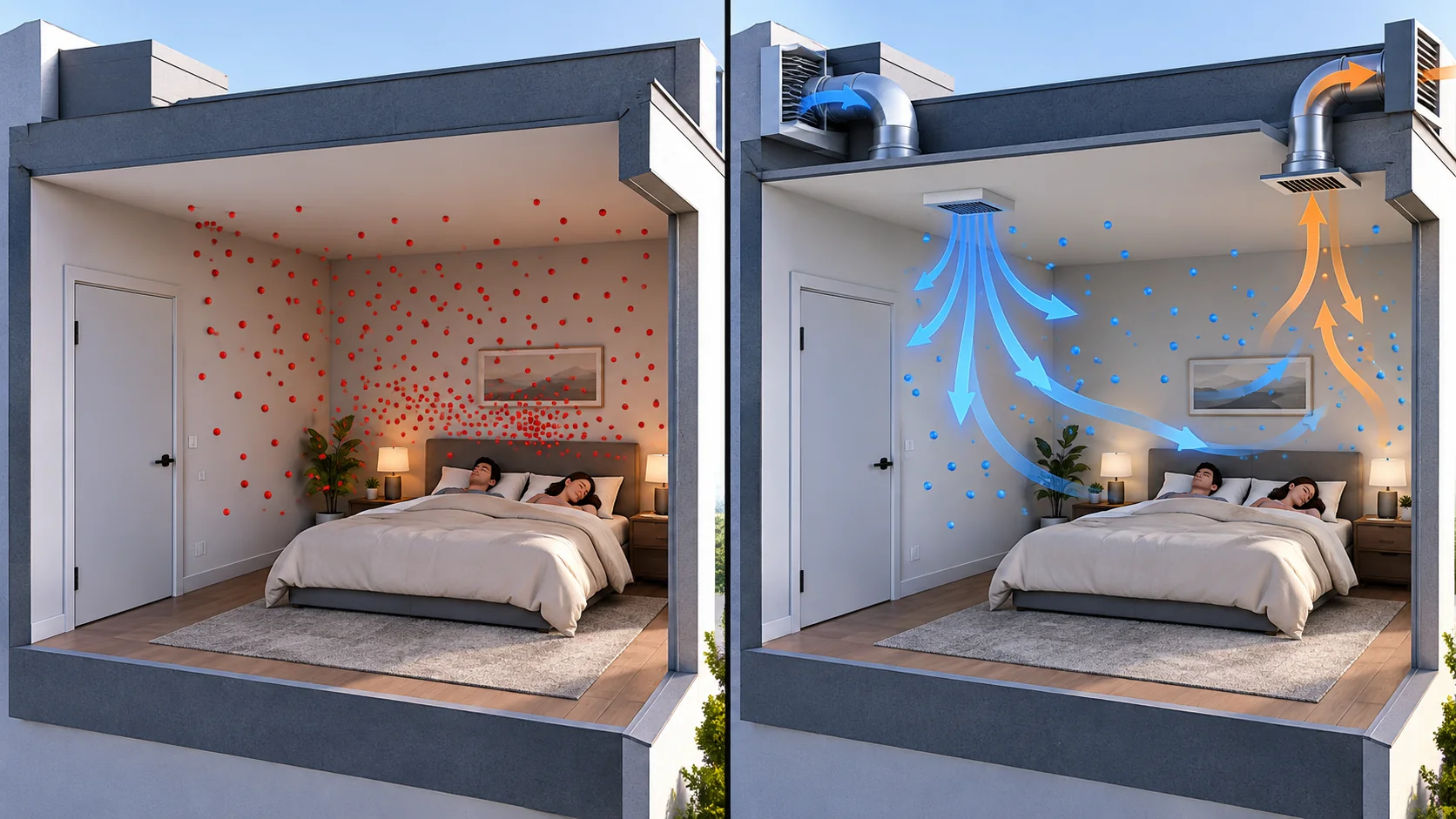
Do not turn a CO₂ reading into an instruction to keep a bedroom door open during sleep if a closed door is part of the household's fire-safety plan. Building layout, alarms, egress and local guidance matter. If a closed bedroom repeatedly has an undesirable CO₂ trend, seek an outdoor-air approach compatible with the home and its safety requirements. A recirculating air purifier can improve some particulate conditions but is not a substitute for outdoor-air exchange.
Opening windows also has trade-offs. Outdoor smoke, traffic pollution, pollen, extreme temperatures or noise can make a simple “leave it open” answer inappropriate. Source control, a properly selected particle filter and designed ventilation can have complementary roles. US EPA's home air cleaner guide places filtration alongside source control and clean outdoor-air ventilation, not in place of either.
What bedroom studies support—and what they do not
ㅏ 2017 field study of 17 healthy volunteers compared window/door-open and closed bedroom conditions over a short period, measuring CO₂, temperature, humidity and sleep outcomes. A 2023 single-blind field intervention varied ventilation conditions in 29 bedrooms; clearer ventilation separation was observed in subsets, and the authors reported differences in some sleep metrics while calling for larger studies with better control. These investigations support the importance of ventilation as an environmental variable. They do not supply an individual “CO₂ reading that causes bad sleep,” and the intervention can change more than CO₂ alone.
This distinction matters if a sleep complaint prompted the purchase of a monitor. Temperature, humidity, noise, light, stress and health conditions can all affect sleep. A CO₂ log can help identify a room-air question to discuss with a building professional; it cannot identify the cause of insomnia or replace a clinical assessment. Avoid the inverse mistake too: a low CO₂ trace does not prove that the bedroom is free of particles, allergens, carbon monoxide or moisture problems. 아쉬래 explicitly separates CO₂ from overall IAQ and notes the limited direct-evidence picture for sleep at commonly observed levels.
Practical interpretation table
| Trace observation | Plausible explanation to check | Next useful observation |
|---|---|---|
| High at bedtime, small further rise | Earlier room use or house air already elevated | Log pre-bed occupancy and adjacent-room state |
| Low at bedtime, strong sustained rise | Occupant generation exceeds current dilution | Repeat with same sleepers and known outdoor-air change |
| Rise flattens late in night | Generation/removal balance, changed air path or logger averaging | Compare event notes and inspect raw interval values |
| Sharp peak near bed | Direct breath or transient local plume | Move logger away and repeat, without comparing locations as if identical |
| Immediate drop after door opens | Inter-room mixing or a changed outdoor route | Observe a longer interval and another room if available |
| Decline only after people wake | Source removal, perhaps simultaneous window change | Record exact wake and opening times separately |
| Perfectly flat line despite events | Data loss, stale display, sensor limit or true stability | Inspect power, timestamps and device status |
| Different nights disagree | Occupants, wind, window, HVAC schedule or calibration | Record conditions and repeat a like-for-like comparison |
The table is a prompt for investigation, not a lookup chart that converts ppm to a diagnosis. If two different monitors disagree, check their specified accuracy range, response, placement and calibration before averaging the values. Our CO₂ monitor accuracy specification guide explains why display resolution and actual uncertainty differ.
Questions about overnight logs
Is the highest overnight ppm the most important number?
Usually not on its own. A peak can be a direct-breath plume, a brief event or the endpoint of a long rise. The starting point, occupancy, duration and whether the trace levels or falls make the peak interpretable. A full trace with annotated events is stronger evidence than a photographed morning display.
Can a bedroom door alone fix a rising trace?
Opening an internal door may mix the bedroom with lower-CO₂ air elsewhere in the home, so the bedroom reading can fall. It does not guarantee increased outdoor-air supply for the whole dwelling. Evaluate the building's actual air path and keep fire-safety requirements in view.
Does an air purifier lower bedroom CO₂ overnight?
An ordinary HEPA particle purifier recirculates indoor air and does not remove meaningful amounts of CO₂. It may improve particles while the CO₂ trace keeps rising; turning its fan on can change the local sensor reading through mixing. Assess the filter's particle performance and the room's outdoor-air exchange as separate questions.
Can I estimate ventilation from the post-wake decline?
Only if the source, baseline, mixing and air-path state are controlled and the instrument is suitable. In a normal morning, occupants leave, doors open and windows or fans change, so several causes overlap. Use the decline qualitatively for routine comparisons; use a designed tracer method for a defensible numerical airflow estimate.
Does a lower CO₂ night prove better sleep?
No. It can be evidence of a different room-air condition, but sleep has many determinants and ventilation changes may affect other environmental factors too. The bedroom field studies report group-level findings under particular designs, not a diagnostic rule for a person or a universal threshold.
What if the monitor says the bedroom is lower than outdoors?
Check whether the outdoor reading was taken near your breath, an exhaust or an enclosed balcony. Confirm that the same device and units were used, allow it to stabilize after a move, and inspect the calibration history. A small difference within the device's uncertainty should not be interpreted as an unusual physical process. Persistently implausible results need a device check before any ventilation conclusion.
Is a morning photograph enough for comparing two bedrooms?
No. The rooms may have different starting levels, occupants, volumes, door positions and air paths. A photo also hides whether the logger failed or a window was opened before the measurement. Preserve a time-stamped trace and a short event log for each room. If comparing two devices, first check their agreement side by side so a fixed instrument offset is not mistaken for a room difference.
Two bedrooms can share a hallway yet have very different outdoor-air paths behind closed doors. If comparing rooms, document the supply and exhaust arrangement as well as the occupants and the monitor positions. A repeated pattern under normal use is more actionable than naming one room “better” from a single morning value. Where the airflow path is unclear, a building professional can help establish what the home actually delivers.
Technical references
- ASHRAE, Position Document on Indoor Carbon Dioxide (2025).
- Fan et al., A single-blind field intervention study of whether increased bedroom ventilation improves sleep quality (2023).
- Mishra et al., Window/door opening-mediated bedroom ventilation and its impact on sleep quality (2017).
- Health Canada, Carbon dioxide in your home 그리고 Guidance for IAQ professionals.
- US DOE Building America, Field Test of Ventilation.
- UK HSE, Using CO₂ monitors.