

A portable refrigerant leak detector and a fixed detector may respond to the same released gas, but they solve different problems. A technician moves a portable probe around a suspected circuit to locate a source. A fixed system watches selected air locations continuously to notice and communicate an event while nobody is searching. In equipment with a refrigerant detection system, a sensor may also initiate a validated mitigation function. The right choice depends first on the decision you need to make, then on sensitivity, technology and price.
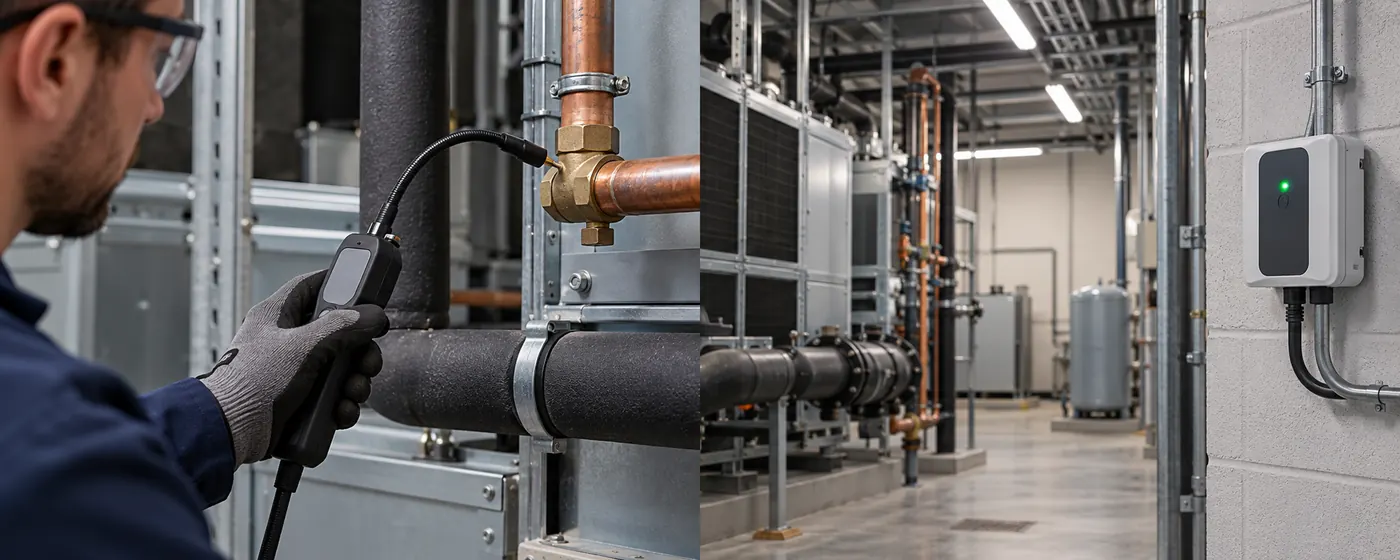

This article compares the complete workflows: what each instrument samples, what its specifications mean, how a fixed point or aspirating network covers a space, and how to commission the alarm path. It does not assign a universal alarm threshold or mounting height. Those decisions need the actual refrigerant, equipment, building conditions, product instructions and applicable requirements.
The same release looks different from a moving probe and a fixed inlet
Imagine a leak at a valve in a refrigeration machinery room. A handheld probe can be brought close to that valve. Its purpose is to give a useful change in response as the technician approaches and withdraws. A wall detector several metres away sees whatever portion of the release reaches its inlet after dilution and transport. A strong close-probe response and a low wall reading can both be correct. So can an alarm at the wall without enough information to know which joint is leaking.
Airflow complicates the picture. Fan state, doors, shelves, pipework, ceiling voids and a warm discharge can redirect a plume. Refrigerant vapor density is relevant, yet it cannot by itself predict where a leak will first reach a sensor. An inlet behind a continuously running exhaust may see a different history from one in a sheltered recess. A commissioning plan should consider likely releases and realistic operating modes, not only a drawing of the empty room.
The U.S. EPA GreenChill Guide on Refrigeration Management distinguishes direct air-sampling detection from indirect equipment measurements and describes automated systems alongside manual inspections. That is a useful division of responsibilities. The exact detector model and current legal obligations must be checked separately because the guide is an older publication.
| Question | Portable locator | Fixed-point detector | Aspirating fixed system |
|---|---|---|---|
| What air is sampled? | Air at a moving probe tip | Air at one mounted inlet | Air drawn from one or more installed inlets through tubing |
| When does it work? | During a technician's search | Continuously while powered and functioning | Continuously while analyzer, pump and lines function |
| Best immediate decision | Where should the technician inspect or repair? | Is refrigerant present at this location; should an alarm/action occur? | Which sampled zone indicates a release; should an alarm/action occur? |
| Main blind spot | No coverage when stored or unstaffed | Release outside the inlet's effective coverage | Inlet and tubing design, transport delay, blockage or leaks |
| Typical output language | Relative response, alarm or tested leak-rate sensitivity | Concentration/trend and configured state | Channel concentration/trend and configured state |
The table describes common architectures, not guarantees of a particular instrument. Some portable devices display concentration, some fixed products provide only an alarm state, and a multi-point system can have many analyzer arrangements. Read the model's documentation.
Portable detection: close-range evidence for a repair
A portable detector is a search tool. A trained technician surveys likely leak paths, then slows and revisits the point where response rises. Depending on the refrigeration system, relevant components may include service connections, valves, brazed joints, coils and flexible sections. The instrument should be compatible with the actual refrigerant and capable of working in the likely background environment.
The key skill is controlled sampling. Probe distance matters because gas concentration usually decreases sharply away from a small leak and is disrupted by air movement. Probe travel speed matters because the instrument needs time to draw a sample and respond. Sweeping quickly over a joint can miss a weak source; holding the probe too close to a broad contaminated area can make localization harder. Technicians should follow the manufacturer's technique, including any zeroing, purge, filter and sensitivity procedures.
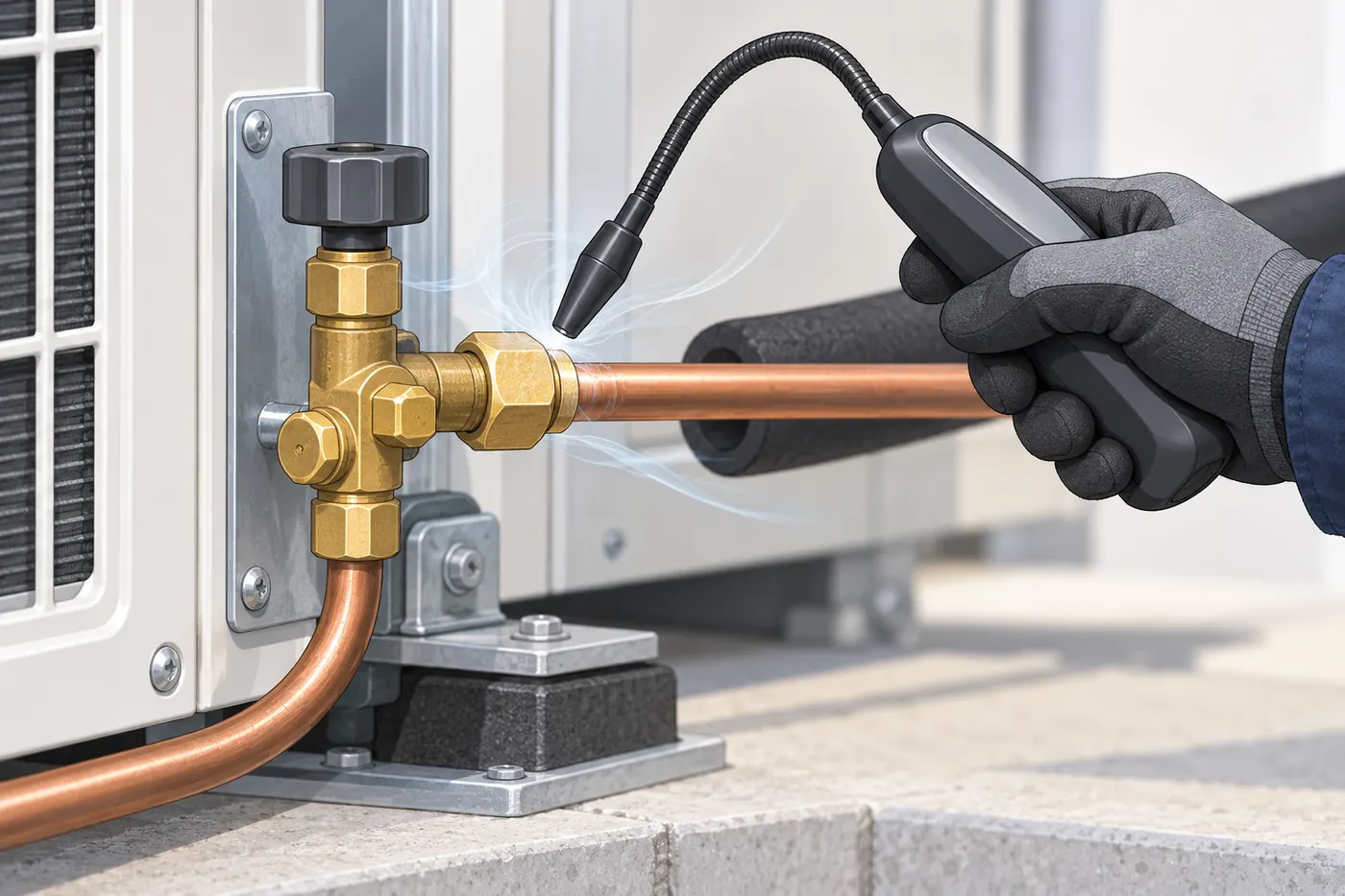

Many suppliers specify a portable detector's minimum detectable leak using a mass-loss rate under a test procedure, often grams per year. That can help compare service tools if the refrigerant and test method match. It does not mean the instrument directly weighs escaped refrigerant in the field. Ambient concentration at the probe depends on release rate, probe distance, air movement, temperature and sampling. A published leak-rate sensitivity cannot be converted into an ordinary fixed-monitor ppm threshold without modeling and validation.
Portable detectors can also respond to contamination or other vapors. A clean-air baseline, filter condition, sensor recovery and regular functional checks therefore matter. A suspicious response is a lead to investigate with an appropriate leak-testing process, not proof that a repair is complete. After repair, the technician must verify the affected system according to the equipment and service procedures. The EPA's refrigerant-management Q&A distinguishes locating a leak from simply observing that a system has lost charge.
What a portable instrument cannot replace
A handheld unit cannot watch an unoccupied room while it is in a case. It usually does not provide an installed fault relay, continuous event log or an automatic mitigation path. Its strong response next to a fitting does not quantify worker exposure at a distant location, and a lack of response on one pass does not prove every component is tight. The instrument is valuable precisely because a person can move it to many likely sources; that mobility is not continuous spatial coverage.
If a site has a recurring leak problem, periodic portable sweeps can complement a permanent system. A fixed alarm may prompt the service visit, and the portable probe then identifies the component. Treat these as two stages of the same maintenance process rather than redundant purchases.
Fixed-point detection: continuous watch at a selected place
A fixed detector monitors the air that reaches its inlet. It may display a concentration, transmit an analog or digital value, trigger local sound/light, and send alarm and fault signals to a building or equipment controller. Its purpose must be written down: environmental loss indication, a room warning, an equipment mitigation input, or a combination that has been specifically engineered and validated. A detector is not a complete safety function by itself.
For direct detection, the EPA's 2026 automatic-leak-detection fact sheet describes systems with air-concentration sensors fixed near an appliance and distinguishes them from indirect systems that analyze operating parameters. Its regulatory thresholds and deadlines apply only within the fact sheet's stated U.S. scope. The measurement principle is more broadly useful: fixed direct systems watch air; indirect systems infer equipment loss.
The first fixed-system design task is a release-and-airflow map. Identify likely release points and credible discharge directions. Mark normal and abnormal ventilation states, nearby openings, enclosures and occupied paths. Decide which locations require observation and whether one inlet is likely to see all relevant releases. A point detector cannot observe the whole room equally. A second sensor may provide better coverage than choosing an expensive element with a nominally lower detection limit at the wrong position.
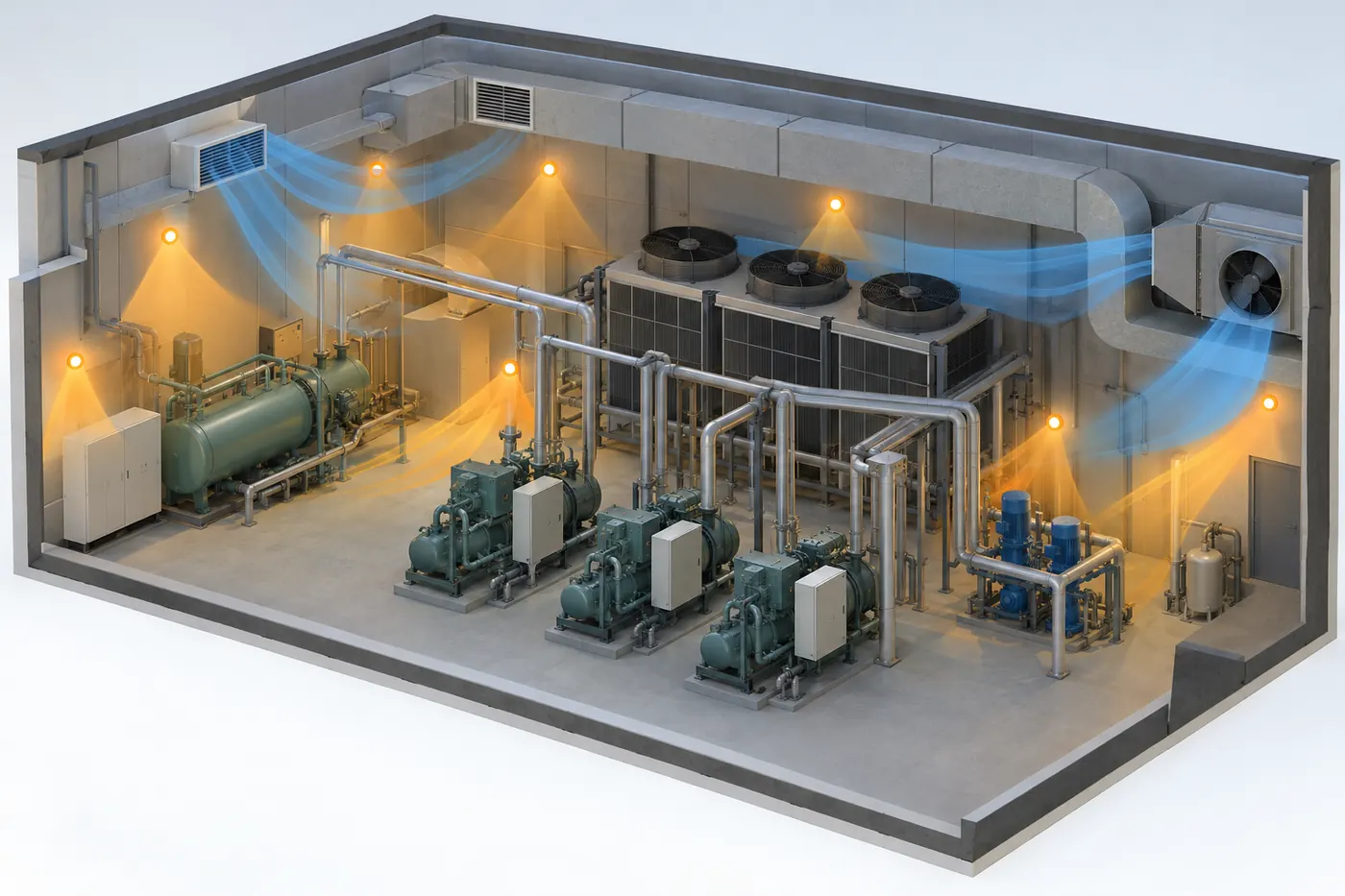
Gas behavior should inform placement but not produce a simplistic rule. A refrigerant may have a particular vapor density at reference conditions, yet a hot jet, cold spill, moving fan, confined cabinet or open door can dominate dispersion. If a detector is part of a listed appliance or safety system, the manufacturer's approved location and installation instructions take precedence. If a room requires an engineered detection layout, the placement should be evaluated for that room and revisited after ventilation or equipment changes.
Fixed alarms are an end-to-end chain
An installed detector's effective response time includes more than the sensing element's T90. Gas must move to the inlet, pass through any filter or tubing, produce a sensor response, survive digital filtering and alarm delay, and reach an output that the controller recognizes. The controller then needs to act, and the effect of that action depends on the ventilation or equipment. If the sensor's brochure quotes a fast laboratory response, it does not establish this whole sequence.
The system should distinguish a gas alarm from a sensor fault. Consider loss of power, broken cable, blocked inlet, failed pump in an aspirating system, contamination, out-of-range signal and overdue maintenance. How each fault is indicated and what the controller does is a design decision that must be documented and tested. A permanent system with an unmonitored failed inlet can create false reassurance.
An alarm budget is a useful design exercise
Instead of asking only whether a sensor is “fast,” trace the event through four intervals: gas travels from the release to the inlet; the instrument produces a usable response; alarm logic decides that the condition persists; and the connected system executes its action. Each interval depends on the installed configuration. A long aspirating tube, a strong digital filter or a controller configured with a delay can dominate the total even if the sensor element responds quickly on a bench. The budget need not be a universal numeric limit to be useful. It makes designers state which interval has been tested and which is still assumed.
Repeat that exercise for fault detection. An aspirating pump failure may be detected immediately, slowly, or not at all depending on flow monitoring. A lost communication link may leave a last displayed value unless the receiving controller is designed to flag stale data. In acceptance testing, simulate or otherwise verify the fault states using manufacturer-approved procedures and record what the remote operator actually sees. A clean trend plot from the sensor is not evidence that the building-control alarm was received.
If an alarm informs people, the local display and remote notification should make the location and meaning understandable. If an alarm controls a fan or equipment, the commissioning record should show that the command actually reaches the actuator. A trend that records rising gas while the alarm relay is disconnected is not a functioning response path.
Aspirating systems: more points, more sample-path responsibility
An aspirating detector draws air from remote points through tubes to a central analyzer. This can help when one analyzer serves multiple areas, when access for service is easier at a central cabinet, or when high-quality analysis is economically shared. The UK Energy Technology List's permanent refrigerant detection page recognizes both fixed-point and aspirating architectures and emphasizes refrigerant-specific calibration.
Every remote point adds a transport path. A long or narrow line can delay a sample; a leak may draw in room air before the analyzer; condensate or debris can restrict flow; cross-contamination can affect sequential sampling. The architecture needs line integrity, flow supervision, maintenance access and a documented way to associate an alarm with its sampling location. The central analyzer may be excellent while a remote inlet is poorly placed or blocked.
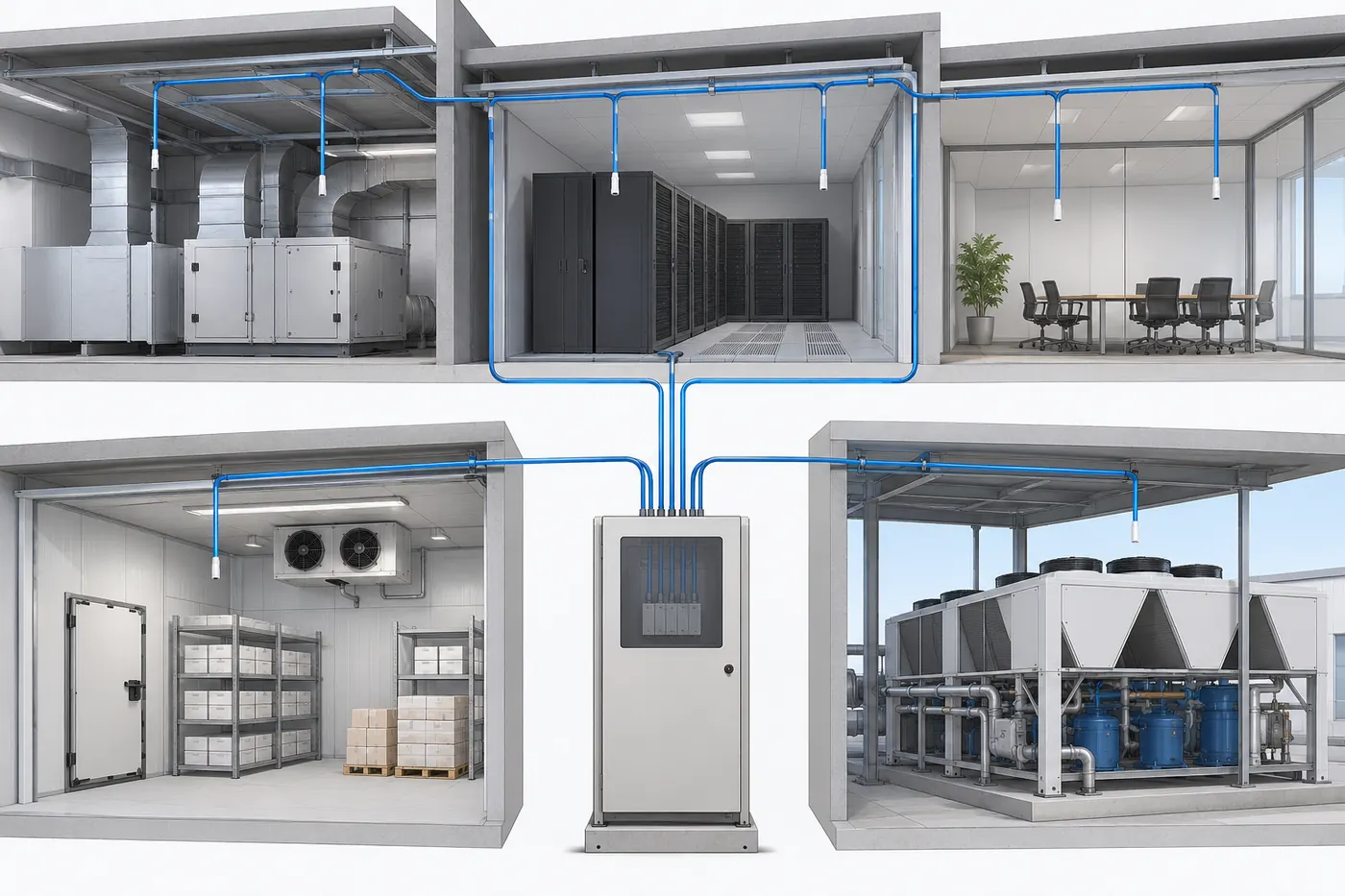
Sampling time also matters when one analyzer cycles among ports. If each port is read in turn, the revisit interval adds to physical transport and sensor response. An alarm claim therefore needs the complete worst-case channel timing under the installed configuration. The specific product manual, not an architecture diagram, supplies the applicable test method and limits.
Embedded refrigerant detection is a third fixed use case
An appliance may contain a refrigerant detection system tied directly to its control and mitigation functions. That is fixed detection, but it should not be treated as a generic wall monitor. The inlet position and decision logic belong to the appliance design. In a system using an A2L or other classified refrigerant, designers should consult the refrigerant designation, relevant equipment standards and the particular product listing; a class label does not provide one universal alarm set point.
ASHRAE's refrigerant designation resources help establish the actual fluid. The finished equipment's approved documentation then governs where and how detection is used. If an OEM is assessing a sensor module, a specific Winsen refrigerant sensing solution can illustrate available component approaches, but its individual product datasheets and the OEM validation determine suitability. A module catalog is not a completed equipment approval.
For example, Winsen identifies its ZRT512E NDIR module for R-32 and R-454B. That is a model-specific target list. It should prompt questions about the chosen configuration, range, environmental tests, diagnostic output and integration; it should not be generalized to all infrared detectors or all refrigerants.
Compare specifications using their units and test conditions
Product tables often place unlike numbers side by side. Before comparing two instruments, identify the measured quantity and the condition behind it.
| Caietul de sarcini | Why it is useful | Question to ask before comparing |
|---|---|---|
| Minimum detectable leak rate | Indicates a portable tool's response to a standardized small release | For which gas, standard, probe speed and operating mode? |
| Ambient measurement range | Indicates concentrations a fixed analyzer is designed to report | Is the range for this exact refrigerant and calibration? |
| Rezoluţie | Smallest reported step | What is the actual accuracy or uncertainty at the decision point? |
| T90 or other response time | Indicates time to reach a defined fraction of a step response | Does this include tubing, filters, software and relay delay? |
| Sensibilitate încrucișată | Shows likely response to other gases or vapors | Which substances and concentrations were tested? |
| Temperature/humidity rating | Shows conditions of operation or specified performance | Is the accuracy guaranteed across the entire range? |
| Maintenance interval | Helps budget checks and replacement | What must be checked after a spill, contamination or repair? |
An instrument that resolves 1 ppm is not necessarily accurate to 1 ppm. A sensor that survives a temperature extreme is not necessarily calibrated accurately at that extreme. A quoted response time measured at the sensing element is not the time from a distant release to a fan starting. Those are different claims; the datasheet should state which is meant.
The gas itself matters. R-32 and R-454B are distinct targets; R-290 is a hydrocarbon; R-744 is carbon dioxide. A detector's response mechanism and calibration need to match the actual refrigerant and purpose. For background on individual fluids, the refrigerant directory is useful for names and categories, while manufacturer documentation and current standards govern the detector decision. Do not infer a gas response from a broad “refrigerant compatible” phrase.
A site selection workflow
1. Define the event and response. What release must be found or noticed? Who acts after indication? Does the system only notify, or does it command equipment? Write this in operational language before reviewing product brochures.
2. Confirm the actual refrigerant. Use the equipment documentation and service records. If the charge is uncertain, an appropriate identifier may be needed; a leak detector is not a composition analyzer. See refrigerant identification versus concentration measurement.
3. Choose the architecture. If the task is a one-time service search, choose a supported portable method. If the task is unattended coverage, design a fixed-point or aspirating system. If equipment mitigation is required, follow the appliance's validated RDS architecture. A facility may need more than one.
4. Map sample access. A portable technician needs physical access to likely joints and a manageable background. A fixed sensor needs a place where a relevant release can reach it; an aspirating inlet also needs a maintainable tube path. Survey the real site rather than copying another room's mounting diagram.
5. Build a specification matrix. Record target gas, measurable range, response basis, environmental conditions, interference, alarm/fault outputs, maintenance and product approvals. Separate required criteria from preferences.
6. Test the installed decision chain. Follow manufacturer-approved commissioning procedures and qualified safety practices. Confirm sampling, indication, alarm, control response and fault reporting. Record configuration and room conditions. Do not improvise release tests with refrigerant simply to see whether the alarm sounds.
7. Assign maintenance ownership. The site needs someone responsible for checks, calibration where specified, filters, pump or line inspection, battery condition for portable tools, repair follow-up and documentation. An unmaintained fixed network and an uncharged portable instrument both fail when needed.

Three realistic scenarios
A supermarket rack with several likely leak locations
The facility wants prompt notice when refrigerant enters monitored areas. A fixed system can give continuous indication at selected points, while equipment data may provide indirect evidence of loss. After an alarm, the technician uses a portable instrument to locate the fitting or component. The fixed system need not identify the exact joint to be valuable; the portable tool need not provide year-round unattended coverage. The site's response plan connects the two.
An air conditioner with an integrated mitigation function
The OEM needs detection in a defined appliance location so the equipment can execute a designed sequence. Model-specific gas response, location, diagnostic state and control timing matter more than a generic claim of high sensitivity. A room detector installed by the building owner may serve a separate purpose. The two should not be substituted without examining the applicable equipment design.
A service visit after an unexplained charge loss
The immediate question is where the circuit leaks, so a supported portable locator and method are appropriate. A low refrigerant charge or changed operating pressure is evidence of a system issue but does not reveal the exact leak. If the refrigerant identity is uncertain, resolve that first with a suitable identifier and service process. Once repaired, verify according to the equipment instructions. Installing a fixed room detector would not by itself complete the repair.
Common mistakes that undermine both methods
Comparing g/year directly with ppm. One is a standardized mass release rate associated with a portable detection claim; the other is a volume fraction in sampled air. Dispersion and sampling conditions are needed to relate them.
Putting a fixed detector wherever wiring is easiest. Installation convenience matters, but coverage of plausible releases is the purpose. Document the airflow and access tradeoff; add points or change architecture if one location is inadequate.
Ignoring configuration and faults. A detector set for the wrong refrigerant, a wrong alarm output mapping, or a blocked aspirating line can defeat an otherwise good sensing element. Treat fault-state testing as part of commissioning.
Using a portable detector as a room-clearance meter without validation. A leak locator is optimized to find local sources. It may lack the accuracy, reporting basis, alarm logic or sampling protocol needed for an exposure or occupancy decision.
Treating an installed sensor as proof of compliance. Applicable rules and standards can require particular system-level performance, placement, response, records and maintenance. A sensor's presence alone does not demonstrate those conditions.
Întrebări frecvente
Do I need both portable and fixed refrigerant detection?
Sometimes. Continuous coverage and source localization are separate needs. A large or unattended site may use fixed monitoring to detect an event and a portable probe to locate the repair point. A small service-only task may not justify a permanent network. Base the decision on the site's release scenarios and applicable requirements.
Can a fixed detector pinpoint a leak?
It identifies gas at its inlet or zone. Multiple points or a trend may narrow the area, but a technician often still needs a portable search and inspection to find the component. A sensor cannot see through walls or infer an exact fitting from one concentration reading.
Why does my handheld detector alarm while the wall monitor reads zero?
The probe may be close to a tiny source while the wall inlet is distant or in a different airflow path. The devices may also have different target-gas calibrations, ranges and response settings. Check the instruments and site conditions before assuming either is defective.
Are infrared detectors always preferable?
No. Infrared can be very useful for specified absorbing gases, but the optical band, calibration, interference, environmental limits and application architecture matter. A non-dispersive infrared module listed for particular refrigerants cannot automatically measure every blend, and its suitability is a model-level decision.
What should a commissioning report contain?
At minimum, record the refrigerant and instrument models, configuration, sampling locations or tubing, alarm and fault outputs, test method and result, connected actions, maintenance owner and revision date. The exact required record may be set by the product, facility and local requirements.
Sources and related reading
- U.S. EPA: GreenChill Guide on Refrigeration Management — manual inspection and automated detection as complementary activities.
- U.S. EPA: Automatic Leak Detection Requirements fact sheet — direct versus indirect ALD in its defined U.S. context.
- UK Energy Technology List: Automated permanent refrigerant leak detection systems — point and aspirating arrangements within a specific program.
- ASHRAE: Refrigerant designations — confirm the fluid before comparing detectors.
For the broader selection questions, read what a refrigerant sensor should measure. For gas-sensor fundamentals beyond this workflow, GasNose's refrigerant-sensor overview provides a separate technical starting point; verify any exact product claim against current product documentation.