
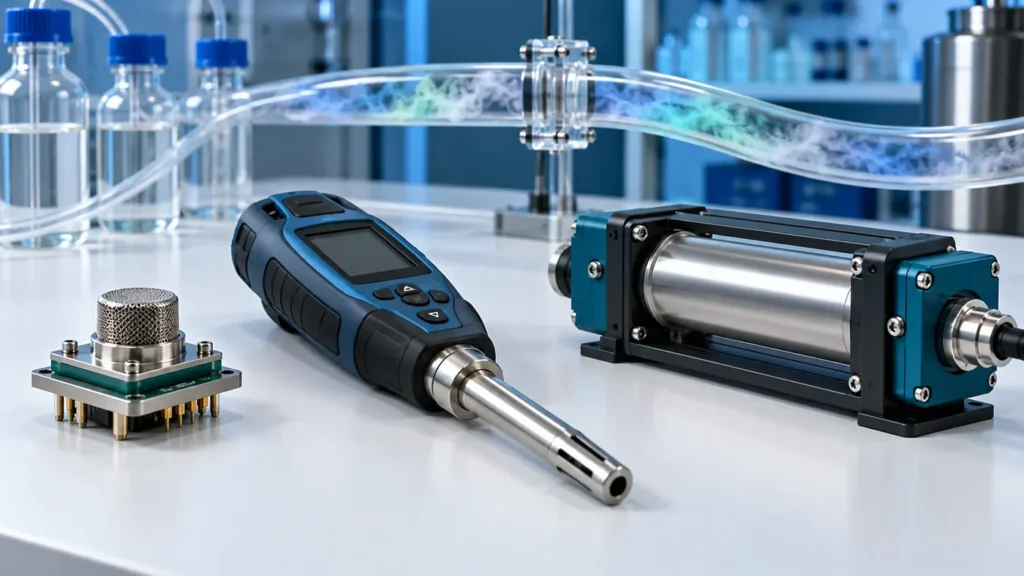
Cross-sensitivity is a response to something other than the substance a measurement is meant to represent. For VOC instruments, that “something” may be another vapor, water, a changing temperature, or a change in the way a mixed sample reaches the detector. A metal-oxide semiconductor (MOS) element, a photoionization detector (PID) and an infrared (IR) instrument do not weight the same mixture in the same way. Their displayed numbers can disagree while each is operating as designed. Before choosing or troubleshooting one, define the target compound or decision, the likely interferents, the calibration and the environment.
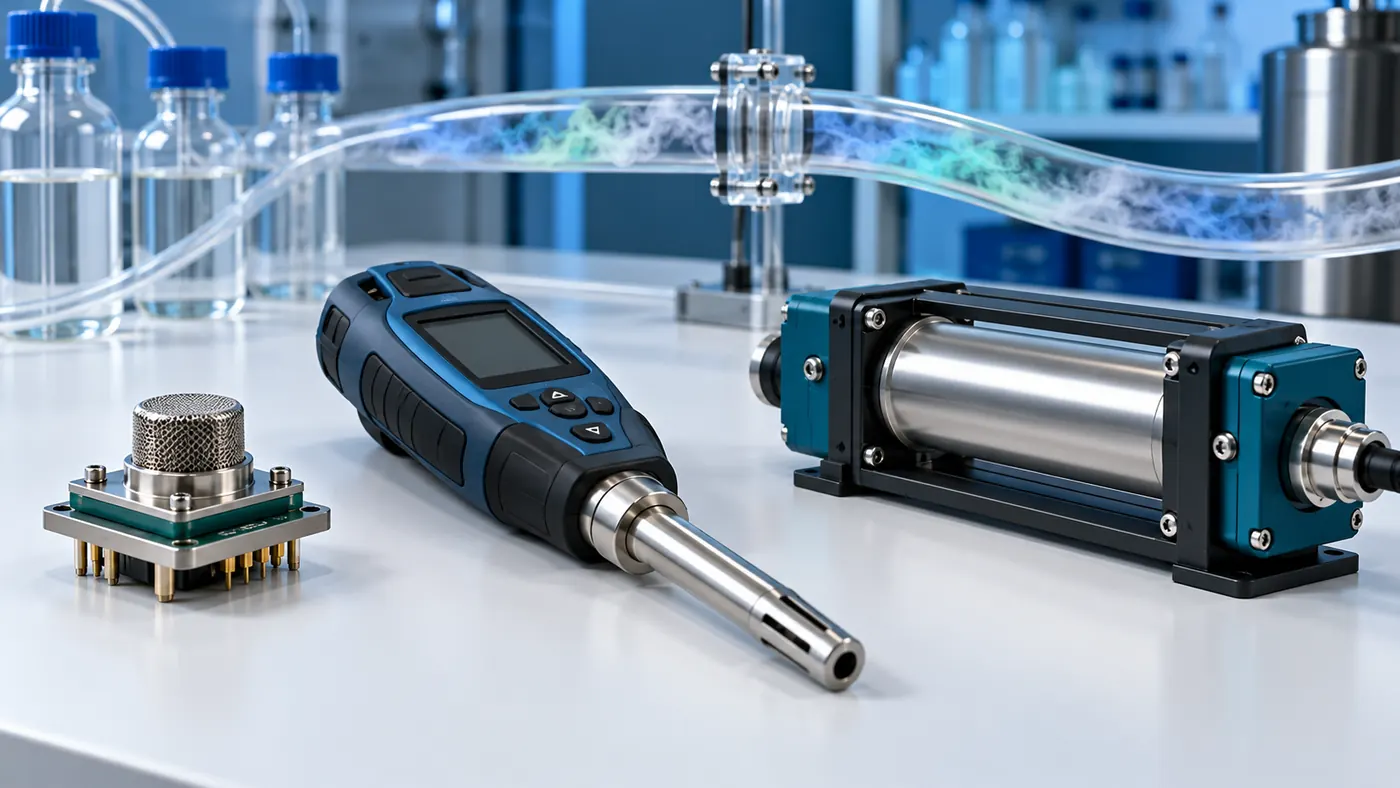

An error is not established merely because two instruments differ. One may report a relative index, another an isobutylene-equivalent concentration, and a third the concentration of a specified IR-active gas. Those are different measurands. A valid comparison needs the same stated target, units, conditions, time window and a reference method suited to the question. The US EPA's enhanced air-sensor guide discusses how VOC sensors respond unevenly to mixtures and why temperature, humidity and other pollutants complicate interpretation. Our TVOC and VOC Index guide explains the output labels that must be sorted out first.
Define the target before naming an interference
The word “cross-sensitivity” has meaning only relative to a target. If the question is “Did the room's general solvent-like signal increase after a process started?”, a broad response may be useful. If the question is “How much of one regulated or hazardous compound is present?”, a response to unrelated vapors can be a serious positive bias. If the instrument is supposed to detect a leak of a named gas, a target gas that produces weak response is a different failure: inadequate sensitivity. State both the chemical and the output before you label an event a false positive or false negative.
Imagine a monitor calibrated to a reference vapor. It samples a blend of that vapor, a second solvent and humid air. The display may move because the second solvent interacts with the sensing surface, because water changes the baseline, or because the first vapor's true concentration changed. A single broad channel cannot generally assign the movement uniquely. The most useful next step is to separate the hypotheses: inspect the process, measure humidity and temperature, test the likely vapors individually under controlled conditions, and use a selective reference method if identity matters. This is a conceptual scenario, not a claim about a particular instrument or mixture.
Five distinctions that prevent a bad comparison
| Soru | Neden önemli? |
|---|---|
| What exactly is the target analyte or event? | “VOC” is a family label; different compounds can yield different responses. |
| What is the reported output? | Raw resistance, index, gas-equivalent concentration and identified-compound concentration are not synonyms. |
| What calibrated the instrument? | A conversion based on one reference vapor does not automatically describe an unknown mixture. |
| What else is in the sample? | Water vapor, other gases, aerosols and surface interactions may alter the signal or sampling train. |
| Under which conditions was performance tested? | Response can depend on temperature, humidity, flow, exposure history, concentration and aging. |
The concentration at an inlet can also be different from the concentration at a source or in the person's breathing zone. Tubing, filters and diffusion barriers can delay or remove some vapors. This sampling-chain effect can look like sensor chemistry unless the whole instrument is tested. The South Coast AQMD laboratory protocol for VOC sensors illustrates why controlled target and interferent challenges, environmental conditions and reporting rules should be specified rather than assumed.
MOS sensors: useful trends, broad chemistry
A MOS gas sensor uses a heated semiconducting surface whose electrical properties change as gases interact with it. The direction and size of the change depend on the material, operating temperature, gas mixture and design. A finished device may run heater cycles, compensate for environmental inputs and process the raw response into a simplified index. That can make it effective for detecting a change from a local background, yet a single MOS channel generally cannot identify all the molecules responsible for that change.

Water is especially important. Relative humidity affects adsorbed species and the way a surface responds, while temperature influences reaction rates and the heater's thermal environment. Algorithms can reduce some effects within their validated conditions, but the amount and direction depend on the model. Do not borrow a compensation curve from another sensor or assume that ambient-temperature compensation removes every effect of a rapidly changing sample. A sudden high-humidity event may be a true source event as well—for example, a cleaning or cooking activity releases both moisture and organics.
The Bosch BME680 datasheet is a useful example of a component that measures gas resistance along with environmental quantities. A product may convert its raw channel into an IAQ estimate with separate software; the datasheet's gas-resistance specification should not be recast as universal ppm accuracy for an arbitrary VOC blend. Likewise, a response observed on one MOS formulation should not be generalized to every MOS sensor. The heater profile, package, inlet and firmware are part of the instrument's selectivity in practice.
For a home or building trend, a broad MOS signal may answer “When did an activity change the background?” For chemical identification, it needs more. A trend that tracks a cleaner proves neither that a particular ingredient dominates nor that the cleaner exceeds any exposure limit. Conversely, a weak response does not clear a compound if the element has low sensitivity to it. Check the maker's target-gas characterization, cross-response data and operating conditions; if missing, plan a test with the actual sample mixture or choose another method.
PID instruments: broad detection with gas-dependent response
A PID exposes sampled gas to ultraviolet photons from a lamp. Molecules with ionization energies below the lamp's photon energy may be ionized and contribute to the signal. This physical gate is useful, but “can ionize” does not mean “responds equally,” and a PID is not a universal VOC detector. A gas that is not efficiently ionized under the chosen lamp may be missed. The sampling path, lamp cleanliness, humidity and instrument design also matter. Read the instrument and lamp specification rather than applying a universal list of detectable chemicals.
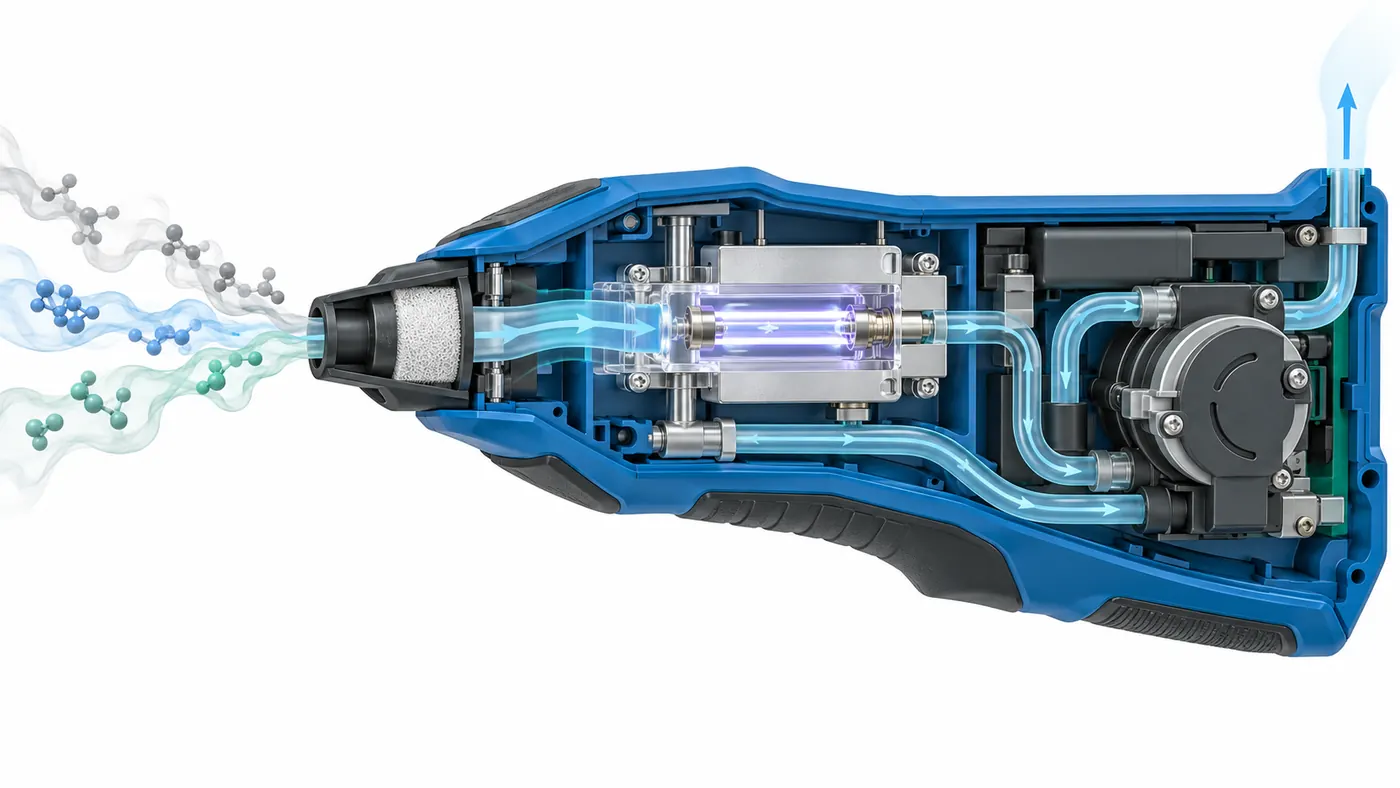
Many PIDs are calibrated to isobutylene and display an isobutylene-equivalent concentration. Honeywell/RAE Technical Note 106 gives instrument-specific response and correction guidance for individual compounds. A correction factor can be useful when the sample is a known single compound and the factor applies to that PID model, lamp and calibration procedure. It cannot magically identify an unknown mixture. Different compounds contribute different responses, and their proportions may vary as a process starts or ventilation changes.
For example, applying a single compound's correction factor to a mixed solvent plume implicitly assumes the entire displayed response arose from that compound. That assumption is usually unproven. More generally, even if a mixture response were approximately additive within a particular range, the instrument does not reveal each constituent's share from one number. A PID screen can locate a changing plume or guide a targeted sampling plan; compound-resolved analysis requires a suitable additional method. Do not take a PID “TVOC” or “VOC ppm” reading as the sum of all chemicals by mass.
Practical maintenance affects interpretation. A contaminated lamp or altered inlet can reduce or delay response; high humidity may affect some models and circumstances. Filter material may remove interferents yet also remove some target vapor. Use the manufacturer's bump-test, calibration, cleaning and service procedure, and challenge the assembled instrument rather than only the sensing chamber when response time or capture efficiency matters. A good lab bench reading from a bare detector does not validate a long, adsorptive sample line in the field.
IR instruments: selectivity is designed, not automatic
Infrared sensing relies on absorption at wavelengths associated with molecular vibrations. An IR system can be engineered for a particular compound or family by selecting optical bands, filters, path length and algorithms. This makes it potentially more selective than a broad MOS channel for the intended target, but there is no generic “IR measures all VOCs” rule. Some substances absorb weakly at the chosen band; others overlap it. Water, carbon dioxide or another gas may matter depending on wavelengths and design. An IR instrument for CO₂ should not be assumed to measure solvents, and an IR instrument for a refrigerant should be evaluated for that refrigerant and likely interferents.
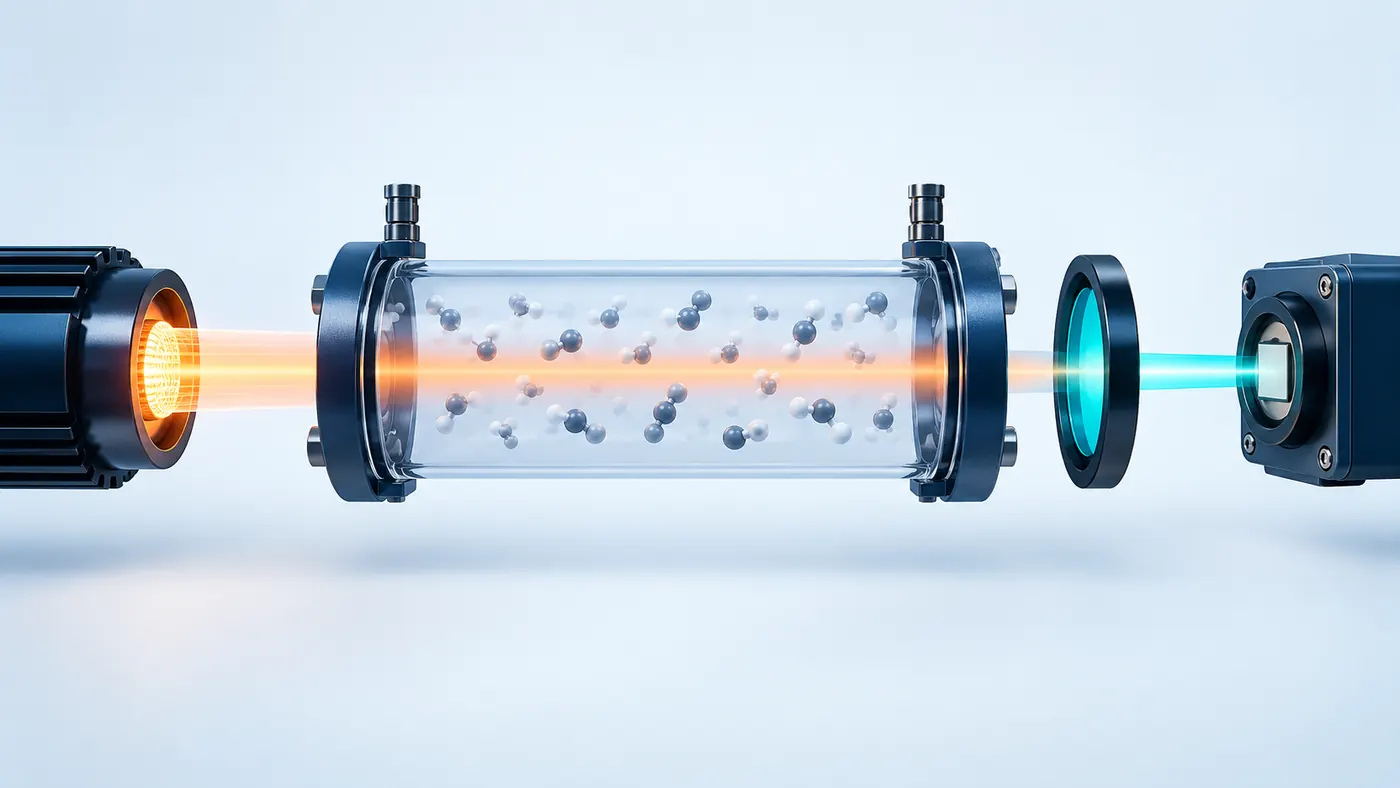
The manufacturer's cross-interference table, calibration gas, optical filter and stated operating range are more informative than the acronym “IR.” A narrow-band detector can be appropriate for a known leak target when the spectral design and validation support it. A broad multi-channel spectrometer with a library is a different instrument. Neither is interchangeable with a portable PID based only on a shared ppm unit. If water-vapor correction is built in, look for its tested range and any condensation constraints; condensation on optics or in a sample path is an equipment problem, not merely a software term.
The older tendency to rank sensor technologies as simply “MOS cheap, PID better, IR best” is misleading. An expensive IR channel designed for one gas may be irrelevant to a different target that a PID detects well. A PID may find a plume yet miss a compound outside the lamp's practical response. A MOS device may be a good event trigger where compound identity is not the decision. The right choice is the smallest measurement chain whose response has been validated for the actual question.
A response matrix, not a single accuracy number
Think of a sensing system as a response matrix. Each possible gas or environmental condition has its own effect on the raw channel. Firmware then compresses those effects into one or more outputs. If there are more unknown mixture components than independent, well-characterized measurements, a single displayed value cannot uniquely solve the mixture composition. Multiple channels may improve discrimination, but only if their responses are sufficiently distinct and the classification model was trained and validated for the relevant range and interferences.
This is why “accuracy ±X%” without a named test gas and conditions is incomplete. Accuracy measured for one reference vapor at a fixed temperature does not prove accuracy for a changing blend at a humid work site. Detection limit, selectivity, precision and response time answer different questions. A device might detect that something changed quickly but report the target concentration poorly; another may be accurate in stable clean lab air but recover slowly after a high exposure. Ask for the test definition behind every claim.
The sample path can dominate the result. Vapors can adsorb to tubing, dissolve in condensate, react with surfaces or arrive at different rates. A drawn-sample PID and a diffusion MOS monitor may sample different air at a different time even when they are mounted nearby. Flow restrictions, pump wear and filters add another layer. To compare instruments, synchronize clocks, put inlets in the same microenvironment, and observe the delay and recovery under the actual configuration. Co-location is useful troubleshooting but does not establish which reading is chemically correct.
Interference can appear as gain, suppression or delay
It is tempting to picture interference only as a false high reading. A competing compound may instead reduce apparent response to the target, consume capacity on a reactive surface, or change how the algorithm adapts. Humidity may shift a baseline and alter sensitivity at the same time. A sorbent or filter may attenuate an interferent but also retain the target. A sampling tube may delay a sticky vapor so that its peak appears after the process ended. These outcomes need different tests: a target-only challenge for baseline sensitivity, an interferent-only challenge for false response, and a combined challenge for masking or enhancement. Testing only the interferent alone can miss suppression of the target.
Dynamic behavior is as important as the final steady reading. A rapid release may be shorter than the monitor's averaging window; a recovery tail may carry into the next sample. Compare rise time, plateau, recovery and repeatability under the manufacturer's stated conditions. If one device is portable and another fixed, sample location and airflow can dominate any nominal sensor-technology difference. A long-term average can be appropriate for one decision and inappropriate for a leak warning. Select the output interval and alarm logic around the event that must be detected.
Read a cross-sensitivity table with its conditions attached
A manufacturer's table usually reports responses to selected gases at selected challenge concentrations, temperature and humidity. It cannot list every possible field mixture. Check whether entries represent raw output, percent of target-gas response or equivalent concentration. Determine whether “no response” means below a specified test threshold, outside the sensor's range or simply untested. The table may describe a bare component, while the finished detector includes compensation and a filter. If the gas of concern is missing, do not infer immunity or sensitivity from a chemically similar name.
For a procurement decision, ask for the full test conditions and uncertainties, then write an acceptance test using the local expected interferents. If a supplier claims selectivity based on a laboratory mixture, confirm whether the actual process has additional solvents, water vapor or temperature cycling. Even an excellent target response in dry clean air is insufficient if the deployed inlet is routinely wet. Conversely, a moderate broad cross-response can be acceptable for an event logger if no chemical-specific claim is made. Tie the acceptance criterion to the consequence of a missed event or a false alarm rather than to a technology label.
One practical way to make the criterion concrete is to write separate limits for detection, false response and recovery. Detection asks whether the target reliably produces the required response at the concentration and time scale of interest. False response asks what an expected interferent alone does. Recovery asks whether the instrument returns to a usable reference state after a high exposure. Repeat these checks over the specified temperature and humidity envelope, and after normal service intervals. If the application is only trending, a relative response may be sufficient; if it controls a safety action, documented alarm performance and a validated response procedure are essential. Record failed or inconclusive conditions rather than averaging them into a single attractive accuracy number.
Design a cross-sensitivity test that answers the application

Start with a written claim: target, concentration range, required decision, allowable error, conditions and likely interferents. Then select a reference method that is specific enough for that claim. The AQMD VOC-sensor testing protocol is an example of structured laboratory evaluation; a product test still needs the actual manufacturer's instructions and the site's use case. A practical challenge sequence includes:
- Instrument state. Record model, serial, software/firmware, calibration, lamp or sensor age, inlet/tubing, warm-up and maintenance status. Verify clean-air or zero behavior using the prescribed procedure.
- Target alone. Challenge the instrument at relevant target levels using a traceable or otherwise suitable generated atmosphere. Record steady response, rise and recovery, not just a single display.
- Likely interferents alone. Test the vapors and environmental changes that plausibly occur at the site. A generic catalog list is not enough; material inventory, processes and outdoor conditions help choose candidates.
- Target plus interferent. A sensor can respond differently in a mixture than when the individual challenges are simply added. Test the combinations and proportions that matter, without assuming additivity.
- Temperature and humidity. Vary them within the stated operating envelope and look at transitions as well as stable points. Distinguish reversible changes from persistent contamination or drift.
- Repeat and age. Repeat challenges after normal recovery and again after the maintenance interval or use history that matters. Check whether the algorithm adapts to prolonged exposure.
- Whole-system verification. Test the finished instrument with its housing, pump, tubing, filter and configured alarm. A sensor-module spec alone is insufficient.
Describe the result as a condition-specific performance statement. For instance, “responded to the target under these listed conditions with this reference method” is meaningful; “detects all VOCs” is not. If a gas mixture cannot be generated safely or a health decision is involved, use a qualified laboratory or industrial-hygiene process. This article is about measurement design, not a substitute for a site-specific exposure protocol.
A compact field investigation form
| Kayıt | Neden önemli? |
|---|---|
| Target chemical or event and decision | Prevents a broad trend from being misused as a compound-specific result |
| Instrument output and calibration gas | Exposes equivalent-concentration and index differences |
| Sample inlet, tubing, flow and averaging | Explains time shifts and losses before the sensor |
| Temperature, humidity and condensation | Separates environmental influence from a changing vapor source |
| Other expected vapors | Defines the cross-sensitivity challenge set |
| Baseline, peak, recovery and repeat | Distinguishes transient, adaptation and possible fouling |
| Independent reference sample | Tests the chemical question the sensor cannot resolve alone |
The form is as important as the graph. A graph without an instrument state, location and source timeline can be overinterpreted months later. Record uncertainties and failed checks; do not silently remove inconvenient observations. If a device is used for an alarm, follow its approved installation, test and response instructions. A broad IAQ monitor is not automatically a safety detector.
Choose by decision, not technology prestige
| Decision | Potential measurement route | Main condition to verify |
|---|---|---|
| Notice repeatable changes in an occupied room | Broad MOS trend or well-described index | Baseline behavior, humidity effects and relevance of the response to expected sources |
| Screen for a known class of ionizable vapors or locate a plume | Suitable PID model and lamp | Compound response, reference-gas equivalence, sampling path and maintenance |
| Detect a named IR-active gas | Target-specific IR system | Absorption band, interferents, calibration, range and application environment |
| Quantify one hazardous compound | Validated analyte-specific method | Detection limit, uncertainty, sampling time and decision standard |
| Identify an unknown mixture | Appropriate laboratory separation and identification | Sample collection, analyte list, method scope and quality control |
One system may combine a broad monitor for timing and a specific method for confirmation. Use the broad signal to choose when and where to take a targeted sample, but do not treat its scale as the laboratory result. ISO 16000-6:2021 describes a method for sampling and analyzing selected indoor VOCs; it illustrates the different evidence needed for compound-resolved work. For selecting an IAQ dashboard, our guide to concentrations versus air-quality scores helps keep the interface separate from the physical measurement.
Questions engineers and buyers ask
Is a PID always more selective than a MOS sensor?
No. A PID has an ionization-energy gate and gas-dependent response, but it can respond to multiple compounds. A MOS sensor also responds to multiple compounds. Which is more useful depends on the target, interferents, calibration and decision. A targeted method is needed when compound identity matters.
Can I correct a PID reading with one factor for a solvent blend?
Not reliably without knowing the blend and validating the calculation for the instrument. Published response or correction factors usually describe individual gases under stated conditions. An unknown mixture's single display does not tell you the contribution of each gas.
Does an IR sensor avoid all humidity interference?
No. The effect depends on the wavelengths, optical design, compensation, sample handling and whether water condenses. Read the model-specific cross-interference and environmental data. “IR” alone is not a humidity specification.
Why did the monitor respond to perfume but not the suspected solvent?
Possible explanations include different sensitivity, concentration at the inlet, sensor history, a filter or sampling loss, or an algorithm that weights the mixture differently. Do not infer the solvent is absent. Check the model's response data and use a suitable target-specific test.
What is the difference between interference and drift?
An interference is a response caused by another gas or condition during measurement. Drift is a change in response or baseline over time under a comparable reference condition. A temporary humidity effect may look like drift if conditions were not recorded. Check a known reference after stabilization to distinguish them.
Can a sensor array identify every VOC?
No array gains unlimited chemical resolution simply by adding channels. Identification depends on distinct responses, a validated model, the concentration and mixture range, and control of environmental effects. Unknown or out-of-distribution samples still require a suitable confirmatory method.