传感器一站式——中国最具价值传感器供应商及供应链

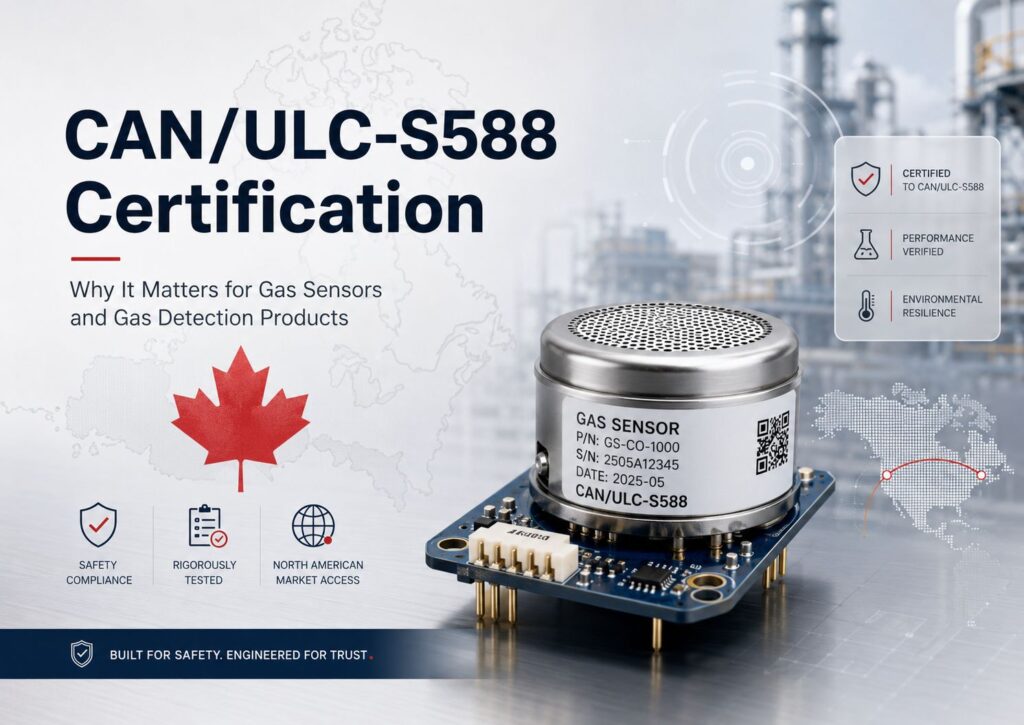
CAN/ULC-S588 认证说明:为什么它对于气体传感器和气体检测产品很重要

对于瞄准北美市场的气体传感器制造商、气体探测器品牌和系统集成商来说,认证已不仅仅是一种合规性要求。这也是客户信任、项目认可和产品选择的重要因素。

受到越来越多关注的一项标准是 CAN/ULC-S588,正式名称为 气体和蒸汽探测器和传感器,包括配件。该加拿大标准适用于用于有毒和可燃气体检测的气体和蒸汽探测器和传感器,包括永久安装、便携式和可运输设备。

对于与以下公司合作的公司 carbon monoxide sensors, hydrogen sensors, combustible gas sensors, toxic gas sensors, and gas detection modules, understanding CAN/ULC-S588 is important when developing products for safety-related applications such as residential safety, commercial buildings, energy storage systems, fuel cell systems, HVAC control, and industrial monitoring.

What Is CAN/ULC-S588?

CAN/ULC-S588 is a Canadian standard for gas and vapour detectors and sensors, including accessories. It covers requirements for products used to detect toxic gases, combustible gases, and vapours in ordinary gas detection applications.

In practical terms, CAN/ULC-S588 is highly relevant to products such as:

  • Carbon monoxide detectors and CO sensors
  • Hydrogen gas detectors and H₂ sensors
  • Combustible gas detectors
  • Toxic gas detectors
  • Multi-gas detection devices
  • Gas sensing modules used in safety systems
  • Accessories related to gas detection products

The scope of the standard includes fixed, portable, and transportable gas and vapour detectors and sensors. It is especially important for products used in indoor locations, outdoor applications, or unconditioned environments where reliability and safety performance are critical.

How Is CAN/ULC-S588 Related to UL 2075?

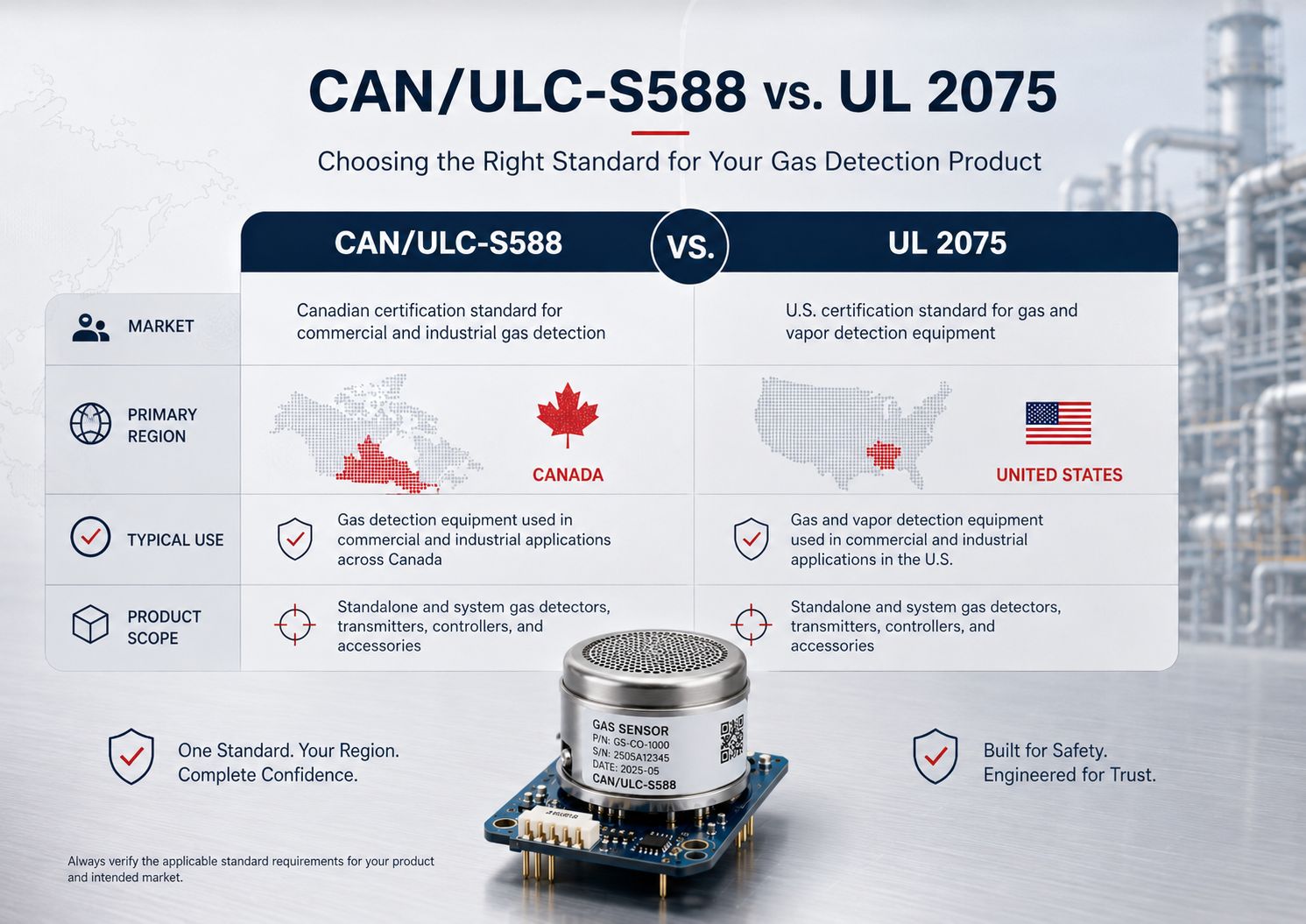
CANULC S588vS. UL 2075

For companies entering North America, CAN/ULC-S588 is often discussed together with UL 2075

UL 2075 is the U.S. standard for Gas and Vapor Detectors and Sensors。它适用于用于普通非危险场所(包括室内和无空调区域)的固定式、便携式和可运输有毒和可燃气体和蒸气探测器和传感器。

理解这种关系的一个简单方法是:

标准主要市场产品聚焦
UL 2075美国气体和蒸汽探测器和传感器
CAN/ULC-S588加拿大气体和蒸汽探测器和传感器,包括配件

对于许多北美项目,制造商可能需要考虑这两个标准。同时支持 UL 2075 和 CAN/ULC-S588 要求的气体检测产品或传感器组件对 OEM 客户、系统集成商和安全设备制造商更具吸引力。

Intertek has also noted that gas detectors have been removed from the scope of UL 61010-1 and CSA C22.2 No. 61010-1 and are now under the scope of UL 2075 and ULC S588, which shows that gas detector certification has become more specialized in North America.

Why CAN/ULC-S588 Matters for Gas Sensor Manufacturers

For sensor manufacturers, CAN/ULC-S588 is not only about selling a certified detector. It can also affect the competitiveness of the sensor itself when the sensor is used as a key component inside a complete gas detection product.

Gas detector manufacturers often look for sensor suppliers that can help reduce certification risk. If a sensor has already been evaluated according to recognized North American safety and performance requirements, it may help the end-product manufacturer simplify product development and improve confidence during certification planning.

This is especially important in applications where gas detection is directly linked to safety, such as:

  • Residential carbon monoxide alarms
  • Commercial building gas monitoring
  • Parking garage ventilation control
  • Battery energy storage system safety
  • Hydrogen leakage detection
  • Fuel cell system monitoring
  • Industrial toxic gas detection
  • HVAC and refrigeration safety systems

In these applications, customers do not only ask whether a gas sensor can detect a target gas. They also care about long-term stability, operating temperature range, response performance, failure behavior, end-of-life indication, calibration strategy, and certification support.

Key Technical Areas Behind CAN/ULC-S588 Evaluation

The full CAN/ULC-S588 standard is a paid technical document, so manufacturers should always work with an authorized certification body for formal testing and interpretation. However, based on public information and standards update notices, several areas are especially important for gas detection products.

1. Gas Detection Performance

A gas detection product must demonstrate that it can detect the target gas reliably under specified conditions. This may involve sensitivity, alarm threshold, response time, recovery behavior, and performance after environmental exposure.

For example, products targeting carbon monoxide, hydrogen, methane, propane, nitrogen dioxide, or hydrogen sulfide must show that they can respond to gas concentrations in a predictable and safe way.

2. Environmental Reliability

Gas detectors and sensors may be installed in non-ideal environments. Temperature, humidity, vibration, contamination, and long-term drift can all affect sensor performance.

For North American applications, customers may pay close attention to wide-temperature performance, especially in outdoor, garage, industrial, and energy storage environments.

3. Electrical and Functional Safety

A gas detection product is not only a sensing device. It is also part of a safety system. Therefore, electrical safety, component reliability, signal failure behavior, and abnormal operation conditions may be considered during evaluation.

4. Marking and Installation Instructions

The latest ULC S588 update notice includes revisions related to marking and installation instructions, which means manufacturers must also pay attention to product labeling, user guidance, installation limitations, and application conditions.

5. Combustible Gas Detection Thresholds

对于可燃气体产品,检测阈值尤其重要,因为该设备可用于在达到危险浓度之前警告用户。 Intertek ULC S588 标准更新通知提到了与可燃气体和蒸汽检测阈值测试相关的要求。

CAN/ULC-S588 和氢气检测

由于电池储能系统、燃料电池、氢能基础设施和工业氢应用的增长,氢检测变得越来越重要。

氢气是一种小分子、高扩散性、易燃气体。在实际系统中,氢气可能出现在电池室、燃料电池设备、充电基础设施、氢气生产场地或封闭的技术空间中。

对于氢传感器制造商来说,与认证相关的性能可能包括:

  • 低浓度氢气检测能力
  • 快速响应和恢复
  • 工作温度范围宽
  • 长期稳定
  • 抗干扰气体
  • 系统集成的输出可靠性
  • 安全相关监控的适用性

由于氢安全正在成为能源转型项目中的一个主要话题,人们越来越期望用于氢检测的气体传感器支持公认的标准和认证途径。

CAN/ULC-S588 和一氧化碳检测

一氧化碳仍然是住宅、商业和工业安全中最重要的气体之一。 CO 无色、无味且有毒,因此可靠的检测至关重要。

CO传感器广泛应用于:

  • Residential carbon monoxide alarms
  • 商业建筑安全系统
  • Parking garage ventilation control
  • 锅炉房
  • 火灾探测和安全系统
  • 燃气器具
  • 休闲车和船舶应用

对于 CO 传感器,客户通常关注:

  • 使用寿命长
  • 低漂移
  • 在温度和湿度范围内稳定输出
  • 耐酒精、氢气等干扰气体
  • 在整个产品生命周期内具有可靠的性能
  • 支持 10 年探测器设计

对于 OEM 制造商而言,在为北美设计气体报警器或气体监测系统时,具有强大认证支持的 CO 传感器可能是一个主要优势。

组件认证与完整产品认证

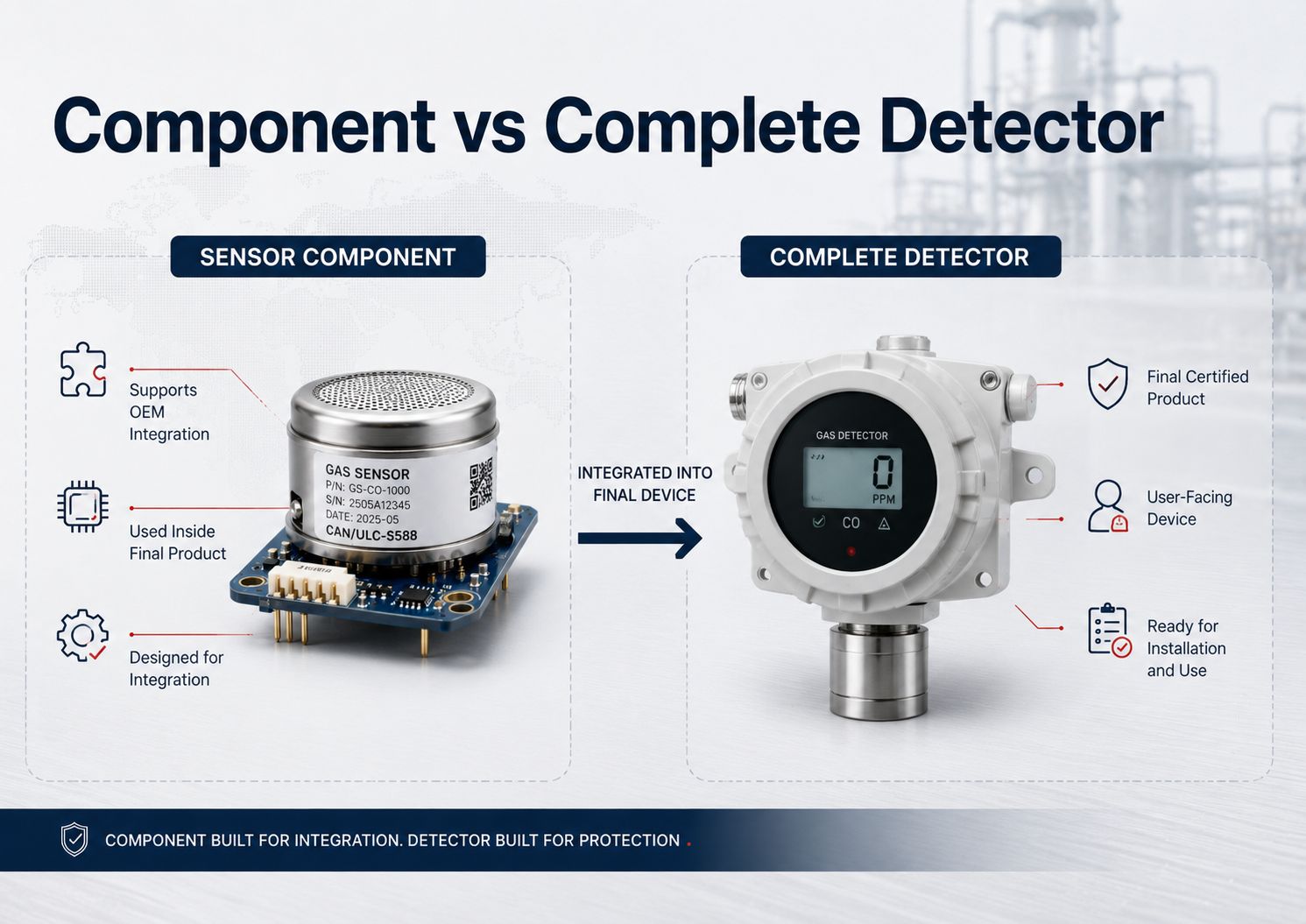
应该清楚地理解一个重要的一点: 经过认证的传感器组件与经过认证的完整气体检测仪不同

A gas sensor may be evaluated as a recognized component used inside a larger certified product. In this case, the sensor supports the certification of the final product, but the complete detector or alarm still needs its own evaluation based on final design, enclosure, power supply, software logic, alarm output, user instructions, and installation conditions.

This distinction matters because gas detector manufacturers often ask sensor suppliers for documentation that can support their own certification process. A well-prepared sensor supplier should be able to provide:

  • Sensor datasheet
  • Performance test data
  • Lifetime and aging data
  • Environmental test data
  • Interference gas data
  • Calibration information
  • Quality control documentation
  • Application notes
  • Certification-related technical support

Why This Certification Is Becoming a Market Advantage

In the gas detection market, technical performance alone is no longer enough. Customers increasingly want products that are easier to approve, easier to integrate, and easier to certify.

CAN/ULC-S588 can create value in several ways:

For Sensor Manufacturers

It helps show that the product is suitable for serious safety-related applications and can support North American customer projects.

For Gas Detector Brands

It reduces uncertainty when selecting core sensing components and designing products for Canada or the broader North American market.

For System Integrators

It provides confidence when gas detection devices are used in building safety, energy storage, industrial monitoring, and ventilation control systems.

For End Users

它通过鼓励更可靠的性能、正确的安装和清晰的产品标记来支持更安全的气体监测。

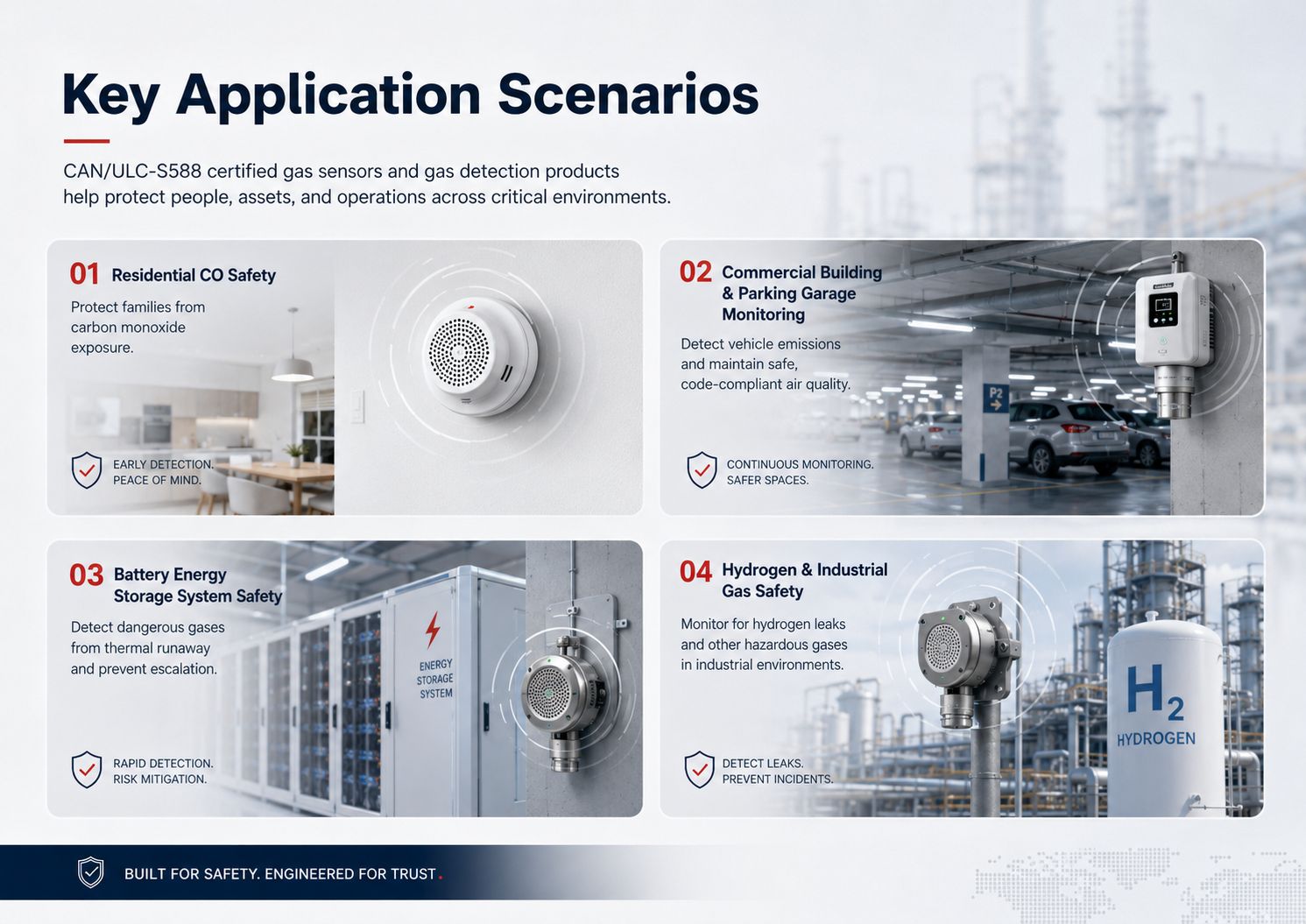
CAN/ULC-S588 可能很重要的应用

CAN/ULC-S588 特别适合以下应用中使用的气体检测产品:

应用典型目标气体
住宅安全一氧化碳、可燃气体
商业建筑CO、NO2、可燃气体
停车场一氧化碳、二氧化氮
电池储能系统H2、CO、VOC、电解质蒸气指示器
燃料电池系统氢气
工业安全H2S、CO、可燃气体
暖通空调和通风控制二氧化碳、一氧化碳、二氧化氮
消防安全系统CO、H2、可燃气体

Different applications may require different standards, installation codes, and certification routes. Therefore, manufacturers should evaluate the target market and application scenario before starting certification.

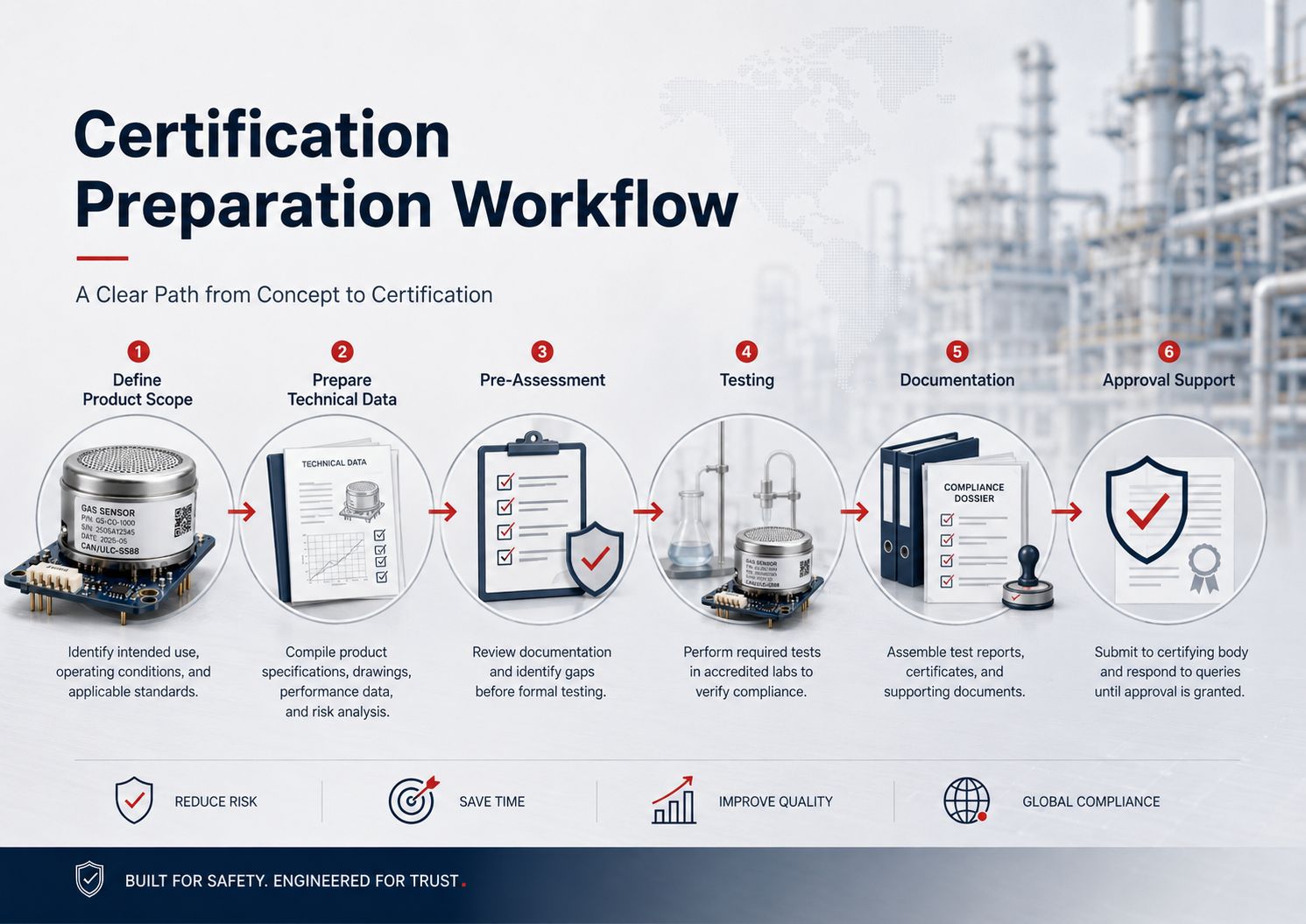
What Manufacturers Should Prepare Before Certification

Before starting a CAN/ULC-S588 or UL 2075 certification project, gas sensor and detector manufacturers should prepare a strong technical foundation.

Important preparation work includes:

  1. Define the product scope
    Confirm whether the product is a sensor component, sensing module, gas detector, gas alarm, or complete monitoring device.

  2. Confirm the target gas and application
    CO、H2、CH4、丙烷、NO2、H2S 和 VOC 相关气体可能有不同的测试要求和客户期望。

  3. 准备可靠性数据
    长期漂移、老化行为、温度循环、湿度暴露和存储稳定性数据非常重要。

  4. 审查环境规范
    应明确规定工作温度、储存温度、湿度范围、压力范围和安装环境。

  5. 准备质量控制文件
    认证机构和OEM客户可以审查生产一致性、校准过程、检验方法和可追溯性。

  6. 明确认证路线
    确定目标是组件识别、模块评估还是完整的产品认证。

  7. 尽早与合格的认证机构合作
    早期预评估有助于避免重新设计、文档空白和意外的测试延迟。

结论

CAN/ULC-S588 是加拿大气体和蒸汽探测器和传感器的重要标准。它与UL 2075一起在北美气体检测产品认证中发挥着关键作用。

对于气体传感器制造商来说,该标准不仅仅是一个监管话题。这也是一个市场信号。住宅安全、商业建筑、能源存储、氢安全、工业监控和暖通空调系统等领域的客户越来越多地寻求具有更强可靠性数据和认证支持的气体传感产品。

随着气体检测应用变得更加安全,了解 CAN/ULC-S588 和 UL 2075 要求的传感器供应商将能够更好地支持 OEM 客户并进入更高价值的市场。

对于评估二氧化碳、氢气、可燃气体或有毒气体传感解决方案的项目团队来说,选择正确的传感器技术只是第一步。认证规划、可靠性测试和特定应用集成正在成为成功的气体检测产品开发的同等重要部分。

常问问题

什么是 CAN/ULC-S588?

CAN/ULC-S588 是气体和蒸汽探测器和传感器(包括配件)的加拿大标准。它涵盖了用于有毒和可燃气体检测的固定式、便携式和可移动形式的产品。

CAN/ULC-S588 与 UL 2075 相同吗?

不会。UL 2075主要用于美国市场,而CAN/ULC-S588是加拿大标准。然而,对于北美气体检测产品,它们经常被放在一起讨论。

哪些气体与 CAN/ULC-S588 相关?

该标准可能适用于有毒和可燃气体检测产品,包括一氧化碳、氢气、甲烷、丙烷、二氧化氮、硫化氢等气体的产品以及其他气体或蒸气危害的产品,具体取决于应用。

经过认证的传感器是否意味着整个探测器都经过认证?

未必。传感器可以作为一个组件进行评估,但完整的气体探测器或报警器通常需要根据最终产品设计和应用进行单独评估。

为什么 CAN/ULC-S588 对于气体传感器供应商很重要?

它帮助传感器供应商支持针对加拿大或北美的 OEM 客户。它可以提高客户信心,减少认证不确定性,并增强在安全相关气体检测市场的竞争力。

Exit mobile version