

Use a fixed altitude setting when the instrument stays at one location, the manufacturer supports that setting, and the remaining pressure variation fits the measurement requirement. Use measured pressure when meaningful pressure changes must be followed and the instrument accepts a suitable input. The measured value must represent the gas at the sensing cell, arrive in the correct units, and remain current. A pressure number that meets none of those conditions can make compensation less reliable.
Altitude is a convenient way to estimate a typical atmospheric pressure. It is not a continuous measurement of the pressure inside a sensor. Weather, ventilation, enclosure restrictions, sampling pumps and process connections can change that pressure without moving the instrument up or down a mountain. Choosing between altitude and measured pressure therefore begins with the gas path and the intended result, rather than the presence of a barometer on a circuit board.
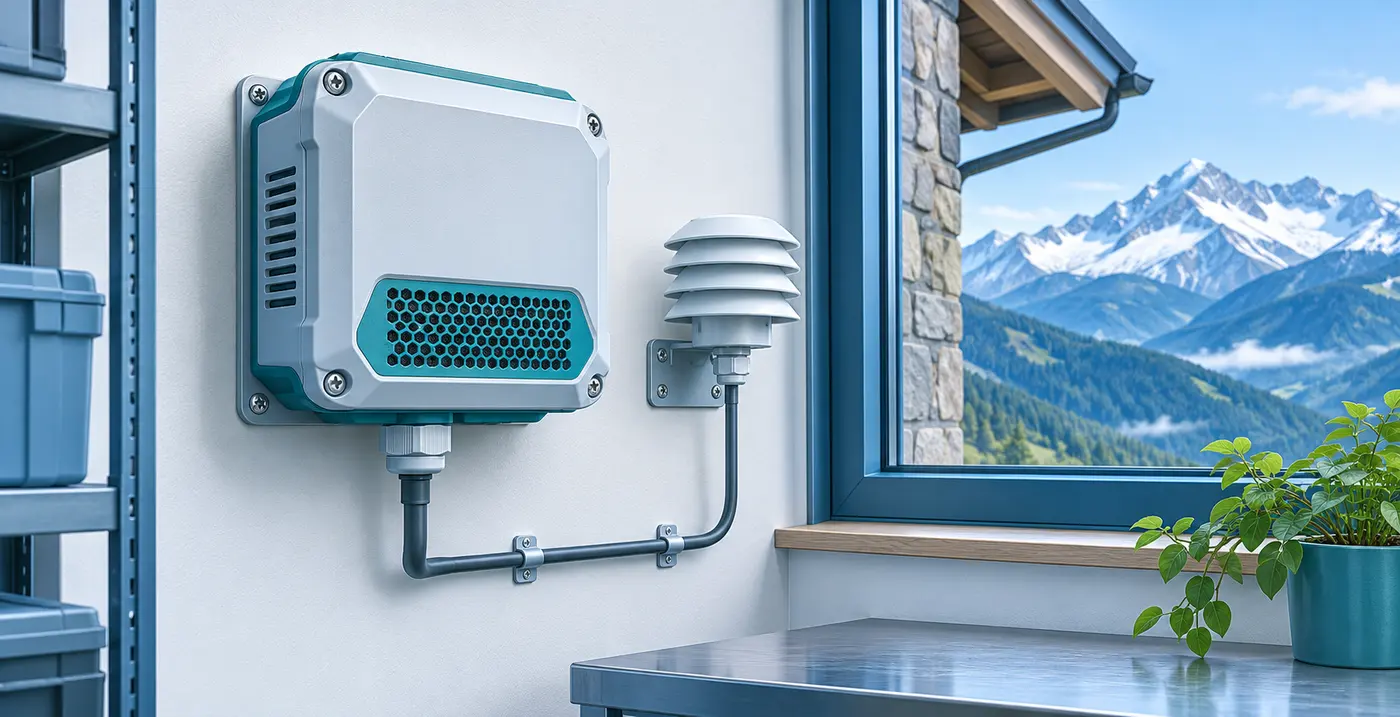
Conceptual installation: building elevation describes the site; a local pressure sensor describes a measured condition. Their usefulness depends on where the gas cell exchanges gas.
What pressure does the gas sensor need?
First establish what the device already measures and compensates. A complete transmitter may contain an internal pressure sensor; a bare module may expect a host-provided value; another model may offer only a permanent altitude correction. Two products both called CO2 sensors can have different input requirements.
Identify the manufacturer's definition of the pressure input. For a module operating in freely exchanging room air, local absolute atmospheric pressure may represent the gas cavity adequately. For an extractive analyzer, pressure at a remote weather station may say little about pressure downstream of a long tube, filter and pump.
Absolute pressure uses vacuum as its reference. Gauge pressure uses a local pressure reference, often atmospheric pressure. Differential pressure reports a difference between two ports. A small gauge-pressure reading near zero does not mean that the gas cell has almost no absolute pressure. Treating a gauge value as an absolute input is a category error that a plausible-looking display may not expose.
A weather service can also present pressure reduced to sea level. That number is useful for comparing weather systems across different elevations, but it is not the station pressure physically acting on a sensor at an elevated site. Read the provider's field definition. A field called pressure is insufficient documentation.
For a closed sampling cell, draw the pressure boundaries before selecting the input source. Mark the intake, restrictions, cell, pump and exhaust. Place each available pressure measurement on that drawing. This exercise often reveals that a well-specified barometer is measuring a different pneumatic space.
ال إرشادات التصميم SCD30 specifically discuss pressure disturbances from airflow and recommend shielding the module from direct flow. Their installation advice shows why a correct site elevation does not solve every pressure-related measurement problem.
What does a static altitude setting represent?
An altitude setting converts a location parameter into a pressure-related correction using the manufacturer's implementation. It can be useful because building elevation is stable, inexpensive to obtain and easy to retain during power interruptions. It avoids adding a pressure sensor and its associated wiring, calibration, firmware and fault handling.
Its limitation follows from that same simplicity. Altitude does not change when a low-pressure weather system passes, when an exhaust becomes restricted, or when a pump changes the cell pressure. A static value can represent a typical condition while missing the actual condition during a particular reading.
This does not make altitude configuration inherently inadequate. The relevant question is whether the untracked pressure variation matters for the required uncertainty. A room monitor intended to follow broad occupancy trends and an analyzer used to compare small concentration differences can justify different input choices.
Do not assume the altitude number is merely descriptive metadata. In some interfaces it actively changes the reported concentration. An installer who enters an elevation without understanding the current correction mode may alter the measurement even though the physical installation remains unchanged.
ال SST CO2 Sensors User Guide describes its supported altitude correction as a persistent correction for an instrument used at an elevated location. It also ties availability to firmware. That is evidence for the behavior of the covered sensor family, not proof that every gas instrument implements altitude in the same way.
When is live pressure the better choice?
Measured pressure becomes valuable when changes at the sensing location are large enough to affect the application and occur within the instrument's supported operating conditions. Examples include a portable device moved between sites, a fixed station needing weather-related pressure tracking, or a sampling system whose cell pressure changes with its gas-handling state.
The gain comes from representing the actual condition more closely. It does not come from the word live. A stream updated every second from a distant or isolated pressure sensor can be less representative than a stable local measurement updated less frequently.
| Installation condition | Potentially suitable approach | Question that decides |
|---|---|---|
| Fixed room instrument, modest requirements | Supported altitude configuration | Does residual pressure variation fit the required result? |
| Fixed site with significant weather tracking needs | Local measured absolute pressure | Does the input follow the same pneumatic space as the cell? |
| Portable instrument changing elevation | Supported measured-pressure input | What happens during transport and source interruptions? |
| Pumped sample line | Cell-representative pressure input if supported | Is the pressure port on the correct side of restrictions? |
| Complete analyzer with internal compensation | Manufacturer's intended internal chain | Would a host correction duplicate work already performed? |
| Device with unsupported external input | Documented configuration only | Is another model or sampling design required? |
A measured input also adds uncertainty. Its accuracy, temperature behavior, installation, timing and conversion all matter. Compare the likely improvement with those contributions before adding hardware. An extra sensor is justified when it reduces a meaningful uncertainty or supports a required condition, not simply because it produces another available number.
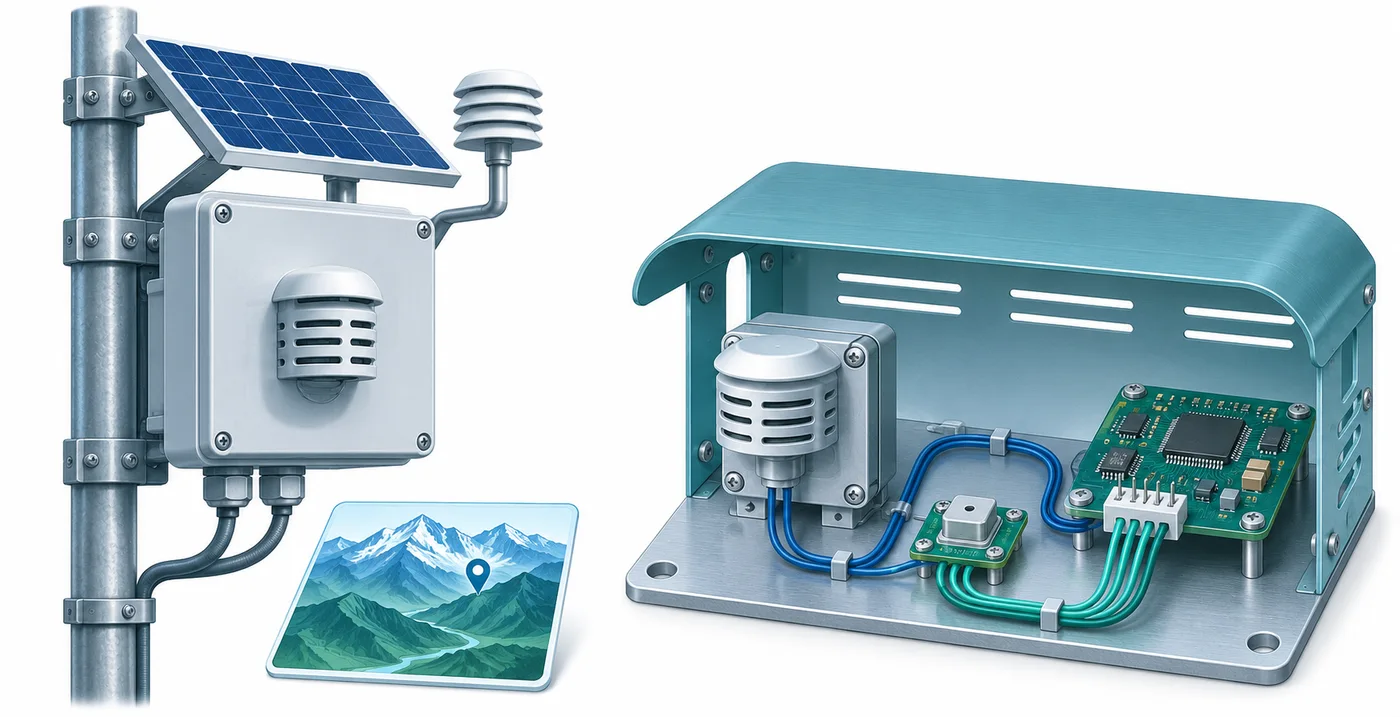
The two approaches have different information sources. Configuration describes a site; measured input supplies a time-dependent condition.
Read command priority before combining settings
A sensor may accept both altitude and pressure commands without applying both simultaneously. The existence of two settings does not establish their interaction. One can override the other, remain stored while inactive, or require a particular restart sequence.
For the SCD30, the interface description states that a supplied ambient-pressure value takes precedence over altitude compensation. It describes altitude as retained in nonvolatile memory. The pressure argument is expressed in mbar, and its zero value has a special meaning rather than representing a physically valid atmospheric condition. These behaviors belong to that interface.
That example illustrates why three different questions must be answered: what has been stored, what is currently active, and what the host most recently attempted to send. They are not necessarily the same. A user interface can show a stored altitude even while a pressure input controls the calculation.
The manufacturer's SCD30 Python API documentation provides the corresponding driver methods and explains updating the ambient-pressure argument during continuous measurement. Check the driver version as well as the sensor manual: an application-facing method can convert physical units before building the command.
Avoid layering a second concentration correction in the host unless the manufacturer documents that workflow. If the module already reports a pressure-compensated concentration, multiplying the output by another pressure ratio can create a new error. Track the correction responsibility explicitly: module, transmitter, host or downstream analytics.
A practical configuration record should name the active mode in plain language. “Measured cell pressure supplied by host” is more informative than “compensation enabled.” Record the source, unit and fallback alongside it. That record allows a later technician to understand the intended behavior without reverse-engineering command history.
Build a pressure-input contract
A pressure-input contract is a description of what a measurement must satisfy before the host treats it as usable. It can remain a simple commissioning document, but it should be precise enough to guide software and troubleshooting.
Start with identity. Which physical sensor supplies the pressure, and which port is exposed to the sample? If a site has several instruments, associate the pressure source with the correct gas channel. A valid pressure value from the wrong analyzer remains the wrong input.
Next define units and encoding. Pa, hPa, kPa and mbar are easy to confuse because many atmospheric values remain numerically plausible after display formatting. The physical conversions are exact: 1 hPa equals 100 Pa, and 1 mbar equals 100 Pa. An interface may nevertheless encode its argument with an additional scaling factor.
Specify quality information. Include pressure-source communication status, any sensor diagnostic, and whether the sample was newly acquired. Successful communication only proves receipt of bytes. It does not prove that the pressure source is functioning, exposed to the intended gas, or within its usable conditions.
Define time meaning. The pressure timestamp should represent acquisition time where possible, rather than merely the time a gateway forwarded a cached reading. If devices have separate clocks, account for their alignment or use a host sequence that can reliably determine age.
Finally define failure behavior. The system might retain the last valid input for a limited period, revert to a documented fixed mode, or mark the concentration as having reduced validity. The correct choice depends on the application and supported interface. An invalid pressure sample should not quietly become a valid-looking default.
| Contract field | سجل مفيد | Failure it helps expose |
|---|---|---|
| Physical location | Cell port, room port or process port | Wrong pneumatic reference |
| Pressure type | Absolute, gauge or differential | Incompatible meaning |
| Unit and scaling | Physical unit plus encoded argument | Conversion error |
| Acquisition time | Timestamp or verified sample age | Cached input |
| Source status | Communication and diagnostic state | Plausible failed sensor |
| Active compensation mode | Readback or verified command state | Inactive stored setting |
| Fallback rule | State, duration and output qualification | Hidden loss of live compensation |
How fresh must a pressure value be?
There is no universal update interval for gas sensors. The appropriate interval depends on how quickly the relevant pressure can change, the gas measurement's own timing, and the acceptable error. A slow weather change and a switching sampling manifold are different timing problems.
A useful design approach is to estimate the largest pressure change that can occur while an input is held. Compare that change with the effect the manufacturer specifies or with an explicitly limited first-order sensitivity estimate. This connects freshness to a measurement requirement instead of choosing an arbitrary polling rate.
For example, if the design assumes pressure changes slowly, document that assumption and challenge it when a pump starts or a valve moves. A timestamp threshold chosen for weather tracking may be unsuitable for a pneumatic transition. Increasing the barometer polling rate will not repair a pressure port that cannot follow the transition.
Also distinguish freshness from synchronization. A pressure value can be fresh while representing a different part of a rapid cycle from the gas reading. If a gas result averages over an interval, determine whether a single pressure sample is representative of that interval. Use the manufacturer's timing information where available.
Do not mask brief disturbances by replacing every pressure spike with a smooth estimate without investigating the cause. Some spikes can be measurement artifacts, while others reflect real conditions at the gas cell. Filtering should preserve the meaning of the input, and its delay belongs in the timing assessment.
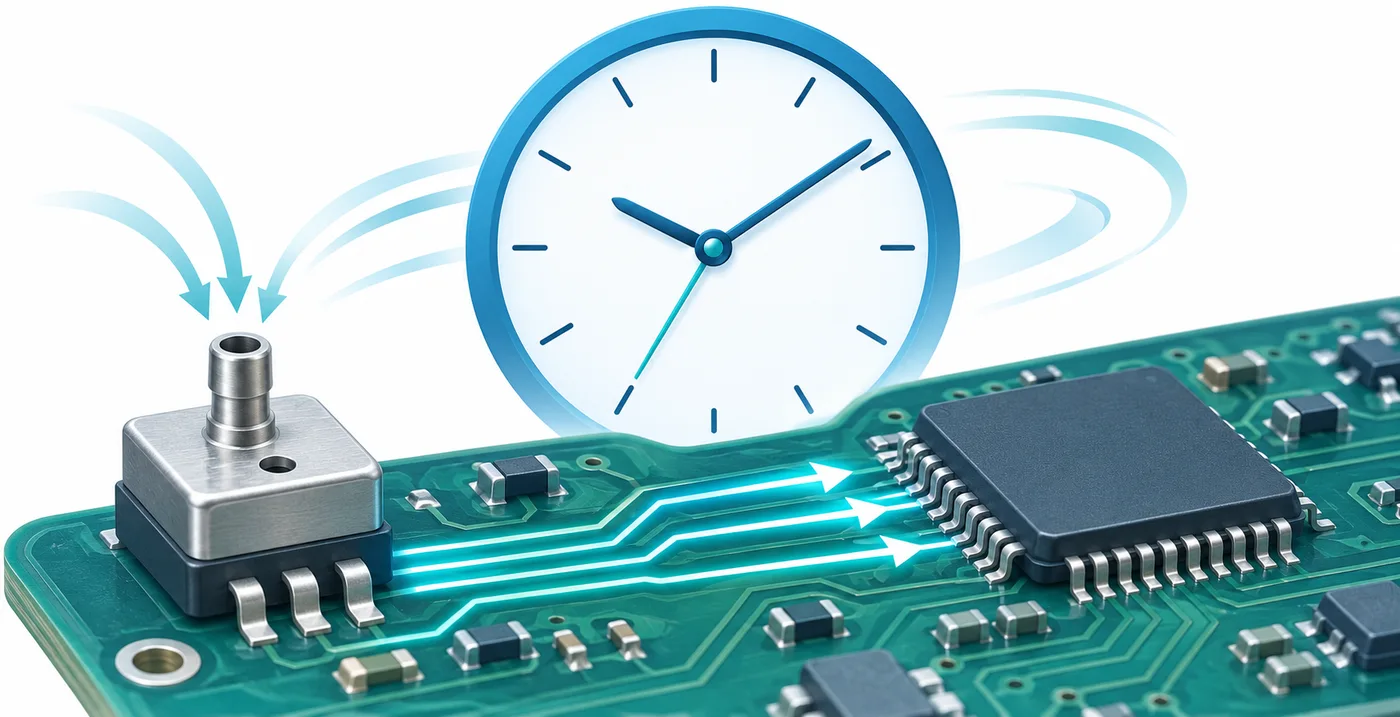
Input age includes the path through sensor, host and gateway. Frequent display refresh alone does not demonstrate recent pressure acquisition.
A checked example: correct units, wrong pressure location
Consider a hypothetical gas measurement with a simple first-order density correction proportional to the ratio of reference pressure to actual cell pressure. This is an explanatory approximation, not a replacement for a manufacturer's compensation model.
Suppose the uncorrected indication corresponds to 950 ppm on a 1000 hPa reference basis, while the cell actually operates at 950 hPa. The illustrative correction is:
Corrected indication = 950 × 1000 / 950 = 1000 ppm.
Now suppose the host supplies a room-pressure value of 980 hPa because the pressure source is upstream of a sampling restriction. The same illustrative calculation becomes:
Indication using the wrong pressure = 950 × 1000 / 980 ≈ 969.4 ppm.
The result is about 30.6 ppm below the correctly pressure-adjusted result, or approximately 3.06% of that result. The pressure source could be perfectly accurate at its own port and still lead to this mismatch.
This example separates three issues that are often combined. The pressure conversion is correct; the measurement location is wrong; the concentration correction therefore uses the wrong condition. Recalibrating the gas sensor would not make that location mismatch disappear when the sample flow changes again.
For a real device, use its documented residual pressure dependence, supported range and compensation procedure. Optical absorption, spectral effects and internal algorithms may make a simple inverse-pressure expression insufficient. The example is valuable because it demonstrates the input-location problem without claiming to predict a particular model's output.
Sample-path pressure is part of the measurement
Filters, tubing and fittings create flow-dependent pressure differences. Their effect depends on the arrangement, flow and condition, including whether contamination or liquid has restricted the path. A pressure port that represented the cell during clean commissioning can become less representative after maintenance changes.
Pump placement matters because the cell can be on a different side of the driving pressure difference. Do not infer the cell condition solely from the nominal pump rating or a flowmeter reading. Record the actual pneumatic arrangement and follow the analyzer manufacturer's installation requirements.
Leaks can complicate interpretation further. A leak may change composition as well as pressure. A pressure-compensation input cannot determine how much room air has entered a sample line. A concentration change after a fitting repair may therefore reflect restoration of sample integrity rather than improved pressure compensation.
Diffusion instruments have their own placement problems. A protective enclosure can slow gas exchange or create a pressure environment affected by airflow. An external pressure sensor mounted in an exposed air stream may experience conditions that differ from a sheltered gas cavity. Physical proximity helps, but it does not prove equal pressure.
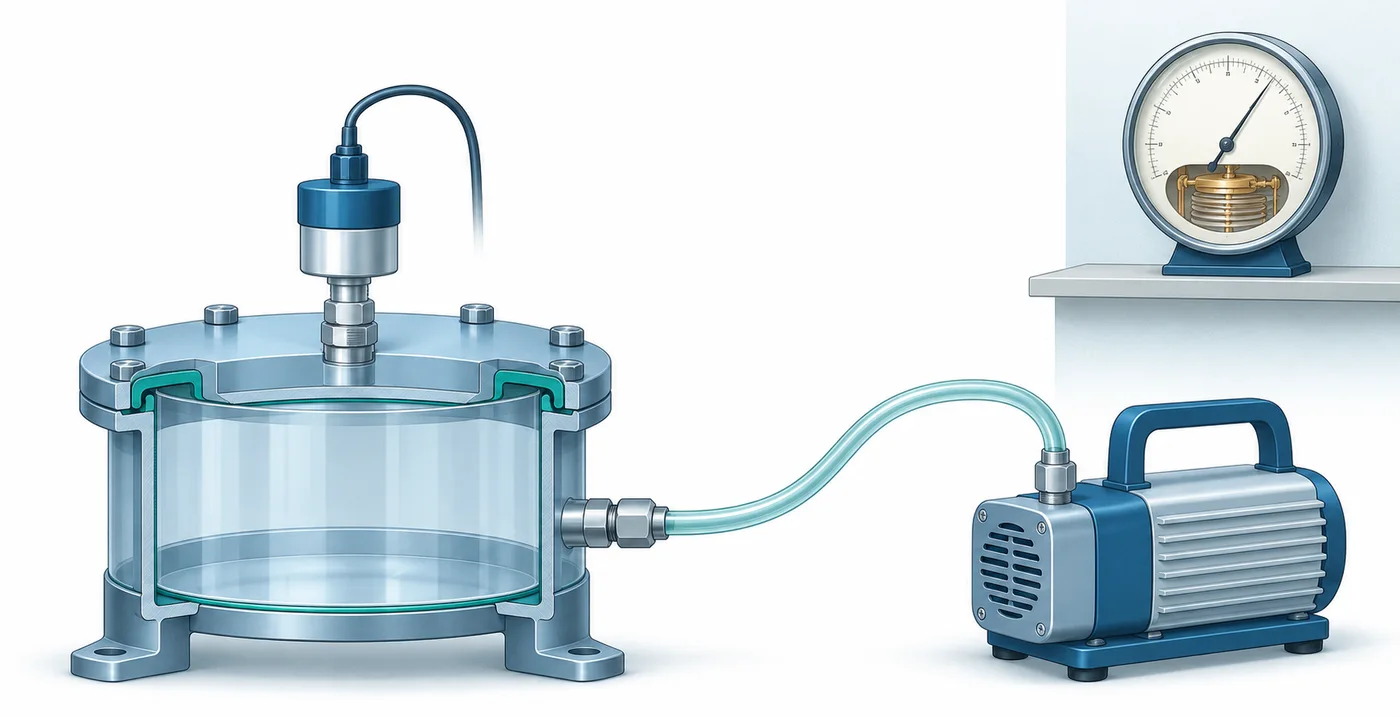
Conceptual gas path: a cell pressure port and a room barometer answer different questions when restrictions and pumping separate their environments.
What should happen at startup or after a reset?
Startup is a useful place to find hidden assumptions. A gas module may retain altitude while the host's live pressure source is still initializing. A gateway may restore a cached pressure value before obtaining a new sample. Neither behavior should be left to chance.
List the intended startup states. Before a valid pressure input exists, what correction mode applies? When the first acceptable sample arrives, what command activates measured pressure? After a communication interruption, does the last input remain active, and how does the host describe the concentration's validity?
Readback can help confirm stored or active state where the interface supports it, but interpret it carefully. Reading a pressure register proves what the device reports as configured; it does not prove that the pressure source is exposed to the intended gas. Software evidence and physical evidence answer different questions.
Power-cycle checks should include both parts of a two-device chain. Restart the gas module while the host remains running, and consider the reverse case in the design review. The purpose is to discover persistence and sequencing behavior, not to assume both devices always restart together.
A mode change should be visible in records. If an instrument switches from live pressure to a fixed fallback, later concentration comparisons need that context. Otherwise a discontinuity may look like a gas event or long-term drift. Preserve the reason for the mode change with the measurement record.
Commission the chain in layers
Begin with documentation and identity. Confirm the sensor model, firmware, pressure-source model, port location and intended mode. Verify that the chosen interface is supported for that exact device rather than a related family.
Then inspect the physical path. Confirm that the pressure source and gas cell share the intended pneumatic condition. Review tubing, restriction placement, enclosure openings and the expected clean and loaded filter states. Changes to the gas path should trigger reconsideration of the input location.
Next verify conversion separately from compensation. Compare the physical pressure value with the command argument and, where supported, readback. This isolates a scaling fault before concentration behavior adds further variables. Record one ordinary operating example with units at every step.
Assess stale-data behavior by examining supported diagnostics and host handling. The acceptance question is whether a failed or old input becomes identifiable and produces the intended state. A live-looking dashboard is inadequate evidence if its pressure field can silently repeat indefinitely.
Finally compare gas measurements against an appropriate documented reference under the intended installation conditions. Pressure-input verification is only one part of that assessment. Reference concentration, humidity basis, thermal state and response time can still limit the comparison. The guide to reading a CO2 accuracy specification explains why the conditions attached to a specification matter.
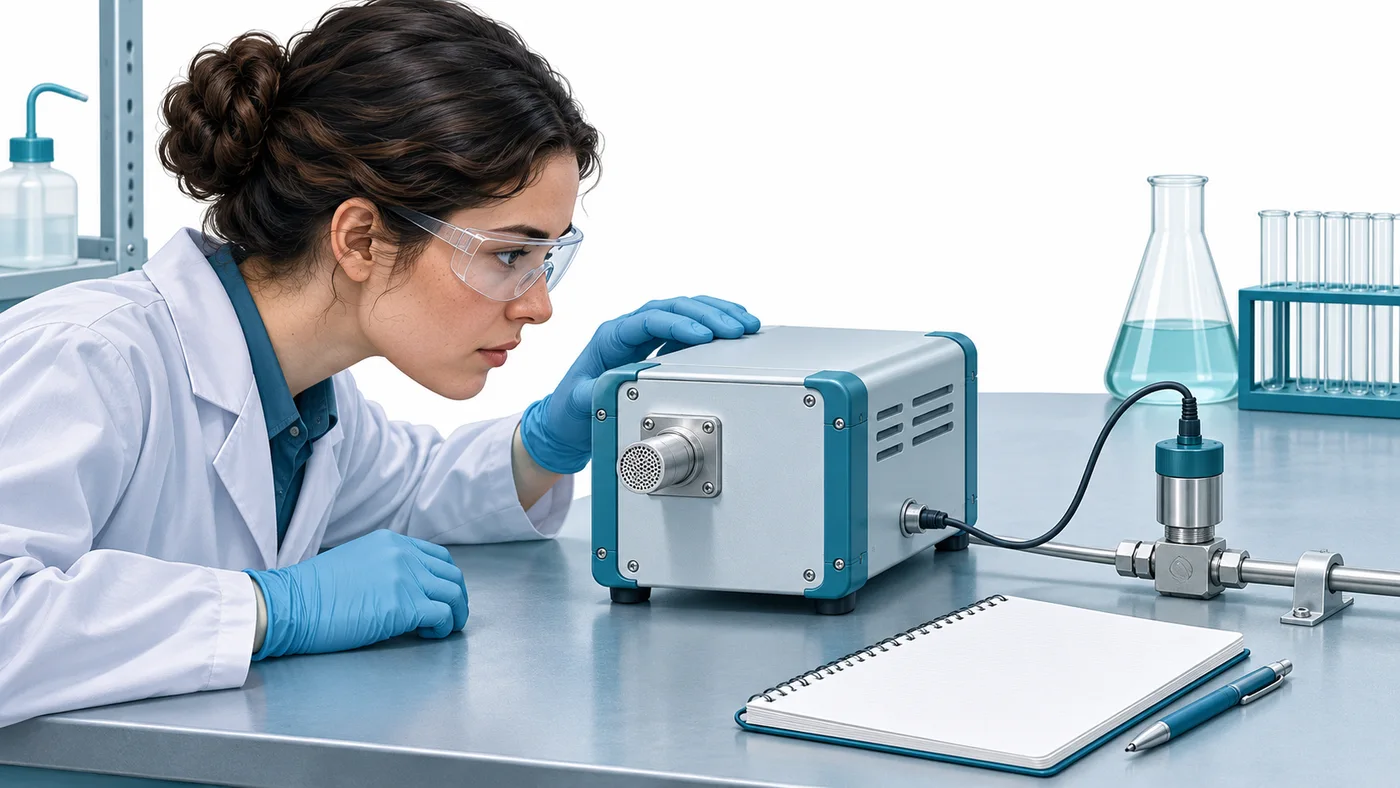
An interpretable commissioning record connects the pressure source, active mode and gas-path arrangement to the concentration comparison.
Troubleshoot without recalibrating away the evidence
If readings change after entering altitude, first check which mode was active before and after the change. A retained setting may have become active because a pressure input stopped. Treat the event as a configuration question before assuming the gas concentration changed.
If the displayed pressure looks reasonable but the gas result follows pump state, inspect pressure location and timing. A room barometer can remain stable while the cell pressure varies. The relevant diagnostic is correlation with the gas-path state, not agreement with a weather application.
If a fixed offset appears after replacing a controller, check unit conversions, default arguments and startup sequence. A new driver can expose different physical-unit conventions even when the same sensor remains installed. Compare the encoded command rather than just the final formatted pressure field.
If disagreement persists only in humid or changing-temperature conditions, investigate those conditions separately. Pressure compensation does not correct condensation, wet/dry concentration basis or thermal gradients. The article on humidity effects in gas sensors provides useful context for separating those mechanisms.
Avoid changing gas calibration until the input chain is understood. A calibration adjustment can temporarily hide an incorrect pressure input at one condition while worsening performance elsewhere. Preserve the original settings and evidence so that each subsequent change remains interpretable.
Decide what must be maintained over the instrument's life
The initial pressure choice should remain understandable after installation. A fixed-altitude design needs a clear location record and a procedure for recognizing relocation. A measured-pressure design needs a source identity, calibration basis and a way to detect loss of input. These are different maintenance obligations.
Consider a hypothetical replacement controller. It can communicate successfully with the gas module while using a new default pressure argument. If the commissioning record contains only the elevation, a technician may miss that the controller now selects another compensation mode. Recording the intended active mode makes the discrepancy visible.
A pressure-source replacement raises a different question. Even a unit with equal nominal accuracy may have a different port arrangement, response or output scaling. Verify the link from physical pressure to encoded value again. Replacing a source is not merely a cable-reconnection task when the value affects another measurement.
This lifecycle view helps choose the simpler defensible arrangement for a particular application. A fixed configuration can be entirely appropriate where its assumptions remain valid and documented. A live source is valuable where changing pressure matters and the system can maintain the additional evidence needed to trust it.
الأسئلة المتداولة
Is altitude compensation the same as pressure compensation?
Altitude can supply an estimated pressure-related condition for a supported correction. Measured pressure supplies an observed condition. Their relationship, precedence and persistence depend on the model.
Can I use a weather application's pressure?
Only after checking its meaning, location, timing and suitability. Sea-level-reduced pressure is different from local absolute pressure. A remote station may also fail to represent the sensing cell.
Should I update pressure for every gas reading?
Use the timing and interface requirements of the instrument, then assess the application's pressure dynamics. One update per output is neither universally necessary nor universally sufficient.
Does an accurate barometer guarantee accurate compensation?
No. Location, units, timing, active mode and the gas sensor's own model still matter. Accuracy at the wrong pressure port does not establish the cell pressure.
Can I leave altitude and measured pressure enabled?
Follow the exact command documentation. Some devices give measured pressure priority while retaining altitude in memory. Do not assume that two available settings combine beneficially.
ما هو الفحص الأول الأكثر فائدة؟
Trace one reading from physical pressure port to encoded input to active compensation mode. That trace often reveals a wrong reference, stale value or scaling problem before more complicated analysis is needed.
المصادر ومزيد من القراءة
- Sensirion SCD30 interface description, version 1.0: model-specific input semantics and setting behavior.
- Sensirion SCD30 design-in guidelines, version 0.2: airflow and installation conditions.
- SST CO2 Sensors User Guide: supported persistent altitude correction and firmware context.
- Sensirion SCD30 Python API documentation: host-interface method meanings.





اترك رد