
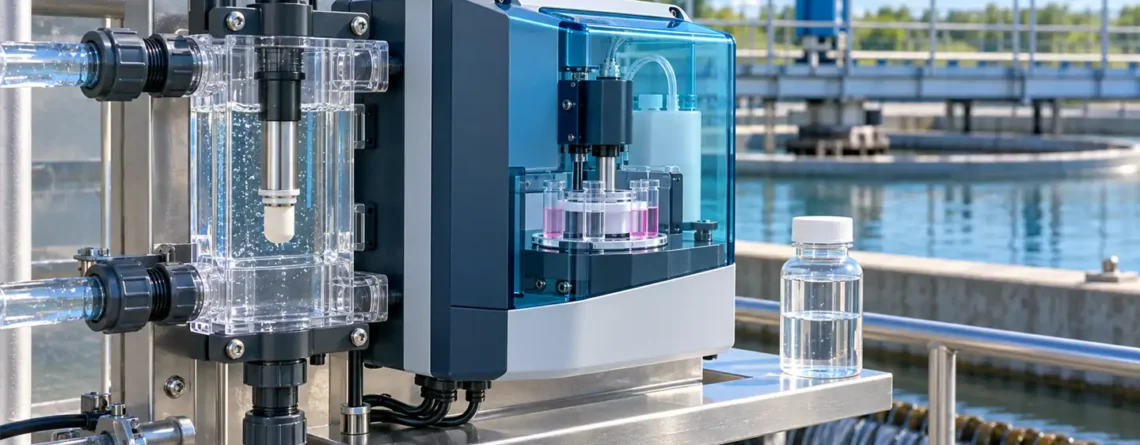
To choose a free-chlorine sensor, first define which chlorine residual must be reported, where the water sample represents the process, and how the online result will be compared with a reference method. A membrane amperometric probe, a bare-electrode system and an online DPD colorimetric analyzer can all serve a water-treatment application, but their response to pH, flow, other oxidants and maintenance differs. A specification that merely says “chlorine sensor, 0–5 mg/L” is too thin to support reliable control.
This article is about free chlorine in water, not chlorine gas leaking into air. The latter requires an atmospheric detector and a different placement and warning strategy; our chlorine gas detector guide covers that task. Here the measurement chain starts at a water sample point, passes through tubing or a flow cell, then through sensor chemistry and transmitter calculations, and finally reaches a display or control action. Each stage can change what the number means.
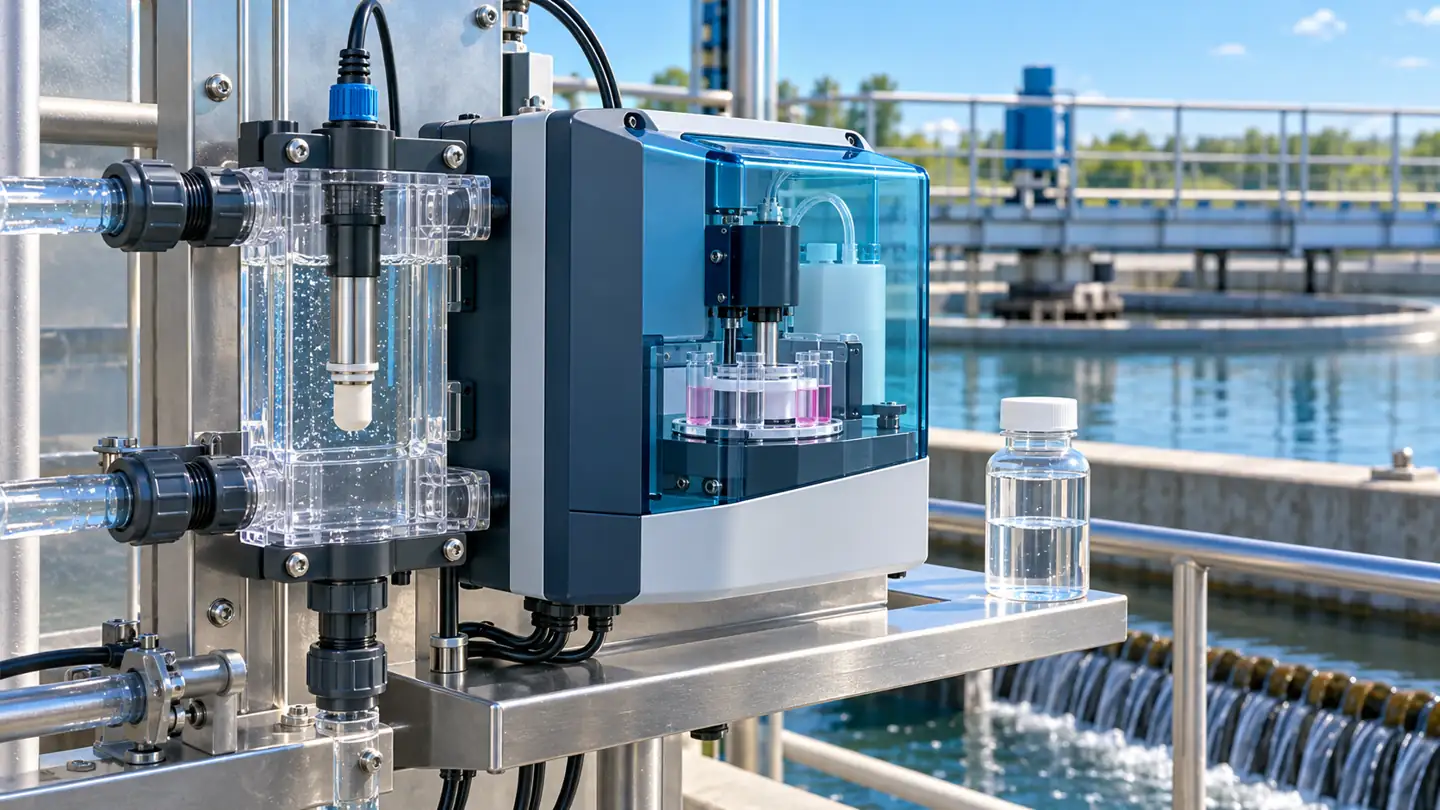
Decide whether the question is free, combined or total chlorine
Free chlorine is commonly described as the sum of dissolved chlorine-related species including hypochlorous acid (HOCl) and hypochlorite ion (OCl⁻), with their proportions governed strongly by pH. Combined chlorine includes chloramines formed when chlorine reacts with ammonia or nitrogen compounds. Total chlorine is free plus combined chlorine under the definition of the chosen method. These categories are not interchangeable. If a plant uses chloramination, a free-chlorine reading alone cannot stand in for its total residual. If a process requires free chlorine after a dosing point, a total chlorine analyzer may conceal a change in species distribution.
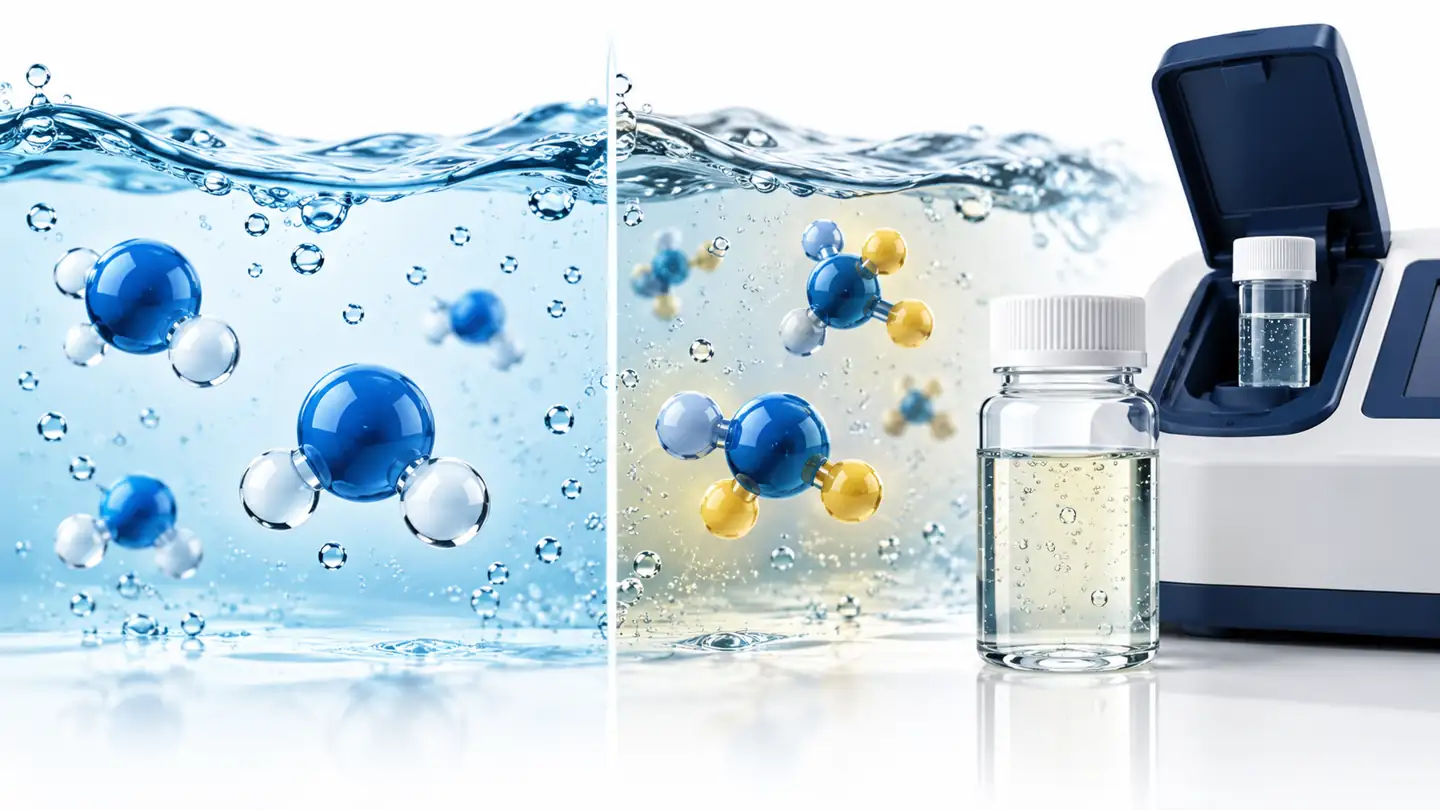
ال EPA's distribution-system sensor evaluation compares reagent-based and reagent-free chlorine instruments and explains why their response and consumables differ. The source also notes that pH changes the balance between HOCl and OCl⁻. When a membrane sensor mainly passes HOCl, the instrument may use pH measurement or conditioning to report an estimated free-chlorine concentration. That calculation and its validity range must be checked for the specific analyzer. Some designs are less pH-dependent than others; “amperometric” alone is not enough information.
For the purchase specification, write the exact reported quantity and units. Many instruments display mg/L as Cl₂, which is a conventional reporting basis for chlorine residual. That does not mean the water sample contains only molecular Cl₂. Do not compare a value reported as free chlorine with one reported as total chlorine without naming the difference. The sample's pH, temperature and chemical treatment history belong beside the residual reading when interpreting a discrepancy.
What an online amperometric probe actually measures
An amperometric instrument produces an electrical current from an electrochemical reaction involving the target oxidant at an electrode. A membrane version separates the electrodes and electrolyte from the sample while permitting the relevant species to diffuse in. A bare-electrode version exposes electrodes directly to flowing sample water. The instrument converts measured current, calibration and possibly pH and temperature information into a displayed chlorine residual. The entire instrument, not the current alone, defines the reported quantity.
The appeal is continuous measurement with no color reagent added for each reading. The tradeoff is that the response depends on the operating envelope of the sensor and sample system. Flow may be needed to keep fresh water at the electrode surface; too little or unstable flow can change the concentration boundary layer. Deposits and membrane condition can slow diffusion or change sensitivity. Electrolyte and electrode condition change over service life. A temperature sensor can support compensation, but it cannot repair a blocked flow cell or an inappropriate sample point.
For a real example, the Hach CLF10sc/CLT10sc documentation describes a three-electrode reagentless analyzer and gives different accuracy statements under different pH stability conditions. Those values belong to those named configurations and their stated test conditions. They illustrate why a single headline accuracy number is insufficient. A procurement comparison should ask for the range, lower limit, allowable pH and pH-change tolerance, flow range, temperature range, expected stabilization, calibration method and consumable schedule for the exact configuration.
What an online DPD analyzer does differently
A DPD colorimetric method adds reagent to a sample. The resulting color is measured optically and related to a free or total chlorine concentration according to the method and reagent sequence. An online analyzer automates sampling, reagent handling and the optical reading. It often offers a chemically defined comparison basis, but it introduces reagent storage, supply, pump/tubing, waste and maintenance needs. A reagent-based analyzer is not “maintenance free” merely because its chemistry differs from an amperometric probe.
ال EPA small-system handbook describes DPD, membrane polarographic and amperometric approaches as distinct ways to measure residual chlorine. The EPA's distribution-monitoring evaluation gives examples of online reagent and reagent-free instruments, including the practical consumables that accompany each. The models and annual prices in that older evaluation are historical examples, not current procurement quotes. Its value here is the comparison of measurement mechanisms and maintenance burden.
The decision is not simply “DPD accurate, amperometric fast.” Both can perform well when the sample and maintenance match the device. A DPD analyzer can still be affected by reagent quality, dirty optics, flow or other oxidants that react in the chemistry. An amperometric analyzer can be accurate after proper calibration yet drift when pH, flow or membrane condition changes. Compare the uncertainty in the actual process water, the operational cost and the time from sample change to usable output. A laboratory or portable DPD test is also commonly used as a comparison for an online probe, but the two samples must represent the same water at nearly the same time.
| Choice | Useful when | What deserves a trial or documented check |
|---|---|---|
| Membrane amperometric probe | Continuous trend or control in a fairly defined water matrix | pH dependence, membrane and electrolyte upkeep, minimum flow, fouling, reference-method comparison. |
| Bare-electrode amperometric system | Suitable sample quality and an approved electrode/flow-cell arrangement | Flow stability, electrode cleaning, water hardness, calibration and matrix effects. |
| Online DPD analyzer | Reagent-based free or total result is needed at a fixed point | Reagent and waste handling, sample and pump reliability, cycle time, other oxidants, optical maintenance. |
| Manual or portable DPD check | Independent field comparison or diagnostic sample | Correct method, reagent condition, timing, sampling location and operator technique. |
The sampling point can dominate the result
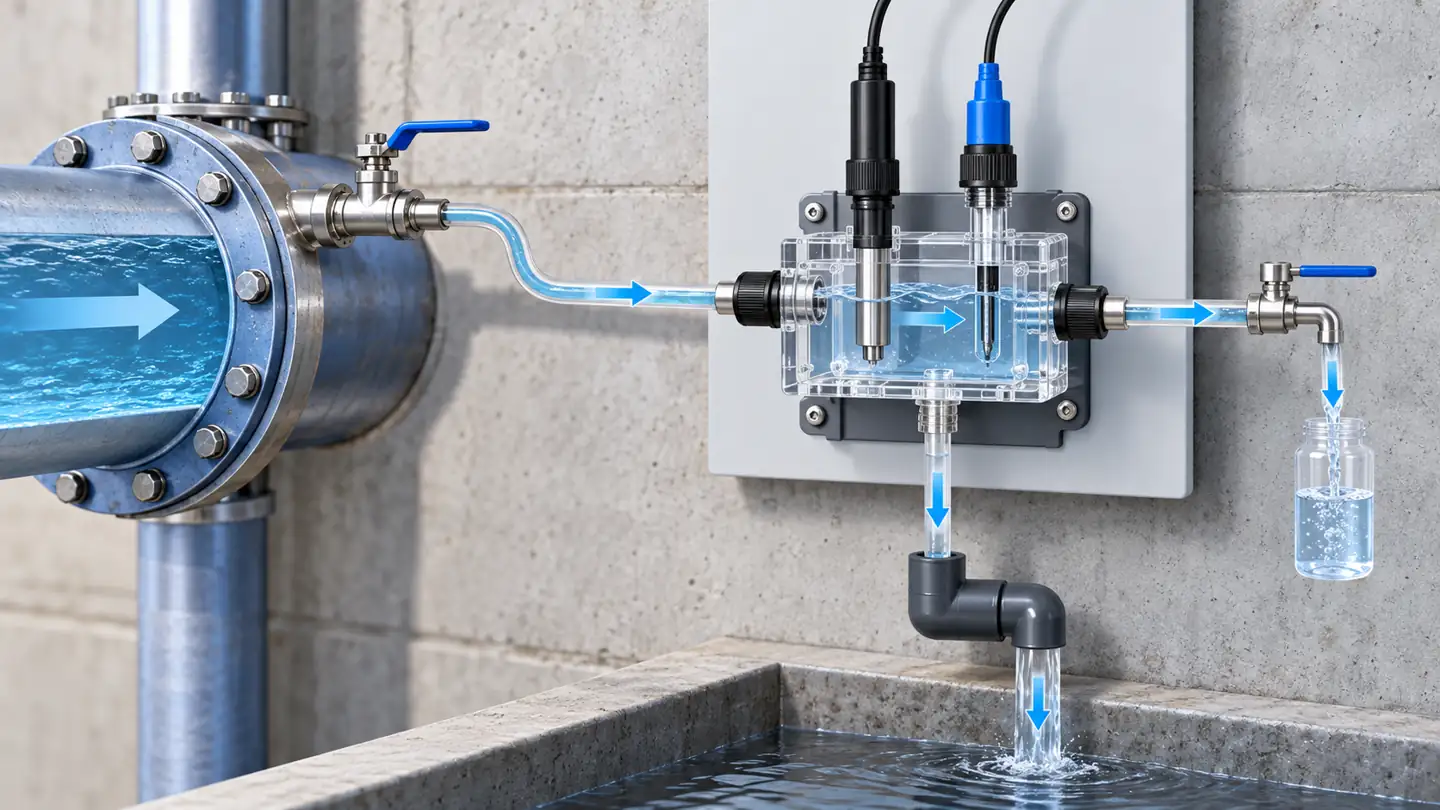
The analyzer only sees the water that reaches it. Place the sample tap where the mixture is representative of the decision: after adequate mixing if the aim is to verify dosing, at a distribution point if the aim is residual delivery, or at a process outlet if the aim is control there. A sample taken immediately beside a chemical injection point may show short spikes or poor mixing that do not represent downstream water. A long line may add delay, consume disinfectant at surfaces, warm or cool the sample, or become a place where stagnant water collects. The instrument cannot correct an unrepresentative sample in software.
For an online side stream, document the tap location, tubing length and material, inlet pressure, flow cell, drain, filtration and sample disposal. Check that flow and pressure remain within the instrument's limits during normal and unusual operating conditions. If the analyzer draws from a side stream with pressure reduction, verify that gas bubbles do not form and disrupt the measurement. If a filter is added, consider whether it changes the sample or delays response. A maintenance plan should include the entire sample path, not only the probe tip.
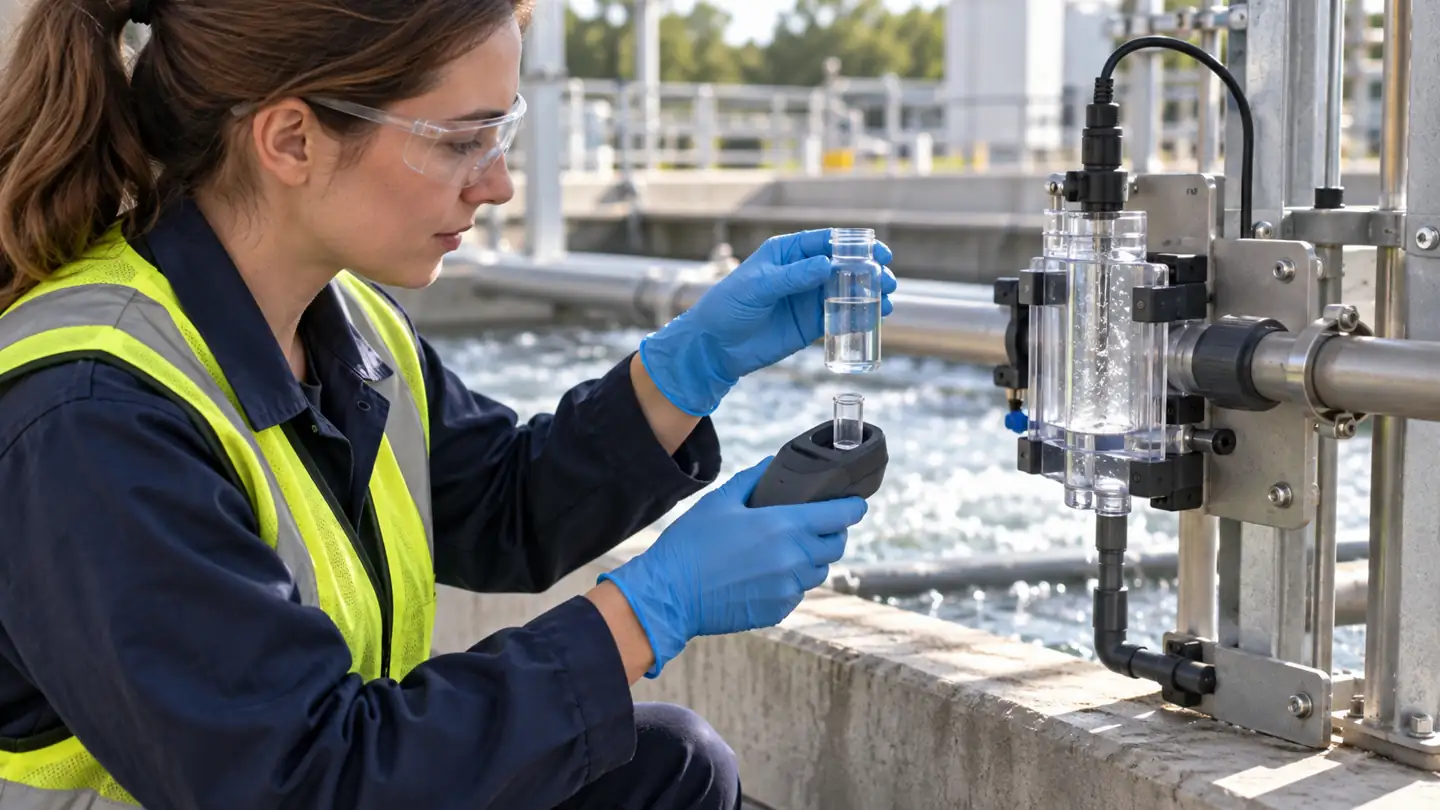
When comparing online readings with a grab sample, collect from a point as close as practicable to the analyzer inlet and note the sampling time. A moving water process can change during the interval between collection, DPD reaction and online display. The analyzer may itself have transport and averaging delay. If values disagree, first determine whether the two measurements saw the same water before adjusting calibration. The Hach case discussion illustrates how a sample location near incomplete chemical mixing can create transient readings; that case is evidence for asking about mixing, not a guarantee that every spike has the same cause.
pH, temperature and chemistry are part of the measurement
As pH rises, the balance between HOCl and OCl⁻ changes. Because an amperometric membrane may be more sensitive to one species, pH can change the current even if an independent free-chlorine method reports the same total free residual. Some analyzers directly measure pH and compensate; others condition the sample; others specify a narrow pH range. Read the instrument's method description rather than assume all “free chlorine” probes work identically.
Temperature changes reaction rates, diffusion and electronics. A probe with integrated temperature measurement may compensate within a specified range. That does not mean its performance is temperature-independent. If a sample line runs through a hot room while the process pipe is cool, the analyzer may see a different temperature and chemical equilibrium from the process. Check where temperature is measured and whether the displayed value refers to the sample at the cell.
Other oxidants and water constituents can interfere with DPD and electrochemical methods in different ways. Hach's chlorine parameter overview notes potential DPD reactions involving bromine, iodine, ozone, chlorine dioxide and other oxidants under some conditions. A membrane or bare electrode can likewise respond to compounds other than its intended analyte. If the plant uses multiple disinfectants or has process-derived oxidants, ask for a matrix-specific interference assessment. A clean calibration standard does not reproduce a complex plant sample.
Verify the installed measurement, not only the sensor
At commissioning, record the analyzer model, chemistry, range, units, sample tap and flow, pH input, temperature input, calibration method, output scaling and control action. Confirm the signal at the controller corresponds to the local display, including fault and out-of-range states. An online chlorine value used for dosing is an operational input; incorrect units, stale sample or a failed pump can have consequences even if the probe itself is healthy.
For a reference comparison, use the approved method and follow its sample timing, reagents and range. Record the reference reading, online reading, sample pH and temperature, flow and the interval between them. Do not adjust a probe to a single questionable grab result. Check reagent expiry, cuvette cleanliness, sample representativeness and analyzer stabilization first. If the instrument requires a zero, slope or multi-point calibration, follow its manual and keep the as-found result before making changes. A result that matches after adjustment does not document how far the instrument had drifted.
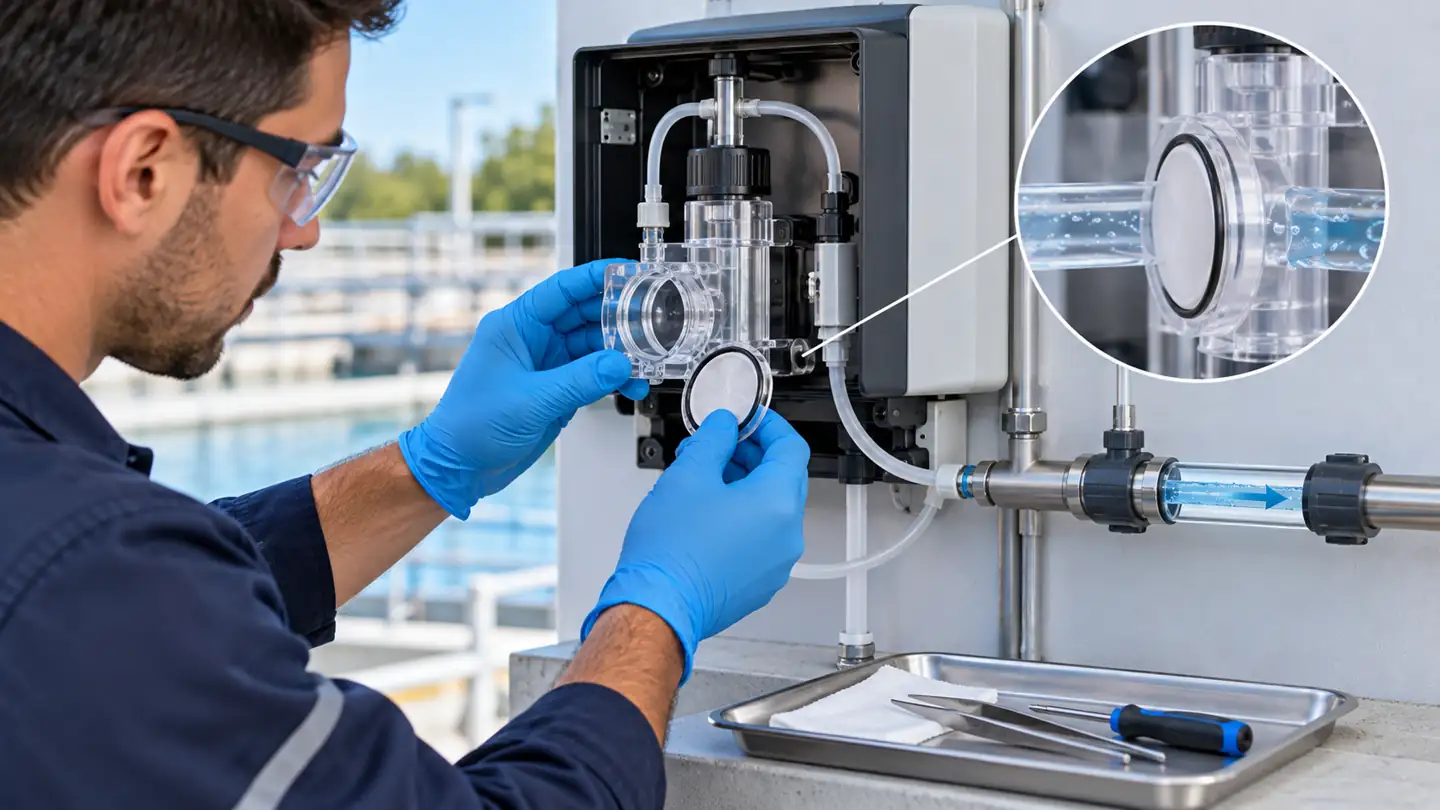
Service tasks depend on the model: cleaning the flow cell, inspecting the membrane, replenishing electrolyte, replacing reagents, checking pump and tubing, and confirming that a pH or temperature input still represents the same sample. A cleaning step can temporarily disturb an electrode; allow the manufacturer's stabilization time before judging its reading. After a replacement or calibration, compare against an independent measurement and verify the downstream signal. Schedule maintenance by observed drift and conditions as well as manufacturer intervals.
What a single chlorine number cannot tell you
A free-chlorine residual does not by itself prove microbiological safety at every point in a distribution system. It is one process measurement and must be interpreted with treatment design, contact conditions, sampling, microbial monitoring and applicable local rules. Nor does one online reading prove that the residual is uniform across a large tank or pipe network. The purpose and sampling location must travel with the data.
ORP is another water measurement often placed near chlorine equipment, but it is not a direct free-chlorine concentration. It reflects a mixed electrochemical potential influenced by pH and all relevant redox species. A plant may use it as an additional trend or control signal after validating its relationship in that specific water, while still using a direct chlorine method when a residual concentration is required. The same caution applies to conductivity: it tracks the water's ionic conductance, not the disinfectant species. Keeping these channels distinct makes the process dashboard more informative.
A practical procurement and acceptance worksheet
Specify the operating envelope, not one ideal sample
An analyzer may perform well at a reference pH and temperature yet see a very different water during plant startup, seasonal source changes or chemical changeover. Build a small matrix of conditions rather than asking only for one nominal point. Include the usual low and high residual, the normal pH span, temperature extremes, maximum turbidity or suspended material, and any period when the sample flow is reduced. Identify when chloramines, bromine compounds or other oxidants may be present. This is the evidence needed to decide whether a proposed technology's stated range is relevant.
Consider the amount of process variation the control loop can tolerate before an online value becomes misleading. If a probe is calibrated at one pH and its specification requires the water pH to remain close to that value, a seasonal pH shift may require a new comparison or a different sensor configuration. If the sample line runs warmer than the main, establish whether the compensation uses the cell temperature and whether the side-stream chemistry remains representative. A vendor statement that a sensor is “temperature compensated” is only the beginning of this check.
Response time should also be described from the process change to the controller value. A cell may react quickly to a step in its flow cell, but a long side stream, analyzer cycle, averaging filter and communication delay can dominate. The process engineer should decide how quickly a control system must recognize a low residual and then verify the complete chain. A fast sensor paired with an unmonitored sample pump is less useful than a slightly slower analyzer whose loss of flow is clearly flagged. These are system-level acceptance criteria, not a competition over the shortest datasheet T90.
Compare at steady and changing conditions
One side-by-side comparison at a stable operating point cannot reveal all relevant errors. A better acceptance plan checks normal operation across several days, then examines naturally occurring changes in residual, flow and pH without deliberately disturbing a safety-critical treatment process. Pair each online observation with a well-timed reference sample and record where both samples came from. Examine whether the online system follows the reference trend, whether it has a persistent offset, and whether a particular condition makes the difference larger.
For an online DPD analyzer, note its cycle and reagent status. For an amperometric probe, note flow-cell condition, pH input and time since calibration. A difference at the exact moment of a dosing change may be transport lag rather than an accuracy failure. The same discrepancy at steady state is more likely to warrant a method or configuration review. This distinction helps avoid a poor adjustment that forces two delayed signals to agree at one instant and makes them disagree later.
Compare uncertainty with the actual decision. If the plant only needs to see a broad trend, a method with modest absolute agreement may still be useful. If a controller or reporting requirement depends on a narrow residual band, the error budget must include the reference method, sampling, analyzer and process variability. Put the accepted tolerance and required comparison frequency in the commissioning record. A number in a brochure is not a substitute for a site acceptance criterion.
Plan the failure state before relying on the reading
An online channel can fail while continuing to display a plausible number. Reagent exhaustion, lost sample flow, a blocked membrane, a disconnected pH input or a stale controller value may not resemble an obvious zero. Ask how the instrument marks its result as invalid, whether the controller receives that status, and what action the site takes when the channel is unavailable. Test the failure and recovery path under an approved commissioning procedure. A process controller should not treat a held-last-good value as fresh evidence of adequate disinfectant.
The monitoring plan should identify who responds to a failed comparison, who authorizes a calibration adjustment, and what independent measurement protects the process while the online channel is under service. Record both the as-found and as-left states. This gives the next operator a usable history: a drift trend can be distinguished from a sudden sample-path problem, and a recent membrane or reagent change can be correlated with a discontinuity in the data.
Before comparing quotes, ask each vendor to fill the same fields:
- Reported quantity: free, combined or total chlorine; units and reporting basis.
- Process sample: source, expected pH and temperature range, pressure, flow, turbidity and other oxidants.
- Measurement method: membrane/bare amperometric or colorimetric chemistry; pH measurement or conditioning; measurement cycle.
- أداء: range, limit of quantitation, accuracy statement and its reference conditions, response at the instrument outlet, drift and recovery.
- Sampling hardware: tap, tubing, flow cell, pump, filters, drain and flow-fault indication.
- صيانة: membrane, electrolyte, reagents, tubing, cleaning and calibration reference method.
- Controls: outputs, failure state, calibration hold, alarm or dosing action and data logging.
- Acceptance: side-by-side comparison protocol at normal and changing process conditions, with pH and flow recorded.
A model can look excellent on one row and unsuitable on another. For instance, a reagent-free design may save reagent handling but need more frequent attention to a fouling membrane in a particular water. A reagent analyzer may be easier to relate to a DPD method but impossible to maintain where reagent delivery and waste handling are constrained. Ask for the full cost and service plan over the intended operating period, not just the purchase price.
Before answering common questions, it helps to distinguish three layers of evidence. The reference method establishes a sample result under a defined procedure. The online analyzer supplies a continuous trend at one location under its stated conditions. The process record explains why that location and time matter to treatment. None of these replaces the others. An excellent analyzer on an unrepresentative side stream can disagree with the process; a carefully performed grab test can miss a short event between samples; a process model can be wrong when chemical demand changes. Maintaining all three layers gives operators a way to investigate rather than simply choose the number they prefer.
For a new installation, save the acceptance data in a form that a future technician can repeat: sample tap drawing, analyzer configuration, reference method, normal pH and flow, comparison schedule and allowed deviation. Note whether the controller receives a direct measured value, an averaged value or a held value during maintenance. The same documentation becomes essential after a probe replacement, software update or change in disinfectant practice. A sensor is most useful when its meaning survives the people who first installed it.
When the analyzer supports a control loop, include a periodic check of the control output itself. The local display, transmitted value and historian tag should agree within their expected timing and scaling. Review any software smoothing or averaging, because it can make a noisy signal easier to use while delaying recognition of a genuine process change. The written acceptance plan should state which value the operator sees and which value the controller acts on.
الأسئلة المتداولة
Does an amperometric free-chlorine probe measure every chlorine species equally?
No. The electrode and membrane design determine which species reach and react at the sensing surface. The transmitter may use pH compensation or sample conditioning to report free chlorine. Check the named model and its specified pH and matrix conditions.
Is DPD always the correct reference for an online probe?
Use the reference method required by the instrument manual and applicable process or regulatory method. DPD is common, but a meaningful comparison requires the correct free or total procedure, suitable range, fresh reagents and a representative sample taken near the analyzer inlet.
Can a stable reading prove the sample line is working?
No. Stagnant water or a failed flow path can also produce a stable display. Check sample flow and the instrument's flow-fault indication, then challenge or compare the system using its approved procedure.
Why did the reading change when pH changed but dosing did not?
The HOCl/OCl⁻ distribution changes with pH, and some sensor designs respond differently to those species. Sample mixing, temperature and actual dosing changes are other possibilities. Compare simultaneous pH, flow and an independent chlorine measurement before assigning a cause.
Is ORP a cheaper substitute for a free-chlorine residual analyzer?
Not when a concentration result is required. ORP is a non-specific potential and its relationship to chlorine depends on the water matrix. It can be an additional trend under a validated control strategy, but it should not be relabeled as mg/L free chlorine.
المصادر الفنية
- US EPA, Distribution System Water Quality Monitoring: Sensor Technology Evaluation — online chlorine measurement methods and sample/matrix considerations.
- US EPA, Small Drinking Water Systems Handbook — distinctions among DPD, polarographic and amperometric methods.
- Hach CLF10sc/CLT10sc documentation — model-specific pH-conditioned performance example.
- Hach chlorine parameter overview — free/total methods and chemical interferences.
- Endress+Hauser amperometric chlorine measurement guide — liquid-phase sensor principle and conditions.








تعليق (1)
[…] when an operating or legal requirement names a concentration. For free chlorine in water, our online free-chlorine sensor guide compares amperometric and DPD methods; link it only after that article is […]