
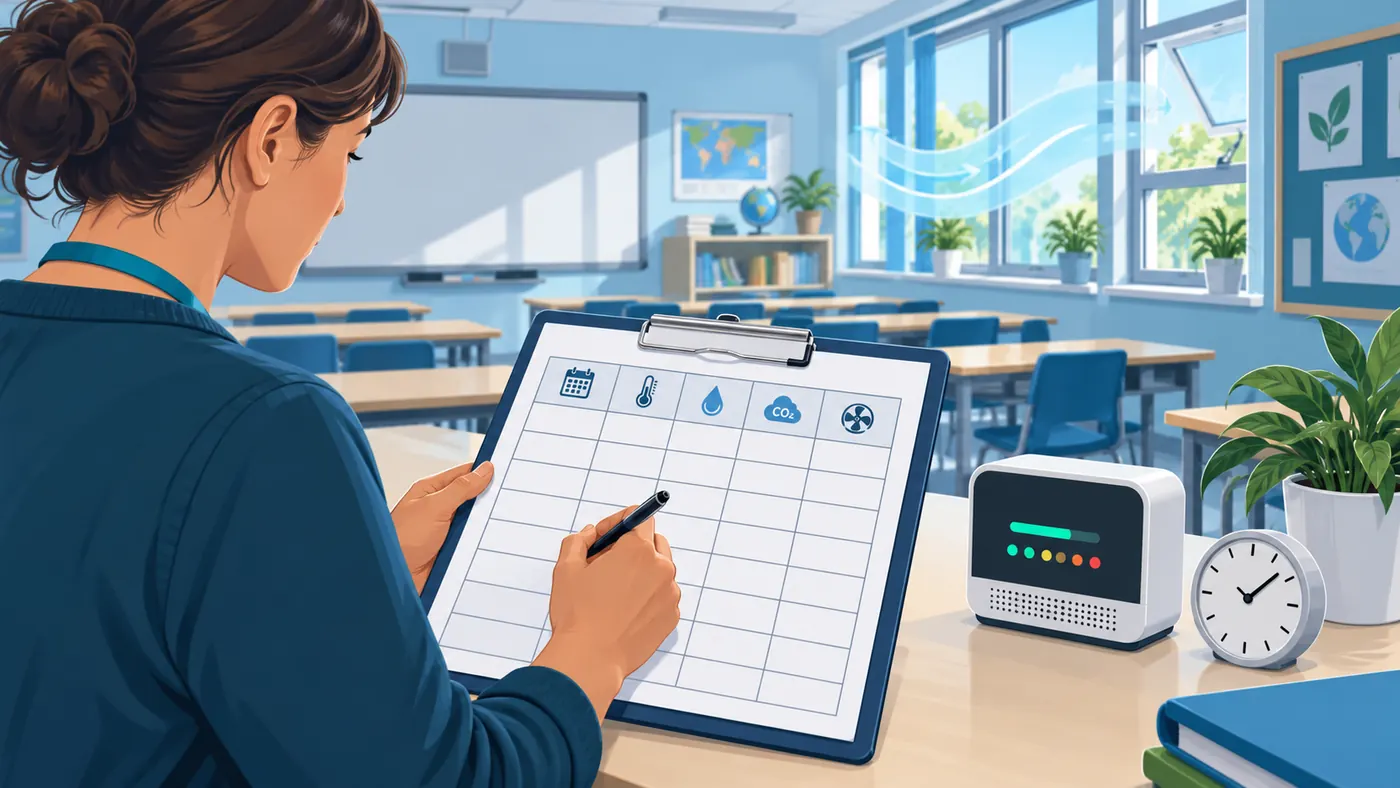
A useful school indoor-air-quality record connects three things: the room and instrument, the conditions during each observation, and the action taken afterward. A CO₂ value on its own cannot tell a facilities team whether a crowded lesson, closed window, changed HVAC schedule, misplaced sensor or actual ventilation fault produced the pattern. Nor can a CO₂ chart describe every indoor pollutant. A short, consistent record turns a monitor into evidence that staff can revisit and use for a specific decision.
Der US EPA's school IAQ guidance treats recordkeeping as part of an ongoing program of observation, communication, inspection and corrective action. The UK Department for Education's current school ventilation guidance gives a practical use for CO₂ monitors in occupied spaces. ASHRAE's position on indoor CO₂ explains why concentration requires measurement context and should not be used as a universal indoor-air-quality score. The templates below are designed around those distinctions. They are blank working examples; adapt fields, retention and escalation to your jurisdiction and school policy.
Decide what the record must answer
Most school monitoring fails when the dashboard becomes a collection of unexplained peaks. A useful record should let a future reviewer answer: Which room and monitor produced this trace? Was the room occupied? What was the ventilation configuration? Was there a specific concern? What action was taken, and was the result checked under comparable conditions? It should also say when the data cannot support a conclusion. That is more valuable than a decorative “good/poor” color attached to every minute of a school day.
Start with the intended decision. A teacher may want to notify facilities of a recurring high occupied-period CO₂ pattern. Facilities may want to check whether scheduled outdoor air was operating. A school leader may need a list of open issues and follow-up owners. A CO₂ monitor can help screen ventilation patterns, but it does not measure particles, carbon monoxide, combustion products, dampness, mold or chemical sources. The EPA's IAQ Tools for Schools coordinator materials use separate checklists and forms because different problems demand different observations.
Keep the record lean enough to be used. A short form completed reliably after a meaningful observation beats an elaborate spreadsheet that teachers abandon. The key is stable identifiers and a clear path from observation to follow-up. Three linked layers work well: a room-and-device register, an occupied-event log, and an issue/action log. Each layer has a different owner and frequency of change.
Layer 1: a room and device register
The register describes the measurement point. Make one entry when a monitor is installed or moved, and version it when anything important changes. Record the room ID used by the school, building or floor, intended use, normal seating capacity, ventilation system or zone if known, monitor make/model/serial number, direct CO₂ measurement method, inlet position and height, logging interval, clock/time zone and current service state. A small sketch can show the inlet relative to desks, windows, doors and supply outlets. Avoid publishing floor plans or identifying children; this is an internal facilities document.
| Register field | Blank entry | Warum es wichtig ist |
|---|---|---|
| Room ID and building | ____ | Links observations to a real location. |
| Room use and normal occupancy | ____ | Helps compare like with like. |
| HVAC system or zone, if known | ____ | Directs a facilities inspection. |
| Monitor make, model and serial | ____ | Separates a device issue from a room issue. |
| Measurement method and software version | ____ | Confirms that CO₂ is measured directly and notes changes. |
| Inlet position, height and nearby air paths | ____ | Explains possible local bias. |
| Logging interval, time zone and clock check | ____ | Makes time-series comparisons possible. |
| Calibration/service status and instructions | ____ | Flags potential instrument uncertainty. |
| Effective date, record owner and revision | ____ | Preserves what position was in use at each observation. |
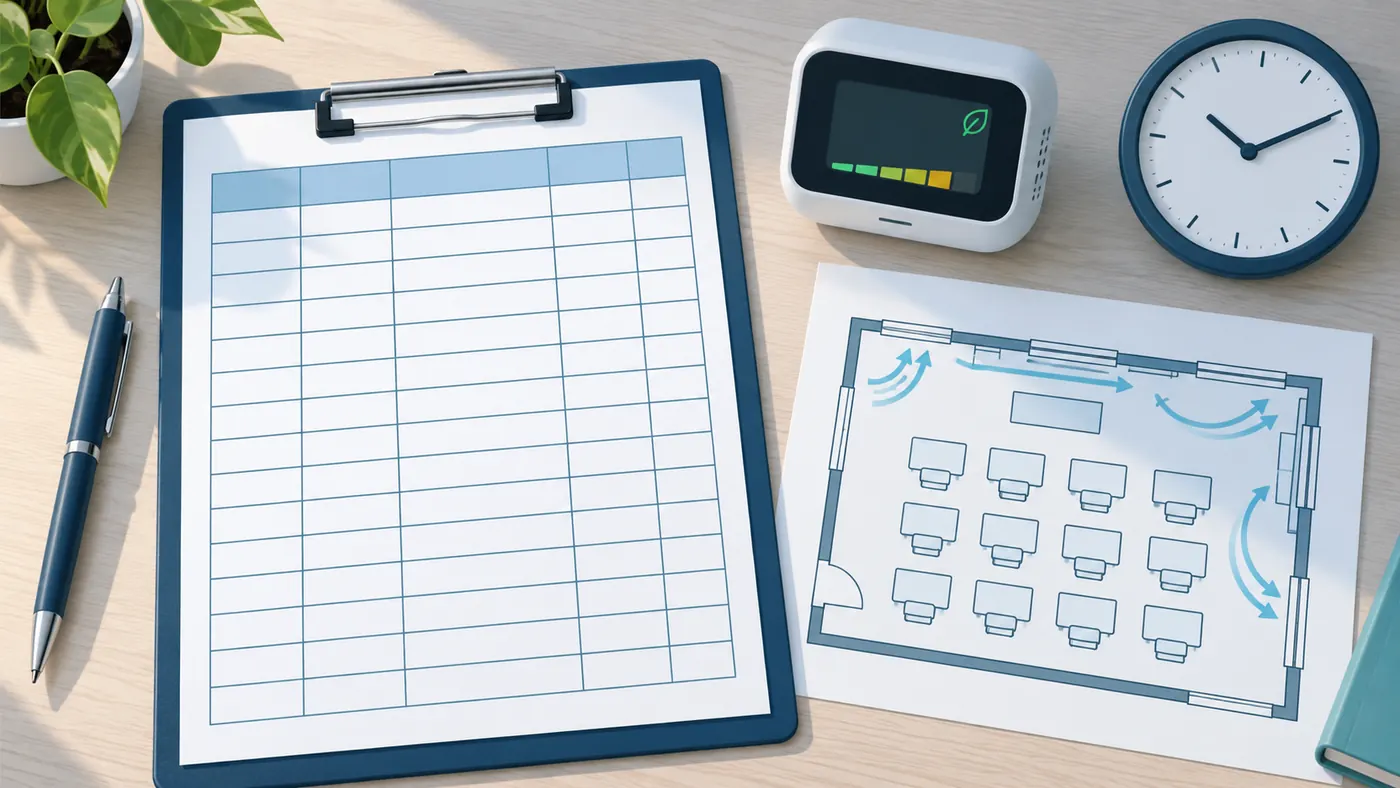
The image illustrates the kinds of fields to capture. It is not a photograph of a school form or evidence of an actual measurement. The exact calibration language should come from the particular monitor's manual. A simple “last serviced” date does not establish that a device is accurate; a service record, verification method and instrument condition must be considered. Our Leitfaden zur Genauigkeit des CO₂-Monitors explains how stated accuracy and display resolution differ.
Do not quietly overwrite old positions when a unit moves. A trace recorded before a move belongs to the old register revision. If the school rotates one portable unit through several rooms, log the deployment start and end time, room ID and responsible person. The school classroom placement guide details how to select and check a representative point. A new shelf, room divider or diffuser setting may be enough to require a placement review even if the monitor has not physically moved.
Layer 2: an occupied-event log
The event log provides the conditions behind a reading or time-series segment. It need not transcribe every number displayed all day. For a manual monitor, record a defined observation time or a short series during an occupied lesson. For a logger, keep its raw export and identify the lesson interval or event being interpreted. In both cases, note people present, approximate time since entry, window and door state, ventilation system mode if known, and any unusual activity. A number from an empty classroom is a useful baseline but should not be presented as the occupied result.
Der Welsh Government's guidance for education settings emphasizes monitoring during occupancy and considering repeated observations. A single snapshot can be distorted by where the device sits or when pupils entered. The UK Health and Safety Executive likewise frames CO₂ readings as an aid to judging ventilation in occupied spaces with a suitable monitor and placement. If the school follows a local action scheme, record its source and version in the procedure, not as a universal interpretation baked into every cell.
| Event field | Blank entry | Recording rule |
|---|---|---|
| Event ID | ____ | Unique, stable reference for follow-up. |
| Room and register revision | ____ | Links to the correct position and device. |
| Date, start/end time and time zone | ____ | Defines the occupied interval. |
| Pupils and staff present | ____ | Count or defensible estimate; do not list names. |
| Activity and time since entry | ____ | Explains changes in occupant generation. |
| CO₂ value(s) or raw-log file reference, ppm | ____ | State whether spot, average or interval trace. |
| Windows, doors and ventilation mode | ____ | Record observed state, not assumed design intent. |
| Temperature/humidity if actually measured | ____ | Use units and device; leave blank otherwise. |
| Event or data-quality note | ____ | Explain a move, outage, unusual class or uncertainty. |
| Recorder and record time | ____ | Enables clarification and later audit. |
These are blank fields, not sample readings. Do not insert made-up ppm values to make a school form look complete. If a dashboard reports a class average, preserve the underlying interval definition and any missing samples. A mean from a five-minute period is not directly comparable with a peak from a full lesson. If the product applies smoothing, note that where it changes interpretation. Record CO₂ in ppm and temperature or humidity in their proper units if those channels are present and suitable. The monitor's marketing “air quality score” is not a substitute for the measured channels.
Capture the sequence of a school day
An occupied classroom often has an empty start, a rise after entry, an interval with a steady or changing ventilation configuration, a break and then another group. The same end-of-lesson concentration can come from different starting values and class sizes. Mark the class boundary and any known event on the trace so that later reviewers do not compare unrelated phases. If windows open just as pupils leave, a decline cannot confidently be attributed to either change alone.
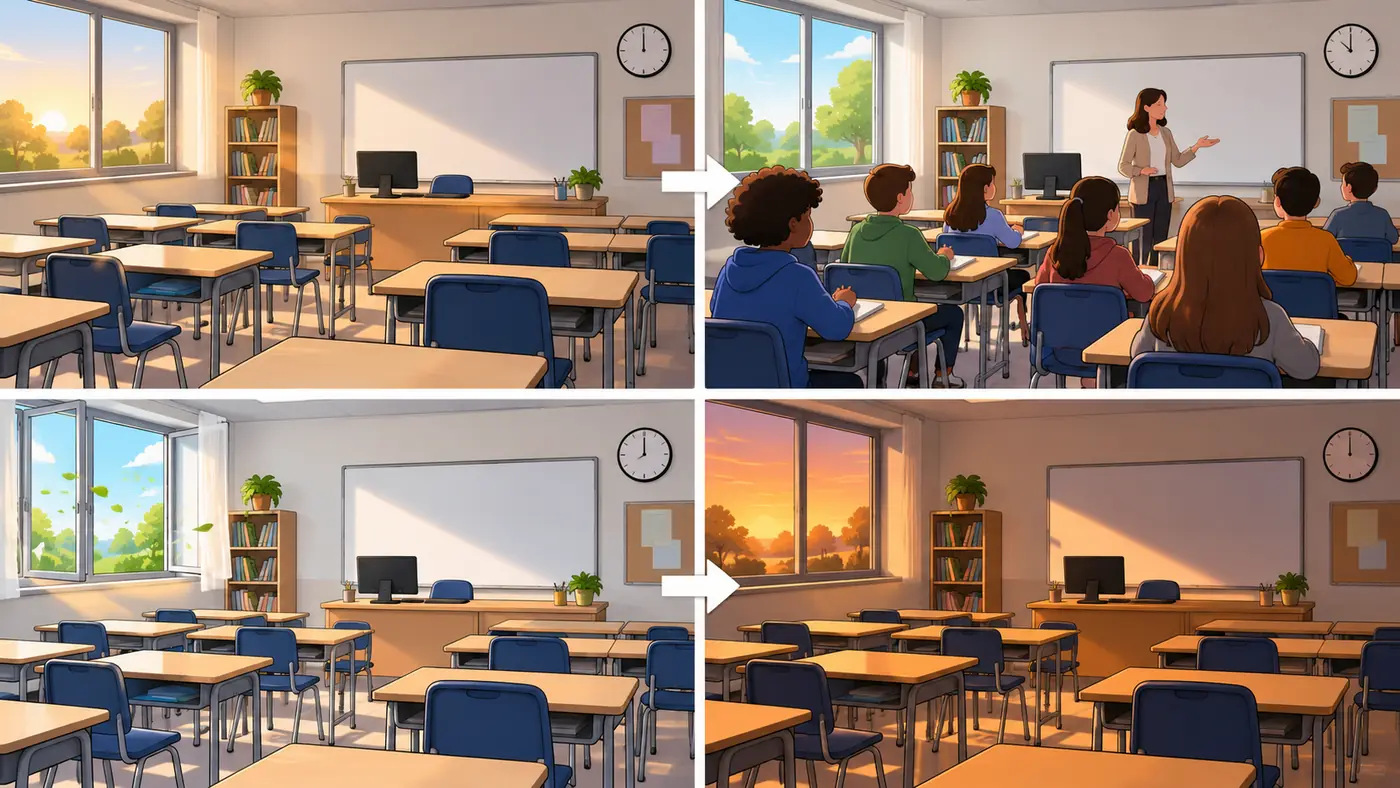
The illustrated timeline is conceptual. A real record should include exact timestamps and source data. For chart comparison, align the monitor clock with the timetable and check daylight-saving and time-zone settings. If one logger records local time and another records UTC, a one-hour or larger offset can create a false apparent delay between a ventilation action and a response. Note manual clock corrections as events; do not silently rewrite the data.
The event log is not a requirement to monitor children individually. Occupancy count and activity category are generally enough for a ventilation question. Avoid names, health details or individual behavior unless a separate authorized school process genuinely needs them. Store monitoring records using the school's access and retention rules. A publicly accessible dashboard should not expose classroom schedules or individual information.
Layer 3: an issue, action and follow-up log
The action log closes the loop. Open an issue when a credible repeated pattern, equipment alert, complaint or other observation calls for investigation. Write the observation in neutral terms, such as “CO₂ increased during three similarly occupied afternoon lessons,” rather than claiming “the HVAC is broken” before it has been checked. State the applicable local guidance or internal criterion and its source. Assign an owner and a next review date. A work order, site inspection or consultation can then connect back to the same issue ID.
| Action field | Blank entry | What to preserve |
|---|---|---|
| Issue ID and linked event IDs | ____ | The observations prompting action. |
| Concern and applicable rule/source | ____ | The question and local context. |
| Initial hypotheses | ____ | Possible causes, clearly marked as hypotheses. |
| Action owner and due date | ____ | Who checks the room or system. |
| Investigation and evidence | ____ | Schedule, settings, maintenance, placement or specialist results. |
| Authorized action and time | ____ | What actually changed. |
| Follow-up room, period and conditions | ____ | Whether the comparison is fair. |
| Outcome, remaining uncertainty and status | ____ | Open, monitoring, escalated or closed with reason. |
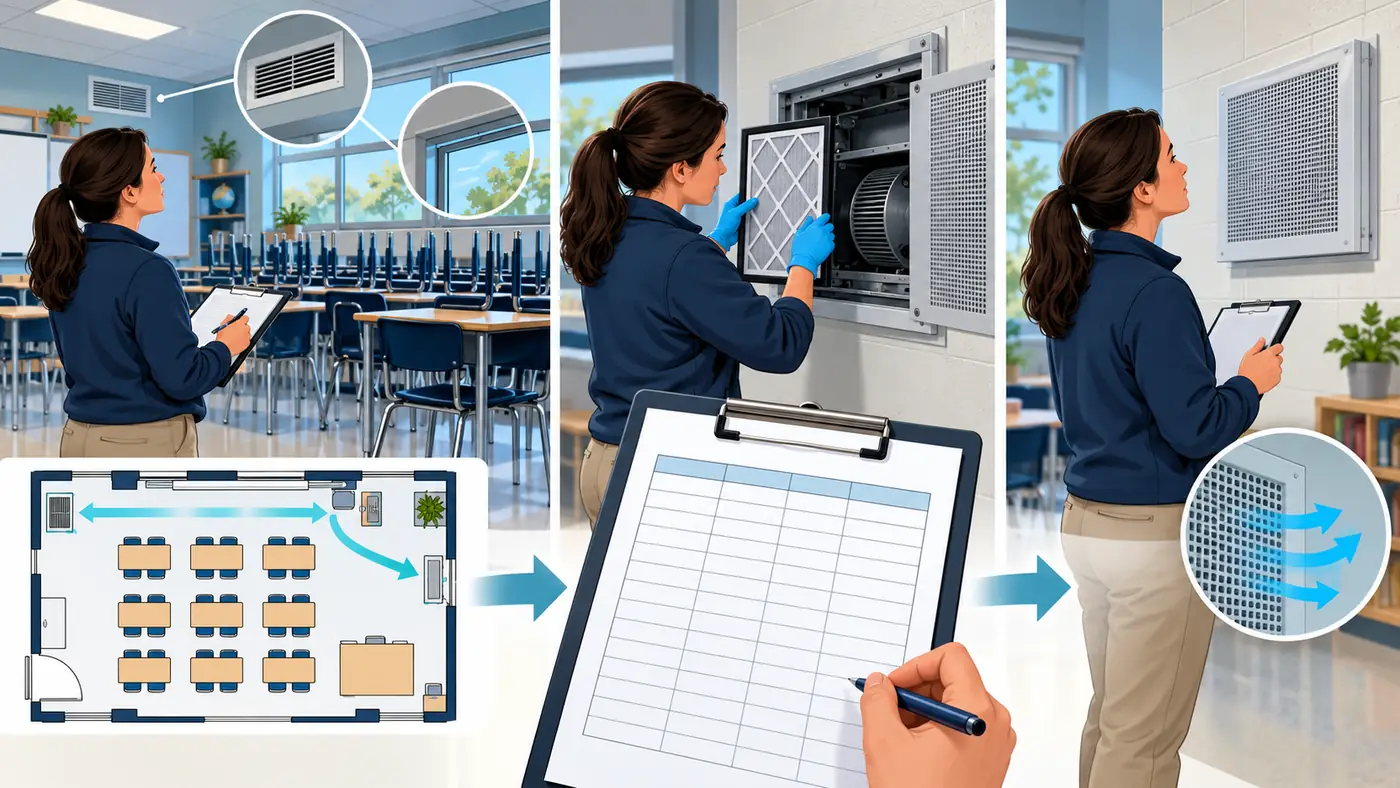
Der EPA's ventilation checklist for schools offers useful categories for facilities checks, including operation and maintenance. It does not make a CO₂ monitor a diagnostic instrument for every fault. The first check may be simple: was the outdoor-air system scheduled on during the lesson, was a damper or vent operating as designed, was the device moved, and were openings used according to school policy? More complex findings need the appropriate building professional. Never use a blog table to authorize an unsafe change to fire doors, security controls or laboratory ventilation.
An action is not complete just because a chart looks lower on the next day. The class might have been smaller, the weather different, the room aired before entry or the monitor moved. Compare similar occupied periods and document differences. Where the action was a mechanical repair, preserve the work order and any commissioning or maintenance evidence. If a concern persists, escalate according to the school's process. If the follow-up is inconclusive, label it inconclusive rather than closing the issue to make a dashboard green.
Mark data quality rather than hiding it
Records become dangerous when they look more certain than the measurement. Use a small set of explicit flags. Examples include missing, device moved, clock uncertain, warm-up, suspected breath plume, ventilation state unknown Und occupancy estimate. Keep the original values or raw export, mark the questionable interval, and explain any exclusion from a comparison. Do not silently interpolate a gap, replace a spike with a pleasing number or combine unverified units. If an extreme value prompts immediate concern, inspect the condition and equipment rather than deleting it automatically.
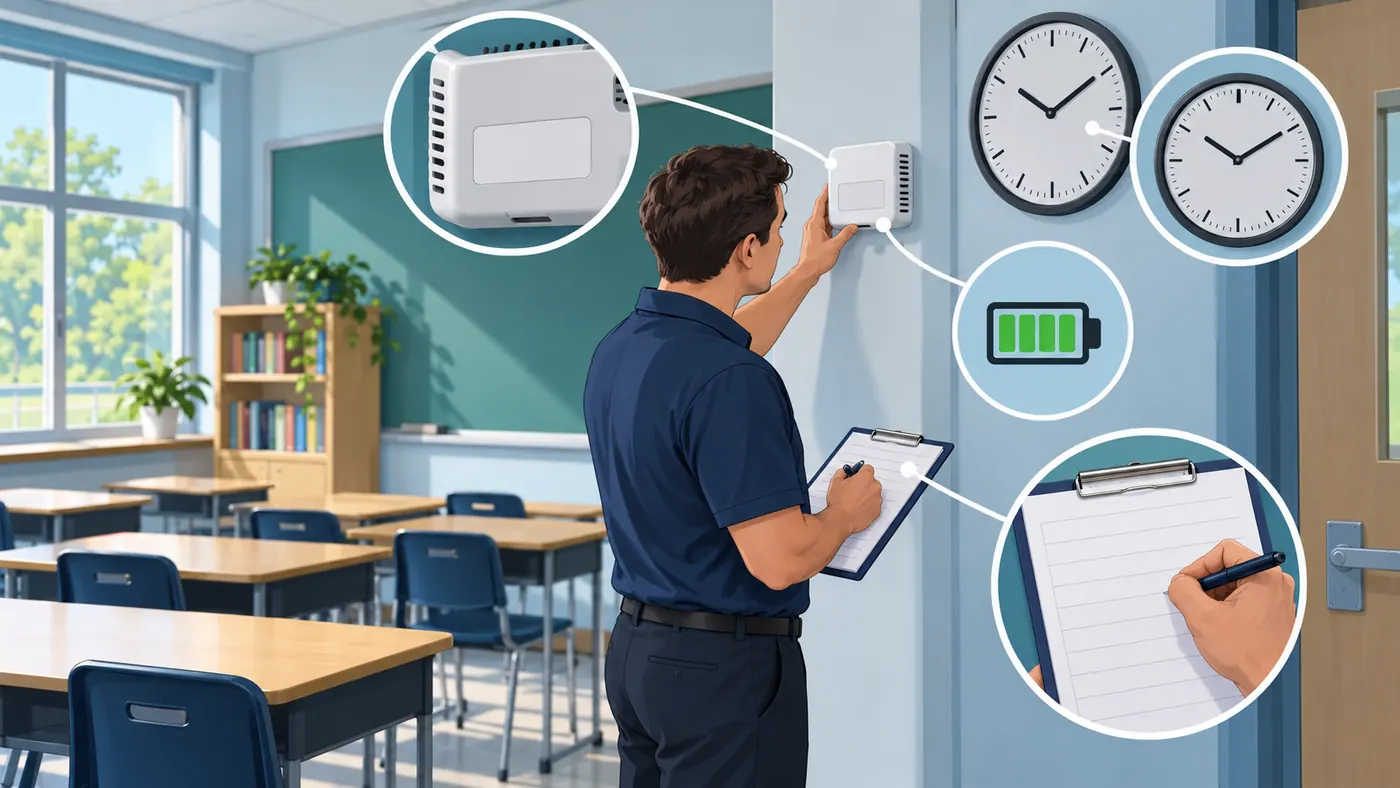
The graphic uses symbols for missing or uncertain intervals; it is not a real school data series. A flat line can be a stable room or a stale sensor output. A sudden jump can be a person breathing near the inlet, a moved unit, a class entry or a genuine air change. A clock discontinuity can place an intervention on the wrong side of a peak. Record enough context to tell these possibilities apart before assigning cause.
For two devices, perform a side-by-side agreement check before using their traces to rank rooms. Allow warm-up as specified, put the inlets in similar air, align clocks and compare the time series against stated accuracy. This is a plausibility check, not formal calibration. If devices differ substantially, investigate the instruments before declaring one classroom worse. Our cross-zone CO₂ comparison guide discusses this principle for other occupied spaces.
Also preserve the measurement definition. A dashboard may report an instantaneous value, rolling average, lesson average or maximum. Those cannot be casually mixed. Write the aggregation and interval next to a reported number. If data is exported, retain the original file and make analysis copies separately. A simple file name containing room ID, date range and time zone helps future staff locate the correct record, but the register and event log remain the authority for device moves and unusual conditions.
Interpret the record without overclaiming
School guidance provides actions within a particular jurisdiction, not a world-wide health diagnosis. For example, the current DfE document for England uses under 800 ppm, 800–1500 ppm and over 1500 ppm as practical ventilation-management bands in education settings. Read those values in that document's context. A different authority or commissioned building design may use another criterion. Our classroom CO₂ interpretation guide explains the limits of a single number and the importance of repeated occupied observations.
ASHRAE warns that CO₂ is not a comprehensive IAQ indicator and that ordinary indoor concentrations cannot be directly translated into a universal health conclusion. The log should therefore allow a teacher or facilities member to report odors, moisture, discomfort or symptoms through the school's established process even when CO₂ is low. For combustion concerns, use appropriate carbon-monoxide safety procedures and instruments; CO₂ and CO are different gases. For particulates, chemicals or biological concerns, assess the relevant source and measurement method. A good monitoring record makes those paths visible rather than erasing them under an all-purpose score.
Do not calculate an air-change rate from a routine classroom trace without a defensible method. Tracer-gas approaches require assumptions about generation, mixing, outdoor concentration and stable conditions. Lessons have changing occupancy and air paths, so a curve that resembles exponential decay is not automatic proof of a ventilation rate. A qualified assessment may use suitable methods when a quantified flow or compliance result is necessary.
Assign a manageable routine
At installation, facilities should create the room/device entry and confirm a representative position. A teacher or designated staff member can record notable occupied observations, or a logger can capture readings while a short event note supplies context. A facilities lead reviews recurring issues, verifies device condition and tracks actions. A school IAQ coordinator or equivalent role can check that unresolved concerns are escalated and that records remain accessible to the people who need them. These roles may be combined in a small school, but the owner should be named.
Choose a review cadence tied to actual decisions: for example, after a newly installed monitor's first occupied lessons, after a ventilation change, after a timetable or seating change, and during routine IAQ review. Avoid generating a daily PDF if nobody reads or acts on it. A summary can show how many rooms were observed, which records have quality flags and which issues remain open. Do not rank classes by a single peak without comparable occupancy and device checks.
If multiple schools use one format, include a revision number and a short field dictionary. Define how occupancy is estimated, what “window open” means, which CO₂ statistic is reported, the time zone and how issue status is changed. Train staff with a blank practice record, not invented readings that might be mistaken for a real classroom. Preserve older versions when fields change so that historical observations are still interpretable.
Common questions about the record
Do we need to write down every CO₂ number?
No. A logger can retain a raw time series while the event log identifies the intervals and conditions relevant to a decision. For a display-only monitor, a small set of timed readings during comparable occupied lessons may be more useful than a long list of untimed values. Keep enough information to reconstruct the observation and avoid selective reporting of only a dramatic maximum.
What if the monitor reads high for one minute?
Record the event and inspect context. A person may have stood next to the inlet, a door may have shut, the room may have filled or the unit may be malfunctioning. Repeat under representative conditions and use the applicable local guidance. One short peak may be a useful prompt to check, but it cannot alone establish a persistent room condition or the cause.
Should temperature and humidity go in the same form?
They can, if suitable instruments actually measured them and their units and locations are recorded. Temperature and humidity affect comfort and can be relevant to a broader IAQ investigation, but they are separate channels. Do not enter estimated values as measurements. A monitor with several sensors still requires each channel's own accuracy and placement considerations.
Can a lower CO₂ reading close a ventilation issue?
It can be part of the evidence if the follow-up is measured in the same room with a suitable instrument and comparable occupancy, duration and operating conditions. Record what changed and what did not. If the original issue concerned another pollutant, a lower CO₂ reading may be irrelevant. Close an issue only with a stated reason and any remaining uncertainty.
Should the school publish classroom-by-classroom charts?
That is a local governance decision, but public charts without context can mislead and may reveal room schedules. A school can often communicate the monitoring purpose, applicable guidance, actions taken and follow-up status more clearly than a raw minute-by-minute feed. Protect pupil information and follow the school's data policy.
A record that survives a staff change
The value of a school IAQ record is continuity. Another teacher, facilities officer or contractor should be able to tell where the monitor was, what happened during the lesson, which observation triggered work and whether a comparable follow-up occurred. When a data gap or weak comparison prevents that conclusion, the record should say so plainly. That honesty makes the next measurement more useful and keeps the school focused on improving actual indoor conditions.
Technische Quellen
- US EPA: Indoor Air Quality Tools for Schools reference guide
- US EPA: IAQ coordinator guide and appendix
- US EPA: Ventilation checklist for schools
- UK Department for Education: Ventilation and air quality in education and childcare settings
- Welsh Government: Carbon dioxide monitors in education settings
- ASHRAE: Position Document on Indoor Carbon Dioxide

So interpretieren Sie CO2-Messwerte in einer Fahrzeugkabine
Lesen Sie CO2-Trends im Fahrzeuginnenraum sowie Passagiere, HVAC-Modus und Streckenbedingungen und trennen Sie Hinweise zur Belüftung von Fragen zur Partikel- und Abgassicherheit.
Mehr lesen
Überwachung von Gasheizungen zu Hause: Welcher Alarm und Sensor macht was?
Machen Sie sich mit den einzelnen Funktionen eines Haushalts-CO-Melders, eines Brenngasdetektors, eines CO2-Monitors und eines qualifizierten Heizungsservices vertraut und erfahren Sie, was nach einer Warnung zu tun ist.
Mehr lesen
So planen Sie die IAQ-Überwachung in gemeinsam genutzten Innenräumen
Planen Sie die Überwachung der Raumluftqualität für Bibliotheken, Wartebereiche und Gemeinschaftsräume, indem Sie CO2, Partikel und andere Kanäle einer definierten Entscheidung zuordnen.
Mehr lesen
Wo man CO2-Monitore in Schulklassen aufstellt
Wählen Sie repräsentative CO2-Monitorpositionen für Schulklassen nach Belegung und Luftwegen aus, überprüfen, dokumentieren und warten Sie dann die Installation.
Mehr lesen
So interpretieren Sie die CO2-Werte im Klassenzimmer für die Belüftung
Interpretieren Sie die CO2-Messwerte im Klassenzimmer als Hinweise auf die Beatmung bei belegter Person mit Kontext, lokaler Anleitung, Monitorkontrollen und wiederholbarer Nachverfolgung.
Mehr lesen
So vergleichen Sie CO2-Messwerte in Großraumbürozonen
Vergleichen Sie synchronisierte CO2-Protokolle im Bürobereich, nachdem Sie die Überwachungsvereinbarung, den Standort, die Belegung und Ereignisse im Luftsystem überprüft haben. Erfahren Sie, wann ein Zonenunterschied eine Untersuchung erfordert.
Mehr lesen