
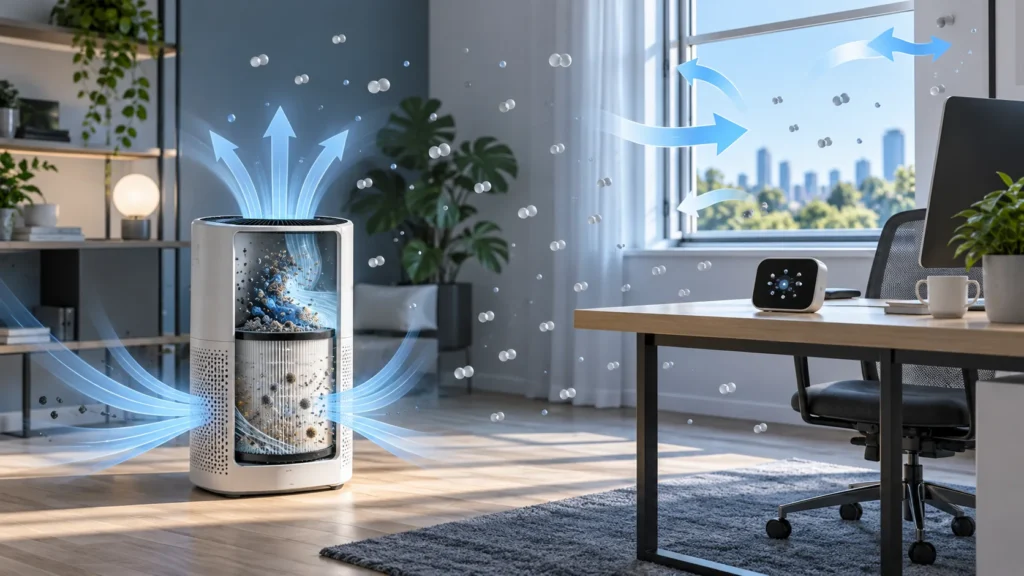
An ordinary room air purifier does not meaningfully lower the carbon dioxide people exhale. A HEPA unit draws indoor air through a particle filter and returns that air to the room; it has not created an outdoor-air supply or a CO₂-removal reaction. A purifier can lower particles while a CO₂ monitor continues to rise in an occupied, poorly ventilated room. If the CO₂ reading changes when the fan switches on, check for room-air mixing, monitor placement, occupancy or another simultaneous change before crediting the filter. Specialized CO₂ scrubbers exist, but they are a different engineered technology and removing CO₂ alone is not the same as providing adequate overall indoor air quality. ASHRAE's 2025 position document makes that distinction.
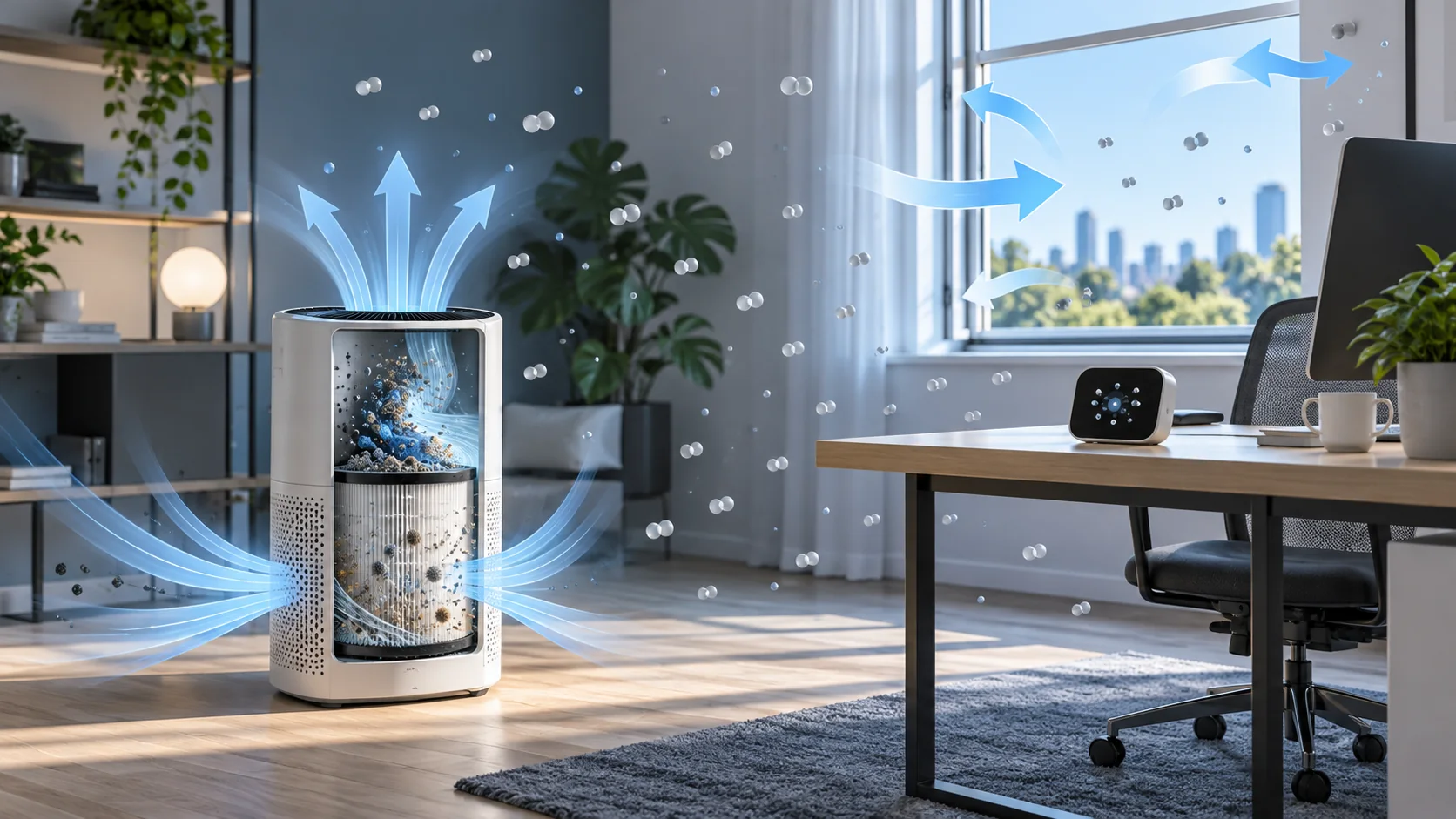

The useful question is not whether a purifier makes air “good” in the abstract. It is which pollutant is being removed, by which physical path, at what flow, in which room? Once the target is named, the device choice and the measurement become clearer. This article considers ordinary consumer room purifiers, typical residential ventilation and household monitors, not industrial gas treatment or an emergency response.
Start with the contaminant, not the box
A dust particle, a respiratory aerosol, an odor-causing volatile organic compound, water vapor, carbon monoxide and carbon dioxide are not interchangeable targets. A device can improve one while leaving another nearly unchanged. A room monitor that combines channels in a colored “air quality” badge can conceal this difference; our concentration-versus-score guide explains why the underlying channel matters.
| Target in a room | Typical relevant pathway | What a normal particle purifier can tell you |
|---|---|---|
| Airborne particles, including some dust and smoke particles | Capture on a suitable mechanical filter; source control; suitable outdoor-air strategy | Particle filtration may help if the unit is correctly sized and operated |
| Occupant-generated CO₂ | Outdoor-air exchange or purpose-designed CO₂ removal | HEPA particle CADR does not establish CO₂ reduction |
| Selected odors or VOCs | Source control, ventilation, sometimes a specifically designed gas sorbent | A carbon stage may help selected gases but needs pollutant-specific evidence |
| Water vapor/humidity | Moisture-source control and moisture removal or suitable ventilation | A HEPA filter is not a dehumidifier |
| Carbon monoxide from combustion | Prevent/repair source, appropriate alarms and safety action | A standard purifier is not a CO alarm or remedy |
Der US EPA Guide to Air Cleaners in the Home distinguishes particle and gas filters. It also explains that the familiar clean air delivery rate, CADR, is a particle-removal metric; it is not a published CO₂ “ventilation rate.” The guide notes that there is no widely used performance rating for portable gas filters comparable to particle CADR. Read the claims for the specific contaminant and device, rather than assuming that a strong particle rating transfers to every gas.
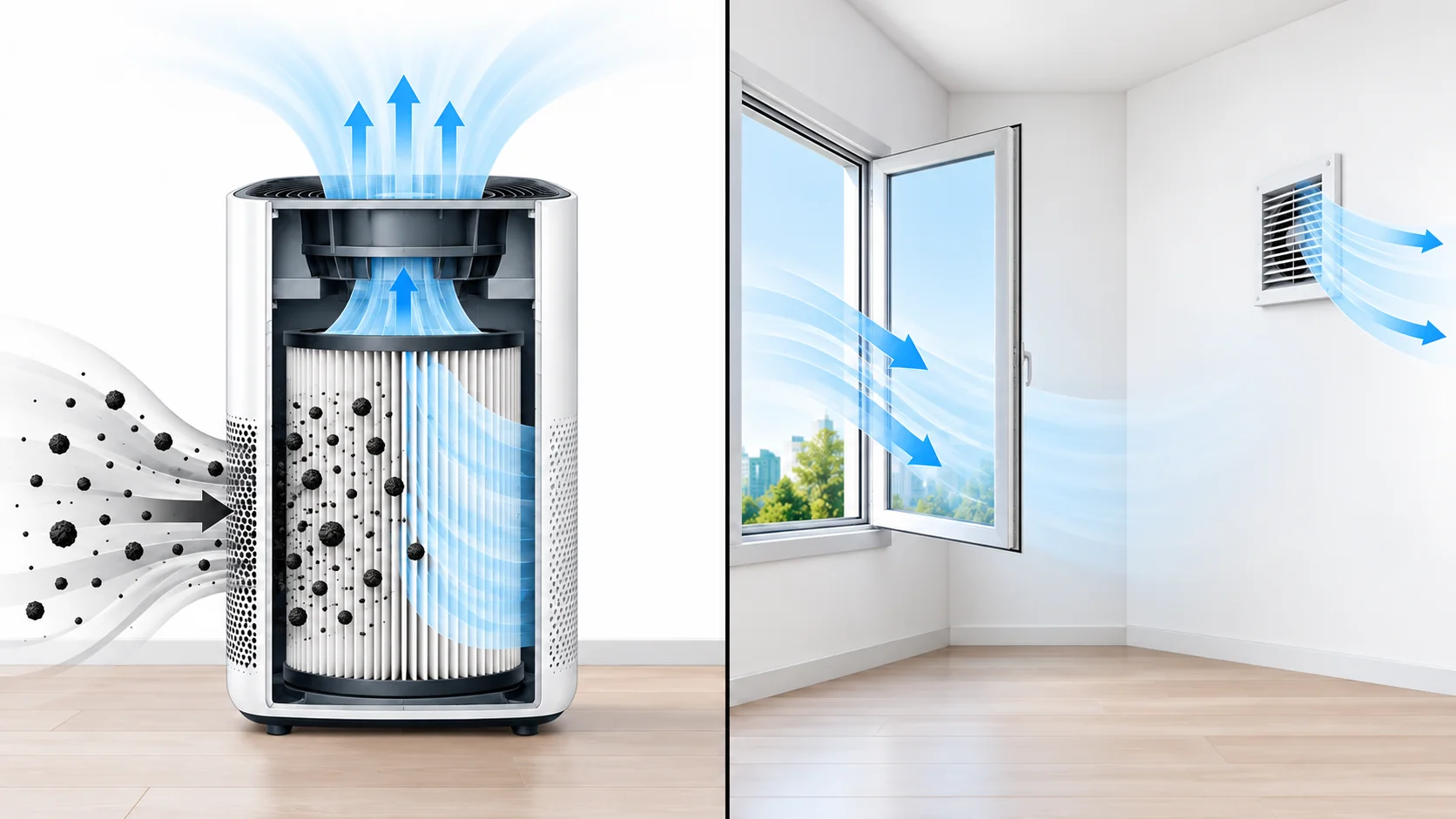
This also explains why US EPA describes portable filtration as a supplement to source control and clean outdoor-air ventilation. The methods solve overlapping but distinct parts of the air-quality problem. In a smoky outdoor episode, particle filtration may be especially useful while open-window ventilation may have a trade-off; that is an environmental decision, not evidence that filtration somehow consumes CO₂.
Follow the air path through a HEPA purifier
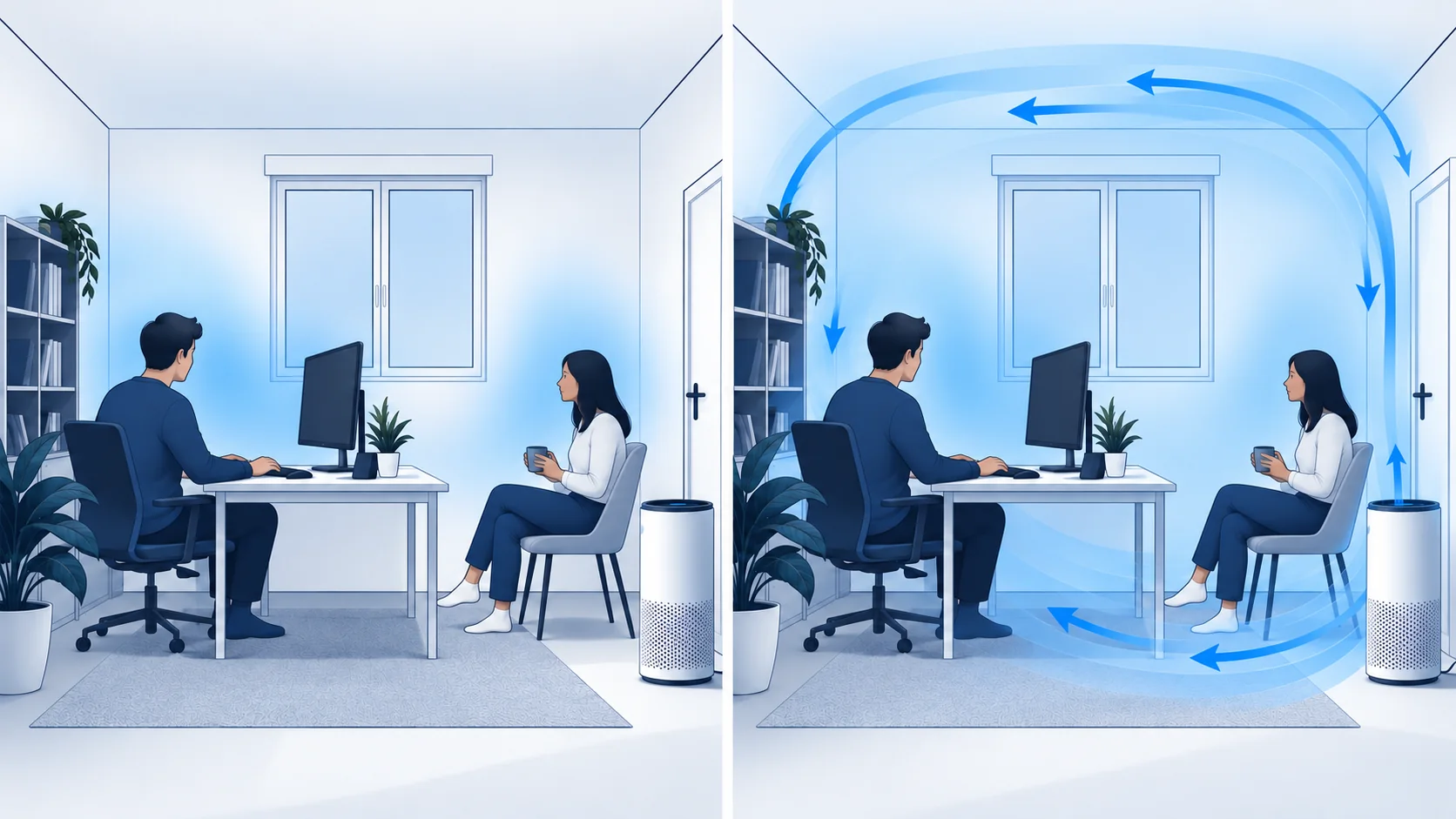
An ordinary portable unit pulls air from its own room, passes it through mechanical media and exhausts it back into the same room. The media captures particles as air passes. CO₂ is a small gas molecule mixed into the air; a mechanical particulate filter does not sieve it out in the way it captures dust. More recirculation passes can improve particle capture but do not create an outdoor-air exchange path. A device can move a great deal of air across a filter while bringing zero intentional outdoor air into a sealed room.
The same caution applies to a central HVAC system. Many residential heating or cooling systems recirculate air for temperature control, although some systems are deliberately connected to outdoor-air intakes. “The AC is on” is not enough information to know whether the bedroom receives outside air. Check the actual system drawings, manual or installer information. EPA's indoor-air improvement guidance notes that most residential forced-air heating and cooling systems do not mechanically bring outdoor air inside; designs with dedicated outdoor-air features do exist. The equipment configuration, not the word “AC,” answers the question.
Activated carbon is another frequent source of confusion. It can adsorb some gaseous pollutants when the media and contact conditions are suitable. It is not a universal gas remover, and a thin consumer carbon sheet should not be assumed to remove substantial occupant-generated CO₂. A manufacturer would need credible, pollutant-specific evidence, capacity and replacement information to support such a claim. The EPA guide advises selecting gas filters for the target gas and notes the lack of a widely used portable gas-filter rating. “Has charcoal” and “removes CO₂” are not equivalent specifications.
Some engineered systems use chemical sorbents or other specialized processes to remove CO₂. That exception matters: saying “nothing but a window can ever remove CO₂” is technically false. Yet a CO₂-only scrubber can leave odors, particles, moisture and other contaminants unresolved. ASHRAE specifically warns that CO₂-directed cleaning may not improve overall IAQ and can even confuse ventilation-control systems that use CO₂ as a signal. For an ordinary home purifier purchase, assume no CO₂-removal function unless the exact product demonstrates one under relevant conditions—and still assess the rest of the air-quality problem independently.
The order of the word “filter” in a product brochure is not evidence of the path. Ask whether the inlet draws room air or outside air; whether there is an exhaust or relief route; whether the claimed gas is actually identified in the test; and what happens when the media is used for weeks or months. A particle-filter replacement indicator often counts fan time or estimates loading; it does not reveal a CO₂ sorbent's remaining capacity. Similarly, a tiny carbon-coated sheet can reduce some odor perception without proving a specified gas-removal rate. A credible performance statement needs the target contaminant, inlet condition, outlet condition, flow, duration and maintenance state.
Ventilation is an exchange process, not a fan sound
Ventilation supplies air from outside and removes or displaces indoor air. Depending on the home, it may occur through windows, dedicated outdoor-air supply, exhaust with a suitable replacement-air path, or a heat/energy recovery ventilator. An HRV or ERV is designed around a real outdoor/indoor air path, with heat or energy exchange across the two streams; it is not just a filter with a premium name. Installed performance still depends on sizing, balance, filters, ducting and maintenance. A bathroom exhaust can alter air exchange in the home, but the replacement air's route must be considered. An internal fan moving air between bedroom and hallway may dilute a local reading by mixing rooms without increasing building-wide outdoor-air flow.
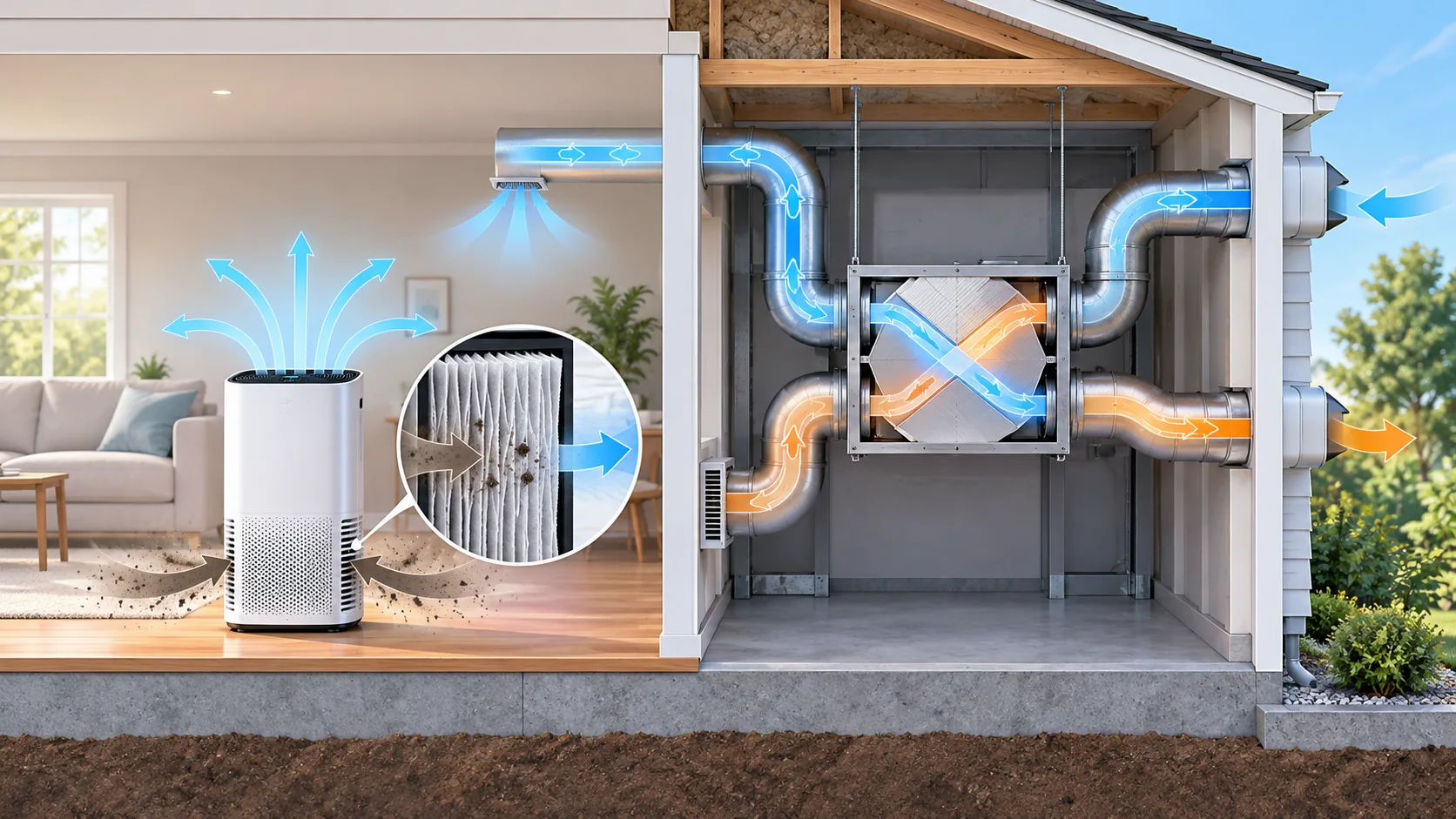
When comparing equipment quotations, look for a clearly drawn outdoor-air intake and exhaust, not just a high recirculation flow printed on a fan box. The airflow that passes a HEPA filter is useful for particle control; the airflow entering from outdoors is the relevant path for diluting occupant-generated CO₂. An installation can provide both in the same home, and supply air can be filtered for particles before it enters. The two flow figures may use the same units but represent different physical services. If a brochure lists “air changes per hour” for a purifier, check whether it means particle-equivalent cleaning of a room volume or actual replacement of indoor air with outdoors. Those are not interchangeable.
CO₂ concentration depends on outdoor concentration, indoor generation and dilution/removal. Health Canada's home CO₂ guidance points to ventilation and indoor sources when reducing residential CO₂. But a lower CO₂ value alone is not proof that all contaminants are controlled. Outdoor air may carry smoke or traffic pollutants; an indoor source unrelated to people may still remain. A purposeful plan may combine source control, filtered mechanical outdoor air and room particle cleaning rather than treating one device as a universal solution.
Unser home CO₂ trend guide explains how to read the start, rise, plateau and decay under known occupancy. For a sleeping room, the overnight bedroom log guide adds the practical event timeline.
Why might the CO₂ display change when the purifier starts?
A local sensor reports the gas concentration at its inlet. When a fan starts, it can move air from one part of the room past the instrument. If the room was unevenly mixed, the reading may fall or rise before the room-wide condition changes much. The fan could also blow directly over the monitor, alter a nearby window draft or change its temperature; the magnitude and direction are installation-specific. A coincident occupant leaving or a door opening is another common explanation. None of these observations alone shows that the filter media captured CO₂.
Think of the room as having a spatial map, not one perfectly uniform number. A sleeper's exhaled plume, a still corner behind a wardrobe, a cold window downdraft and a purifier outlet can expose a sensor to different air even within the same room. Starting a fan can make the sensor's local air more representative of the mixed room while the total CO₂ in the room remains approximately governed by the same generation and outdoor-air exchange. This is why moving the CO₂ meter toward the purifier outlet to “show the effect” is a poor test. If the fan has altered a genuine outdoor-air pathway indirectly, document that mechanism rather than crediting filtration media.
Monitor technology adds another layer. A direct CO₂ sensor has response and averaging time; a VOC-derived eCO₂ value may respond to cleaning-product vapors or odors rather than actual CO₂. A purifier that changes a VOC signal can therefore make an estimated eCO₂ display move even though a true CO₂ monitor would behave differently. Check the device's measurement method before interpreting a correlation. The direct CO₂ versus eCO₂ article covers this distinction in detail.
The reverse can happen too: a purifier improves measured PM₂.₅ while CO₂ continues upward, because the two channels respond to different processes. That is not a failure of a correctly used particle filter; it is evidence that particle cleaning and outdoor-air supply are different functions. A multiparameter instrument can help illustrate the distinction, but only if its CO₂ channel is direct rather than a VOC-derived eCO₂ estimate, and its PM channel is understood as an optical estimate with its own limitations. Our single-gas versus multiparameter monitor guide describes how to keep the channels separate.
If the purifier includes an “auto” mode driven by a particle or VOC sensor, the fan may accelerate when that channel changes. A display of “clean” on the purifier does not mean the bedroom CO₂ is low. Conversely, a CO₂ monitor's green light does not guarantee that particle concentration is low. Verify the actual measured quantity and the threshold logic stated by the device maker. Do not infer performance from a color without a concentration history.
A controlled home observation: CO₂ and particles are two questions
You can investigate the mechanisms without claiming a laboratory test. First decide the question: “Does my purifier reduce particle concentration in this room?” is different from “Does this room receive enough outdoor air under usual occupancy?” If you have suitable instruments, log a direct CO₂ channel and a particulate channel separately. Keep the monitors in stable, representative positions, away from the purifier outlet and direct breath. Record clock settings, sampling intervals and gaps. Then note the room's occupants, door and window state, ventilation mode, outdoor air conditions and purifier speed.
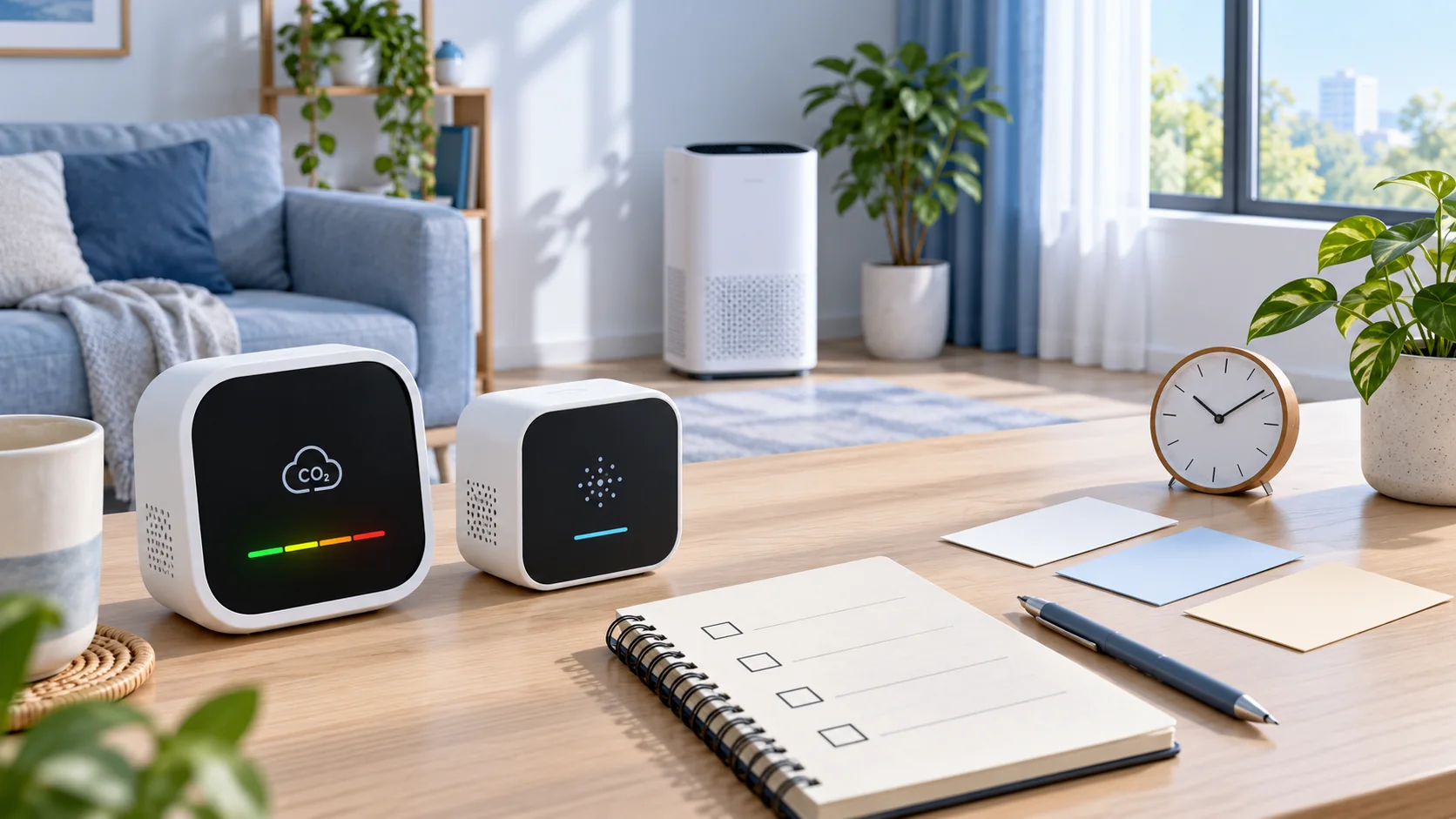
Observe the normal room for a comparable period before changing one thing. If you change purifier fan speed, avoid changing the window and occupancy at the same time if the aim is to understand the purifier. If you want to test an outdoor-air change, keep the purifier setting stable. Repeat under similar conditions where feasible. A single abrupt CO₂ dip right at the fan start is weak evidence; a sustained difference under similar occupancy and a documented outdoor-air change is more informative. Even then, an amateur room experiment is a qualitative comparison, not a certification of CADR, ventilation flow or clinical benefit.
| Observation during a documented comparison | Reasonable first interpretation | Check before claiming a cause |
|---|---|---|
| PM channel falls; CO₂ continues rising | Particle cleaning may be working; outdoor-air dilution is insufficient for current occupancy | PM sensor conditions, occupants, ventilation state |
| Both channels fall after a window opens | Outdoor exchange may affect both, depending on outdoor air | Outdoor PM/smoke, wind, simultaneous occupancy changes |
| CO₂ jumps when purifier fan starts | Local mixing, direct airflow on monitor or unrelated event | Move neither monitor mid-run; inspect position and timeline |
| CO₂ falls after an internal door opens | Inter-room air mixing is plausible | Check hallway/other room and sustained trend |
| CO₂ appears low, odor persists | Odor source unrelated to occupants or monitor's limited scope | Identify source and pollutant; do not infer all-clear |
| PM looks good, CO alarm sounds | Unrelated hazardous gas requires immediate appropriate safety response | Follow the CO alarm's instructions, not the purifier display |
Do not deliberately generate smoke, CO or other hazardous contaminants to test a purifier. Real-world background changes are enough to illustrate a time-series question, and a laboratory or professional test is needed for performance claims. When evaluating a monitor, remember that two displayed ppm values may differ because of instrument accuracy, location or smoothing; our CO₂ monitor accuracy guide gives the specification-reading method.
When the two channels appear to disagree
If the PM estimate drops but CO₂ rises, first confirm that the room remains occupied and its outdoor-air condition has not changed. That pairing is entirely plausible: the filter captures particles while people keep exhaling CO₂. If both fall, look for an outdoor-air change, occupants leaving or a changed location before claiming the purifier removed both. If PM rises after a window opens while CO₂ falls, outdoor particles may have entered; check outdoor conditions and whether a filtered ventilation path would be more appropriate. If CO₂ falls after a door opens but PM stays similar, inter-room mixing may have changed the gas signal without materially changing particle generation or capture.
Optical PM sensors can also be affected by particle composition and high humidity, and home monitors may smooth channels differently. A one-to-one minute-by-minute correlation is therefore a fragile performance test. Compare sustained trends, document conditions and respect each instrument's uncertainty. The point of recording two channels is to avoid treating a single color badge as all of air quality—not to create a new universal score from the two lines.
Choosing a practical combination for the room
For a room with occupant-related CO₂ build-up and a particle concern, design two pathways. Address CO₂ with a feasible outdoor-air strategy that respects outdoor air quality, weather, building safety and energy use. Address particles by reducing sources and using a purifier or HVAC filter appropriate for the room and particle size. A purifier's particle CADR should be interpreted with room size, ceiling height, speed and noise in mind; the EPA home guide explains its particle-sizing role. A unit run only at a barely audible setting may move less filtered air than its highest-speed rating suggests.
For a bedroom, verify that outdoor air reaches the bedroom when the door is in its usual nighttime position. Do not defeat a fire-safety door plan just to lower a monitor reading. A designed supply, transfer path or professionally evaluated whole-home system may be more suitable. During wildfire smoke or heavy outdoor pollution, a simplistic instruction to leave windows wide open can be counterproductive for particles; assess local conditions and building options. Filtration and outdoor-air exchange can be coordinated rather than treated as rival products.
Ask a seller or installer for evidence tied to the claim being made. For a particle purifier: target particle CADR, room sizing at the operating speed, filter maintenance and noise. For outdoor-air equipment: actual supply/exhaust flow, where the air enters, filtration if needed, controls and commissioning. For a device claiming gas removal: which gas, test conditions, capacity, performance over time and replacement schedule. For any CO₂ monitor: direct measurement method, accuracy, calibration and location. The CO₂ measurement requirements worksheet helps turn those questions into a project brief before buying equipment.
Common misunderstandings
“The purifier moves air, so it must ventilate.” Air movement is not necessarily outdoor-air exchange. A ceiling fan, split AC and portable filter can improve mixing or comfort without bringing in outside air. Trace the inlet and outlet of the actual system.
“My carbon filter removes gases, therefore it removes CO₂.” Gas sorption is target- and media-specific. A generic carbon stage does not establish a useful CO₂ removal rate or lifetime. Request product-specific evidence; do not extrapolate from odor reduction.
“The HEPA unit has a huge CADR, so the CO₂ should fall.” CADR on a consumer purifier describes particle removal under a test method, not carbon-dioxide removal or outdoor-air flow. Read the EPA guide for the metric's scope.
“A low CO₂ number means the air is clean.” CO₂ does not summarize every pollutant. The room can have low CO₂ while particles, moisture or a combustion contaminant still need attention. ASHRAE cautions against using CO₂ as a general IAQ index.
“Opening a window is always the best answer.” It may increase outdoor exchange, but wind, temperature, smoke and other outdoor contaminants matter. Choose an appropriate air pathway for the current context.
Questions readers ask
Can any household purifier actually remove CO₂?
Most ordinary HEPA/activated-carbon room purifiers are not designed to do so to a useful extent. Specialized sorbent or chemical CO₂ scrubbers exist, but they require evidence of capacity, regeneration or replacement and may not address the rest of indoor air quality. Do not assume a consumer “gas filter” is a CO₂ scrubber.
Why did my CO₂ monitor fall as soon as I switched on the purifier?
The fan may have brought lower-CO₂ air from elsewhere in the room past the monitor, or another condition changed at the same time. One local dip is not a removal test. Record the event, keep the monitor position fixed, check occupancy and openings, and observe whether the sustained trend changes under comparable conditions.
Will a split air conditioner lower CO₂?
Many split systems recirculate indoor air for cooling or heating and do not intentionally bring in outside air. Some HVAC arrangements include dedicated fresh-air systems. Check the actual equipment path and documentation instead of assuming the word “air” means ventilation.
Should I turn off my purifier if CO₂ is high?
Not necessarily. It can still reduce particles for which it is suitable. Address the CO₂ trend by checking occupancy and an appropriate outdoor-air pathway while continuing particle control when it is needed. Do not rely on a purifier as the sole remedy for an unrelated safety hazard.
Is CO₂ the same as carbon monoxide?
No. CO₂ and CO are different gases with different sources and sensing needs. A home CO₂ monitor is not a carbon monoxide alarm. Maintain purpose-designed CO alarms and follow their instructions. Our CO and CO₂ channel guide explains the measurement distinction.
Can houseplants replace ventilation for CO₂?
Houseplants exchange gases under appropriate light and growth conditions, but a few decorative plants are not a specified, controllable outdoor-air supply for an occupied home. The practical question is whether the proposed approach has a documented room-scale removal rate under the actual lighting and occupancy conditions. Do not use a plant count as a substitute for checking ventilation, especially when other contaminants and moisture also matter.
Does a window fan count as ventilation?
It can, if it actually brings in outdoor air or exhausts indoor air with a suitable replacement-air path. A fan pointed around a closed room only mixes air. Even a window fan's useful flow depends on its installation, pressure effects, wind, open pathways and outdoor air quality. Identify direction and where replacement air comes from before treating the motor rating as a room ventilation rate.
Technical references
- US EPA, Guide to Air Cleaners in the Home, second edition.
- US EPA, Air Cleaners and Air Filters in the Home Und Verbesserung der Raumluftqualität.
- ASHRAE, Position Document on Indoor Carbon Dioxide (2025).
- Health Canada, Carbon dioxide in your home.
- University of Melbourne, Air cleaner frequently asked questions.