
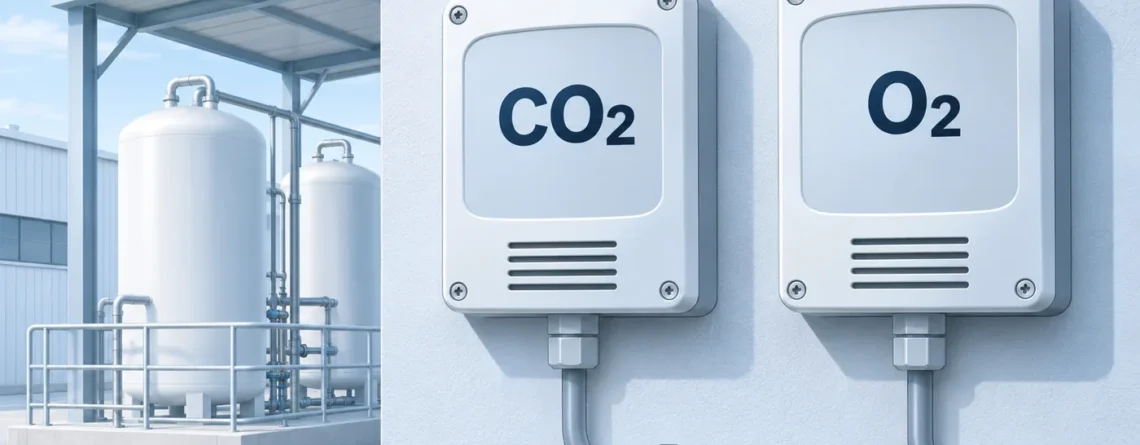
A carbon dioxide monitor measures CO2; an oxygen monitor measures O2. Neither reading establishes the other gas concentration in a real workplace. A CO2 release can create a harmful exposure while oxygen remains above an oxygen-deficiency alarm threshold. Nitrogen or argon can displace oxygen without producing a corresponding rise in CO2. Where both release mechanisms are credible, the monitoring assessment must address both measurements and their separate limitations.
Diese Unterscheidung ist wichtig, wenn in einer Spezifikation nur „Erstickungsüberwachung“ steht. Dieser Ausdruck beschreibt ein Gefahrenergebnis, keine vollständige Messanforderung. Der Entwurf erfordert ein identifiziertes Gasinventar, definierte Szenarien, geeignete Instrumente und eine dokumentierte Beziehung zwischen Messwerten und Schutzmaßnahmen. Ein bekannter Gerätename oder eine normale Anzeige können diese Lücken nicht schließen.
Zwei verschiedene Fragen hinter dem Wort Erstickung
Die erste Frage ist, ob die Atmosphäre genügend Sauerstoff für die beabsichtigte Aktivität enthält. Die zweite Frage ist, ob ein bestimmter Stoff eine inakzeptable Exposition verursacht. Diese Fragen können sich überschneiden, ohne austauschbar zu werden. CO2 hat eigene physiologische Wirkungen; seine Bedeutung lässt sich nicht auf die Menge an Sauerstoff reduzieren, die es verdrängt. Der NIOSH-Kohlendioxid-Eintrag identifiziert respiratorische und kardiovaskuläre Auswirkungen sowie Asphyxie. Seine Expositionsangaben beziehen sich daher direkt auf die CO2-Konzentration.
Beispielsweise verändert eine Störung der Stickstoffversorgung die Zusammensetzung der Luft, auch wenn sich keine CO2-Quelle in der Nähe befindet. Ein Sauerstoffkanal kann einen Sauerstoffmangel innerhalb seiner spezifizierten Kapazität erkennen, während ein CO2-Kanal nahe an seinem vorherigen Messwert bleiben kann. Umgekehrt muss durch die Zugabe von CO2 nicht der Großteil des Sauerstoffs entfernt werden, bevor die direkte CO2-Exposition wichtig wird. Die Überwachungsziele sollten als separate Erklärungen formuliert werden, bevor sich jemand für ein Gerät entscheidet.
Ein Ingenieur könnte schreiben: „Erkennen Sie eine glaubwürdige CO2-Ansammlung im Zylinderraum“ und „Erkennen Sie einen Sauerstoffmangel im Zusammenhang mit der separaten Stickstoffinstallation“. Jede Anweisung benötigt eine Standortbasis und eine Antwortdefinition. Durch die Kombination zu „Einen Luftqualitätsmonitor installieren“ werden wichtige Informationen darüber entfernt, was gemessen werden muss und warum.
Eine Verdünnungsrechnung erklärt die Diskrepanz
Betrachten Sie eine bewusst vereinfachte Berechnung, kein Raummodell oder eine Alarmempfehlung. Beginnen Sie mit einer gleichmäßigen Atmosphäre mit 20,9 % Sauerstoff. Ersetzen Sie 1 % dieser Atmosphäre durch reines CO2, ohne Verbrennung, biologischen Sauerstoffverbrauch, Druckänderungen oder selektive Entfernung. Der verbleibende Sauerstoffanteil beträgt etwa 20,9 % multipliziert mit 0,99 oder 20,691 %. Das hinzugefügte CO2 beträgt etwa 1 Vol.-%, was 10.000 ppm entspricht, abgesehen vom ursprünglichen Hintergrundbeitrag.
Die Berechnung zeigt einen wichtigen mathematischen Punkt: Eine wesentliche Änderung des CO2 kann mit einer viel geringeren absoluten Änderung des Sauerstoffanteils einhergehen. Es stellt keine tolerierbare Exposition dar. Niemand sollte diese Berechnung verwenden, um eine Belegung zu autorisieren, eine Alarmzeit vorherzusagen oder einen Sensorstandort auszuwählen. Bei echten Freisetzungen ändern sich Strömung, Temperatur, Mischung, Belüftung und lokale Konzentrationsgradienten.
Ersetzen Sie nun stattdessen dieselbe Fraktion durch Stickstoff. Die berechnete Sauerstoffreduktion ist ähnlich, es ist jedoch keine entsprechende CO2-Erhöhung erforderlich. Daher ist die umgekehrte Berechnung unterbestimmt: Ein Sauerstoffwert allein gibt keinen Aufschluss darüber, welches Gas die Luft verdrängt hat. Ein CO2-Wert allein berücksichtigt nicht den Sauerstoffverbrauch durch Korrosion, Verbrennung oder andere Prozesse. Eine angezeigte Konzentration erhält erst dann Bedeutung, wenn sie mit der tatsächlichen Messung und dem tatsächlichen Szenario in Zusammenhang steht.
Trennen Sie Expositionsreferenzen von Alarmentscheidungen
Expositionsreferenzen haben Zuständigkeit, Mittelungszeitraum und Zweck. Ein arbeitszeitgewichteter Durchschnitt ist nicht automatisch ein sofortiger Alarmsollwert. Eine kurzfristige Grenze ist keine universelle Evakuierungsschwelle. Eine Definition einer sauerstoffarmen Atmosphäre ist keine vollständige Spezifikation für ein festes Detektorsystem.
Für US-Genehmigungsflächen für die allgemeine Industrie: OSHA 1910.146 definiert einen Sauerstoffmangel unter 19,5 Vol.-% Sauerstoff und umfasst weitere Kriterien für gefährliche Atmosphären. Ihr Anwendungsbereich schließt Baugewerbe, Landwirtschaft und Werftbeschäftigung aus. Die Definition ist in diesem Rahmen relevant; Dies bedeutet nicht, dass jede Atmosphäre oberhalb dieser Zahl sicher ist oder dass jede Anwendung die gleiche Alarmanordnung übernehmen muss.
Der HSE-CO2-Gefahrenleitfaden addresses Great Britain and points to workplace exposure limits under COSHH. Its short-term reference differs from the NIOSH recommendation. That difference is a useful reminder to identify the controlling jurisdiction and reference rather than copy a value from a search result. The approved system design should document the source and purpose of every threshold, including any delay, latching, acknowledgement, and reset behavior.
Start with a release inventory
Make the inventory specific enough to distinguish a beverage CO2 supply from a nitrogen generator, dry-ice handling, welding shielding gas, fermentation, and a refrigeration circuit. A cylinder count alone may miss a connected source outside the room. A normal process description may miss maintenance conditions or a disconnected line. The responsible assessment should consider credible changes in use as well as the initial installation.
Zu den nützlichen Feldern gehören Gasidentität, Lieferform, angeschlossene Geräte, normaler Betriebsbereich, mögliche Freisetzungsorte, angrenzende Aufenthaltsräume und die Person, die für die Bestätigung von Änderungen verantwortlich ist. Menge und Druck können die Beurteilung beeinflussen, dieser Artikel führt sie jedoch nicht in eine vereinfachte Detektor-Zählungsformel um. Der Zweck der Bestandsaufnahme besteht darin, verborgene Annahmen für den Designer sichtbar zu machen.
Where the material is a mixture, obtain its actual identity and relevant safety documentation. “Inert gas” is not a channel specification. A shielding-gas mixture containing CO2 can raise both direct exposure and oxygen-displacement questions. A mixed installation may require separate instruments or a suitable combined system; the answer depends on the hazards and the capabilities of the exact equipment, not the label on the enclosure.
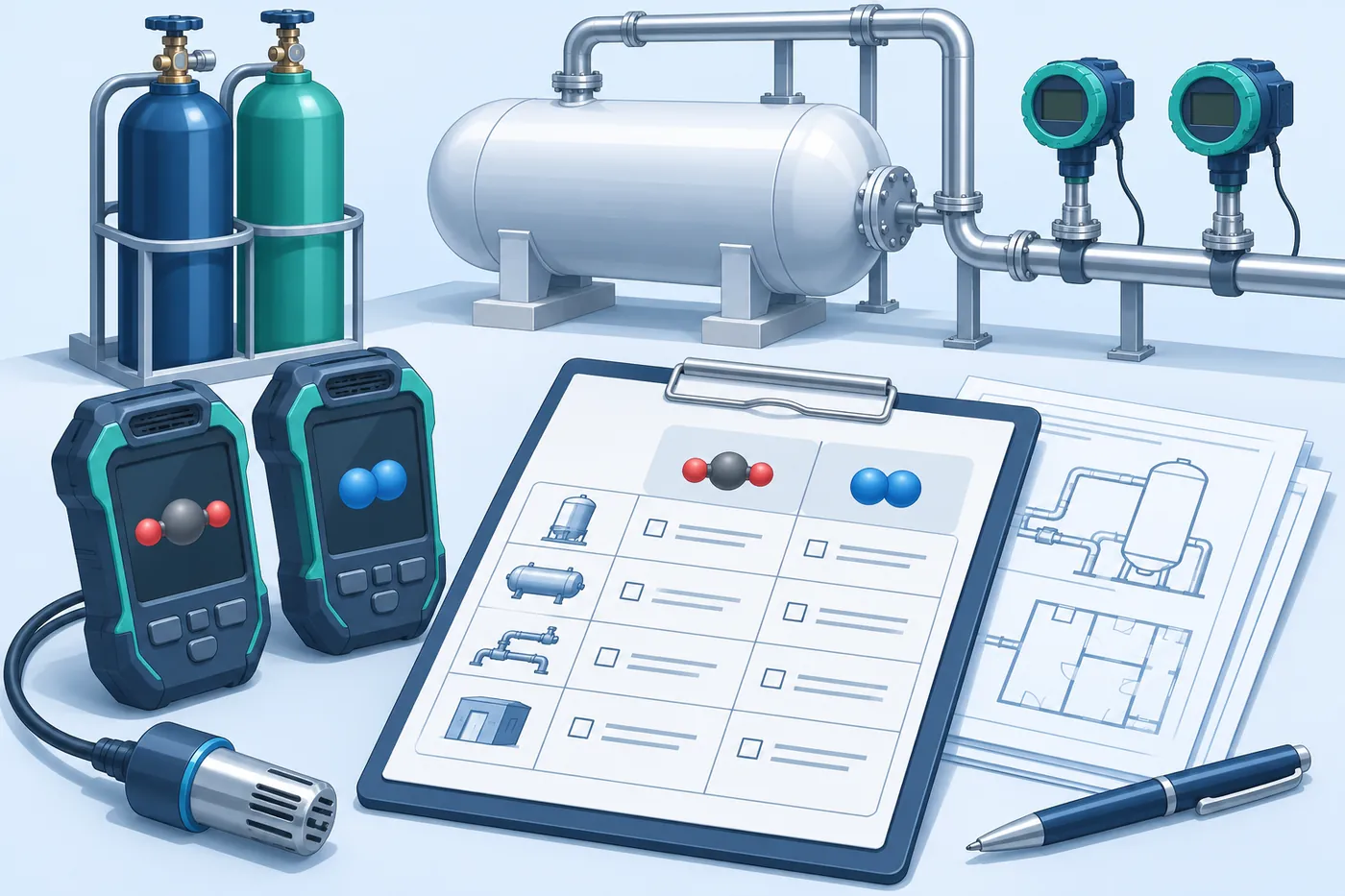
Compare objectives before comparing products
| Assessment question | Nachweise auf Anfrage | What cannot be inferred |
|---|---|---|
| Is CO2 accumulation credible? | Gas inventory, process description, release assessment | A normal O2 reading does not exclude direct CO2 exposure |
| Is oxygen depletion credible? | Inert-gas sources and oxygen-consuming processes | A normal CO2 reading does not establish adequate oxygen |
| Is the space represented by the sensor? | Location rationale, air movement and obstructions | One point does not characterize every connected space |
| Will people receive the warning? | Notification layout and defined response | A detector LED does not prove an alarm is understood |
| Is the system available? | Fault behavior, power provisions and maintenance evidence | A blank or stale display is not a healthy measurement |
| Is the design applicable locally? | Adopted requirements and project approvals | A manufacturer application guide is not local adoption |
Use the table to establish the questions that a supplier must answer. It is not an equipment qualification checklist by itself. A proposal may be technically capable of measuring both gases and still leave the location basis or warning interface unresolved. Those omissions affect the usefulness of the installed system even when each sensor performs correctly on a bench.
An indoor-air-quality monitor has a different job
An occupied-room CO2 trend can help assess ventilation when people are the relevant source and the space is suitable for that interpretation. That does not make the same instrument a safety detector for a gas-release scenario. The HSE ventilation guidance explicitly separates ventilation assessment from CO2 as a hazardous substance and identifies limitations where processes produce CO2.
For procurement, identify the actual intended use of the instrument. Review its range, output behavior, power dependence, environmental limits, maintenance instructions, and available alarm functions. A display intended to prompt occupants to open a window may have a very different role from a continuously supervised detection system connected to notification or other protective equipment.
Avoid translating a ventilation traffic-light color into a safety conclusion. The color may reflect a manufacturer-selected ventilation category, a user configuration, or a cloud service rule. It does not establish that the instrument has the required concentration range, fault response, or suitability for the assessed gas hazards. Read the exact manual and the project requirements together.
Location depends on the release and the room
Gas density matters, but it does not produce a universal mounting height. Cold releases, jets, obstructions, ventilation patterns, equipment enclosures, doors, and openings can change how gas reaches a sensing point. A drawing should explain why a location represents the scenario that the instrument is intended to detect.
Der HSE-Schweißanleitung erklärt, dass Turbulenzen und Gasbewegungen einfache Annahmen über das Aufsteigen oder Absinken von Gasen zerstören können. Dies ist besonders relevant, wenn sich ein Design nur auf „CO2 ist schwerer als Luft“ verlässt. Die Aussage ist eine physikalische Eigenschaft und kein Beweis dafür, dass ein einzelner niedrig montierter Detektor jede Freisetzungs- oder Atmungsstelle abdecken kann.
Betrachten Sie angrenzende Räume als Schnittstellen. Durch Öffnungen kann Gas austreten, wenn Personen aus einer anderen Richtung eindringen. Der Ort, an dem eine Warnung eingehen muss, kann daher von dem Ort, an dem die Konzentration gemessen wird, abweichen. Die Standortüberprüfung sollte beides berücksichtigen. Es sollte auch berücksichtigt werden, ob geplante Lagerung, Reinigung oder neue Geräte den Sensor blockieren oder die Benachrichtigung nach der Übergabe verschleiern könnten.

Treat a combined instrument as two measurement chains
A combined CO2/O2 instrument can simplify installation, but the shared enclosure does not remove the need to review each channel. Confirm the actual installed sensors, their supported ranges and units, and the conditions under which each specification applies. Check that the displayed channel is active and that outputs identify it unambiguously.
The two measurements may have different sensing principles, service requirements, interference limits, and failure indications. A common power supply or controller also creates shared dependencies. The technical review should identify which faults remove one measurement and which remove both. A single green status light is insufficient evidence unless its meaning is documented for that precise configuration.
Geben Sie bei Probenahmesystemen die vollständige Route vom Probenahmeeinlass bis zu jedem Sensorelement an. Schläuche, Filter, Pumpen und Zubehör können die Probenabgabe beeinträchtigen. Die geltenden Herstelleranweisungen müssen das Gas, die Materialien, die Länge und die Anordnung unterstützen. Gehen Sie nicht davon aus, dass ein mit einer Pumpe ausgestattetes Multigasmessgerät jedes Gas durch jedes Rohr, das physisch in seinen Einlass passt, korrekt misst.
Konzentrationseinheiten sichtbar halten
CO2 wird üblicherweise in ppm oder Volumenprozent angezeigt; Sauerstoff wird üblicherweise in Volumenprozent angezeigt. Ein Volumenprozent entspricht 10.000 ppm für das gleiche Gas und die gleiche Konzentrationsbasis. Diese Umwandlung wandelt eine CO2-Konzentration nicht in eine Sauerstoffkonzentration um. Es ändert nur die Art und Weise, wie eine einzelne Größe ausgedrückt wird.
The documents should show gas identity and units together on each channel. In a building management interface, a generic “gas level” label invites confusion. The integration review should also confirm scaling, valid range, fault indication, and whether the displayed value is current. A correct number with the wrong engineering unit can lead to a materially wrong interpretation.
Check the same details in exported trends and alarm messages. A controller may retain a meaningful local display while a downstream system applies the wrong range. A record that says “1.2 gas” without channel, unit, timestamp, and quality information cannot support a reliable review. Better documentation makes the reading interpretable without requiring someone to reconstruct the original configuration from memory.
Measurement is only one part of the warning function
Ein Melder kann korrekt reagieren, während ein Bewohner keine sinnvolle Warnung erhält. Die Benachrichtigung kann außerhalb des relevanten Bereichs erfolgen, in der Arbeitsumgebung unhörbar sein, visuell verdeckt sein oder mit mehrdeutigen Formulierungen dargestellt werden. Ein Remote-Signal kann einen unbeaufsichtigten Arbeitsplatz erreichen. Hierbei handelt es sich um Systemfragen, nicht um Korrekturen der Sensorgenauigkeitsspezifikation.
Der Entwurf sollte den identifizierten Zustand mit der erforderlichen Benachrichtigung und der genehmigten Reaktion verbinden. Darin sollte angegeben werden, wer die Warnung erhält, welchen Bereich sie betrifft und wie sich ein Messausfall von einem Gasalarm unterscheidet. Jede Schnittstelle zu Lüftung, Isolierung oder einem anderen System benötigt eine eigene dokumentierte Verantwortungs- und Akzeptanzbasis.
This article does not prescribe actions for entering, investigating, or rescuing in a suspect atmosphere. Those actions belong to the employer's applicable procedures and competent response arrangements. The documentation review should confirm that the installed warning vocabulary and equipment behavior agree with those arrangements. An alarm that requires interpretation of undocumented codes adds uncertainty precisely when time and attention may be limited.
Availability needs explicit evidence
Ask how the system indicates power loss, sensor fault, blocked sampling, communications loss, maintenance inhibition, and an overdue required check. Not every product detects every failure, so request the documented limitations as well as the advertised diagnostics. A healthy controller does not prove that every connected sensing point is delivering a valid measurement.
Maintenance records should identify the device and channel, work performed, applicable instructions, outcome, and unresolved restrictions. “Checked” is too broad when it could mean visual inspection, gas-response verification, calibration, or an end-to-end system check. These activities answer different questions. A calibration record does not automatically demonstrate that an external alarm or linked output operated correctly.
Define ownership of a bypass or disabled channel. The important record is not simply that someone knew about it; the responsible organization needs to know which monitoring objective was unavailable, what authorized arrangements applied, and how restoration was confirmed. Do not invent a universal maintenance interval. The applicable requirements, manufacturer's instructions, service conditions, and assessment determine the schedule.
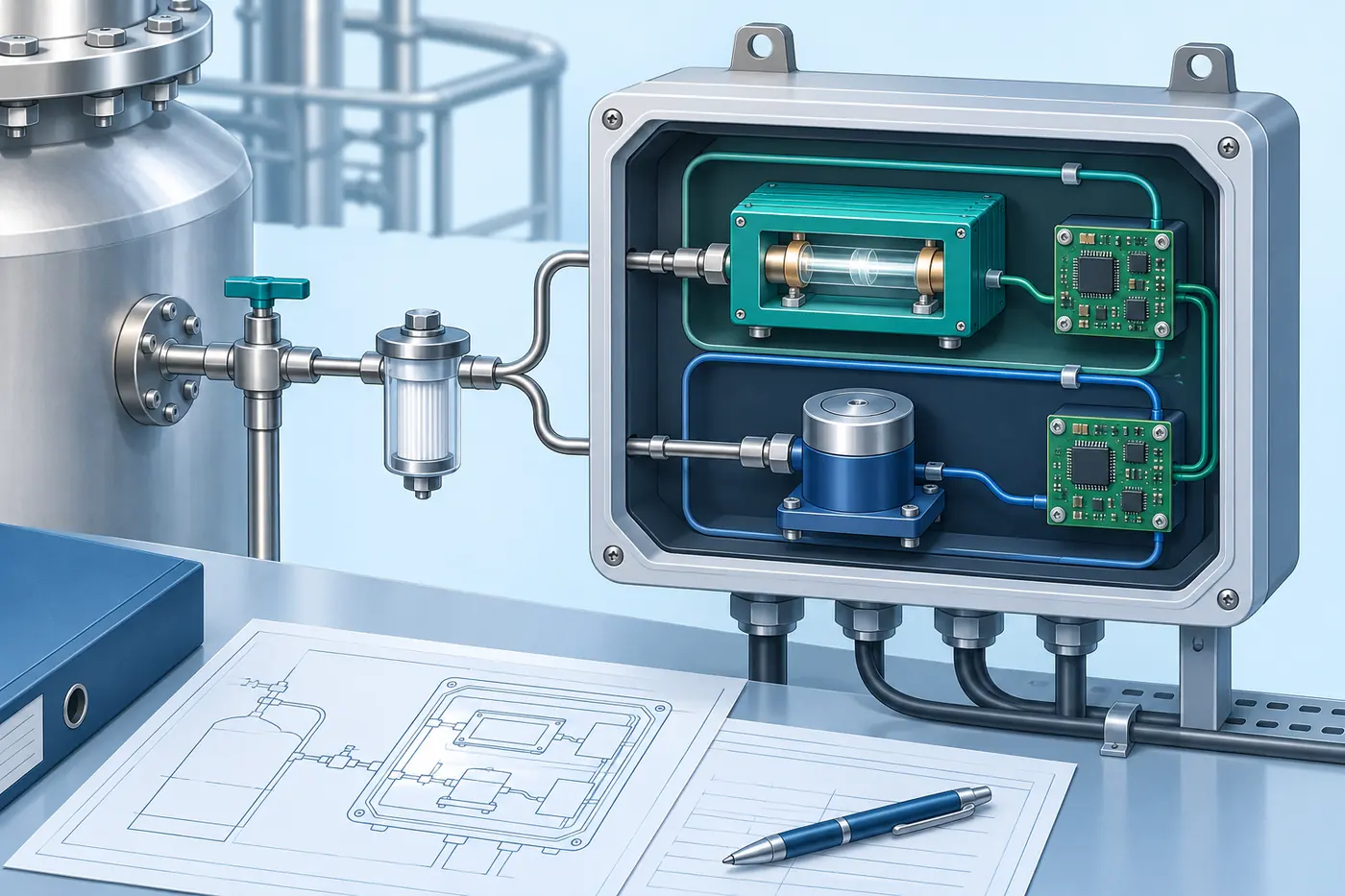
Eine hypothetische Untersuchung eines Mischgaslabors
Imagine a laboratory with a nitrogen supply and a separate CO2 incubator supply. The initial request says “one asphyxiation alarm.” The design reviewer first separates the nitrogen release objective from the CO2 release objective. The question becomes whether the proposed equipment and locations can address both, with suitable evidence.
The supplier offers an oxygen detector and a room ventilation display. That proposal does not yet demonstrate a CO2 safety detection function. The reviewer requests the exact intended-use documentation for the CO2 device, the applicable concentration range and alarm behavior, and the rationale for its location relative to the supply equipment and room arrangement. The oxygen detector is reviewed against its own objective and operating conditions.
Angenommen, die Raumaufteilung ändert sich später und die Zylinder werden hinter eine Trennwand verschoben. Die ursprüngliche Sensorposition bleibt in der Zeichnung erhalten, ihre Begründung ist jedoch möglicherweise nicht mehr zutreffend. Bei der Änderungsüberprüfung werden daher sowohl die Erfassungsabdeckung als auch die Sichtbarkeit von Benachrichtigungen berücksichtigt. Hierbei handelt es sich um ein hypothetisches Dokumentationsbeispiel und nicht um den Anspruch, dass die vorgeschlagene Installation akzeptabel ist oder dass eine bestimmte Detektoranzahl ausreichend ist.
Die praktische Lektion besteht darin, eine Meinungsverschiedenheit auf der Ebene der Anforderungen zu lösen. Die Frage, ob ein Produkt „gut“ ist, ergibt nicht, dass zwei Personen mit demselben Wort unterschiedliche Gefahren meinen. Die Frage, welches Szenario jeder Kanal abdeckt, macht die fehlenden Beweise identifizierbar und ermöglicht es dem verantwortlichen Designer, darauf einzugehen.
Questions to settle before accepting a proposal
- Which gas release or oxygen-consuming process creates each monitoring objective?
- Which exact channel measures the relevant quantity, and in what units?
- What installed range and performance evidence support the application?
- What conditions, gases, accessories, or environments limit that evidence?
- Why are the proposed sensing locations representative of the assessed scenarios?
- Where must warnings be received, and how are gas alarms distinguished from faults?
- Which local requirements, adopted editions, and manufacturer instructions govern the design?
- What evidence will confirm the installed channel mapping and linked responses?
- Who owns maintenance, configuration changes, and restoration after an impairment?
Record answers as references to drawings, manuals, configuration records, and acceptance evidence rather than as unsupported yes/no statements. A statement such as “complies with standards” does not reveal which gas, edition, clause, or part of the system was assessed. A useful answer can be checked by someone who was absent from the original discussion.
Resolve apparently contradictory readings without inventing a relationship
Zwei Messwerte können inkonsistent erscheinen, weil sie unterschiedliche Gase, Orte, Zeitfenster oder Datenzustände darstellen. Stellen Sie vor dem Versuch eines numerischen Abgleichs die Kanalidentität und die Umstände jedes Datensatzes fest. Ein CO2-Instrument in der Nähe einer Quelle und ein Sauerstoffinstrument in der Nähe einer anderen Öffnung messen nicht dieselbe Atmosphäre, nur weil sie sich im selben Raum befinden. Ein Remote-Trend kann auch ein anderes Aktualisierungsintervall als die lokale Anzeige verwenden.
The first useful comparison is documentary. Match the gas, unit, timestamp, location and configuration. Identify whether each value was valid, stale, inhibited, over range, or associated with a fault. A communications system that retains the previous value during an outage can create an apparently steady reading after the underlying measurement is unavailable. That is a data-quality issue rather than evidence that the atmosphere remained unchanged.
Next, review whether the proposed relationship is physically justified. The simple dilution example earlier assumes a particular replacement gas and uniform mixing. A real workplace may contain multiple gas sources, oxygen-consuming processes and changing ventilation. No unique CO2 concentration can be calculated from a single oxygen measurement without those assumptions and sufficient supporting information. Similarly, an increase in CO2 does not quantify every other atmospheric hazard.
Where an instrument's fitness is uncertain, use the organization's arrangements for that condition and the applicable manufacturer instructions. Do not adjust a channel or invent an offset simply to make two readings agree. A good investigation produces an explanation linked to the actual measurement chain, or explicitly identifies the evidence that remains missing. Numerical agreement obtained by unsupported configuration changes is not a reliable resolution.
Define coverage claims at handover
A handover statement should describe the monitoring function with its boundaries. For instance, it can identify the accepted CO2 sensing points, the separate oxygen sensing points, their associated alarm zones, the accepted configuration revision, and the records that demonstrate the required interfaces. It should also identify limitations that affect interpretation, such as areas outside the assessed coverage or functions outside the supplier's scope.
The wording matters. Saying that a building is “protected against asphyxiation” is broader than most equipment evidence can support. It can conceal missing channels, unassessed rooms, or scenarios outside the original design. Saying which measurement functions were accepted under a defined assessment lets the owner understand what a later process change might affect. This is a practical description of evidence, not a new performance certification.
Review the relationship between measurement locations and work patterns. A warning arrangement designed for a normally occupied room may be interpreted differently when the same room becomes intermittently occupied storage. A new door, equipment enclosure, or ventilation change may affect gas movement and the path by which people receive a warning. The handover should make the original assumptions accessible so that the responsible change review can examine them.
Ownership should cover the continuing function rather than only the equipment. Someone must own the inventory changes, another person or team may maintain the instruments, and an integrator may control remote display mapping. The organization needs a way for changes in one area to reach the others. Without that connection, each team can maintain its own component correctly while the original monitoring objective becomes less well supported.
Finally, make the accepted records usable during a future review. A device tag should connect to the channel list, location drawing, manual revision, configuration and relevant service history. The alarm zone name should agree with signs and response information. These links reduce the chance that a normal-looking display or familiar room name will be interpreted as stronger evidence than it is. They also help the owner distinguish an equipment fault, an integration issue and a genuine change in atmospheric conditions.

What should a dual-objective review record contain?
Eine nützliche Aufzeichnung bewahrt die Unterscheidung zwischen den beiden Zielen bis zur Akzeptanz. Geben Sie jedem Ziel eine eigene Kennung, eine eigene Gas- oder Prozessbasis, einen betroffenen Bereich, einen vorgesehenen Instrumentenkanal, relevante Einschränkungen und Nachweisreferenzen. Wenn das gleiche Gehäuse beides bedient, identifizieren Sie die gemeinsamen Abhängigkeiten sowie die separaten Messungen. Dadurch wird verhindert, dass eine kombinierte Produktbeschreibung den Verlust eines Kanals oder eine gemeinsame Stromabhängigkeit verbirgt.
Keep assumptions explicit. If the location assessment relies on a particular ventilation arrangement or gas-use pattern, identify that condition and the drawing or assessment that supports it. A later reviewer can then recognize that a partition, fan change or new source may affect coverage. An unexplained assertion that the position is correct gives the owner little help when the installation changes.
The record should also distinguish a measured condition from an interpretation. A CO2 reading, an oxygen reading, an alarm state and a system-health indication are different fields. If a remote interface combines them into a single summary, preserve access to the underlying meanings and identify how faults affect the summary. A green icon without a documented definition cannot establish which objectives remain available.
Finally, connect review outcomes to actual responsibilities. If additional evidence is required, state what is missing and who will resolve it. A reviewer should be able to tell whether the issue concerns equipment capability, location, integration, jurisdiction or operating arrangements. That makes the next decision concrete and avoids repeatedly asking whether the room has an adequate monitor without identifying what adequacy means for either hazard.
Häufig gestellte Fragen
Can a normal oxygen reading prove that CO2 is acceptable?
No. Oxygen concentration and CO2 concentration are different quantities. Direct CO2 exposure may matter before the reduction in oxygen reaches an oxygen-deficiency criterion. The relevant CO2 measurement and assessment remain necessary where a credible CO2 hazard exists. A stable oxygen display also says nothing about unmeasured toxic gases or local conditions away from its sampling point.
Can a CO2 monitor detect nitrogen leakage?
It does not measure nitrogen simply because nitrogen can displace air. Some release scenarios may change several gas fractions, but that correlation is not a dependable substitute for the required oxygen measurement. Identify the monitored hazard directly and confirm the chosen instrument's intended use.
Is a dual-gas device always the best option?
No. It may be appropriate if both channels, the common dependencies, installation conditions, and notification functions satisfy the design. Separate equipment may fit another application better. The comparison should address the complete installed function and lifecycle support, rather than the number of gas names printed on a product page.
Does the oxygen-deficiency definition establish that entry is safe above it?
No. Other atmospheric and non-atmospheric hazards may remain, and the applicable entry framework has additional requirements. A monitoring device does not issue a permit or replace the employer's assessment. Scope and jurisdiction must be identified before using any regulatory definition in a project specification.
Where can I read the broader background?
The existing guides to oxygen-deficient atmospheres Und CO2 safety in restaurants and venues introduce those wider topics. Use the distinction here when translating a hazard description into separate, evidence-backed monitoring objectives.


Hinterlasse eine Antwort