
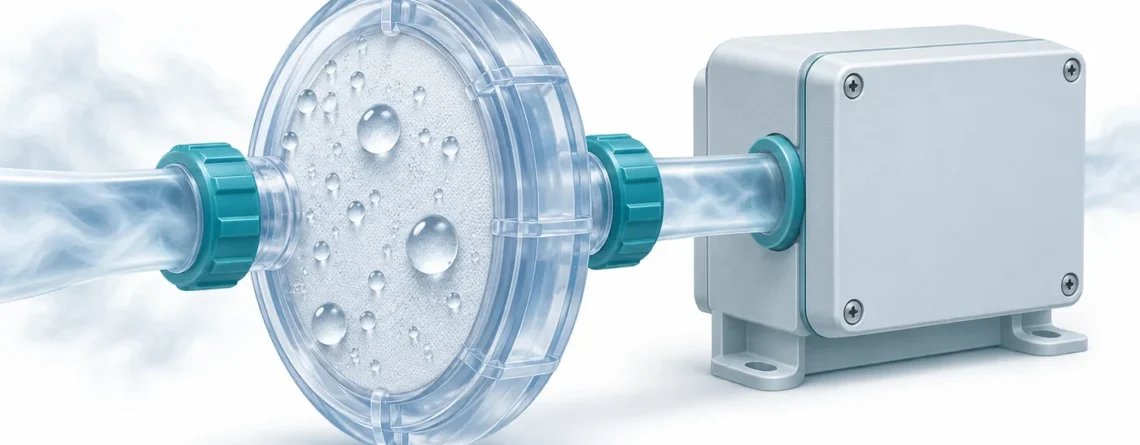
Ein geeigneter hydrophober Filter kann verhindern, dass flüssiges Wasser in einen Gassensor eindringt, während er Gas passieren lässt. Normalerweise wird der Wasserdampf nicht aus einer feuchten Probe entfernt und es kann nicht garantiert werden, dass sich weiter stromabwärts keine Kondensation bildet. Der Schutz hängt von der Membran, der Flüssigkeitschemie, dem Druckunterschied, der Installation und dem Filterzustand ab.
Die praktische Frage ist daher umfassender als die Frage, ob ein Filter wasserdicht ist. Für eine Gasmessung sind sowohl ein geschütztes Sensorelement als auch eine repräsentative Probe erforderlich. Ein Filter kann das Element schützen und gleichzeitig die Gasankunft verzögern, den Druckabfall erhöhen oder von Flüssigkeit bedeckt werden. Ein Trockner kann ein Feuchtigkeitsproblem lösen und gleichzeitig die Konzentrationsbasis ändern. Diese Auswirkungen müssen gesondert betrachtet werden.
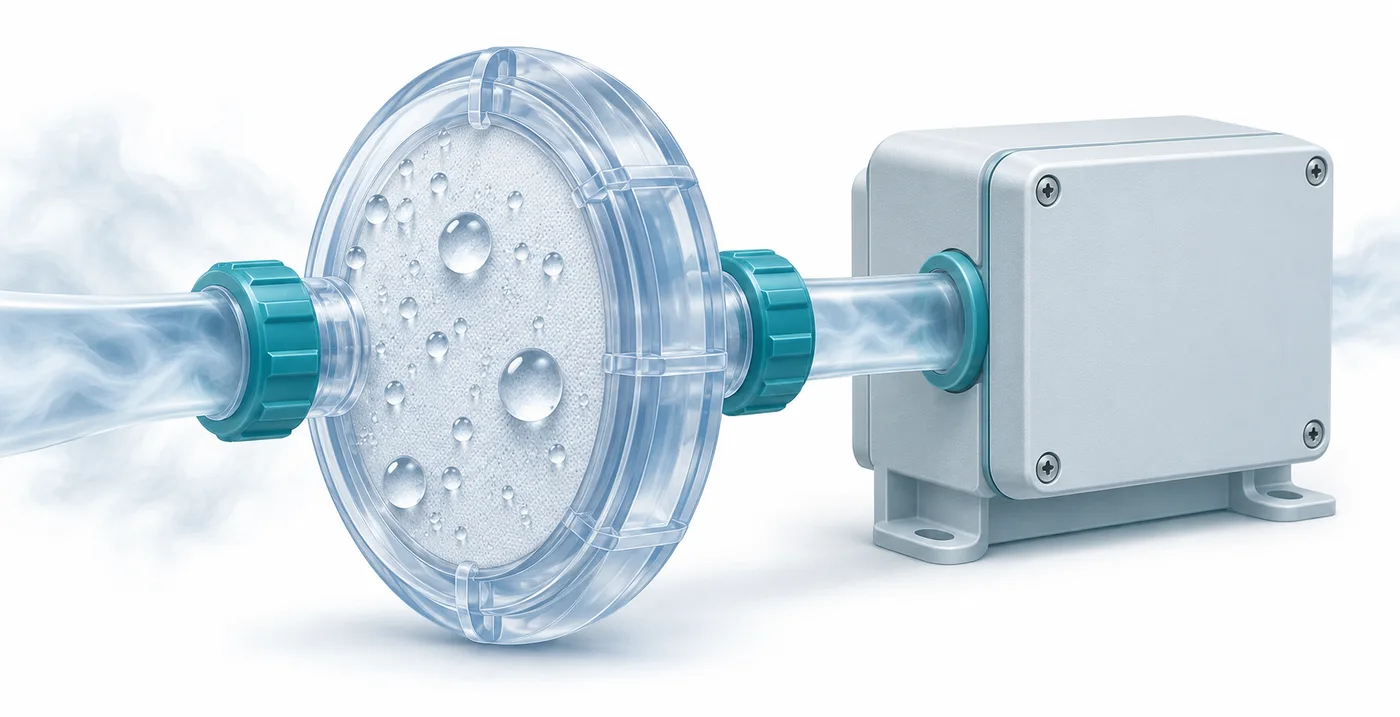
Konzeptionelle Barriere: Tröpfchen können an einer Membran Widerstand leisten, während auf beiden Seiten feuchtes Gas zurückbleibt. Eine Flüssigkeitssperre ist nicht automatisch ein Dampftrockner.
Wasserdampf und flüssiges Wasser erfordern unterschiedliche Steuerungen
Wasserdampf besteht aus Wassermolekülen in der Gasphase. Feuchtes Gas kann völlig klar aussehen. Flüssiges Wasser erscheint als Tröpfchen, Film, Nebel oder gesammeltes Kondensat. Eine Probe kann eine Phase oder beide enthalten.
A hydrophobic membrane's liquid resistance arises from its material and pore behavior under specified conditions. Water vapor can still accompany the gas through the available gas pathways. Calling the incoming sample high humidity does not reveal whether the main threat is vapor exposure, entrained liquid or condensation after cooling.
Die relative Luftfeuchtigkeit beschreibt die Nähe zur Sättigung bei der lokalen Temperatur. Es ist nicht dasselbe wie der Molenbruch von Wasser. Wenn sich ein feuchtes Gas erwärmt, ohne Wasser aufzunehmen oder zu verlieren, kann seine relative Luftfeuchtigkeit sinken, obwohl sein Wassergehalt nicht verringert wurde.
Der Taupunkt ist nützlich, da er den Wassergehalt mit der Temperatur in Beziehung setzt, bei der die Kondensation bei dem entsprechenden Druck beginnt. Wenn ein Teil der Probenahmestrecke diesen Taupunkt unterschreitet, kann sich dort Flüssigkeit bilden. Eine vorgeschaltete Membran kann Wasser, das beim Durchqueren der Membran noch Dampf war, nicht aufhalten.
Auch Druckänderungen gehören in die Beurteilung. Taupunkt und Wasserdampfbedingungen hängen vom Druck ab. Eine aus einem Druckprozess entnommene Probe weist nach der Druckreduzierung möglicherweise nicht das gleiche Kondensationsverhalten auf. Verwenden Sie die Bedingungen in jeder Phase und nicht eine einzelne Feuchtigkeitszahl, die aus der Quelle kopiert wurde.
Beschreiben Sie vor der Auswahl der Hardware das Wasserproblem in physikalischen Begriffen: Tröpfchen am Einlass, feuchter Dampf in der gesamten Leitung, eine kalte Armatur, die Wasser kondensiert, oder ein Sensor, der den Wassergehalt nicht verträgt. Unterschiedliche Beschreibungen führen zu unterschiedlichen Abhilfemaßnahmen.
Was kann eine hydrophobe Membran eigentlich?
A suitable membrane can provide a barrier to liquid intrusion while permitting gas exchange. The useful performance depends on the pressure difference and the liquid's interaction with the membrane. It is not an unlimited barrier under every flow, pressure and chemical condition.
Gore's packaging-vent FAQ unterscheidet das hydrophobe Verhalten wässriger Flüssigkeiten vom oleophoben Verhalten, das für Flüssigkeiten mit geringerer Oberflächenspannung wie Öle oder Reinigungsmittel relevant ist. Es erklärt auch, dass das Bedecken einer Entlüftungsmembran mit Flüssigkeit den Gasaustausch verhindern kann. Dies sind nützliche Membranprinzipien, aber ein Verpackungsbeispiel zertifiziert nicht die Installation eines Gasanalysators.
Eine kontaminierte Probe kann daher eine Membran anders beanspruchen als sauberes Wasser. Öle, Reinigungsrückstände und Tenside können die Benetzung beeinträchtigen. Geben Sie die tatsächliche Flüssigkeit und die Verunreinigungen an, wenn Sie nach der Filterkompatibilität fragen. Ein Anspruch auf sauberes Wasser allein beweist möglicherweise nicht die Eignung.
Der komplette Filter umfasst mehr als das Membranmaterial. Gehäusedichtungen, Stützstruktur, Anschlüsse, Montage und Ausrichtung können zusätzliche Einschränkungen schaffen. Eine flüssigkeitsbeständige Membran in einem schlecht abgedichteten Halter schafft keinen flüssigkeitsbeständigen Probenweg.
Gore's performance-membrane information also distinguishes membrane applications and airflow characteristics. The integration lesson is to use the relevant product's data and test conditions. Material names such as PTFE do not identify a universal pressure drop, gas response or water-entry rating.
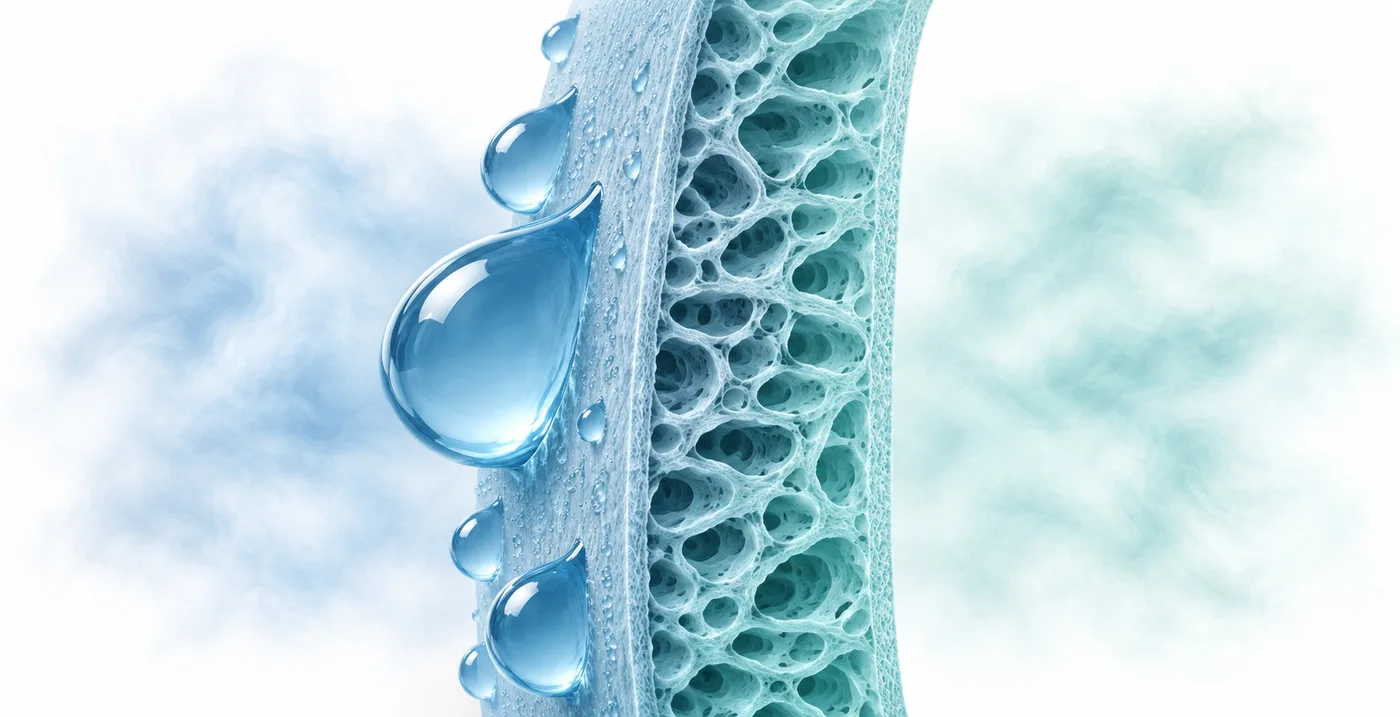
Konzeptionelles Membranverhalten, kein mikroskopisches Produktmodell. Flüssigkeitsbeständigkeit und Wasserdampfentfernung sind unterschiedliche Funktionen.
Warum kann nach einer erfolgreichen Filterung Kondenswasser entstehen?
Consider a warm humid sample that passes through an inlet membrane without any droplets crossing it. The sample then enters a cooler fitting. If that fitting is below the sample's dew point, some of the vapor condenses there.
In dieser Reihenfolge kann die Eintrittssperre ihre vorgesehene Aufgabe erfüllt haben. Das stromabwärts gelegene Wasser bildete sich lokal aus Dampf. Das Ersetzen des Filters durch eine andere Flüssigkeitsbarriere in derselben thermischen Anordnung kann dazu führen, dass das zugrunde liegende Problem unverändert bleibt.
Die kälteste Oberfläche ist wichtiger als die durchschnittliche Schranktemperatur. Eine Metallschottwand, ein freiliegender Anschluss oder ein Rohr, das eine kalte Wand berührt, können eine lokale Kondensationsstelle bilden. Eine überwiegend warme Probenleitung kann noch einen problematischen kalten Abschnitt enthalten.
Vaisala's high-humidity application note verdeutlicht die Bedeutung von Leitungs- und Installationskältestellen. Das Beispiel betrifft Feuchtigkeitssonden, aber die Überlegungen gelten auch für die Lokalisierung, wo in einem Gasweg Kondensation auftreten kann: Die Temperatur der tatsächlichen Oberfläche und nicht nur des umgebenden Prozesses bestimmt, ob sich dort Wasser bildet.
Überprüfen Sie den gesamten Weg von der Quelle bis zum Auspuff. Ein Filter kann Raumtemperatur haben, während ein nahegelegener Einlass erwärmt wird, oder die Sensorkammer kann während einer Abschaltung über Nacht abkühlen. Beim Anfahren kann sich daher der Wasserzustand vom Dauerbetrieb unterscheiden.
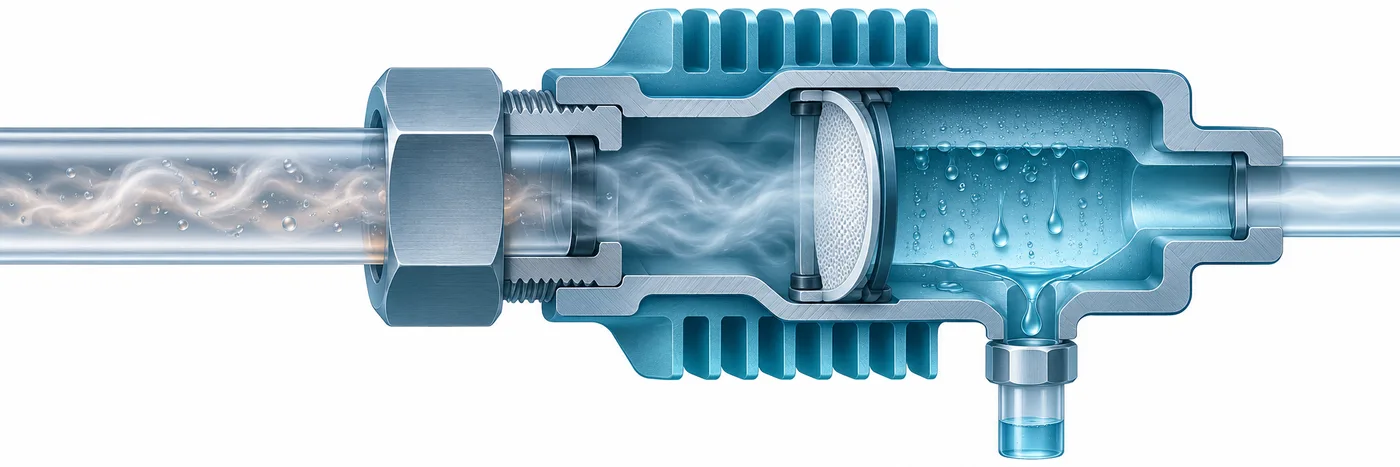
Konzeptionelle nachgeschaltete Kondensation: Dampf passiert die Membran und bildet später an einem kälteren Abschnitt Tröpfchen. Es ist kein Flüssigkeitsdurchbruch erforderlich.
Vergleichen Sie eine Barriere, eine Falle, einen Trockner und einen beheizten Pfad
Diese Komponenten lösen unterschiedliche Probleme und sollten nicht als austauschbares Zubehör betrachtet werden.
Eine Flüssigkeitsbarriere verhindert das Eindringen an einer Grenze. Eine Falle sammelt oder trennt bereits vorhandene Flüssigkeit. Ein Trockner entfernt Wasserdampf nach einem bestimmten Verfahren. Ein beheizter Pfad zielt darauf ab, Oberflächen über dem relevanten Kondensationszustand zu halten und gleichzeitig den Dampf in der Probe zu bewahren.
| Komponente oder Strategie | Hauptaufgabe | Was es nicht feststellt |
|---|---|---|
| Hydrophobe Membran | Widersteht dem Eindringen von Flüssigkeit und ermöglicht gleichzeitig einen geeigneten Gasaustausch | Trockenes Messgas oder uneingeschränkte Reaktion bei Nässe |
| Flüssigkeitsfalle oder -abscheider | Flüssigkeitströpfchen und Kondensat entfernen bzw. auffangen | Vollständige Wasserdampfentfernung |
| Dampftrockner | Wassergehalt reduzieren | Unveränderte Zielgasrückgewinnung oder unveränderte Konzentrationsbasis |
| Beheizter Probenweg | Reduzieren Sie das Kondensationsrisiko durch thermische Kontrolle | Entfernung von Wasserdampf |
| Partikelfilter | Kontrollieren Sie bestimmte Partikel | Flüssigkeitsbeständigkeit, sofern nicht separat angegeben |
| Sensor zugelassen für feuchte Gase | Innerhalb dokumentierter Feuchtigkeitsbedingungen betreiben | Unbegrenzte Toleranz gegenüber Flüssigkeiten, Verunreinigungen oder Kondensation |
Ein Trockner erfordert eine Beurteilung der Zielgaskompatibilität. Einige Gase können durch Kontakt mit einem Trocknungsmedium oder Kondensat verloren gehen, verzögert oder verändert werden. Ein niedriger Feuchtigkeitswert stromabwärts beweist nicht, dass das Zielgas unverändert angekommen ist.
Eine Falle erfordert eine Kapazitäts- und Wartungsbewertung. Flüssigkeitsansammlungen können das verfügbare Volumen, den Durchfluss und den Druck verändern, und eine Falle kann ohne Aufmerksamkeit nicht unbegrenzt Wasser sammeln. Sein Vorhandensein sollte im Rahmen der Probenahmekonfiguration aufgezeichnet werden.
A heated path requires complete thermal coverage and an appropriate temperature measurement strategy. Heating one sensor element does not prove that every fitting remains above dew point. Temperature control also has to remain compatible with the sampled gas and instrument materials.
Der HMM170 condensation-prevention documentation provides a useful model-specific warning about parameter meaning: heating changes how temperature-dependent humidity outputs can be used, and an external process-temperature input may be required. Heating is a measurement-design choice, not simply a way to make a wet probe read normally.
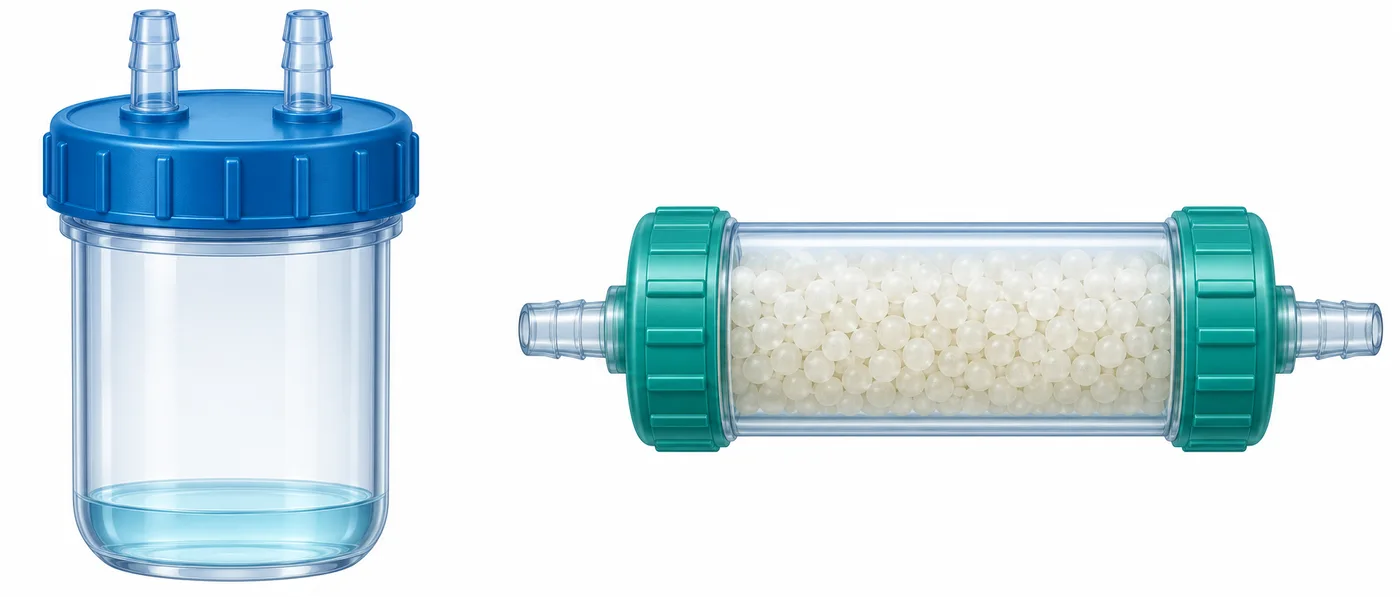
Conceptual components: a trap handles collected liquid; a dryer changes water-vapor content. Selection must also preserve the target measurement.
Does a hydrophobic filter make the result dry-basis?
No. If water vapor passes through with the sample, it remains part of the gas mixture at the cell. A liquid-resistant membrane does not by itself convert a wet-basis concentration into a dry-basis concentration.
A wet-basis fraction includes water vapor in the total gas amount. A dry-basis fraction excludes it. The distinction applies even when the target gas does not react with water and the sensor is otherwise unaffected by humidity.
Vaisala's CO2 measurement application note explains that adding or removing water changes the gas composition and consequently the reported concentration basis. That is a real mixture change, distinct from optical or electronic humidity interference.
A reading can therefore change after moisture removal without indicating a sensor error. Before comparing two analyzers, determine whether both report the same basis and whether their sample conditioning differs.
The converse also matters. If a filter has become wetted and the reading changes, do not immediately label the result a wet/dry conversion. The path may also have developed a pressure drop, a delayed response, a leak or target-gas loss. A valid basis conversion assumes more than the presence of water.
A checked wet/dry example
Assume a hypothetical sample contains 1000 ppm CO2 on a dry basis. Water vapor accounts for 3.0% of the total wet mixture. Assume that adding water does not add or remove CO2 and that the comparison uses consistent mole-fraction units.
The dry gases occupy 97.0% of the wet mixture. The wet-basis concentration is therefore:
Wet CO2 = 1000 × (1 − 0.030) = 970 ppm.
Reversing the calculation:
Dry CO2 = 970 / (1 − 0.030) = 1000 ppm.
The difference is 30 ppm. A membrane that passes the water vapor leaves this basis difference present. A correctly specified dryer that removes water without changing CO2 could change the result toward the dry-basis value even when the sensor's calibration remains unchanged.
The 3.0% figure in this example is water mole fraction, not 3% relative humidity. Substituting an RH value directly into the equation would be incorrect. Converting RH to water fraction requires the relevant temperature and pressure information.
The same arithmetic can be applied to another nonreacting gas fraction under the same assumptions. It does not establish that a real dryer preserves that gas. For gases that dissolve in condensate, adsorb on surfaces or react in the sampling system, investigate recovery separately.
A partially dried sample also needs its remaining water content. Calling the outlet dry because a trap is installed is inadequate. A trap removes collected liquid; gas leaving it can still contain substantial vapor at its local conditions.
How can filters change response time?
Gas takes time to reach the sensing element. Tubing volume, filter housing volume, flow and diffusion all contribute. A membrane adds a transport boundary whose effect depends on its area, thickness, support and condition.
For a flowing system, a simple volume divided by actual volumetric flow provides a rough transport-time scale. It is not a complete response-time specification because mixing, adsorption and sensor dynamics can broaden the response. A housing can hold old sample even after a new sample reaches its inlet.
For a diffusion instrument, there may be no pump to overcome a restrictive path. A membrane or protective cover can slow exchange with the environment. The bare sensor's response time should therefore not be assumed to describe the installed instrument.
Liquid coverage can reduce the membrane area available for gas exchange. A sensor may then continue reporting a stable value from slowly changing gas inside its chamber. The stability can look reassuring while the measurement becomes stale.
This creates an important diagnostic distinction: a noisy reading is not the only sign of a wet sampling problem. An unusually unresponsive or delayed signal can be equally informative. Compare response behavior, flow status and moisture evidence rather than relying on the apparent smoothness of a trend.
Pressure drop can connect moisture to gas error
A restrictive filter can change the pressure at the cell in a pumped system. If the analyzer has pressure sensitivity or uses a pressure input, that pressure change can affect the reading. A symptom that appears humidity-related may therefore include a pneumatic contribution.
The relevant pressure is the condition at the measurement cell. A pressure sensor upstream of the filter may not see the drop downstream. Increasing the flow demand can enlarge the difference while the upstream pressure remains ordinary.
A flow indication also needs location and units. A flowmeter upstream of a leak or restriction may not describe what reaches the cell. Standard and actual volumetric flow are different quantities, so record the meter's basis when evaluating transport.
Do not use a pressure-compensation setting to compensate for an unqualified sampling path. Pressure correction cannot recover gas lost to a leak or water contact, and it cannot make a delayed sample represent the present process.
Der Alphasense technical FAQ includes gas-train design guidance addressing flow direction, pressure effects, filtering and condensation. Apply the instructions for the chosen sensor and analyzer; a layout appropriate to one family should not become a universal pump-placement rule.
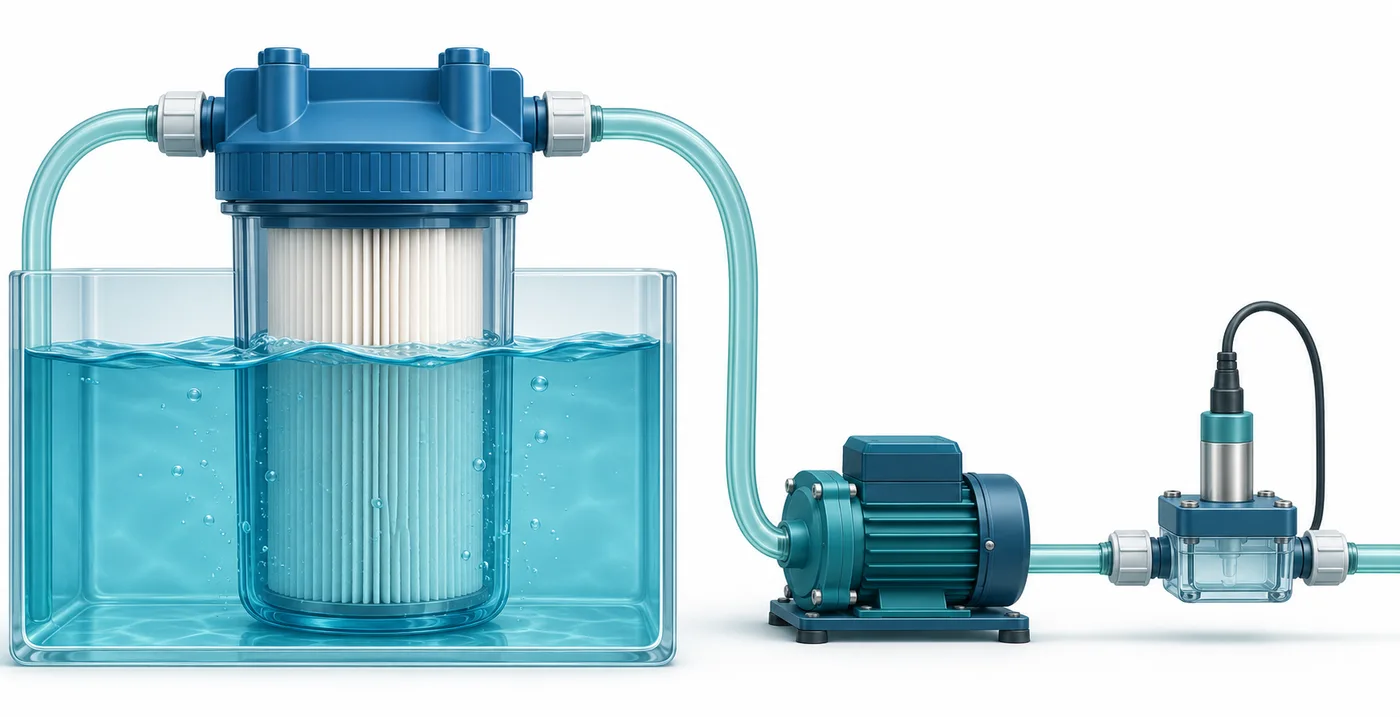
Conceptual liquid coverage: a protected sensor can still receive a restricted or delayed sample. Protection and representativeness need separate checks.
Select the filter using more than pore size
Pore size is only one selection parameter. The complete decision should include liquid-entry behavior, airflow or pressure-drop data, membrane area, housing volume, temperature and chemical compatibility.
Ask which test fluid and pressure conditions support the liquid-resistance claim. Clean water does not represent every condensate. A process containing oils, surfactants or solvents may require different materials or additional separation.
Check the target gas as well as the water. A filter acceptable for CO2 or oxygen may not preserve a reactive trace gas adequately. The relevant question is recovery and response at the required concentration, not merely whether gas can pass through the membrane.
Inspect the housing materials and seals. A membrane may be chemically suitable while an adhesive or elastomer is not. Low concentrations can make otherwise small surface interactions significant.
Review permitted orientation and maintenance. A filter that can shed droplets in one position may remain flooded in another. Installation space should permit inspection and replacement without damaging tubing or confusing the flow direction.
Finally assess the installed response. A component's airflow curve under a specified pressure difference does not establish the complete analyzer's response to a concentration step. The sensor, enclosure, tubing and processing remain part of the result.
Diagnose the symptom by following the water
If liquid is visible before the filter but not after it, the barrier may be containing droplets. Still check whether liquid coverage has reduced gas exchange. Successful containment does not establish unchanged flow.
If droplets appear after the filter, consider both breakthrough and local condensation. Compare surface temperatures and dew point, inspect seals and assess membrane compatibility. The position of the first visible droplet can help form a hypothesis, but visual inspection alone may miss thin films.
If the reading becomes slow during humid operation, compare flow and cell pressure with the clean, dry configuration. Check for collected liquid, saturated protective material and changes in available membrane area. Preserve the original trend before replacing parts.
If the reading changes after drying, first reconcile sample basis. Then assess whether the dryer or condensate could remove target gas. A concentration increase consistent with water removal and a decrease caused by target-gas loss can even partially cancel.
If the problem appears during temperature cycling, inspect cold points and shutdown conditions. A system can operate acceptably after warming but collect water while idle. Restart then introduces a different sample-path state.
The article on Feuchtigkeitseffekte in Gassensoren provides broader context for distinguishing moisture dilution, sensor response and physical condensation. Those mechanisms should remain separate in the fault record.
A useful acceptance record for a humid sample path
Begin with the measurement definition: target gas, concentration range, source location, required response and wet or dry basis. Without that definition, it is difficult to decide whether a change introduced by conditioning is acceptable.
Record the sample path in sequence. Include source pressure and temperature, tube materials and dimensions, filter type, trap or dryer, pump, cell and exhaust arrangement. Add the locations of pressure, temperature and humidity measurements.
Describe expected water states. Is the inlet expected to contain droplets? Can any section cool below dew point? Does the system intentionally remove vapor? State which component handles each condition rather than writing a broad moisture protection label.
Keep clean and challenged conditions distinct. A dry commissioning comparison may establish basic gas response while leaving humid-service behavior unresolved. Any humidity challenge should follow an appropriate manufacturer-supported method and preserve target-gas reference conditions.
Record pressure drop and response behavior along with concentration agreement. A sample path that gives the right settled value but arrives too late may fail the application's need. A path that responds quickly but changes the gas basis may require a documented conversion or a different design.
Specify maintenance evidence. Useful indicators can include filter condition, flow status, collected-liquid level or a manufacturer-defined diagnostic. A fixed replacement interval alone may not reveal an unexpectedly severe moisture event.
After changing a filter type, tubing route or dryer, reassess the affected evidence. Nominally interchangeable parts can differ in internal volume, membrane area and surface chemistry. A stable gas-sensor calibration does not make all sample-path changes neutral.
How to compare two proposed solutions fairly
Compare solutions against the same required output. If one keeps the sample humid and another dries it, first decide how both results will be expressed on the chosen basis. Otherwise an expected composition difference can be mistaken for superior accuracy.
Include time behavior. A small diffusion barrier and a large conditioning assembly can reach the same final value at very different times. Define whether the application needs a settled laboratory result, a process trend or a prompt indication.
Include failure visibility. A solution that loses flow silently when wet presents a different integration problem from one with a clear low-flow status. The diagnostic does not prevent every failure, but it can keep a stale reading from being treated as current.
Include the real maintenance environment. A trap that is easy to inspect on a bench may be inaccessible in a cabinet. A membrane that works with clean condensate may see detergent during routine cleaning. Those conditions belong in selection, not only in later troubleshooting.
Avoid declaring one component universally best. The correct combination is the one that controls the relevant water phase, preserves the target-gas measurement, meets the response requirement and provides interpretable failure behavior within the documented conditions.
A transport example: protection succeeds while the sample changes
Consider a hypothetical warm process sample containing humid gas and occasional entrained droplets. An inlet membrane resists those droplets. The gas then travels through a cooler cabinet fitting before reaching an analyzer. The sensor remains protected from the original droplets, but new liquid forms at the fitting.
Three observations would answer different questions. A dry sensor face supports the limited conclusion that visible liquid did not reach that face. Collected water at the fitting indicates a local phase change. A concentration difference from the source raises a separate question about moisture basis, target-gas recovery and leakage.
Adding another membrane near the sensor could provide another liquid boundary, but it would not explain the sample change upstream. Moving the first membrane would likewise leave the water vapor present unless another process removes it. The design decision should follow the required sample basis and the permitted source-to-cell conditions.
An interpretable comparison would document both source and cell conditions and the intended conditioning method. It would also preserve response-time evidence, because a liquid film can restrict exchange even when a final concentration eventually appears reasonable. This example shows why the most useful question is not whether the sensor stayed dry, but whether the entire measurement remained representative.
Häufig gestellte Fragen
Does hydrophobic mean that water vapor cannot pass?
No. A hydrophobic membrane can resist liquid water while permitting humid gas exchange. Check the exact product specification.
Can a filter prevent every condensation problem?
No. Vapor can cross a membrane and condense on a colder surface downstream. Temperature and dew point through the whole path matter.
Is a water trap the same as a dryer?
No. A trap handles collected liquid; a dryer reduces water vapor. Gas leaving a trap can still be humid.
Does drying always improve gas accuracy?
No. Drying can make the sample compatible with an analyzer, but it changes concentration basis and may affect target-gas recovery. Those effects need qualification.
Why did the reading become stable when the filter got wet?
One possibility is restricted exchange, leaving slowly changing gas at the sensor. Confirm with flow, pressure and response evidence; stability alone does not establish accuracy.
What should be checked after replacing the filter?
Confirm the correct part, seals, orientation, flow or pressure behavior and installed gas response. A changed housing volume or membrane can alter performance even when the sensor itself is unchanged.
Quellen
- Gore packaging-vent FAQ: membrane wetting and gas exchange principles.
- Gore performance membranes: application-specific membrane characteristics.
- Vaisala high-humidity instrument selection: cold spots, conduction and condensation.
- Vaisala HMM170 condensation prevention: model-specific heating and output conditions.
- Vaisala CO2 measurement application note: water-vapor dilution and concentration basis.
- Alphasense technical FAQ: sampling-system considerations.





Hinterlasse eine Antwort