
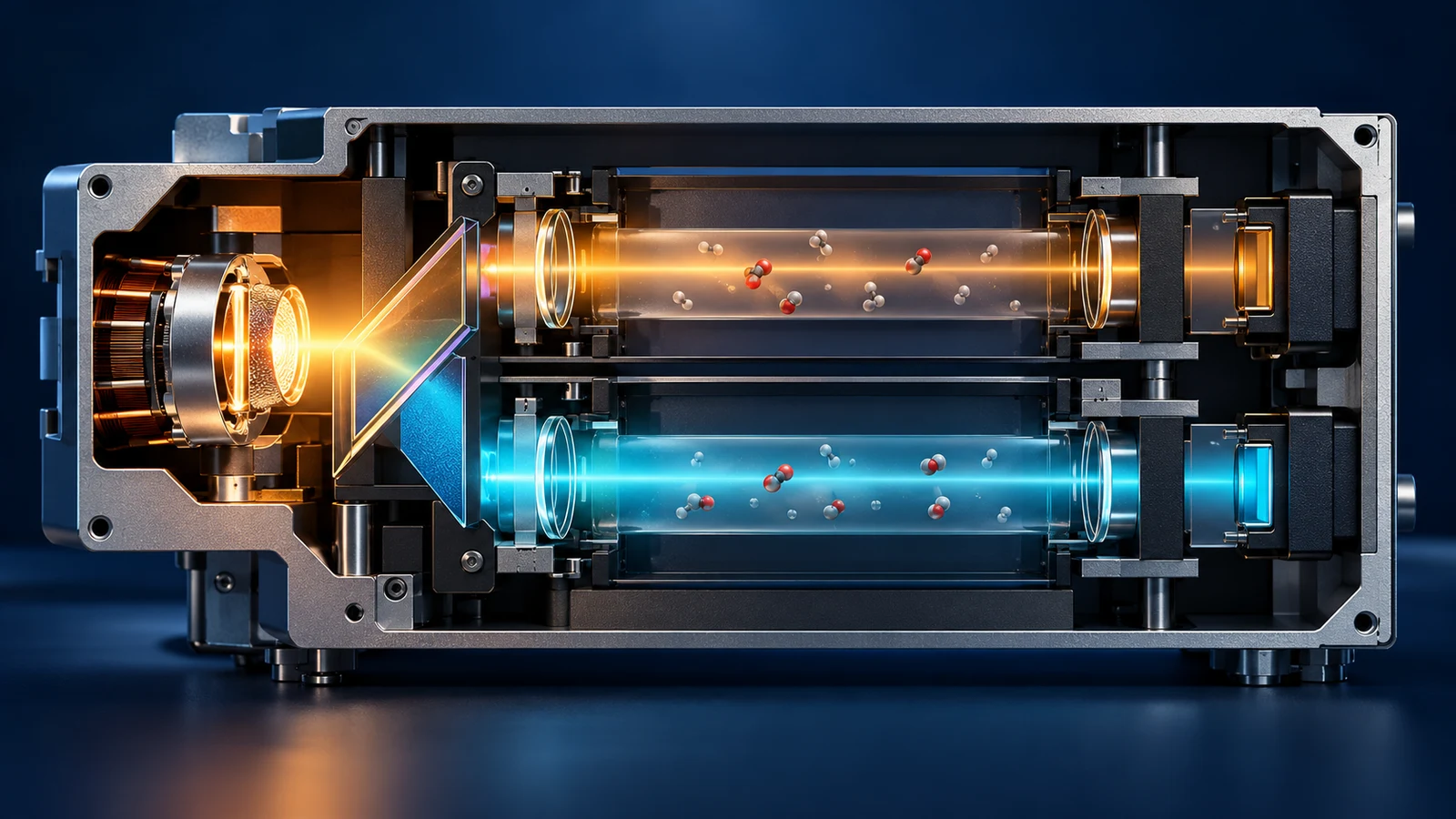
An NDIR CO₂ sensor interprets a small change in received infrared light as gas absorption. The difficulty is that light reaching a detector can also change when the source ages, an optical surface gets dirty or the electronics drift. A reference channel provides a second observation to help separate some of those optical changes from CO₂ absorption. It is a valuable design feature, but its correction is limited by what the two observations have in common.
The key distinction is this: optical referencing, environmental compensation and concentration calibration solve different problems. A product may use all three. Calling all of them “self-calibration” hides the information needed to judge long-term readings.
What Is the Reference Actually Measuring?
In a simple explanation of NDIR, the CO₂-sensitive channel receives light near an absorption band, while a reference observation is chosen to respond less to CO₂. If source output falls similarly at both observations, comparing the two can make the CO₂ estimate less sensitive to that common change. The comparison may be implemented with separate detectors or optical bands, or by changing a filter in one optical path. The manufacturer's actual optical design matters.
Sensirion describes its SCD30 as a dual-channel transmissive NDIR module whose built-in reference channel improves long-term stability. Vaisala's CARBOCAP technology uses a tunable filter to observe CO₂ absorption and a nearby nonabsorbing reference wavelength along the same path. Both illustrate referencing, yet they should not be treated as identical architectures.
An illustrative signal ratio is R = SCO₂ / Sref. If a source-intensity change multiplies both signals by approximately the same factor, that factor can largely cancel in the ratio. The example explains why referencing can work; it is not the algorithm of every commercial sensor. Real designs must characterize wavelength-dependent source changes, detector responses, offsets, filters and calibration.
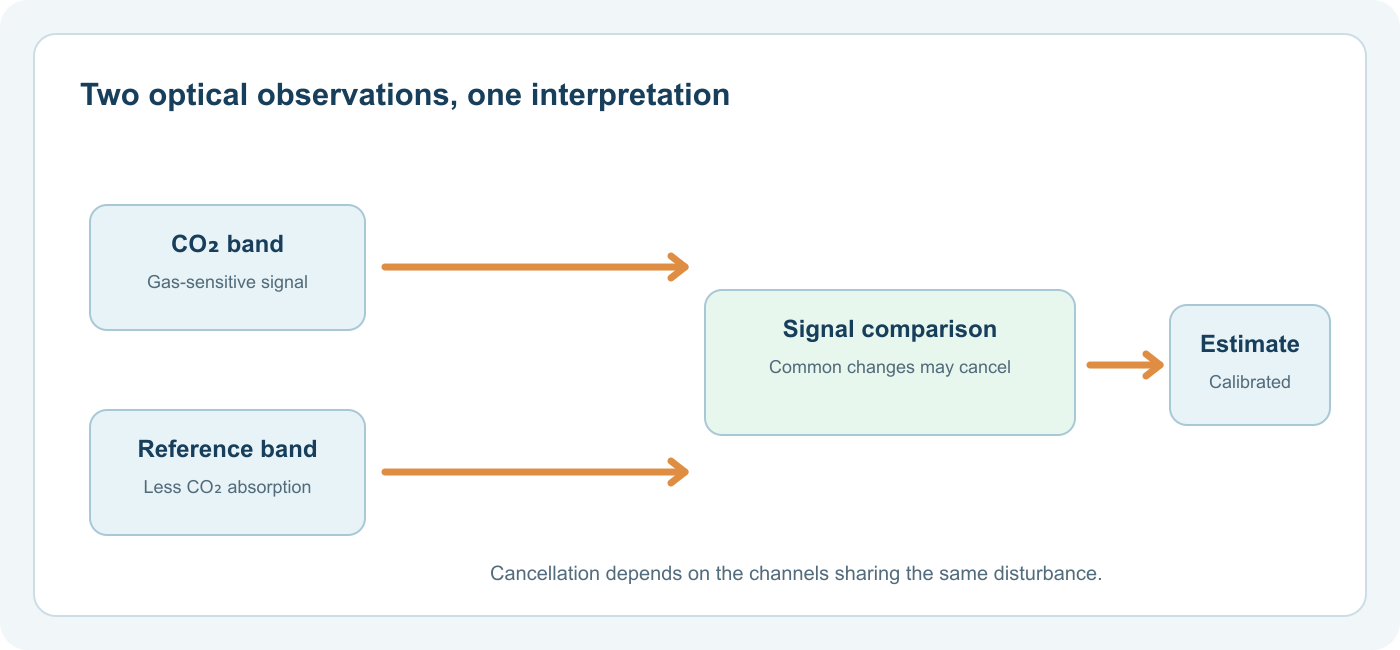
What a Well-Designed Optical Reference Can Help With
Source-output drift. An IR source may deliver less usable light as operating time accumulates. If both observations see a comparable change, their comparison can reduce the resulting concentration error. “Comparable” is the condition: source aging can change spectral shape as well as total output, so correction depends on the instrument's design.
Some shared optical attenuation. A film or dust that attenuates both measured bands through the same path may be partly compensated. Vaisala explicitly describes compensation for contamination in its shared-path CARBOCAP design. That claim cannot be generalized to contamination occurring in only one of two separate paths, or to all wavelengths equally.
Certain common signal-chain changes. When electronics and detectors share a characterized drift mechanism, referencing may help make the ratio less sensitive to it. Again, whether it does so is established by a particular implementation and its tests, not by the label “dual channel.”
The benefit is commonly discussed as long-term stability. Stability is not the same as a guarantee of absolute accuracy at all concentrations. A stable wrong calibration can still report the wrong number.
What the Reference Cannot Fix by Itself
| Change or error | Why the reference alone is insufficient | What to examine instead |
|---|---|---|
| Incorrect concentration calibration | A ratio still needs a validated map to CO₂ concentration | Calibration method, range and reference gas |
| Pressure or altitude difference | Gas number density in the cell changes even when mixture fraction does not | Pressure input or model-specific altitude correction |
| Temperature gradient near the module | Gas density, detector and electronics may respond differently | Installation guidance and temperature compensation |
| Moisture or interfering gas | Absorption and gas reporting basis may change in ways a single optical ratio cannot resolve | Specified humidity range, cross-sensitivity and sample preparation |
| Dirt on only one channel | Changes are no longer common to both observations | Optical geometry, maintenance, diagnostic limits |
| Obstructed inlet or stagnant sample | The optics can be correct while seeing the wrong gas | Airflow, enclosure and sample-path design |
| Source or detector near its signal limit | A ratio of weak or saturated signals is unreliable | Signal range, fault detection and service procedure |
These are categories, not a claim that all devices fail in the same way. A complete module may separately measure temperature or receive a pressure value and compensate within defined conditions. Some designs have diagnostics that flag optical faults. Read the data sheet and integration guide to determine which functions are actually available.
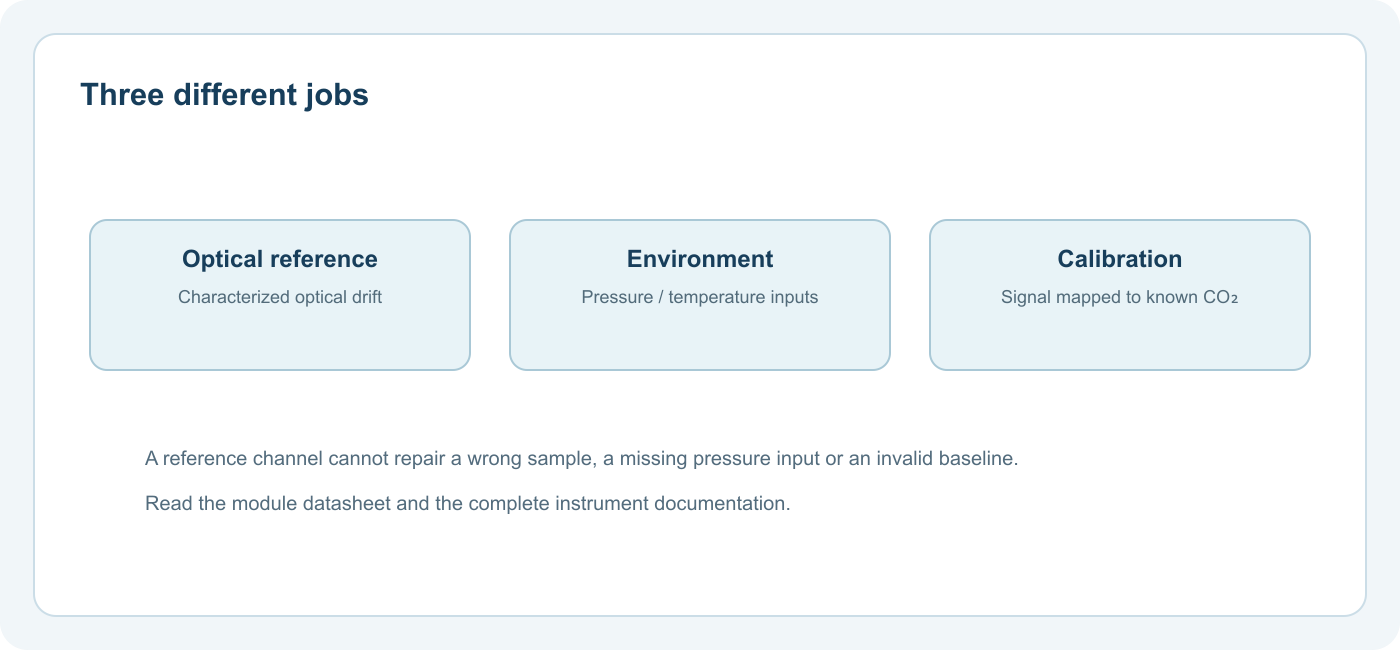
Optical Referencing Is Not Environmental Compensation
The CO₂ absorption signal depends on the number of molecules encountered along the optical path. Ambient pressure and temperature can alter gas density, and therefore the optical response, for the same nominal concentration fraction. Sensirion's Dokumentation der SCD30-Schnittstelle includes ambient-pressure and altitude compensation commands. These inputs are separate from its dual-channel optical principle.
Likewise, the SCD30-Design-in-Leitfaden warns that airflow around a module can create pressure changes, and that nearby heat sources can affect performance. An optical reference inside the module cannot identify the intended sample pressure or repair a poor mounting location without the relevant model and inputs.
For a finished instrument, find out whether pressure is measured internally, supplied by the host system, entered as altitude, or left at a default. Record the expected pressure range for the actual site. Ask what the output represents in humid air. Those are reporting questions, not mere feature labels.
Optical Referencing Is Not Automatic Baseline Calibration
Some CO₂ products use an automatic baseline or self-calibration procedure that assumes periodic exposure to a known low-CO₂ environment. That procedure adjusts the concentration mapping over time. It is conceptually different from observing a reference optical wavelength during a measurement cycle. A sensor can have an optical reference and still need a suitable calibration procedure; a module without a second optical channel may use baseline calibration for long-term management.
The distinction matters in continuously elevated CO₂ environments: incubators, controlled-atmosphere storage, greenhouses and some processes may never reach the baseline assumed by a particular algorithm. The SCD30-Datenblatt describes conditions for its automatic self-calibration and also offers forced recalibration. Those conditions belong to that model, not to every NDIR device.
See Gasnose's explanation of gas-sensor drift for the distinction between zero and span changes, and for why an automatic baseline assumption can be unsuitable in a process that does not return to a known baseline.
When Does “Dual Channel” Add Useful Confidence?
Ask for evidence tied to the use case. A claim of “dual-channel NDIR” is strongest when the documentation explains the reference architecture, measurement range, accuracy conditions, drift specification, environmental corrections and maintenance assumptions. Long-term stability data should be read alongside calibration conditions. The reference channel's own condition also matters: if it drifts or becomes attenuated differently, its ratio may introduce rather than remove an error.
For a room monitor, check location, air access, calibration assumptions and whether the whole device reports useful trends. For a duct installation, check pressure effects and airflow. For a process sample, define the gas composition and conditioning. For a safety use, evaluate the complete instrument and intended-use documentation; a sensor architecture alone cannot qualify an alarm system.
Here is a concise supplier checklist:
- Is the reference a separate optical path, a separate detector, or another wavelength in a shared path?
- Which long-term changes has the manufacturer shown it compensates, and under what conditions?
- Which environmental parameters require additional sensors or user inputs?
- Which accuracy and drift claims apply to the exact range and duty cycle?
- What fault flags, calibration checks and maintenance steps does the finished product require?
Unser Leitfaden zur NDIR-Messkette places the reference between optical detection and the reported value. The general CO₂ measurement guide helps connect module claims to the sampling and output requirements of a full device.
A Practical Interpretation
Think of an optical reference as a second measurement of the instrument, not as a second measurement of the room. It can help reject changes shared by the relevant optical observations. It cannot know whether the gas sample is representative, whether pressure was set correctly or whether a calibration premise is valid. Those issues must be solved elsewhere in the measurement chain.
Häufig gestellte Fragen
Does a reference channel eliminate sensor drift? It may reduce characterized optical drift. It does not eliminate every drift mechanism or remove the need to follow the manufacturer's calibration and maintenance instructions.
Is a reference channel the same as automatic self-calibration? No. A reference compares optical observations. Automatic baseline calibration adjusts the concentration mapping using an assumed or supplied environmental reference.
Can a reference correct dust? Some shared-path, multiwavelength designs can compensate for common optical attenuation within their specified limits. Dust affecting one channel differently, blocking gas exchange or exceeding the optical signal budget is another situation.
Should I choose a module solely because it has two channels? No. Compare the specified accuracy, drift, operating conditions and complete-device integration for the intended measurement task.
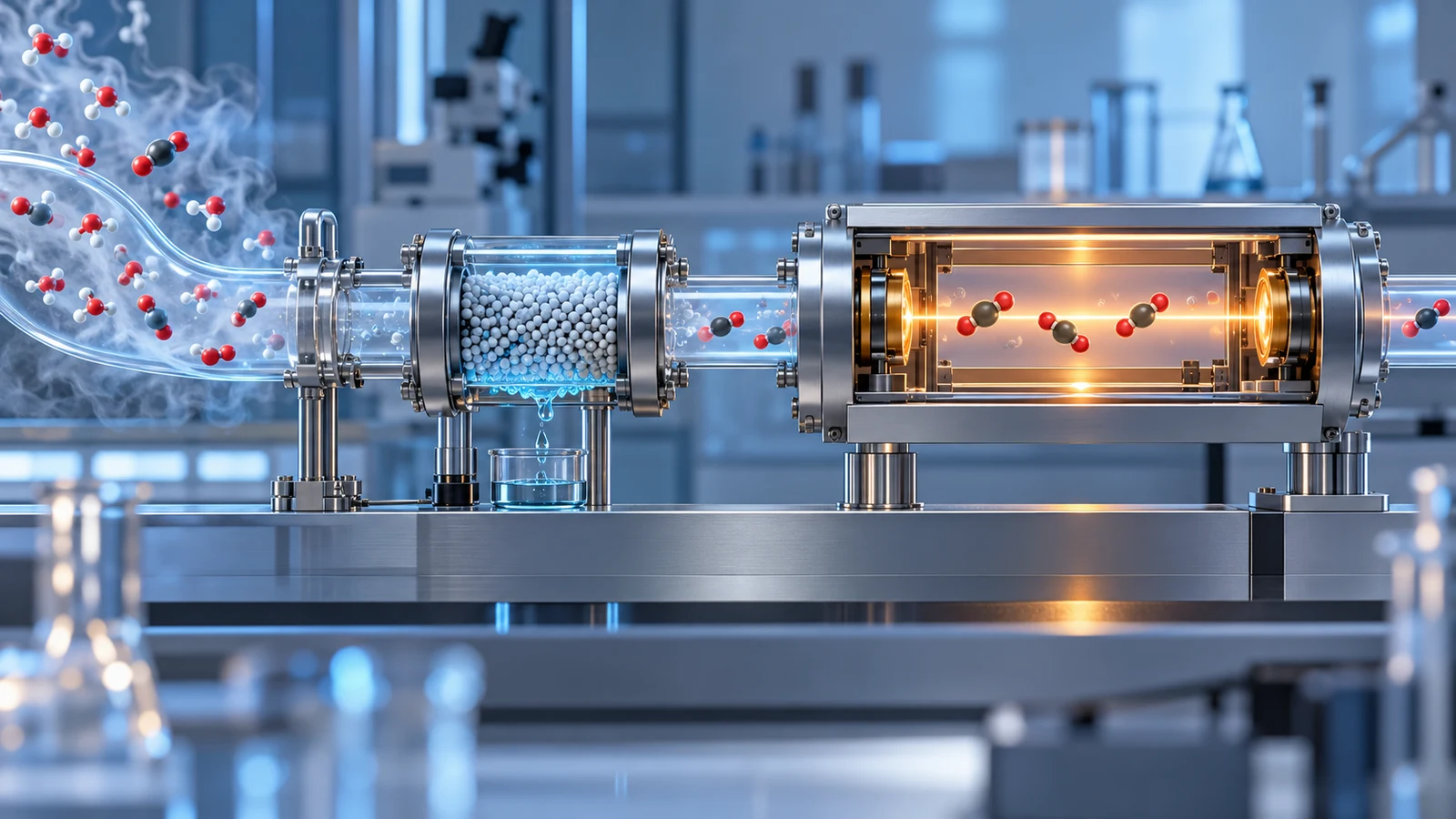
Feuchte vs. trockene CO2-Messwerte: Warum die Probenbasis die Zahl verändert
Die CO2-Werte in feuchter und trockener Luft können unterschiedlich sein, da Wasserdampf den Nenner des Bruchs ändert. Erfahren Sie, wie die bedingte Umrechnung funktioniert und was in einem Probengassystem aufzuzeichnen ist.
Mehr lesen
CO2-Sensorbereich: Auswahl der ppm- oder Prozentmessung
Wählen Sie einen CO2-Messbereich entsprechend den Konzentrationen und Entscheidungen, die wichtig sind. Vergleichen Sie ppm- und Prozenteinheiten, Genauigkeitsintervalle, Bereichsüberschreitungsverhalten und Probenahmebedingungen.
Mehr lesen
CO2-Monitor vs. Gasanalysator: Probenahme, Daten und Instrumentenauswahl
Vergleichen Sie CO2-Monitore und Gasanalysatoren nach Probenpunkt, Gasweg, Messbereich, Zeitauflösung, Kalibrierungsnachweis und der Entscheidung, die die Daten unterstützen.
Mehr lesen
CO2-Sensormodul vs. kompletter Monitor: Was jede Spezifikation beweist
Ein CO2-Sensormodul und ein kompletter Monitor lösen unterschiedliche Engineering-Aufgaben. Vergleichen Sie Gehäuse, Probenahme, Leistung, Daten, Kalibrierung, Alarme und fertige Gerätenachweise.
Mehr lesen
NDIR-CO2-Sensoren: So funktioniert die Messkette
Verfolgen Sie die NDIR-CO2-Messkette von der Infrarotquelle und der Gaszelle bis hin zu Filter, Detektor, Referenzsignal, Kompensation und kalibriertem Ausgang.
Mehr lesen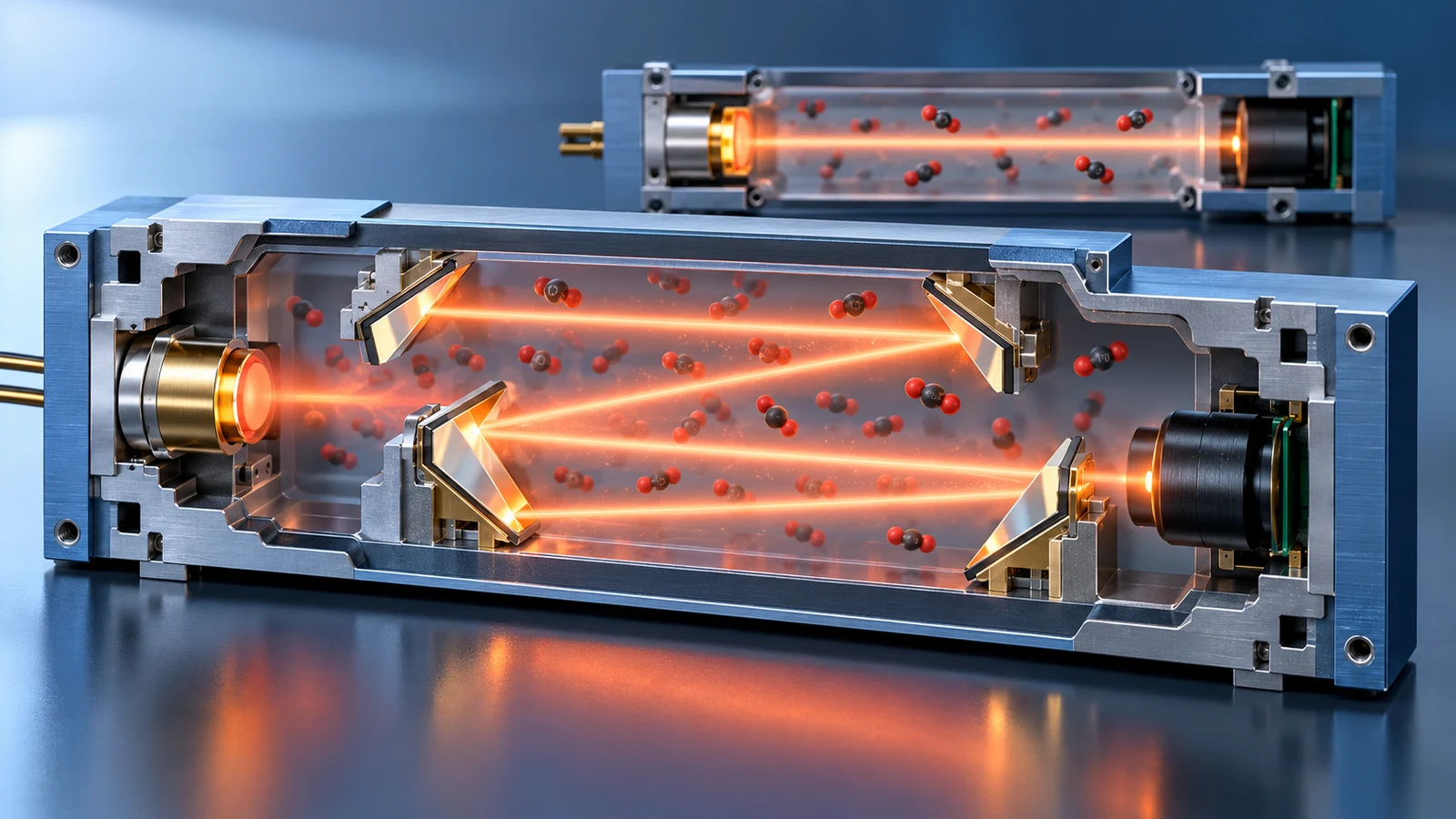
Optische Weglänge in CO2-Sensoren: Reichweite, Empfindlichkeit und Größe
Erfahren Sie, wie sich die optische NDIR-Pfadlänge auf das CO2-arme Signal, den hohen Konzentrationsbereich, die Zellgeometrie und die Modulgröße auswirkt und welche Spezifikationen Sie vergleichen sollten.
Mehr lesen
Kommentar (1)
[…] guarantee continued operation if the optical signal is too weak or the gas inlet is blocked. Read what an NDIR reference channel can compensate alongside path geometry rather than treating the two as independent […]