
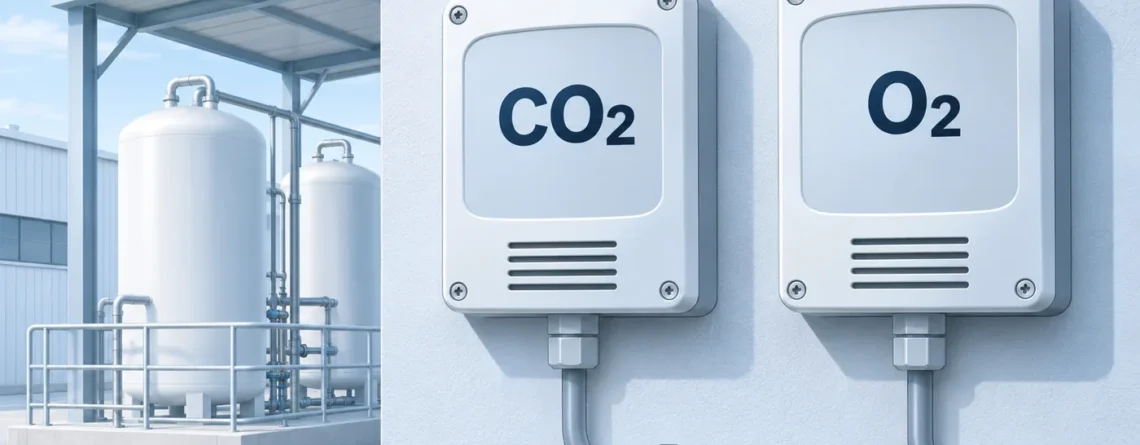
A carbon dioxide monitor measures CO2; an oxygen monitor measures O2. Neither reading establishes the other gas concentration in a real workplace. A CO2 release can create a harmful exposure while oxygen remains above an oxygen-deficiency alarm threshold. Nitrogen or argon can displace oxygen without producing a corresponding rise in CO2. Where both release mechanisms are credible, the monitoring assessment must address both measurements and their separate limitations.
This distinction matters when a specification says only “asphyxiation monitoring.” That phrase describes a hazard outcome, not a complete measurement requirement. The design needs an identified gas inventory, defined scenarios, suitable instruments, and a documented relationship between readings and protective actions. A familiar device name or a normal display cannot fill those gaps.
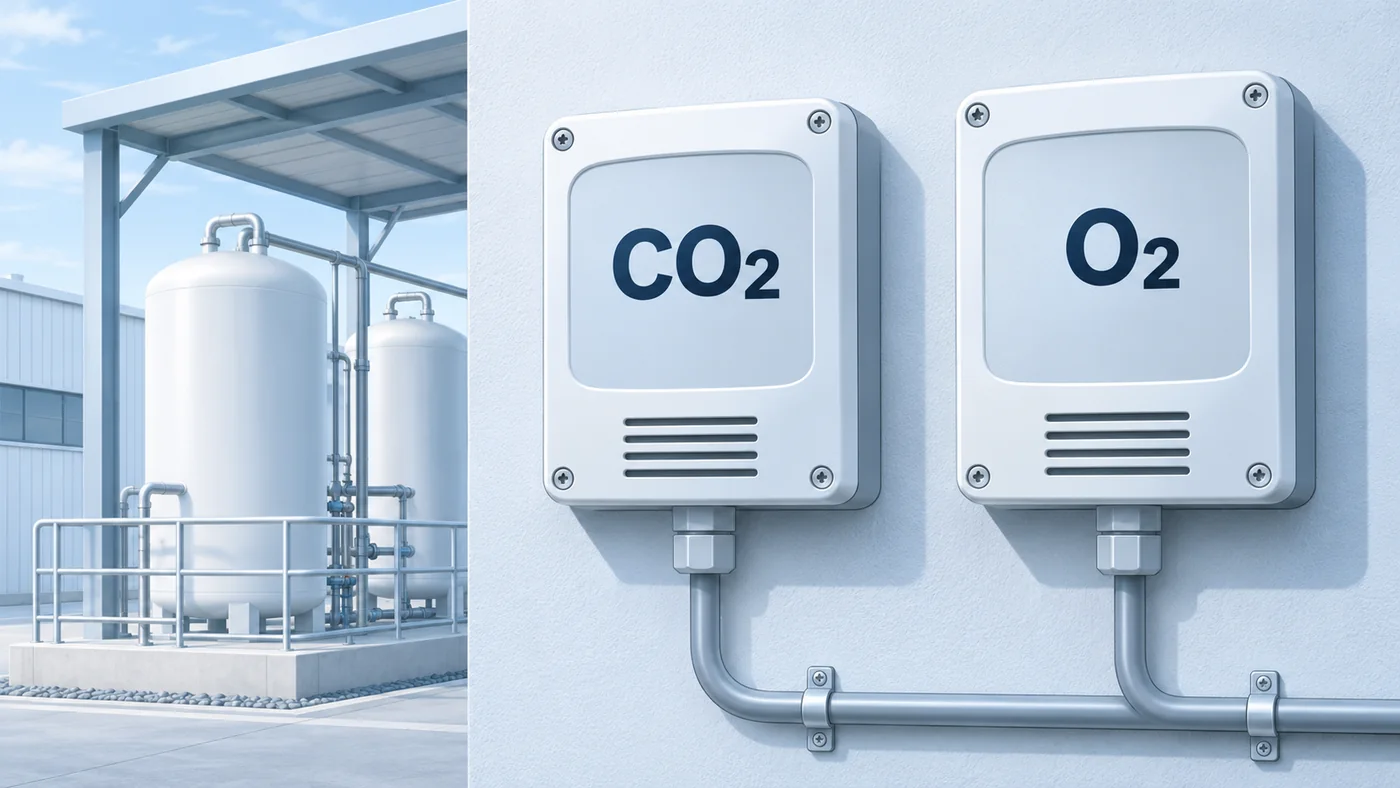
Two different questions behind the word asphyxiation
The first question is whether the atmosphere contains enough oxygen for the intended activity. The second is whether a specific substance creates an unacceptable exposure. These questions can overlap without becoming interchangeable. CO2 has physiological effects of its own; its significance cannot be reduced to the amount of oxygen that it displaces. The NIOSH carbon dioxide entry identifies respiratory and cardiovascular effects as well as asphyxia. Its exposure references therefore concern CO2 concentration directly.
For example, a nitrogen supply fault changes the composition of air even if there is no CO2 source nearby. An oxygen channel can detect oxygen depletion within its specified capability, while a CO2 channel may remain close to its previous reading. Conversely, adding CO2 does not need to remove most of the oxygen before direct CO2 exposure becomes important. The monitoring objectives should be written as separate statements before anyone chooses a device.
An engineer might write “detect a credible CO2 accumulation in the cylinder room” and “detect oxygen depletion associated with the separate nitrogen installation.” Each statement needs a location basis and a response definition. Combining them into “install an air-quality monitor” removes essential information about what must be measured and why.
A dilution calculation explains the mismatch
Consider an intentionally simplified calculation, not a model of a room or an alarm recommendation. Start with a uniform atmosphere containing 20.9% oxygen. Replace 1% of that atmosphere with pure CO2, without combustion, biological oxygen consumption, pressure changes, or selective removal. The remaining oxygen fraction is approximately 20.9% multiplied by 0.99, or 20.691%. The added CO2 is approximately 1% by volume, equivalent to 10,000 ppm, apart from the original background contribution.
The calculation demonstrates an important mathematical point: a substantial change in CO2 can accompany a much smaller absolute change in oxygen percentage. It does not establish a tolerable exposure. No one should use this calculation to authorize occupancy, predict an alarm time, or select a sensor location. Real releases involve changing flow, temperature, mixing, ventilation, and local concentration gradients.
Now replace the same fraction with nitrogen instead. The calculated oxygen reduction is similar, but no corresponding CO2 increase is required. Thus the inverse calculation is underdetermined: an oxygen reading alone does not identify which gas displaced air. A CO2 reading alone does not account for oxygen consumed by corrosion, combustion, or other processes. A displayed concentration becomes meaningful only when connected to the actual measurement and scenario.
Separate exposure references from alarm decisions
Exposure references have jurisdiction, averaging period, and purpose. An occupational time-weighted average is not automatically an instantaneous alarm setpoint. A short-term limit is not a universal evacuation threshold. A definition of an oxygen-deficient atmosphere is not a complete specification for a fixed detector system.
For United States general-industry permit spaces, OSHA 1910.146 defines oxygen deficiency below 19.5% oxygen by volume and includes other hazardous-atmosphere criteria. Its scope excludes construction, agriculture, and shipyard employment. The definition is relevant within that framework; it does not mean that every atmosphere above the number is safe or that every application must adopt the same alarm arrangement.
El HSE CO2 hazard guidance addresses Great Britain and points to workplace exposure limits under COSHH. Its short-term reference differs from the NIOSH recommendation. That difference is a useful reminder to identify the controlling jurisdiction and reference rather than copy a value from a search result. The approved system design should document the source and purpose of every threshold, including any delay, latching, acknowledgement, and reset behavior.
Start with a release inventory
Make the inventory specific enough to distinguish a beverage CO2 supply from a nitrogen generator, dry-ice handling, welding shielding gas, fermentation, and a refrigeration circuit. A cylinder count alone may miss a connected source outside the room. A normal process description may miss maintenance conditions or a disconnected line. The responsible assessment should consider credible changes in use as well as the initial installation.
Useful fields include gas identity, supply form, connected equipment, normal operating area, possible release locations, adjacent occupied spaces, and the person responsible for confirming changes. Quantity and pressure may influence the assessment, but this article does not turn them into a simplified detector-count formula. The purpose of the inventory is to make hidden assumptions visible for the designer.
Where the material is a mixture, obtain its actual identity and relevant safety documentation. “Inert gas” is not a channel specification. A shielding-gas mixture containing CO2 can raise both direct exposure and oxygen-displacement questions. A mixed installation may require separate instruments or a suitable combined system; the answer depends on the hazards and the capabilities of the exact equipment, not the label on the enclosure.
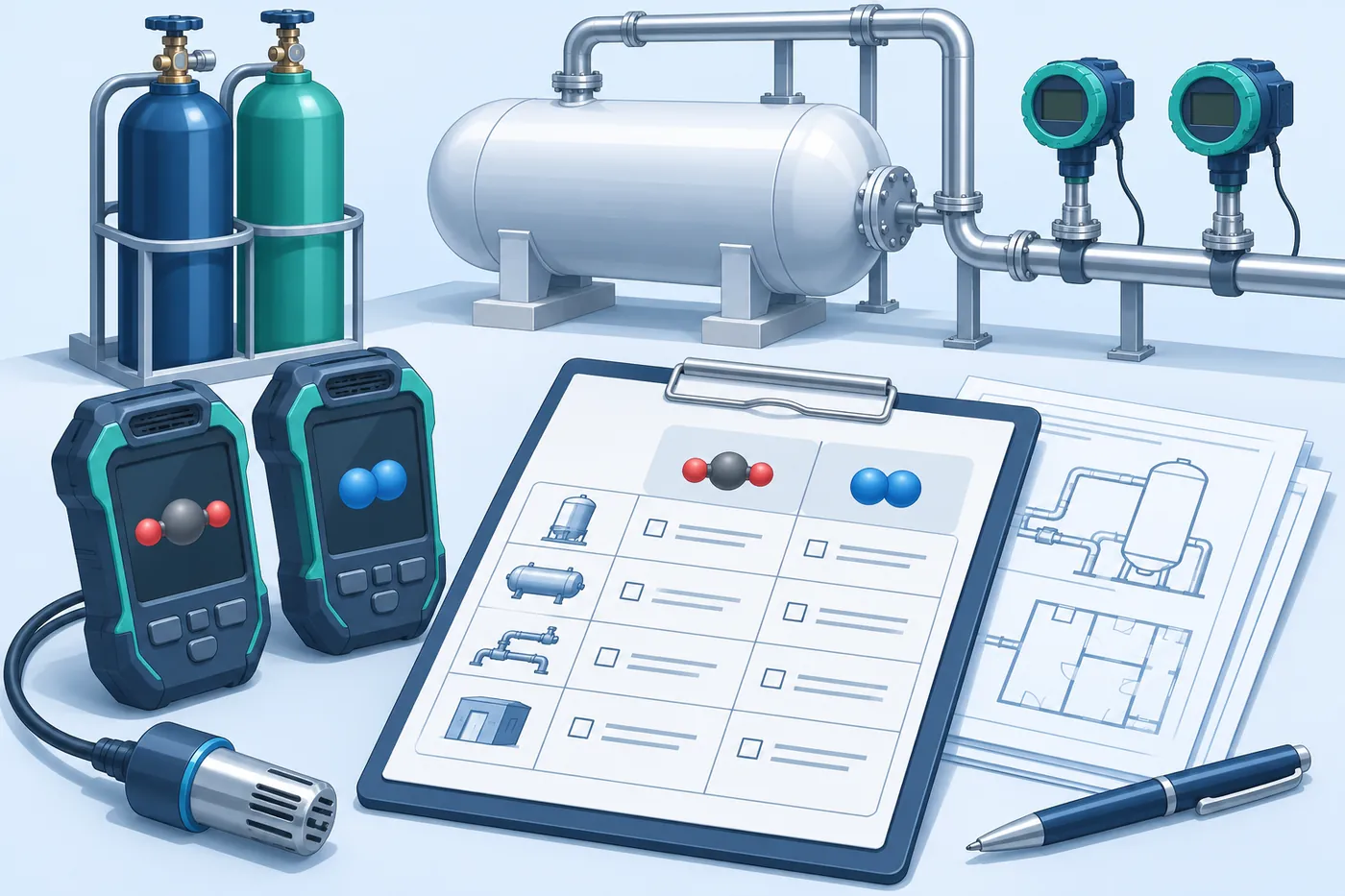
Compare objectives before comparing products
| Assessment question | Pruebas a solicitar | What cannot be inferred |
|---|---|---|
| Is CO2 accumulation credible? | Gas inventory, process description, release assessment | A normal O2 reading does not exclude direct CO2 exposure |
| Is oxygen depletion credible? | Inert-gas sources and oxygen-consuming processes | A normal CO2 reading does not establish adequate oxygen |
| Is the space represented by the sensor? | Location rationale, air movement and obstructions | One point does not characterize every connected space |
| Will people receive the warning? | Notification layout and defined response | A detector LED does not prove an alarm is understood |
| Is the system available? | Fault behavior, power provisions and maintenance evidence | A blank or stale display is not a healthy measurement |
| Is the design applicable locally? | Adopted requirements and project approvals | A manufacturer application guide is not local adoption |
Use the table to establish the questions that a supplier must answer. It is not an equipment qualification checklist by itself. A proposal may be technically capable of measuring both gases and still leave the location basis or warning interface unresolved. Those omissions affect the usefulness of the installed system even when each sensor performs correctly on a bench.
An indoor-air-quality monitor has a different job
An occupied-room CO2 trend can help assess ventilation when people are the relevant source and the space is suitable for that interpretation. That does not make the same instrument a safety detector for a gas-release scenario. The HSE ventilation guidance explicitly separates ventilation assessment from CO2 as a hazardous substance and identifies limitations where processes produce CO2.
For procurement, identify the actual intended use of the instrument. Review its range, output behavior, power dependence, environmental limits, maintenance instructions, and available alarm functions. A display intended to prompt occupants to open a window may have a very different role from a continuously supervised detection system connected to notification or other protective equipment.
Avoid translating a ventilation traffic-light color into a safety conclusion. The color may reflect a manufacturer-selected ventilation category, a user configuration, or a cloud service rule. It does not establish that the instrument has the required concentration range, fault response, or suitability for the assessed gas hazards. Read the exact manual and the project requirements together.
Location depends on the release and the room
Gas density matters, but it does not produce a universal mounting height. Cold releases, jets, obstructions, ventilation patterns, equipment enclosures, doors, and openings can change how gas reaches a sensing point. A drawing should explain why a location represents the scenario that the instrument is intended to detect.
El HSE welding guidance explains that turbulence and gas movement can disrupt simple assumptions about gases rising or sinking. This is particularly relevant when a design relies only on “CO2 is heavier than air.” The statement is a physical property, not evidence that a single low-mounted detector will cover every release or breathing location.
Review adjacent spaces as interfaces. Gas can migrate through openings while people enter from a different direction. The place where a warning must be received can therefore differ from the place where concentration is measured. The location review should address both. It should also consider whether planned storage, cleaning, or new equipment could block the sensor or obscure notification after handover.
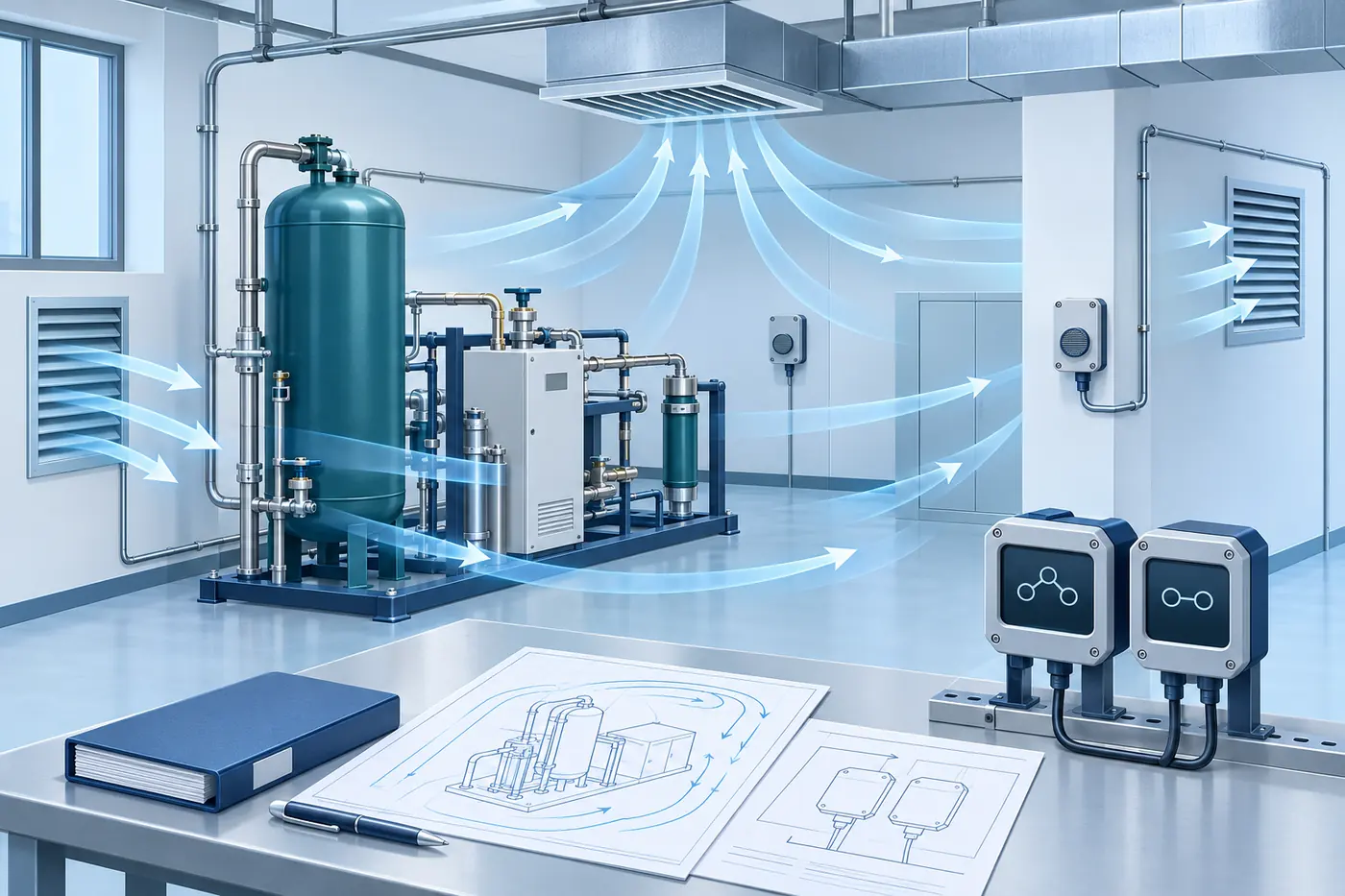
Treat a combined instrument as two measurement chains
A combined CO2/O2 instrument can simplify installation, but the shared enclosure does not remove the need to review each channel. Confirm the actual installed sensors, their supported ranges and units, and the conditions under which each specification applies. Check that the displayed channel is active and that outputs identify it unambiguously.
The two measurements may have different sensing principles, service requirements, interference limits, and failure indications. A common power supply or controller also creates shared dependencies. The technical review should identify which faults remove one measurement and which remove both. A single green status light is insufficient evidence unless its meaning is documented for that precise configuration.
For sampled systems, include the complete route from the sampling inlet to each sensing element. Tubing, filters, pumps, and accessories can affect delivery of the sample. The applicable manufacturer instructions must support the gas, materials, length, and arrangement. Do not assume a pump-equipped multigas detector measures every gas correctly through any tube that physically fits its inlet.
Keep concentration units visible
CO2 is commonly displayed in ppm or volume percent; oxygen is commonly displayed in volume percent. One volume percent equals 10,000 ppm for the same gas and concentration basis. That conversion does not convert a CO2 concentration into oxygen concentration. It only changes how a single quantity is expressed.
The documents should show gas identity and units together on each channel. In a building management interface, a generic “gas level” label invites confusion. The integration review should also confirm scaling, valid range, fault indication, and whether the displayed value is current. A correct number with the wrong engineering unit can lead to a materially wrong interpretation.
Check the same details in exported trends and alarm messages. A controller may retain a meaningful local display while a downstream system applies the wrong range. A record that says “1.2 gas” without channel, unit, timestamp, and quality information cannot support a reliable review. Better documentation makes the reading interpretable without requiring someone to reconstruct the original configuration from memory.
Measurement is only one part of the warning function
A detector can respond correctly while an occupant receives no useful warning. Notification may be outside the relevant area, inaudible in the work environment, visually obscured, or presented with ambiguous wording. A remote signal may reach an unattended workstation. These are system questions, not corrections to the sensor accuracy specification.
The design should connect the identified condition to the required notification and the approved response. It should state who receives the warning, what area it concerns, and how loss of measurement is distinguished from a gas alarm. Any interface to ventilation, isolation, or another system needs its own documented responsibility and acceptance basis.
This article does not prescribe actions for entering, investigating, or rescuing in a suspect atmosphere. Those actions belong to the employer's applicable procedures and competent response arrangements. The documentation review should confirm that the installed warning vocabulary and equipment behavior agree with those arrangements. An alarm that requires interpretation of undocumented codes adds uncertainty precisely when time and attention may be limited.
Availability needs explicit evidence
Ask how the system indicates power loss, sensor fault, blocked sampling, communications loss, maintenance inhibition, and an overdue required check. Not every product detects every failure, so request the documented limitations as well as the advertised diagnostics. A healthy controller does not prove that every connected sensing point is delivering a valid measurement.
Maintenance records should identify the device and channel, work performed, applicable instructions, outcome, and unresolved restrictions. “Checked” is too broad when it could mean visual inspection, gas-response verification, calibration, or an end-to-end system check. These activities answer different questions. A calibration record does not automatically demonstrate that an external alarm or linked output operated correctly.
Define ownership of a bypass or disabled channel. The important record is not simply that someone knew about it; the responsible organization needs to know which monitoring objective was unavailable, what authorized arrangements applied, and how restoration was confirmed. Do not invent a universal maintenance interval. The applicable requirements, manufacturer's instructions, service conditions, and assessment determine the schedule.
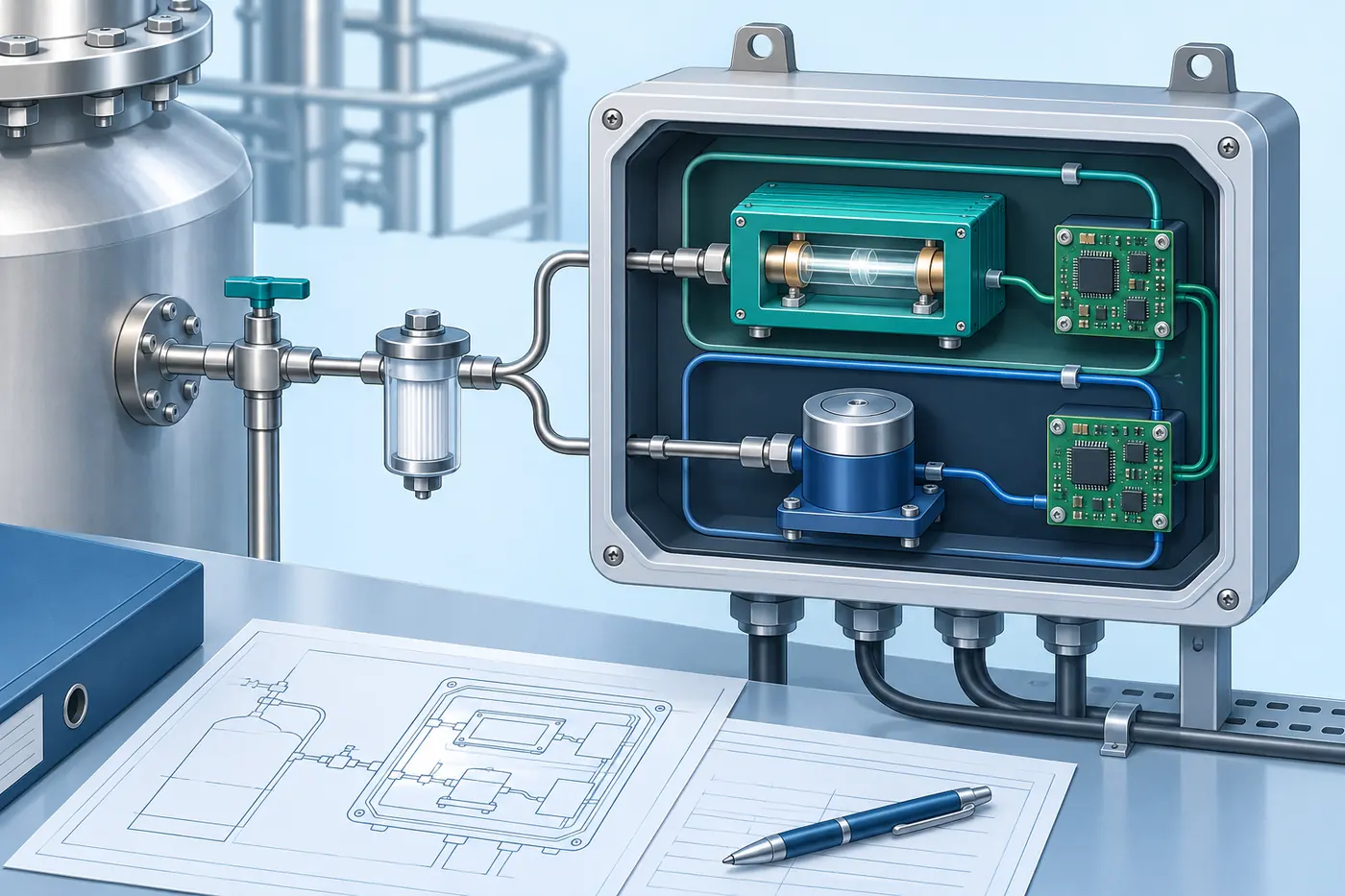
A hypothetical mixed-gas laboratory review
Imagine a laboratory with a nitrogen supply and a separate CO2 incubator supply. The initial request says “one asphyxiation alarm.” The design reviewer first separates the nitrogen release objective from the CO2 release objective. The question becomes whether the proposed equipment and locations can address both, with suitable evidence.
The supplier offers an oxygen detector and a room ventilation display. That proposal does not yet demonstrate a CO2 safety detection function. The reviewer requests the exact intended-use documentation for the CO2 device, the applicable concentration range and alarm behavior, and the rationale for its location relative to the supply equipment and room arrangement. The oxygen detector is reviewed against its own objective and operating conditions.
Suppose the room layout later changes and the cylinders move behind a partition. The original sensor location remains on the drawing, but its reasoning may no longer apply. The change review therefore considers both sensing coverage and notification visibility. This is a hypothetical documentation example, not a claim that the proposed installation is acceptable or that any particular detector count is sufficient.
The practical lesson is to resolve a disagreement at the level of requirements. Asking whether a product is “good” will not reveal that two people mean different hazards by the same word. Asking which scenario each channel covers makes the missing evidence identifiable and allows the responsible designer to address it.
Questions to settle before accepting a proposal
- Which gas release or oxygen-consuming process creates each monitoring objective?
- Which exact channel measures the relevant quantity, and in what units?
- What installed range and performance evidence support the application?
- What conditions, gases, accessories, or environments limit that evidence?
- Why are the proposed sensing locations representative of the assessed scenarios?
- Where must warnings be received, and how are gas alarms distinguished from faults?
- Which local requirements, adopted editions, and manufacturer instructions govern the design?
- What evidence will confirm the installed channel mapping and linked responses?
- Who owns maintenance, configuration changes, and restoration after an impairment?
Record answers as references to drawings, manuals, configuration records, and acceptance evidence rather than as unsupported yes/no statements. A statement such as “complies with standards” does not reveal which gas, edition, clause, or part of the system was assessed. A useful answer can be checked by someone who was absent from the original discussion.
Resolve apparently contradictory readings without inventing a relationship
Two readings can appear inconsistent because they represent different gases, locations, time windows, or data states. Before attempting a numerical reconciliation, establish the channel identity and the circumstances of each record. A CO2 instrument near one source and an oxygen instrument near another opening are not sampling the same atmosphere merely because they are in the same room. A remote trend may also use a different update interval from the local display.
La primera comparación útil es documental. Haga coincidir el gas, la unidad, la marca de tiempo, la ubicación y la configuración. Identifique si cada valor era válido, obsoleto, inhibido, fuera de rango o asociado con una falla. Un sistema de comunicaciones que conserva el valor anterior durante una interrupción puede crear una lectura aparentemente estable después de que la medición subyacente no esté disponible. Se trata de una cuestión de calidad de los datos más que de una prueba de que la atmósfera se mantuvo sin cambios.
Next, review whether the proposed relationship is physically justified. The simple dilution example earlier assumes a particular replacement gas and uniform mixing. A real workplace may contain multiple gas sources, oxygen-consuming processes and changing ventilation. No unique CO2 concentration can be calculated from a single oxygen measurement without those assumptions and sufficient supporting information. Similarly, an increase in CO2 does not quantify every other atmospheric hazard.
Where an instrument's fitness is uncertain, use the organization's arrangements for that condition and the applicable manufacturer instructions. Do not adjust a channel or invent an offset simply to make two readings agree. A good investigation produces an explanation linked to the actual measurement chain, or explicitly identifies the evidence that remains missing. Numerical agreement obtained by unsupported configuration changes is not a reliable resolution.
Define coverage claims at handover
A handover statement should describe the monitoring function with its boundaries. For instance, it can identify the accepted CO2 sensing points, the separate oxygen sensing points, their associated alarm zones, the accepted configuration revision, and the records that demonstrate the required interfaces. It should also identify limitations that affect interpretation, such as areas outside the assessed coverage or functions outside the supplier's scope.
The wording matters. Saying that a building is “protected against asphyxiation” is broader than most equipment evidence can support. It can conceal missing channels, unassessed rooms, or scenarios outside the original design. Saying which measurement functions were accepted under a defined assessment lets the owner understand what a later process change might affect. This is a practical description of evidence, not a new performance certification.
Review the relationship between measurement locations and work patterns. A warning arrangement designed for a normally occupied room may be interpreted differently when the same room becomes intermittently occupied storage. A new door, equipment enclosure, or ventilation change may affect gas movement and the path by which people receive a warning. The handover should make the original assumptions accessible so that the responsible change review can examine them.
Ownership should cover the continuing function rather than only the equipment. Someone must own the inventory changes, another person or team may maintain the instruments, and an integrator may control remote display mapping. The organization needs a way for changes in one area to reach the others. Without that connection, each team can maintain its own component correctly while the original monitoring objective becomes less well supported.
Finally, make the accepted records usable during a future review. A device tag should connect to the channel list, location drawing, manual revision, configuration and relevant service history. The alarm zone name should agree with signs and response information. These links reduce the chance that a normal-looking display or familiar room name will be interpreted as stronger evidence than it is. They also help the owner distinguish an equipment fault, an integration issue and a genuine change in atmospheric conditions.

What should a dual-objective review record contain?
A useful record preserves the distinction between the two objectives all the way through acceptance. Give each objective its own identifier, gas or process basis, affected area, intended instrument channel, relevant limitations, and evidence references. If the same enclosure serves both, identify the shared dependencies as well as the separate measurements. This prevents a combined product description from hiding the loss of one channel or a common power dependency.
Keep assumptions explicit. If the location assessment relies on a particular ventilation arrangement or gas-use pattern, identify that condition and the drawing or assessment that supports it. A later reviewer can then recognize that a partition, fan change or new source may affect coverage. An unexplained assertion that the position is correct gives the owner little help when the installation changes.
The record should also distinguish a measured condition from an interpretation. A CO2 reading, an oxygen reading, an alarm state and a system-health indication are different fields. If a remote interface combines them into a single summary, preserve access to the underlying meanings and identify how faults affect the summary. A green icon without a documented definition cannot establish which objectives remain available.
Finally, connect review outcomes to actual responsibilities. If additional evidence is required, state what is missing and who will resolve it. A reviewer should be able to tell whether the issue concerns equipment capability, location, integration, jurisdiction or operating arrangements. That makes the next decision concrete and avoids repeatedly asking whether the room has an adequate monitor without identifying what adequacy means for either hazard.
Preguntas frecuentes
Can a normal oxygen reading prove that CO2 is acceptable?
No. Oxygen concentration and CO2 concentration are different quantities. Direct CO2 exposure may matter before the reduction in oxygen reaches an oxygen-deficiency criterion. The relevant CO2 measurement and assessment remain necessary where a credible CO2 hazard exists. A stable oxygen display also says nothing about unmeasured toxic gases or local conditions away from its sampling point.
Can a CO2 monitor detect nitrogen leakage?
It does not measure nitrogen simply because nitrogen can displace air. Some release scenarios may change several gas fractions, but that correlation is not a dependable substitute for the required oxygen measurement. Identify the monitored hazard directly and confirm the chosen instrument's intended use.
Is a dual-gas device always the best option?
No. It may be appropriate if both channels, the common dependencies, installation conditions, and notification functions satisfy the design. Separate equipment may fit another application better. The comparison should address the complete installed function and lifecycle support, rather than the number of gas names printed on a product page.
Does the oxygen-deficiency definition establish that entry is safe above it?
No. Other atmospheric and non-atmospheric hazards may remain, and the applicable entry framework has additional requirements. A monitoring device does not issue a permit or replace the employer's assessment. Scope and jurisdiction must be identified before using any regulatory definition in a project specification.
Where can I read the broader background?
The existing guides to oxygen-deficient atmospheres y CO2 safety in restaurants and venues introduce those wider topics. Use the distinction here when translating a hazard description into separate, evidence-backed monitoring objectives.





Deja una respuesta