

El CO₂, la temperatura y la humedad relativa describen diferentes propiedades del mismo aire interior. Utilice CO₂ para buscar patrones asociados con la generación y dilución humana, la temperatura para rastrear el calentamiento y enfriamiento sensibles y la humedad relativa junto con la temperatura para comprender las condiciones de humedad. Un gráfico sincronizado puede mostrar cuándo coinciden esos patrones. No puede establecer una causa común sin ocupación, modo de equipo, condiciones exteriores y mediciones representativas.

Los canales ubicados conjuntamente ayudan a alinear las observaciones, pero cada canal responde a una pregunta diferente.
Dale a cada lectura un trabajo separado.
En una habitación ordinariamente ocupada donde las personas dominan la fuente de CO₂, la concentración puede aumentar a medida que las personas entran y cae a medida que el aire con bajo contenido de CO₂ la diluye o la generación se detiene. El volumen, la ocupación y la actividad, la concentración exterior, el flujo de aire exterior, el aire de otros espacios y el tiempo transcurrido afectan la trayectoria. Una lectura alta aislada no establece el suministro de aire exterior por persona. Una lectura baja en una habitación vacía o junto a un difusor de suministro no establece que la ventilación sea adecuada cuando la habitación está llena. La combustión u otra fuente importante de CO₂ cambia la interpretación.
Temperature indicates the local thermal condition at the probe. It responds to the HVAC system, room gains and air movement, including solar radiation, adjacent equipment or enclosure heating. It helps interpret occupant reports and equipment operation, but a single dry-bulb temperature cannot characterize thermal comfort. Radiant conditions, air speed, clothing and activity can matter even when an office sensor is within the building's normal band.
La humedad relativa (HR) compara el vapor de agua presente con la cantidad correspondiente a la saturación a la temperatura medida. Su respuesta incluye tanto un término de humedad como un término de temperatura. Se puede producir una disminución porcentual sin eliminar el vapor de agua y un aumento porcentual sin agregarlo. El punto de rocío, derivado de la temperatura y la humedad relativa en el mismo lugar y momento, a menudo hace que el patrón de humedad sea más fácil de leer.
| Canal o valor derivado | Unidades típicas | Pruebas que puede aportar | Limitación importante |
|---|---|---|---|
| CO₂ medido directamente | PPM | Cambios de generación y dilución durante la ocupación | No mide otros contaminantes ni establece directamente el flujo exterior |
| Temperatura de bulbo seco | °C o °F | Calefacción, refrigeración, ganancias de espacio y condiciones térmicas locales. | Afectados por la calefacción del lugar, la radiación y el recinto. |
| Humedad relativa | % RH | Proximidad a la saturación a la temperatura del sensor. | Cambia cuando la temperatura cambia incluso a presión de vapor constante |
| Punto de rocío calculado | °C o °F | Cambios en la presión de vapor y el potencial de condensación. | Depende de ambas mediciones de entrada y no dice nada sobre una temperatura de superficie no medida |
Los canales pueden cambiar a diferentes velocidades y en direcciones opuestas. Las personas en una reunión liberan CO₂, calor y vapor de agua, pero el sistema HVAC puede eliminar el calor sensible y la humedad a diferentes velocidades. Un serpentín de enfriamiento puede estar lo suficientemente frío como para eliminar la humedad en un modo de funcionamiento y solo cambiar la temperatura en otro. El patrón en el gráfico refleja el saldo neto en la ubicación del sensor. ASHRAE's position document on indoor carbon dioxide

La ocupación puede cambiar varias cargas de habitaciones a la vez. El equipo y las condiciones exteriores determinan cómo responde cada canal medido.
Distinguir el calentamiento del secado con punto de rocío.
A una temperatura del aire dada T, escriba la humedad relativa como HR = 100 × e/eₛ(T), donde e es la presión parcial del vapor de agua y eₛ(T) es la presión de vapor de saturación en T. El punto de rocío Tᵈ satisface miₛ(Tᵈ) = mi. Debido a que eₛ aumenta con la temperatura en el rango interior habitual, el calentamiento eleva el denominador de la expresión de HR. Si la presión de vapor es aproximadamente constante, el punto de rocío permanece aproximadamente constante mientras la humedad relativa disminuye. Esta es una interpretación útil para aire calentado sin adición o eliminación apreciable de humedad a una presión total casi constante. Capítulo de Fundamentos de ASHRAE sobre psicrometría
Considere una habitación hipotética a 20 °C y 50 % de humedad relativa. La presión de vapor de saturación es de aproximadamente 2,34 kPa, lo que da e ≈ 1,17 kPa y un punto de rocío cercano a 9,3 °C. Si el aire de la habitación se calienta a 24 °C mientras la presión de vapor permanece en 1,17 kPa, la presión de vapor de saturación aumenta a aproximadamente 2,98 kPa y la humedad relativa cae a aproximadamente 39%. El indicador de humedad derivado de la presión de vapor todavía da un punto de rocío cercano a 9,3 °C. Un informe solo de humedad relativa mostraría una disminución de 11 puntos porcentuales y podría erróneamente llamarlo secado.
| Condiciones de aire hipotéticas. | Temperatura | RH | Punto de rocío |
|---|---|---|---|
| Aire ambiental inicial | 20ºC | 50% | Alrededor de 9,3 °C |
| Misma presión de vapor después del calentamiento. | 24ºC | Alrededor del 39% | Alrededor de 9,3 °C |
| Mayor presión de vapor a la misma temperatura final | 24ºC | 50% | Alrededor de 12,9 °C |
Compare la temperatura de la superficie con el punto de rocío del aire local cuando investigue la condensación. Si el aire cerca de la superficie de un panel o conducto tiene un punto de rocío cercano a 9,3 °C y la superficie expuesta está a 7 °C, la condensación es físicamente posible en esa interfaz. Las cantidades relevantes son la temperatura de la superficie y la presión de vapor cercana, que pueden diferir de las condiciones en un transmisor de pared al otro lado de la habitación. El agua visible puede tener otras fuentes, como fugas. Combine la tendencia de la humedad con la inspección en lugar de inferir una fuente únicamente a partir de un umbral de humedad relativa. Guía de la EPA de EE. UU. sobre moho y humedad
Dew point is useful for comparing vapor pressure. When estimating how outdoor air changes the room's water content, humidity ratio is the mass of water vapor per mass of dry air and depends on pressure as well as vapor pressure. An outdoor RH percentage cannot tell you whether ventilation will dry or moisten the space. Cool outdoor air at a high relative humidity can carry less water vapor than warm indoor air at a lower relative humidity. Compare dew point or appropriately calculated humidity ratio, then account for coil operation, humidification and other moisture sources.
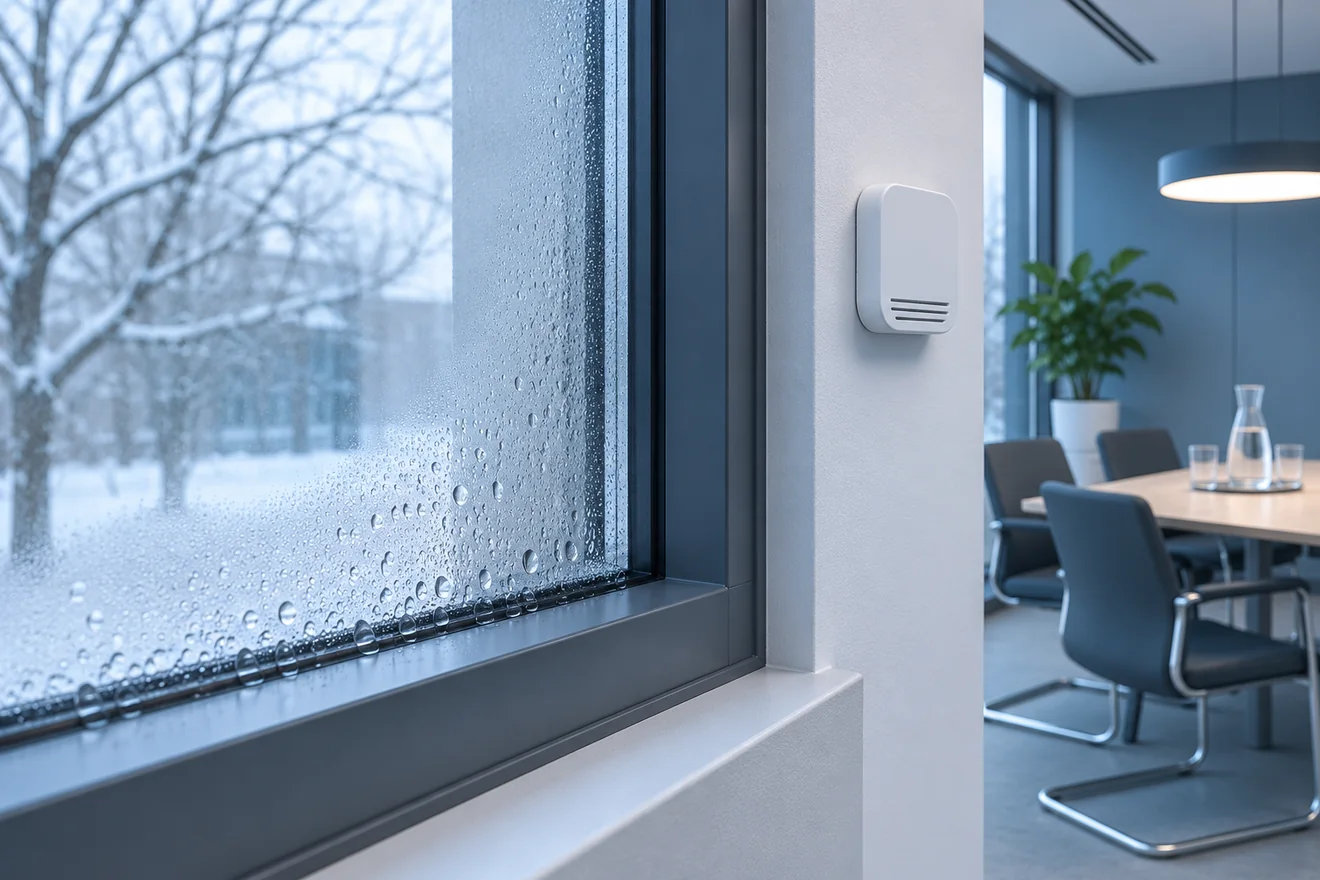
La condición en la superficie fría gobierna la condensación local. Una medida de pared proporciona contexto para la investigación.
Seleccione una ubicación para la pregunta que se hace
Una unidad multicanal montada en la pared ahorra cableado y puede emparejar observaciones en un sitio. Elija una ubicación representativa de la zona ocupada para el propósito principal. Una pared conveniente detrás de una pantalla caliente, al lado de una puerta o al lado de un difusor de suministro puede desviar uno o más canales. Un asiento lleno de gente puede bloquear la entrada de CO₂ repetidamente al exhalar. El sol sobre la carcasa puede elevar la temperatura indicada y disminuir la humedad relativa indicada. Una pared externa fría o una corriente de aire procedente de la abertura de un conducto pueden hacer que el recinto se lea de manera diferente a la experiencia de los ocupantes del aire.
El Ejecutivo de Salud y Seguridad del Reino Unido recomienda a los usuarios de monitores en el lugar de trabajo que verifiquen las ubicaciones representativas, eviten aberturas, puertas y ventanas de suministro y registren el contexto de ocupación y ventilación. En un espacio grande, abierto o dividido, las mediciones temporales en varias posiciones pueden revelar si una ubicación permanente es defendible. Utilice condiciones representativas de la zona de respiración para preguntas sobre CO₂ relacionadas con la ocupación. Utilice una ubicación relevante separada para una ventana fría, un conducto de suministro u otro objetivo de diagnóstico específico de humedad o HVAC. Nombra cada punto según lo que realmente mide. Guía para el control de CO₂ en el lugar de trabajo, HSE
Co-location inside a product does not guarantee that the temperature and RH sensing elements are exposed to the same air or thermal field as a CO₂ cell. A printed circuit board and housing can produce temperature offsets, and different inlets or thermal masses create different settling behavior. Read the finished transmitter's documentation for the environmental performance you need. A combined module datasheet provides separate specifications for each channel. It cannot determine the heat rise of the complete installed housing. The Sensirion SCD30 datasheet illustrates a combined CO₂, humidity and temperature module with separately defined channel specifications. Ficha técnica del Sensirion SCD30
Un canal utilizado internamente para compensar una medición de gas puede tener un propósito diferente al canal de temperatura ambiente que ve un operador. Verifique qué valores recibe el BAS y qué correcciones ya ha aplicado el dispositivo. Agregar una corrección del sitio basada en la humedad relativa o la temperatura cercanas puede duplicar la compensación o aplicar un modelo no relacionado. El comportamiento del sensor y la composición del aire húmedo muestreado son cuestiones distintas. Cómo afecta la humedad a las lecturas del sensor de gas
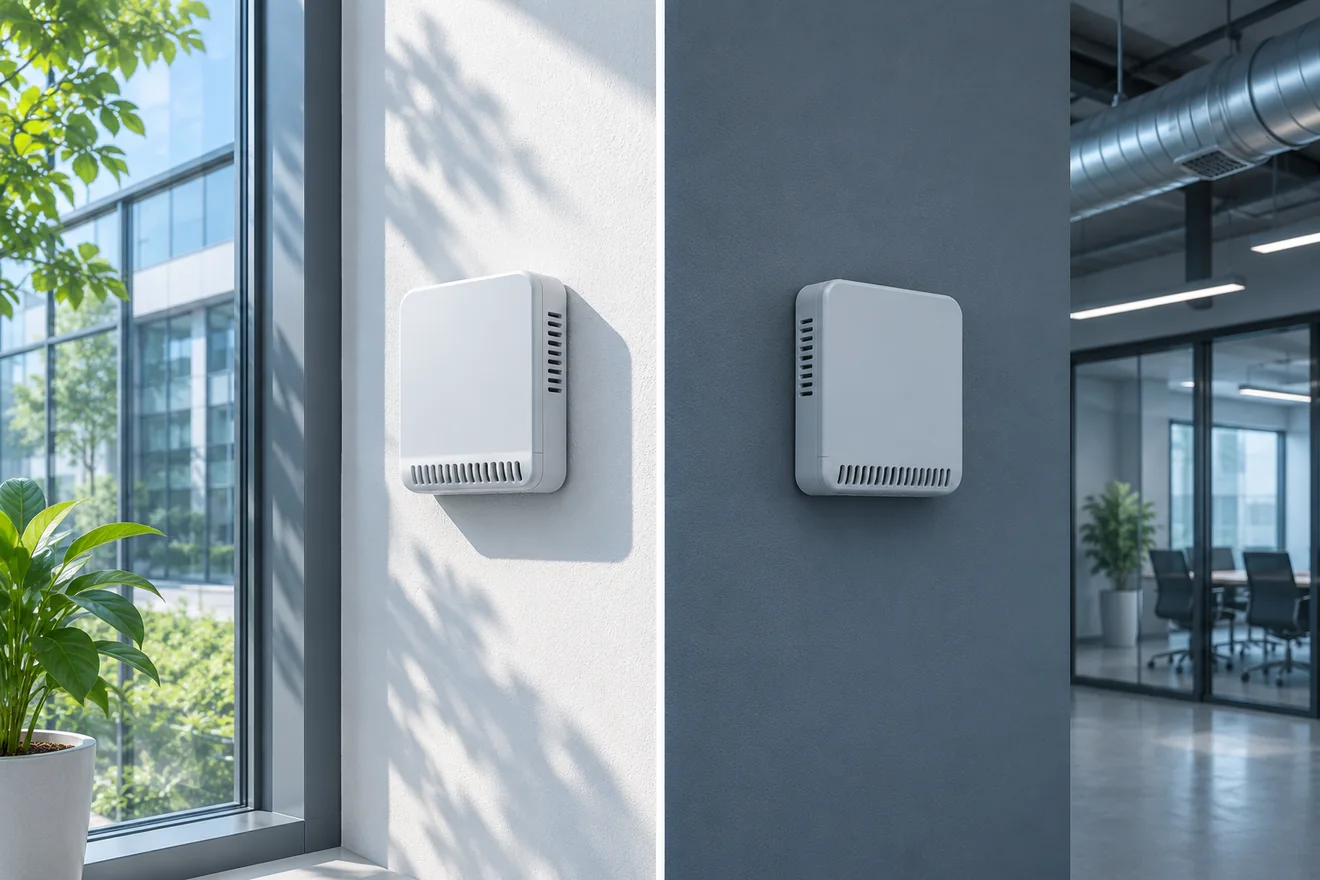
Compare las posiciones candidatas en condiciones que puedan producir un sesgo de ubicación, incluida la exposición solar directa.
Recopilar evidencia sincronizada sin tratarla como evidencia idéntica
Set an observation window that covers the room's occupancy cycle and relevant HVAC events. Record how each channel is acquired, its update interval, the source of timestamps and any onboard averaging. Check clocks before comparing the apparent order of changes. A temperature rise stored every minute and a CO₂ value acquired every five minutes can seem to lead or lag each other purely because of acquisition timing. If the source values are not simultaneous, state how they were aligned and how far apart they can be before a calculated dew point is withheld.
Trend readings with their quality states and units. An intermittent wireless device might retransmit a held value, and the RH channel might recover later than the temperature channel after a restart. Keep gaps explicit. If computing dew point, use valid values from the same location and a compatible time window. Record the formula or calculation service and the rounding policy. A small shift in dew point should be interpreted in light of both sensor uncertainties rather than displayed as a precise moisture change.
Collect context at the same time. Occupancy count or schedule, outdoor temperature and moisture, window state, fan proof, operating mode, damper or airflow evidence and nearby activities can distinguish plausible explanations. Record any changes to the monitor position, firmware, offsets, enclosure or power mode. If the room underwent a meeting or housekeeping event, preserve the event time as an annotation. This kind of context makes comparison possible on a later day when the people who observed the event are unavailable.
| Pattern in valid readings | Posible explicación | Próxima evidencia útil |
|---|---|---|
| CO₂ and temperature rise while RH falls | Occupant generation and sensible warming without a comparable moisture rise | Occupancy, calculated dew point and fan or heating mode |
| CO₂ falls while dew point rises | La dilución y el aumento de la presión de vapor ocurren juntos. | Punto de rocío exterior, modo de flujo de aire y fuentes de humedad locales |
| La temperatura baja, la humedad relativa aumenta, el punto de rocío es estable | El enfriamiento sensible domina durante el período observado | Estado de la bobina o del suministro, referencia emparejada y superficies locales |
| Todos los puntos saltan o se congelan juntos. | Evento real, problema de adquisición compartida o reinicio del dispositivo | Estado, marcas de tiempo, tiempo de actividad y referencia independiente |
| El CO₂ aumenta solo cerca de un asiento | La columna de aliento local puede estar influyendo en la entrada | Un segundo sitio alejado de la respiración directa, con marcas de tiempo coincidentes |

The three traces can be aligned to events while preserving their separate units and interpretations. The display is conceptual.
Read three contrasting hypothetical building events
An occupied winter meeting. Occupants enter a room at 09:00. CO₂ gradually rises. The room warms from 20 °C to 24 °C, and RH drops from 50% to about 39%. The calculated dew point is almost unchanged. Under those stated conditions, the data support a sensible warming interpretation for the RH change. They do not establish whether occupant moisture release balanced drier incoming air or whether another process held vapor pressure steady. Check occupancy and mechanical state before changing ventilation or humidification.
A humid outdoor-air event. Cuando hace calor, los ocupantes se marchan, continúa el modo de aire exterior programado y el CO₂ en el interior disminuye. El punto de rocío interior aumenta mientras que la temperatura de bulbo seco apenas cambia. Más aire exterior podría estar introduciendo humedad si el punto de rocío exterior es más alto y el sistema de acondicionamiento no elimina el vapor adicional. El mismo patrón también podría resultar de una fuente de humedad separada o de una eliminación latente reducida después de un cambio de modo. Compare el punto de rocío exterior, la evidencia del ventilador y del aire exterior, la condición y el tiempo del serpentín de enfriamiento. Un valor de CO₂ más bajo puede coexistir con un problema de humedad.
Una instalación de pared sesgada. In the afternoon, a monitor near glass warms relative to a temporary comparison on an interior wall. It reports lower RH at the same time. The two locations have similar dew point estimates, and the CO₂ readings are comparable within the agreed comparison method. That pattern is consistent with local heating affecting the two thermal quantities. Repeat the comparison with a documented reference during sun and shade, allowing for response and instrument uncertainty. If the reference also shows a true spatial temperature difference, moving the transmitter changes the monitored location as well as its exposure. Record the reason and effective date.
These are three different questions with different supporting evidence. The first asks which part of an RH trend is temperature-related. The second asks whether an observed moisture change can be linked to outdoor conditions and equipment operation. The third asks whether the fixed point characterizes the room or a local microclimate. A generic combined score can hide those differences and make it harder to investigate.
Keep interpretation separate from control authority
A monitor can support several diagnostic tasks while only one or none of its channels is approved to drive HVAC control. Specify which point is authoritative for each sequence and which points are contextual. A room CO₂ point may support a demand calculation while a separate room temperature sensor supplies comfort control. An equipment or space humidity sensor may participate in a separate control sequence. Each needs its own valid range, fallback behavior, configuration and commissioning evidence.
Avoid encoding three observed thresholds into a single inference about adequate ventilation or comfort. Adequate CO₂ dilution under one occupancy condition leaves open humidity, temperature, particles and other pollutant questions. A stable RH trace at one location leaves open moisture conditions at cold surfaces, inside assemblies or in unmonitored spaces. A favorable temperature trend leaves open outdoor-air quantity. Operational criteria should come from the building's approved requirements and use rather than from applying one general number across building types.
For a monitor-only pilot, decide how staff should respond to each kind of event. A recurring occupancy-related CO₂ rise may lead to a schedule and airflow investigation. A repeatable rise in dew point may trigger a moisture or coil review. A disagreement among nearby temperature readings may require a siting or sensor comparison. Route these observations to the people able to verify the associated mechanism. The trend window and supporting evidence can be common without making the action common.
Establish a comparison that separates sensor bias from room variation
For a room survey, compare the fixed monitor with a suitable independent instrument in comparable air. Document the reference, its condition and the relevant specifications for each channel. Keep the instruments far enough apart to avoid blocking inlets, with comparable radiation exposure and local airflow. Let the devices stabilize under their own instructions, then compare readings using an agreed time window and method. A brief side-by-side spot reading while a wall device is warming up can overstate a disagreement.
Where temperature and RH differ, calculate dew point using each instrument's own paired values. A warmer device reporting lower RH at similar dew point can indicate that the two probes are sampling air of similar vapor pressure at different temperatures. If both probes are supposed to represent the same room location, investigate enclosure heating, wall influence and airflow. If the dew points also differ substantially, check sensor offsets, placement, actual moisture gradients and timing before assigning a cause. CO₂ agreement does not resolve the thermal question.
Repeat at another representative site if room gradients are likely. Measurements on a sunny wall and at a shaded central desk cannot distinguish device bias from a real temperature difference without further observations. Swap suitable temporary devices or colocate them in each environment while recording changes in sun, HVAC state and occupancy. Where the permanent sensor cannot be moved, compare a portable reference at both sites and state the uncertainty introduced by sequential measurements. A shared transition can be useful, but only if its timing is captured well enough to align observations.
| Comparison condition | What to document | How it helps |
|---|---|---|
| Co-located during stable conditions | Position, reference and stabilization time | Helps establish channel agreement |
| Humedad similar, diferentes temperaturas. | Tanto los pares T/RH como los puntos de rocío | Ayuda a distinguir el calor sensible y la humedad. |
| Comparación de habitaciones en varias posiciones. | Distancia de origen, ocupación y trayectoria aérea. | Ayuda a identificar gradientes espaciales persistentes |
| Inicio de mañana o período soleado. | Estado del equipo y tiempo de exposición. | Ayuda a descubrir sesgos de recinto o relacionados con el modo |
| Monitorear reinicio o muestras faltantes | Quality transitions and each channel's recovery | Evita valores calculados engañosos |
Accuracy and representativeness are separate. A monitor can accurately measure air near an external wall that differs from the occupied space. A representative site can still use an instrument with an offset. The acceptance record should preserve both findings. If the intended diagnostic question changes, reassess where the relevant air is. An outdoor-air intake check, a window-condensation investigation and an occupied-zone assessment may each require a different observation point.
Build a reporting view that preserves the physical distinctions
Use a common timeline with separate units and clearly labeled vertical axes. It can be useful to put CO₂, temperature, RH and calculated dew point in adjacent panels, then show occupancy and fan mode as event annotations. Avoid dual-axis presentation that makes unrelated magnitudes look interchangeable. If a common graphical scale is used to compare direction, disclose the normalization and retain access to original units and values.
Suppose an analyst receives a daily report showing 900 ppm mean CO₂, 22 °C mean temperature and 50% mean RH. Those three summaries might come from different valid portions of the day. The temperature-RH pair needed to compute dew point can be obscured, and a busy meeting can disappear into a daily mean. Calculate paired quantities from sufficiently aligned source values first, apply a clearly defined completeness rule, and summarize over a window that fits the question. If one channel has a gap, include the count or duration of usable paired samples.
Mark changes that can alter interpretation across weeks. A sensor moved away from a diffuser, a room reconfigured with partitions, a changed cooling schedule or a new correction in firmware can each change the observed series. A stable point label should not make the periods appear equivalent without a note. Document date, reason, changed settings, location and the validation used to resume reporting.
A reporting view can include a practical decision note for each observed pattern. When room CO₂ follows occupancy despite a steady temperature, review ventilation timing and delivery. When dew point rises with no corresponding CO₂ change, review moisture sources and conditioning. When temperature and RH diverge but dew point stays steady, compare sensible gains and placement. When all channels change at the same timestamp as a restart, verify acquisition quality first. These are investigation routes. Determine the actual cause with context appropriate to each channel.
Account for uncertainty in calculated dew point
An estimate of dew point inherits errors from both inputs and from the degree of time and location alignment. For example, at 22 °C, 50% RH gives a dew point near 11.1 °C. At the same temperature, 48% and 52% RH correspond to about 10.5 °C and 11.7 °C. These values illustrate the local sensitivity to RH alone using typical saturation behavior. A temperature error can shift the estimate as well, and an installed product's errors may be correlated. The arithmetic is not an uncertainty claim for any particular monitor.
Interpret a small change in dew point alongside the stability and agreement of the inputs. A constant half-degree difference across two instruments can reflect rounding, thermal offset or humidity accuracy. A repeated larger difference under a certain condition can justify checking a nearby moisture source or the operating system. If the decision depends on a surface close to the estimated dew point, obtain an appropriate surface temperature measurement and consider the combined uncertainty. A result a few tenths of a degree apart may leave the condensation diagnosis open.
Use like-for-like comparisons for outdoor and indoor air. A sheltered outdoor probe measures a different environment from an intake affected by hot roofing or nearby exhaust. For moisture-loading questions, select the outdoor observation that best represents the entering air under the operating condition. Document that measurement basis before interpreting a dew point difference as the effect of outdoor ventilation.
Preguntas frecuentes
Does a CO₂ increase mean humidity should increase?
No. Occupancy can introduce both CO₂ and moisture, but ventilation, dehumidification, temperature and other sources determine the two trends. Compare dew point and operating context before interpreting the RH direction.
Can I use outdoor RH alone to decide whether fresh air will dry a room?
No. RH is relative to saturation at the outdoor temperature. Compare indoor and outdoor dew point or humidity ratio and consider the effect of equipment conditioning and other moisture sources.
Should dew point be measured or calculated?
For many monitoring tasks a documented calculation from paired valid temperature and RH observations is useful. Its accuracy depends on both inputs and the calculation. An application requiring tighter moisture evidence may need a suitable independent reference and an explicit comparison method.
Can all three channels be checked with a single reference?
An integrated reference may supply all three, but verify its range, current condition, response and uncertainty separately for each channel. Similar placement and simultaneous observations help. Agreement in CO₂ does not establish agreement in temperature or RH.
How can I tell whether a low RH reading is real?
Check the temperature, exposure and enclosure conditions. Compare paired temperature and RH with a suitable reference in comparable air and calculate dew point from both valid pairs. The result can separate a real moisture difference from local heating or channel bias.








Deja una respuesta