
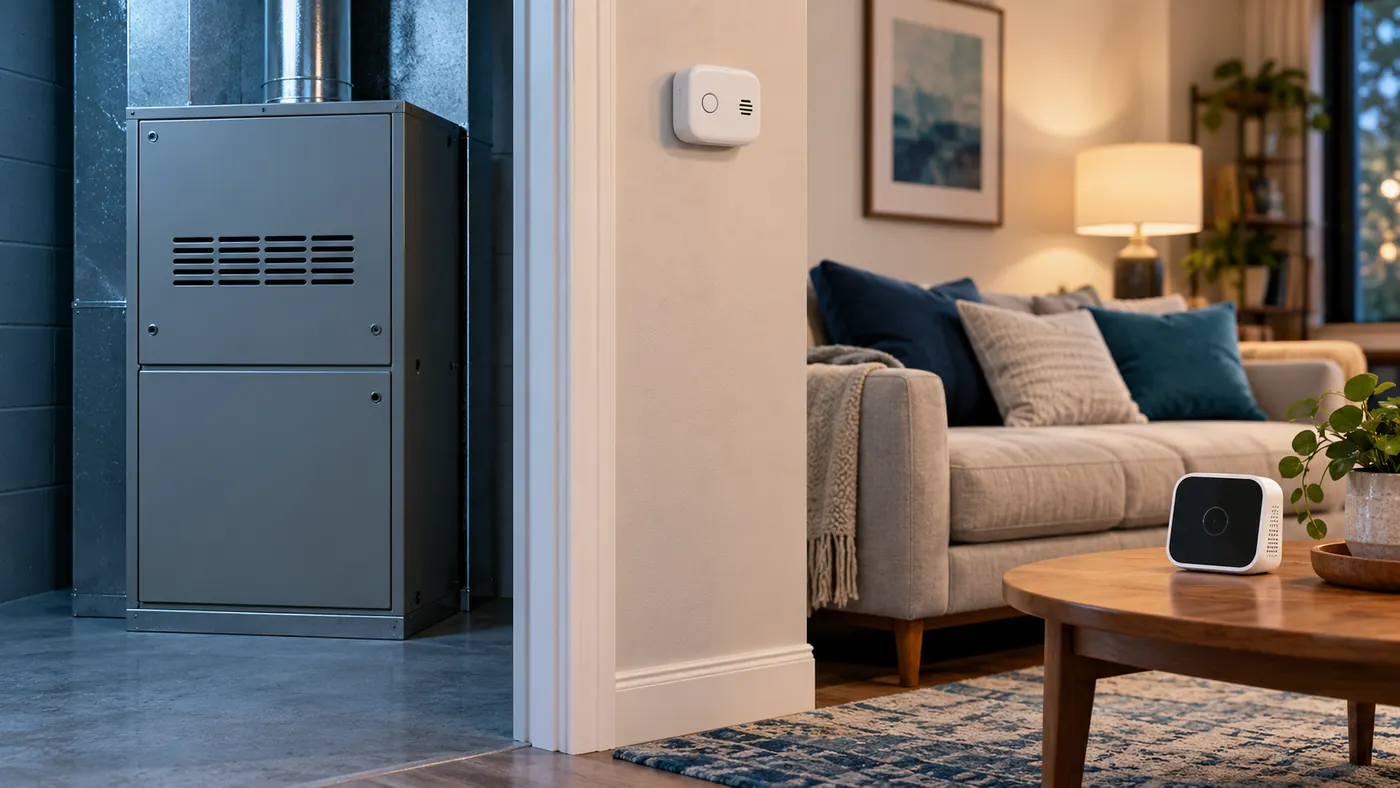
For a home with a fuel-burning heater, a suitable carbon-monoxide (CO) alarm and proper appliance installation and maintenance are the core safety measures. A room CO₂ monitor can describe an occupied-air or ventilation trend, but it cannot detect carbon monoxide or declare that a heater is safe. A natural-gas leak detector, where appropriate, serves a third job: detecting unburned fuel gas. These instruments respond to different substances and have different product requirements. Choose each for the actual hazard, follow the local rules and the finished product's instructions, and have combustion equipment inspected by a qualified professional.
The distinction matters because “gas monitor” is an ambiguous phrase. A person may mean a safety alarm for toxic CO, a CO₂ display marketed for ventilation, or a detector for a leaking fuel. Even a device advertised as “multi-gas” should be checked channel by channel, including the alarm function and applicable certification. An accurate CO₂ screen would not warn about CO from a faulty furnace. The US Consumer Product Safety Commission's CO alarm guidance، CDC's furnace-safety information و EPA's combustion-products guide each address a different part of this picture.
Name the appliance and the possible path into the room
“Gas heater” might mean a central gas-fired furnace, a boiler, a wall heater, a portable room heater or another appliance. Some are designed to vent combustion products outdoors, while others have different arrangements and restrictions. A furnace in a utility space can affect living rooms if exhaust is improperly vented, a flue is blocked, a heat exchanger or connection fails, or air-pressure conditions cause back-drafting. An unvented space heater puts combustion products into the occupied space by design and requires particular care under its local rules and instructions. Do not assume that a heater is harmless because the flame is not visible in the bedroom.
Fuel combustion produces several possible indoor pollutants. EPA describes carbon monoxide, nitrogen dioxide and particles among the important combustion products; the amounts depend on appliance type, installation, condition, venting and fuel. Carbon monoxide is especially important for emergency detection because it is colorless and odorless and can cause sudden serious harm. Nitrogen dioxide is a different pollutant and may be elevated with unvented combustion or poor installation, as EPA's nitrogen dioxide IAQ guidance explains. Soot or odor can be clues to investigate, but the absence of odor or visible smoke does not rule out CO.
There is also a different hazard: unburned fuel gas escaping from a supply line or appliance. A CO alarm is not necessarily a natural-gas leak detector, and a fuel-gas detector is not necessarily a CO alarm. Product packaging and an app icon may suggest broad coverage, but the relevant gas, test method and alarm behavior must be explicit. Local fire or gas utility guidance may govern leak-detector selection and response. This article does not turn a household sensor into a do-it-yourself appliance diagnostic tool.
Separate the four measurement jobs
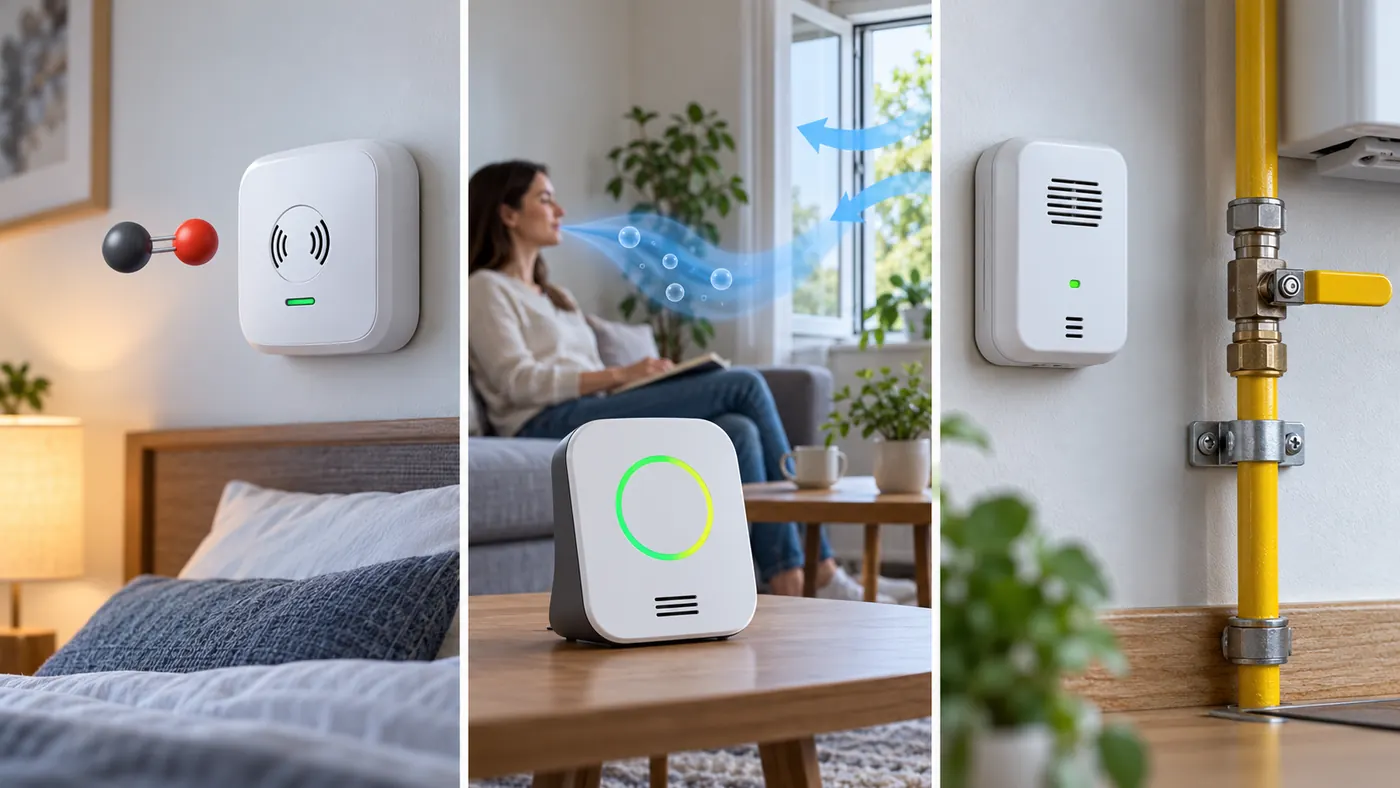
| سوال | Relevant instrument or process | What it cannot do |
|---|---|---|
| Could occupants be exposed to toxic carbon monoxide from combustion? | A suitable, working CO alarm installed and maintained according to local rules and its instructions, plus qualified appliance service. | A CO₂ display or fuel-gas detector cannot stand in for it. A silent alarm does not prove all appliance components are sound. |
| Does occupant-generated CO₂ accumulate under a particular room-use/ventilation condition? | A suitable direct CO₂ monitor, used as contextual trend information. | It cannot detect CO, prove safe combustion or substitute for an alarm. |
| Is unburned fuel gas leaking? | A suitable fuel-gas leak detector and the gas supplier/local emergency procedure where applicable. | It cannot certify combustion exhaust is safe or replace a CO alarm. |
| Are appliance, vent and flue operating as designed? | Installation records and inspection/service by a qualified professional using appropriate methods. | A consumer IAQ score or one room reading cannot commission the system. |
The different symbols and devices in the image represent separate tasks; there are no displayed values because a number without gas identity, product behavior and conditions would mislead. For the sensor-level distinction between CO and CO₂, our CO versus CO₂ measurement-channel guide explains why a dual-gas instrument needs two appropriate channels. A component can respond to CO, but its data sheet is only one part of a complete alarm's design. The product also needs power management, fault detection, audible warning, test function, placement instructions, service life and compliance with the rules that apply where it is used. Our sensor module versus complete monitor guide explains that distinction for CO₂ equipment; the same caution about component versus finished system is even more important for safety alarms.
The user-facing implication is simple: read the exact gas name and symbol on the device and its manual. CO is carbon monoxide; CO₂ is carbon dioxide. A “CO₂ alarm” may be meant for a particular high-CO₂ use, not for a domestic furnace's CO hazard. A smoke alarm does not automatically include CO detection either, although properly specified combination products exist. Conversely, a CO alarm is not a general smoke alarm unless its instructions explicitly say it provides both functions.
The household CO alarm is an emergency device
CPSC recommends CO alarms on each level of a US home and outside sleeping areas, with testing according to its guidance and the product instructions. The exact number and permitted locations also depend on local requirements and the manufacturer's installation directions. CPSC's page advises regular testing and battery replacement; a hard-wired device still needs attention to its backup power and end-of-life indication. A consumer should not relocate or silence an alarm merely because an IAQ display looks normal. In another country, consult its applicable law, fire authority and approved product instructions instead of importing a US placement diagram as binding law.

The illustration is not a mounting plan. Wall/ceiling positions, clearances from fuel-burning equipment, ceiling shape, airflow, sleeping areas and combinations with smoke alarms are product- and jurisdiction-specific. Follow the actual alarm instructions. A CO sensor on a desk with an app notification is not automatically equivalent to a household alarm that can alert sleepers during a network outage. Check battery or backup arrangement, audible function, test and end-of-life instructions before relying on a product. A silent, dead or expired alarm has no useful protection just because its plastic enclosure remains mounted.
CPSC has warned about particular combination products failing to alert, which illustrates why checking the finished device and its safety compliance matters more than counting the gases printed on a box. A 2026 CPSC warning about a specific plug-in natural-gas/CO combination detector is a product-specific warning, not a claim that every combination alarm is defective. In the US, CPSC's warning points consumers to CO alarms meeting the relevant UL 2034 standard. Check current recalls and the product model if there is a concern; a badge on a marketplace listing is not proof of performance.
Do not use a general IAQ monitor's user-configurable ppm alert as a homemade replacement for a listed CO alarm. Alarm timing, fault response and end-of-life handling are part of safety performance. Nor should a person rely on symptoms: CO exposure can impair judgment, and there may be no warning smell. Follow a real alarm's instructions promptly, even if a separate CO₂ or fuel-gas display gives an apparently reassuring number.
If a CO alarm sounds
Use the alarm's instructions and local emergency procedure. In general, leave the building promptly for fresh air, account for everyone, and call the local emergency service or fire department from outside. Do not go back inside to investigate a furnace, open the cabinet, reset the alarm repeatedly or wait for a consumer CO₂ monitor to confirm it. The CPSC's prevention guidance and public-health advice treat a CO alarm as a safety event. If anyone has symptoms, request medical help and tell responders about possible CO exposure. Re-entry and appliance restart should be decided by the appropriate responders and qualified professionals.

The image illustrates leaving and calling from outside, not a step-by-step emergency protocol. An alarm can sound for many reasons, including a real hazard or a product fault; occupants should not diagnose which one while remaining in a potentially contaminated home. The cost of a needless evacuation is much smaller than the risk of ignoring a genuine CO warning. A home with multiple occupants also needs a plan that works for sleepers, children and people who require assistance.
CO₂ is a separate ventilation clue
People exhale CO₂, so a direct CO₂ monitor can show how a living room or bedroom changes with occupancy and outdoor-air exchange. It is a contextual signal, not a combustion-safety clearance. CO₂ can be elevated in a tightly closed but otherwise properly functioning room simply because people are present. CO could be a problem from a poorly vented appliance while CO₂ looks ordinary. One gas is not a reliable proxy for the other.
را ASHRAE indoor CO₂ position document warns against treating an indoor CO₂ number as a universal indicator of overall IAQ or a direct health diagnosis. The راهنمای روند CO2 خانه explains how to read patterns with occupancy, openings and device placement. In a home with a gas heater, this trend might prompt a ventilation discussion or help understand an occupied bedroom, but it must never be used to decide that a CO alarm is unnecessary or that an appliance is safe to continue using after a warning.
If a product reports “eCO₂” inferred from a VOC channel rather than measured CO₂, it is even less appropriate as a direct ventilation clue. Check the measurement method and the finished monitor's accuracy and operating conditions. Sensor location matters: a device in someone's exhaled plume, beside a window or directly in warm supply air can report a local condition. The monitor's data can complement a proper building review, but it cannot replace it.
An air cleaner does not solve this distinction. A particle filter can reduce some particles without removing CO, CO₂ or an unburned fuel leak in a way that establishes safety. Do not interpret a colored IAQ score after an air cleaner is switched on as a verified combustion fix. Source control, proper venting and qualified maintenance remain essential. EPA's combustion-products and nitrogen-dioxide pages describe how venting and correct installation address pathways that an ordinary filter cannot.
A fuel-gas leak detector addresses unburned gas
Fuel gas, often natural gas or LPG depending on the home, presents a different detection question. A device sold for a particular combustible gas must state what it detects, its installation conditions and how it alerts. Gas composition, lighter/heavier-than-air behavior, airflow and enclosure can affect where a detector should be installed, so generic mounting diagrams are a weak substitute for the approved product manual and local utility guidance. A detector specified for methane may not be appropriate for LPG, and neither becomes a CO alarm merely because both are “gas sensors.”
If a person suspects a fuel-gas leak, follow the gas supplier's and local emergency authority's instructions from a safe location. Do not use this article to locate a leak, operate switches, relight an appliance or test a pipe. The alarm and response should be designed for the actual supplied fuel and jurisdiction. Combination devices can be useful when properly specified and approved for each function, but every claimed channel and alarm path needs independent verification.
At the component level, electrochemical CO cells, infrared CO₂ sensors and combustible-gas elements work differently. The GasNose carbon-monoxide sensor overview gives further background on CO sensing components. It is an educational component comparison, not an endorsement of any component as a certified household alarm. In a home safety decision, select and maintain a finished device approved for the intended use.
Evaluate the finished device, not its list of sensor chips
Start a purchase or replacement decision by writing down the exact job: household CO warning, detection of the home's supplied fuel gas, or optional occupied-air CO₂ trending. For each job, check that the دستگاه تمام شده is intended for that application in the place it will be used. A seller's statement that it contains an electrochemical or infrared element tells little about alarm behavior, power loss, fault indication, replacement life or compliance. The approval or listing, where required, belongs to a specific product and intended use, not to a generic component photograph.
Inspect the product documentation for the gas it names, its warning method, test procedure, power source and end-of-life behavior. A cloud notification can be a useful extra channel, but a lost Wi-Fi connection, muted phone or depleted handset must not make the household's basic warning plan disappear. Likewise, a numerical display is not proof that an audible alarm meets the applicable residential standard. A multi-gas panel may be convenient, yet every claimed sensing and alarm function should be checked independently. Do not assume that the word “combination” establishes equivalence between CO, combustible-gas and smoke detection.
The response plan also belongs to the device choice. All occupants should know which audible warning means what, where to find the manufacturer's instructions and whom to call from a safe location. If two instruments disagree, identify the gas and instrument involved; do not average their numbers or use a normal CO₂ reading to overrule a CO alarm. If a required safety alarm is beyond its service life, replace it according to its instructions and local rules rather than extending its use because its display still lights up. An optional data logger can support maintenance records, but it is not a substitute for this basic operational readiness.
Professional appliance service remains essential
را CDC furnace-safety fact sheet advises having fuel-burning furnaces inspected annually. EPA likewise points to correct installation, venting and maintenance for combustion sources. The exact service schedule and scope for a particular appliance should follow its manufacturer, local requirements and a qualified professional. Records of inspection, identified defects and completed repairs are stronger than a clean-looking sensor dashboard. A CO alarm is a last-line warning, not a preventive maintenance plan.
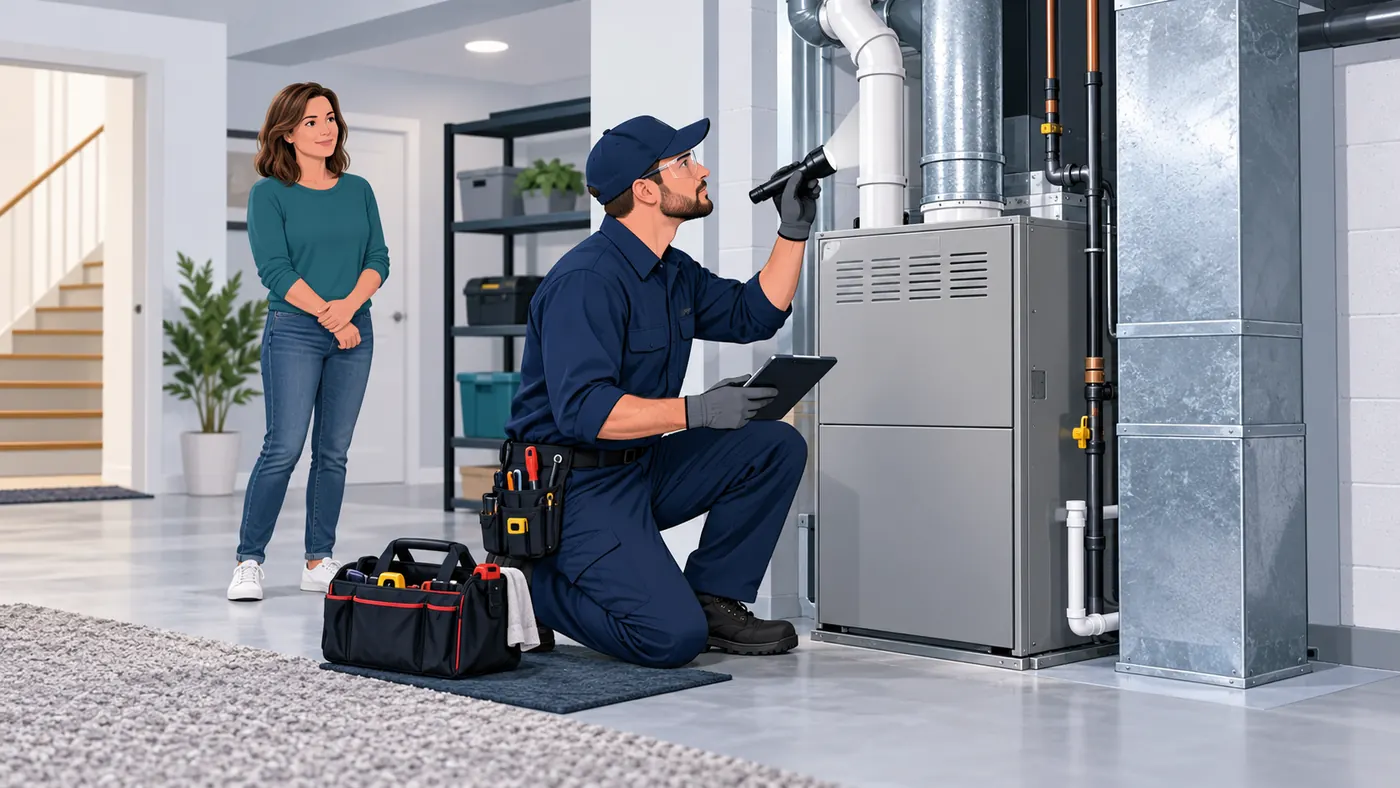
The technician in the illustration is a conceptual scene, not evidence of a real inspection. Only competent personnel should examine combustion, venting, flue integrity or appliance controls. Homeowners can keep manufacturer documents, service records and alarm replacement dates, and can check that a qualified visit actually occurred. They should not infer proper venting from a normal flame appearance or low room CO₂; neither observation substitutes for appropriate service.
An important seasonal pattern is that the first period of heater use may occur after months without operation. An alarm's battery can have failed during that gap, and a vent or appliance may have changed. Check the alarm and arrange service before the heating season according to instructions and local guidance. After remodeling, weatherization, changes to exhaust fans or a new appliance, a professional may need to reassess how the house supplies combustion air and vents exhaust. A tighter home can alter pressure relationships, while a consumer air monitor remains unable to diagnose the flue.
Rental housing and shared venting introduce another record-keeping issue. Residents may not control the appliance or know whether the flue serves more than one unit. Report concerns to the responsible property manager and the appropriate local authority; an alarming instrument still calls for the immediate safety response described above. Keep the appliance and alarm model, installation instructions and service contact accessible to occupants. A building manager should not ask a tenant to conduct an improvised combustion test or treat a normal consumer IAQ chart as evidence that a reported fault has been resolved.
When a qualified technician investigates, the result should identify the appliance and relevant venting or combustion-air conditions, the observations made and what was repaired or remains open. The resident does not need to translate a CO₂ graph into a burner diagnosis. A written service outcome and a functioning alarm answer different questions: one addresses causes and maintenance, the other warns of a hazard if something goes wrong. Keeping those records distinct makes a future service visit more efficient and avoids confusing a sensor trend with a safety clearance.
Households should also account for backup heat. A portable fuel-burning appliance can introduce a new combustion source with different venting and use restrictions. Check its approved instructions and local fire guidance before use; never treat a CO₂ monitor, an open window or a normal reading from another room as permission to use an appliance in an unsuitable enclosed space. If the home's regular heater fails, the safer response is qualified repair and an appropriate temporary heating plan, not improvising with a device intended for outdoor use.
A practical household equipment record
| مورد | چه چیزی ضبط شود | Who should use it |
|---|---|---|
| Appliance | Type, model, fuel, venting design and professional service date. | Owner and qualified technician. |
| CO alarm | Exact model, location, power/backup, test and replacement instructions. | Occupants and owner. |
| Fuel-gas detector, if installed | Target fuel gas, model, installation instructions and response contact. | Occupants and gas supplier/installer. |
| CO₂ monitor, if used | Direct measurement method, location, occupancy context and trend purpose. | Occupants or facilities adviser. |
| Emergency plan | Outside meeting point and local emergency/gas utility numbers. | Everyone in the household. |
This record separates devices that are often conflated. It also helps when someone moves house or an appliance is replaced. Do not put a universal CO alarm threshold into the table; the finished product's applicable standard and instructions govern its operation. Do not record a CO₂ “safe” number as evidence that a heater passed inspection. If a detector fails its prescribed test or reaches end of life, replace or service it as directed rather than leaving it in place as a nonfunctional decoration.
سوالات متداول
Can a CO₂ monitor warn about a faulty gas furnace?
No. A normal or elevated CO₂ display does not tell you whether toxic CO is present. Use a suitable CO alarm for CO warning and a qualified inspection for the furnace and vent. People can raise CO₂ by breathing even when the heater is off, while a CO hazard may arise without an informative change in a household CO₂ trend.
If my CO alarm has a digital display, can I wait for a high number?
No. Respond to the alarm according to its instructions and local emergency advice. A display may show a particular current or historical reading, but it does not authorize occupants to override an audible warning. Do not use a blog's ppm examples to make a stay-or-leave decision.
Does a natural-gas detector also detect carbon monoxide?
Only if the specific finished product explicitly includes a separate suitable CO detection and alarm function. Check model documentation and current safety information. The words “gas detector” or “combination” alone are insufficient. CPSC's product-specific warnings show why alarm performance cannot be inferred from marketing claims.
Will opening a window fix a CO alarm event?
Do not stay inside to test that idea. Leave, call for help from outside and let responders and qualified professionals determine the cause and when re-entry is safe. General ventilation advice cannot replace emergency response to possible CO.
Does a smoke alarm cover CO?
Not unless the device is a clearly specified combination smoke-and-CO alarm providing both functions under the relevant requirements. Read the model and instructions. Both hazards may be relevant in a home with fuel-burning equipment.
Is an electrochemical CO sensor the same thing as a household CO alarm?
No. It is a sensing element or channel that a complete product may use. The alarm's enclosure, electronics, power backup, audible warning, fault handling, service life, placement instructions and applicable certification all matter. A component data sheet cannot establish that an assembled consumer product meets household requirements.
Keep the roles separate
A sound plan does not ask one screen to solve every problem. A CO alarm warns about a dangerous combustion product, a gas-leak detector targets unburned fuel, a CO₂ monitor can describe occupied-air trends, and professional service checks the appliance and exhaust path. Each can be useful when chosen for its own question. The most dangerous mistake is letting a reassuring reading from the wrong channel cancel an alarm or delay qualified help.
منابع فنی

How to Read A2L Refrigerant Detection Documentation
Read A2L detector data sheets, component approvals, control-system evidence and appliance instructions as one traceable detection and mitigation chain.
ادامه مطلب
Which Sensors Does a Heat Pump Need for Useful Monitoring?
Choose heat-pump temperature, flow, electrical, pressure and refrigerant-safety measurements by system type and the decision each channel supports.
ادامه مطلب
What Should a Refrigeration Monitoring Procurement Worksheet Include?
Use a decision-led procurement worksheet to compare refrigeration process, cold-room and ambient gas monitoring with verifiable evidence.
ادامه مطلب
How Should a Refrigerant Detection Module Be Integrated into HVAC Equipment?
Integrate refrigerant detection modules with the right gas profile, inlet location, monitored interface, fault response and full-system validation.
ادامه مطلب
Which Pressure Readings Actually Help Diagnose an HVAC System?
Interpret HVAC pressure readings by medium, measurement point, operating mode and paired temperature before forming a diagnosis.
ادامه مطلب
آیا گاز دیگری می تواند یک آشکارساز مبرد را تحریک کند؟ خواندن ادعاهای حساسیت متقابل
حساسیت متقاطع آشکارساز مبرد را درک کنید، شواهد NDIR و MOS را مقایسه کنید و ادعاهای تداخل گاز را بدون رد کردن یک هشدار واقعی بخوانید.
ادامه مطلب