
Pressure compensation adjusts a gas measurement for a documented pressure dependence of the sensing system. It works when the model fits the sensor and gas, the pressure input represents the gas being measured, and the operating conditions remain inside the model's validated range. Enabling a setting does not establish those conditions.
For an optical gas sensor, pressure can change the number of absorbing molecules in a fixed path even when the gas mixture's mole fraction stays constant. Pressure can also affect spectral behavior, gas delivery and other parts of the instrument response. The ideal gas law explains the density contribution, but a complete manufacturer's compensation model can include more than a simple pressure ratio.
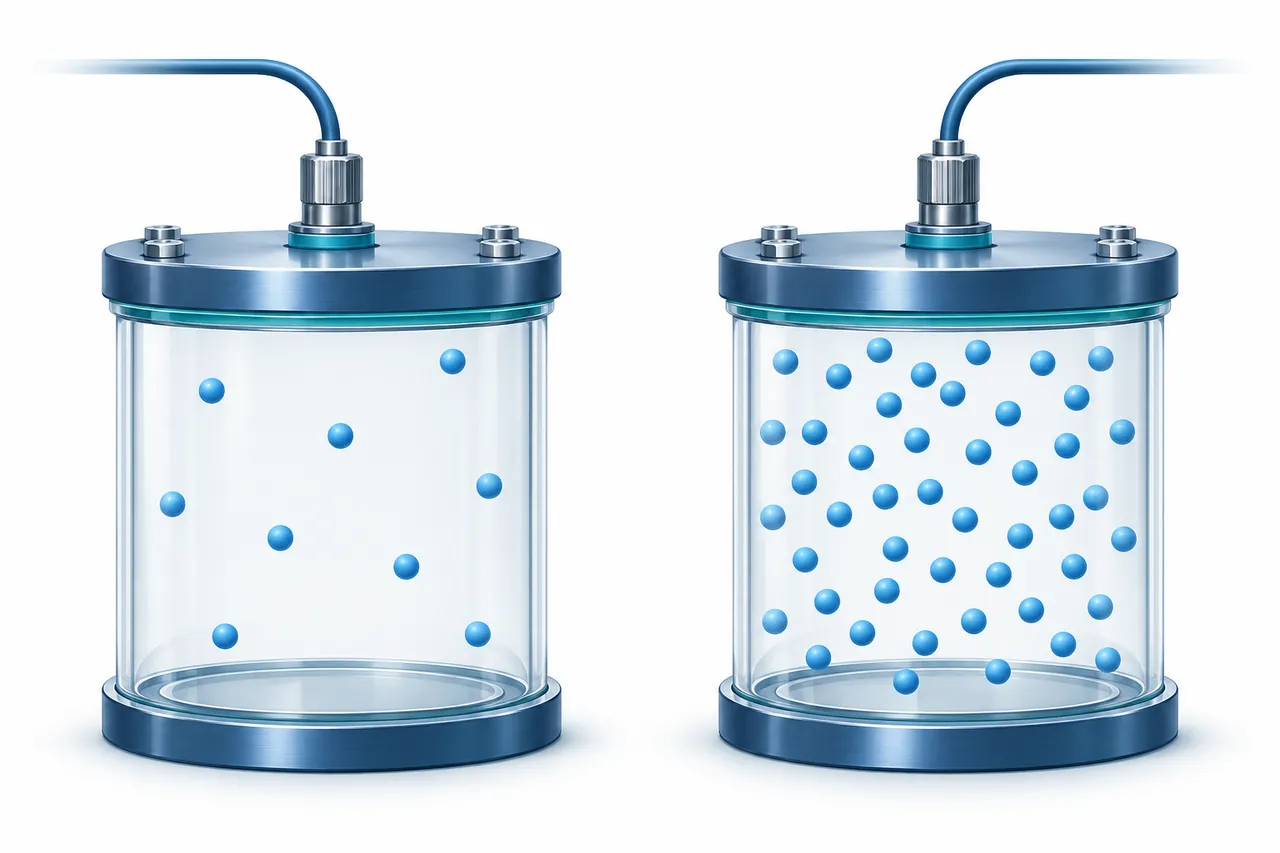
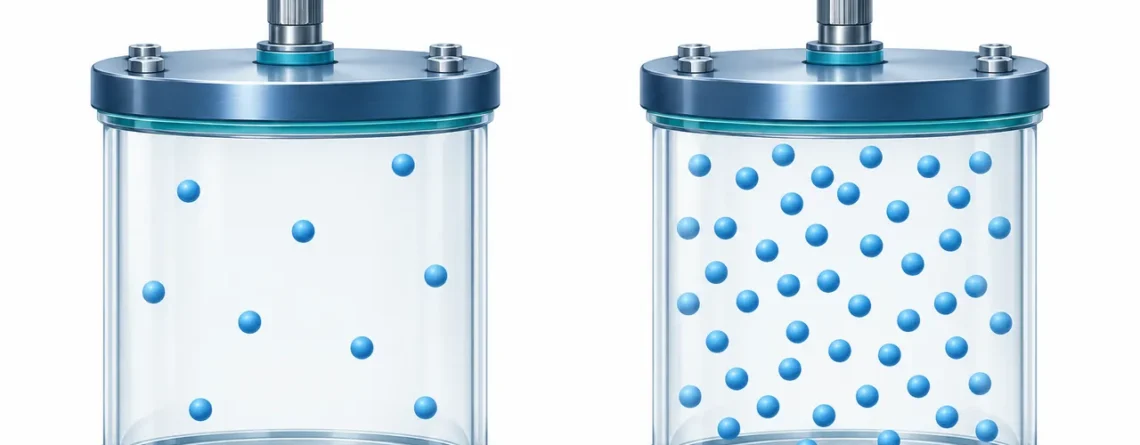
Conceptual number-density comparison at different pressures and equal temperature. The spheres are explanatory symbols, not molecular counts or measurement data.
Define what the instrument is supposed to report
Start with the measurand. Gas mole fraction, partial pressure, mass concentration and a volume reported at reference conditions are different quantities. The same physical gas can have an unchanged mole fraction while its mass per actual volume and partial pressure change with pressure. A correction that is appropriate for one reporting basis may be inappropriate for another.
For an ideal mixture, a component's partial pressure is its mole fraction multiplied by total absolute pressure. If the fraction is x and total pressure is P, then the component partial pressure is xP. At unchanged x and temperature, increasing P increases the number of target molecules in a fixed volume. This is the density mechanism that a gas-fraction measurement may need to account for.
An instrument that is intended to report oxygen partial pressure should respond to a genuine partial-pressure change. Converting that output into oxygen fraction requires an appropriate pressure measurement and model. A gas-fraction instrument, by contrast, may compensate a pressure-induced response so its reported fraction remains consistent. Do not decide whether a change is an error until the intended output is clear.
Dry and wet gas basis also matter. Removing water changes the mixture basis and can change the target gas fraction. Pressure compensation does not automatically perform that conversion. Record whether the instrument, reference and gas certificate describe the same basis before interpreting a remaining difference.
| Reporting quantity | Effect of pressure at fixed mixture and temperature | Main interpretation question |
|---|---|---|
| Mole fraction | Ideally unchanged | Does sensor response retain density dependence? |
| Component partial pressure | Changes with total absolute pressure | Is partial pressure the intended measurand? |
| Mass per actual volume | Changes with gas density | Which temperature and pressure define the volume? |
| Volume at reference conditions | Depends on the stated conversion basis | Which reference conditions and gas model apply? |
This distinction is especially important when moving information between a gas sensor, a flow system and a control dashboard. Identical-looking concentration fields do not guarantee identical definitions. Preserve units, basis and the location of each measurement through the complete data path.
Use the ideal gas law as a bounded explanatory model
For an ideal gas, total molar density is P/(RT), where P is absolute pressure, T is absolute temperature and R is the gas constant. A component with mole fraction x has molar density xP/(RT). At fixed optical path length and a suitably simplified absorption model, changing pressure changes the absorbing population even when x remains constant.
را Texas Instruments NDIR application report, SNAA207, describes gas-specific infrared absorption and a Beer–Lambert relationship. That optical framework explains why number density matters. It does not establish that every finished NDIR instrument should be corrected using the same equation or that spectral and electronic effects can be ignored.
Consider a deliberately simplified sensor calibrated at P0 and T0. If its inferred output is proportional only to target-gas number density, an uncorrected fraction-like indication could follow x_ind = x_true × (P/P0) × (T0/T). Rearranging gives x_true = x_ind × (P0/P) × (T/T0). This is an explanatory model under its stated assumptions, not a recommended replacement for a manufacturer's algorithm.
Checked example: pressure-only density effect
Let the actual mixture contain 1,000 ppm of a gas, the calibration pressure be 1,000 hPa and the measurement pressure be 900 hPa, with equal temperatures. Under the simplified density-only model, the uncorrected indication is 1,000 × 900/1,000 = 900 ppm. Applying the inverse ratio returns 900 × 1,000/900 = 1,000 ppm.
The direction is useful: lower pressure gives fewer target molecules in a fixed volume at unchanged fraction, so a density-sensitive uncorrected signal can decrease. But the calculated 100 ppm effect belongs only to this hypothetical model. It is not a universal sensitivity coefficient, a product correction or an assurance that a sensor will behave linearly over that range.
If a module already reports a pressure-compensated fraction, applying the inverse ratio again would double-correct its output. Identify the output's processing state first. A raw signal, a calibrated uncompensated estimate and a fully compensated measurement are different inputs to any host calculation.
Checked example: temperature cannot be entered in Celsius ratios
Suppose pressure stays constant while temperature changes from 20°C to 30°C. The absolute temperatures are 293.15 K and 303.15 K. At fixed mole fraction, the simplified density ratio is 293.15/303.15, about 0.9670. The change is about −3.30% in density, not the 20/30 ratio that would result from incorrectly using Celsius.
A real gas sensor's temperature response also includes its source, detector, electronics, thermal gradients and compensation design. The ideal-gas calculation isolates the density component. It does not imply that every sensor needs an external temperature multiplication or that temperature compensation can be reconstructed from a room thermometer alone.
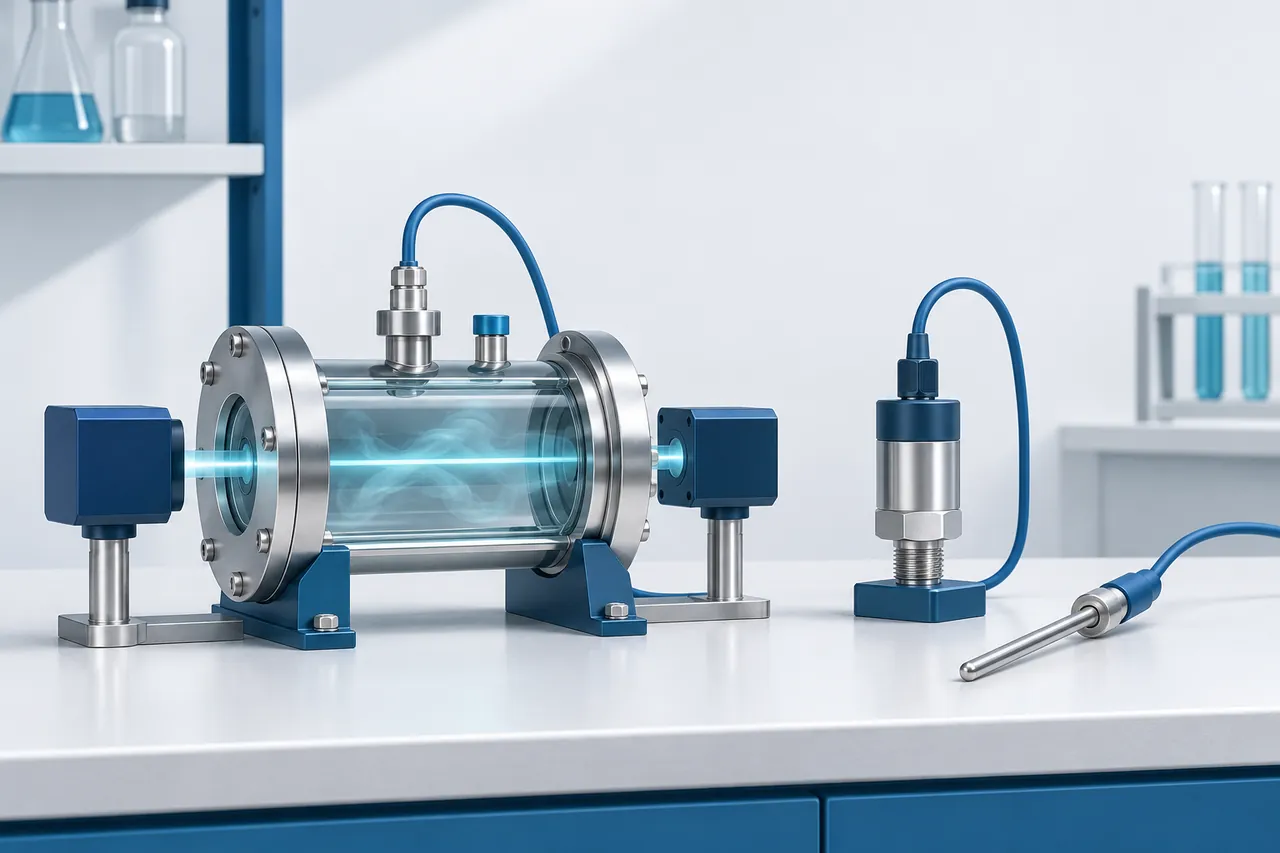
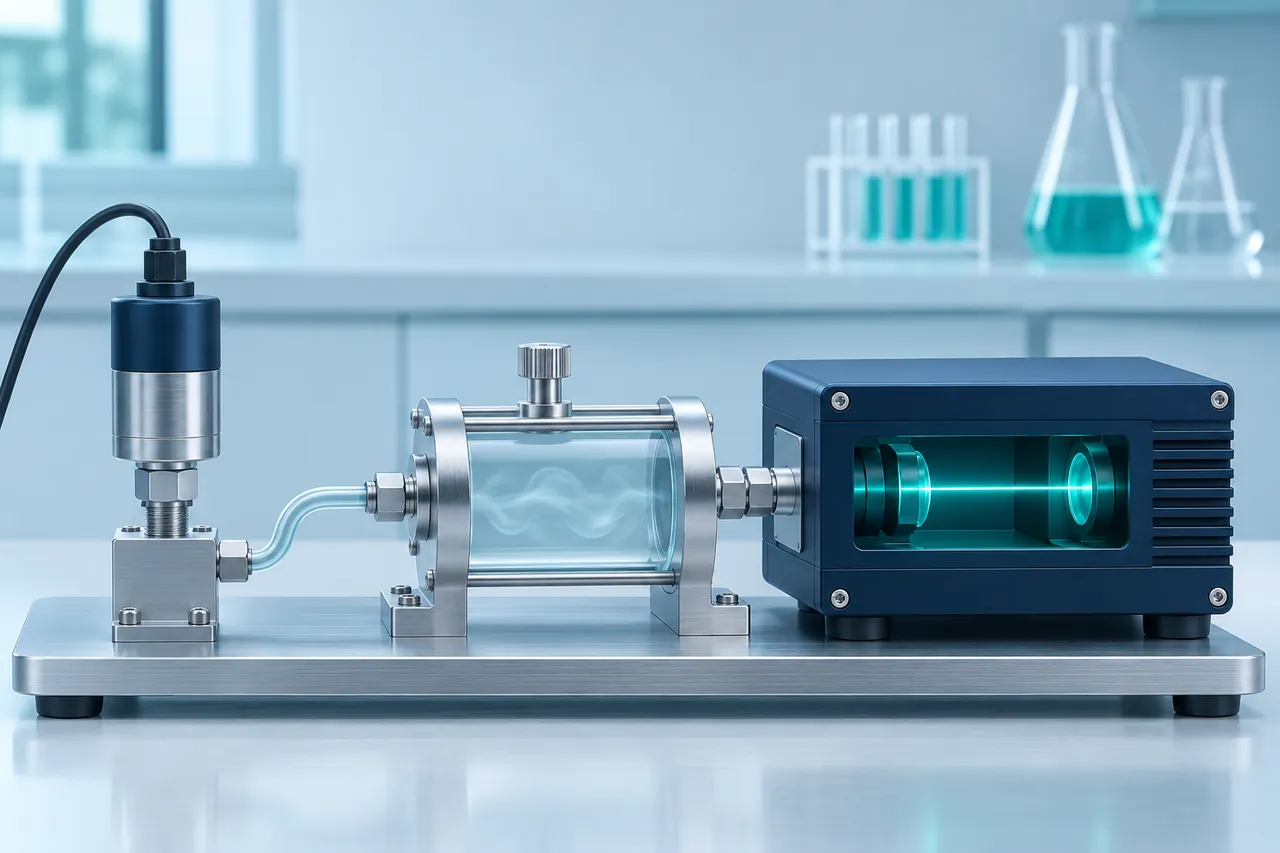
Pressure and temperature are inputs to a defined model. Luminous paths in this illustration are conceptual, not visible infrared beams. The correct model, units and sensing locations are more important than the mere presence of auxiliary sensors.
Find the pressure that represents the measurement cell
The relevant pressure is normally the absolute pressure of the gas at the sensing location for a density or partial-pressure correction. Ambient pressure can represent that value in a freely vented diffusion instrument with negligible pressure difference. It may be unsuitable in a pumped line, pressurized chamber or flow cell with meaningful restrictions.
A pump upstream or downstream can change cell pressure relative to the room. Filters, tubing, valves and outlet restrictions can create pressure drops or backpressure. The pressure at a regulator or inlet manifold therefore may not equal pressure in the optical cell. Identify the pneumatic arrangement and the manufacturer's specified pressure-sensing point.
را RITTER pressure-sensor documentation explicitly discusses pressure measurement inside its gas sample cell for concentration compensation. Its product-specific improvement and range claims belong to that system. The broadly useful lesson is the location of the measured gas pressure, not a transferable performance multiplier.
را راهنمای طراحی Sensirion SCD30 cautions that airflow can produce pressure drops, backpressure and fluctuations. A room sensor placed directly in a duct or forced stream therefore needs integration review. A nominally ambient application does not guarantee a pressure-neutral sensing environment.
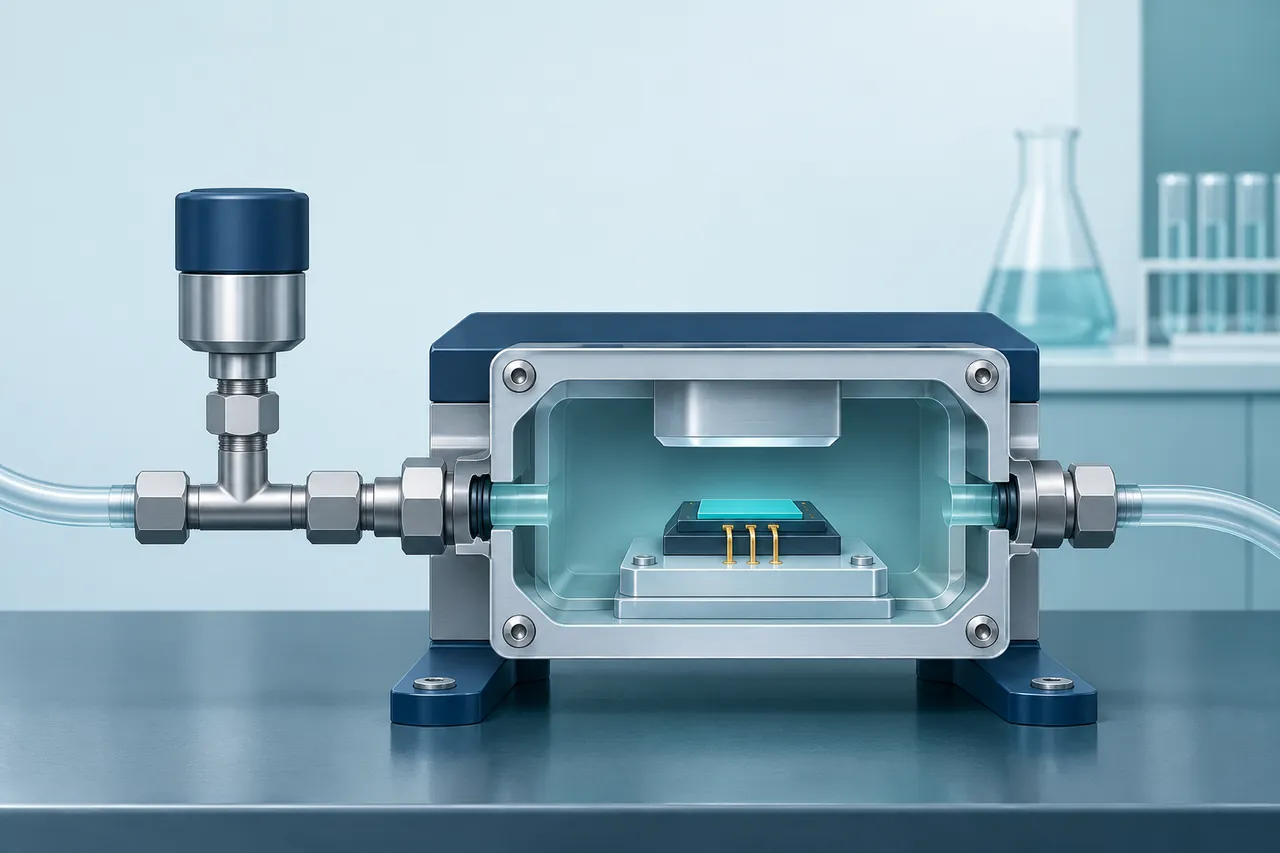
The pressure input should represent the gas in the measurement region. This conceptual arrangement does not specify a product's required plumbing.
Absolute, gauge and differential pressure are different inputs
Absolute pressure is referenced to vacuum. Gauge pressure is referenced to local ambient pressure. Differential pressure is the difference between two specified points. A compensation model expecting absolute pressure cannot generally accept a gauge or differential value without the appropriate additional measurement and conversion.
For a constructed example, local ambient pressure is 980 hPa and a cell is at +20 hPa gauge pressure relative to that ambient. Its absolute pressure is approximately 1,000 hPa. Entering 20 hPa into an absolute-pressure field would be a major input error. The arithmetic assumes the gauge reference truly is the same ambient condition and that both measurements are suitable.
Units can produce equally serious mistakes. One hPa equals 100 Pa; one mbar has the same magnitude as one hPa; one kPa equals ten hPa. A value of 1,000 hPa is 100,000 Pa or 100 kPa. Document the unit at the sensor output, host variable and compensation command, including any integer scaling in the protocol.
Meteorological sea-level pressure is another possible trap. It is a derived quantity intended to compare weather observations after elevation adjustment. It is generally not the actual absolute pressure in a local gas measurement cell. Use a representative local pressure measurement or the model's specified input source, rather than assuming a weather application's displayed pressure has the required basis.
Read the compensation contract for the exact model
A useful “compensation contract” records what the sensor expects, what it outputs and what the host must supply. It includes supported pressure range, unit, update behavior, defaults, persistence, command validity and interaction with calibration. This is a practical integration worksheet, not a claim that every manufacturer uses the same interface.
را Vaisala GMP252 pressure-compensation guide, document M211897EN-F, states that the probe has no onboard pressure measurement and can use an external pressure value. It also identifies the default used when pressure compensation is off. The example shows why a compensated product can still depend on the installation for a representative input.
را برگه اطلاعات Sensirion SCD30 identifies model-specific performance conditions. Its accompanying interface documentation is needed when implementing pressure input; a headline accuracy table does not define command encoding or update semantics. Use the document set for the exact product and revision, including relevant firmware qualifications.
Do not infer that a command's accepted numerical range equals the range over which the full accuracy specification is valid. Input acceptance, survivable operating conditions, measurement range and validated compensation range can differ. Software successfully writing a value is only evidence that a communication operation succeeded unless readback and measurement behavior establish more.
| Model condition | Question to answer | شواهد برای حفظ |
|---|---|---|
| Input definition | Absolute pressure of which gas location? | Manual section and pneumatic layout |
| Unit and encoding | Pa, hPa, kPa or scaled integer? | Protocol definition and conversion check |
| Valid range | Command range or performance range? | Both limits with conditions |
| Output state | Already compensated or partly processed? | Output definition and active mode |
| Persistence | What happens after restart? | Readback or documented startup behavior |
| Missing input | Default, stale value or invalid result? | Host policy and status records |
| Calibration interaction | Which compensation state applies during adjustment? | Approved calibration procedure |
An external pressure value becomes part of the gas measurement chain. Its identity, location and quality should be documented with the gas result.
Check application-specific limits before trusting a correction
Gas species and background mixture can matter. An optical model calibrated for a particular balance gas may have residual dependencies in another mixture. Thermal-conductivity and electrochemical systems have different response mechanisms and model requirements. “Pressure affects density” is a useful starting point, not a universal compensation algorithm across sensor technologies.
Spectral pressure effects can extend beyond total molecule count. Broadening, optical bandwidth and concentration-dependent behavior can affect a real infrared response. The manufacturer may fit an empirical or physically informed model over a stated range. Replacing it with a simple ratio can remove one contribution while leaving or creating another.
Non-ideal gas behavior can matter outside the conditions where the ideal-gas approximation is adequate. A process application may require a compressibility model and documented mixture properties. Do not extend an indoor-air module's ambient-pressure model into a pressurized process solely because its communication interface can represent a larger number.
Humidity, condensation and sample conditioning create separate questions. A pressure correction does not remove liquid water, restore an obstructed path or undo a changed dry/wet basis. A dryer or pressure reduction stage can alter the sample delivered to the sensor. Document those changes rather than attributing every remaining difference to pressure-model residuals.
Flow effects also need separation. A pressure value may correct a density contribution while excessive flow changes cell temperature, causes turbulence or exceeds the approved mechanical arrangement. A compensated output should not be taken as proof that all flow rates are acceptable. Follow the sensor or analyzer's specified flow conditions.
Calibration and compensation must describe the same state
If a calibration comparison is made with the wrong pressure input, an adjustment may absorb that error into the calibration. Later, when the pressure input is corrected, the instrument can become wrong in a different way. Verify relevant compensation settings before applying the manufacturer's calibration procedure.
Record the active pressure and temperature values during both as-found and as-left checks. If the reference gas delivery changes cell pressure, use the representative value required by the model. A nominal ambient pressure entered once at installation does not automatically describe a later calibration arrangement with different plumbing.
Preserve raw or uncompensated signals when the product exposes them and their interpretation is documented. They can help distinguish a response change from a compensation input problem. Do not invent a raw-equivalent value by reversing an unknown algorithm; an undocumented inverse calculation can obscure the very contribution you are investigating.
Validate the complete model with an independent comparison
Begin with a controlled, suitable gas reference and define the concentration basis. Establish the pressure and temperature at the sensing region. Compare the gas output with the reference across the intended pressure conditions while keeping other influential factors controlled or measured. The goal is to assess the complete measurement arrangement, including its external input path.
Use the manufacturer's recommended method and approved pressure limits. This article does not prescribe a pressure test procedure or modifications to a gas system. A conceptual comparison matrix can identify the evidence needed before a qualified operator performs the actual work.
At each stable point, record reference concentration, indicated concentration, cell pressure, pressure value used by the algorithm, temperature, humidity where relevant, flow arrangement, active compensation mode and status. Retain timestamps so that input age and gas response can be interpreted. A pressure trace without the actual applied value leaves a gap in the evidence.
Evaluate residual deviation as a function of pressure. If the residual follows pressure, investigate input bias, location, units and model scope. If residuals follow time after a change, investigate equilibration and synchronization. A persistent concentration-dependent residual may need a different analysis than a pressure-dependent one.
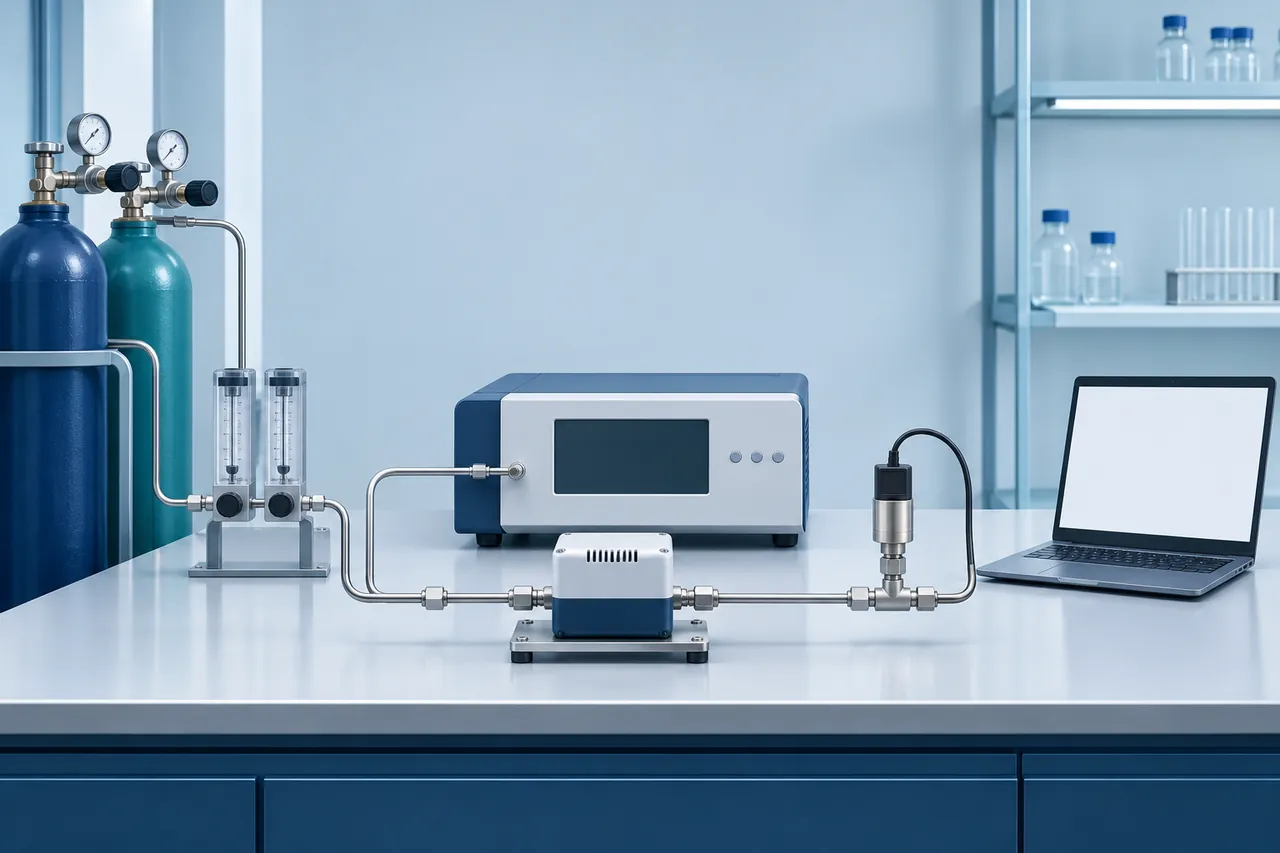
Validation compares the complete compensated result with an independent reference under documented conditions. A successful input command alone does not validate performance.
Checked example: the pressure input itself can introduce error
Under the simplified density-only model, the corrected concentration is inversely proportional to the pressure value used. Suppose actual cell pressure is 900 hPa but the model uses 910 hPa. With other assumptions satisfied, a true 1,000 ppm mixture would be reported as approximately 1,000 × 900/910 = 989.0 ppm. The input mismatch introduces about −11.0 ppm in this constructed case.
The approximate relative effect for a small pressure-input error is −ΔP/P. A 1 hPa error at 1,000 hPa corresponds to about 0.1% in this idealized contribution; at 1,000 ppm that is about 1 ppm. These are sensitivity illustrations, not complete uncertainty budgets. A real product's documented residual compensation specification remains the relevant performance evidence.
This calculation helps allocate attention. A pressure sensor with a small nominal resolution but a location bias of several hPa can still cause a meaningful gas error. Likewise, excellent pressure accuracy does not repair an unsuitable gas model. Choose the auxiliary measurement and its installation based on the required gas result, not its last displayed digit.
Audit the input path before changing the gas calibration
Treat the pressure input as a measurement channel with its own identity and state. Confirm the transducer's pressure reference, range, unit and calibration status. Check the host conversion and the value actually applied by the gas instrument. A correct physical pressure measurement can still become an incorrect compensation input through scaling, rounding or a stale software variable.
Use simple conversion checks when reviewing software. A known test value of 100 kPa should become 1,000 hPa or 100,000 Pa, depending on the destination definition. If an interface uses a scaled integer, document the scale separately from the physical unit. The verification should examine both the transmitted value and the instrument's accepted or read-back value where supported.
Check whether the input represents current valid information. A communications packet received recently may contain an old pressure observation. A sensor can also return a numeric value accompanied by an invalid status. Decide how the system identifies missing or unreliable inputs according to the model and application requirements. This is part of validating the compensation chain, even when the nominal gas signal looks plausible.
Record the pressure input used with each gas result in an engineering log where practical. If pressure is stored only in a separate file with a different clock, reconstructing its relationship to a gas deviation can be difficult. The needed temporal resolution depends on the application, but the principle is to preserve enough synchronization to explain the result.
Interpret residual patterns without overclaiming
Suppose a constructed comparison gives residual gas deviations of −2, +1 and +3 ppm at three pressure points. Those small values do not establish a universal pressure-independent accuracy claim. The reference uncertainty, concentration point, temperature, gas mixture and model range still define the evidence. Report the tested matrix rather than extending it to untested conditions.
If a residual changes sign across the pressure range, avoid averaging the points into a reassuring near-zero result. The average can hide a pressure-dependent structure. Review each point and consider whether a model, input bias or condition mismatch explains the pattern. A good aggregate score does not replace inspection of the underlying residuals.
If the compensation appears to worsen a result, first verify that the supposedly uncompensated output is actually uncorrected and that the external pressure value has the correct basis. A neutral default, an already corrected host output or a changed calibration state can make a simple on/off comparison misleading. Keep the configuration and data definition with every comparison.
Finally, distinguish validation of a model from validation of its deployment. The manufacturer may have characterized a sensor successfully, while a particular installation supplies pressure from the wrong location. Conversely, a carefully measured local pressure cannot make an unsuitable sensor model valid for a new gas mixture. Both the model and its actual inputs must fit the application.
Give the application a clear validity boundary
Document the combination of gas, concentration, pressure, temperature, humidity basis and sampling arrangement for which the compensated output has been assessed. A range written in one column should not imply that every combination of all other extreme values has been validated. Identify any model-specific restrictions or coupled conditions described by the manufacturer.
For a new installation, compare that boundary with the expected operating envelope before evaluating a few convenient laboratory points. If the application falls outside it, obtain appropriate model documentation or select a suitable measurement system. A successful check at ordinary ambient conditions cannot establish performance in an untested pressurized or unusual-mixture application.
Keep this boundary with the instrument configuration and maintenance record. A later process change, enclosure modification or sample-conditioning change can alter the validity of the original assessment. Reviewing those changes against the documented model conditions helps prevent an initially valid compensation setup from becoming an unsupported assumption over time.
سوالات متداول
Does pressure compensation change the real gas concentration?
It changes the reported result according to a model. At fixed mixture composition, mole fraction can remain constant while density and partial pressure change. Whether a pressure-related response should be corrected depends on the intended measurand. The correction does not physically change the gas or remove sampling problems.
Can I always use room barometric pressure?
Only when it adequately represents the gas at the sensing location and the model expects that value. A vented diffusion instrument may meet that condition; a pumped, restricted or pressurized cell may not. Check the pneumatic arrangement and the manufacturer's pressure definition. The distance to the pressure sensor alone is not the deciding factor.
Is a pressure-compensated sensor automatically measuring pressure?
No. Some models use an external input or a configured assumption. The GMP252 documentation provides one explicit example of external pressure compensation without onboard pressure measurement. Read the exact product manual and verify the value in use instead of inferring the hardware from the word “compensated.”
Can I apply P0/P to any gas sensor output?
No. That ratio follows a simplified density-only model with explicit assumptions. A product may already compensate its output or use a model incorporating other effects. Applying a generic ratio can double-correct or miscorrect the result. Use the documented model and intended output definition.
Why does pressure compensation not remove every error?
It addresses the dependencies included in its validated model. Gas mismatch, contamination, thermal gradients, reference uncertainty, poor sampling and output-chain errors can remain. Even pressure-related residuals can remain within a documented limit. Compare the complete instrument under its relevant conditions rather than expecting one setting to guarantee accuracy.
Should pressure be measured during calibration?
The applicable procedure determines the required measurements and settings. The calibration state should use representative compensation values so an environmental input error is not inadvertently absorbed into an adjustment. Record the active value and the actual conditions together with as-found and as-left results.
What should an integrator document first?
Document the measurand, pressure definition, input unit, sensing location, validated range and output processing state. Then record default and missing-input behavior, calibration interaction and the independent validation method. These details establish whether the model can represent the actual application before software implementation is treated as complete.
منابع و ادامه مطلب
- Texas Instruments SNAA207: LMP91051 NDIR CO2 Gas Detection System: optical absorption model context.
- Vaisala GMP252 pressure compensation, M211897EN-F: external input and default behavior.
- راهنمای طراحی Sensirion SCD30: airflow, thermal and integration conditions.
- برگه اطلاعات Sensirion SCD30: model-specific specification conditions.
- RITTER pressure sensor for gas analysis: sample-cell pressure measurement and product-specific compensation scope.
- Atmospheric pressure: background and measurement: related pressure concepts.






پاسخ دهید