
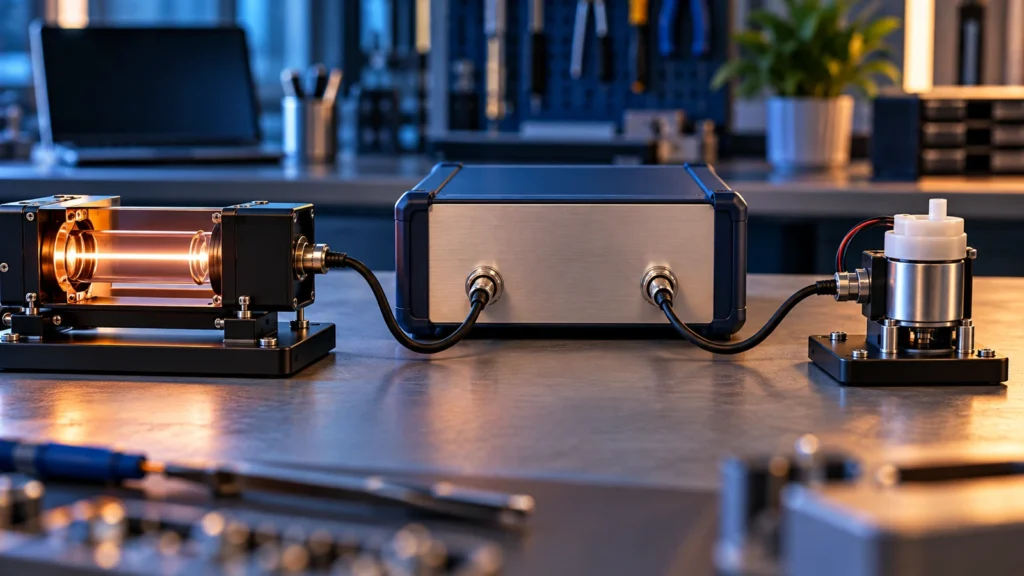
A CO sensor measures carbon monoxide; a CO₂ sensor measures carbon dioxide. The two gases share carbon and oxygen atoms, but one reading cannot be converted into the other. A combined instrument must have an independently specified way to measure each gas, then preserve the identity, range, units and fault state of each channel. This matters when a buyer sees “CO/CO₂ monitor” in a catalog, when an integrator adds a second sensing element to a board, or when a building operator assumes a ventilation display can also warn about combustion gas.
The instrument question is more useful than a general comparison of the gases: What is each channel actually sensitive to, what conditions were used to specify it, and what action will the finished device support? An ordinary CO₂ monitor is not a carbon monoxide alarm. Likewise, a CO alarm does not provide a meaningful indoor CO₂ ventilation trend. The US EPA distinguishes ordinary air-pollution monitors from certified emergency CO alarms, because their intended functions and evidence are different.

The Target Gas Comes Before the Technology
The formulas are CO and CO₂. A CO molecule has one oxygen atom; CO₂ has two. The symbols on a product listing must therefore describe two different measurands, not two names for a shared “carbon gas” value. Both may be expressed in parts per million, but the unit alone never identifies which molecule was measured. A display showing 800 ppm CO₂ and another showing 8 ppm CO would be reporting different fractions of the gas mixture. Neither number can be inferred from the other.
The source also changes the measurement task. Occupants exhale CO₂, so room CO₂ trends can help investigate ventilation under defined conditions. CO can be produced by incomplete combustion. CDC describes CO as a colorless, odorless toxic gas and recommends appropriate CO alarms in homes. A room with a combustion appliance can have a CO question even if its CO₂ trend looks ordinary; a busy meeting room can have elevated CO₂ without implying that CO is present. These are separate diagnostic paths.
For a broader description of the gases and individual CO sensor choices, Gasnose's carbon monoxide sensor guide is a related technical reference. Here the focus is the measurement boundary of the complete device.
Why the Channels Usually Use Different Sensing Principles
Many compact CO₂ instruments use an optical method that measures how CO₂ interacts with infrared light. For a concrete module example, Sensirion's SCD4x data sheet identifies the SCD40/SCD41 as photoacoustic NDIR CO₂ sensors. The specified CO₂ accuracy applies over stated concentration intervals and test conditions. The existence of a digital CO₂ output does not imply an independent CO result. Our NDIR measurement-chain guide explains what the optical path, detector and calibration do.
Many CO instruments instead use an electrochemical cell. Figaro's TGS5042 product information describes a CO-targeted electrochemical element whose output current changes with CO concentration in its specified conditions. Alphasense's CO-B4 data sheet presents a different CO cell intended for low-level environmental measurement. Those are examples of CO-channel architectures, not interchangeable specifications. A particular CO cell may have filters or compensation for interferents; it is not magically sensitive only to CO under every mixture.
Other technologies exist for both gases. An instrument designer may select different optical, electrochemical or semiconductor approaches for a particular range and duty. The practical rule remains: check the named target gas and channel specification, not a sensor-family label. If a component provides only a CO₂ register, software cannot create a trustworthy CO measurement merely by renaming that register.

One Enclosure Does Not Mean One Measurand
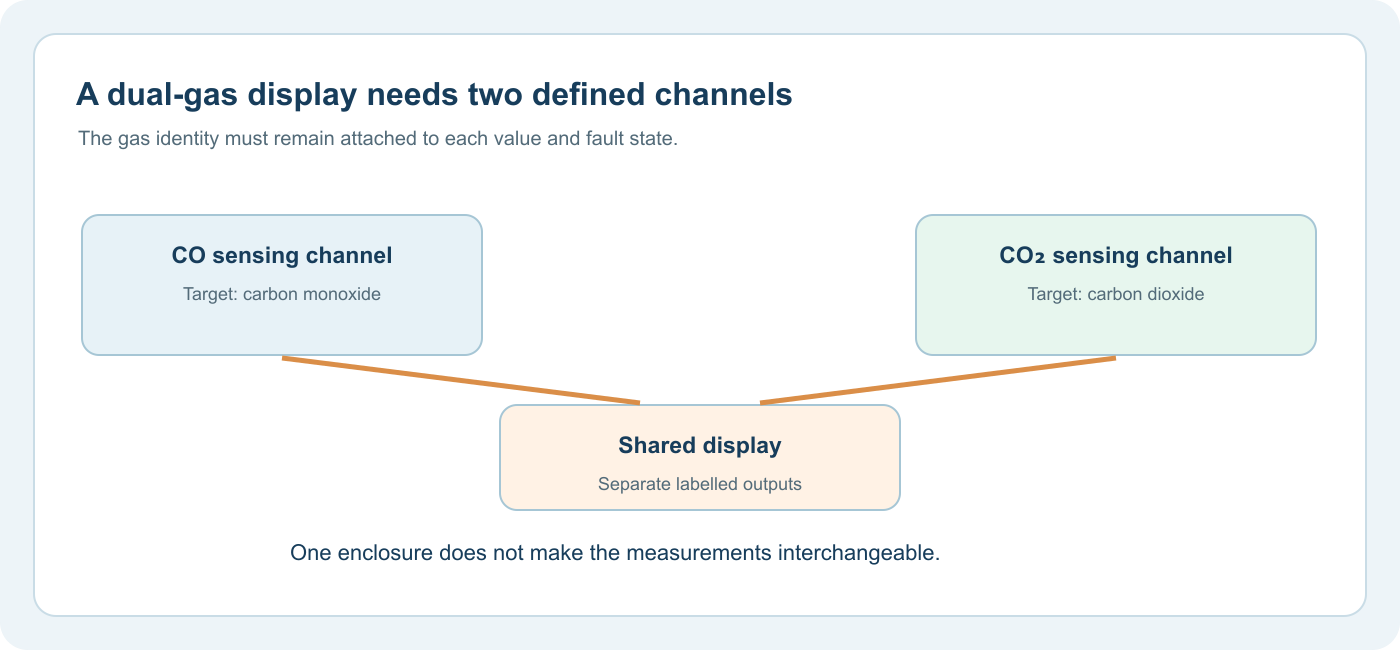
A dual-gas product can put both elements behind one display, battery and communication interface. That convenience can hide important differences. Each element may have its own warm-up, response time, calibration history, temperature dependence, service life and failure mode. The gas may reach each element through different openings or diffusion barriers. A shared screen is therefore the final presentation layer, not proof that both channels sample and respond identically.
| Question | CO channel | CO₂ channel |
|---|---|---|
| Which gas is reported? | Monoxyde de carbone | Dioxyde de carbone |
| What example principle is documented? | Electrochemical current in a CO cell | Photoacoustic NDIR in the SCD4x CO₂ module |
| What must the specification name? | CO range, response, interferents, calibration and fault behavior | CO₂ range, accuracy interval, environmental compensation and fault behavior |
| What does a second channel add? | A separate measurement of CO | A separate measurement of CO₂ |
| What does a shared display prove? | Only that the instrument presents a CO result | Only that it presents a CO₂ result |
This table describes the cited example architectures, not every available product. For a comparison of a component's data sheet with a finished device's claims, see our module-versus-monitor guide. In particular, a component rating cannot automatically be promoted into a whole-device alarm, accuracy or service claim.
A Worked Instrument-Reading Example
Imagine a monitor that displays CO₂: 900 ppm et CO: 4 ppm at the same time. These are hypothetical readings used only to show the interpretation. The first means 900 CO₂ molecules per million molecules of the specified gas mixture on the instrument's reporting basis. The second means 4 CO molecules per million on its own reporting basis. The readings are not a ratio of CO to CO₂, and the difference between 900 and 4 does not quantify a common “air-quality score.”
If the CO₂ number rises while the CO number remains unchanged, an investigator might examine occupancy, ventilation, placement and CO₂ calibration. The unchanged CO channel does not certify that all combustion products are absent. If the CO channel rises, the operator should use the applicable instrument instructions and site response procedure; a CO₂ trend cannot explain it away. A simultaneous rise is possible, but it does not prove a single source without sample-location and instrument checks.
Our ppm explanation covers the fraction arithmetic. The arithmetic is the same for either gas; the target molecule, measurement range and intended response are not.
Read Each Data Sheet Separately
The right comparison is two complete evidence chains. For each channel, record the following from the exact model and revision of the manufacturer documentation:
- Target and principle. Does the document explicitly name CO or CO₂? What else can produce a response?
- Specified interval. Where is accuracy stated, and how does that differ from an output or maximum exposure range?
- Conditions. What temperature, humidity, pressure, flow, supply voltage and gas mixture apply?
- Timing. Is the published response for the sensing element alone, a module, or the finished enclosure?
- Calibration and drift. How is each channel checked and maintained? Is a baseline algorithm appropriate for its environment?
- Diagnostics. How does the device signal a failed, out-of-range, warming or disconnected channel?
- Intended use. Is the finished device a trend display, a process instrument, or an alarm designed for a defined hazard?
The last item is especially important. EPA notes that low-cost air monitors' alerts are not equivalent to emergency CO alarms. A device showing a CO concentration is not, by that fact alone, an approved or appropriately installed alarm for every use. The required alarm product and placement depend on the application and relevant local requirements; those details belong in the finished-device instructions, not in a generic sensor article.
Cross-Sensitivity Is Not a Second Calibrated Channel
No real chemical sensor should be assumed perfectly selective. An electrochemical CO cell may show a response to another gas under some conditions; a manufacturer may use a chemical filter, an auxiliary electrode or an algorithm to reduce a known interference. A CO₂ optical measurement also has documented environmental conditions and possible optical or pressure effects. However, an interfering response is not an alternative method for measuring the interfering gas. It may instead be an error in the target-gas reading.
For example, if a CO element has a specified response to hydrogen, that does not make its CO output a calibrated hydrogen measurement. Equally, an environmental-compensation sensor inside a CO₂ module does not turn it into a separate CO detector. Ask whether the second value has its own sensing route, calibration and error statement. A label such as “multi-gas” is incomplete without a channel map.
Application Examples That Change the Brief
Occupied room near combustion equipment. CO₂ can be useful for a ventilation question; CO needs its own suitable detection and response strategy if combustion risk is in scope. An ordinary room-air display cannot substitute for a CO alarm.
Garage or loading area. CO may be a key gas of interest where engines operate. The design brief should identify traffic patterns, sampling positions, ventilation controls and the required finished-device function. A building CO₂ monitor alone does not resolve the CO task.
Fermentation or beverage area. CO₂ can become elevated from process gas. The CO channel may be irrelevant unless a separate CO source is credible. The process sample, worker area and any alarms require distinct placement and range decisions.
Combustion analyzer. A sampled exhaust stream can contain both gases, but the ranges, dilution, conditioning and reporting basis may differ greatly from a room monitor. Instrument selection should follow the sample path and documented analyzer specifications, as discussed in our monitor-versus-analyzer guide.
These examples are measurement briefs, not universal installation instructions. The same two gas names can lead to different equipment choices depending on location, expected concentration, timing and intended action.
An Acceptance Test for a “CO/CO₂” Product Listing
Before accepting a dual-gas claim, ask the seller or integrator to show a channel table. It should identify the sensing element or method behind each number, the gas path to each element, its units, stated range, accuracy and environmental conditions, and its calibration and fault indication. Then check the finished product's manual for the intended use of any audible or remote alarm. If the listing gives only a single generic “air quality sensor” specification, its two gas claims are not yet documented well enough to support a selection decision.
Treat both channels as separate measurements even when the device sends one data packet. Store gas identity with every value in a building-management or logging system. Avoid a generic field name such as carbon_ppm; use explicit names like co_ppm et co2_ppm, and retain timestamps and validity flags. This small data-design choice prevents a dashboard from silently swapping a ventilation trend into a CO-related workflow.
Check the Sampling Boundary in a Combination Enclosure
The enclosure may protect electronics while also changing how gas reaches the sensors. A CO₂ optical module can sit behind a ventilation slot, whereas a CO cell may have its own diffusion membrane and filter. Blocking either opening, placing the product close to a local source, or using it outside the documented orientation and environment can alter what reaches that channel. A commissioning check should therefore identify the inlet for each element and confirm that the manufacturer's placement instructions apply to the complete combination device, not only to one component.
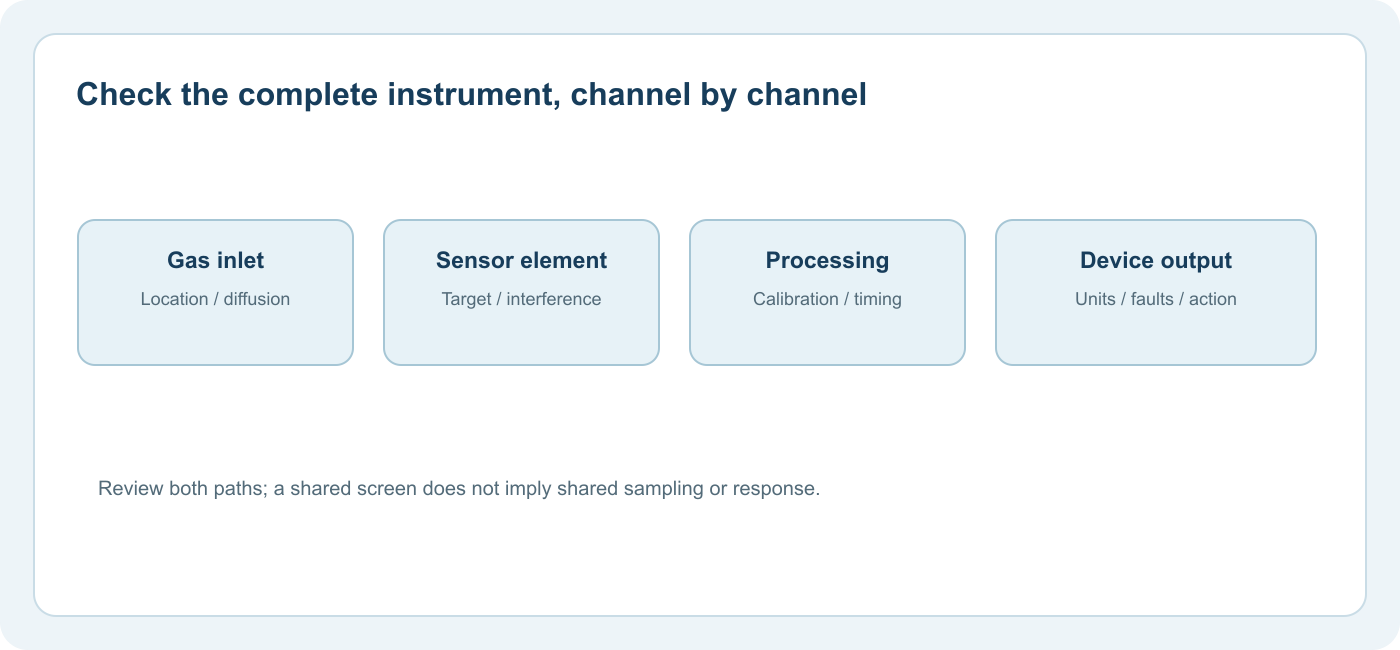
This matters for timestamps as well. A combined display may refresh both numbers at once, while the two sensors have different physical response and software averaging. If a brief event is being investigated, do not assume matching screen-update times mean matching gas arrival times. Preserve the reported update interval and any channel-specific status instead of treating a shared user interface as a common measurement clock.
Questions fréquemment posées
Can a CO₂ monitor warn about carbon monoxide? Only if the complete product has a separately specified CO measurement and the intended warning function. A CO₂-only sensor does not measure CO.
Can a CO alarm show room CO₂? A CO-only alarm has no CO₂ result. A combination product may include a separate CO₂ channel; check its actual manual.
Do both readings use ppm? Often yes, but ppm is a fraction unit, not a gas identifier. The CO and CO₂ values remain separate measurands.
Does cross-sensitivity make one sensor measure both gases? No. An unintended response to another gas is normally an interference unless the manufacturer independently calibrates and specifies that measurement.
Is a dual-gas display automatically a dual-gas safety alarm? No. A displayed concentration and an emergency alarm are different finished-device functions with different evidence and instructions.
What should I compare first? The target-gas label and the intended decision for each channel. Then compare the applicable range, environmental conditions, system response and fault behavior.