
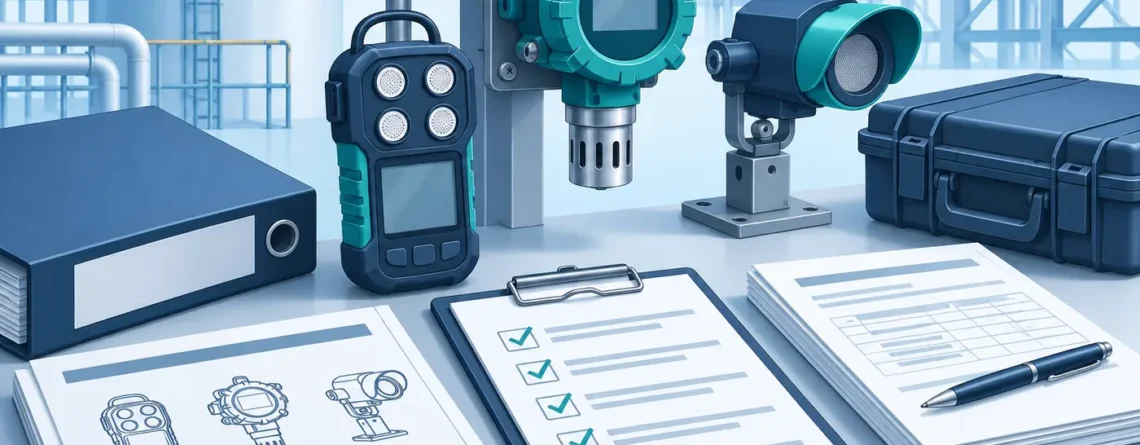
Buy a gas detection function by requesting evidence that connects the application requirement to the exact supplied equipment, installed configuration, and acceptance records. A quotation, certificate, or calibration label alone cannot establish that whole chain. The procurement file should show what must be detected, why the equipment is suitable, how the system will warn or respond, what will demonstrate acceptance, and who will support it afterward.
The most useful checklist separates claims from evidence and identifies who owns each unresolved issue. It should make competing proposals comparable without pretending that a low price, long specification table, or familiar approval mark proves suitability. This guide focuses on safety detection procurement evidence rather than general building-sensor specifications or routine service-record templates.

Write the detection duty before requesting a quotation
A request for “a gas detector” leaves the supplier to guess the problem. State the gas or hazard, the application, expected operating environment, fixed or portable role, relevant areas, required interfaces, and the responsible design basis. Identify what the supplier is being asked to provide and what remains the owner's or designer's responsibility.
The detection duty should distinguish a direct gas measurement from oxygen depletion, ventilation assessment, leak investigation, or another role. A device appropriate for one can be inappropriate for another even when the product page uses similar words. Specify whether the proposal covers equipment only or a complete installed function, including configuration and integration.
Where assessment is incomplete, identify the open inputs. A supplier can provide conditional options, but those conditions should remain visible until resolved. Do not let a quotation become the only record of design assumptions. The procurement decision needs a stable statement against which technical differences and exceptions can be reviewed.
Use a claim-to-evidence matrix
For every important claim, identify the evidence type that could establish it. “Measures CO2” needs exact sensor and range information. “Suitable for the installation” needs environmental, location, and application evidence. “Compatible with the controller” needs supported interface information and configuration. “System accepted” needs records matched to the installed scope.
The matrix should also identify an evidence owner. A distributor may obtain a manufacturer's certificate but cannot necessarily establish the location design. An installer may document wiring but not characterize a sensor's interference response. Assigning the wrong evidence to the wrong party can leave an important issue unresolved while everyone believes it belongs elsewhere.
| Claim or requirement | Fianaise le hiarraidh | Ceist athbhreithnithe |
|---|---|---|
| Correct gas and measurement role | Application statement and exact sensor configuration | Does the measurement address the assessed hazard? |
| Suitable performance | Model-specific specifications with conditions | Are the relevant range and operating conditions covered? |
| Suitable assembly | Applicable certificates and supported component list | Does the delivered variant remain inside the stated scope? |
| Correct integration | Interface schedule and configuration records | Are units, scaling, faults and outputs agreed? |
| Installed function accepted | Authorized acceptance plan and resulting records | Does the evidence cover the required end-to-end function? |
| Maintainable service | Instructions, parts and ownership arrangements | Can the owner sustain the accepted function? |
Establish the legal and contractual basis
Request exact document names, editions, and applicability statements. An adopted code, a consensus standard, a regulator bulletin, and a manufacturer guide have different roles. A broad compliance sentence should be broken into reviewable claims rather than accepted as a substitute for the underlying basis.
Tá an NFPA 55 official page, for example, identifies the published document and current edition. It does not identify the edition adopted for a particular site. The procurement team should obtain the applicable local or contractual basis and ensure that supplier references align with it.
Keep unresolved jurisdiction questions in the project register. A bidder's assumption may be reasonable for pricing, but it is not a final authority determination. Where complete standards text has not been reviewed, do not mark clause-level compliance as established. A procurement matrix should distinguish confirmed evidence, conditional statements, exceptions, and information still required before acceptance.
Identify the exact orderable and delivered assembly
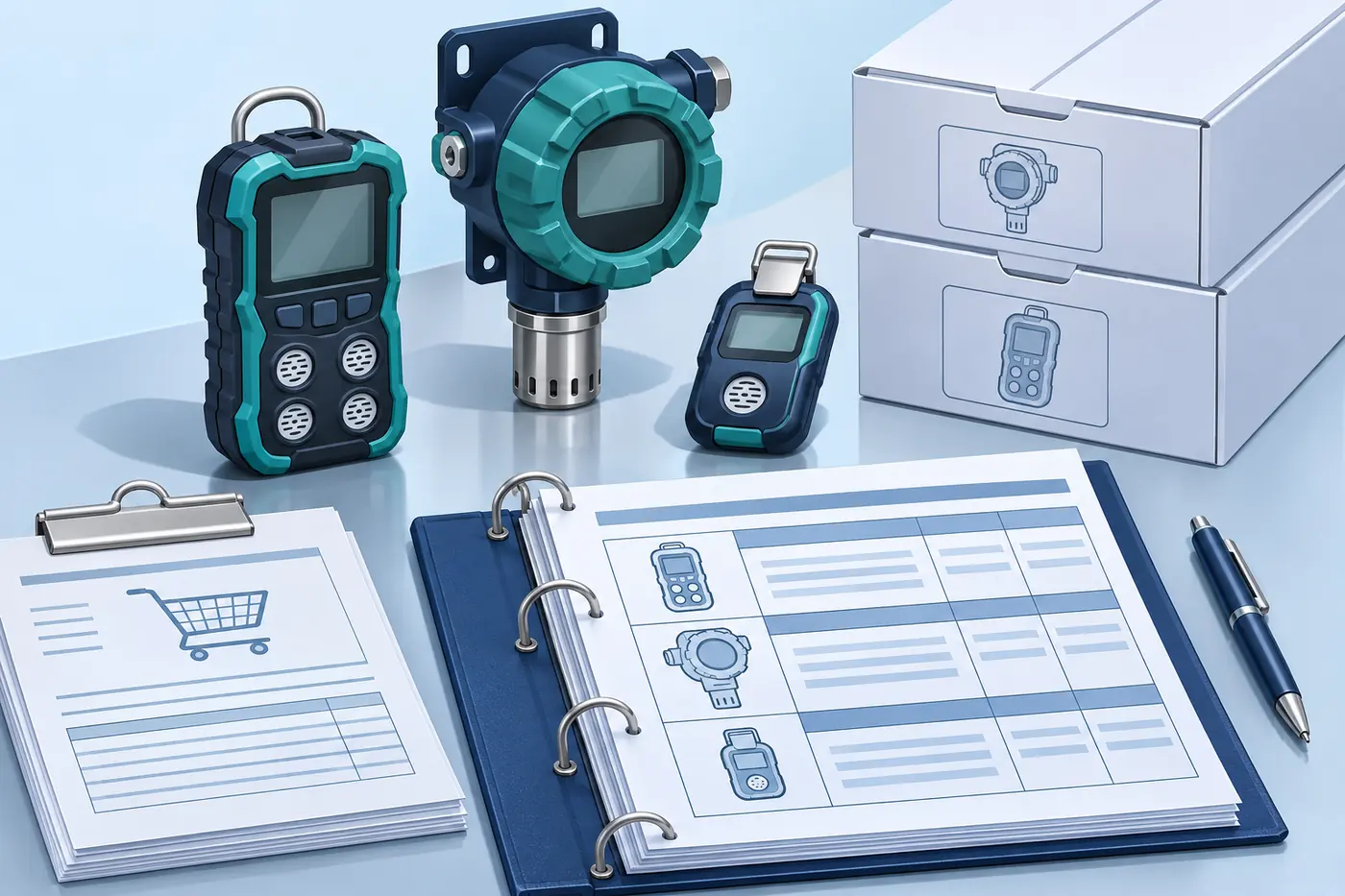
Ask for the full part or order code, sensor variants, ranges, power options, output options, accessories, and software or firmware identity where relevant. The delivered serial number should later connect those items to the actual equipment. A product-family brochure cannot make that connection by itself.
Check the proposed substitution rules before placing the order. A supplier may consider two variants commercially equivalent while the project relies on a particular sensor technology or interface. Require technical differences to be declared so that the responsible reviewer can determine whether the substitution changes the accepted basis.
At receipt, reconcile the purchase specification, accepted submittal, packing information, nameplate, configuration, and certificates. A mismatch is an issue to resolve, not an invitation to infer compatibility from appearance. The same enclosure may contain different sensor combinations. A record that identifies only the enclosure model can therefore be insufficient to establish the measurement configuration.
Read performance statements with their conditions
Accuracy, resolution, response time, repeatability, range, and drift describe different characteristics. A large number of display digits does not establish small installed error. A fast sensing-element response does not establish the time required for a remote sampling system to warn an occupant. A nominal range does not establish performance throughout every environmental condition.
Require the conditions attached to each performance claim. Identify the gas, concentration range, temperature, humidity, pressure, sampling mode, response criterion, and relevant configuration. Where the supplier provides a single favorable number, ask which part of the intended duty it supports and what restrictions apply elsewhere.
The review should focus on necessary performance rather than collecting specifications without a purpose. A project may need reliable fault reporting more urgently than additional display resolution. Another may depend on sample delivery or interference behavior. The requirement statement should explain why each requested characteristic matters so that differences between proposals can be assessed in terms of the intended function.
Ask for interference and unsupported-use information
The proposal should identify substances or conditions that can cause misleading response, loss of sensitivity, damage, or an unsupported measurement. For multigas equipment, review the actual channel combination and the relevant cross-response documentation. A channel name is insufficient evidence of selectivity in a mixture.
Tá an HSE selection guidance for flammable-gas detectors emphasizes detector type, application conditions, and sample-path considerations within its stated industrial flammable-gas scope. It does not qualify every toxic-gas or CO2 product. Use it as a reminder to request the correct model-specific information, while preserving its own limits.
Ask suppliers to identify what the equipment does not measure or cannot establish. This is useful technical information, not a reason to reward vague claims of universal coverage. A clearly bounded proposal may be easier to assess than one that describes every channel as suitable for every industrial gas without supporting evidence.
Review the sampling and installation package
Include probes, filters, tubing, pumps, barriers, mounts, enclosures, power supplies, and relevant communications components. An accessory's physical fit does not establish that it preserves the intended measurement or equipment qualification. The supported combination should appear in the manufacturer documentation or an appropriate written clarification.
The installation evidence should identify where the sensing point is and why that location addresses the assessed scenario. Gas density alone is not a complete location design. Release momentum, temperature, ventilation, obstructions, connected spaces, and access can matter. The responsible designer should provide the rationale rather than requiring a purchaser to infer it from a generic catalogue diagram.
Also consider service access. A location that cannot be inspected or maintained as required creates an ongoing problem even if it appears convenient during installation. Procurement should establish the parts and access arrangements necessary for the intended lifecycle. This does not mean inventing a standard maintenance interval; it means identifying the manufacturer's and project's actual support requirements.
Certificates need a defined scope
Request certificate identifiers and the underlying documents where the claim is material. Confirm the model variants, component restrictions, operating conditions, and other limitations. Distinguish a certificate for electrical equipment in a hazardous location from evidence of gas measurement performance. Neither automatically establishes the complete installed system's suitability.
A supplier's quality-system certificate is also different from a product certificate or a calibration record. It may support confidence in organizational processes, but it does not establish the response of a specific delivered instrument. Keep each document in the role it can actually support.
Avoid asking for a generic “all approvals” package without stating what the application requires. That can produce a large folder of irrelevant documents while leaving a necessary qualification unresolved. The evidence matrix should name the required claim and connect it to the applicable certificate scope. Any exception should be visible before acceptance, with its technical disposition recorded.
Separate factory records from installed acceptance
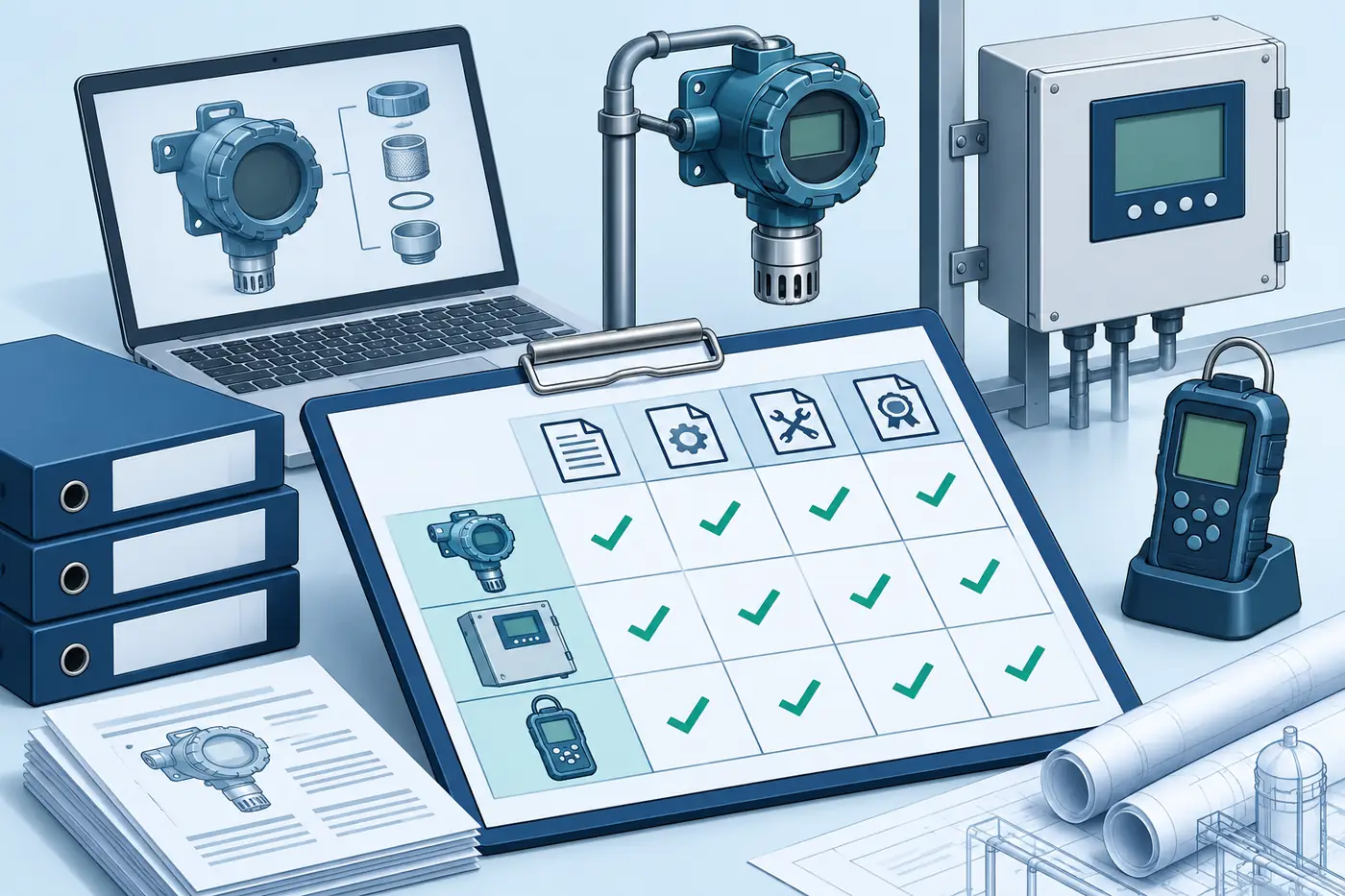
Factory testing can provide valuable evidence about equipment before shipment. Calibration can establish a defined measurement relationship or record an adjustment. Receipt inspection can confirm identity and condition. Installed acceptance addresses the actual project function. These activities overlap in useful ways, but none should be renamed to imply a wider scope than it had.
Tá an OSHA direct-reading monitor bulletin distinguishes qualitative function checks, accuracy checks, and calibration. Its advisory status is stated explicitly. Use those distinctions when describing requested records, and obtain procedures matched to the actual equipment and application.
The acceptance plan should say which requirements will be demonstrated, by whom, under what authorized procedures, and with what criteria and records. It should also identify exclusions. A factory record may not cover site wiring, remote notification, local environmental conditions, or controller mapping. Those interfaces need their own appropriate evidence rather than an assumption that the factory certificate includes them.
Make calibration evidence traceable
An instrument record should identify the actual unit and relevant channels, the activity performed, the date, applicable procedure, reference used, results, and disposition. If adjustments were made, retain the information needed to understand the outcome. The evidence should be interpretable by someone who did not perform the work.
The reference-gas information should be connected to the instrument record. Relevant details can include cylinder or batch identity, assigned mixture and concentration, expiry information, and certificate information. A generic gas certificate in the same folder does not prove it was the reference used on the named instrument.
Request evidence appropriate to the claim rather than requiring a decorative calibration sticker as the primary deliverable. A label can help identify service status, but the underlying record explains what occurred. Conversely, do not infer a long-term maintenance schedule from a single factory calibration date. Ongoing requirements depend on the applicable instructions, conditions, and organizational arrangements.
Define interface evidence before integration begins
For each required output, document the channel, engineering unit, range, scaling, destination, alarm or status meaning, and fault behavior. Clarify which party configures the source and which configures the receiving system. Where communications are involved, identify how stale or unavailable data will be represented.
A correct local display does not prove a correct remote value. The receiving system may apply a different scale, associate the value with the wrong gas, or retain a last-good number during a fault. The interface acceptance evidence should address the behavior required by the project rather than only showing that a cable is connected.
For linked protective functions, use an approved cause-and-effect or equivalent specification with defined responsibility boundaries. Do not let an equipment quote imply a complete safety function when the supplier's scope ends at a relay terminal. The owner needs to know which evidence demonstrates the remaining path and who is responsible for resolving an interface failure.
Review alarms as communications to people
An alarm must be recognized in its intended environment. Procurement should request information about available notification modes and identify how the project will establish their suitability. A visible lamp on a detector may not provide the required warning to someone outside the room. A remote message may be ineffective if its destination is unattended.
Tá an HSE leak/gas detection technical measures discuss warning effectiveness, connected protective equipment, and system management. The procurement implication is to define the warning objective and its evidence, rather than assume that any product with an alarm icon completes the function.
Check consistency with the organization's response arrangements and required signage. This article does not prescribe investigation, rescue, or entry actions. The useful procurement question is whether the supplied interfaces and messages can implement the approved arrangements accurately. Ambiguous gas labels, unexplained codes, or inconsistent room names should be resolved before handover.

A hypothetical comparison of two proposals
Imagine an owner comparing two fixed gas detection proposals. Proposal A has the lower equipment price and a short compliance statement. Proposal B includes a full configuration list, an interface schedule, and defined exclusions. Neither should be selected merely on the amount of paperwork or the price.
The owner places both proposals against the same requirement matrix. Proposal A is asked to identify its sensor variant, supported accessories, fault output behavior, and acceptance scope. Proposal B is asked to resolve an exception concerning a required output. The comparison now concerns evidence for the same intended function, rather than brochure length.
Suppose both ultimately provide suitable equipment evidence, but neither includes the external notification installation. That gap becomes a separate project responsibility and cost. The purchasing decision can then consider the complete delivered function and ongoing support. This hypothetical example does not endorse either proposal; it shows how explicit evidence boundaries prevent a cheap equipment line item from being mistaken for the total system scope.
Handover should establish ownership
Identify who owns inspection and service scheduling, calibration resources, configuration access, replacement parts, impairment management, and record retention. A technically suitable instrument can become ineffective if nobody owns the tasks necessary to keep it available. Procurement is the right time to identify those continuing dependencies.
Request the applicable manuals, accepted configuration, drawings, certificates, acceptance records, training scope, and support contacts as organized deliverables. The file should distinguish the final accepted documents from superseded proposals. A folder containing several conflicting configuration exports can make future maintenance harder rather than easier.
The owner should also understand which changes require review. Sensor substitutions, firmware updates, new sampling accessories, revised gas use, and altered room layouts may affect different parts of the accepted basis. The handover file should make that basis retrievable so that change decisions do not depend on the memory of the original project team.
Manage exceptions without losing them
An exception register should state the unmet or conditional requirement, technical consequence, proposed resolution, responsible party, and closure evidence. Distinguish a harmless document clarification from a missing capability. Avoid closing an exception with “accepted” when nobody has recorded what was accepted and under what conditions.
Commercial pressure can encourage late assumptions. A delivery deadline does not establish the correctness of an accessory substitution or an omitted interface. The record should keep those issues visible so that the responsible decision maker can evaluate them with the necessary evidence. A partial delivery can be described accurately without being represented as a fully accepted detection function.
After closure, retain the connection to the final configuration and documents. If the resolution involved a revised sensor or output assignment, the equipment schedule and acceptance evidence should agree. Otherwise the exception register can say “closed” while the rest of the file still describes the original, unsupported proposal.
A practical purchase-review sequence
- Confirm the application statement and unresolved assessment inputs.
- Establish the applicable legal, contractual, and manufacturer document basis.
- Compare complete proposed configurations against the same requirements.
- Review performance conditions, interference limits, accessories, and certificates.
- Define interface responsibilities and acceptance evidence before ordering.
- Reconcile the delivered identity with the accepted submittal.
- Resolve exceptions and retain the final accepted configuration.
- Complete the authorized installed acceptance activities and record their scope.
- Hand over ownership, instructions, support resources, and change records.
This sequence is a review method rather than a standard or a universal commissioning procedure. Its purpose is to prevent evidence from being collected too late to influence the purchase. A well-written order can make a missing deliverable visible before shipment; an ambiguous order often leaves the same issue to be argued over during handover.
Compare lifecycle scope rather than sticker price alone
A purchase comparison should identify the resources needed to sustain the intended function. Depending on the equipment and application, those can include supported replacement sensors, accessories, reference gases, service tools, software access and competent service support. Request the supplier's actual terms and product instructions rather than assuming that all proposals include the same continuing resources.
Separate mandatory support dependencies from optional convenience features. A cloud subscription might be essential to one proposed reporting workflow and irrelevant to another. A proprietary service tool might be necessary for configuration restoration in one system. The comparison should explain which functions depend on each resource and what happens if the resource becomes unavailable. That makes lifecycle cost meaningful without inventing unsupported failure predictions.
Ask how the owner will obtain future compatibility information. A sensor replacement can change the applicable instructions or configuration, and a software update can change record formats or integration behavior. The handover should identify the supported information source and who reviews changes. A general promise of lifetime support is less useful than clear terms, supported parts and an actionable documentation path.
Do not let a commercial warranty stand in for technical acceptance. A warranty defines contractual remedies under stated terms; it does not prove location coverage, measurement suitability or correct alarm mapping. Those claims need evidence even when equipment replacement would be available. Similarly, a short warranty does not by itself demonstrate poor sensing performance. Compare each commercial and technical statement in its appropriate role.
Define what happens when evidence is incomplete
The procurement plan should say which documents are required for design review, ordering, shipment, installation and final acceptance. Some information becomes available only after serial numbers are assigned or site work is complete. That timing is reasonable when it is explicit. It becomes a problem when essential pre-order capability evidence is deferred until after equipment has arrived.
Use staged deliverables to keep the evidence sequence practical. A preliminary submittal can establish the proposed configuration and relevant qualifications. A final delivery record can connect serial numbers to that accepted configuration. An installed acceptance record can then address the project interfaces and final condition. Each stage should identify unresolved items and the next evidence needed, rather than repeat a generic compliance statement.
If a supplier cannot provide a requested document, determine what claim the missing document was intended to support. An equivalent evidence form may be acceptable if it answers the same technical question and the responsible reviewer agrees. Conversely, a different certificate with an impressive title is not an adequate substitute if it addresses another scope. The objective is defensible evidence, not paperwork volume.
Keep acceptance decisions tied to defined authority. Commercial receipt of equipment is not necessarily technical acceptance of its function. An invoice being paid does not establish that open configuration or integration issues were resolved. The organization should make these distinctions visible in its normal procurement process so that progress in one workstream does not accidentally close another.
At completion, a new owner or reviewer should be able to follow the chain without relying on undocumented conversation: requirement, applicable basis, accepted proposal, delivered identity, installed configuration, acceptance evidence, exceptions and continuing ownership. When that chain is intact, the file becomes useful for maintenance and change review as well as purchasing. When a link is missing, the checklist should reveal it clearly enough that the responsible party can obtain the necessary evidence.

What makes a supplier clarification usable later?
A useful clarification identifies the question, the relevant equipment and configuration, the supporting document basis, and the scope of the answer. If it concerns an accessory, name the accessory and intended gas or application. If it concerns an output, state the parameter, unit, scaling and relevant software or option. An answer to a generic product-family question may not resolve a question about the delivered variant.
Preserve conditions attached to the answer. A capability may depend on a specific sensor, firmware version, sample arrangement or operating environment. Removing those conditions when summarizing the response can turn a correct statement into an unsupported general claim. Link the clarification to the accepted submittal and identify any changes required to the equipment or design.
Keep technical acceptance separate from commercial acknowledgement. A salesperson confirming receipt of a question is not necessarily the manufacturer's technical disposition. The responsible project process should identify when the answer is sufficient and who accepted it. Where evidence remains incomplete, the open item should continue to show the missing decision rather than disappearing inside an email chain.
At handover, include the final clarifications that materially support the accepted function. Superseded questions and informal alternatives can remain in the project history, while the accepted package should be clear about the actual solution. This gives service and change reviewers a reliable basis for deciding whether a later substitution preserves the required function or needs additional evidence.
Ceisteanna coitianta
Is a calibration certificate sufficient to accept a gas detection system?
No. It demonstrates only the activity and scope recorded. The installed system can include locations, sampling paths, outputs, notification, and interfaces that the certificate does not address. Require evidence for each necessary function.
Should every proposal have the same approvals?
The relevant qualifications depend on the application and governing requirements. Compare the applicable certificate scopes and configurations. A larger collection of unrelated certificates is not better evidence of suitability.
Can the supplier choose alarm settings from an exposure-limit table?
The settings need the applicable system design basis, including jurisdiction, purpose, averaging behavior, response arrangements, and equipment capability. An exposure reference alone is not a complete alarm specification. Require the source and interpretation to be documented by the responsible parties.
Why retain serial numbers and firmware identity?
They connect records to the actual delivered instrument and help interpret later changes. A calibration result or configuration export without sufficient identity may be impossible to reconcile confidently with the equipment in service.
Does a hazard diamond qualify the detector?
No. The existing NFPA 704 guide concerns material-hazard communication for emergency response. Product qualification and installed-system acceptance need separate evidence.
What is the most useful question before releasing the purchase?
Ask whether an independent reviewer can trace every material requirement to a named deliverable, a responsible party, and an agreed acceptance basis. If the answer depends on undocumented assumptions, resolve those assumptions while the order can still define the required scope clearly.









Fág freagra