

Fixed and portable gas detectors answer different questions. A fixed system observes defined locations while it remains available, including periods when nobody carries a monitor there. A portable instrument follows a person or a temporary sampling task while it is correctly selected, functioning and deployed. Many facilities need both. The choice should begin with the locations, operating periods and decisions that require observation, rather than a claim that one format is always safer.
The most useful comparison is a responsibility map: which arrangement watches each hazard, during which modes, for which people, and with which warning or protective response? A fixed point does not represent every position in a room. A personal instrument does not continuously watch an unattended plant after its wearer leaves. A temporary area monitor has a separate deployment boundary and should not be assumed to perform either role automatically.
The discussion below supports equipment selection and document review. It does not provide a confined-space entry procedure, emergency response method or generic alarm settings. US permit-space requirements and Great Britain's industrial flammable-gas guidance have different scopes. Apply the rules for the actual workplace and the exact instrument instructions.

A fixed point and a moving personal instrument have different observation boundaries; ribbons are illustrative.
Define the object that needs observation
Start with three objects: the release source, the place where people may be exposed, and the work task. They can overlap but they are rarely identical. A pump may be a release source. A room may contain equipment and a walkway. A maintenance task may put a person close to a connection that is normally enclosed. The appropriate sample location depends on the decision being supported.
A fixed installation can connect observation of a defined source or area to local and remote indication and engineered control interfaces. A wearable detector can move with the worker's surroundings. A pumped portable arrangement can obtain a sample from a remote point within the conditions for that instrument and sample path. Distinguish those uses in the schedule; the word “portable” alone does not specify how the atmosphere reaches the sensor.
Next draw the time boundary. A process can remain hazardous during an unattended night period, a change of shift or a maintenance shutdown. A portable detector in a charging rack does not observe a plant room. A fixed system whose relevant channel is inhibited does not provide its normal function simply because the control panel has power. Availability must refer to the required measurement and response, not just an energized device.
For each task, ask who will notice an alarm and who can act. A local warning on a wearable instrument serves its wearer within its specified capabilities. A site-wide notification or automatic equipment response requires its own arrangement. Connected portable instruments may transmit events, but communications, coverage and response ownership still need review. The existence of a radio feature does not establish an accepted control function.
Compare deployment patterns rather than product labels
| Deployment | Useful observation boundary | Important selection question | Gap to avoid assuming away |
|---|---|---|---|
| Fixed point detector | Atmosphere reaching a defined point or sample inlet | Why will the relevant release reach this location? | Nearby workers or hidden spaces may experience different conditions |
| Fixed sampled system | Atmosphere delivered through the designed sample path | Does the full path preserve and deliver the target sample? | A responsive sensor does not prove representative sampling |
| Personal diffusion monitor | Atmosphere reaching the wearable instrument's inlet | Does the fitted configuration match the worker's task hazards? | An instrument left elsewhere cannot follow the worker |
| Pumped portable instrument | Atmosphere drawn from an identified remote location | Are sampling accessories and response conditions suitable? | A convenient tube may delay or remove a target substance |
| Temporary area monitor | Defined temporary location during a controlled deployment | Who owns its placement, readiness and removal? | A temporary unit is not an unreviewed replacement for a fixed function |
HSE distinguishes fixed, portable and transportable equipment in its industrial flammable-gas guidance. It also separates point measurement from open-path measurement. These are useful categories, but their performance depends on the actual equipment and application. Avoid the shortcut that all fixed detectors are diffusion devices or that every portable has a pump. HSE selection and use of flammable gas detectors.
Manufacturers' comparisons can help frame the purchasing conversation. Crowcon's fixed-versus-portable discussion addresses continuous area observation and mobile worker tasks. Treat its broad comparison as orientation; the selected model's instructions and the site's requirements must resolve actual power, sampling and interface details. Family-level statements about fixed or portable equipment should not become unexplained restrictions in a specification.

A remote sampling assignment includes the instrument and its complete sample path.
Spatial coverage and personal observation are separate claims
Gas must reach the relevant sensing inlet or measurement path. A detector on a wall does not have a universal circular protection radius. The release source, ventilation, obstacles and operating modes affect the relationship between the hazard and a point measurement. A fixed layout needs a documented coverage basis for the scenarios it is meant to address.
The portable instrument changes the location of observation, but that does not make it a complete survey of everything around the worker. Its response concerns the fitted channels and atmosphere reaching the inlet. If the worker handles a different substance, enters a different area or uses a remote sampling accessory, the assignment may need reevaluation. A device can be functioning correctly and still be unsuitable for the new task.
Consider the difference between early source warning and personal exposure observation. A fixed detector near an accepted release path may warn before a person approaches, depending on the design and scenario. A wearable detector may observe conditions along a route that is poorly represented by fixed points. Neither statement establishes a guaranteed warning time. A project should state the expected role and limitations of each layer rather than promising that one always precedes the other.
Keep the geometry explicit in records. Label a fixed point by source or area and location. Label a portable assignment by instrument identity, worker or task, and relevant time. A report titled “room gas level” can conceal whether the data came from a wall transmitter, a personal instrument or a one-off remote sample. That distinction matters when reviewing an event after the fact.
Readiness has different owners and failure opportunities
A fixed installation usually has named maintenance, controls and operations responsibilities. Review how faults reach those people, what happens during maintenance and how an impaired function is restored. A detector can remain physically installed while its inlet is obstructed, its output is inhibited, or an external warning device is unavailable. Physical presence alone is weak evidence of readiness.
Portable readiness includes the instrument's condition, supported configuration, power, required checks, assignment and correct deployment. The equipment-management process should make it possible to identify the actual instrument issued for a task. If a worker substitutes a similar-looking unit, verify that the channels and intended application remain suitable. Appearance is not a configuration control system.
OSHA's SHIB 11-26-2024 explains the distinction between bump testing, calibration checking and full calibration and emphasizes the manufacturer's recommendations. A power-on self-check should not be casually described as proof of gas response. Likewise, a successful function check does not establish that a different gas or a newly added sample tube is suitable. OSHA guidance on direct-reading monitor testing.
Ask how failed or overdue instruments are identified and prevented from being issued for an unsuitable assignment. Record the route for replacement and the owner of follow-up. The goal is an auditable readiness decision, not a collection of certificates detached from the instruments that workers actually carry. Similar attention is needed for a fixed channel returned from maintenance: the record should identify restoration of the intended function, not merely replacement of a part.
Remote sampling changes the measurement system
A pump can extend the sampling location, but the sample path becomes part of the measurement. Tube material, length, connections, filters and conditions can affect delivery of the target substance. A clear tube and an operating pump do not prove that the relevant gas arrives at the sensor without unacceptable loss or delay.
HSE's CEMHD1-2020 alert describes a fatal incident in which adsorption onto an unsuitable sampling tube contributed to a failure to detect flammable vapour. The alert recommends considering the combined detector and tube arrangement for a new intended use or sampling configuration. Its example is evidence of a specific failure mechanism, not a generic instruction to make trial releases. HSE sample-tube safety alert.
In a purchasing review, request the approved accessories, target-gas restrictions and response information for the whole proposed configuration. A salesperson's description of “remote capability” is insufficient if the chosen tube is absent from the evidence. If the task requires substances outside the documented response, return the configuration question to the manufacturer and responsible technical reviewer.
Do not improvise a universal waiting time from tube length alone. Gas transport and instrument response depend on more than the geometric volume of a hose. The accepted procedure should use model- and application-specific information. A review worksheet can identify that information as missing; it should not manufacture a field rule to close the gap.
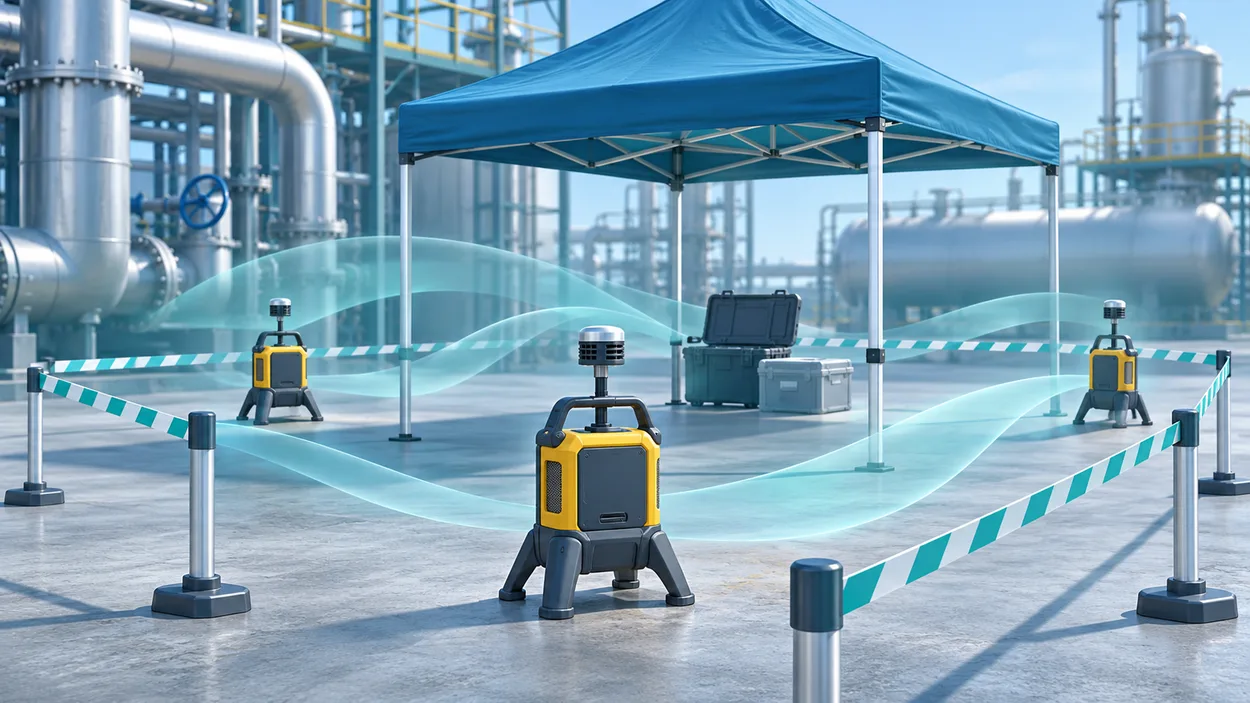
A temporary area deployment needs a defined location, duration and owner; no coverage radius is shown.
Temporary coverage needs a deployment plan
A temporary area monitor may be useful during a defined maintenance period, construction phase or interruption of a permanent system. The word “temporary” should identify a controlled interval with a responsible owner. It should not mean that placement, warning arrangements and readiness checks can remain informal.
Document the reason for deployment and the function it is intended to support. If it is part of an impairment arrangement for a fixed system, compare the original function with the temporary arrangement. A local portable alarm may not replace remote annunciation or automatic protective action. A stationary temporary monitor may not address a moving worker's task. Any remaining difference needs explicit consideration by the responsible site process.
Also identify the practical dependencies: power or charging, suitable environmental protection, permitted location, communications where required, and who sees the indications. Include how the temporary unit is checked, handed between shifts and removed. Removal is a change in the observation arrangement; it deserves a defined trigger rather than the assumption that the equipment will be collected at a convenient moment.
An equipment count is not enough. “Two portable monitors supplied” does not identify whether they are personal, remote-sampling or temporary area instruments, or whether both can be available at the same time. The schedule should connect each unit to its actual duty. This prevents double allocation of the same device to simultaneous jobs.
Build a responsibility map for normal and changed modes
Use the following table as a document-review worksheet. Fill the observation column with a defined arrangement, not simply “fixed” or “portable.” Fill the evidence column with a record or a named open item. The final column should identify the site role that owns the decision, rather than assuming the instrument supplier controls every aspect of the task.
| Mode or task | Observation to define | Evidence to review | Responsibility to assign |
|---|---|---|---|
| Unattended operation | Required fixed or other accepted continuous observation | Coverage basis, fault routing and response logic | Operations and system owner |
| Routine occupied work | Area function and any personal monitoring requirement | Hazard assessment and task assignment | Employer and work supervisor |
| Maintenance near a source | Task-specific instrument configuration and changing local conditions | Work planning and instrument suitability | Maintenance and safety roles |
| Remote atmosphere sampling | Complete instrument, pump and sample path | Exact instructions and application suitability | Competent task planner |
| Fixed-channel impairment | Accepted temporary measures and duration | Impairment approval and restoration criteria | System owner |
| Shift change | Transfer of equipment and unresolved status | Issue log and handover record | Outgoing and incoming supervision |
| New chemical or process | Review of gases, channels and detection strategy | Updated hazard and equipment review | Change owner |
| Return to service | Restoration of the required observation and response | Accepted verification and closeout | Authorized acceptance role |
The map is most useful when disagreements become visible. A contractor may believe the facility's fixed system covers their task, while the facility expects the contractor to bring personal instruments. Write the responsibility and evidence requirement before the work is scheduled. This is a planning issue that a detector purchase cannot settle by itself.
Hypothetical example: a normally unattended pump room
Imagine a hypothetical plant with a pump room that operates unattended between routine visits. The facility has a fixed gas detection function for documented release scenarios. A maintenance contractor will work near a connection during a planned equipment task. No actual test results, detection distances or customer experience are asserted in this example.
The initial suggestion is to replace the fixed system with wearable detectors because maintenance personnel will carry them. The responsibility map exposes a time gap: the wearables leave when the workers leave, while the process room may remain in its defined hazardous operating state. The proposal therefore changes unattended observation and any connected response. Those changes need assessment rather than a purchase-price comparison.
A second suggestion is that the existing fixed detector eliminates the need to review the contractor's monitoring requirements. The map exposes a different gap: the worker's task is close to a potential source and may involve a local atmosphere different from the fixed point. The facility's accepted layout does not automatically define the contractor's equipment, channels or procedure. The task assessment must address those questions separately.
The resulting plan retains the defined permanent function unless an authorized engineering review changes it. The maintenance assignment receives its own instrument suitability and readiness review. If a fixed channel must be taken out of service, the impairment plan states the temporary arrangement and its limits. This example illustrates complementary duties; it does not decide the controls required at an unidentified real site.
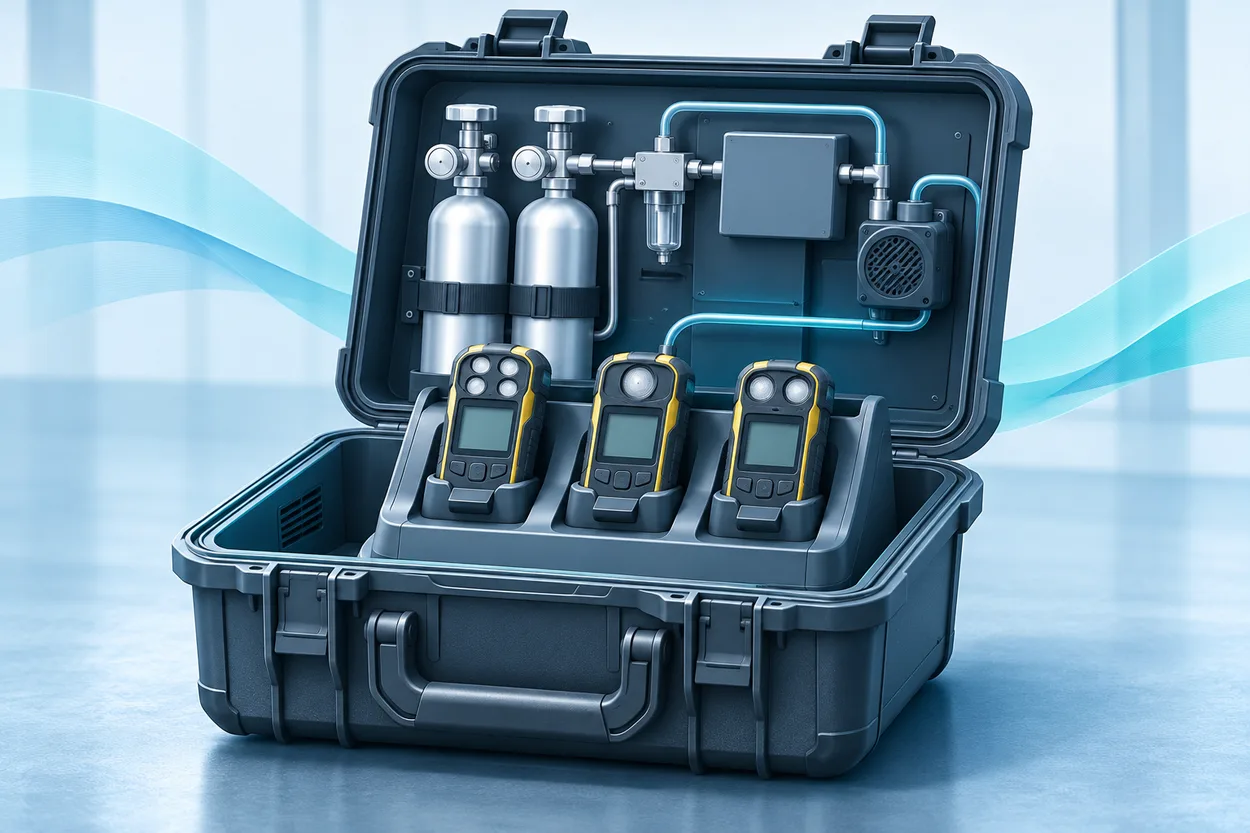
Portable fleet readiness includes suitable service arrangements and traceable equipment records.
Compare lifecycle cost through activities and availability
Purchase price is only one cost category. For a fixed system, review installation, power and signal infrastructure, engineering, commissioning, maintenance access, spares and periodic verification. For a portable fleet, review issuing, checking, charging where applicable, service, replacement, record handling and sufficient availability for simultaneous assignments. Use actual supplier and facility inputs rather than universal cost ratios.
A smaller portable purchase can still require a substantial management process. A larger fixed installation can provide an accepted function over a defined operating period, but its value depends on maintaining that function. Neither format has a universal service life or maintenance interval. Gas exposure, environment, model, sensor design and manufacturer instructions affect those details.
Keep the cost comparison aligned with equivalent duties. Comparing one portable to a complete fixed installation may compare different observation periods and responses. Comparing a fleet with a single transmitter may omit infrastructure or staffing on either side. Make a list of required duties first, then price an arrangement that meets them. If duties remain unfulfilled, identify the gap rather than presenting the cheaper subtotal as an equivalent option.
Itu Sensor1stop introduction to detector types can help readers identify equipment categories. For procurement, the next step is the exact model and configuration. The exact equipment instructions and responsibility map should resolve application boundaries for the proposed arrangement.
Understand the regulatory boundary
In US general industry, OSHA 29 CFR 1910.146 addresses permit-required confined spaces, including evaluation, testing and monitoring within its scope. A fixed detector elsewhere in a facility does not by itself establish compliance with an entry program. Construction and other activities can have different applicable provisions. The employer's competent assessment must determine the actual requirements. OSHA 1910.146.
Avoid transferring a rule from one application merely because it uses similar equipment. A domestic alarm, a process-room detector and a personal toxic-gas monitor can have different intended uses and evidence. Hazardous-area suitability is another distinct question: an instrument's ability to measure a gas does not alone establish that its construction and installation are appropriate for a classified location.
When reviewing bids, request explicit statements of scope. Identify which requirements are addressed by the instrument, which by the installed system and which by employer procedures. The final responsibility map should identify remaining dependencies. This is more useful than a general claim that equipment “meets safety standards” without the standard, configuration, edition or conditions being stated.

Responsibility for location, task and equipment readiness should be explicit across teams.
Review the transitions where monitoring duties change hands
The most revealing part of a responsibility map is often the transition between two otherwise well-managed activities. A fixed system may be maintained correctly and a portable fleet may be checked correctly, yet a gap can appear when a channel is inhibited and a temporary arrangement is expected to take over. Review the transfer itself: what starts it, who accepts the temporary duty and what evidence confirms that the intended observation is available.
A shift change creates a similar boundary. An outgoing worker can return a portable instrument while an incoming worker assumes it remains assigned to a continuing task. An area monitor can be moved for charging while another team assumes it is stationary. These are hypothetical planning failures, not claims about an actual facility. The equipment log should make the assignment, location and status clear enough that the next team can identify the real arrangement.
Contractor interfaces deserve particular attention. The facility may own the fixed function, the contractor may supply personal instruments, and another party may control a remote work location. The task documents should identify who determines channel suitability, who verifies readiness and who communicates an impairment. A broad statement that each contractor brings 'appropriate equipment' leaves the technical acceptance and interface responsibilities unresolved.
Compare two proposals against the same duty schedule
Suppose a purchasing team receives a proposal for an installed detection system and a proposal for several portable units. Before comparing totals, list the duties that both proposals are supposed to fulfill. Include the required operating periods, measurement locations, warning recipients, control interfaces and equipment availability. A proposal can be economical while addressing only part of the requirement. The comparison should show that partial scope rather than silently credit it with the whole duty.
For the fixed proposal, ask which engineering, installation, acceptance and maintenance tasks are included. For the portable proposal, ask which accessories, readiness arrangements, fleet capacity and management tasks are included. If a temporary area function is proposed, give it its own row. This prevents the same units from being counted as personal monitors and stationary coverage during overlapping periods.
Do not assign a universal reliability ranking to the formats. Each arrangement has specific dependencies. A fixed function may depend on power, communications and downstream equipment. A portable assignment may depend on correct issuing, deployment, power and user response. Evaluate the dependencies that matter to the duty and the means of recognizing loss of availability. A format label cannot answer those questions.
Preserve observations without turning them into broader claims
After a task, retain enough context to interpret the instrument records. A logged portable value should remain associated with its channel, instrument, assignment and relevant time. A fixed trend should retain its point identity and status. If records are later combined, preserve the distinction between a stationary observation and a moving instrument rather than averaging them into an unexplained room result.
The absence of an alarm is also bounded information. It may show that no defined alarm was recorded by that instrument during the available record period; it does not establish that every location and hazard was observed. The task review should compare the record with the intended deployment and limitations. Accurate wording helps prevent a useful instrument record from becoming an unsupported assurance claim during an investigation or audit.
Pertanyaan yang sering diajukan
Can a portable detector replace a fixed detector?
Only after the responsible review establishes that the proposed arrangement meets the required duty. Compare location, time coverage, gases, readiness, warning recipients and any protective outputs. A wearable that leaves the area cannot provide the same unattended observation. A temporary area unit may support a defined impairment plan, but its limitations and ownership must be explicit.
Can fixed detection replace personal monitoring?
A fixed layout does not automatically represent a moving worker's atmosphere or task. Determine the worker's hazards, locations and applicable requirements. Personal monitoring may address a different observation boundary. The accepted solution can include both formats, but the need follows from the task assessment rather than from a universal requirement to buy two instruments.
Is a connected portable equivalent to an installed safety system?
Connectivity can provide useful event visibility. Equivalence requires much more: the required function, communications availability, status behavior, response timing, recipients and control interfaces must be established. Review the intended use and system evidence for the exact arrangement. A dashboard demonstration cannot alone establish an accepted automatic protective function.
Is a pumped instrument always preferable?
A pump supports a defined sampling task; it also introduces a sample path whose suitability must be established. A wearable diffusion instrument may be appropriate for another task. Choose the sampling method from the required sample boundary and exact instructions. Do not add an arbitrary hose to solve a location problem without reviewing its effect on the measurement.
What should be recorded at handover?
Identify the instrument or fixed function, configuration, current status, duty, unresolved limitations and responsible people. For an impaired system or temporary arrangement, include the authorized duration and restoration conditions. For a portable assignment, retain the readiness and issue information needed to connect the equipment to the task. The record should make the actual observation arrangement understandable to the next person.
Sources and scope
- HSE industrial flammable-detector guidance, Great Britain; defined industrial scope and exclusions.
- Crowcon: Fixed versus portable, manufacturer application discussion.
- OSHA direct-reading monitor guidance, SHIB 11-26-2024, US guidance on instrument testing and calibration.
- HSE sample-tube alert, CEMHD1-2020, 10 September 2020.
- OSHA 29 CFR 1910.146, US general-industry permit-required confined spaces.







Tinggalkan Balasan