
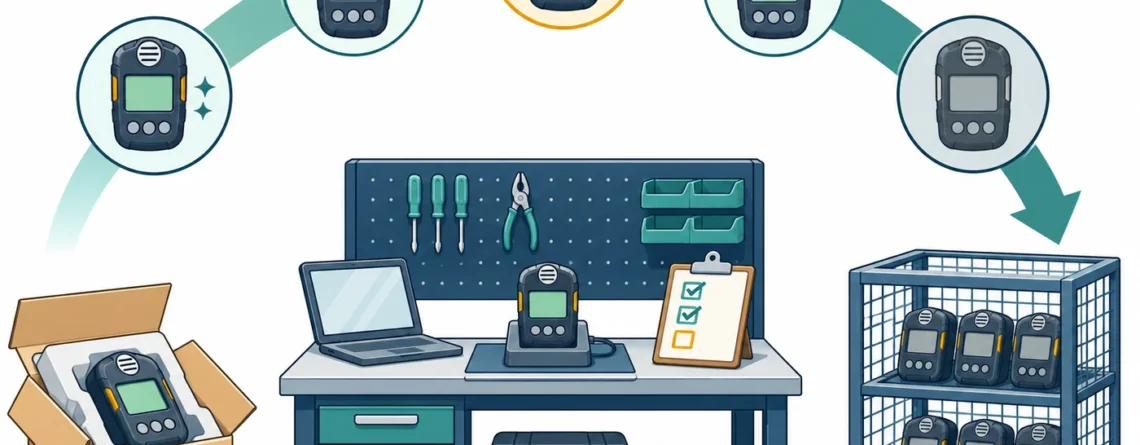
A gas detector maintenance plan should define what must remain functional, which failure mechanisms can undermine it, how those failures are detected, and who restores the required protection when equipment is unavailable. Build the plan around the actual detector, sampling path, outputs, environment and intended duty. Manufacturer instructions and applicable site requirements provide the starting constraints; operating history helps refine tasks and resources within those constraints.
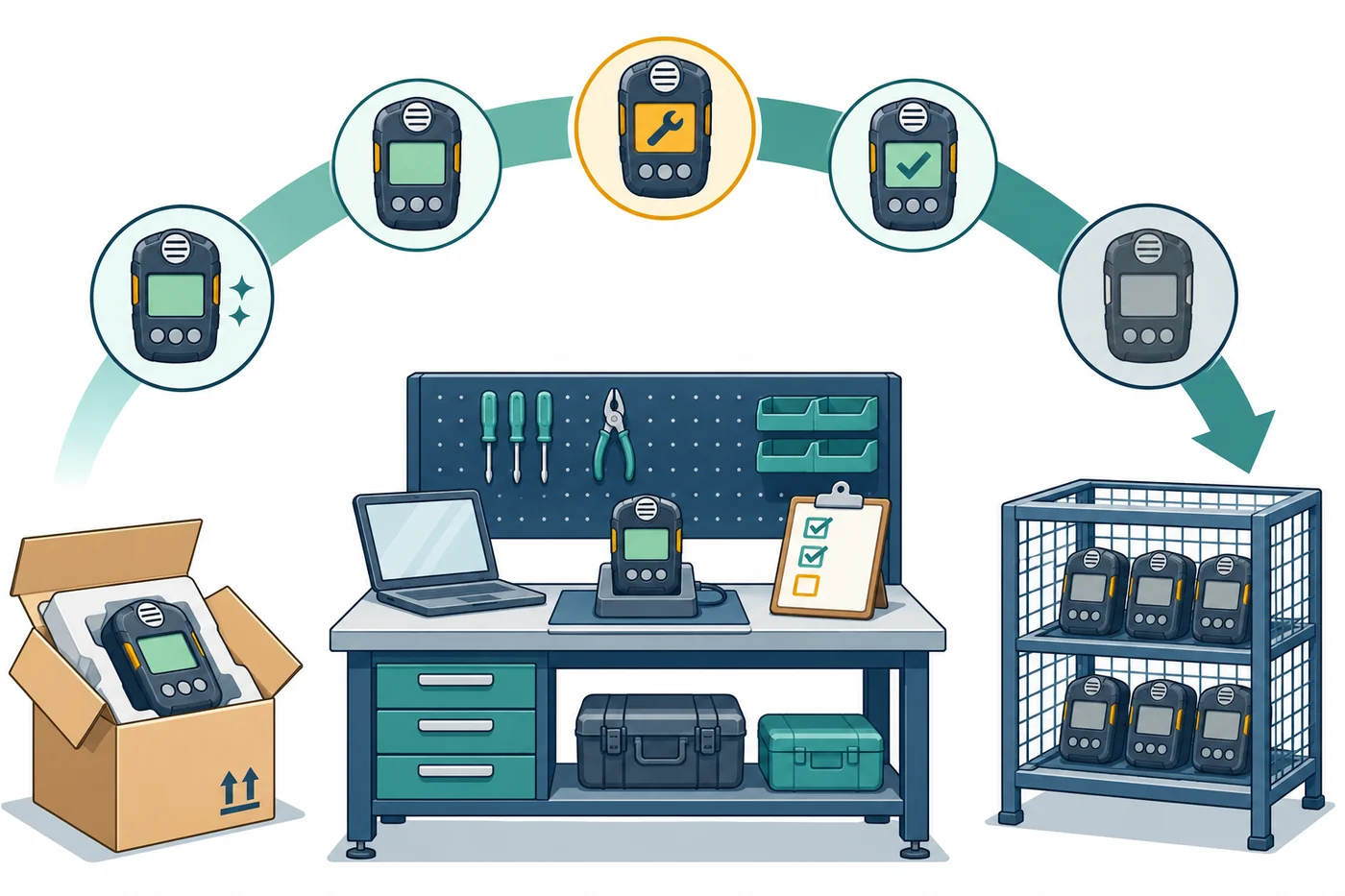
A maintenance strategy connects equipment acquisition, service support and eventual replacement.
The deliverable is a practical maintenance program, rather than a calendar of calibration appointments. Calibration is one task among several. A detector can indicate concentration correctly during a comparison while a blocked inlet, unavailable alarm, unsuitable replacement part or unresolved maintenance inhibit prevents it from performing its intended role. Planning has to address these different ways protection can be lost.
Define the maintained function before selecting tasks
Begin with the reason the instrument exists. A portable personal monitor, fixed room detector, process analyzer and gas detector initiating an interlock have different duties. State the target gases, required locations, operating conditions, reporting outputs and necessary response. That description becomes the basis for deciding which components and activities belong in the maintenance scope.
Separate sensing from the wider system. A fixed sensing head may connect to a transmitter, controller, sounder, supervisory system or final element. A portable monitor may depend on charging equipment, compatible docking infrastructure and correctly maintained sampling accessories. The asset boundary should include the supporting equipment whose condition is necessary for the claimed function.
Itu HSE guidance on selecting and using flammable gas detectors discusses maintenance in relation to sensor type, operating conditions and manufacturer advice. It is UK guidance for flammable-gas applications, and its dated standards references should not be treated as a current international code list. Its useful planning principle is that the maintained function depends on both equipment and environment.
Assign an owner for that function. Maintenance may perform service, operations may control access and process shutdowns, and a specialist may own the protective logic. Without a named coordination role, each team can complete its own task while an interface remains unverified. The plan should identify who assembles the evidence and who decides whether unresolved restrictions affect the intended duty.
Map failure mechanisms to maintenance activities
Start with mechanisms that can actually affect the installed equipment. Gas access can be restricted. A sensor can lose sensitivity or develop drift. A sampling line can leak or retain gas. Power can become unreliable. An alarm output can fail or be disabled. A changed configuration can make an otherwise healthy device report on the wrong basis. These mechanisms call for different observations.
Visual inspection can find external obstruction or physical damage, but it cannot establish quantitative response to gas. A gas challenge can test a defined response, but its coverage depends on where gas is applied and which outputs are observed. Configuration review can find a wrong range, but it cannot establish that gas reaches the sensor. A robust plan combines activities according to their actual diagnostic scope.
Do not select tasks solely because the maintenance system already has a convenient template. A generic “annual calibration” work order can omit filter condition, alarm indication, sample-path integrity and final-element interfaces. Conversely, requiring intrusive service where the manufacturer specifies another method can introduce unnecessary risk and expense. Match each activity to a credible mechanism and an applicable instruction.
| Vulnerability | Useful planning question | Evidence category | Batasan penting |
|---|---|---|---|
| Restricted gas access | Is the installed path available to the sensor? | Inspection and appropriate path verification | Direct gas application can exclude remote tubing |
| Changed sensitivity | Does response satisfy the required comparison? | Specified gas comparison or calibration | Checked conditions do not cover every interference |
| Unavailable indication | Are relevant alarm outputs functioning? | Functional observation | Concentration display alone excludes other outputs |
| Configuration mismatch | Is the installed basis still approved? | Controlled configuration comparison | Correct settings do not prove physical response |
| Support failure | Are power, charging and service resources available? | Support inspection and readiness review | A stocked spare may still be unsuitable |
| System interface gap | Does the connected response remain effective? | Defined interface verification | Component service does not prove the whole chain |
Keep maintenance requirements tied to their sources
For each task, identify its source: the instrument manual, an applicable safety manual, adopted rules, the approved site design or a justified local requirement. Store the relevant revision and explain which equipment configuration it covers. A task copied from another site may be sensible, but its applicability still needs a reason.
Itu Det-Tronics PIRECL safety manual 95-8630 revision 5.2 is an example of an additional product document that defines proof-test requirements for listed safety-certified models. A planner who consults only a general calibration brochure can miss that distinct obligation. The correct document set depends on the installed product and claimed application.
Similarly, the Honeywell GasAlertMicro 5/PID/IR quick reference guide contains model-specific use, exposure and service cautions. Those instructions help define relevant triggers for those instruments. They do not establish a universal interval for all portable monitors or justify applying one product's limits to another sensor technology.
Keep recommendations distinguishable from mandatory requirements and from local policy. A manufacturer instruction can be binding within the selected equipment's approved use, while a guidance document can help structure the site's judgment. A maintenance register that merges these into one anonymous list makes later changes harder to assess and can lead to unsupported claims about regulatory compliance.
Build a schedule with both calendar and event triggers
Calendar tasks support routine planning, stock control and access arrangements. Event triggers address changes that can invalidate a previously acceptable condition before the next scheduled service. A complete plan needs both. Examples of triggers include failed checks, suspected contamination, unusual readings, severe exposure, impact, flooding, prolonged storage, component replacement and process change, where relevant to the actual instructions.
Itu OSHA advisory bulletin on direct-reading monitors, dated November 26, 2024, describes the value of operational verification and historical records. It discusses portable-monitor checks in the context of manufacturer instructions. It should not be converted into a blanket fixed-detector calibration schedule or a statement that one interval meets every employer's obligations.
For each trigger, identify the action owner and required disposition. “Report abnormal readings” is incomplete if nobody decides what happens to the instrument or the measurements made before the report. The plan should direct the event into the approved review and service process, with the device status made visible to people who might otherwise rely on it.
When operating history suggests a revised interval, retain the reasoning and approval. A string of passes may reflect a benign environment, but it can also reflect a narrow test that misses the relevant mechanism. Interval review should examine task coverage, failed events, exposure conditions and consequences of unavailability. Do not extend a required interval merely because a dashboard shows few failures.
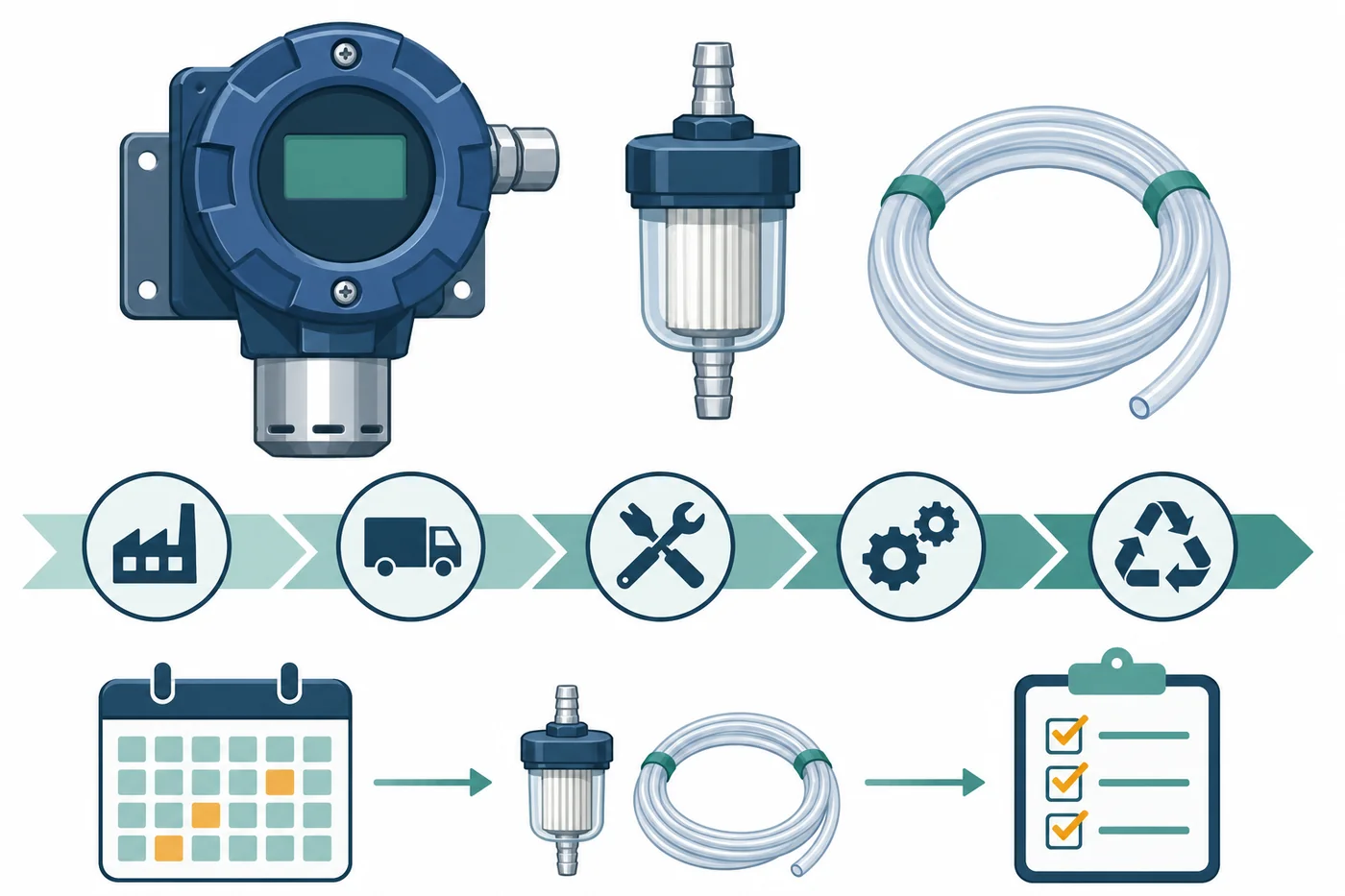
The exposure path belongs in the maintenance scope when it affects the measurement.
Plan for environmental and process conditions
The same model can face different maintenance needs in different locations. Dust, water, corrosive atmosphere, temperature cycling, vibration and contamination can affect the equipment and access to it. A sheltered sensor in a clean room and an exposed detector beside a wet process should not inherit identical tasks solely because they share a part number.
Record the conditions that matter to the chosen technology and product. For sampled equipment, include tubing, filters, pumps and conditioning. For diffusion equipment, include inlet protection and possible obstruction. For a portable fleet, consider storage, charging, cleaning products and handling as well as time in use. The plan should reflect the equipment's actual lifecycle rather than the environment assumed during purchase.
Process changes can introduce hazards or exposures that were absent from the original assessment. A new cleaning agent, production material or ventilation arrangement may affect the detection requirement or sensor performance. Maintenance should have a route into change control so these changes prompt the right technical review. A service technician should not have to discover a changed application from an unexplained failure pattern.
Environmental mitigation also needs manufacturer compatibility. Adding a cover, extending a sample tube or substituting a filter can change response. A practical maintenance plan identifies approved accessories and who can authorize changes. Protecting an instrument physically is useful only if the change preserves the required gas access and other product conditions.
Resource the plan so tasks can actually be completed
A technically sound schedule can fail if there is no access, trained staff, compatible reference gas or replacement equipment. Translate each task into resources and constraints. Identify required competence, service facilities, approved accessories, gas-source validity, access permits, process availability and the time needed to restore the equipment under its instructions.
Reference gas deserves inventory planning beyond quantity. A cylinder can be in stock while its composition, balance gas, validity or connection is unsuitable for the intended device. Link the inventory to actual methods and anticipated demand. Avoid buying a large generic stock that expires before use or cannot support one of the less common installed channels.
Spare equipment needs an acceptance basis. A spare portable monitor may have different sensors or configuration from the unit it replaces. A spare fixed sensor may fit mechanically but lack the necessary range or approval relationship. Plan how a spare is identified, stored, verified and configured for its intended duty before assuming it provides equivalent coverage.
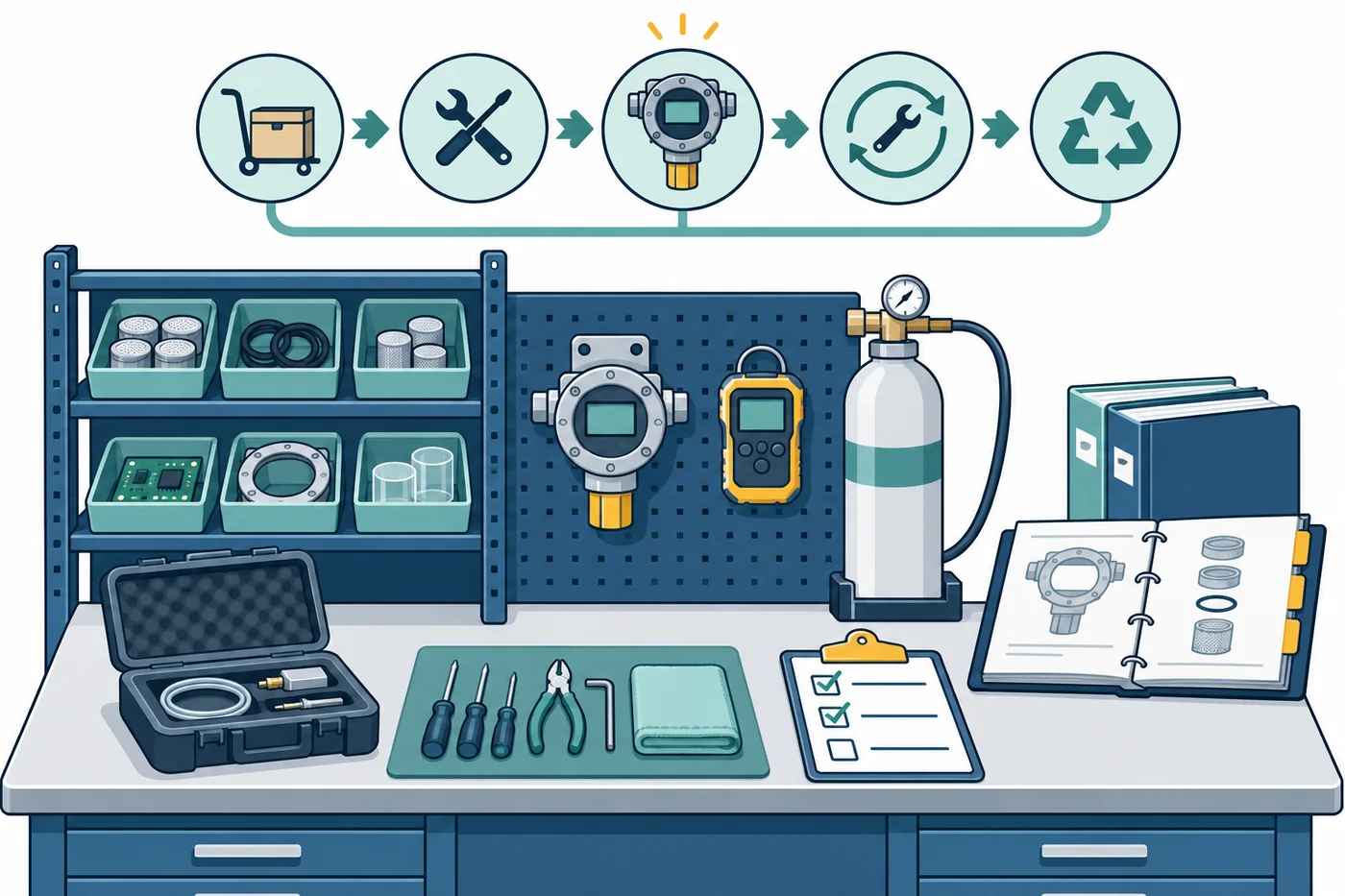
Maintenance readiness includes compatible materials, instructions and competent support.
Address equipment unavailability explicitly
Taking a detector out of service can remove a required measurement or protective function. The plan should identify how that condition is recognized and managed through the site's approved process. It may involve a process restriction, an approved alternative arrangement or another defined action. The correct arrangement depends on the hazard and design; a spare detector placed nearby is not automatically equivalent protection.
For fixed systems, document which channels and effects are unavailable during service. For portable fleets, identify how unavailable devices are prevented from being issued. For sampled analyzers, account for the time needed after service to establish a valid measurement under the method. Restoring electrical power is not necessarily the same as restoring usable measurement evidence.
Responsibility should remain clear across shifts and contractors. A work order can be mechanically complete while a calibration, configuration check or interface verification remains open. The system status should reflect the outstanding requirement. Avoid closing the asset as available simply because the technician finished one component of a larger task.
Plan restoration evidence alongside the outage. Identify which temporary changes must be removed, which results support the as-left condition and who accepts the return to duty. This prevents a common planning weakness: detailed instructions for taking equipment out of service followed by an ambiguous “reinstate system” line at the end.
Use history to distinguish recurring mechanisms
Maintenance records become useful when they preserve identity, condition and intervention. Separate the detector body from replaceable sensors and important sample-path components. Otherwise a trend can mix old and new sensing elements and imply deterioration or improvement that actually reflects a component change. The existing Sensor1stop explanation of zero and span provides background on why baseline and sensitivity evidence answer different questions.
Review failures by mechanism and context rather than by count alone. Repeated blocked filters point toward a different action from repeated sensitivity loss or communication faults. A high number of planned replacements can be a sign of active preventive work rather than poor reliability. A low failure count can conceal missing reports or tests with insufficient coverage.
Preserve as-found results where the service method permits. They help distinguish a device that remained acceptable from one brought back into tolerance by adjustment. Keep the corrective action linked to the original symptom and subsequent verification. “Calibrated successfully” does not explain whether a sensor was replaced, a line repaired or a configuration corrected.
Use trends to generate a focused review question. For example: are failures concentrated in a wet area, after a particular cleaning activity or in one accessory configuration? Then examine the evidence and manufacturer guidance. Do not infer causation from a small cluster without checking whether workload, exposure and reporting practices differ between groups.
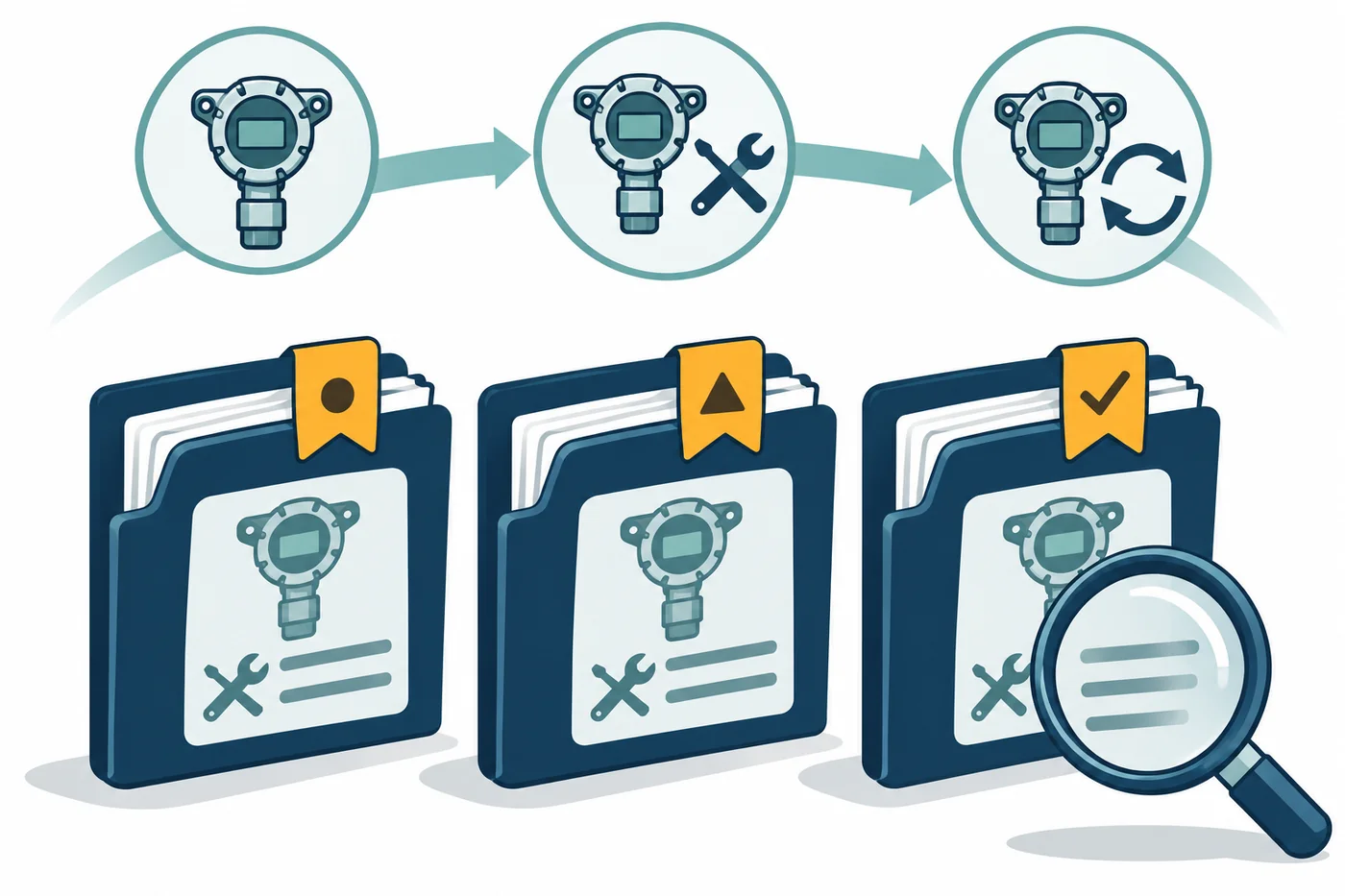
A history review asks which mechanism is recurring and what evidence supports that interpretation.
Decide when replacement is a strategy rather than a repair
Replacement can address an aged sensing element, an unsupported product or repeated failures, but it does not automatically correct an unsuitable application. If the root issue is contamination, an inaccessible service location or a blocked sample path, replacing the same sensor may only restart the failure cycle. The replacement decision should consider the whole maintained function.
Itu IGD MK8 pellistor manual discusses sensor aging, exposure and changes in response, and identifies model-specific replacement provisions. Its product-specific guidance is useful evidence that the ability to zero and calibrate is not the only lifecycle question. It does not establish the replacement age for every pellistor or every installed gas detector.
Obsolescence planning should start before parts disappear. Identify supported firmware and hardware, approved spares, service availability and any dependence on proprietary infrastructure. A last-time purchase of sensing elements can introduce storage-life and support problems of its own. Compare that option with a controlled system replacement, including the evidence needed for the new configuration.
When equipment is retired, preserve the service history and disposition. A removed sensor can remain relevant to an earlier measurement investigation. A retired housing should not reappear as an apparently equivalent spare without a documented assessment. Retirement is part of the maintenance strategy because it closes the equipment's operational identity and prevents accidental reuse.
A hypothetical maintenance program review
Consider a hypothetical facility with fixed detectors in a dry packaging area and a washdown area. Both groups have the same calendar calibration task. The service summaries show repeated inlet contamination in the washdown area, while the dry-area units usually require no corrective work. The reports also show that some checks apply gas directly to the sensing head and omit the installed protective arrangement.
The review should first clarify what the existing tasks establish. A successful direct challenge may be valid for the detector comparison while leaving the installed gas-access condition unresolved. The planner can then ask the manufacturer and design owner how the protective arrangement should be assessed and whether the current installation remains suitable. Simply shortening the calibration interval would not necessarily address the missing path evidence.
Next, examine resources and availability. If washdown-area service repeatedly waits for a special replacement filter, improve the compatible spare strategy and defined outage response. If access requires process coordination, schedule it explicitly. The maintenance plan should make the required work feasible rather than relying on technicians to improvise around a production constraint.
Finally, preserve the basis for any change. A revised task should state which mechanism it addresses, which equipment it covers and how effectiveness will be reviewed. This example does not claim a measured reliability improvement. It shows why maintenance strategy is a combination of task selection, application review and support planning, with calendar frequency only one variable.
Turn the strategy into an implementable task register
A useful task register names the equipment scope, maintained function, failure mechanism, activity, source instruction, trigger, required resources, acceptance evidence and disposition owner. These fields help a planner see whether a proposed work order is complete. They also show where two tasks overlap and where a necessary function has no assigned activity.
Distinguish the task register from the service record. The register explains what is planned and why; the service record explains what happened on a particular occasion. A detailed record template cannot compensate for a missing maintenance activity. Equally, a complete strategy needs event records to establish whether the work occurred and whether the intended condition was restored.
- Define each asset's intended duty and supporting components.
- Map credible failures to observations that can detect them.
- Identify the applicable manual and any safety application requirements.
- Assign calendar tasks and event-driven triggers separately.
- Plan competence, references, spares, access and outage arrangements.
- Define acceptance evidence and unresolved-condition handling.
- Review trends without mixing different sensors or applications.
- Reassess the plan after changes and before unsupported equipment becomes critical.
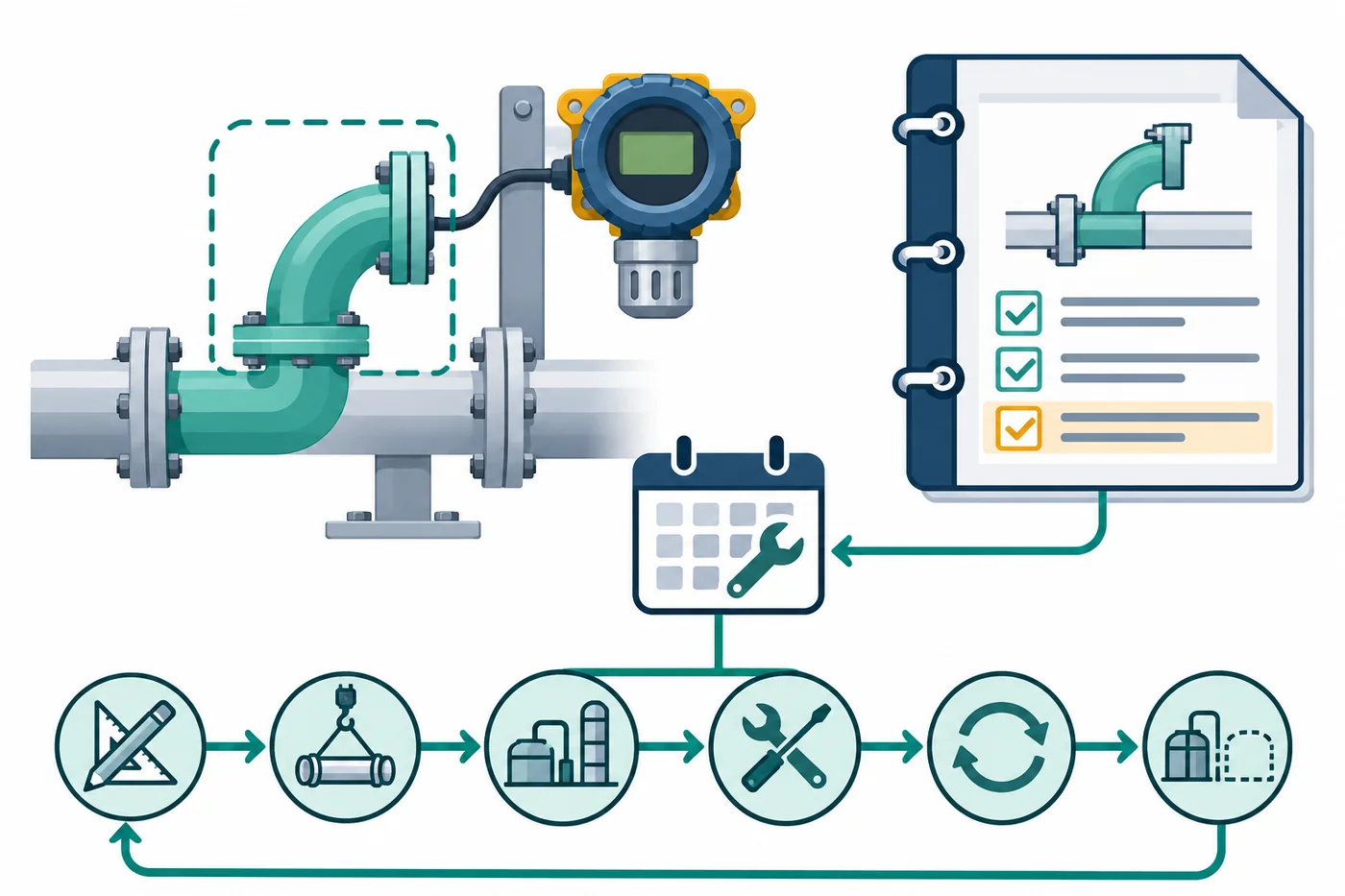
A changed application can require a changed maintenance strategy even when the detector itself is unchanged.
Compare strategies by coverage and practical consequence
Calendar maintenance, condition-based activities and planned replacement can each be appropriate, but they address different uncertainties. A calendar task ensures a defined activity occurs by a planned trigger. A condition-based task uses an observation to initiate work. Planned replacement removes a component under a supported lifecycle rule. None is inherently sufficient for every detector or failure mechanism.
For a condition-based approach, ask whether the relevant deterioration produces a detectable warning with adequate opportunity for the approved response. A diagnostic may report an electrical fault while providing no warning of an external obstruction. Historical drift may be visible in quantitative records while a sudden contamination event requires a different trigger. Match the strategy to the available evidence, not a general preference for predictive maintenance.
For planned replacement, examine whether the proposed criterion is manufacturer supported and whether it addresses the actual failure pattern. Replacing a sensing element at a defined stage can simplify support for one duty while doing little for a sampling line that frequently blocks. The strategy should identify what remains dependent on inspection or functional verification after replacement.
For calendar calibration, separate adjustment from deterioration detection. If the process automatically adjusts the instrument before preserving any as-found result, the history may provide little evidence of performance between services. That can limit later interval review. Where the approved method allows it, retain the observations that distinguish satisfactory pre-service condition from successful post-service correction.
The comparison should include outage consequence. A task requiring a long equipment absence can create a larger planning burden than an equally valuable task performed with shorter unavailability, but the alternative still needs technical support. Record access, replacement coverage, service turnaround and acceptance needs so the selected strategy is feasible for the actual process.
Make periodic plan review a defined activity
Set a review trigger for the maintenance strategy itself. Equipment changes, repeated faults, new exposure conditions and manufacturer revisions are obvious reasons. A periodic management review can also identify overdue work, unsupported spares or unresolved restrictions before they become routine background conditions. The review does not replace individual maintenance tasks; it checks whether the program still makes sense.
Use a small, interpretable evidence set. Compare recurring mechanisms, incomplete tasks, repair delays, unplanned unavailability and changes in duty. Include failures discovered outside scheduled service, since those events can show that the current trigger did not address a relevant condition. Avoid interpreting a better completion percentage as improved technical performance without examining what was completed.
Assign actions with owners and closure criteria. If the review finds that one detector family lacks an approved spare, the action is to establish a supported replacement and outage strategy. If it finds that sample-path checks are missing, the action is to define the applicable method and task. A general instruction to improve maintenance gives the planner too little information to implement a meaningful correction.
Preserve the rationale when the plan remains unchanged. A review can reasonably conclude that existing tasks and resources continue to match the duty. Documenting that conclusion with its evidence is more useful than changing intervals merely to show activity. Future reviewers can then identify which assumptions were considered and which new conditions would justify another assessment.
Pertanyaan yang sering diajukan
Is calibration enough maintenance for a gas detector?
It addresses a defined measurement comparison or adjustment. The maintained function may also depend on gas access, sampling components, power, alarms, configuration and downstream response. Select additional tasks according to the actual device and application. A single calibration task should not be assumed to cover every failure mechanism.
Can every gas detector use the same maintenance interval?
Different products, duties and environments have different requirements. Use the applicable instructions and site obligations, then consider justified local review within those constraints. A portable instrument's use check and a fixed safety application's proof test serve different purposes and should not be collapsed into one fleet-wide calendar entry.
Does a self-diagnostic fault system eliminate routine checks?
Diagnostics have a defined coverage. They can identify some failures while leaving others, such as external obstruction or unsuitable application, outside their scope. Read the manual's description of diagnostics and required maintenance. The presence of a healthy status indication is evidence only for the conditions that indication is designed to represent.
When should a maintenance interval be reconsidered?
Review it when relevant operating conditions, exposure, failure history, equipment configuration or source requirements change. Also consider whether the current task actually detects the mechanism of concern. A shorter interval for the wrong task can increase workload without resolving the underlying evidence gap.
Should sensors be replaced as soon as they need adjustment?
Adjustment alone does not establish end of life. Evaluate the manufacturer's criteria, failed checks, drift, response behavior, exposure history and service limits. Conversely, a successful adjustment does not prove indefinite suitability. Replacement should follow a supported assessment of the actual component and duty.
What is the most useful maintenance performance measure?
No single number answers every question. Look at task completion, unresolved failures, restoration delays, recurring mechanisms and availability in the required duty. Interpret these with exposure and workload. A high pass rate is helpful only if the tests have suitable coverage and failures are consistently recorded.
Sources and equipment documents
- HSE: Pemilihan dan penggunaan detektor gas yang mudah terbakar, maintenance and application principles for flammable-gas detection.
- OSHA: Calibrating and Testing Direct-Reading Monitors, SHIB 11-26-2024, advisory discussion of operating checks and service history.
- Det-Tronics: PIRECL safety manual 95-8630 revision 5.2, specific safety-application maintenance obligations.
- Honeywell: GasAlertMicro 5/PID/IR quick reference guide, named-model service and exposure conditions.
- IGD: MK8 pellistor manual, model-specific sensor lifecycle and replacement discussion.








Tinggalkan Balasan