
Kelembapan dapat mengubah pembacaan detektor gas respon sensor, komposisi gas sampel, dan kondisi fisik jalur pengambilan sampel. Itu adalah masalah yang berbeda. Pergeseran garis dasar yang berhubungan dengan kelembapan tidak sama dengan pengenceran uap air, dan juga tidak sama dengan kondensasi di dalam detektor.
Arah perubahannya tidak bersifat universal. Pembacaan dapat naik, turun, menjadi tidak stabil untuk sementara, pulih setelah stabilisasi, atau tetap tidak dapat diandalkan karena kelembapan mempengaruhi instrumen. Jawabannya tergantung pada teknologi penginderaan, gas target, model sensor, enclosure, sistem sampel, dan algoritma pemrosesan.
Oleh karena itu, bagi pengguna instrumen, pertanyaan praktisnya bukan sekadar apakah kelembapan itu penting. Dia which humidity effect the particular device is designed to handle, under which conditions, and how that is documented.
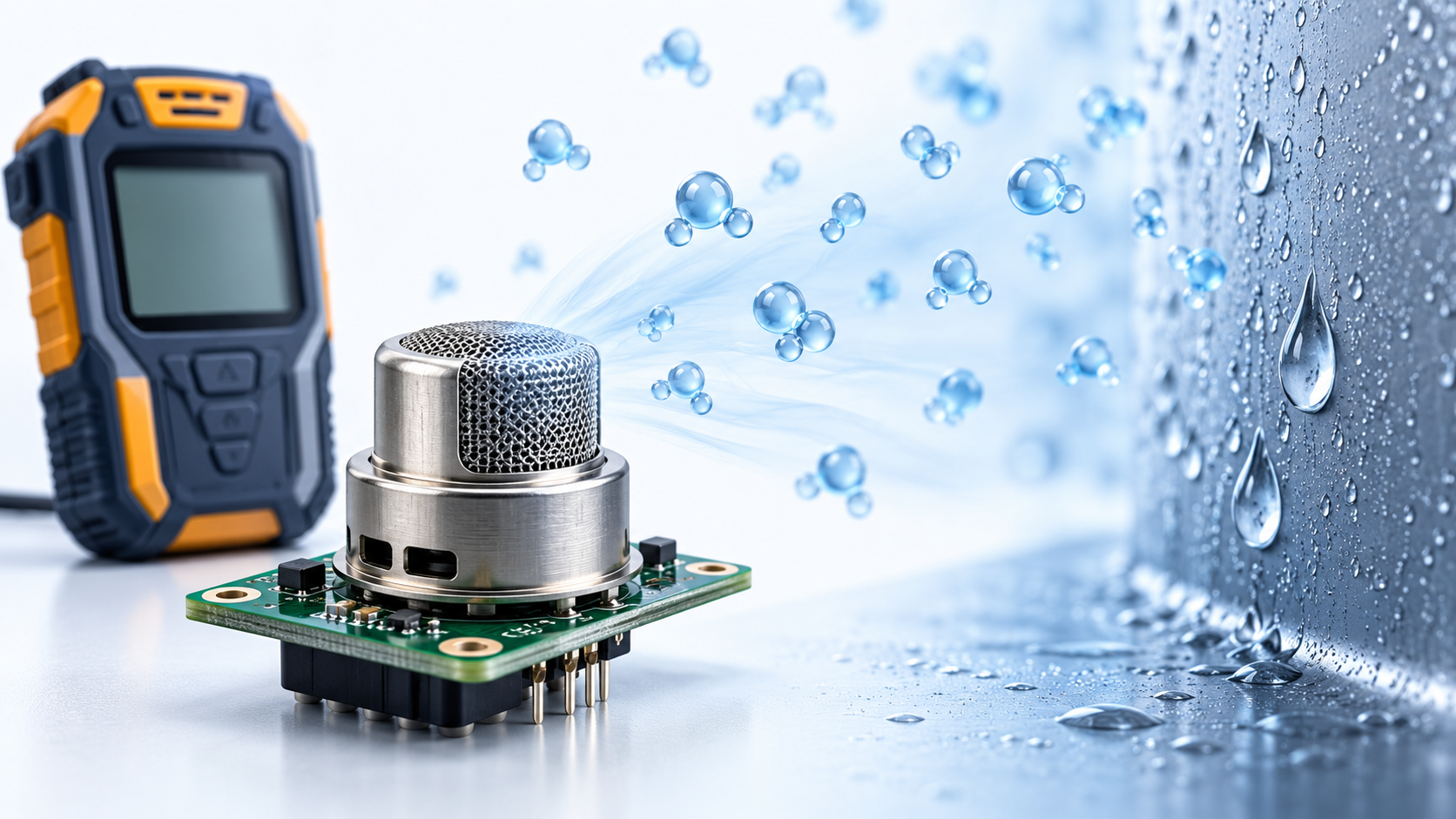
Conceptual illustration. The components do not represent a specific commercial instrument or a laboratory test.
Start With Three Different Explanations
When a reading changes during a humid event, separate these possibilities before deciding that the sensor has drifted or failed:
| Possible explanation | What changes? | What information helps distinguish it? |
|---|---|---|
| Sensor or measurement-chain response | The relationship between gas reaching the sensor and its electrical or processed output | Raw output, model-specific humidity characterization, compensation configuration |
| Sample composition or reporting basis | The gas mixture reaching the instrument, or the denominator used for a reported concentration | Gas preparation, water content, wet/dry basis and sampling method |
| Moisture in the instrument | Inlet, filter, optical surfaces or other components exposed to liquid water | Dew point, local surface temperature, condensation inspection and device instructions |
More than one can occur at the same time. A detector moved from a cold store into a warm, humid room can undergo an environmental transition while a cold inlet becomes vulnerable to condensation. A logging system that records only the final gas number loses much of the information needed to interpret the event.
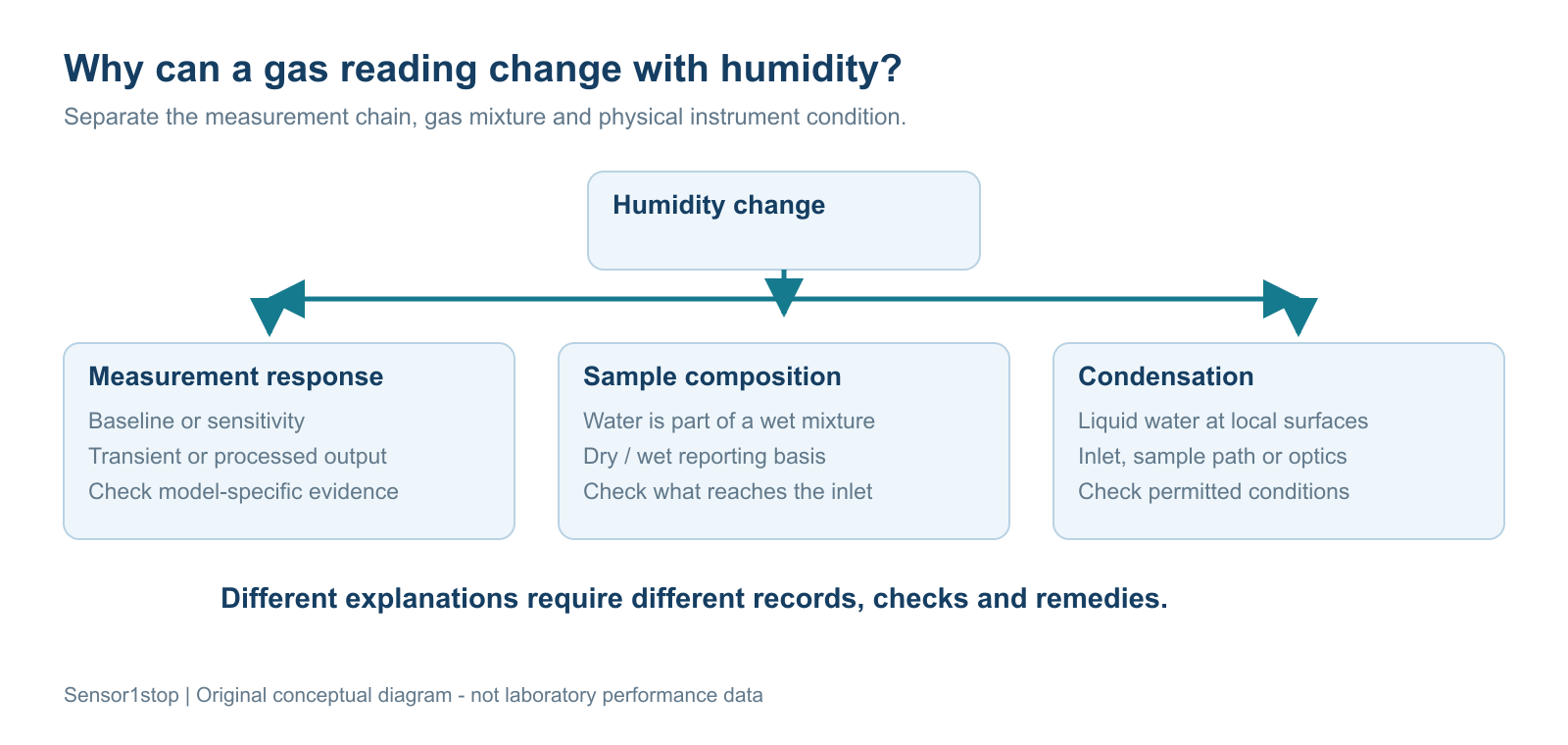
Peta diagnostik, bukan prediksi bahwa setiap instrumen menunjukkan ketiga efek tersebut.
Kelembaban Relatif, Kelembaban Absolut, dan Titik Embun Berbeda
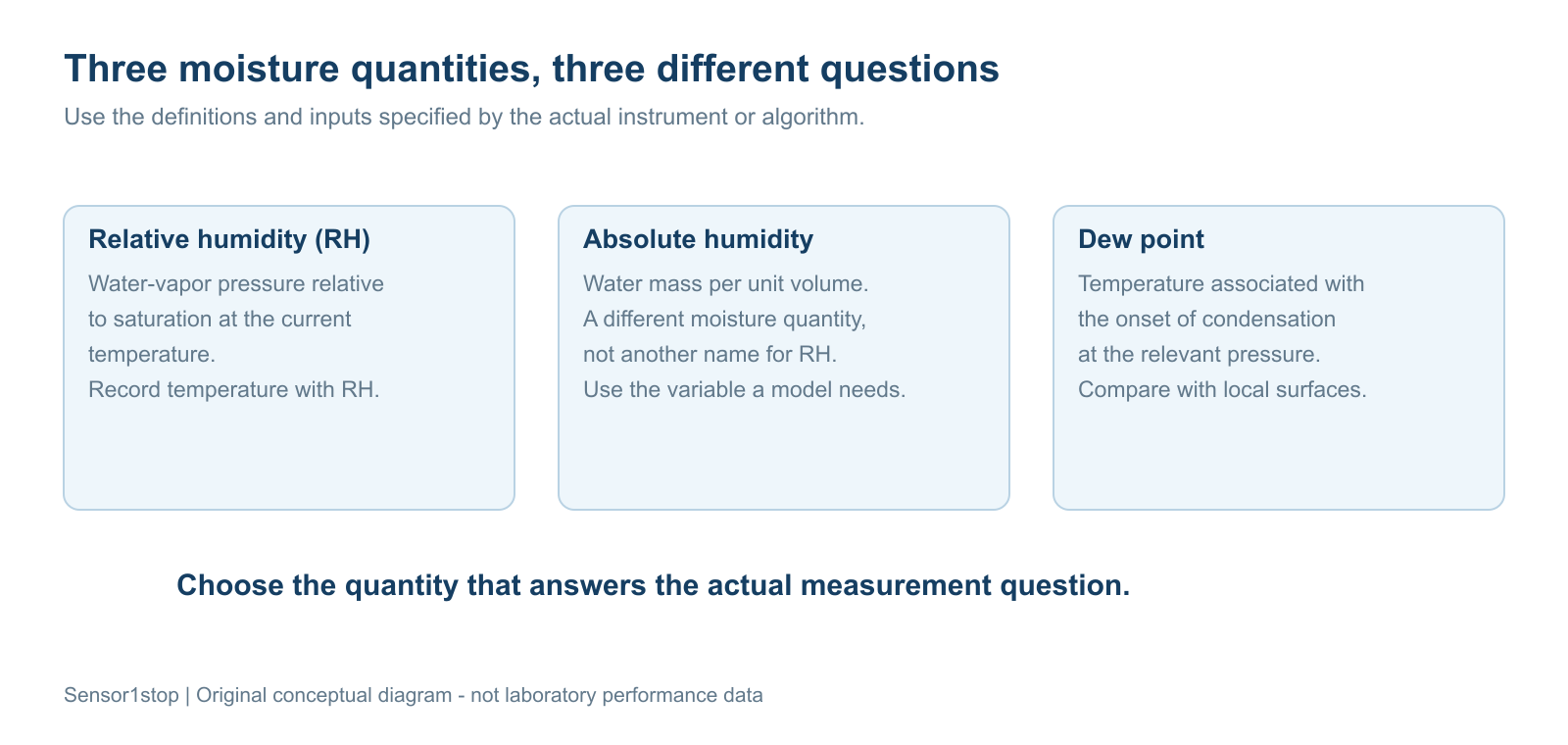
Kelembaban relatif menggambarkan bagaimana tekanan parsial uap air dibandingkan dengan tekanan uap jenuh pada suhu saat ini. Kelembaban absolut menyatakan massa air per satuan volume gas. Titik embun mengidentifikasi suhu di mana kondensasi dimulai pada kondisi tekanan yang relevan. Vaisala mendokumentasikan ini sebagai besaran pengukuran yang berbeda di dalamnya definisi parameter kelembaban.
Untuk pekerjaan penginderaan gas, pilihannya penting:
- Kelembaban dan suhu relatif help describe the environment used in many sensor specifications and compensation interfaces.
- Water concentration or absolute humidity can be relevant when comparing conditions with different temperatures or specifying a particular correction model.
- Dew point and surface temperature help determine whether the sample path may encounter liquid water.
A statement such as “tested at 70% RH” is incomplete without its temperature and the rest of the test conditions. Two observations made at the same RH but different temperatures should not automatically be treated as the same moisture exposure.
Related background: relative humidity explained Dan the relationship between temperature and humidity.
Humidity Can Change Zero and Gas Response Separately
A useful simplified measurement model is:
Output = sensitivity × concentration + baseline
For a humidity-sensitive measurement chain, a conceptual extension is:
Y = S(H, T) × C + b(H, T)
Here, Y is output, C is the concentration represented by the chosen calibration basis, S is sensitivity, b is baseline, H denotes the humidity quantity used by the model, and T is temperature. This is an explanatory model, not a ready-made correction equation for a commercial sensor. Nonlinear instruments may need a different description.
It illustrates two separate questions:
- Does the output change when the target-gas condition used as the baseline is held fixed?
- Does the response to a known gas concentration change when the environment changes?
A zero adjustment alone does not establish that the span or slope is correct. Likewise, one gas challenge at one environmental condition does not prove that the baseline behaves correctly elsewhere. A useful test report states what was held constant, which output was recorded and which conditions were validated.
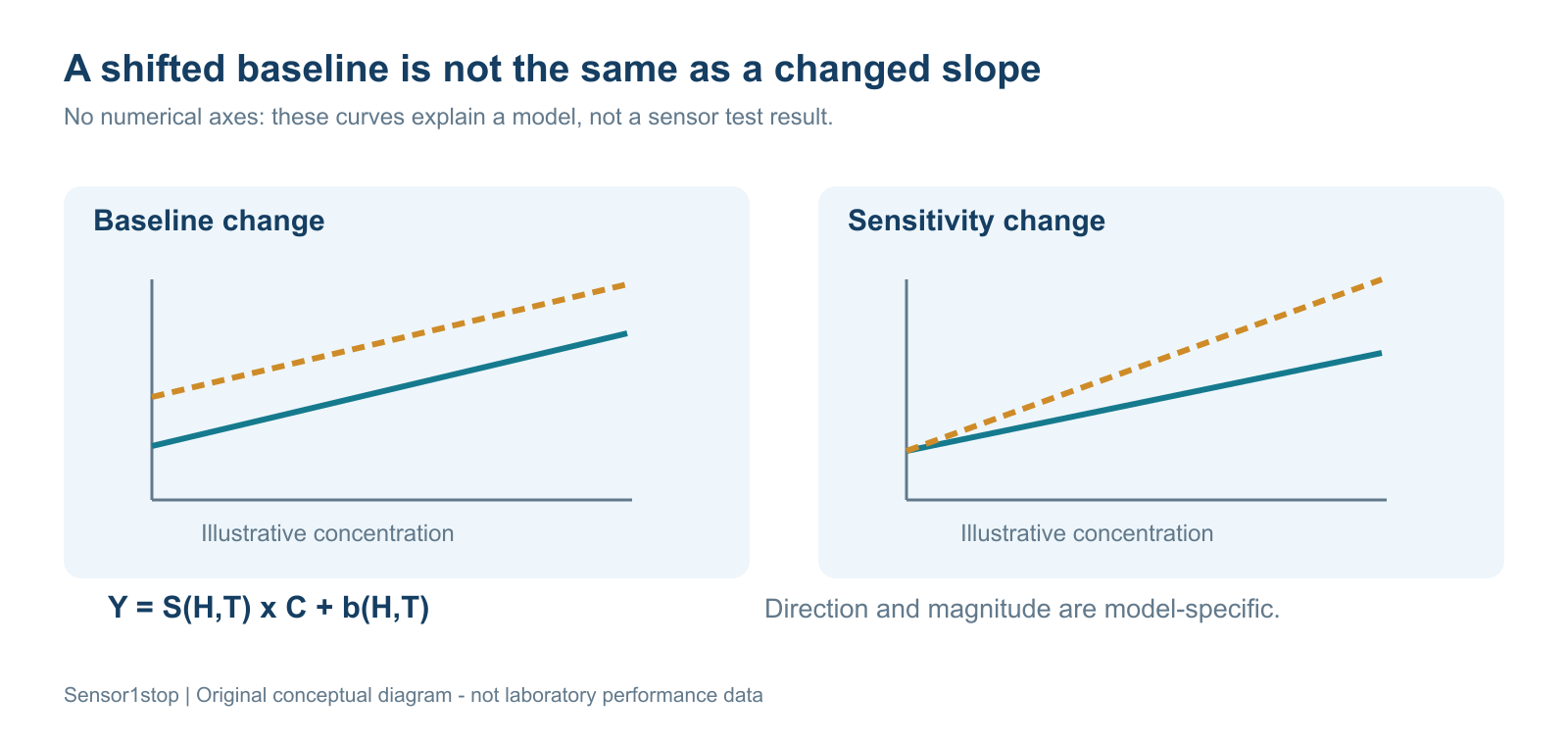
Conceptual curves only. They are not measured data and do not establish the direction or magnitude of any particular sensor's humidity dependence.
Transisi Kelembapan yang Cepat Bukanlah Tren Jangka Panjang
Bandingkan instrumen yang telah mengalami keseimbangan dalam lingkungan stabil dengan instrumen yang baru saja mengalami perubahan kelembapan mendadak. Mereka belum tentu menjalani kondisi pengukuran yang sama.
Dalam catatan aplikasi AAN 110, Alphasense menjelaskan arus transien selama tahap kelembapan untuk sensor elektrokimia yang dibahas, termasuk contoh sensor NO₂. Pengamatan tersebut mendukung perlakuan terhadap perilaku transisi secara terpisah dari perilaku menetap; ia tidak memberikan waktu pemulihan universal atau kurva kompensasi untuk setiap instrumen. Melihat Alfasense AKTIF 110.
For investigation, record the change itself rather than just the before-and-after humidity. Note when the instrument was moved, whether its enclosure was colder than the new environment, whether the sample line changed, and whether its prescribed warm-up or stabilization conditions were met.
A repeatable environmental response, a temporary transition effect and persistent penyimpangan sensor require different interpretations. Do not reset a safety-critical reading merely because it correlates with an RH change.
Electrochemical Sensors: Ask About Transition and Exposure Conditions
For an electrochemical detector, the practical review should distinguish temporary output behavior from the manufacturer's permitted operating and storage conditions. A brief transition test is not a substitute for exposure qualification, and a room-condition calibration does not describe every installation.
Questions to ask when reading the actual sensor and instrument documentation include:
- What humidity range is specified, and is it explicitly non-condensing?
- Is the range associated with continuous operation, short exposure, storage or transport?
- Are transient responses characterized separately from settled readings?
- Does the complete detector apply corrections beyond the bare sensor output?
- What does the manufacturer require after an exposure outside the stated conditions?
These questions are an engineering review checklist, not instructions for recalibrating every electrochemical cell in the same way. An instrument may use a sensor-specific circuit, correction scheme and service procedure. Conclusions from a different target gas or sensor family should remain separate.
MOS Sensors: Read the Reference Conditions Behind Resistance Ratios
Metal-oxide sensor output can depend on the surrounding humidity as well as the target gas. Figaro's TGS2600 product information provides temperature/humidity dependency curves and defines the reference resistance used in those curves. That is a useful example of why a resistance ratio must be interpreted with its reference conditions. See Figaro TGS2600 product information.
Pertanyaan tinjauan desain bukan hanya apakah kurva itu ada. Tanyakan apakah hal tersebut menggambarkan hambatan udara bersih, respons terhadap gas tertentu, perilaku tipikal, atau jaminan toleransi. Kurva lingkungan yang khas tidak secara otomatis merupakan fungsi koreksi konsentrasi.
Untuk modul atau monitor VOC lengkap, tanyakan juga di mana resistansi mentah menjadi indeks yang diproses atau perkiraan konsentrasi. Perubahan dalam indeks yang dilaporkan tidak dapat diinterpretasikan persis seperti perubahan resistensi mentah kecuali hubungan pemrosesannya dipahami. Perbedaan tersebut sangat berguna ketika membandingkan dua perangkat yang layarnya menggunakan kuantitas berbeda.
Contoh Terdokumentasi: Kompensasi Kelembapan Memerlukan Masukan yang Valid
Sensirion's SGP40 documentation describes humidity compensation that uses temperature and RH values supplied with the measurement command. It also explains the behavior when default input values are used and shows a compensation-optimized environmental region distinct from other specified conditions. See the Lembar data SGP40, bagian 2.3 dan 3.1.
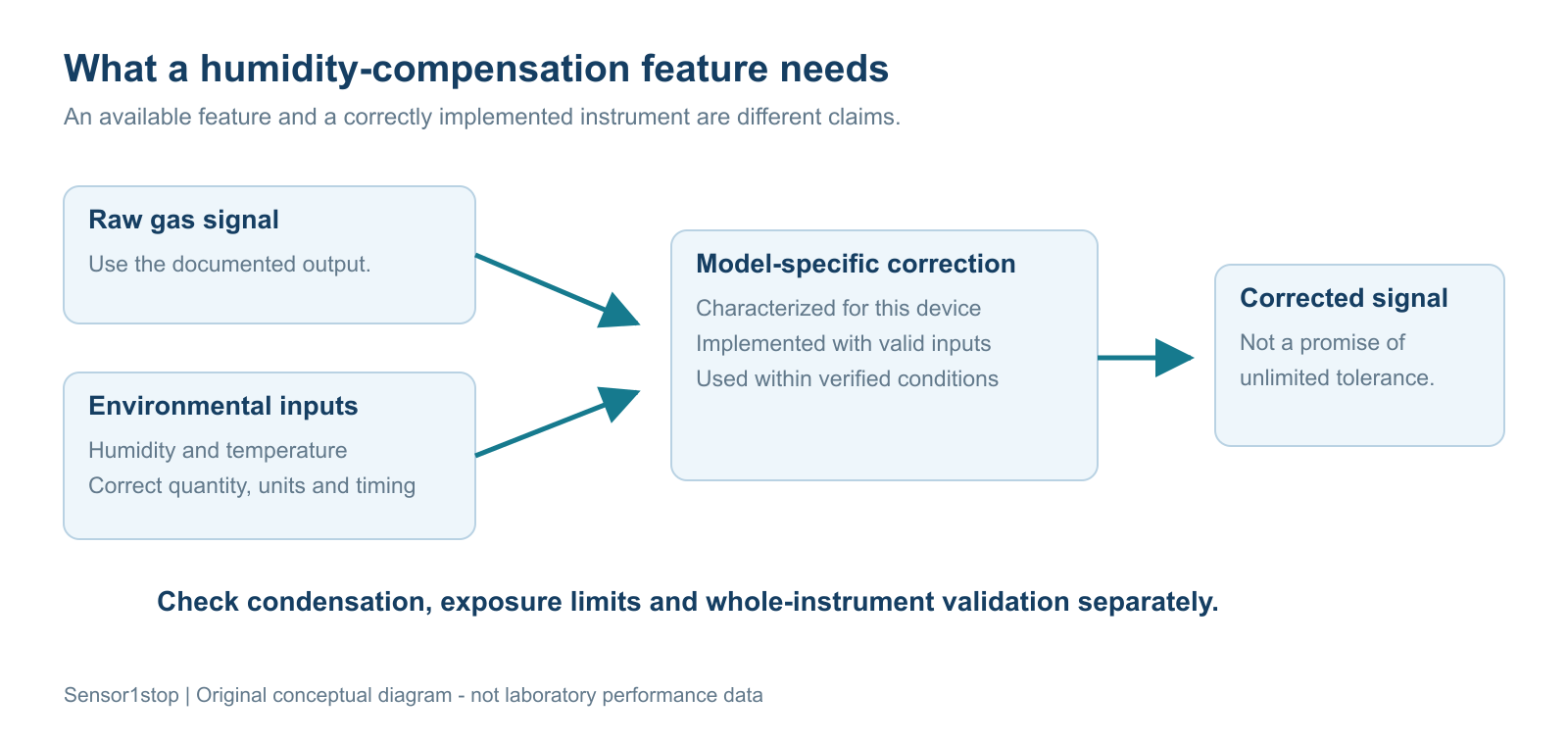
Pelajaran untuk membaca spesifikasi modul bersifat spesifik: kehadiran fitur kompensasi tidak menentukan bahwa instrumen tertentu yang telah selesai menyediakan input yang diperlukan dengan benar. Penerapan tersebut harus didokumentasikan atau diverifikasi untuk perangkat sebenarnya.
Gunakan contoh ini untuk membentuk pertanyaan, bukan untuk menyimpulkan cara kerja produk yang tidak terkait. Periksa masukan lingkungan, unit, jalur pembaruan, kondisi validitas yang dinyatakan, dan tahap pemrosesan yang memerlukan koreksi. Sinyal yang dikoreksi dan Indeks VOC yang dihitung selanjutnya merupakan keluaran yang berbeda dalam rantai pengukuran.
Sensor NDIR CO₂: Non-Kondensasi Adalah Kualifikasi Nyata
Penggunaan teknologi penginderaan optik tidak menghilangkan kebutuhan untuk memeriksa kondisi kelembapan. Lembar data Sensirion SCD30, misalnya, menentukan kondisi pengoperasian kelembaban sensor CO₂ pada 0–95% RH tanpa kondensasi. Ini adalah kualifikasi untuk sensor tersebut, bukan peringkat untuk setiap monitor yang dirakit. Lihat Lembar data SCD30, kondisi pengoperasian.
For instrument selection, keep the sensor specification and the complete equipment specification in separate columns. The enclosure, inlet, sampling arrangement and electronics may have different requirements. A module's listed RH range should not be copied into an instrument specification without confirming the assembled system's validation.
Also distinguish environmental tolerance from accuracy conditions. A device may have an operating range, a more specific set of performance conditions and a service procedure. The strongest selection comparison uses the same kind of specification on both sides rather than comparing one product's operating limit with another product's accuracy test condition.
PID Instruments: Do Not Assume a Universal Humidity Correction
ION Science's technical article on PID operation discusses humidity-related suppression of response, contamination-associated high readings, and design measures used in its own instruments. It makes clear that the sensor design and condition matter. The manufacturer's account should not be read as proof that every PID is affected identically or that one advertised design solves every condensing sample. See Artikel teknis ION Science TA-01, pembahasan kelembaban.
Untuk detektor VOC portabel atau tetap, tanyakan spesifikasi gangguan kelembaban, kondisi pemeliharaan, dan lingkungan sampel yang diizinkan. Perhatikan apakah kinerja yang diklaim mengacu pada sensor yang bersih, instrumen yang lengkap, gas uji tertentu, atau riwayat paparan tertentu. Hindari penggunaan faktor koreksi yang diambil dari model berbeda hanya karena kedua produk menggunakan teknologi PID.
Pengenceran Uap Air Belum Tentu Terjadi Kesalahan Sensor
Jika uap air ditambahkan ke dalam campuran gas, ia menjadi bagian dari campuran yang digunakan sebagai penyebut mol dasar basah atau fraksi volume. Oleh karena itu, pecahan yang dilaporkan dari komponen lain dapat berubah meskipun instrumen merespons dengan benar terhadap apa yang sebenarnya mencapainya.
For an idealized mixture, let x₍dry₎ be a component's fraction excluding water and x₍H₂O₎ the water-vapor fraction in the wet mixture. The relationship is:
x₍basah₎ = x₍kering₎ × (1 − x₍H₂O₎)
Ini mengikuti langsung definisi kedua penyebut tersebut. Ini bukan formula kompensasi kelembaban pabrikan dan tidak boleh diterapkan pada kuantitas tampilan yang tidak diketahui.
Sebagai contoh ilustrasi aritmatika, 1.000 ppm pada basis kering dan campuran basah yang mengandung 2% air akan sama dengan 980 ppm pada basis basah berdasarkan asumsi yang disebutkan. Ini adalah nilai contoh yang ditemukan, bukan pengukuran, kondisi lingkungan yang direkomendasikan, atau toleransi sensor.
Before interpreting a difference, ask which reporting basis each instrument or reference uses and whether the sample was dried or otherwise conditioned. Alphasense separately notes water-vapor dilution when discussing oxygen-sensor readings in its sensor FAQs. A real composition change and an instrument interference effect should not be merged into one label.
Condensation Is Different From High Humidity
A non-condensing RH specification does not mean that liquid water is acceptable at the sensor. Condensation depends on the conditions at the relevant surface, not just an RH value measured somewhere else in the room. Vaisala explains the role of dew point in its humidity, dew point and moisture overview.
Saluran masuk, tabung sampel, atau ruang optik yang lebih dingin dibandingkan sampel di sekitarnya dapat menunjukkan kondisi lokal yang berbeda dari pengukuran ambien yang dicatat. Inilah sebabnya mengapa tinjauan kelembapan harus mencakup di mana suhu dan kelembapan diukur dan bagian mana dari jalur pengambilan sampel yang mungkin lebih dingin.
Treat suspected liquid-water exposure as an instrument-condition issue. Follow the manufacturer's inspection, recovery and service instructions rather than assuming that a software correction can restore a valid measurement. Whether a device is suitable for a condensing environment must be established for that device and configuration.
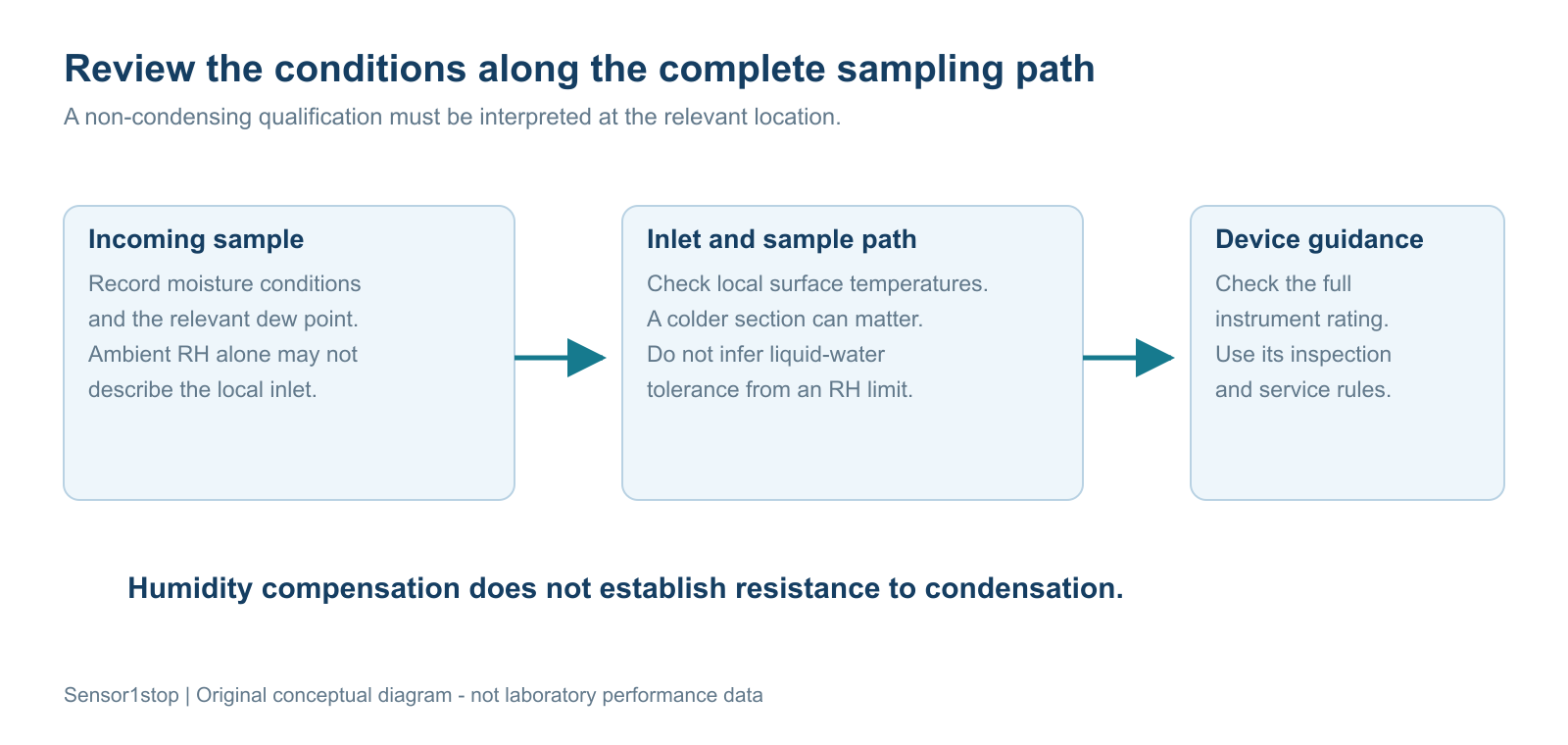
Tinjauan instalasi konseptual. Tidak ada batasan suhu universal atau desain pelindung yang ditentukan.
Kompensasi, Pengkondisian dan Perlindungan Memecahkan Berbagai Masalah
Sebaiknya tanyakan kepada pemasok, manakah dari tiga pendekatan yang digunakan perangkat:
| Mendekati | Peran yang dimaksudkan | Batasan untuk diperiksa |
|---|---|---|
| Kompensasi sinyal | Sesuaikan ketergantungan lingkungan yang berkarakter dengan menggunakan input yang valid | Rentang validitas, akurasi masukan, dan verifikasi khusus model |
| Pengkondisian sampel | Ubah kondisi sampel sebelum pengukuran | Apakah komposisi target gas atau dasar pelaporan diubah |
| Perlindungan fisik | Kelola masuknya atau paparan dalam desain instrumen | Kualifikasi seluruh instrumen dan persyaratan pemeliharaan |
These are review categories, not interchangeable guarantees. A water-resistant enclosure does not establish immunity to water-vapor interference. A correction algorithm does not establish resistance to condensation. A conditioned sample needs to be interpreted on the documented basis.
A useful purchase question is: “Which problem is this feature intended to solve, and where is that performance demonstrated?” It is more informative than accepting a general description such as “humidity resistant” without its conditions.
What to Record When Investigating an Unexpected Reading
Berikut ini adalah daftar periksa dokumentasi untuk evaluasi non-darurat. Ini bukan prosedur untuk mematikan alarm, dengan sengaja memaparkan detektor ke gas berbahaya, atau memulihkan perangkat yang penting bagi keselamatan agar dapat digunakan.
| Bidang | Catat atau periksa |
|---|---|
| Identitas perangkat | Model, konfigurasi sensor, firmware, dan versi manual yang relevan |
| Keluaran | Tampilkan kuantitas, unit, sinyal mentah jika tersedia dan pengaturan pemfilteran |
| Lingkungan | Suhu, RH, lokasi pengukuran dan waktu |
| Transisi | Ketika lingkungan berubah, cara perangkat dipindahkan, dan apa saja yang berubah |
| Jalur sampel | Inlet, tubing, filter, pengaturan aliran dan pengkondisian yang diketahui |
| Status instrumen | Pemanasan, riwayat perawatan, catatan kalibrasi, dan peringatan paparan apa pun |
| Referensi | Metode perbandingan yang sesuai dan terdokumentasi serta dasar pengukuran yang cocok |
Record an event timeline. A note saying “the gas value changed in humid weather” is much less useful than synchronized observations of the gas output, temperature, RH, relocation and device state.
Where repeatable evaluation is appropriate, distinguish changes in the environmental inputs from changes in the target-gas condition. The test design should be approved for the actual instrument and application. A device-to-device disagreement by itself does not identify which device is correct.
How to Compare Gas Detectors for a Humid Application
Start with a description of the measurement task, not a preferred sensor family. A handheld instrument moved between environments, a fixed monitor in an equipment room and a sample-pumped analyzer may need different evidence even when they report the same target gas.
Ask each supplier the same questions:
- Is the humidity rating for the sensor element or the complete instrument?
- Which conditions apply to accuracy, operation, storage and transport?
- Does the humidity specification exclude condensation?
- How is a rapid environmental transition handled and characterized?
- What environmental measurements are used by compensation, if any?
- What maintenance or recovery instructions apply after moisture exposure?
- Has the configuration been validated for the intended sample and reporting basis?
Put the answers and their document references in a comparison table. Use “not provided” for missing information. An unspecified condition is not evidence of unlimited tolerance, and a long feature list is not a substitute for a relevant test report.
Common Interpretation Mistakes
Calling Every Correlated Change Drift
An RH change and a gas-reading change occurring together identify a correlation, not a complete cause. Consider measurement response, actual sample change, environmental transition and device condition before selecting an explanation.
Assuming High Humidity Always Raises the Reading
The sign of the effect is not universal. Avoid describing an increase or decrease as a rule across technologies, gases and sensor models. A processed display can also behave differently from its raw input.
Comparing RH Numbers Without Temperature
Write both conditions and the relevant measurement location. A single room RH number does not fully describe the sample reaching the sensor or the conditions at a colder inlet.
Treating Operating Limits as Accuracy Guarantees
Keep permitted operation separate from stated performance conditions and compensation validity. Check how the manufacturer defines each before comparing products.
Assuming Compensation Repairs Moisture Damage
Koreksi, kualifikasi paparan, dan pemulihan layanan adalah pertanyaan yang berbeda. Ikuti dokumentasi instrumen setelah paparan di luar kondisi yang divalidasi.
Pertanyaan yang sering diajukan
Apakah kelembapan mempengaruhi semua sensor gas dengan cara yang sama?
Tidak. Perilaku lingkungan harus diperiksa untuk sensor dan instrumen tertentu. Teknologi penginderaan adalah titik awal untuk mengajukan pertanyaan, bukan aturan koreksi universal.
Bisakah kelembapan menghasilkan pembacaan gas sementara?
Beberapa kelompok sensor menunjukkan respons transisi lingkungan, seperti yang diilustrasikan oleh catatan aplikasi Alphasense. Apakah hal tersebut menjelaskan pembacaan tertentu memerlukan dokumentasi perangkat dan bukti lainnya; ini bukan alasan untuk mengabaikan alarm yang sebenarnya.
Haruskah saya menggunakan kelembapan relatif atau kelembapan absolut sebagai kompensasi?
Gunakan kuantitas dan kondisi yang ditentukan oleh algoritma atau pabrikan sebenarnya. Jangan mengganti satu variabel kelembapan dengan variabel lainnya tanpa konversi dan validasi yang diperlukan.
Mengapa mencatat suhu dan kelembapan?
Ini membantu menggambarkan kondisi di balik nilai RH dan hubungan antara lingkungan, jalur sampel, dan titik embun. Catat di mana pengukuran dilakukan serta nilainya.
Apakah monitor NDIR CO₂ tahan terhadap kondensasi?
Do not infer that from NDIR technology or a high listed RH limit. Check the whole instrument's documentation. The SCD30 example cited here explicitly uses a non-condensing qualification.
Apakah PID yang tahan kelembapan sama sekali tidak terpengaruh oleh kelembapan?
Read the particular design claim and its test conditions. Vapor interference, contamination and liquid-water exposure are distinct issues; one feature description does not establish immunity to all three.
Can software compensation replace calibration?
They have different roles. Compensation addresses a characterized environmental dependence; calibration establishes the measurement relationship under defined conditions. Use the instrument manufacturer's required procedures.
Should a gas monitor be recalibrated whenever humidity changes?
There is no universal rule. Follow the actual device's calibration and service instructions, and investigate unexpected readings with the necessary environmental and instrument records.
Can a dryer or filter be added to any sampling line?
Asumsi seperti itu tidak boleh dibuat. Konfigurasi pengambilan sampel yang lengkap memerlukan validasi untuk gas target, respons yang diperlukan, dan dasar pelaporan. Tanyakan kepada produsen bagaimana pengondisian yang diusulkan mempengaruhi pengukuran.
Apa pemeriksaan pertama yang paling berguna?
Identifikasi perangkat yang tepat, kuantitas yang ditampilkan, dan spesifikasi lingkungan yang berlaku. Kemudian bandingkan kondisi tersebut dengan catatan peristiwa. Ini lebih dapat diandalkan daripada menerapkan koefisien kelembapan umum yang ditemukan untuk sensor lain.
Kesimpulan Praktis
Perlakukan kelembapan sebagai bagian dari pertanyaan pengukuran lengkap: apa yang mencapai sensor, bagaimana rantai pengukuran merespons, dan apakah instrumen tetap berada dalam kondisi tervalidasi.
For OEM design, that means model-specific inputs, characterization and system qualification. For detector selection, it means comparing whole-instrument evidence and documented conditions. For troubleshooting, it means preserving an event record rather than changing settings until a number looks familiar.
References and Further Reading
- Alphasense AAN 110 — Environmental Changes: Temperature, Pressure, Humidity — model-specific environmental transition examples.
- Alphasense sensor FAQs — oxygen measurement, water-vapor dilution and sensor-specific guidance.
- Figaro TGS2600 product information — resistance reference and temperature/humidity dependency example.
- Sensirion SGP40 datasheet — compensation inputs and environmental validity conditions.
- Sensirion SCD30 datasheet — kondisi pengoperasian non-kondensasi untuk sensor CO₂ yang disebutkan.
- ION Science TA-01 — Apa itu PID? — diskusi kelembaban dan kontaminasi untuk teknologi PID.
- Definisi parameter kelembaban Vaisala — definisi RH, kelembapan absolut, dan titik embun.
- Kelembapan Vaisala, titik embun dan ikhtisar kelembapan — memilih dan membedakan kuantitas kelembaban.
Sensor CO2 vs Sensor VOC: Penjelasan CO2 Langsung, eCO2 dan TVOC
Bandingkan pengukuran CO2 langsung dengan sinyal VOC, perkiraan eCO2, dan keluaran TVOC. Pelajari apa yang diukur setiap saluran dan cara memverifikasi monitor kualitas udara.
Baca selengkapnya
CO2 ppm Arti: Persen Konversi dan Rentang Sensor
Pahami ppm CO2, fraksi mol dan volume, konversi ppm ke persen, dasar pelaporan basah dan kering, serta apa yang ditentukan dan tidak ditentukan oleh rentang sensor.
Baca selengkapnya
Pengukuran CO2: Metode, Pemilihan Sensor, dan Pembacaan yang Andal
Pilih metode dan instrumen pengukuran CO2 untuk udara ruangan, sampel proses, atau deteksi gas. Bandingkan rentang, pengambilan sampel, kalibrasi, dan catatan data yang berguna.
Baca selengkapnya
Cara Membaca Spesifikasi Akurasi Monitor CO2
Baca spesifikasi akurasi monitor CO2 dengan benar: hitung ppm ditambah persentase pembacaan, bedakan kesalahan dan resolusi skala penuh, dan bandingkan kondisi pengoperasian.
Baca selengkapnya


Komentar (2)
[…] related guide to humidity effects on gas sensor readings separates composition changes from sensor response and […]
[…] separate water-vapor effects from condensation. See humidity effects on gas sensor readings for the relevant measurement […]