

Put a classroom CO₂ monitor where it can sample the air that pupils and staff generally occupy, and record exactly where it is. In a typical classroom, the UK Department for Education's ventilation guidance recommends a nondispersive infrared (NDIR) monitor at roughly seated head or table height, away from doors, windows and ventilation outlets, and at least 0.5 m from people. That is a useful starting point, not a universal mounting specification or a guarantee that one reading represents every desk. A good position also has a clear purpose, an unobstructed inlet, safe mounting and a repeatable way to check that its readings make sense during occupied lessons.
The position matters because a classroom is not a perfectly mixed box. A student exhales a short-lived plume. A window can produce a stream of incoming or outgoing air. A supply diffuser, radiator, corridor door and densely occupied corner can all produce local conditions. Moving the same instrument by a few metres may change the displayed value without any change in the building's ventilation plant. Placement is therefore part of the measurement method, not a decoration chosen after the purchase order.
This guide is for teachers, facilities staff and school leaders establishing routine ventilation observations. It does not replace the local building code, a commissioned ventilation test or a specialist assessment. If a formal compliance decision is needed, the school should use the specified local measurement method and a competent practitioner. For the meaning of the resulting number, see our guide to interpreting classroom CO₂ readings.
Define the question before picking a wall
Ask what decision the monitor will support. A teacher may need an immediate indication that a room has become stuffy during a lesson. A facilities team may compare the same classroom across similar days before and after a schedule change. A district may screen several classrooms to decide where to investigate further. These jobs can use the same type of direct CO₂ monitor, but they do not necessarily use the same sampling plan or report.
Write a one-sentence purpose for each device: observe the trend during occupied lessons in Room 12, for example. Record whether the unit is fixed or rotates among rooms, whether staff will read the display or review a time-series log, and who responds to recurring readings under the applicable school guidance. A portable display placed on a teacher's desk is easy to see but can be moved without documentation. A fixed unit preserves a consistent position but may hide behind a new cabinet or become inaccessible for maintenance. Neither format solves the placement question by itself.
The displayed channel should be a direct CO₂ measurement suitable for this use, rather than an “eCO₂” estimate derived from volatile organic compound response. Read the finished monitor's manual for its inlet, measurement method, warm-up, logging interval and calibration method. The DfE calls out NDIR technology as an effective choice. A separate direct CO₂ versus eCO₂ explanation is useful when checking a product description. Do not assume that a product marketed as an “air quality monitor” measures CO₂ at all.
Select rooms deliberately
Start with rooms that are occupied for sustained periods and where a ventilation observation could change a real decision. The Welsh Government's education-setting guidance describes the use of CO₂ monitors to identify poorly ventilated occupied spaces and suggests moving devices between spaces when appropriate. A timetable, room capacity and complaint history can help prioritize a limited number of instruments. Document the reasons for selecting a room so that staff do not interpret a monitored subset as a complete survey of the school.
| Space | Useful first question | Sampling caution |
|---|---|---|
| Standard occupied classroom | Does a recurring lesson-time pattern suggest that outdoor air provision needs checking? | Note class size, lesson length and the position of the inlet. |
| Small group room | Does a short, densely occupied session produce a repeatable trend? | A monitor very close to one person can exaggerate the room reading. |
| Large or irregular teaching space | Are conditions different in occupied subareas? | One point may be especially unrepresentative; assess the air paths and test multiple points. |
| Laboratory or workshop | Does routine use create a ventilation concern? | CO₂ does not measure process gases, fumes or chemical exposures; use the required specialist controls. |
| Corridor, stairwell or transient lobby | Is a particular air-transfer question being investigated? | A transit reading is usually a weak proxy for a classroom's occupied ventilation. |
| Unoccupied room | What is the starting or background condition? | It does not describe the room under teaching load. |
Rooms with unusual activity, moisture or chemical sources may require an IAQ investigation beyond CO₂. Do not let a convenient display substitute for inspection of dampness, combustion appliances, cleaning products, filtration or outdoor pollution. The US EPA's school IAQ reference guide organizes those issues alongside ventilation, rather than reducing them to one gas.

The school-plan image is only an illustration of prioritization; it is not a measured ventilation map. A real room list needs IDs and actual building-zone information. If units rotate, keep a deployment register so that a chart from one room is never assigned to another after a device has moved.
Make a simple air-path sketch
Before choosing a spot, walk the room while it is used normally. Locate openable windows, external doors, corridor doors, mechanical supply and return openings, fan units and any spaces where people cluster. Identify the normal student seating pattern, teacher position and likely obstructions. Ask how those conditions change across the day. The preferred position samples broadly representative occupied air, not a local jet or one person's breath.
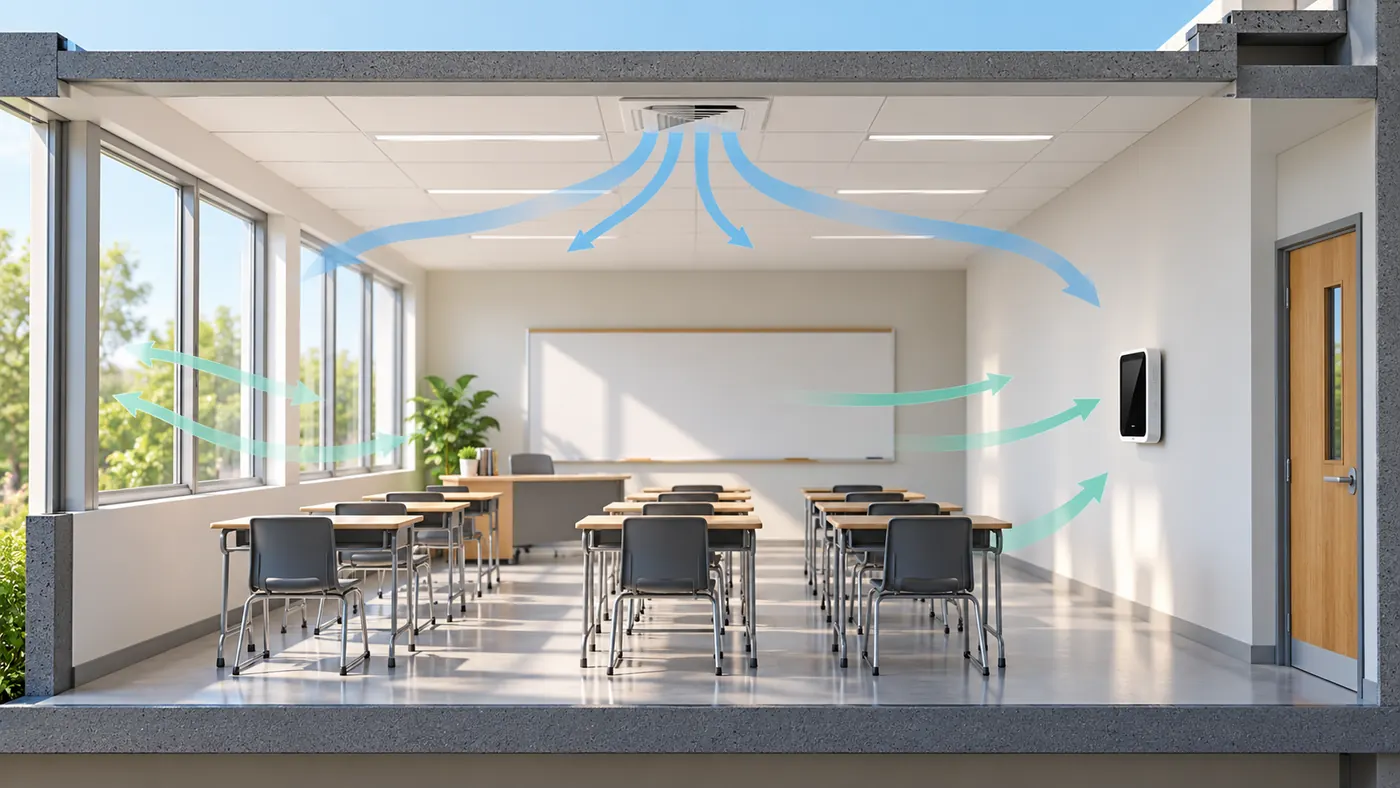
The blue paths in the image indicate possible movements of air; actual direction, speed and mixing must be observed or measured in the room. A window is not always an inlet, and an open corridor door is not necessarily outdoor air. Mechanical ventilation may change mode by schedule or occupancy. A ceiling fan can mix air without delivering outdoor air. These distinctions matter if a monitor is intended to evaluate a change to a ventilation strategy.
IL UK Health and Safety Executive's CO₂-monitoring advice cautions against positions beside windows, doors and ventilation openings and against placing units close to people. A monitor in a supply-air jet may report lower CO₂ than the occupied zone, while a monitor directly in an exhaled plume may report higher. Neither local extreme is an honest summary of the room. If the only available power socket is in such a location, use a suitable battery-powered unit or arrange a safe installation instead of accepting a visibly biased position without documenting it.
Use the occupied breathing zone as the starting reference
For an ordinary classroom of seated pupils, table or seated head height is a practical starting height in the DfE guidance for England. It puts the inlet near the air people actually use while avoiding the ceiling, floor and a local supply jet. The guidance also says to keep the unit at least 0.5 m from people. This specific distance belongs to that guidance and should not be silently turned into a world-wide technical law. The same document advises keeping the instrument away from doors, windows and ventilation outlets.
What counts as “away” must be judged in the actual room. A position can meet a tape-measure distance yet still sit directly in a window draft or under a high-velocity diffuser. Conversely, a wall unit may be useful if it is near the occupied area, unobstructed and checked against a second position. Read the manufacturer's installation instructions for clearance and orientation around the inlet. A display behind curtains, under a shelf or inside a closed display case measures the microenvironment of that obstruction. A unit at arm's length from the nearest desk can be safer from tampering, but the staff must still be able to see or retrieve its data.
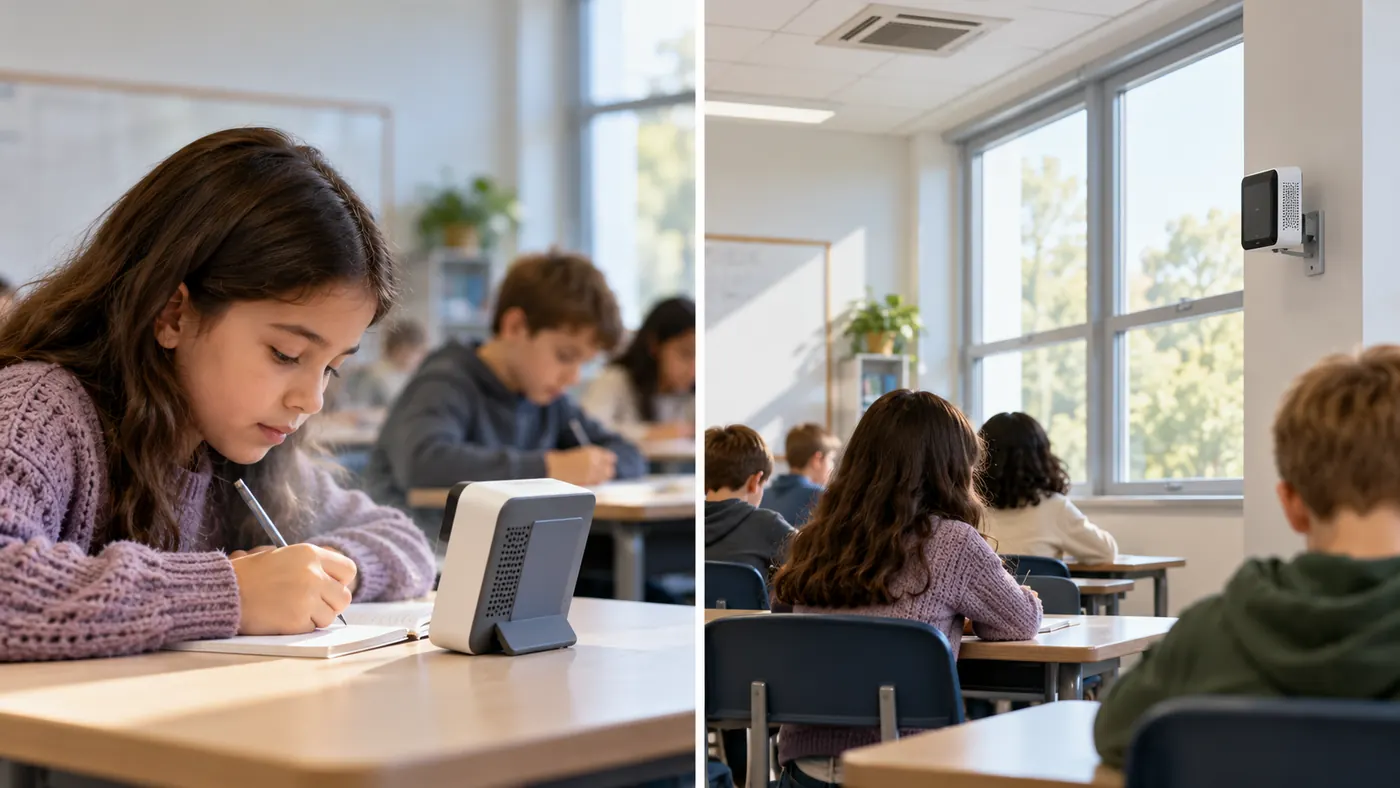
The breath plume in the illustration explains a local sampling error, not a fixed plume size. People move and talk. If a unit is used on a table, note whether a pupil routinely sits close to it. If a wall location is chosen, record the inlet height and distance from nearby seats, window and outlet. Take a photograph for the school's internal facilities record if permitted, but a public article does not need a classroom photograph or pupil image.
Situations that deserve extra care
A very high ceiling, partitioned layout or long narrow room can produce a spatial pattern that a single point hides. Natural ventilation often changes with wind and window position. An original field study of naturally ventilated classrooms investigated spatial CO₂ differences; its lesson for practice is to examine whether the particular room is sufficiently represented, not to copy one “best” wall position into every building. A monitor near a teacher's desk may represent that area well while missing a densely occupied back corner. A classroom adjacent to a busy road may also have a trade-off between opening windows and outdoor pollution that CO₂ alone cannot settle.
Portable HEPA cleaners are another source of confusion. A particle filter may change air movement and particle levels, but it generally does not remove CO₂ or provide outdoor air. Do not put the CO₂ inlet in a cleaner's discharge stream and then treat a falling or unchanged number as proof that the cleaner is working or failing. Our air purifiers and CO₂ guide separates the two measurement questions.
Treat “one per classroom” as an initial sampling plan
One unit can be useful in a typical room; it cannot prove that every location has the same concentration. The DfE's suggestion of one device for a typical classroom is a manageable starting point. An unusual room may require a second location, a temporary rotation or a specialist assessment. The ASHRAE position document on indoor CO₂ describes sensor location and measurement quality as conditions for interpreting a reading. It also cautions against converting a CO₂ number into a universal IAQ verdict.
A practical placement trial can answer whether the chosen point is adequate for the school's purpose:
- Establish a candidate position using the guidance above and record a rough room sketch.
- During a comparable occupied period, take readings or log data at that position and at one or two other plausible occupied-zone positions. Use the same instrument sequentially only if occupancy and ventilation are stable enough for comparison; otherwise use suitable instruments simultaneously.
- Note time, head count, open windows and doors, system mode and any movement of the units. A quick spot reading immediately after moving a device may still reflect its previous location and response time.
- Compare the time-series shape and any persistent difference, not just one maximum. If a large difference changes the intended decision, retain more than one location or get a qualified assessment.
- Choose and document the final position. Recheck it when the room layout or ventilation arrangement changes.
There is no universal numerical tolerance for two positions in this informal screen. Instrument uncertainty, response time and the room's dynamics must be considered before deciding whether a difference is meaningful. A school cannot use a casual five-minute walk-around as a formal proof of outdoor-air flow. The point is to reveal obvious local bias before a dashboard turns one sensor into an authoritative room label.
Check the instruments before comparing positions
Two instruments placed side by side in the same air should normally show broadly consistent behavior within their stated specifications. This is a co-location check, not a field calibration or certification. Allow both instruments to warm up as required, place their inlets in similar air without blocking each other, synchronize clocks and review readings over enough time to see their trend. If they disagree substantially, do not assume that two positions in the classroom caused the difference. Review the product's accuracy statement, service history, automatic baseline settings, calibration instructions and data-processing intervals.

IL Guida alle specifiche sulla precisione del monitor CO₂ explains why a display that increments by one ppm may still have a much larger measurement uncertainty. A direct CO₂ channel can also drift or behave poorly when its baseline-correction assumptions are wrong for a space. Do not reset or recalibrate equipment merely to make two screens match. Follow the manufacturer's procedure, document what was done and seek support if a discrepancy persists. For networked devices, ensure the time zone and clock are correct before comparing logs.
If several school rooms are assessed with different models, an apparent room ranking can reflect instrument differences. Co-locate them first, note model and serial number, and where possible rotate devices deliberately to see whether the pattern follows the room or the device. The office-zone comparison method describes the same principle for other occupied buildings.
Install for everyday school use
The final position must be safe and sustainable. Follow the manufacturer's mounting instructions and the school's electrical, fire and safeguarding policies. Secure a fixed unit so that it cannot fall or obstruct movement. Route power and data cables safely. Do not wedge a fire door open, change a controlled HVAC setting or place a unit where its maintenance would expose staff or pupils to a hazard. If the monitor has a display for teachers, make it readable without inviting frequent handling that changes the sample. If it is a logger, ensure authorized staff can actually retrieve and interpret the time series.
Give every installation a simple record: room ID; device make, model and serial number; CO₂ measurement method; inlet height; exact wall or table position; nearby openings; installation date; logging interval; time zone; calibration or verification status; responsible owner; and a photo or sketch stored in the school's own system. Record changes as new versions, not by overwriting the original. A subsequent furniture move, new divider, sealed window or diffuser adjustment can make yesterday's representative point a poor one.
The device must be maintained. Check power, display and data transfer on a routine schedule. Review manufacturer recommendations for calibration, service and replacement. Identify who notices a flat-line chart, implausible value or long missing-data period. An unlabeled monitor that silently stops reporting can be more misleading than no monitor at all. Schools should also avoid public displays or reports that attach individual pupils to room readings; occupancy count and room context are usually enough for ventilation work.
A commissioning checklist
Before accepting the position, confirm the following with the person who will use the data:
| Check | What to record or demonstrate |
|---|---|
| Scopo | The room and decision the monitor supports. |
| Misurazione | Direct CO₂ method, product instructions and current service state. |
| Location | Inlet height, distance from regular seats, windows, doors and supply/return outlets. |
| Air path | Normal window, door and mechanical modes during lessons. |
| Accessibilità | Safe mounting, power, visibility or logging access and assigned owner. |
| Tempo | Correct clock, time zone, logging interval and occupancy schedule. |
| Cross-check | A co-location or spatial trial when the decision warrants one, with exceptions noted. |
| Follow-up | The local guidance/action process and date to review the placement. |
IL US EPA ventilation checklist for schools is a broader facilities companion. It asks staff to examine ventilation operations and maintenance instead of expecting a sensor alone to diagnose a system. The installation record should connect to the school's maintenance and IAQ process. If a particular reading becomes important, staff should be able to reconstruct where it came from and what the room was doing.
Common placement questions
Should the monitor go on the teacher's desk?
It may be a practical temporary location if the inlet is in representative occupied air, clear of the teacher's own breath and away from a window, supply jet or obstruction. A desk also makes accidental relocation easy. Mark the exact position and assess whether a fixed spot or logger would make comparisons more reliable. A desktop unit tucked under papers or behind a computer is a poor placement.
Is mounting at the ceiling better because warm air rises?
Not for routine seated classroom CO₂ observation. The reading should answer a question about occupied air, and the DfE's starting guidance points to seated head or table height. The actual vertical pattern depends on ventilation and room geometry. If a high-mounted building sensor is used for a control system, interpret it according to that system's design and commissioning rather than assuming it is interchangeable with a breathing-zone observation.
Can we put it next to the open window to see whether ventilation is working?
That might tell you about the local window stream, not the room's occupied air. Use a representative room position to observe the class, and separately document window status. If a formal study of the window's effect is required, compare occupied conditions carefully and consider other sampling positions. Opening a window can also change temperature, noise and outdoor pollutant exposure.
Should every classroom have two monitors?
Not automatically. A typical classroom may start with one suitable unit, as the DfE suggests. A complex geometry, unusual air path or high-stakes decision can justify additional points. Spend limited resources on reliable devices, sound placement, maintenance and meaningful follow-up before adding screens without a plan.
What if the reading changes after moving the unit?
Log the move with its time and new position. Allow for instrument response and a changed local air sample, then compare similar occupied periods. A change after moving does not prove that the room ventilation changed. If the difference persists and affects the decision, investigate spatial variation and instrument agreement.
Keep the placement linked to the decision
A useful classroom monitor is a documented observation point. It helps staff see patterns in occupied time and test whether a reasonable action has changed those patterns. It does not certify the whole room, measure every contaminant or identify the cause of a problem without supporting evidence. The best placement is one that can be defended from the room's occupancy and air paths, maintained safely, and revisited when conditions change.
For repeated readings, record the room, device, location, occupied period and ventilation state together. Those details allow a facilities team to distinguish a room change from an instrument move, a timetable change or a missing-data interval.
Fonti tecniche
- Dipartimento dell’Istruzione del Regno Unito: Ventilazione e qualità dell’aria negli ambienti educativi e di assistenza all’infanzia
- UK Health and Safety Executive: Using CO₂ monitors
- Governo gallese: monitoraggio del biossido di carbonio negli ambienti educativi
- ASHRAE: Documento di posizione sull'anidride carbonica indoor
- EPA statunitense: lista di controllo della ventilazione per le scuole
- Zhang and colleagues: field research on spatial CO₂ variation in naturally ventilated classrooms

Come interpretare le letture di CO2 nell'abitacolo di un veicolo
Leggi le tendenze della CO2 nell'abitacolo del veicolo insieme ai passeggeri, la modalità HVAC e le condizioni del percorso separando gli indizi sulla ventilazione dalle domande sulla sicurezza delle particelle e dei gas di scarico.
Per saperne di più
Monitoraggio delle stufe a gas domestiche: quale allarme e sensore fa cosa?
Comprendere i ruoli separati di un allarme di CO domestico, di un rilevatore di gas combustibile, di un monitor di CO2 e di un servizio di assistenza qualificato per il riscaldatore, compreso cosa fare dopo un avviso.
Per saperne di più
Come pianificare il monitoraggio IAQ negli spazi interni condivisi
Pianifica il monitoraggio della qualità dell'aria interna per biblioteche, aree di attesa e stanze condivise abbinando CO2, particelle e altri canali a una decisione definita.
Per saperne di più
Come costruire un registro di monitoraggio della IAQ scolastica che porti all'azione
Utilizza i registri delle stanze collegate, degli eventi occupati e dei problemi per trasformare le osservazioni della CO2 della scuola in un follow-up affidabile sulla ventilazione.
Per saperne di più
Come interpretare le letture di CO2 in classe per la ventilazione
Interpretare le letture di CO2 in classe come indizi di ventilazione occupata con contesto, guida locale, controlli di monitoraggio e follow-up ripetibile.
Per saperne di più
Come confrontare le letture di CO2 nelle zone degli uffici open space
Confronta i registri sincronizzati della CO2 della zona dell'ufficio dopo aver controllato l'accordo del monitor, la posizione, l'occupazione e gli eventi del sistema di aerazione; imparare quando una differenza di zona merita un'indagine.
Per saperne di più