
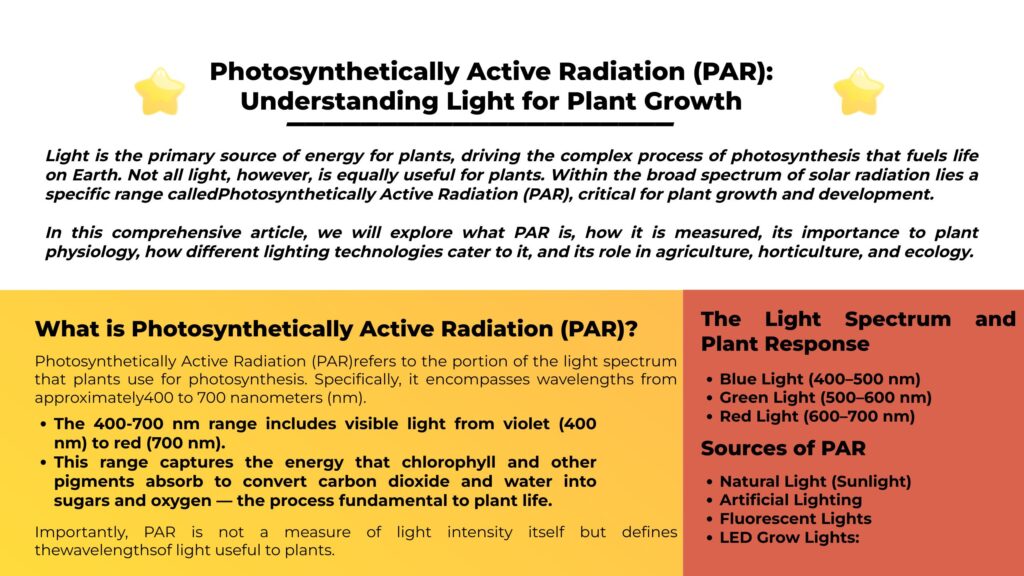
Light is the primary source of energy for plants, driving the complex process of photosynthesis that fuels life on Earth. Not all light, however, is equally useful for plants. Within the broad spectrum of solar radiation lies a specific range called Photosynthetically Active Radiation (PAR), critical for plant growth and development.
In this comprehensive article, we will explore what PAR is, how it is measured, its importance to plant physiology, how different lighting technologies cater to it, and its role in agriculture, horticulture, and ecology.
1. What is Photosynthetically Active Radiation (PAR)?
Photosynthetically Active Radiation (PAR) refers to the portion of the light spectrum that plants use for photosynthesis. Specifically, it encompasses wavelengths from approximately 400 to 700 nanometers (nm).
- The 400-700 nm range includes visible light from violet (400 nm) to red (700 nm).
- This range captures the energy that chlorophyll and other pigments absorb to convert carbon dioxide and water into sugars and oxygen — the process fundamental to plant life.
Importantly, PAR is not a measure of light intensity itself but defines the wavelengths of light useful to plants.
2. The Light Spectrum and Plant Response
The sun emits electromagnetic radiation across a wide range of wavelengths, including ultraviolet (UV), visible light, and infrared (IR). Plants, however, are primarily sensitive to the visible range.
Key Regions Within PAR:
- Blue Light (400–500 nm): Critical for vegetative growth; influences leaf thickness, stem elongation, and phototropism (growth towards light).
- Green Light (500–600 nm): Less absorbed by chlorophyll but penetrates deeper into plant canopies, assisting photosynthesis in lower leaves.
- Red Light (600–700 nm): Essential for flowering and fruiting; works synergistically with blue light for overall plant development.
Chlorophyll a and chlorophyll b, the main photosynthetic pigments, absorb mostly blue and red wavelengths, reflecting green, which is why most plants appear green.
3. Measuring PAR
Unlike typical light measurements for human vision (lux or lumens), measuring PAR focuses on the number of photons rather than perceived brightness.
Key Measurement Units:
- Photosynthetic Photon Flux (PPF): Measures the total amount of PAR photons emitted by a light source per second. Expressed in micromoles per second (μmol/s).
- Photosynthetic Photon Flux Density (PPFD): Measures the number of PAR photons falling on a square meter per second. Expressed in micromoles per square meter per second (μmol/m²/s). This is the most relevant measurement for evaluating lighting in horticulture.
- Daily Light Integral (DLI): The cumulative PPFD received over 24 hours, expressed in mol/m²/day. This metric helps determine the total light plants receive daily.
Quantum sensors are typically used to measure PAR by counting the number of photons within the 400–700 nm range.
Realted Read: Photoacoustic Spectroscopy (PAS): Principles, Technology, and Applications
4. Importance of PAR to Plant Growth
Photosynthesis efficiency is tightly linked to the availability and quality of PAR:
- Higher PAR = Higher Photosynthetic Rates (up to a saturation point)
- Low PAR = Reduced Growth (plants stretch towards light, become leggy)
Light Compensation and Saturation Points
- The light compensation point is where the rate of photosynthesis equals the rate of respiration. Below this, plants lose energy.
- The light saturation point is where an increase in light no longer increases photosynthesis.
Different plant species have evolved for different light environments:
- Shade-tolerant plants: Lower compensation and saturation points.
- Sun-loving plants: Higher points and require greater PAR for optimal growth.
5. Sources of PAR: Natural and Artificial
Natural Light (Sunlight)
- Provides a full spectrum including UV, visible, and IR radiation.
- The amount and quality of PAR from sunlight depend on latitude, season, time of day, weather conditions, and atmospheric factors.
Artificial Lighting
In controlled environments like greenhouses and indoor farms, artificial lights are crucial:
Types of Grow Lights:
- Fluorescent Lights:
- Emission: Mostly blue light.
- Good for seedlings and vegetative growth.
- High-Pressure Sodium (HPS) Lamps:
- Emission: Rich in red and orange light.
- Good for flowering stages.
- Metal Halide Lamps:
- Emission: More balanced with blue-rich light.
- Used for vegetative growth.
- LED Grow Lights:
- Highly customizable; can be designed to emit specific wavelengths.
- Energy-efficient and long-lasting.
- Modern horticultural LEDs provide optimal PAR with minimal energy wastage.
6. PAR Distribution and Canopy Penetration
In dense plantings, not all leaves receive the same amount of light.
Key Concepts:
- Top Leaves: Receive more intense PAR.
- Lower Leaves: Receive less PAR; may rely more on green light penetration.
Proper light management ensures that the entire plant, not just the top leaves, participates effectively in photosynthesis.
Light diffusion strategies (e.g., diffusing panels or supplemental lighting) help distribute PAR more evenly across plant canopies.
7. Practical Applications of PAR Management
Greenhouses
- Supplemental lighting ensures adequate PAR during short winter days.
- Dynamic shading systems modulate natural sunlight to prevent overexposure.
Indoor Vertical Farming
- LED systems finely tune PAR to plant needs.
- Adjusting spectra and intensity at different growth stages maximizes yield.
Forestry and Ecology
- PAR measurements help assess plant health and productivity in natural ecosystems.
- Understanding PAR availability assists in managing forests and natural habitats.
Research
- Experiments on plant physiology often require precise PAR control to isolate the effects of light on growth.
8. Factors Affecting PAR Availability
Season and Latitude
- Summer provides longer daylight hours and higher PAR intensity.
- Tropical regions receive more consistent PAR year-round than polar regions.
Weather Conditions
- Cloud cover significantly reduces direct PAR but increases diffuse light, which can penetrate canopies more effectively.
Time of Day
- Midday provides the highest PAR levels; morning and evening levels are lower.
Atmospheric Conditions
- Air pollution and particulate matter can scatter and absorb sunlight, reducing PAR reaching the surface.
9. Advances in PAR Technology
Smart Lighting Systems
- Sensors monitor real-time PAR levels, dynamically adjusting artificial lighting.
- Automation ensures optimal light conditions without human intervention.
Spectral Tuning
- Modern LEDs allow growers to tune light spectra for specific plant stages — stimulating vegetative growth with blue light and flowering with red light.
Integrated Crop Management
- Combining PAR monitoring with temperature, humidity, and CO₂ management creates optimal microclimates for crops.
10. Common Misconceptions About PAR
- “More light is always better”: Excessive PAR can damage plants (photoinhibition) and waste energy.
- “All LEDs provide good PAR”: Only specialized horticultural LEDs are optimized for PAR output.
- “Green light is useless”: While green light is less absorbed, it penetrates deeper into the canopy and contributes to photosynthesis.
Conclusion
Photosynthetically Active Radiation (PAR) is essential for understanding plant-light interactions. By focusing on the 400-700 nm range, growers, researchers, and ecologists can optimize plant health, maximize yields, and manage natural environments more effectively.
As lighting technologies advance and our understanding of plant physiology deepens, managing PAR will become an even more critical component of sustainable agriculture and ecological stewardship. Mastery over PAR is no longer optional — it is fundamental for anyone serious about cultivating plants, whether for food, research, or preserving our planet’s ecosystems.