Sensor One Stop – The Best Value China Sensor Supplier and Supply Chain

What is PIR: A Comprehensive Guide to Passive Infrared Sensors

What is PIR

Passive Infrared (PIR) sensors are one of the most widely used motion detection technologies in the world today. They are crucial components in security systems, lighting controls, automatic doors, and various other applications where detecting movement is essential. But what exactly is a PIR sensor, and how does it work? This article provides a detailed exploration of PIR technology, its applications, advantages, and considerations when using PIR sensors.

Introduction to PIR Sensors

What is PIR?

PIR stands for Passive Infrared. A PIR sensor is an electronic sensor that detects infrared (IR) light emitted from objects in its field of view. “Passive” means that the sensor does not emit any energy of its own but rather detects the infrared radiation naturally emitted by objects. PIR sensors are designed to sense movement by detecting changes in the infrared radiation levels that occur when a warm body, such as a human or animal, passes in front of the sensor.

Basic Principle of Operation
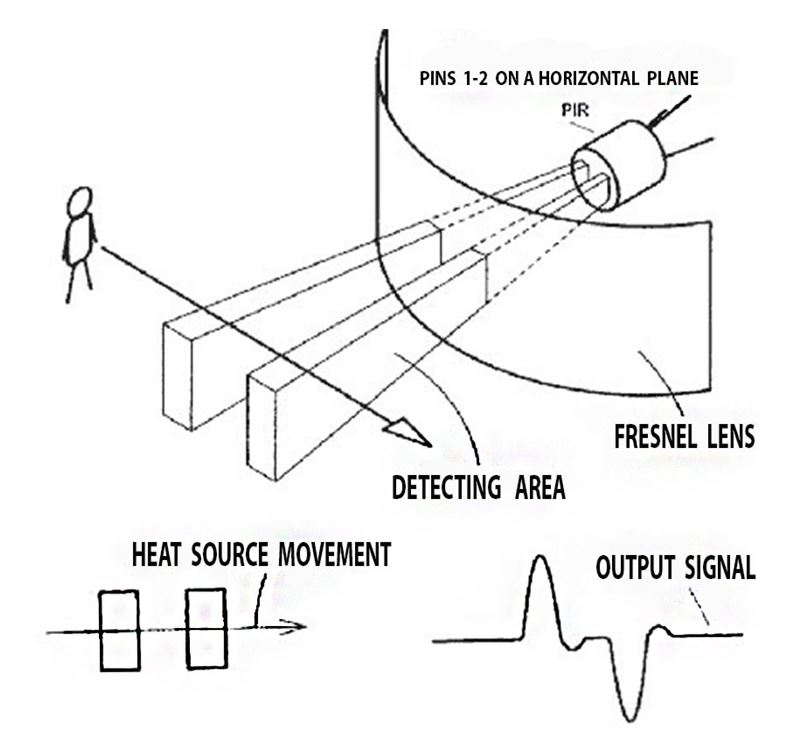
Working principle of PIR

The operation of a PIR sensor is based on the detection of infrared radiation. All objects with a temperature above absolute zero emit some level of IR radiation. Human bodies, for example, emit infrared radiation with a peak wavelength of about 10 micrometers. The PIR sensor detects this IR radiation and triggers an alarm or action when it notices a change in the radiation levels within its field of view.

PIR sensors consist of a pyroelectric sensor, which generates an electrical charge when exposed to IR radiation. This charge is then processed to determine whether there has been a significant change in the IR radiation levels, indicative of movement within the sensor’s detection zone.

Components of a PIR Sensor

A typical PIR sensor comprises several key components:

  • Pyroelectric Sensor: The core component that detects changes in infrared radiation.
  • Fresnel Lens: A lens that focuses the infrared radiation onto the pyroelectric sensor. The Fresnel lens is crucial for enhancing the sensor’s sensitivity and determining the detection area.
  • Signal Processing Circuit: Converts the electrical signals from the pyroelectric sensor into a readable output that can trigger actions like turning on lights or activating alarms.
  • Housing: Protects the internal components of the sensor and may include features for mounting or adjusting the sensor’s field of view.

How PIR Sensors Work

Detection Mechanism

The detection mechanism of a PIR sensor revolves around the concept of differential sensing. PIR sensors are usually equipped with two or more pyroelectric elements, each sensitive to infrared radiation. These elements are arranged in such a way that when the infrared radiation detected by one element differs from that detected by the other, it indicates movement.

When a warm object, like a human or animal, enters the sensor’s field of view, it causes a rapid change in the infrared radiation levels. The pyroelectric sensor detects this change and generates an electrical signal. The signal is then processed by the sensor’s internal circuitry, which determines whether the change is significant enough to be considered movement.

The Role of the Fresnel Lens

The Fresnel lens plays a critical role in the operation of PIR sensors. This lens is not a single, continuous lens but rather a series of concentric rings or sections. It focuses the infrared radiation onto the pyroelectric sensor, allowing it to detect radiation from a wider area.

The design of the Fresnel lens also helps divide the sensor’s detection area into multiple zones. As a warm object moves across these zones, the amount of infrared radiation reaching the pyroelectric sensor fluctuates, enabling the sensor to detect motion. The lens effectively increases the sensitivity and range of the PIR sensor.

Signal Processing

Once the pyroelectric sensor detects a change in infrared radiation, the sensor’s internal circuitry processes the signal. The processing involves filtering out noise and amplifying the signal to determine whether the detected change is due to motion. If the signal meets the predefined criteria for movement, the sensor generates an output signal.

This output signal can be used to trigger various actions, such as:

  • Activating a light or alarm
  • Sending a signal to a security system
  • Initiating a recording on a security camera

Sensitivity and Range

The sensitivity and range of a PIR sensor depend on several factors, including the design of the Fresnel lens, the quality of the pyroelectric sensor, and the processing circuitry. Sensitivity refers to the sensor’s ability to detect small changes in infrared radiation, while the range refers to the maximum distance at which the sensor can detect motion.

Most PIR sensors allow users to adjust the sensitivity and range to suit specific applications. For example, in a residential security system, the sensor might be set to detect movement within a 10-meter range, while in a commercial setting, the range might be extended to 20 meters or more.

Applications of PIR Sensors

PIR sensors are incredibly versatile and are used in a wide range of applications. Some of the most common uses include:

Security Systems

PIR sensors are a staple in security systems, where they are used to detect unauthorized entry or movement within a protected area. When a PIR sensor detects movement, it can trigger an alarm, alert security personnel, or activate surveillance cameras.

Lighting Control

PIR sensors are widely used in automatic lighting systems. In residential and commercial buildings, these sensors detect movement and automatically turn lights on or off, helping to conserve energy and enhance convenience. For example, a PIR sensor in a hallway can turn on the lights when someone enters and turn them off when the hallway is empty.

HVAC Systems

In heating, ventilation, and air conditioning (HVAC) systems, PIR sensors help improve energy efficiency by detecting occupancy and adjusting the system’s operation accordingly. When the sensor detects that a room is occupied, the HVAC system can adjust the temperature to the desired level, and when the room is empty, it can reduce heating or cooling to save energy.

Smart Home Automation

PIR sensors are integral to smart home automation systems. They can be used to control a variety of devices, from lights and security systems to entertainment systems and appliances. For example, a PIR sensor can trigger a smart home system to play music or adjust the lighting when someone enters a room.

Public Restrooms and Facilities

In public restrooms and facilities, PIR sensors are used to control lighting, hand dryers, and other devices. These sensors help conserve energy by ensuring that lights and devices are only activated when the facility is in use.

Automotive Applications

PIR sensors are also used in automotive applications, such as in vehicle occupancy detection systems. These systems can detect whether a person or animal is inside the vehicle and trigger alarms or other responses if necessary.

Industrial Automation

In industrial settings, PIR sensors are used to monitor movement in areas where safety is a concern. For example, they can be used to detect the presence of workers in dangerous areas and ensure that machinery operates only when it is safe to do so.

Advantages of PIR Sensors

PIR sensors offer several advantages that make them a popular choice in various applications:

1. Low Power Consumption

PIR sensors are highly energy-efficient, making them ideal for battery-operated devices and systems where power consumption is a critical concern. Their low power consumption extends the battery life of wireless devices and reduces overall energy costs.

2. Cost-Effective

PIR sensors are relatively inexpensive compared to other types of motion detection technologies. This affordability makes them accessible for a wide range of applications, from residential security systems to large-scale industrial installations.

3. Easy to Install and Use

PIR sensors are straightforward to install and configure. Most sensors are designed to be plug-and-play, requiring minimal setup. This ease of use makes them a popular choice for both DIY enthusiasts and professional installers.

4. Reliable Detection

PIR sensors provide reliable motion detection in a wide range of environments. They are less prone to false alarms caused by environmental factors like wind, rain, or shadows, which can trigger other types of motion sensors.

5. Wide Range of Applications

The versatility of PIR sensors allows them to be used in a variety of applications, from simple lighting controls to complex security systems. Their adaptability makes them suitable for both indoor and outdoor use.

6. Passive Operation

Because PIR sensors are passive, they do not emit any energy, making them safe and unobtrusive. Their passive nature also means they can operate in environments where active sensors might be inappropriate or ineffective.

Limitations of PIR Sensors

Despite their many advantages, PIR sensors do have some limitations:

1. Limited Detection Range

The detection range of a PIR sensor is typically limited to a few meters. While this is sufficient for most applications, it may not be adequate for large open areas or long-distance detection.

2. Sensitivity to Environmental Conditions

PIR sensors can be affected by environmental conditions such as temperature changes, drafts, and direct sunlight. These factors can sometimes cause false alarms or reduce the sensor’s sensitivity.

3. Inability to Detect Stationary Objects

PIR sensors are designed to detect movement, which means they cannot detect stationary objects. If an object remains still within the sensor’s field of view, it will not trigger a response.

4. Vulnerability to Obstructions

Obstructions such as walls, furniture, or thick curtains can block the infrared radiation that a PIR sensor needs to detect movement. This can limit the sensor’s effectiveness in certain environments.

5. Sensitivity to Temperature

PIR sensors are sensitive to temperature changes, and their performance can be affected by the ambient temperature. In extremely hot or cold environments, the sensor’s ability to detect movement may be compromised.

Considerations When Choosing a PIR Sensor

When selecting a PIR sensor for a specific application, several factors should be considered:

1. Detection Range and Angle

The detection range and angle of the PIR sensor should match the requirements of the application. For example, a sensor with a wide detection angle is ideal for covering large areas, while a sensor with a narrow angle

may be better suited for focused detection, such as in a hallway.

2. Sensitivity Adjustment

Some PIR sensors offer adjustable sensitivity, allowing users to fine-tune the sensor’s response to different levels of movement. This feature is useful in environments where the sensitivity needs to be adapted to reduce false alarms.

3. Environmental Resistance

For outdoor applications or environments with harsh conditions, choosing a PIR sensor that is resistant to water, dust, and temperature fluctuations is essential. Look for sensors with appropriate IP (Ingress Protection) ratings to ensure they can withstand the conditions.

4. Power Requirements

Consider the power requirements of the PIR sensor, especially if it is to be used in a battery-operated device. Sensors with low power consumption are ideal for extending battery life.

5. Integration with Other Systems

If the PIR sensor is to be integrated with other systems, such as smart home automation or security systems, ensure that it is compatible with the desired platform or devices. Many PIR sensors support common communication protocols like Zigbee, Z-Wave, or Wi-Fi.

6. Aesthetics and Mounting Options

In residential or commercial settings, the aesthetics of the PIR sensor and its mounting options may be important. Choose a sensor that blends well with the surroundings and offers flexible mounting options for optimal placement.

Conclusion

PIR sensors are a cornerstone of modern motion detection technology, offering a reliable, cost-effective, and energy-efficient solution for various applications. From enhancing security in homes and businesses to improving energy efficiency in lighting and HVAC systems, PIR sensors play a crucial role in our daily lives.

Understanding how PIR sensors work, their advantages, and their limitations allows users to make informed decisions when selecting and using these sensors. As technology continues to evolve, we can expect PIR sensors to become even more sophisticated, offering improved performance, greater integration with smart systems, and enhanced capabilities for detecting motion in diverse environments.

Exit mobile version