

A carbon dioxide sensor gives a demand-controlled ventilation (DCV) sequence a measure of CO₂ concentration in the air it samples. When people are the dominant indoor source, that concentration can help the controller adjust the occupancy-related part of outdoor ventilation. The controller still needs a representative measurement, an appropriate setpoint or demand relationship, a minimum airflow calculation, and a way to confirm delivery. A ppm reading, a damper position, and an outdoor airflow rate are three different points in that chain.
For a controls review, start by identifying each point that can change a decision. Ask what air the CO₂ sensor samples, where the airflow request goes, which limits are active, and how actual outdoor air delivery is established. The answer can be simple for a single-zone system and distributed across several controllers for a variable-air-volume system. In both cases, low CO₂ during a quiet period is insufficient evidence that the minimum ventilation service has been delivered.

The measurement starts in an occupied space. The response may involve equipment at the zone, at the air handler, or at both.
Start with the four quantities the sequence must keep separate
A zone carbon dioxide point is a concentration, commonly in parts per million by volume. It reflects the balance of outdoor background, occupant generation, accumulated CO₂ and air exchange, plus local mixing near the sensing point. The demand calculation is the controller's interpretation of that point. Its output could be a binary request, a normalized demand, a zone airflow setpoint or another intermediate variable. The outdoor airflow setpoint is a flow rate for a defined part of the system. The delivered flow is the physical quantity to verify.
Drawing these as separate lines on a controls diagram helps reveal missing information. For example, a commissioning record may establish that a controller receives 925 ppm and moves a damper to 42%. Those observations prove signal transmission and a change in command. Damper travel feedback adds evidence that a shaft moved. To establish outdoor air delivery, the record needs a reliable flow measurement or an accepted, verified way of maintaining the specified minimum under that operating condition.
| Point in the sequence | Typical unit or form | 질문에 대한 답변 | What can change it |
|---|---|---|---|
| Room or zone CO₂ | ppm | What concentration is present at this inlet? | Occupants, mixing, ventilation, instrument error |
| Outdoor reference | ppm | What CO₂ enters with intake air, or what background does the approved sequence assume? | Intake location, local emissions, sensor condition |
| Zone ventilation request | State, percentage, or airflow setpoint | What response is the zone controller requesting? | Setpoint, proportional band, filtering, occupancy mode |
| Outdoor airflow command | L/s or cfm | How much outdoor air should the equipment deliver under active constraints? | Zone requests, system ventilation calculation, overrides |
| Damper output and feedback | Percentage, angle, or state | What motion was requested or observed? | Actuator range, binding, linkage, calibration |
| Verified outdoor airflow | L/s or cfm at a named location | How much outdoor air actually crosses the measured boundary? | Fan speed, pressure, damper characteristics, wind, sensor validity |
A display that calls both damper position and flow “outside air percent” invites a specific error. The first percentage is mechanical position or controller output. The second could be outdoor air divided by supply flow. Even a correctly measured 25% outdoor fraction represents 250 L/s at 1,000 L/s supply and 125 L/s at 500 L/s supply. Every percentage in the sequence should identify its denominator or physical meaning.
Choose a CO₂ input that follows the people the sequence serves
When people enter a room, their respiration adds carbon dioxide. Ventilation removes some of the excess relative to the incoming air. A higher concentration may reflect more occupants, higher activity, lower airflow, a higher incoming background, or some combination. If an occupied room is large relative to the flow through it, its concentration may rise slowly even when the population increases abruptly. The transmitter may report a stable measurement while the air itself is still changing.
For a device specification, see how fixed and percentage CO₂ accuracy terms apply at a given concentration. That arithmetic helps identify whether a transmitter's documented performance fits the decision range.
A suitable input therefore has two kinds of validity. First, the instrument reports carbon dioxide with the accuracy, range, response and environmental tolerance the application needs. Second, the air sampled corresponds to the zone whose demand will be reset. A correctly scaled transmitter in a common return can still miss the signal from a crowded room. A sensor mounted close to a supply jet may respond more strongly to the supplied air than to changes in the occupied zone.
Treat the outdoor reference as part of this measurement design. If the adopted sequence permits an assumed outdoor concentration, document the value, why the method applies, and what to do when site background varies materially. If it uses a measured outdoor reference, check that the reference represents the relevant incoming air, that its timestamp and status are available, and that its failure has a defined fallback. Direct measurements can improve the interpretation only when the reference itself is credible.
그만큼 ASHRAE indoor carbon dioxide position document describes how the relationship between ventilation and CO₂ depends on space type, population and activity. The Guideline 36 addendum on CO₂ setpoints illustrates how a specific controls approach accounts for occupancy type and design quantities. Use the sequence and governing criteria selected for the project when setting actual limits.

The sensor reports the air that reaches its inlet. Compare the proposed location against the occupied air the controller is meant to represent.
Use independent inputs for occupancy and operating state
A presence sensor may detect that someone entered before the CO₂ signal rises. A reliable count may support a different reset method when allowed. A schedule can establish expected operating hours, while door or reservation data can provide context. Each input has its own error modes. A booked meeting room may be empty, a presence sensor may time out during quiet activity, and a CO₂ signal can remain elevated after occupants leave. Design documents should state which point establishes occupied mode, which adjusts ventilation demand, and how inconsistencies are resolved.
Avoid assigning a fixed population to every concentration. For example, a room can be at 750 ppm at both the start of a busy event and near the end of a sparsely occupied event, because its starting concentration and airflow history differ. A proportional CO₂ control band can still be useful within an approved sequence. It should be interpreted as a request based on measured concentration, with the designed limits and timing, rather than a direct count.
Establish the ventilation floor before applying the reset
An occupancy-based reset addresses the portion of ventilation that varies with the people served. In a Ventilation Rate Procedure calculation, the breathing-zone outdoor airflow is commonly expressed as the sum of a people contribution and an area contribution, written as Vbz = Rp × Pz + Ra × Az. The zone outdoor airflow can also depend on air distribution effectiveness. A system serving several zones adds distribution and system-level considerations. These relationships explain why one concentration setpoint cannot replace the ventilation design.
Consider an illustrative occupied zone with an approved area contribution of 40 L/s and a design people contribution of 80 L/s. Those assumed components sum to 120 L/s in the breathing zone at design occupancy, before any applicable distribution adjustment. The example shows the structure of the calculation, with no implied rates for a particular space category. A reset may reduce the 80 L/s contribution when conditions warrant it. The building and system may still require more than 40 L/s because of other minimums, exhaust makeup, pressurization or a mode-specific rule.
The floor should exist as a documented flow requirement with a point or an acceptance test attached. If the requirement is translated into a fixed damper position, verify how that translation holds over fan speed and pressure range. If the chosen sequence uses a measured intake flow, specify the sensor's installed range, proof of minimum accuracy and what happens when data are unavailable. The California Energy Commission's ventilation measurement and control project treated intake measurement and CO₂ sensing as separate research tasks. Both matter to the end result.
Minimum, design and higher operating airflow can coexist
The occupied minimum is the least flow allowed under stated conditions. The design ventilation request is linked to the design occupancy and zone or system calculation. An economizer may bring in additional outdoor air when conditions favor free cooling. Pressurization logic may impose another requirement. Equipment protection and higher-priority sequences can alter how airflow is delivered. A controls sequence needs explicit priority and a defined recovery path for these interactions.
Low CO₂ during economizer operation is an expected possible consequence of increased outdoor air. A trend review should identify the active mode before concluding that DCV is reducing demand successfully. In cold weather a coil-protection action can interrupt normal ventilation. Its treatment depends on the approved sequence, with the priority, alarm behavior and recovery recorded. A signal value plotted without its control state can hide the most important explanation for a change.
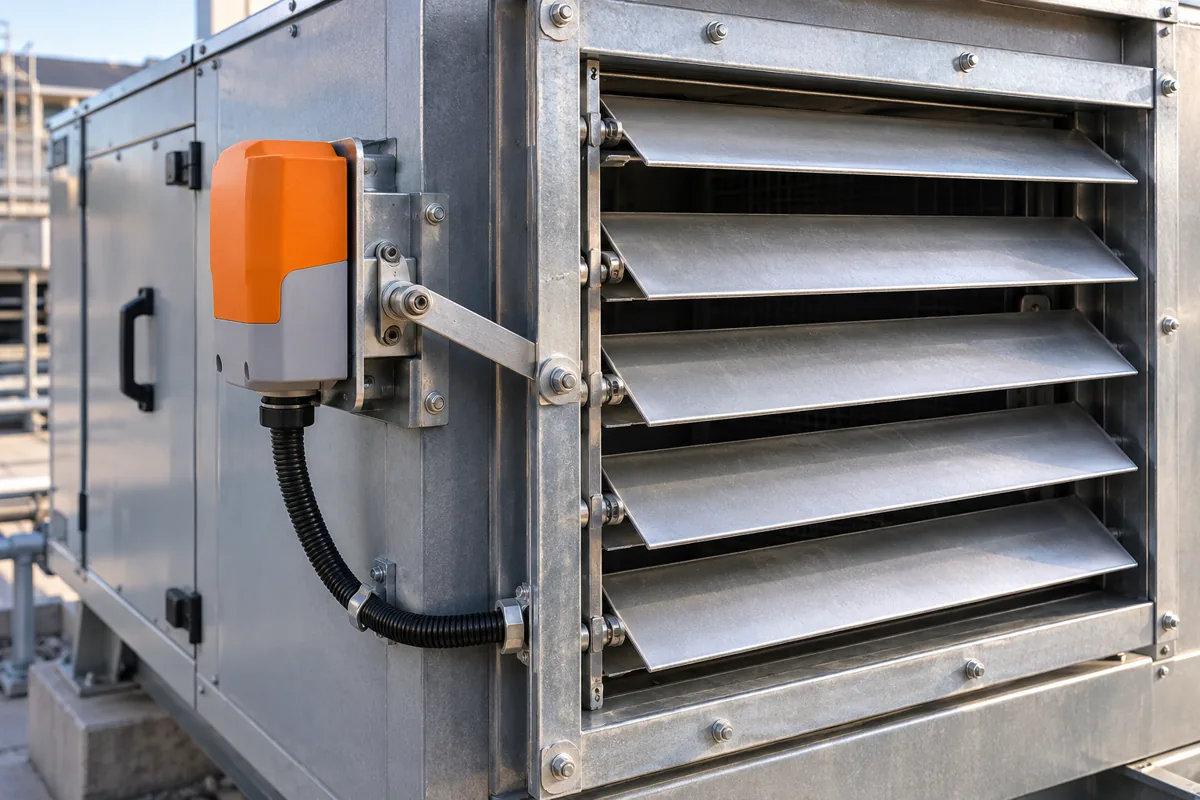
An actuator changes an opening. Outdoor air through that opening also depends on the pressure and airflow conditions at the air handler.
Follow the request through single-zone and multizone equipment
A single-zone air handler can use a room signal to reset its outdoor airflow target within the documented limits. Some designs allow a properly validated return point for a truly representative single-zone return. When several occupied areas share a unit, trace the actual served spaces and return paths before assuming that the one air handler is equivalent to one representative sample.
In a variable-air-volume system, a rise in one room may reset the zone terminal's minimum primary airflow or generate a request at the air handler. The controller must coordinate zone flow with the outdoor air fraction and system-level ventilation calculation. A room's primary supply airflow can contain recirculated air. The airflow reported by a terminal is therefore not automatically the outdoor airflow delivered to the room. One zone can be critical because of its ventilation requirement relative to its primary air even while other zones are comfortably meeting theirs.
For a conceptual example, take a terminal delivering 300 L/s primary air and assume its supply contains a uniform 20% outdoor fraction. The simple outdoor component is 60 L/s. If terminal supply falls to 180 L/s and the fraction remains 20%, the component falls to 36 L/s. The example omits distribution and system efficiency and does not substitute for the project's multizone procedure. It illustrates how a thermal airflow reduction can also change ventilation delivery.
그만큼 ASHRAE Handbook chapter on ventilation and infiltration discusses how demand-based reset and fan speed can interact. A lower damper command at the same time as a lower supply fan speed can reduce outdoor intake more than expected. The reverse can also happen when higher fan pressure increases intake through a fixed opening. Verify both the zone and central portions of the sequence over the actual operating range.

The terminal can change primary air to a zone. The air handler determines the outdoor component of the common supply stream.
Commission the points, the request, and the physical response
A point-to-point check starts with a known change at the transmitter and ends with the expected value and quality state in the building automation system. A reasonable test covers the meaningful part of the signal range. For analog inputs, verify the configured scale at both ends and a useful intermediate value. For a digital transmitter, confirm the register, units, validity flags and behavior during a communications interruption. Check whether the graphics page uses the raw point, a filtered value or a calculated point.
After signal checks, apply a controlled test stimulus in accordance with the project and manufacturer procedures. A simulated rising value is useful to isolate the programmed response, and a representative field comparison is useful to evaluate the sample location and sensor. A forced point tells the reviewer how the software acts under that value. It cannot validate how the installed sensing element responds to the room air. Restore all overrides and verify normal control before leaving the test condition.
An acceptance record should follow the same sequence on the screen and in the field. Record the zone state, outdoor reference, raw and filtered CO₂, request, applicable floor or cap, fan status, commanded and proven damper position, and flow reading or test result. Include timestamps and point names. If an installation uses a derived flow, document the measurement on which it depends and the conditions under which the relationship was verified.
| Test state | 보유할 증거 | Question it resolves |
|---|---|---|
| Occupied, low CO₂, ordinary minimum mode | Flow target, operating fan condition and independently verified flow | Does the occupied minimum hold when the CO₂ request is low? |
| Rising valid CO₂ | Raw point, processed point, sequence output and controlled airflow | Does demand produce the expected change at the intended equipment? |
| More than one zone requesting | Zone airflow data, central intake, system state and request priorities | Can the system respond while serving the other zones? |
| Economizer available | Active economizer state and outdoor flow while the DCV request is low | Can cooling demand govern outdoor air when applicable? |
| Detected sensor or communication failure | Alarm, fallback request and airflow verification | Does the controller preserve the required service on bad data? |
| Return from a forced or faulted state | Overrides removed, valid status restored and stable flow | Is the loop back in its intended operating state? |
The failure test should distinguish loss of communications, a known out-of-range value and a plausible value that stops updating. A network failure can be easy to detect. Slow drift or an input frozen at a reasonable reading can stay hidden. If the sequence has a stale timestamp alarm or fault flag, prove that the timeout and fallback work as specified. If the device has no validity output, define what evidence triggers manual inspection or independent comparison.

Test outputs and restore normal control before evaluating the response to real occupancy.
Handle occupied startup, delay and recovery explicitly
Consider a room that fills at 9:00 after a quiet morning. At 9:02 the raw CO₂ is still close to the overnight value. At 9:15 it is rising. At 9:30 the room empties, while the reading remains elevated. A proportional band, average, persistence timer or rate limit can prevent hunting and reaction to short local spikes, but each can also add delay. Review the combined response of the room, instrument, communications and controller. An algorithm that looks smooth in a trend may be too slow for the relevant use pattern.
Confirm the expected sequence when the schedule changes to occupied, when occupancy is detected outside scheduled hours, and when people leave. Any preoccupancy ventilation or after-hours ventilation strategy belongs in the approved sequence. The review needs both an input event and the response expected from the equipment. A calendar-based description alone gives little guidance when a room is used differently from its normal schedule.
Sensor failure behavior is also an explicit design choice constrained by the governing requirements. For example, Addendum d to ASHRAE Standard 62.1-2022 retains a fallback calling for the required minimum breathing-zone outdoor airflow for the design population upon detected sensor failure. Confirm the adopted edition, relevant addenda and project documents before applying that specific requirement. Fallback should include the equipment response and status indication so an operator can tell when the reset is unavailable.
Recognize when CO₂ is the wrong demand signal
CO₂ is useful for demand control when occupants dominate the changing source and the measurement can inform the ventilation decision. A fermentation process, fuel-burning appliance or other source can create a concentration pattern unrelated to occupant load. A specialized system that removes CO₂ can also change the relationship between concentration and outdoor airflow. The ASHRAE ventilation chapter discusses these cases and the mismatch between the signal and the underlying ventilation calculation.
Other indoor air quality concerns have different sources and control mechanisms. Material emissions can continue in an empty room. Particles may enter with outdoor air or result from indoor activities. Moisture can come from occupancy, infiltration or a process. Particle filtration can reduce aerosols while leaving carbon dioxide essentially unchanged. An operator can use the CO₂ trend as one diagnostic input and evaluate other concerns with the methods intended for them.
Commercial projects also need to distinguish an indoor environmental dashboard from a control sensor. A dashboard may favor a simple averaged signal that helps an operator see a general pattern. A demand input has consequences for specific outdoor-air service. If the intended population, room or operating mode changes, review whether the original signal and sequence still fit the application. The local controller should identify which value it uses after a sensor swap or graphics change.
A short field example
Suppose a training room repeatedly shows high CO₂ during afternoon sessions, but its terminal reports normal airflow. First confirm whether the normal reading is total primary airflow or a verified outdoor component. Next check the air handler outdoor intake and relevant system state for the same interval. Check occupancy and the setpoint actually loaded into the terminal controller. If the room sensor is representative and both target and delivery are low, the sequence may be misconfigured or a limit may be active. If the target rises and measured flow does not, investigate delivery and the applicable airflow instrumentation.
This order keeps separate failure modes from being assigned the same cause. A biased CO₂ point, a threshold derived for another room type, an incorrectly scaled airflow station and an unresponsive actuator can all contribute to poor response. The strongest diagnosis follows time-aligned evidence from the initiating measurement to the final physical result.
Review the sequence after a tenant or equipment change
A controls sequence can become unsuitable after a room conversion even when every point works. A quiet workroom converted to a densely occupied training space may have different design population, area use, occupancy pattern and ventilation allocation. Confirm the relevant design calculation and the equipment's ability to serve the new use before treating an unchanged setpoint as authoritative. The original area may be the same while the people term and schedule differ.
A replacement air handler or balancing change can similarly alter the relationship between fan speed, damper position and intake flow. If the airflow setpoint remains the same, a usable flow sensor may expose the difference. A setup that depends on a commissioned minimum position has to demonstrate the relationship again over the operating range. Record the hardware and software revision, the measured airflow under the tested modes, and the date the interpretation changed.
Build the operating handover around a few reconstructable conditions. For each, preserve the design premise, sensor or occupancy input, active setpoint, relevant limit, measured output and any alarm. An operator should be able to distinguish a zone with no demand, a zone requesting more air while a limit is active, and a zone that made a request the equipment did not deliver. If a trend aggregates zones, keep enough of the original points to identify the source and timing of the request.
A check for competing constraints
Suppose central intake remains stable while a terminal requests more primary air. That can be expected if the rest of the system already draws adequate outdoor air and the selected sequence meets the zone requirement through a terminal adjustment. It can also point to a missing central request. Use the approved sequence and measured system state to tell the difference. A rule that every CO₂ increase must immediately move the outdoor damper would misdiagnose this case.
A second trend might show the central outdoor intake rising while the zone stays unchanged. If the increase came from an economizer, it says little about the response to the zone request. Determine what the active source of the airflow setpoint was and whether the zone terminal changed. A mode indicator, setpoint origin and airflow trace together make this interpretation possible without guessing from damper travel.
자주 묻는 질문
Does 1,000 ppm tell the controller that a room is adequately ventilated?
A setpoint depends on the application, control method and governing requirements. CO₂ concentration also depends on incoming concentration, generation, history and mixing. Use the room value within the selected sequence and establish actual airflow and other ventilation conditions separately.
Can a controller keep outdoor air at minimum whenever CO₂ is low?
The sequence may use low valid CO₂ as evidence of low occupant demand. It must still account for occupied minimum flow, area-related ventilation, other zones, building pressure and any higher-priority operating modes. At startup, low CO₂ can coexist with newly arrived occupants.
Is an outside-air damper feedback point enough for commissioning?
It can confirm actuator travel or position. Delivered outdoor air also depends on pressure and operating mode. Establish how flow is independently measured or verified over the conditions covered by the sequence.
What should an operator trend first?
Trend zone CO₂ and its quality status alongside occupancy or schedule, the processed demand, zone flow, central outdoor flow, damper feedback and active mode. Use shared timestamps. This makes it possible to see whether a delayed or absent response began at measurement, interpretation, actuation or delivery.







답장을 남겨주세요