
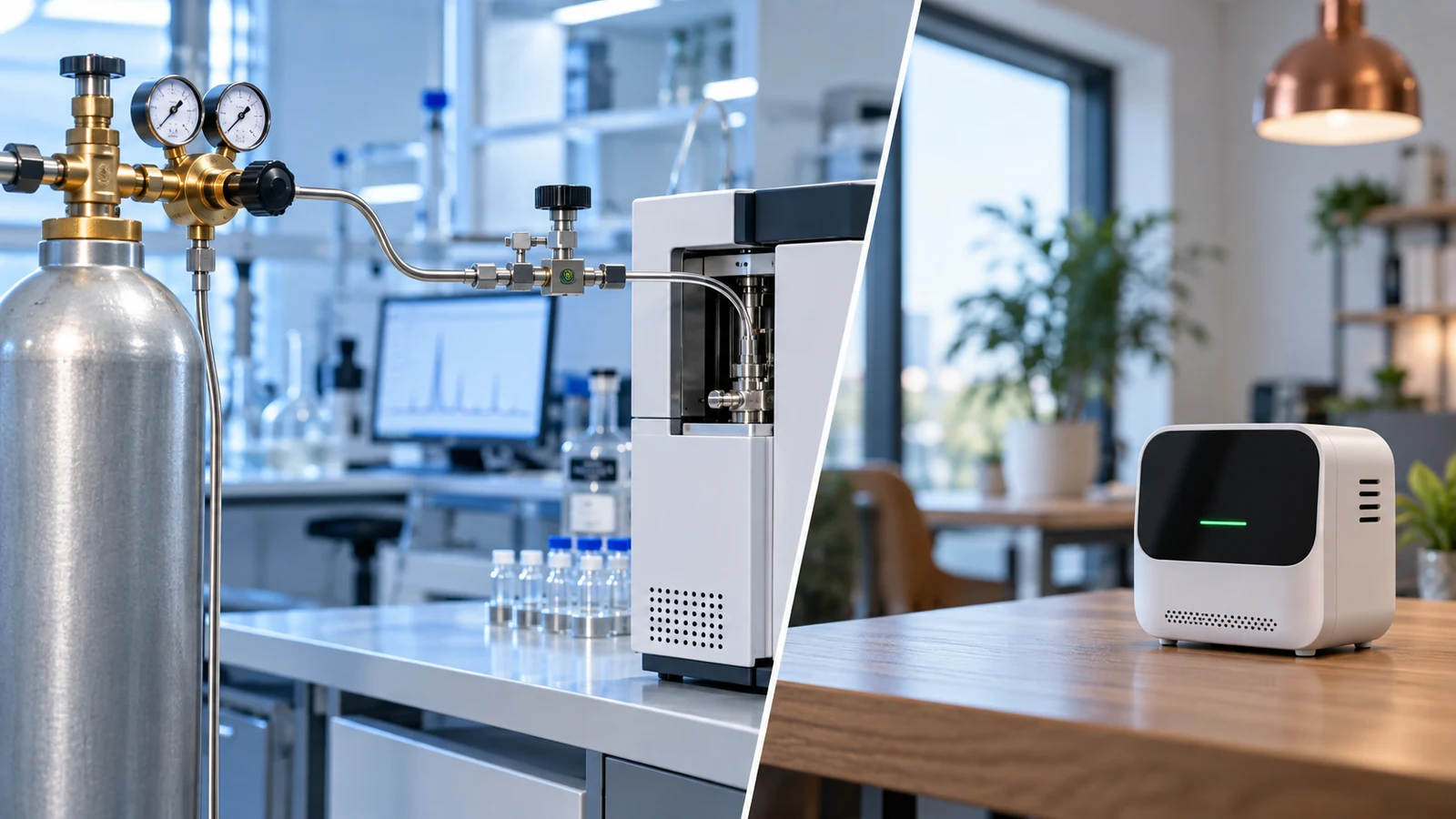
CO₂ purity asks what fraction of a supplied gas is CO₂ and which other substances remain. Ambient CO₂ concentration asks how much CO₂ is present in the air at a defined location. Both can be written as ppm or percent fractions, but they use different samples, different concentration regions and different evidence. A room CO₂ monitor cannot certify a cylinder's purity, and a cylinder purity certificate cannot tell you the CO₂ level beside a worker or in a greenhouse.
The confusion often starts with a correct conversion: 1% equals 10,000 ppm on the same fraction basis. That arithmetic does not make two instruments interchangeable. A near-pure CO₂ supply may require measuring small amounts of oxygen, moisture, CO, hydrocarbons or other specified impurities in a high-CO₂ matrix. A room monitor instead measures a comparatively small CO₂ fraction in air. The analyte, background gas, range and decision must all be defined before selecting a sensor.
Start With the Sample and the Question
A useful specification begins with two sentences. For supply quality: “At this sample point, determine whether this lot of CO₂ meets the applicable product specification, including the required impurity limits.” For ambient monitoring: “At this occupied or process location, track the CO₂ fraction over time for this operational decision.” The first may concern a cylinder, bulk tank or supply line after a defined sampling procedure. The second concerns a room, duct or other environmental sample. Measuring one location cannot answer the other question.
The distinction is practical. If a delivery report says “CO₂ assay 99.9%,” it describes the composition of a sampled supply under a stated method. It does not mean the room air is 99.9% CO₂. If a room monitor reports 900 ppm CO₂, that says nothing about whether a connected supply meets an impurity specification. A nearby leak could change the room reading without changing the purity of gas left inside a cylinder; impurities could violate a gas specification without creating a noticeable room CO₂ change.
Our CO₂ measurement guide follows the sample-to-output chain. The chain must be drawn separately for the supply gas and the ambient air.
Purity Is Not Just One Large CO₂ Number
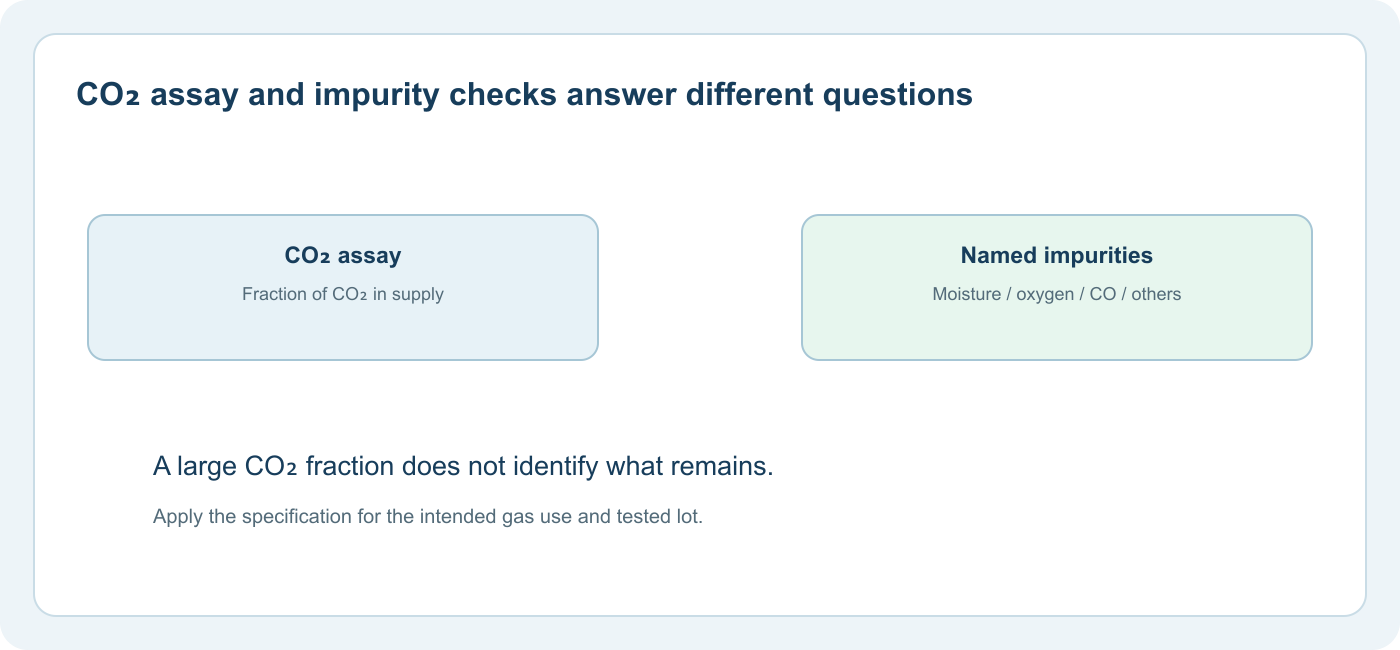
For a simple binary mixture, purity can be described as the fraction of the desired component, and the remainder is impurity. Real specifications are more detailed: the residual fraction can contain several different substances, each with its own significance. The EU's published E 290 carbon dioxide specification illustrates the distinction by stating an assay and separate purity checks, including a carbon-monoxide limit. It is an example for a particular food-additive application, not a universal rule for every beverage, industrial, medical or research gas. The applicable current version and local requirements must be checked for a real purchase.
A hypothetical assay of 99.9% CO₂ leaves 0.1% non-CO₂ material by fraction, or 1,000 ppm of all other components together on that same basis. It does ~ 아니다 tell you whether the remainder is 1,000 ppm water, 1,000 ppm oxygen, a mixture of trace gases, or something else. It does not prove any individual impurity meets a named limit. The calculation is simply 100% − 99.9% = 0.1%; identifying and quantifying the constituents requires appropriate analytical methods and a defined sample.
The wording “food grade,” “beverage grade,” “industrial” or “research grade” by itself is also insufficient to choose a sensor or infer a particular impurity profile. Ask for the actual specification revision, assay method, impurity list, limits, lot certificate and intended application. Our older CO₂ purity-grade overview introduces the vocabulary; the controlling evidence for a real lot is its applicable specification and tested documentation.
Ambient CO₂ Is a Different Fraction in a Different Matrix
An ambient monitor samples air: mostly nitrogen and oxygen, with variable water vapor and a much smaller CO₂ fraction. The information is usually a trend at a place and time. A CO₂ sensor may be calibrated and specified for concentrations typical of its intended application, and its accuracy interval may be narrower than the range of numbers it can display. For example, Sensirion's SCD4x data sheet shows a CO₂ output range extending well beyond the stated accuracy intervals for the SCD40 and SCD41. These are exact model examples, not generic limits for all ambient instruments.
A process analyzer may be designed to measure high CO₂ fractions. It may need a different optical path, sample conditioning, dilution or calibration approach from an ambient module. Our ppm-versus-percent range guide explains why the useful range is the overlap between the sample, the instrument's specified accuracy and the decision band. The monitor-versus-analyzer guide examines the sampling and data requirements behind those names.
The ambient number also needs a basis. A wet-air fraction includes water vapor in the denominator; a dry-air fraction excludes it. If supply gas is conditioned differently from room air, two ppm labels may not refer to the same denominator. Our wet-versus-dry CO₂ guide derives the conditional relationship and shows why relative humidity alone is not the required water mole fraction.
Why a Room Sensor Cannot Test a Purity Claim
There are several independent mismatches.
Range. A low-level ambient CO₂ module may provide a digital output at high values without specified accuracy there. Testing nearly pure CO₂ is far outside the intended measurement task of many room devices. The output should not be extrapolated into a purity certificate.
Matrix. An ambient sensor is normally characterized in air or a defined test mixture. A near-pure CO₂ stream has a very different composition, pressure and water content. Optical response, pressure effects and sample handling must be evaluated for the actual matrix.
Analyte. A CO₂-only channel does not measure moisture, oxygen, hydrocarbons or trace CO. Even a perfect CO₂ assay would not identify what makes up the remainder.
Sampling. A cylinder, line or bulk tank must be sampled with a suitable method that preserves the composition of the material being tested. The gas beside the cylinder is not that sample. A room monitor's inlet is designed for its local environment, not automatically for pressurized supply gas.
Traceability. A product-quality decision may require specified analytical methods, reference materials, calibration and documented lot results. NIST's gas-standard program explains how reference gas mixtures can be linked to primary standards. That metrology context is different from reading a consumer room display.
These are measurement-system limits, not merely a request for a more expensive sensor. If a product is used in food, beverage, medical or another controlled application, the relevant specification and competent testing process govern. The exact legal and contractual requirements vary by application and jurisdiction.
Why a Purity Certificate Cannot Replace Ambient Monitoring
A certificate describes the tested gas lot or defined supply point, within its sampling and time scope. Once CO₂ enters a room or process, the local concentration depends on release rate, ventilation, geometry, occupancy and where the sensor is placed. The certificate cannot reveal an environmental build-up, a faulty connection or a difference between a work area and a supply line.
For example, a beverage cylinder could meet its gas specification while a poorly controlled transfer creates elevated CO₂ in a nearby enclosed space. Conversely, the room CO₂ trend could look ordinary while the supply fails a low-level impurity limit. Those two observations can coexist because the measurements answer different questions. If the ambient result supports a safety or control decision, evaluate the finished detector or monitoring system, its range, placement, alarm behavior and intended use rather than relying on the supplier's quality document.
This is also why a gas purity instrument and a room monitor may both appear on one site. They are complementary only if each is specified for its own sample and decision; one does not certify the other.
A Measurement Plan for Both Tasks
| Planning item | CO₂ supply quality | Ambient CO₂ monitoring |
|---|---|---|
| Sample | Cylinder, bulk tank or line at a defined tap | Air at a defined room, duct or process location |
| Principal question | Assay and named impurity limits | CO₂ concentration or trend at that point |
| Required analytes | CO₂ and relevant individual impurities | CO₂; other gases only if separately required |
| Typical evidence | Method, calibration, sample chain, lot-specific result | Sensor specification, location, calibration, time record and faults |
| Major interpretation risk | Treating high CO₂ assay as proof every impurity is acceptable | Treating a room ppm reading as proof of supply quality |
The word “typical” here describes the shape of a brief, not a fixed regulatory checklist. A specific project may require additional analytes, continuous process analysis or several ambient positions. The table's purpose is to stop a single CO₂ number from crossing the sample boundary unnoticed.
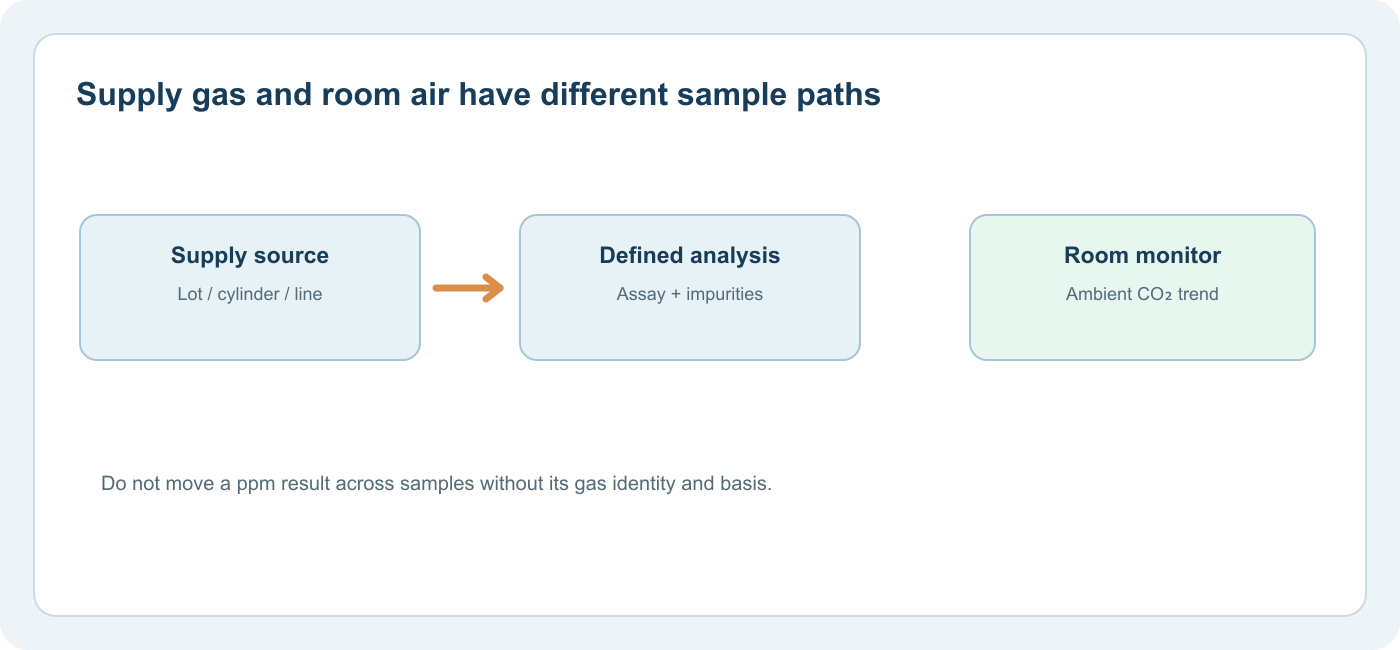
To write a useful procurement request, state the supply source and intended end use; the governing product specification; each analyte and its target interval; required sample pressure, flow, temperature and conditioning; calibration or reference requirements; and what document will demonstrate acceptance. Write a separate ambient brief for the occupied or process area, including expected CO₂ range, placement, response, maintenance and any alarm function. The same purchasing department may handle both, but the technical questions should remain separate.
Read a Lot Certificate as a Measurement Record
A useful certificate links a defined lot or delivery to a named test, result, unit and applicable specification. For a trace impurity, look for the analyte name, method and reporting limit, not just the word “pass.” A statement that a constituent is “below detection” is not a measured zero; its meaning depends on the method's detection or reporting limit. A result can satisfy one application specification and still be insufficient for another application with a different impurity list or limit. The certificate should also make clear which material was sampled and when.
An ambient monitor log answers a different audit question. It should connect a reading to a sensor location, timestamp, calibration status, averaging interval and any fault. It does not inherit a gas lot's certificate merely because that gas is used nearby. If a facility needs both supplier acceptance and environmental monitoring, keep both records and do not merge their ppm columns without gas identity, sample point and basis.
The same distinction matters when a product is marketed as “high accuracy.” Ask accuracy for which analyte in which gas matrix? A CO₂ channel specified for room air might be highly suitable for that purpose while being unable to resolve a trace impurity in nearly pure CO₂. An impurity analyzer can be excellent at its chosen trace constituent yet have no useful room-air CO₂ channel. Capability follows the measurement method and conditions, not the sophistication of the enclosure.
Beware of a Superficially Correct ppm Conversion
The fraction conversion itself is simple: 1% = 10,000 ppm on the same numerator, denominator and basis. That statement helps translate units; it does not turn a CO₂-only reading into an impurity analysis. In the hypothetical 99.9% purity example, the missing 0.1% is 1,000 ppm total non-CO₂ material, not 1,000 ppm CO₂ in ambient air. In a hypothetical ambient 1,000 ppm CO₂ reading, the numerator is CO₂ and the denominator is the ambient gas mixture. The two “1,000 ppm” figures describe different constituents in different samples.
그만큼 Gasnose CO₂ sensor guide provides a broader technology-selection context for different CO₂ applications. The correct next step is still to obtain the actual instrument and gas specifications for the task at hand.
자주 묻는 질문
Can a 0–10,000 ppm room CO₂ meter verify 99.9% CO₂ gas? No. Its stated ambient application and accuracy interval do not establish performance near pure CO₂, and it does not measure the individual impurities.
Does 99.9% purity mean 1,000 ppm CO? No. It means a hypothetical total remainder of 0.1% on the same fraction basis. CO is only one possible constituent and must be measured or constrained separately.
Can a purity certificate prove the room is safe? No. It documents a defined gas sample or lot, not the concentration at an occupied location.
Is a high-range CO₂ analyzer enough for food or beverage gas testing? Not necessarily. A CO₂ assay alone does not establish compliance with all impurity and quality requirements of the applicable specification.
Why might two CO₂ readings differ after sample drying? The wet and dry gas fractions use different denominators if water is removed and CO₂ is preserved. Real sample handling can also introduce other errors.
What should be specified first? The sample point, intended use, required analytes and decision. Those choices determine the range, method and evidence to request.
공기질 점수와 가스 농도 비교: 실내 모니터가 실제로 알려주는 것
오염물질 농도는 명명된 측정값입니다. 공기질 점수는 매핑입니다. 실내 점수를 공식 미국 실외 AQI와 비교하고 모니터의 원시 채널을 검사하세요.
자세히 알아보기
CO 대 CO2 센서: 이중 가스 기기에 두 개의 측정 채널이 필요한 이유
CO 및 CO2 센서는 다양한 가스를 측정합니다. 각 채널, 감지 원리, 범위, 교정, 샘플링 경로 및 완제품 장치 목적을 확인하는 방법을 알아보세요.
자세히 알아보기
습식 및 건식 CO2 판독값: 샘플 기준에 따라 수치가 변경되는 이유
습한 공기와 건조한 공기의 CO2ppm은 수증기가 분모를 변경하기 때문에 다를 수 있습니다. 조건부 변환과 샘플링된 가스 시스템에 기록할 내용을 알아보세요.
자세히 알아보기
CO2 센서 범위:ppm 또는 백분율 측정 선택
중요한 농도와 결정에 따라 CO2 측정 범위를 선택하십시오. ppm 및 퍼센트 단위, 정확도 간격, 초과 범위 동작 및 샘플링 조건을 비교하십시오.
자세히 알아보기
CO2 모니터와 가스 분석기: 샘플링, 데이터 및 기기 선택
샘플 지점, 가스 경로, 측정 범위, 시간 분해능, 교정 증거 및 데이터가 뒷받침하는 결정을 기준으로 CO2 모니터와 가스 분석기를 비교합니다.
자세히 알아보기
CO2 센서 모듈과 전체 모니터 비교: 각 사양이 증명하는 것
CO2 센서 모듈과 완전한 모니터는 다양한 엔지니어링 작업을 해결합니다. 인클로저, 샘플링, 전력, 데이터, 교정, 경보 및 완성된 장치 증거를 비교하십시오.
자세히 알아보기