

건물 자동화 시스템(BAS)이 위치와 의미를 식별하고, 올바른 엔지니어링 값을 획득하고, 유효하지 않거나 오래된 데이터를 인식하고, 필요한 해상도로 증거를 유지할 수 있으면 CO2 센서를 통합할 준비가 된 것입니다. 게이트웨이를 선택하거나 객체 목록을 가져오기 전에 포인트 계약에서 해당 동작을 지정하세요. 표시된 PPM 수치는 센서에서 센서에 의존하는 건물 결정까지의 경로 중 작은 부분만을 확인합니다.
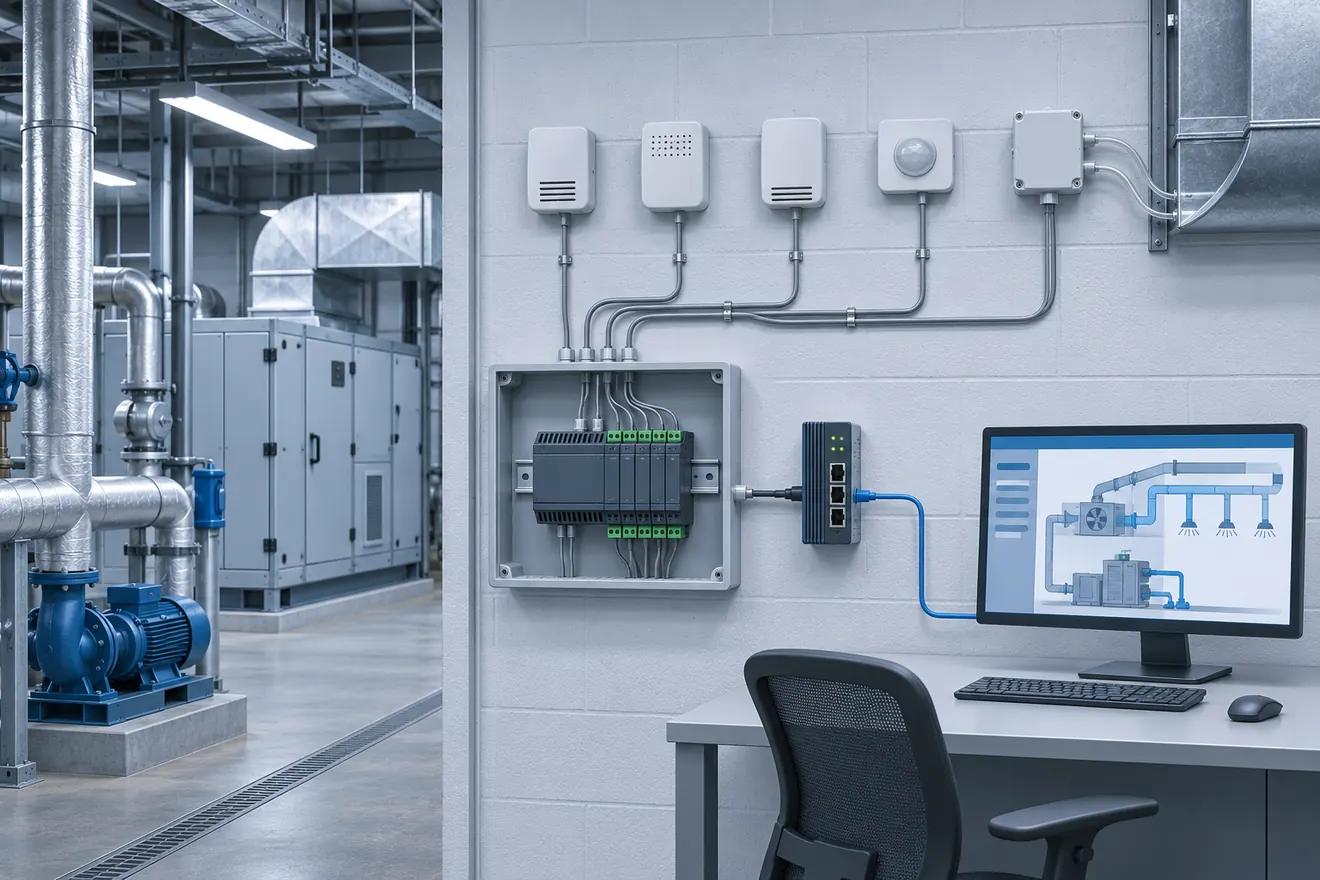
통합 계약은 현장 장치와 소비자 간의 각 전송에서 무엇이 유지되는지 설명합니다.
실제 소비자와 포인트 계약을 해보세요
Begin by stating the consumer's purpose. An operator might review weekly occupancy-related CO₂ patterns. A building engineer might use recent samples in a diagnostic comparison. A local controller might use a verified CO₂ input in an approved ventilation sequence. The same physical sensor can serve more than one purpose, but each consumer has different tolerance for latency, unavailable history and unreliable values. Decide which use is supported and where the authoritative measurement resides.
포인트 계약은 ID, 인터페이스, 의미, 시간, 품질 및 검증을 결합합니다. 그래픽 이름 변경이나 컨트롤러 교체 후에도 지속될 수 있는 안정적인 식별자를 정의합니다. 공간, 구역, 장비 및 센서 자산과 적절하게 연결합니다. 물리적 샘플링 위치와 제어 구역은 별도의 필드입니다. 환기 농도는 그것이 제공하는 각 방을 대표하지 않고 중앙 장치에 속할 수 있습니다. 위치가 공유되거나 센서가 재배치된 경우 유효 날짜를 기록하고 기록 사용자에게 변경 사항을 인식할 수 있는 충분한 정보를 제공하십시오.
| 계약항목 | 녹음할 내용 | 수락 증거 |
|---|---|---|
| 신원 | 안정적인 포인트 ID, 물리적 센서, 공간, 서비스 구역 및 소유자 | 준공 지도와 필드 라벨이 실시간 지점과 일치합니다. |
| 값 | 가스, 엔지니어링 단위, 규모, 범위, 수량 역할 및 정밀도 | 알려진 입력 또는 비교는 모든 매핑을 통해 추적 가능 |
| 인수 | 인터페이스, 소스 주소, 읽기 경로, 업데이트 모드 및 케이던스 | 부하가 걸린 상태에서 예상되는 케이던스로 데이터가 수신됩니다. |
| 품질 | 유효성, 오류, 사용 불가능, 준비, 재정의 및 오래된 의미 체계 | 시뮬레이션 또는 관찰된 상태가 각 소비자에게 올바르게 전달됩니다. |
| 시간 | 소스 대 수신 시간, 시간대, 동기화 및 격차 정책 | 여러 장치에서 시퀀스 이벤트를 주문할 수 있습니다. |
| 역사 | 샘플링 모드, 간격 또는 불감대, 보존 및 내보내기 | 내보내기는 의미, 품질 및 간격을 보존합니다. |
| 사용 | 폴백이 포함된 모니터, 파생 값 또는 승인된 제어 입력 | 소유자에게 분실, 복원 및 사용 목적 확인 |
| 수명주기 | 펌웨어 및 매핑 수정, 교체 및 검토 프로세스 | 핸드오프에는 편집 가능한 아티팩트 및 증거 식별자가 포함됩니다. |
"CO2"라고 표시된 BAS 태그는 그것이 직접 측정된 농도를 나타낸다는 것을 보장하지 않습니다. 실내 센서, 평균 바닥값, 선택된 최대값, 감독 설정점 및 권고 플래그에는 고유한 식별자와 역할이 있어야 합니다. 모니터가 다른 채널에서 추정된 CO2를 보고하는 경우 해당 방법을 유지하고 직접 측정된 CO2와 구별되도록 하십시오. 파생된 통계에는 계산, 소스 입력, 누락된 입력 동작 및 기록된 버전이 필요합니다. 동일한 단위로 표시되는 두 지점은 서로 다른 의미와 권한을 가질 수 있습니다.
Project Haystack's point documentation 센서, 명령 및 설정값 간의 의미적 차이를 보여줍니다. 또한 장비 및 공간에 대한 참조, 숫자 데이터의 단위, 시간대, 기록 모드 및 기록 상태에 대한 태그를 문서화합니다. 태그는 시스템 전체에서 의미를 공유하는 데 도움이 됩니다. 특정 지점이 올바른 물리적 터미널이나 방에 매핑되었는지 확인할 수 없습니다.
BAS 인터페이스와 가스 모듈 구별
A gas module's connector is often designed for a short local link to a host circuit. UART describes serial signaling at one layer and does not guarantee a BACnet or Modbus interface. An I²C output may be useful inside an instrument, but a field system needs a host or transmitter designed to translate the value, maintain its validity and survive the installation conditions. Even when two devices use an RS-485 physical layer, their protocol framing and addressing can be incompatible.
설치된 송신기는 감지 모듈 값을 아날로그 전압이나 전류로 변환하거나, 네트워크 객체를 게시하거나, 두 가지 모두를 수행할 수 있습니다. 전기 출력에는 스케일링 경계가 도입됩니다. 디지털 출력에는 데이터 입력 및 매핑 경계가 도입됩니다. 로컬 디스플레이는 두 출력으로부터 서로 다른 필터링된 신호를 수신할 수 있습니다. 형제 제품이나 유사한 이름의 통신 보드가 아닌 설치된 모델에 대한 설명서와 펌웨어를 확인하십시오.
게이트웨이는 직렬 네트워크에서 룸 포인트를 획득하고 이를 BACnet/IP에 노출하거나, 데이터를 기록자에게 전달하거나, 포인트를 프로젝트 명명 체계로 변환할 수 있습니다. 각 기능은 의미를 변경할 수 있습니다. 예를 들어 게이트웨이는 필드 네트워크 중단 중에 마지막으로 유효한 값을 반복할 수 있습니다. 그러면 클라이언트는 오래된 내용이 포함된 명백히 새로운 응답을 받을 수 있습니다. 이러한 게이트웨이를 사용하는 프로젝트에는 외부 인터페이스의 통신 상태 외에도 소스 업데이트 또는 수명 표시기가 필요합니다.
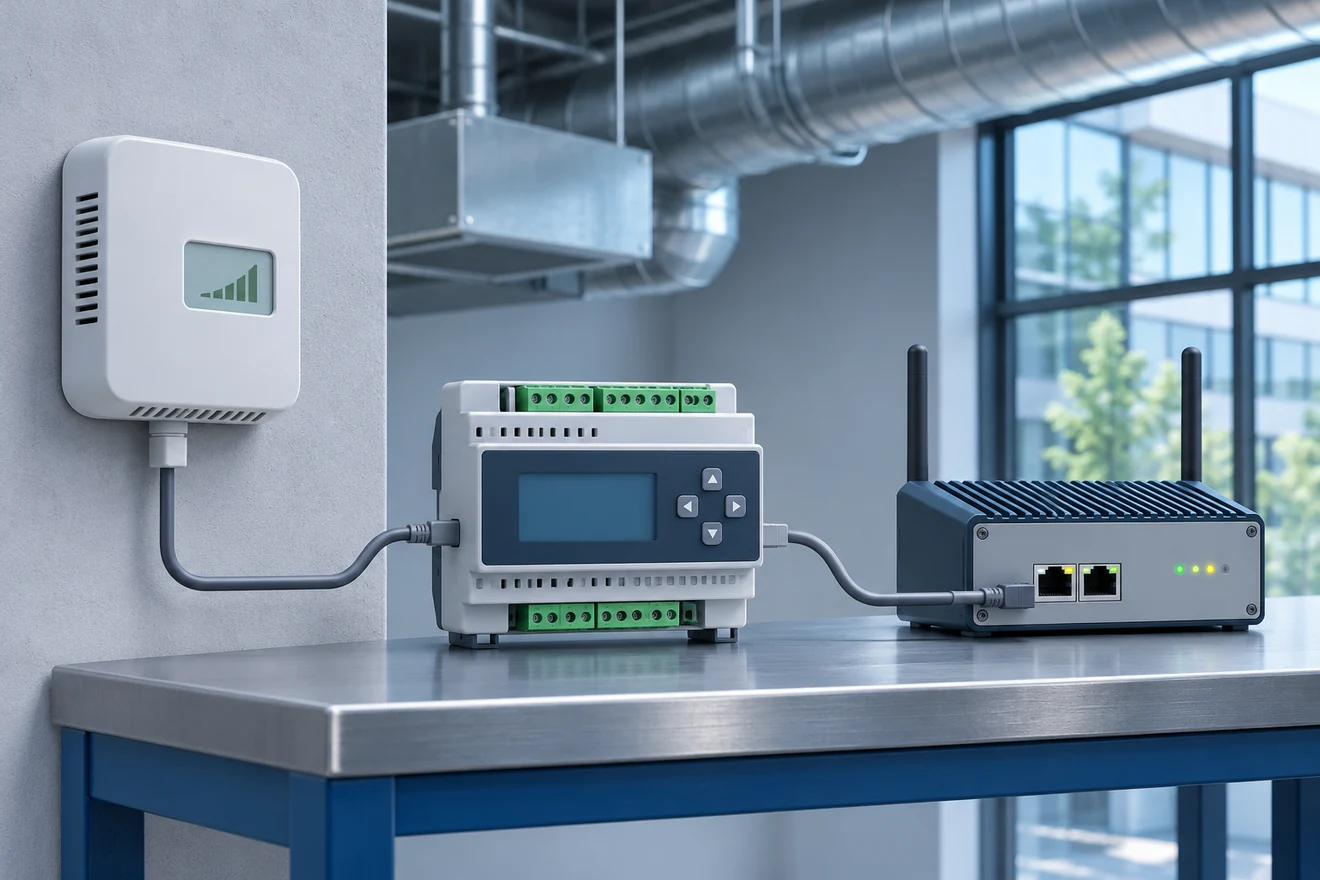
센서, 필드 인터페이스 및 BAS 게이트웨이는 동일한 값에 대해 서로 다른 책임을 갖습니다.
아날로그 스케일링 및 디지털 디코딩 확인
0~2,000ppm 범위의 선형 4~20mA 출력으로 구성된 가상 트랜스미터의 경우 변환은 다음과 같습니다. ppm = (mA − 4) × 125. 예상 값은 4mA에서 0ppm, 8mA에서 500ppm, 12mA에서 1,000ppm, 20mA에서 2,000ppm입니다. 이는 권장 송신기 범위나 현장 테스트 수준이 아닌 스케일링 예입니다. 0~20mA 및 0~2,000ppm으로 설정된 수신기는 동일한 12mA에서 1,200ppm을 표시합니다. 결과 오류는 호환되지 않는 끝점에서 발생합니다.
Check both ends of an analog path. Record the transmitter's configured range, selected output mode and fault behavior. Record the receiver terminal, input type, configured endpoints, engineering unit, expected accuracy contribution and applied filtering. A high or low fault current might be meaningful for one device and unsupported by another. Define what the controller does outside the expected range from the approved documents. A controller that clamps every low signal to the minimum ppm value may hide wiring faults or warm-up states.
디지털 포인트의 경우 제조업체 매핑 개정판을 받아 레지스터나 개체 식별자를 문서화하세요. Modbus의 경우 레지스터 유형 또는 기능, 주소 번호 지정 규칙, 데이터 유형, 부호, 다중 레지스터 값의 바이트 및 단어 순서, 스케일, 오프셋 및 잘못된 값 인코딩을 확인합니다. 표현은 모델에 따라 다릅니다. 카운트당 0.1ppm을 사용하는 가상 정수 인코딩에서 원시 값 8,350은 835ppm을 나타냅니다. 통신 스택이 성공적인 트랜잭션을 보고하더라도 잘못된 요소로 올바른 주소를 읽으면 8,350ppm이 보고됩니다.
Keep the number used in the vendor manual and the address used in the integration tool when they follow different conventions. Also keep a decoded example and a raw value example with the map revision. The person replacing a gateway should be able to tell whether a displayed "40001" is a label or an address already interpreted by software. Johnson Controls' Metasys point-mapping documentation illustrates a vendor-specific commissioning workflow; the field device documentation supplies the actual interpretation.
For BACnet, identify the device and object type/instance together with the property read and the engineering units used by the project. Confirm whether the point represents a physical input, a derived value, a communicated proxy or a setpoint. The manufacturer's Protocol Implementation Conformance Statement (PICS) helps identify supported BACnet functionality. It does not establish project point mappings, actual device configuration or the application behavior under a fault. BACnet 국제 용어집
A real equipment example is Trane's Symbio integration guide, which distinguishes local and communicated points and documents an arbitrated result for applicable inputs. The lesson is to name the exact exposed quantity before trend or control users infer a physical origin from the label. The project's observed source should be checked through mode changes and loss or restoration of the communicated input. Trane Symbio BACnet 및 Modbus 통합 가이드

검증된 전기 입력은 기본 농도 측정과 인터페이스 스케일링을 분리하는 데 도움이 됩니다.
가치 품질과 장비 모드를 눈에 띄게 유지하세요.
성공적인 읽기는 제어 또는 해석에서 제외되어야 하는 값을 반환할 수 있습니다. 센서가 예열 중이거나, 이전 판독값의 값이 유지되거나, 포인트가 무시되거나, 트랜스미터가 지정된 범위를 벗어났을 수 있습니다. 소스 상태를 유지하고 소비자별 사용성 결정을 유지합니다. BACnet 객체의 경우 적용 가능한 상태 및 신뢰성 속성이 인터페이스를 통해 구현되고 전달되는지 확인합니다. 등록 포인트의 경우 문서화된 진단 소스를 확인하세요. 누락된 프로토콜 플래그가 반드시 유효한 데이터를 나타내는 것은 아닙니다.
장비 작동 모드와 측정 상태를 분리하세요. 판독값은 팬이 차단된 동안 유효할 수 있지만 정상 작동 중 판독값과 다른 작동 상황에 속할 수 있습니다. 반대로, CO2 입력이 유효하지 않은 동안 팬이 정상적으로 작동할 수 있습니다. 분석이 구분에 따라 달라지는 경우 둘 다 저장합니다. 센서가 의도적으로 시뮬레이션되거나 승인된 테스트 중에 포인트가 작동하지 않는 경우 내보내기의 값과 함께 해당 상태를 유지하십시오.
마지막으로 알려진 값은 수명 및 상태와 함께 표시되는 경우 운영자 디스플레이에 유용할 수 있습니다. 간격을 가로질러 선을 그리는 차트나 모든 여론 조사에서 새 샘플을 검색한다고 가정하는 제어 루프에서는 오해의 소지가 있을 수 있습니다. 오래된 데이터를 계산에서 제외할지, 디스플레이에 주석을 달지, 간격으로 기록할지, 별도의 플래그와 함께 전달할지 여부를 정의합니다. 허용된 제어 사용의 경우 승인된 폴백을 별도로 문서화하고 실제 입력을 사용할 수 없게 될 때 작동하는지 확인하십시오.
Distinguish an instrument reporting a steady valid concentration from a gateway that is frozen. Value equality cannot establish freshness. A timestamp, acquisition sequence, explicitly defined heartbeat or fault register may provide the necessary evidence. If the integration cannot distinguish those states, record the limitation in the contract and decide which consumers can use the point given that evidence.
Separate the clocks from the sampling policies
센서 측정 업데이트, 컨트롤러 스캔 또는 폴링, 게이트웨이 새로 고침 및 내역 기록 간격을 기록합니다. 이러한 기간은 다를 수 있으며 센서 응답 시간을 정의하지 않습니다. 5초 동안 BAS를 새로 고치면 50초마다 새로운 측정값을 생성하는 센서에서 10개의 동일한 값을 표시할 수 있습니다. 1분 아카이브는 컨트롤러가 유효한 순서로 사용하는 경우에도 중간 업데이트를 놓칠 수 있습니다.
Decide what each timestamp means. The time the sensor measured an observation, the time a controller read it and the time a historian inserted it are different. A device that does not supply source timestamps can still be useful if the gateway labels receipt time accurately. For multi-point diagnostics, measure clock error, preserve UTC or an explicit offset and document display-local time. A repeated clock hour at a daylight-saving transition can make two different events appear simultaneous if the export keeps only local strings.
Select interval or change-of-value history according to the question being answered. Periodic history gives a regular grid, but can create repeated stale-looking values without quality context. Change-of-value history can reveal transitions and reduce storage, but a flat or missing interval can be ambiguous if no heartbeat, status transition or periodic confirmation is included. Averages may suit summaries while hiding brief changes needed for troubleshooting. Retain sufficiently detailed data for the verification window and state how raw and summarized records relate.
The archive configuration deserves its own checkout, even when its points carry a shared semantic model. Brick's point documentation shows how a point can be related to equipment and given an explicit unit such as ppm. Those relationships describe a series. The integrator still needs to verify that the historical consumer can retrieve the series, that it uses the intended time source and that its retained evidence covers the agreed use. 데이터 소스 모델링에 대한 브릭 문서

각 스트림의 시계 타임스탬프와 변경 사이에 아카이브가 수행하는 작업을 기록합니다.
각 경계의 양쪽을 비교하여 점을 승인합니다.
Begin by verifying the physical sensor against the installed asset list. Use a project-approved comparison with a suitable reference and comparable air conditions. If the objective is analog or register scaling, a controlled signal simulation can test the interface boundary without proving that the sensing element itself is accurate. Keep the comparison and the signal simulation separate in the record.
At the field interface, capture the sensor display or manufacturer diagnostic value, raw voltage or current if relevant, or returned register and status. Then compare the controller's raw and engineering readings, the BAS graphics, the stored history and the external consumer if present. An exact match of rounded values is rarely the right criterion. Use the project's specified tolerance, input resolution and method uncertainty. Record whether sequential readings were taken while the environment was stable or whether observations were synchronized.
Acceptance should include adverse cases. A disconnected field path tests one type of loss. A gateway that can still answer with a held value tests another. An actual quality flag, data timeout, sensor restart and override each carry a different meaning. Exercise relevant states under an approved procedure and verify that status travels through every consumer. A control consumer needs a separate review of its behavior in normal, unavailable and recovered modes.
| Hypothetical event | Field evidence | Intended downstream result |
|---|---|---|
| Stable comparison near 835 ppm | Source value and condition documented | BAS reading agrees within project tolerance and uses ppm |
| Sensor remains level | Device reports current valid observations | Trend policy distinguishes unchanged from unavailable |
| Field link drops but gateway stays up | Source update stops and gateway reports old cache | Value becomes stale according to defined policy |
| Controller placed in a supervised test state | Simulated value and test flag recorded | Operator can identify the test and its scope |
| Field link returns | New valid observations and age recorded | Display and authorized controls recover according to verified rules |
These rows are proposed verification cases, not real test results. Define the expected timing, pass criteria and source behavior before tests so a surprising result can remain open as evidence. Restore approved operating conditions after testing and note who verified the restoration.

Field communications failure and gateway availability can occur at the same time.
Preserve enough information to replace a device
A handoff needs the native point schedule, as-built identifiers, configuration and test evidence. Include the protocol document, exact address, version, unit mapping, timestamps, quality states and control dependencies. A device replacement can preserve the room name while changing output range or firmware behavior. Require a targeted point check and a review of adjacent history so later users know where continuity is reliable.
Separate human display names from stable integration identifiers. A room can be renumbered without altering historic ownership of the observations. Conversely, retaining an identifier after physically moving a sensor could silently merge two spaces. Document such transitions in the project system rather than treating every name change as an asset change or every asset change as a mere label update.
An owner also needs a way to identify failing integration before analysts discover it. Review how the BAS signals an increasing age, partial network loss, a missing historian point or a controller under override. Define which team receives each condition and where the operating record lives. The commissioning evidence is most useful when a later operator can repeat the checks with the documentation available to them.
Write a point schedule entry the next integrator can use
For a hypothetical monitor-only installation, the CO₂ transmitter serves meeting room M210 and has asset identifier IAQ-M210-01. The stable BAS point name is M210.RoomAir.CO2 and its unit is ppm. Its role is a direct room measurement used for diagnostics. The local controller is the authoritative BAS source. The point schedule references the transmitter's configured range and field interface, records the exact source address or terminal, and separately identifies the historian tag. If room naming changes, a metadata revision links the former display label and the same physical measurement history.
The site uses an acquisition period chosen to match the sensor's supported update behavior and the intended diagnostic window. History is sampled periodically, includes quality, and reports time in UTC with a separate display-local time setting. A successful outer network poll is insufficient for freshness; the controller tracks the most recent completed acquisition from the transmitter. If the site defines a stale interval, the project records how the timer behaves on startup, network recovery and repeated reads of unchanged values. The operator can distinguish these states without checking the polling driver.
For contrast, a proposed floor-level aggregate would need a second entry even if it shares the ppm unit. The entry would identify the population of room inputs and the statistic, such as a maximum of usable sources. It would state how the calculation behaves with a failed room point, whether the number of contributing points is reported and how long an individual sample remains eligible. If all inputs are unavailable, the output should reflect the agreed missing state. A floor maximum with six rooms contributing and one with only one room contributing carry different diagnostic context.
| Schedule entry | Room point example | Aggregate example |
|---|---|---|
| Role | Directly measured room concentration | Derived maximum of eligible room readings |
| Source identity | One named field asset | Versioned list of room point IDs |
| Usability | Source reports valid and fresh | Eligibility rule and contributor count |
| Timestamp | Defined acquisition or receipt time | Calculation time plus source age policy |
| 수락 | Field comparison and mapping checks | Test changed values and loss of contributors |
| Control use | None in this example | None in this example |
These names illustrate how to record meaning. They are not a standardized BAS naming convention. The project can follow its own names provided the location, quantity and relationship are recoverable independently of the graphics.
Test two failures that can look alike on a dashboard
In a hypothetical overnight trend, a conference room reports a level concentration near outdoor background for hours. The first explanation is ordinary. The room is vacant, the point receives new valid observations, and rounding makes small variations invisible. The second explanation is a gateway replaying its last sample. The rendered line can look the same. Inspect source observations or freshness evidence, upstream and downstream communications and the latest quality update. A graphical flat line establishes neither fault nor health by itself.
Now consider a value that returns to normal after a service visit, while the export shows an unexplained gap. The display may have recovered immediately but the historian might have been disabled or its source tag renamed. Check the enabled status and start time for the correct archive. If the gateway did backfill observations, verify whether source timestamps and original quality were preserved. Backfilled receipt times can make a past event appear to happen at recovery. Preserve actual gaps and mark transformed records clearly rather than visually joining every segment.
Two clocks can further confuse diagnosis. Suppose the sensor itself has no timestamp, the controller receives a new reading at 09:00:25, and the history service stores the latest reading at 09:01:00. If the exported timestamp is the logging time, pairing this row with a 09:01:00 damper event does not establish that the room concentration changed at the same instant. If the system preserves both timestamps, the reader can distinguish the last confirmed receipt from the archive record. Neither clock can establish the precise instant of the concentration change at the inlet.
Check units at conversions and exports
Standardize ppm representation at each receiving boundary and document any conversion from the transmitted form. A point labeled percent, ppm or a raw integer should never be interpreted from value magnitude alone. One percent of a volume or mole fraction corresponds to 10,000 parts per million on the same basis. Changing from a volumetric concentration to mass per volume involves additional physical assumptions and should be explicit. Sensor1stop’s explanation of CO₂ ppm describes the concentration unit used for typical monitor displays.
Make sure the engineering unit persists in CSV headers, API metadata, dashboards and derived calculations. A graphics label can be right while the export field is unlabeled. Reconcile displayed precision with source resolution, accuracy and project tolerance. Adding decimal places after converting an integer point to a floating-point representation does not create new measurement information.
Include a documented data access check for a user with the normal operator role. Can the operator export the point with units and quality and identify the associated equipment? Can they retrieve data across a date boundary without losing offsets or gaps? A system with a correct field map but inaccessible history may still fail its diagnostics purpose. Record any authorized access dependencies and keep the acceptance record useful when responsibilities change.
자주 묻는 질문
Is RS-485 enough information to select a BAS input?
No. RS-485 defines electrical characteristics. Confirm the protocol, supported roles, settings, device address and point map. A compatible electrical connection can still fail to provide usable information.
Does BACnet discovery verify the point?
Discovery establishes visibility of a device or object under the observed conditions. Confirm the object's identity, units, quality and relationship to the real sensor. Then check what the controller and historian use.
Is 0 ppm a good code for missing CO₂?
Use a distinct missing state, or an explicitly defined sentinel kept separate from valid engineering values. Reporting a missing reading as zero can mislead plots, diagnostics or decisions.
Can a gateway timestamp substitute for the sensor clock?
It can record receipt time if labeled accordingly. It cannot establish precisely when the sensor measured the value or how long the value was cached upstream. Confirm the available timing evidence matches the application.
Why does the chart show a gap if the live display looks normal?
Live acquisition and history collection are separate. Check that the trend is enabled, that it reads the intended source, and that data quality, retention and exports are behaving as specified. A recovered live point does not recreate missing observations.







답장을 남겨주세요