

For a CO2 accuracy specification written ±(A ppm + B% of reading), multiply the stated reading by B/100, add A, and retain the result as a plus-or-minus allowance in ppm. For the hypothetical specification ±(50 ppm + 3% of reading), a reading of 1,000 ppm gives 50 + 30 = 80 ppm. The expression is ±80 ppm under the conditions attached to that specification.
The arithmetic does not establish a true concentration, a confidence interval, or a calibration result. It translates a manufacturer's claim into a useful unit. To decide whether a monitor meets an application requirement, also check the concentration range, environmental conditions, calibration assumptions, output path, and verification method. The same monitor can have a broad measurement range and a narrower range over which its accuracy is specified.

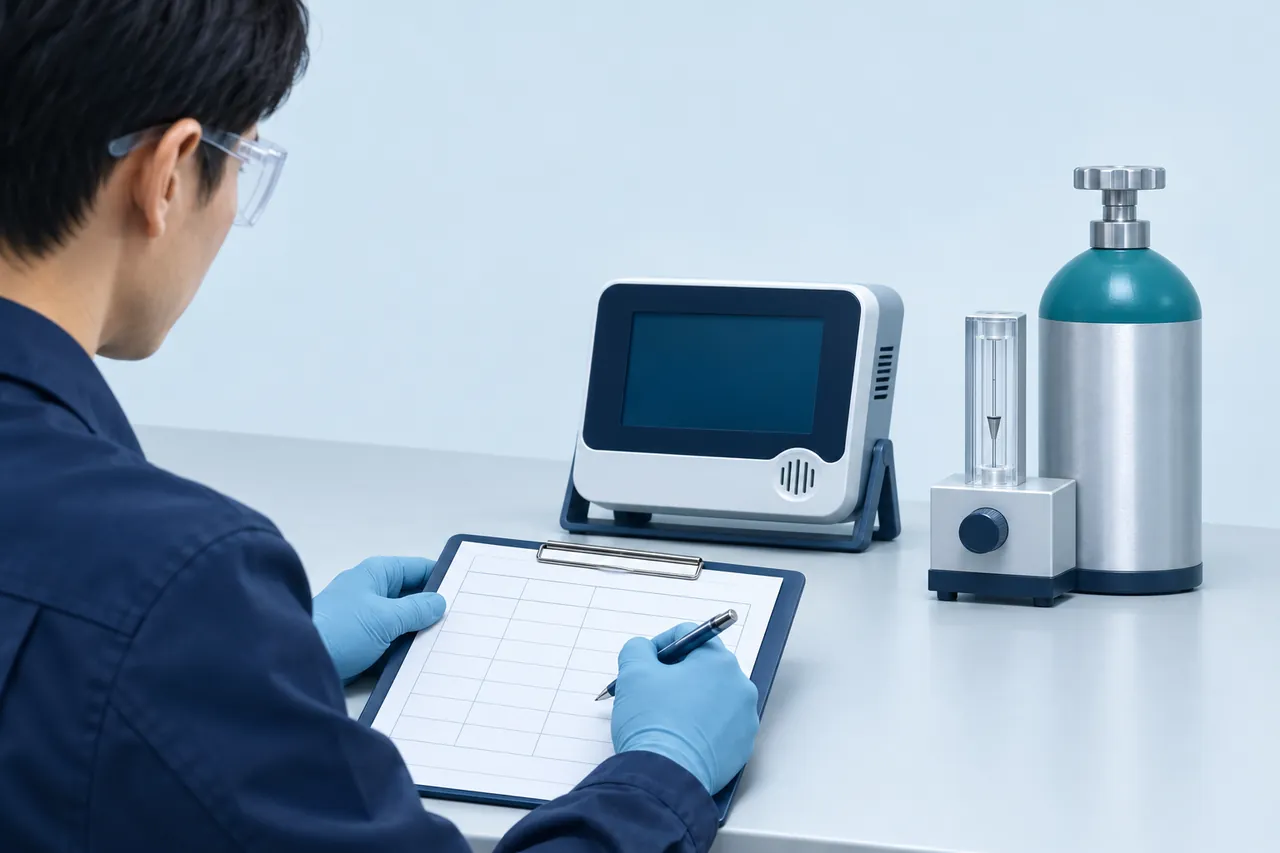
Conceptual instrument comparison scene. All numerical examples below are constructed examples, not measurements of the pictured equipment.
Read the entire expression before calculating
The fixed ppm term remains the same throughout a stated range. The reading term increases with concentration. Neither is optional when the formula uses a plus sign. A useful calculation worksheet has separate columns for concentration, fixed contribution, proportional contribution, total allowance, and applicable conditions. This makes a misunderstood percent sign easier to detect than a single final result.
Use the concentration named by the source. Some verification procedures evaluate the allowance at the reference concentration, while a product specification may explicitly say percent of measured value. These conventions are close at small errors but are not identical. Record the convention and follow the manufacturer's verification method rather than silently switching between them. In the examples here, C is the displayed or measured reading unless explicitly stated otherwise.
At 400 ppm, the hypothetical 3% term contributes 12 ppm, giving 62 ppm overall. At 2,000 ppm, it contributes 60 ppm, giving 110 ppm overall. At 5,000 ppm, it contributes 150 ppm, giving 200 ppm overall. The final allowance increases, even though the same formula applies throughout. The relative allowance decreases because the fixed contribution becomes a smaller fraction of the concentration.
| Reading C | Fixed contribution | 3% contribution | Total A + 0.03C | Total divided by reading |
|---|---|---|---|---|
| 400 ppm | 50 ppm | 12 ppm | 62 ppm | 15.5% |
| 1.000 ppm | 50 ppm | 30 ppm | 80 ppm | 8.0% |
| 2.000 ppm | 50 ppm | 60 ppm | 110 ppm | 5.5% |
| 5.000 ppm | 50 ppm | 150 ppm | 200 ppm | 4.0% |
A última coluna é uma tolerância relativa calculada para este exemplo. Não é uma nova especificação independente. Perto de zero, dividir pela leitura torna-se inútil ou indefinido, enquanto o termo fixo ainda tem significado. Não force uma comparação percentual na concentração zero.
As duas contribuições são iguais quando A = bC, onde b é a percentagem expressa em fração. Aqui C = 50/0,03 = 1.666,7 ppm. Abaixo desse valor, o prazo fixo contribui mais; acima dele, o termo leitura contribui mais. Este cruzamento é útil ao selecionar pontos de comparação, mas não é uma transição física no sensor.

The two contributions are added in the stated specification. The blocks are conceptual and do not encode measured values.
Plus, or, and full scale give different answers
A phrase such as “50 ppm or 3% of reading, whichever is greater” is a different rule. At 1,000 ppm, the two candidates are 50 ppm and 30 ppm, so the larger is 50 ppm. The additive expression gives 80 ppm. At 2,000 ppm, the larger candidate is 60 ppm, while the additive expression gives 110 ppm. Copying the same numerical terms without their connecting words changes the claim.
Percentage of full scale is also different. A hypothetical ±3% full-scale allowance on a 5,000 ppm range is ±150 ppm throughout that range. At 1,000 ppm, ±3% of reading is only ±30 ppm. Changing a transmitter's configured output span may or may not change a manufacturer's specified full-scale basis; the relevant documentation must identify which span is meant.
Os pontos percentuais exigem outra distinção. Uma mudança de 1,00% de CO2 para 1,03% de CO2 é de 0,03 pontos percentuais, igual a 300 ppm. É um aumento relativo de 3% em relação a 1,00%. Enquanto isso, 3% de uma leitura de 1.000 ppm equivale a 30 ppm. O símbolo de porcentagem por si só não identifica a aritmética. Anote a quantidade base antes de fazer uma conversão.
Translate a product claim without expanding its scope
O Ficha técnica do Sensirion SCD30, version 1.0, May 2020, specifies ±(30 ppm + 3% of measured value) over 400–10,000 ppm. Its table and footnotes also identify reference conditions and calibration qualifications. At a measured value of 1,000 ppm, the expression becomes ±60 ppm; at 5,000 ppm, it becomes ±180 ppm. Those calculations apply the published formula, not an independent evaluation of any finished product containing that module.
O mesmo documento distingue uma faixa de medição digital mais ampla da faixa de precisão. Uma saída numérica válida além de uma faixa de precisão não estende essa faixa. Um instrumento completo pode ainda limitar sua exibição, escala do transmissor, aplicação aprovada ou condições ambientais. Para compras, coloque o intervalo relevante próximo a cada número calculado para que uma comparação aparentemente impressionante não possa esconder um ponto fora do intervalo.
O Perguntas frequentes sobre precisão de Murata fornece expressões separadas de desempenho real e de especificação. Este é um lembrete útil de que uma declaração de desempenho típica ou observada não pode substituir automaticamente uma especificação formal. Identifique o modelo exato, a revisão atual do documento, o status do produto e as condições antes de tratar uma declaração geral de perguntas frequentes como um limite de aceitação contratual.
As páginas de produtos podem resumir vários canais em um cartão compacto. Por exemplo, o Página DwyerOmega Series-CO2 includes CO2, humidity, and temperature information. A short resolution field without a channel identifier should not be assumed to describe CO2. The detailed CO2 accuracy line is the relevant place to start, followed by the model's full manual and data table.
Uma comparação pode ser revertida com concentração
Consideremos dois instrumentos hipotéticos, ambos adequados para as mesmas condições. O instrumento A é especificado em ±(30 ppm + 3% da leitura). O instrumento B é especificado em ±(50 ppm + 2% da leitura). A 500 ppm, A dá 45 ppm e B dá 60 ppm. A 3.000 ppm, A dá 120 ppm e B dá 110 ppm. A maior tolerância numérica muda com a concentração.
Defina 30 + 0,03C = 50 + 0,02C para encontrar o cruzamento. Subtrair os termos dá 0,01C = 20, então C = 2.000 ppm. Ambas as expressões dão 90 ppm ali. Esta é uma comparação de duas fórmulas assumidas, não uma classificação de marcas, sistemas de calibração ou confiabilidade geral. Uma tolerância mais restrita só é útil se as suas condições e âmbito se adequarem à medição pretendida.
| Leitura hipotética | R: 30 ppm + 3% | B: 50 ppm + 2% | Subsídio de fórmula menor |
|---|---|---|---|
| 500 ppm | 45 ppm | 60 ppm | A |
| 1.000 ppm | 60 ppm | 70 ppm | A |
| 2.000 ppm | 90 ppm | 90 ppm | Igual |
| 3.000 ppm | 120 ppm | 110 ppm | B |
Compare at concentrations that matter to the application rather than selecting only the crossover or an easy ambient point. A room-monitoring application and a higher-concentration process application can reasonably emphasize different points. Avoid treating a ventilation product's ppm expression as evidence that it is suitable for an unrelated process gas or safety function.
Mantenha a tolerância, o desvio medido e a incerteza separados
Suppose a monitor indicates 1,080 ppm while a suitable reference reports 1,000 ppm under stable, matched conditions. The observed signed deviation is +80 ppm. This subtraction describes the comparison. It does not by itself prove that the monitor's error relative to the true measurand is exactly +80 ppm, because the reference and the comparison arrangement also contribute uncertainty.
For the hypothetical ±(50 ppm + 3% of reading) rule, evaluating at the monitor's 1,080 ppm gives 82.4 ppm. Evaluating at the 1,000 ppm reference gives 80 ppm. This is a deliberately marginal example: the convention matters near a decision boundary. A test method should specify the evaluation point and decision rule before the result is known. Choosing whichever convention passes a result is not a defensible verification method.
O Vocabulário Internacional de Metrologia provides the terminology behind error, uncertainty and precision. An engineering worksheet should keep the observed comparison, published allowance and comparison uncertainty in separate fields. Doing so prevents a tolerable disagreement from becoming a false claim of exact accuracy.
A manufacturer's additive formula is not an instruction to calculate the root-sum-square of its two terms. For 50 ppm and 30 ppm, the specified sum is 80 ppm; the root-sum-square would be about 58.3 ppm and would change the claim. Statistical combination belongs to an explicitly defined uncertainty model with justified distributions and dependencies, not to casual rewriting of an accuracy line.
Da mesma forma, não adicione a incerteza de referência à tolerância do produto e declare o resultado maior como uma banda passante universal. Algumas regras de decisão utilizam faixas de guarda ou outro tratamento de incerteza. O procedimento contratual ou laboratorial aplicável determina a regra. Um registro local útil pode indicar “desvio observado +80 ppm; magnitude permitida 80 ppm no ponto de referência; incerteza e regra de decisão registradas separadamente” sem reivindicar mais do que as evidências suportam.

A co-localização apenas suporta uma comparação quando a exposição ao gás, o tempo, as condições ambientais e a adequação da referência são controlados.
Two monitors can disagree while each fits its allowance
At an assumed common concentration of 1,000 ppm, two instruments with ±80 ppm allowances could hypothetically indicate 920 and 1,080 ppm. The disagreement would be 160 ppm. This is a simple bound illustration assuming the same allowance basis and conditions. It is not the predicted distribution of differences between real instruments.
O acordo também tem limites como prova. Dois monitores que leem 1.050 ppm podem compartilhar uma suposição de calibração, problema de compensação ambiental ou viés de exposição. As exibições correspondentes, portanto, não estabelecem rastreabilidade. Um terceiro monitor de consumo pode ajudar a localizar uma inconsistência grosseira, mas só se torna uma referência quando são estabelecidas a sua adequação e incerteza para a comparação.
Verifique as condições que podem invalidar um cálculo caprichado
Temperature, pressure, humidity, calibration status, warm-up, sampling and housing design can all determine whether a stated specification applies. Their effects should be handled according to the model documentation. Do not automatically add every published sensitivity coefficient to an accuracy term: some effects may already be included within a stated condition range, while others are explicitly additional.
O Guia de design do SCD30 emphasizes gas exchange, separation from external heat sources and protection against problematic airflow. These are integration conditions, not decorative installation advice. A module installed beside a warm processor or behind an unsuitable enclosure opening is a different measurement arrangement from a bare module under its reference conditions.
Pressure deserves particular attention when a monitor is moved between sites or connected to a sampling system. A gas sensor may require an external absolute-pressure value, use a configured assumption, or include an onboard measurement. “Pressure compensated” does not establish which of these applies. Check the value actually used and whether it represents the gas at the measurement cell.
Humidity basis can create another comparison problem. A reference that reports dry-gas mole fraction and a monitor exposed to humid air may not report the same measurand. Correcting the difference requires measured conditions and an appropriate method, not a generic offset. Similarly, a cylinder's nominal concentration alone is insufficient without its certificate, balance gas, validity and delivery suitability.
| Condição para gravar | Por que isso muda a interpretação | O que obter |
|---|---|---|
| Faixa de concentração de precisão | A faixa de saída pode ser mais ampla | Tabela de modelo exato e notas de rodapé |
| Temperatura e pressão | A compensação e os efeitos residuais são condicionais | Valores reais e configurações ativas |
| Estado de calibração | O ajuste pode ocultar um erro encontrado | Última ação, modo e leituras antes/depois |
| Arranjo de amostragem | Gás ou atraso diferentes podem imitar desacordo | Posições, tubulação e intervalo estabilizado |
| Saída usada | O display e o caminho analógico podem ser diferentes | Leitura digital, dimensionamento e canal de recepção |
| Base de referência | Comparação de alterações de incompatibilidade de gás seco/úmido ou de equilíbrio | Definição de certificado e medição |

Os insumos ambientais pertencem ao modelo de mensuração. A presença deles em uma bancada não demonstra que um monitor acabado os utiliza corretamente.
Crie uma planilha de aceitação em torno do aplicativo
Start with the quantity being measured and the decision it will support. Write the relevant concentration interval and environmental envelope. Then identify the exact product specification that applies to that interval. A single spreadsheet cell labelled “accuracy” cannot preserve all of this information; a small structured table is more useful.
For each point, retain the original formula as text, calculate the fixed and proportional terms separately, and record whether the percentage is based on reading, reference or full scale. Include units in headings and in any exported report. Keep the unrounded calculation internally, while reporting the final allowance with sensible precision consistent with the specification and procedure.
Consider a hypothetical monitoring requirement that permits a magnitude of deviation no greater than 100 ppm at selected check points. A candidate specified at ±(50 ppm + 3% of reading) gives 80 ppm at 1,000 ppm and 110 ppm at 2,000 ppm. On the formula alone, it fits the first numerical requirement and exceeds the second. This tells the buyer where further evidence or a different product may be needed; it does not establish actual failure of an untested device.
Não substitua esta revisão por uma tolerância média em toda a faixa. Uma média poderia esconder o ponto onde a aplicação é mais exigente. Distinguir também um requisito de concentração absoluta de um requisito para pequenas diferenças de concentração. A subtração de duas leituras pode introduzir contribuições de ambas as cadeias de medição, de modo que a margem para um único instrumento não é automaticamente a margem para a diferença.
Preservar a observação antes do ajuste
Record the as-found result before changing calibration, compensation, filters or scaling. A post-adjustment result answers whether the adjusted system meets the chosen check; it cannot reconstruct the error present before the work. Include instrument identity, firmware, settings, reference identity, environmental values, stabilization criterion, raw readings and calculation convention.
Repeat a check when the original arrangement did not provide stable or representative exposure. Document why the first result was invalid rather than deleting it. If a repeat differs, identify what changed: gas delivery, equilibration, pressure input or instrument configuration. Otherwise, the worksheet becomes a collection of selected passing numbers rather than evidence about the instrument.
Para verificação recorrente, use os mesmos pontos de comparação quando for prático. Alterar todos os pontos, a referência, o filtro de software e o arranjo de exposição juntos torna uma diferença posterior difícil de interpretar. Um registro controlado ajuda a separar uma mudança real de instrumento de um método alterado. O procedimento ainda deverá ser revisado quando a configuração original for inadequada; a reprodutibilidade de um método falho não é o objetivo.
Um registro de aceitação útil retém a especificação original, as condições reais, o desvio medido e a regra de decisão em conjunto.
Armadilhas de cálculo comuns e como capturá-las
Inserir 3 em vez de 0,03 multiplica a leitura por três, em vez de três por cento. Uma verificação simples e independente é calcular primeiro 1%: a 1.000 ppm, 1% é 10 ppm, então 3% deve ser 30 ppm. Essa verificação mental detecta erros decimais e células da planilha que já aplicam formatação percentual.
Misturar ppm e concentração percentual é outra armadilha. A concentração de um por cento corresponde a 10.000 ppm. Se uma planilha armazena uma leitura de 1.000 ppm como concentração de 0,1%, sua representação numérica deve ser tratada de forma consistente antes de combinar com um termo expresso em ppm. Converta ambas as contribuições na mesma unidade antes da adição.
Using the configured analog span as the denominator without checking the claim can produce a much larger error. A transmitter may have a physical measurement range, an accuracy range and a user-configured output span. They answer different questions. Read the source's definition of full scale instead of inferring it from the screen or control-system configuration.
Arredondar antecipadamente pode afetar um resultado limítrofe. Se uma contribuição proporcional for de 32,4 ppm, preserve-a até que o subsídio final declarado seja calculado. O procedimento de aceitação deve descrever o arredondamento e o tratamento dos limites. Uma exibição arredondada pode ocultar uma pequena diferença subjacente, portanto, retenha valores digitais brutos ou registrados quando o procedimento permitir e a interface for compreendida.
Finally, a published formula is not a calibration correction. Subtracting 80 ppm from every reading because the allowance is ±80 ppm has no technical basis. The formula describes a permitted or stated magnitude under conditions; it gives neither the sign nor the actual magnitude of an individual instrument's deviation. Apply a correction only from a justified calibration model.
Review the complete instrument, not only its sensing element
A product built around a documented sensing module has additional design choices. The enclosure controls gas access, the power supply affects operating conditions, the software applies settings, and the output path presents the result. A module's data table is valuable evidence about the component. It does not automatically describe every finished monitor that uses it.
For an OEM comparison, ask which conditions were verified after integration. Was the final enclosure fitted? Were its usual processor, display and communications functions operating? Which compensation values were applied? Was the output taken from the module, the front panel or a building controller? These questions connect the published formula to the measurement that the application will actually use.
Consider a hypothetical integrated monitor whose sensing module meets an 80 ppm allowance at a check point. If the receiving system has an independently identified offset, the application may observe a larger deviation. The correct response is to characterize the full path. Assigning the whole discrepancy to the gas module or subtracting a guessed fixed allowance conceals the actual issue.
An acceptance specification can state both a component requirement and a complete-system requirement when necessary. Keep their scopes distinct. A supplier may reasonably provide a module report while an integrator supplies the final monitor evidence. The reader needs to know which measurement arrangement each report covers and whether the intended installation remains within that arrangement.
Mantenha os cálculos reproduzíveis quando uma especificação for alterada
Registre a revisão do documento usada em uma comparação. Se uma revisão posterior alterar a expressão, o intervalo ou as condições, preserve o cálculo anterior em vez de substituí-lo silenciosamente. Uma decisão de aquisição tomada no âmbito de uma reclamação e uma verificação de manutenção posterior no âmbito de outra necessitam de uma relação explícita. A alteração pode refletir uma gama de produtos alargada, um método de teste revisto ou um resumo corrigido; investigue em vez de assumir que o desempenho mudou fisicamente.
Uma planilha reproduzível armazena entradas separadamente das fórmulas. Coloque A, b, a leitura relevante e qualquer base completa nas colunas nomeadas. Inclua uma verificação aritmética independente em uma ou duas concentrações simples. Uma célula de planilha copiada pode reter o intervalo ou a base percentual errada, mesmo quando o resultado exibido parece plausível.
Por exemplo, usar 2 em vez de 3 como coeficiente percentual a 2.000 ppm resulta em 90 ppm em vez de 110 ppm para a especificação hipotética de prazo fixo de 50 ppm. Ambos os resultados parecem razoáveis isoladamente. Manter o texto original ao lado dos campos de entrada torna a discrepância detectável durante a revisão. O registro deve mostrar de onde veio cada coeficiente, em vez de depender da memória.
Evite formatar uma margem calculada como um erro observado. Rotule-o como “permissão de especificação calculada” e forneça a concentração da avaliação. Rotule uma subtração de teste como “desvio de referência observado”. Rotule a incerteza com as informações de cobertura declaradas, quando disponíveis. Esses títulos tornam o relatório compreensível para um revisor posterior que não assistiu à comparação sendo realizada.
Perguntas frequentes
±80 ppm significa que a concentração real está sempre dentro de 80 ppm do display?
It describes the translated specification under its stated scope and conditions. It is not automatically an absolute guarantee for every device, environment or time, and it is not a probability statement. Consult qualifications concerning production population, calibration and operating conditions. A measurement result with uncertainty needs its own documented comparison or calibration basis.
Can I ignore the fixed term at high concentrations?
Only if the applicable documentation explicitly permits a different expression there. The fixed term may become a smaller proportion of the total, but it remains part of an additive formula. For the worked 5,000 ppm example it is still 50 of the 200 ppm total, so dropping it would understate the stated allowance by one quarter.
A resolução de exibição de um ppm implica precisão de um ppm?
Não. A resolução é o incremento de saída; a precisão diz respeito à concordância com o mensurando sob condições específicas. Um monitor pode mostrar pequenos incrementos e ao mesmo tempo ter um desvio sistemático ou tolerância combinada muito maior. Mais dígitos podem ser úteis para registrar tendências, mas não substituem a verificação de referência.
Devo escolher o menor número de ppm em uma comparação de produtos?
Compare toda a fórmula nos pontos relevantes e, em seguida, compare as condições e o instrumento completo. Um prazo fixo menor pode acompanhar um prazo proporcional maior. Verifique também se uma afirmação é típica, uma é máxima, uma se aplica a um módulo e outra a um monitor finalizado. Os números só se tornam comparáveis depois que essas diferenças são resolvidas.
O ar exterior é uma referência suficientemente conhecida para este cálculo?
Outdoor air provides an environmental observation, not an automatically certified concentration. Local sources, mixing, sampling location and time affect it. It may be part of a manufacturer's specified baseline procedure, but that procedure is different from demonstrating absolute accuracy with a suitable reference. Do not silently substitute an assumed outdoor number for a documented comparison value.
O que devo perguntar a um fornecedor quando o texto é ambíguo?
Solicite a especificação e revisão exata do modelo, o significado da base percentual, a regra de conexão entre os termos, a faixa de precisão, as condições ambientais e o método de verificação recomendado. Pergunte se a declaração cobre o monitor completo e a saída que você usará. Um esclarecimento por escrito é mais útil do que adivinhar a partir de uma linha abreviada do catálogo.
Fontes e leituras adicionais
- Ficha técnica do Sensirion SCD30, versão 1.0, maio de 2020: expressão, alcance e qualificações específicas do modelo.
- Diretrizes de projeto do Sensirion SCD30, fevereiro de 2019: condições de gabinete, calor e fluxo de ar.
- Perguntas frequentes sobre a precisão do sensor de CO2 Murata: distinção entre expressões de desempenho declaradas.
- Série DwyerOmega-CO2: exemplo de especificação de produto específico do canal.
- JCGM 200:2012, Vocabulário Internacional de Metrologia: terminology for interpreting measurement claims.
- Atmospheric pressure and its measurement: background for understanding a pressure condition in a gas measurement.










Comentários (11)
[…] Twitter LinkedIn Google + Email 2026-10-12 Sem comentários Sensor One […]
[…] How to read a CO2 monitor accuracy specification: interpreting a combined ppm and percentage allowance. […]
[…] Reading a CO2 monitor accuracy specification: keeping a stated allowance distinct from observed comparison results. […]
[…] humidity basis, thermal state and response time can still limit the comparison. The guide to reading a CO2 accuracy specification explains why the conditions attached to a specification […]
[…] of full scale, percentage points, maximum error and typical behavior are different. The guide to reading accuracy specifications uses CO2 examples, but its distinction between error terms and conditions is also useful […]
[…] a device specification, see how fixed and percentage CO₂ accuracy terms apply at a given concentration. That arithmetic helps identify whether a transmitter's documented performance fits the […]
[…] To evaluate each device on the correct basis before taking a difference, see how to interpret a CO₂ monitor accuracy specification. […]
[…] CO₂ monitor accuracy guide explains how to compare stated tolerance terms at the concentrations that will affect a decision. […]
[…] differently, the observed difference may partly reflect their response rather than the room. The CO₂ monitor accuracy guide explains how to evaluate the separate specification terms involved in interpreting two […]
[…] the device or configuration is replaced, preserve the prior trend period and verify the new state. Sensor1stop's guide to CO₂ monitor accuracy specifications explains how to read a manufacturer accuracy statement when comparing a field monitor or […]
[…] or temperature effects. Read the manufacturer’s definitions before adding or comparing terms. The CO₂ monitor accuracy guide works through fixed and concentration-dependent terms for that specific instrument category. A […]