
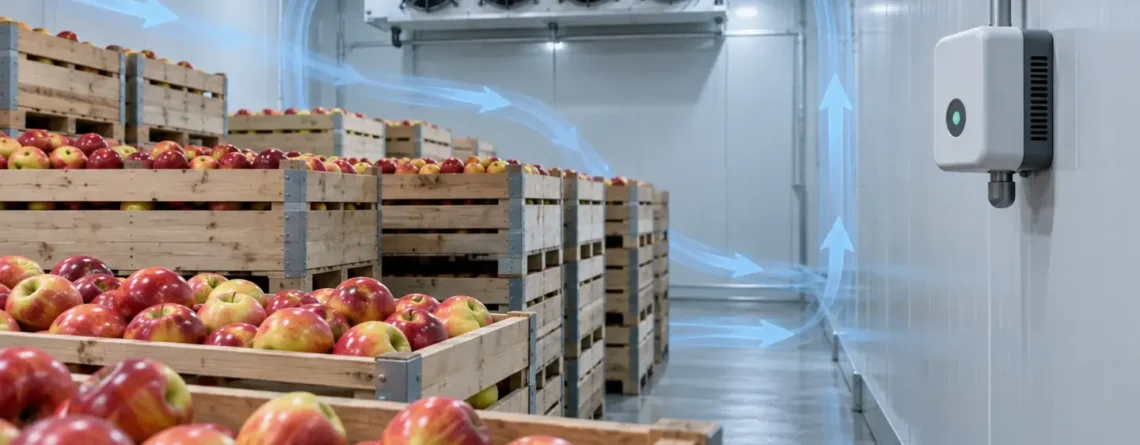
Select an ethylene monitoring system for fruit storage by the concentration you need to detect, the atmosphere in which you will measure it, and the decision the result must support. A device that displays 0–100 ppm of C₂H₄ may be useful for one process but unable to resolve a small change at the low concentrations relevant to another. Cross-sensitivity, sampling location, time delay and reference checks can matter as much as the nominal sensor technology.
Ethylene is a plant hormone that influences ripening and senescence in many horticultural products. The practical monitoring question may be whether ethylene is accumulating in a room, whether a treatment reached its target, or whether a source is affecting sensitive produce. Those are different measurement tasks. Before buying a “C₂H₄ sensor,” define the required detection range and smallest meaningful change, the storage temperature and humidity, nearby volatile compounds, airflow pattern and whether the output will control ventilation or simply support investigation.
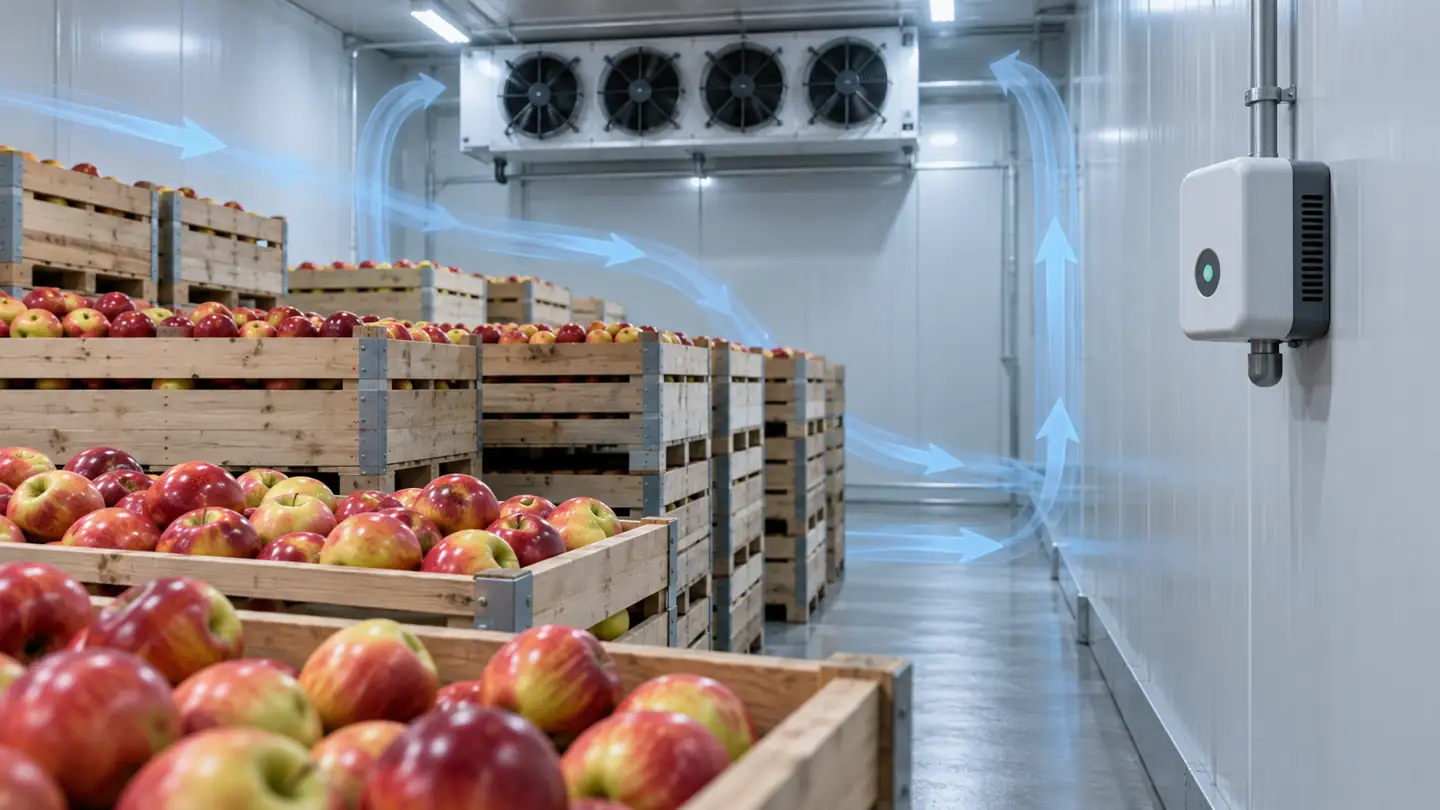
Define the decision and the atmosphere
Ethylene production and response vary by commodity, maturity, handling and storage conditions. There is no single concentration that is “good” for all fruit, nor a universal alarm threshold appropriate to every cold store. A monitoring specification should therefore start with the product and management question rather than a generic concentration printed on a sensor datasheet.
| Monitoring task | What the measurement must demonstrate | Likely measurement challenge |
|---|---|---|
| Detect a low-level accumulation near sensitive produce | A meaningful change from a documented baseline at the relevant location. | Resolution, drift and cross-sensitivity at low concentrations. |
| Follow an ethylene treatment or ripening room | Whether the treatment atmosphere achieved the intended profile. | Range, response time, mixing and sampling across the room. |
| Trace a suspected source in storage or transport | Spatial and time differences between locations. | Representative sampling and reproducible sample handling. |
| Control ventilation or scrubbing | Stable enough signal and delay for the control action. | Sensor dynamics, airflow and false response to other volatiles. |
O UC Davis Postharvest explanation of measuring ethylene in cold storage warns that accurate low-level measurement can require more specialized instruments than a simple detector. Wageningen University describes ethylene measurements in storage and transport using collected samples and analytical measurement. These are useful reminders that a displayed number is the end of a sampling and analysis chain.
Trace the whole measurement chain
Gas must first reach the sensor. In a direct-reading instrument, room air reaches a sensor behind an inlet or membrane. In an aspirated system, a pump draws air through tubing and perhaps filters or dryers before measurement. In a laboratory approach, an air sample is collected, transported and analyzed, often by gas chromatography (GC). Each path can alter what is measured if it is leaky, delayed, contaminated or positioned poorly.
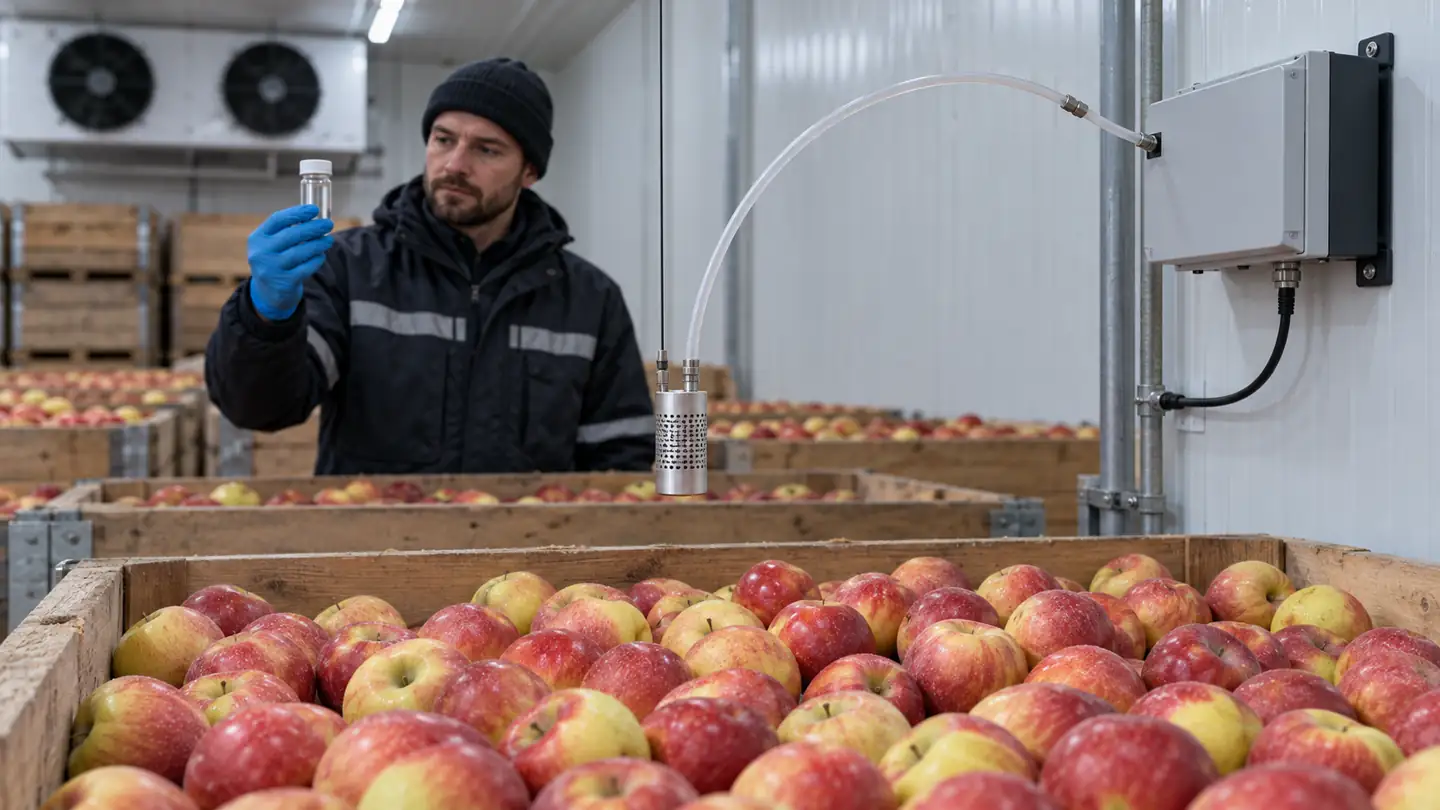
Specify the sample inlet, tubing material and length, flow rate, filtration or moisture handling, pump behavior, residence time and the instrument's response time. The reading that reaches a dashboard may describe air that entered the inlet minutes earlier. If ventilation cycles rapidly, that delay can change the apparent relationship between fan state and ethylene concentration. Timestamp the sampling event, not merely the moment a value is received by a server.
Check whether the system measures ethylene directly or uses a proxy. A general VOC sensor reports a combined response to many compounds and is not an ethylene-specific instrument. CO₂ trends can be useful for ventilation or respiration questions, but CO₂ is not a substitute ethylene reading. If a product brochure says it “detects ripening gases,” identify the actual analyte, sensor principle, calibration gas and known interferents.
Why the smallest useful change matters
Suppose a monitoring program needs to distinguish a baseline from a small rise. A nominal 0–100 ppm span does not tell you whether the device can do that. You need its resolution, limit of detection or quantification where defined, repeatability, baseline stability, uncertainty and response under the actual temperature and humidity. Different manufacturers use these terms differently. Request the test conditions and evaluate the sensor at the decision range, not only at midspan.
For example, the MGK C2H4-MD-100 product page describes an electrochemical sensor with a 0–100 ppm range and 1 ppm resolution; it also gives model-specific baseline and response conditions. That example illustrates why a 0–100 ppm label alone is insufficient for a sub-ppm decision. It does não establish the performance of other electrochemical models or every complete instrument using that component.
Compare sensing approaches by the task
Several technologies can contribute to ethylene measurement, but no family guarantees a specific low-end performance or immunity to interference. A sensor element, packaged transmitter and laboratory analyzer also have different specifications. Ask which part of the system the published values describe.
| Abordagem | Useful role | Questions to verify |
|---|---|---|
| Electrochemical C₂H₄ sensor | Compact continuous monitoring when the model's range and cross-response fit the task. | Baseline, humidity and temperature dependence, lifetime, interferents and calibration interval. |
| Optical or photoacoustic analyzer | Potentially sensitive, selective measurement depending on the instrument design. | Optical interference, sample conditioning, detection limit and reference validation. |
| Gas chromatography | Analytical reference and periodic confirmation of low-level or disputed measurements. | Sampling method, calibration, turnaround time and whether results represent the same place/time as an online sensor. |
| General VOC or “air quality” sensor | Context for broad volatile changes, if useful. | It cannot be assumed to quantify ethylene specifically. |
O UC Davis postharvest measurement material points to GC as an accurate method for ethylene analysis. That does not mean every storage room needs a GC installed permanently. It means a reference method may be needed when choosing and validating a continuous monitor, especially where a small difference could change a costly handling decision.
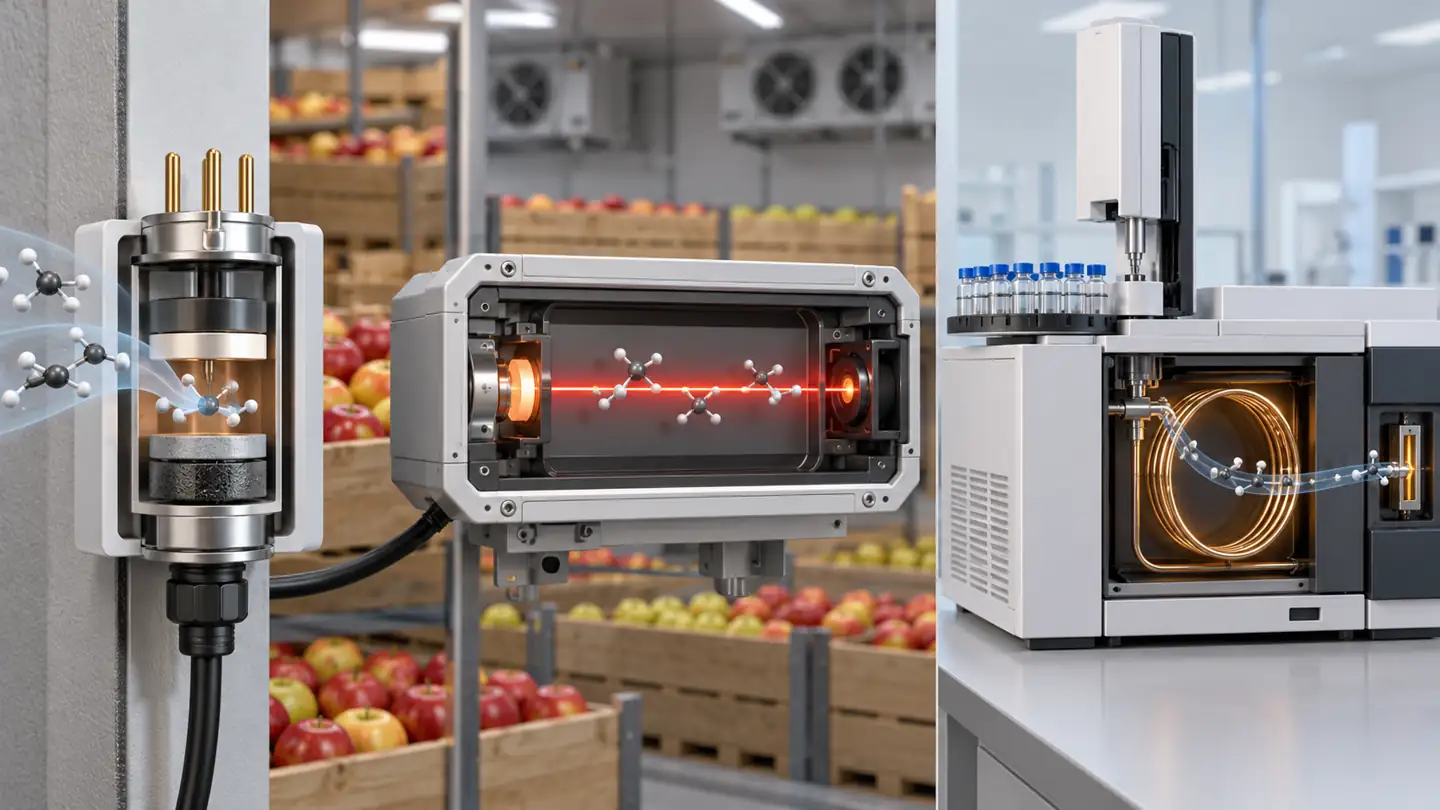
An optical analyzer can measure absorption or an acoustic response related to ethylene under a defined design. Its specificity depends on wavelength, filtering and correction for other gases. An electrochemical cell produces a signal through chemical reaction at its electrodes; other reactive compounds may contribute. The datasheet of the actual model should list relevant cross-sensitivities and environmental limits. Do not infer that one technology is universally more accurate from a technology label alone.
Cross-sensitivity and storage-room conditions
Fruit storage air is not a clean calibration mixture. It can contain other volatile organic compounds, including ethanol and compounds released during ripening, cleaning or packaging. Some sensors may respond to these gases. Humidity can be high, and cold-room temperatures may differ greatly from a datasheet reference condition. Condensation at an inlet or on an optical window can make a reading invalid even if the sensor itself has a broad operating-temperature range.
Ask the manufacturer for a cross-sensitivity table covering the likely atmosphere. The absence of a compound from a table is not proof of zero response. Where cross-response is plausible, compare suspected events with a more selective reference measurement. Record cleaning, sanitizing, forklift operation, packaging changes and door openings alongside sensor data; such events may explain a transient that otherwise looks like ethylene production.
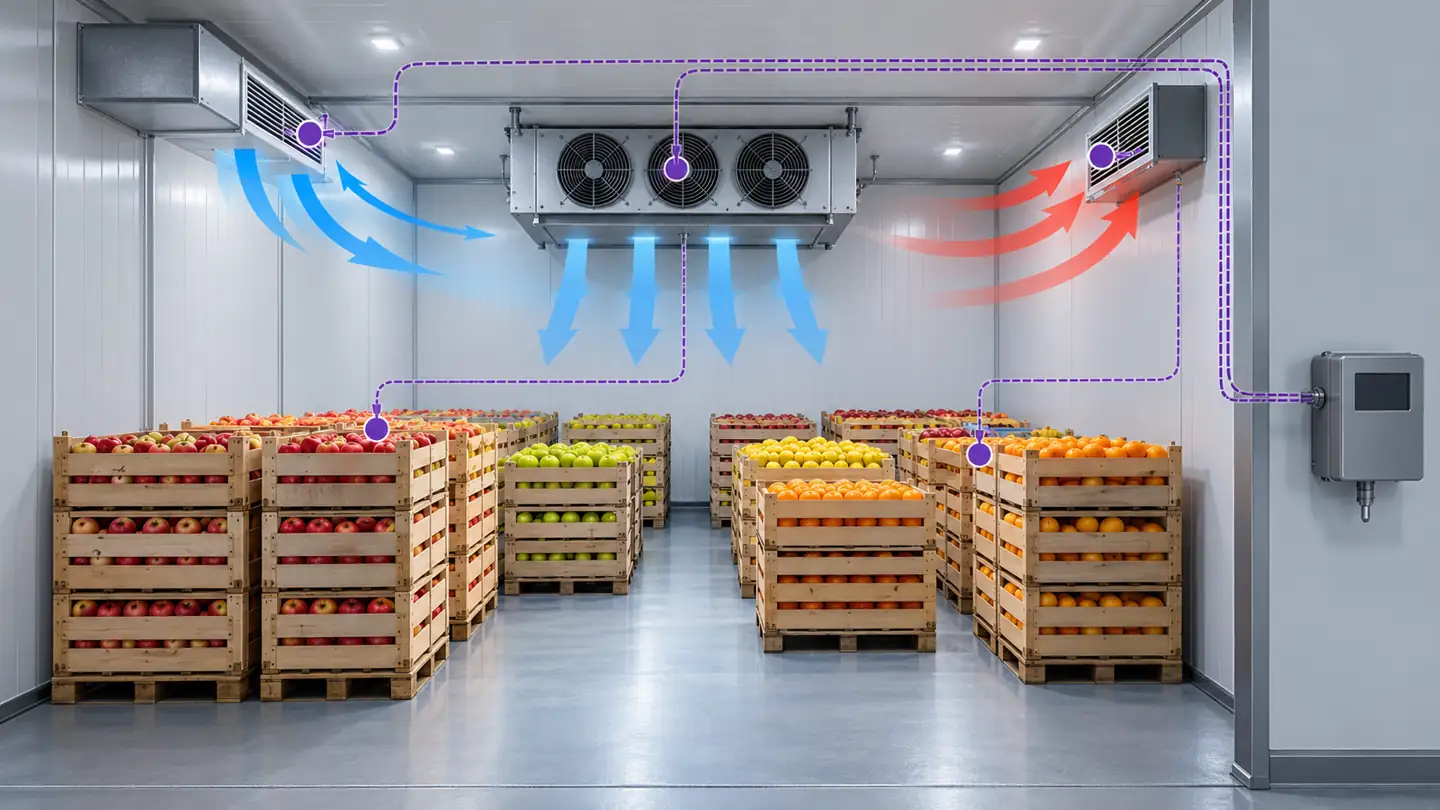
Consider the installation position. An inlet near a produce stack, a door, a fan discharge and a scrubber outlet will sample different air. That variation can be useful for diagnosis if locations are intentional, but it makes a single point poor evidence for a room-wide statement. Cold dense air, circulation, loading pattern and ventilation create spatial differences. The Wageningen study on a battery-powered air sampler illustrates why sampling through time is important in real storage environments.
Plan a representative sampling strategy
For a continuous room monitor, place the inlet where the decision needs information. If the goal is exposure of sensitive produce, a representative produce-zone location may be more meaningful than the ceiling near an exhaust. If the goal is diagnosing a source or verifying scrubber performance, measure upstream and downstream under comparable flow conditions. Avoid locations that are routinely blocked by pallets or sprayed during cleaning.
During an initial trial, make a small spatial survey at several heights and zones while recording fan and door status. Compare measurements at the same times and with the same method. You may find that one fixed point adequately tracks the room after mixing, or that multiple points are needed. A fixed monitor should not be declared “representative” solely because it is convenient for cable routing.
If a pump draws from multiple locations through valves, allow enough purge time after switching for the line and instrument to respond to the new sample. Label each point and preserve the valve schedule with the data. A short reading immediately after a switch may describe a mixture of the previous and new locations.
Understand time response and signal processing
The sensor's quoted T90 or T60 response is usually measured under a specified gas step, temperature, humidity and flow. A complete sampling system adds tubing delay, chamber volume, filters, data averaging and communications. Thus, a “30-second sensor” can become a much slower field monitor. Test the installed response if a control loop depends on it.
Avoid aggressive smoothing that hides short but meaningful events. Also avoid triggering costly actions from every one-sample spike. A practical rule may require both a sustained threshold and a data-quality check. Define how the system handles warm-up, calibration, maintenance, sensor fault, lost power and missing data. A zero reading from an offline sensor is not evidence of zero ethylene.
If a monitor controls ventilation, coordinate with temperature and humidity management. Extra ventilation might reduce ethylene but increase energy use or disrupt product conditions. The ethylene measurement should inform the decision with its uncertainty and delay made clear; it should not be treated as a complete storage-control strategy by itself.
Verify the instrument against the decision range
An effective acceptance test has three parts: confirm the instrument works with known gas or reference samples under the manufacturer's procedure, check performance at the relevant low or working range, and compare room-air samples with an independent suitable method. A successful high-range span check alone may not demonstrate that the instrument can resolve the low-end difference that matters for the crop.
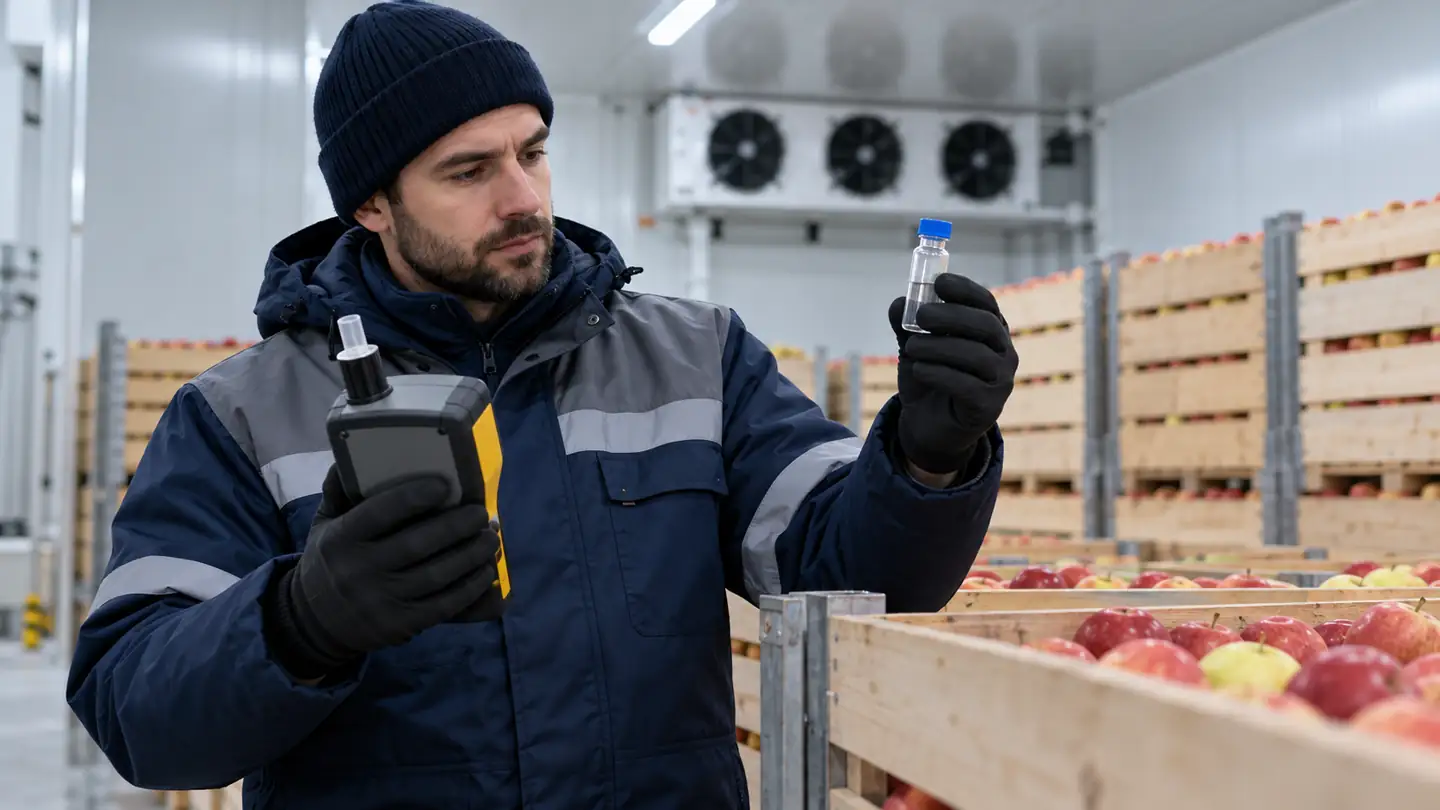
Use certified or otherwise appropriately characterized calibration gas as specified for the instrument. Check cylinder concentration, expiration, balance gas, regulator materials, flow, exposure time and ambient conditions. A simple zero check in fresh air can be misleading if the air is not truly ethylene-free or if an interfering vapor is present. Record pre-adjustment response before making a change so drift remains visible.
For reference comparison, take samples close to the online inlet at the same time and document how they were stored and analyzed. A laboratory result from a different corner of the room two hours later cannot isolate sensor error from spatial or temporal change. If the online and reference readings disagree, examine the sample path, unit, calibration, environmental conditions and interferents before declaring either method wrong.
| Observação | Likely questions | Immediate check |
|---|---|---|
| Reading rises after cleaning | Can the sensor respond to solvent or sanitizer vapors? | Compare event log and a selective reference sample. |
| Reading is flat through a known treatment | Is the range, inlet, valve or data status correct? | Inspect flow, location and functional check. |
| Different corners disagree | Is room mixing incomplete or one inlet obstructed? | Survey locations with consistent timing and method. |
| Baseline shifts after temperature change | Is compensation specified over this temperature? | Check actual sensor temperature and calibration condition. |
| Online and GC values differ | Were the same air and time sampled? | Align sampling location/time and review line handling. |
Do not confuse produce monitoring with gas safety detection
Ethylene measurement for fruit management and a flammable-gas safety alarm are different engineering tasks. They can involve very different concentration ranges, certification requirements, installation rules and response expectations. A low-level postharvest monitor should not be presented as a combustible-gas safety system merely because both devices detect C₂H₄. Conversely, a detector chosen for high-concentration leak warning may not resolve the low range needed for produce decisions. Specify each function separately and follow the applicable local safety design requirements for a hazard-control system.
This distinction is especially important when an instrument is sold as a “gas detector” without stating its intended use. Ask for the complete instrument's certifications, alarm architecture, proof-test requirements and environmental rating if a safety function is intended. For storage quality, ask instead whether the device can quantify or trend the concentration that affects the management decision, with documented cross-response and validation. The two specifications should never be silently substituted.
An equipment-selection worksheet
Compare datasheet numbers under their stated conditions
Several specifications that sound similar describe different limits. Resolução is the smallest display increment or reported step; it does not prove that a change of that size is accurate. Repetibilidade describes how closely repeated readings agree under comparable conditions. Baseline stability describes how much the zero signal may shift over time or environment. A stated detection limit may use a particular statistical definition and test atmosphere. Request the definition, temperature, humidity and measurement period for each number.
An instrument may offer multiple ranges. A 0–10 ppm configuration and a 0–100 ppm configuration may have different low-end performance even when the sensing principle is the same. Check whether the selected range is fixed at manufacture or can be changed in the field, and whether a range change requires recalibration. Do not assume that a wider range is automatically better; it may trade away useful resolution near the decision point.
Look for environmental performance across the actual storage conditions. A sensor rated to operate in cold air may still have slower response, a shifted baseline or a narrower guaranteed accuracy range there. Condensation risk depends on the temperature of the inlet, sampling tube and instrument enclosure, not only the room set point. If the sample is warmed before analysis, ensure that this conditioning is specified and does not introduce a new measurement bias.
Make a commissioning trial answer a real question
A trial should include at least a baseline period, a period with a meaningful process change and an independent reference comparison at the concentration range of interest. Record produce loading, door openings, fan and scrubber operation, temperature, humidity and cleaning events. A clean-gas demonstration in an office can show that the electronics respond; it cannot show whether the device is selective and representative in a fruit store.
Place a temporary second inlet or move a portable instrument during the trial to learn whether the proposed permanent point reflects the produce zone. If the room has several compartments or a strong airflow path, treat each as a separate sampling question. Analyze the expected action: would the observed difference have changed ventilation, treatment or investigation? If not, the monitor may add a chart without adding a useful decision.
Maintain an audit trail for drift and service
Keep the raw reading, calibration state, instrument status and service events. A slow rise over weeks could reflect accumulation, sensor drift, a blocked inlet or a change in produce mix. The trend becomes interpretable when cleaning, zero and span checks and reference samples are dated. When a sensor is replaced, overlap the old and new systems briefly if feasible and record the configuration change. Do not silently join two datasets that have different ranges or response times.
Define a practical response to invalid data. A missing sample flow, overdue calibration, saturated sensor or communication failure should be flagged separately from a low ethylene value. If automated ventilation depends on the monitor, agree in advance how the control system behaves while data are invalid. The fail state is an engineering design decision, not a number to infer from a missing dashboard point.
Check the air path for losses and contamination
The sampling line is part of the analyzer. A leak can dilute a sample with surrounding air; a restriction can lower flow and slow response. Condensed water can block or temporarily trap compounds, while a filter chosen for particle protection may add delay or interact with the sample. Use materials and lengths recommended for the instrument and the intended concentration range. During commissioning, verify sample flow at the inlet and at the instrument rather than assuming the pump specification guarantees delivery.
Sampling lines may be cleaned, replaced or re-routed as the storage layout changes. Record those interventions because a shortened line can make an apparent improvement in response time. If multiple rooms share one analyzer, prevent sample carryover with a documented valve sequence and purge period. A value displayed under a room name is only valid when the air actually came from that room and the previous sample was cleared.
Keep a measurement decision separate from a biological conclusion
An ethylene reading can document an atmosphere at a place and time. It cannot by itself establish why fruit is ripening, how much quality will be lost, or whether every pallet experienced the same exposure. Commodity, cultivar, maturity, temperature, duration and other storage conditions influence response. Pair gas data with product observations and the site’s postharvest protocol before changing a handling plan.
Conversely, visible ripening does not prove the ethylene monitor is wrong. The response may reflect earlier exposure, another location, or a biological process that continues after air concentration has fallen. Preserve timing and batch context when interpreting a chart. If the consequence is significant, collect representative samples and consult the relevant postharvest guidance rather than making a room-wide claim from one instantaneous reading.
Before requesting quotations, prepare a one-page brief:
- Commodity and objective: Which produce is stored, and what exact action depends on ethylene data?
- Required range: What concentration range and smallest meaningful change must be distinguished?
- Atmosfera: What are the actual temperature, humidity, oxygen level and plausible interfering vapors?
- Amostragem: Where are inlets, how is air moved to the instrument, and what delay is acceptable?
- Data: What logging interval, status flags, alarm logic and power/communications are needed?
- Verificação: What calibration gas and independent method will be used near the decision range?
- Manutenção: Who will inspect inlets, filters and tubing, and how will drift be documented?
Request a model-specific datasheet, not only a sensor-technology overview. A product with several selectable ranges may have different resolution, baseline and response in each configuration. Ask the supplier to distinguish sensor-element specifications from complete-system performance. If a trial is possible, test in the real storage atmosphere before committing to a room-wide deployment.
Perguntas frequentes
Can a normal VOC sensor measure ethylene in a fruit store?
Do not assume so. A general VOC response combines many compounds and normally does not uniquely quantify C₂H₄. Use an ethylene-specific method if the decision requires an ethylene concentration, and verify it against likely storage-room interferents.
Is a 0–100 ppm ethylene sensor suitable for low-level monitoring?
Only if its low-end resolution, baseline stability and uncertainty meet the decision. The stated range alone is insufficient. A model with 1 ppm resolution, for example, cannot be assumed to resolve a much smaller change.
Why does sampling location matter if the room has fans?
Fans improve mixing but do not guarantee identical concentration at every pallet, inlet or exhaust. Sources, scrubbers, doors and airflow paths create local differences. Survey the room under representative operating conditions before choosing a permanent point.
How should an online monitor be checked?
Follow the manufacturer's zero and span procedure, then compare representative room-air samples against a suitable independent method when the result matters. Check at the concentration range near the actual decision and document temperature, humidity, sampling location and timing.
Does an ethylene monitor also serve as a safety alarm?
Only if the complete system was designed and approved for that safety function. Produce-quality monitoring and combustible-gas hazard detection have different ranges and requirements. Treat them as separate specifications.
Is gas chromatography required for every storage room?
No. Continuous sensors can be practical for routine trending or control when validated for the task. GC or another suitable selective reference can be valuable during commissioning, periodic checks or investigation of disputed low-level readings.
Technical references
- UC Davis Postharvest, measuring ethylene in cold-storage air.
- UC Davis Postharvest, ethylene measurement methods.
- Wageningen University, ethylene measurements in storage and transport.
- MGK Sensor, C2H4-MD-100 product specification: a model-specific example of why range and resolution must be read together.
- Wageningen University, battery-powered air sampler research.





Deixe uma resposta