

Gas detection around an air-conditioning system can serve several different requirements. An occupied-space CO₂ sensor can inform ventilation control. A listed air conditioner may need an integral refrigerant detection system to initiate equipment mitigation. A refrigeration machinery room may have separate detection, alarm and emergency ventilation requirements. A workplace assessment can also require monitoring for a task or location. One building can have all of these functions. Each one has its own sample, trigger, authority and responsible party.
Start by identifying the equipment, refrigerant, charge and layout, along with the spaces and work activities the system serves. Establish the adopted code and referenced editions. Then map each required action to the controller, device and person responsible for it. The question “does this HVAC system need a gas detector?” is answered by that map, which shows both where detection is required and what it must accomplish.

A building can have several HVAC gas measurement and response boundaries.
Start with the equipment and space boundaries
A gas measurement in the return duct may support an airside control sequence. A detector inside a fan coil may support a response to a refrigerant release inside its cabinet. A room detector may respond to a release reaching air outside that cabinet. A worker’s monitor samples the atmosphere at the location relevant to the work. In each case, the physical sampling boundary and action matter more than the fact that the system has a gas sensor.
Record the actual equipment and rooms rather than using the project label alone. An air-conditioning project may include roof units, indoor air handlers, piping branches, occupied zones and dedicated machinery rooms. One refrigerant circuit may serve several spaces. Another unit may be entirely outside. Combustion equipment, vehicle exhaust or another process may affect air quality independently of the refrigerant system. The drawings should make these boundaries and relationships available to the review team.
| Trabalho de medição | O que é amostrado | What can govern it | Typical responsibility to assign |
|---|---|---|---|
| Occupied-space IAQ or ventilation control | Room or duct air in a defined ventilation zone | Adopted ventilation and energy rules, owner requirements and sequence | Airside designer and building controls contractor |
| Integral refrigerant detection | Air at defined points in or associated with the listed equipment | Equipment certification, manufacturer instructions and adopted installation requirements | Equipment supplier and installing contractor |
| Refrigeration machinery-room detection | Room air at the designed fixed detection points | Adopted mechanical and fire rules and referenced refrigeration safety standard | Refrigeration designer, detection system supplier and mechanical or electrical trades |
| Occupational gas monitoring | Area or worker sample for a defined task | Employer hazard assessment and applicable workplace obligations | Employer, safety staff and assigned work supervisor |
| Combustion or adjacent source | Defined flue, room or intake sample according to the job | Fuel gas, appliance, mechanical, workplace or other applicable requirements | Relevant equipment or site safety owner |
The parties can vary by contract. The important deliverable is an owner for the decision and an owner for every interface. If the equipment supplier provides a contact, identify who wires it, who defines its state and who tests the receiving response. A signal with no receiving owner can look complete on an equipment drawing while the building action is still undefined.
Room CO₂ can inform a ventilation decision
Indoor carbon dioxide from occupants can provide information about ventilation when interpreted with occupancy, outdoor concentration, mixing and operating conditions. Some demand-controlled ventilation arrangements use CO₂ as one input. The applicable ventilation and energy requirements and approved design determine the required conditions and the role of the sensor. ASHRAE’s 2025 position document on indoor carbon dioxide explains the limited information that one CO₂ concentration supplies about overall indoor air quality.
An indoor CO₂ measurement does not characterize every pollutant. Particles, volatile compounds, moisture-related conditions and combustion products can have different sources and time patterns. A room at a low occupancy can have a low occupancy-related CO₂ signal while still needing an investigation of a separate contaminant. Select the measurement according to the question and the ventilation strategy.
Review the location and sample definition for the airside control. A sensor in a room measures air at that point. A return duct serving multiple rooms can combine air from different zones. An outdoor reference, where required by the control logic, has its own location and validity considerations. If the point becomes invalid, the approved ventilation design should say which state applies and how operations staff can tell that the measurement is unavailable.
The same chemical can appear in a different job
An installation using R-744 uses CO₂ as refrigerant. The occupied-space CO₂ function and the refrigerant-release detection function still have separate specifications. An IAQ transmitter intended for a ventilation control range may not cover the hazard response range, response time, alarm or listing for the release application. A machinery-room detector may have a different range, location and interface. The CO₂ sensor range guide explains how the working range and decision point affect instrument selection. A high room value can also have more than one possible source. The design should tie each point to a defined use and investigate events under the applicable procedure.
The labels on the controls drawings should make these differences visible. “Conference room CO₂ for ventilation” and “R-744 machinery room detector” give the operator better context than two points both called “CO₂ ppm.” Document which channel is authoritative for each response, and retain the exact detector configuration, units and invalid-state behavior.

An occupied-space point can support the defined ventilation control sequence.
The listed equipment can have its own detection and mitigation
Some air conditioners and heat pumps use an integral refrigerant detection system, often called an RDS. The detector, control logic and mitigation form part of an equipment arrangement evaluated under the applicable product certification. UL Solutions’ equipment inspection guidance explains why the exact equipment markings and installation instructions determine whether an integral RDS is required and how it is installed. It describes UL 60335-2-40 for covered equipment and notes that requirements can depend on the model and installation.
The submitted equipment and installation orientation matter. An air handler may be configurable in several orientations, with different approved detector positions. Piping arrangement, charge, cabinet construction and the use of accessories or zoning components can also affect the reviewed installation. Check the complete model designation and the instructions covering the actual arrangement. A brochure stating that a detector is included does not document the approved configuration by itself.
The equipment instructions can specify responses such as a circulation fan operation or another local mitigation. Some arrangements require coordination with an external controller or device. Use the equipment documentation to establish which actions are integral, which interfaces are available and which actions are required elsewhere by the approved design. If a device only sends a monitoring signal, the receiving system should not be credited with an automatic mitigation without a documented, accepted and verified control path.
For a building controls review, identify the difference between an internal equipment event and an externally visible status. An OEM controller can react locally before a gateway updates. A BAS display can receive a contact or network point that conveys only some of the internal states. If the manufacturer’s approved interface provides a leak or fault distinction, preserve it where the project requires it. If the interface lacks that distinction, document the limitation and resolve how the required outcomes and visibility will be achieved.
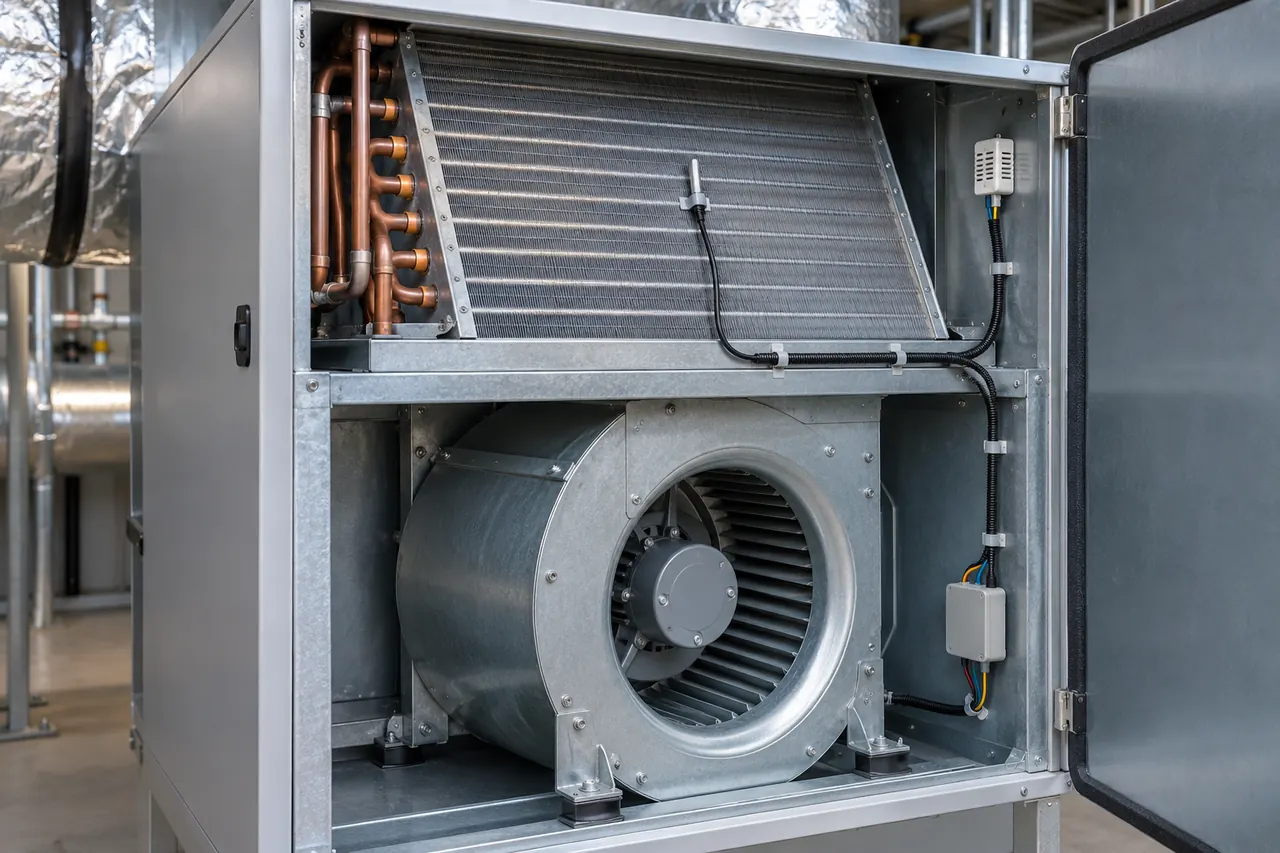
Equipment-integral detection follows the exact listed configuration.
What should the equipment submittal identify?
- The complete equipment model and options, refrigerant designation, approved orientation and relevant installation instructions.
- The equipment listing or certification scope and the exact integral detection and mitigation configuration.
- The local actions, their source of control and the conditions relevant to recovery.
- The external terminals or documented network objects, their valid and fault states and any wiring limits.
- The interfaces that rely on other trades, with evidence for the installed outcome.
- The records required when the device, equipment configuration or instructions change.
A factory-installed detector still has an installation context. A field change to orientation or zoning can affect how the listed arrangement should be assembled. A replacement sensor must be handled under the approved equipment documentation and applicable project requirements. A compatible signal voltage or connector is insufficient evidence of compatibility for a required safety function.
Machinery-room detection is a separate building function
A dedicated refrigeration machinery room can have its own required detection, audible or visible warning, ventilation and other responses under the adopted provisions. The requirements depend on the jurisdiction, referenced standards, system type, refrigerant and site conditions. The ICC’s 2024 I-Code A2L changes document illustrates how mechanical and fire provisions can address related parts of a machinery-room design. It is a changes reference. Determine the actual adopted text, any amendments and the edition of the referenced standard before applying its provisions.
ASHRAE lists its published Standard 15-2024 among its refrigeration safety resources. Locate the edition of the refrigeration safety standard referenced by the adopted requirements and check any special system scope. Equipment standards, installation standards and occupational requirements are different layers. A newer reference on a website and the edition legally adopted for a project can differ.
Map the intended sample and response by room. Identify the target refrigerant or other gas, coverage basis, detector listing if required, controller, local warnings, remote indications and ventilation interface. The room detector should appear on a plan tied to the documented release and airflow assumptions. The equipment listing may address an internal leak mitigation without providing the required room-level detection. A fixed room detector in turn does not establish that an integral RDS requirement has been met.
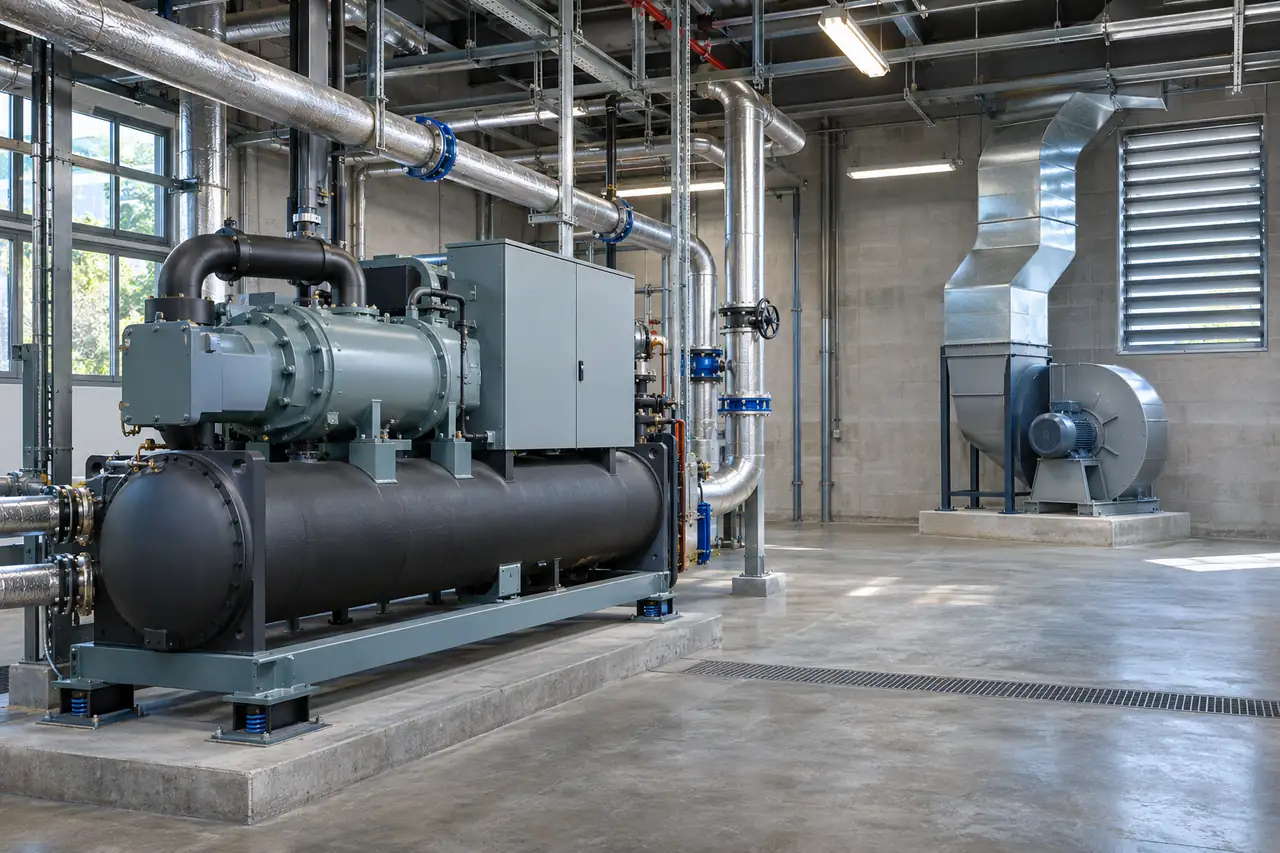
Machinery-room detection concerns the room atmosphere and its approved response.
Separate loss detection, release detection and exposure
A circuit pressure measurement can help indicate an equipment condition. A service instrument can help a technician find a leak. A fixed ambient detector measures what reached its sample location. Those facts can complement each other in an investigation. They answer different questions and have different evidence requirements.
Workplace decisions are also distinct. A worker might enter a particular enclosure, open equipment or perform service while plant operating states differ from normal. A fixed room detector can provide useful context. The employer still needs to apply the workplace obligations and assessment relevant to the task. In US federal general industry, 29 CFR 1910.146 addresses permit-required confined spaces where its scope and conditions apply. A room label or installed detector does not determine whether a specific space or task is governed by that rule.
Some facilities have other hazards near HVAC equipment. Gas-fired heat, an adjacent loading bay or an industrial process can affect a room or a building air intake. Where the project identifies a combustion or process gas task, give it a separate requirement and owner. Its detection and response logic should not be inferred from the refrigerant system, and its signals should be named independently in the building controls documents.
Assign interfaces before purchasing equipment
A requirements matrix should identify both what happens locally and what crosses a boundary. For each required action, write who generates the request, who receives it, which system has authority to act, what proof is required and who receives an abnormal-state notification. This exposes gaps that a single note reading “interlock with BAS” can conceal.
| Interface question | O que gravar | Evidence at handover |
|---|---|---|
| Which controller owns the action? | Local equipment controller, room detection panel or building system, with applicable approval | Sequence and schematic tied to the equipment and installed configuration |
| What crosses the boundary? | Terminal, relay state or data object, units and meaning of all required states | Wiring drawing or point list and observed receiving state |
| What does loss of signal mean? | Local fallback, trouble indication and recovery under the approved arrangement | Authorized loss-of-power or loss-of-communications evidence |
| What is physical proof? | Motor status, damper feedback, independent alarm output or other required observation | Evidence from the affected device or site acceptance record |
| Who handles recovery? | Authorized party, conditions, record and procedure | Operations handover with temporary impairment and service responsibilities |
An interface can be functional and still fail to meet its intended timing. A local controller might request mitigation immediately under its approved design while the building graphics update on a different interval. Verify the timing at the appropriate boundary. Operator event timestamps should indicate whether they are local event times or the time a receiving system recorded a message. This becomes important when several points change during the same event.
Also document priority. An exhaust fan or damper can serve a normal ventilation sequence and another approved response. The controls design must state how those modes interact. A local equipment signal should reach the system with the authority to coordinate that response. A generic command from a supervisory display is weak evidence when a separate system can override it or when the actual position is not monitored.

A documented interface assigns ownership across equipment and controls.
Keep degraded states visible
A missing refrigerant reading, equipment warm-up and a valid low reading are different states. A fixed detector under service can report a test response while its normal coverage is temporarily impaired. A network gateway can preserve an old value after communications stop. The point list should preserve validity and state, with alarm or service handling defined by the approved arrangement.
Ask how the design handles power loss to each independent system. Loss of power to the BAS can affect visibility while a local safety control remains active, depending on the design. Loss of power to the equipment detector can be a different condition. Record which actions continue, what notification is available and how restoration is authorized. Test only under the applicable authorized procedure and describe what was actually exercised. A simulation can support a logic test, while observing the intended output supplies different evidence.
Hypothetical requirements review for a small commercial building
Consider a commercial building with office areas served by ducted equipment, listed heat pumps with integral detection where specified, and a separate machinery room serving another circuit. Assume the project has already established the applicable rules and equipment instructions. The following matrix illustrates how to assign the evidence. It does not decide whether a real building must include any of these functions.
| Project row | Requirement boundary | Owner and handoff |
|---|---|---|
| Office ventilation CO₂ | Representative airside point for the approved occupied ventilation sequence | Controls contractor maps data and validity. Airside designer owns the ventilation sequence. |
| Heat pump integral detection | Exact equipment orientation and listed mitigation configuration | Equipment supplier provides the instructions. Installer documents the arrangement and local verification. |
| Machinery-room detection | Separate room sample and approved warning and ventilation sequence | Refrigeration designer assigns room requirements. Detection and mechanical trades verify interfaces under the acceptance plan. |
| Service work assessment | Particular task and place, including access and ventilation states | Employer or authorized work lead owns the assessment and monitoring procedure. |
Suppose the original mechanical notes say the BAS must record an integral equipment event. The equipment submittal shows a local fan mitigation and a documented status contact. The team records two outcomes. One is the local action under the listed arrangement. The other is event visibility in the BAS. The controls contractor wires and verifies the status path, while the installer confirms the local equipment arrangement. The records say which action was observed in each test. A missing BAS graphic can be repaired without rewriting the evidence for the equipment’s local action, provided the design and test boundaries support that distinction.
Now suppose a replacement unit changes the equipment orientation and control interface. The change reaches more than the mechanical schedule. It can affect detector placement within the equipment, point naming and the interface test. The change review should route the exact new instructions to the people who own the mechanical arrangement, electrical connection and controls sequence. A record from the earlier model remains useful history. Approval of the changed configuration needs evidence for the changed conditions.
Make the operating record usable after turnover
At closeout, keep the adopted requirement references, equipment and detector identities, scope of each test, drawings and unresolved conditions together. Label which tests used simulation and which observed the required physical response. If an alarm or equipment action depends on external power or another controller, include that dependency in the record so operations staff can assess impairments.
The whole-building handover assigns monitoring and mitigation functions to the systems and parties responsible for them. Lifecycle records then preserve how those functions are maintained. When the owner later changes a room layout, replaces a control panel or adds equipment, the requirements matrix shows which evidence must be revisited.
Read the authority behind every requirement
Write the source and version next to each line in the matrix. A city or state adoption can reference a particular mechanical code and modify its refrigeration provisions. The adopted text can then reference a specific edition of a safety standard. The equipment documents identify the listing and configuration for the model selected. An owner specification can add monitoring, documentation or operations features. An employer procedure can govern a service activity even when the facility installation was approved under building rules. Keeping these sources separate helps the review team resolve an apparent conflict.
For example, a project standard might request that all equipment alarms appear on a dashboard. An equipment listing might require a local response independent of that dashboard. The project then has two outcomes to prove. One belongs to the certified equipment arrangement and its installation. The other belongs to the supervisory display and event history. The approved design identifies which outcome takes priority if a communications fault affects one of them. Requests to change equipment logic or interface behavior should be evaluated against both requirements before field changes are made.
Maintain a revision history when the applicable basis changes. A late refrigerant or equipment substitution can change the governing product documentation and the inputs used to determine room or equipment requirements. A revised architectural layout can change the defined space, available circulation path or interface with another system. A change to the owner’s alarm routing might leave local mitigation intact while changing response responsibility. Identify the requirement lines affected by each revision and name who approves their new evidence.
Decide how to interpret a missing document
In review, distinguish absent evidence from evidence that the submission deviates. For example, a submittal may omit the wiring page that shows an external fault contact. The omission leaves the interface unverified. A submitted wiring page may instead show that the proposed device has no supported output for the required distinction. That is a documented difference to resolve through the appropriate design and approval process. Both situations call for a specific question or disposition, with responsibility assigned.
For an occupied-space sensor, the missing item could be the airside sequence or the purpose of an outdoor reference point. For a listed unit, it could be the instructions covering the actual cabinet orientation or a permitted accessory. For a room system, it could be the approved warning destination or exhaust proof. For a workplace program, it could be the task assessment or the identity of the person authorized to issue an entry decision. Record the requested evidence in terms that identify exactly which requirement it is meant to close.
A building-wide review should therefore keep track of dependencies and unknowns. Some work can be complete within its own boundary while a separate interface is still pending. A supplied detector can have complete product documentation while the building sequence has no assigned receiving point. An approved wiring drawing can still need installation and acceptance evidence. During handover, tie the outstanding item to the responsible party and the system state so operations staff can understand what coverage and actions are available.
Perguntas frequentes
Does every air conditioner need a refrigerant leak detector?
Determine the requirement from the exact equipment, refrigerant, charge and installation arrangement, then check the adopted rules and product instructions. The listed appliance can have a different detection requirement from the surrounding room or building.
Can an indoor CO₂ monitor detect a refrigerant leak?
An ordinary IAQ CO₂ channel measures CO₂ within its stated conditions. It does not measure refrigerants that require other sensing methods. In an R-744 application, the common gas name still leaves differences in range, performance, alarm purpose and approval to resolve.
Can the BAS provide all required refrigerant detection and mitigation?
The approved design, listing and governing requirements define where the control authority sits. The BAS may receive status or participate in a required interface when the design supports that use. Identify and verify each function separately before assigning it to the supervisory system.
Is a machinery-room detector enough for service work?
Its reading describes the air that reached its point. The employer’s work assessment determines what monitoring is appropriate for the task, including a worker’s location, restricted spaces and operating conditions.
What should be checked when an HVAC unit is substituted?
Review the exact listing, instructions, orientation, refrigerant and installation details, local mitigation and external signals. Update the requirement and interface records that depend on the changed configuration, and confirm what evidence is required for acceptance.








Deixe uma resposta