
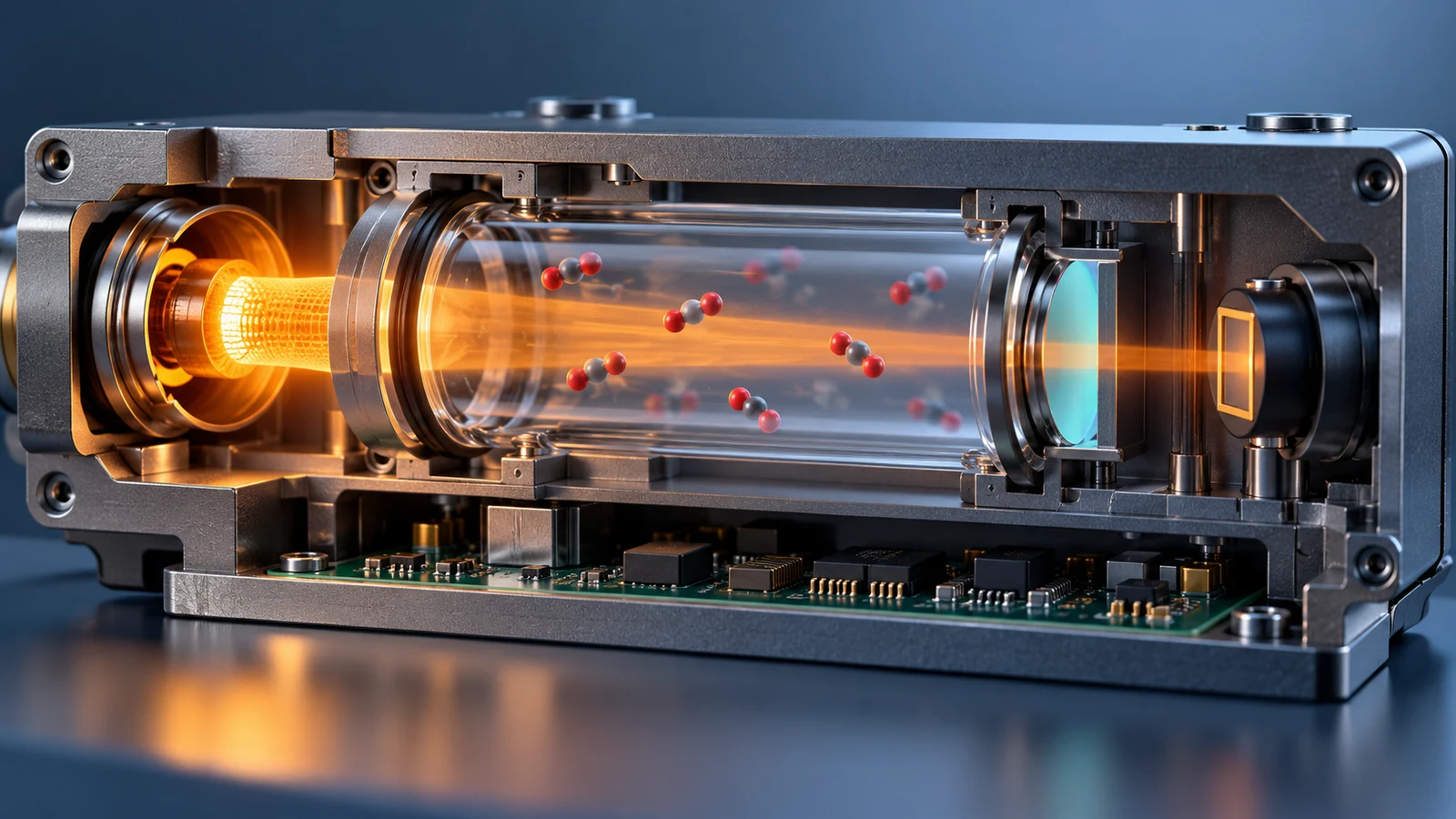
An NDIR CO₂ sensor does not count individual molecules. It estimates concentration from the infrared light that reaches a detector after passing through a gas sample. The useful question is therefore not just whether a module is “NDIR,” but which gas reaches its optical cell, which wavelengths are measured, and how the optical signal becomes a reported value.
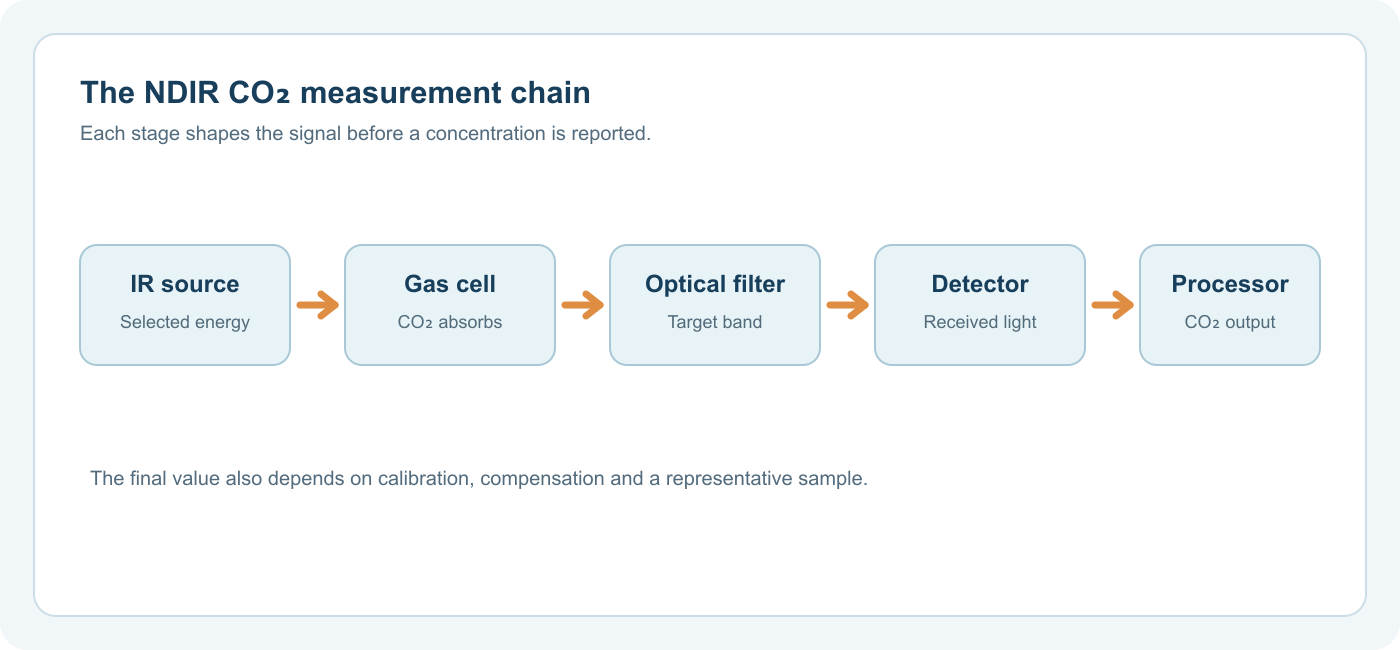
The chain is straightforward in principle: an infrared source illuminates a gas path; CO₂ absorbs part of the light in a selected band; a detector measures the remaining signal; electronics use calibration and appropriate compensation to report concentration. The design details determine what the resulting number means and where it can be trusted.
What Does NDIR Actually Measure?
Non-dispersive infrared (NDIR) describes a way of selecting an infrared band without dispersing the light into a full spectrum. CO₂ has an absorption band around 4.26 µm, so a CO₂ channel can compare transmitted light in a suitable band with a reference or calibrated baseline. A different target gas requires an appropriate optical band and its own calibration; software cannot turn any NDIR module into a universal gas detector.
In a simplified, monochromatic model, transmission follows T = I/I₀ = e^(−εcL), onde EU is transmitted intensity, I₀ is incident or reference intensity, ε represents absorption under the defined conditions, c is concentration and L is optical interaction length. This relationship explains why increasing concentration or path length increases absorption. A real module uses a finite filter band, a source spectrum, detector response and a fitted calibration curve; the equation is a design guide, not a drop-in conversion formula for an arbitrary voltage. Hamamatsu's NDIR design explanation presents the optical principle and example configurations.
NDIR measures an optical response to gas in the cell. The final display may use ppm or percent, depending on the application and specified range. For the reporting units, see CO₂ ppm, percent conversion and sensor ranges.
Follow the Complete Optical and Electronic Chain
| Stage | Job | A practical question |
|---|---|---|
| Gas entry and cell | Admit the gas being measured and define its interaction with light | Does the sample represent the room, duct or process point? |
| Infrared source | Provide usable energy in the selected band | How does the design detect source change over time? |
| Optical path and filter | Define interaction length and reject unwanted wavelengths | What gas and concentration interval is this optical design calibrated for? |
| Detector and electronics | Convert received infrared energy into a stable signal | Is there enough signal over the full operating range? |
| Reference and calibration | Separate useful absorption from characterized drift and map it to concentration | What is corrected by design, and what needs a known reference? |
| Environmental inputs and output | Apply model-specific corrections and report data | Are pressure, temperature, humidity and validity status handled as specified? |
These stages are connected. A capable detector cannot fix a sample that never reaches the cell. A stable source does not by itself correct a pressure setting that does not match the installation. An accurate sensor component also cannot prove the performance of an assembled monitor without considering enclosure, airflow, display, alarm and maintenance.
1. Getting the Right Gas into the Cell
Diffusion modules rely on surrounding air reaching the sensing area. Pumped and flow-through arrangements bring a defined stream to an analyzer. Position, enclosure openings, filters, tubing and flow can affect which gas is actually measured and the time required for a change to appear. For a room monitor near an occupant, the sample may differ from that at a return-air duct or the outdoor-air intake. For a process line, moisture and pressure may matter before the optical measurement begins.
The sampling arrangement is therefore part of the measurement chain, even when the data sheet is headed “CO₂ sensor.” Define the sample location and any preconditioning before comparing modules.
2. Source, Filter and Detector
The source must deliver infrared energy that overlaps the target band's absorption. The cell guides that energy through the gas. A filter or wavelength-selective system gives the detector a band useful for CO₂ rather than treating all received infrared energy as equivalent. Some designs use a second wavelength or reference channel. Other designs rely on different stabilization and calibration methods. The term “dual channel” alone does not tell you precisely how two signals are acquired.
The detector measures received energy, not concentration directly. Electronic processing must account for background, source modulation, amplification, noise and the module's optical geometry. At high absorption the transmitted signal can become small; at low absorption the change from baseline can be close to noise and drift. A good design is matched to its intended range rather than assumed to be equally useful from outdoor background to a concentrated process sample.
3. Reference, Calibration and Compensation
The reference signal helps distinguish target-gas absorption from some changes in the optical system. Its benefit depends on the implementation. For example, Sensirion describes the SCD30 as a dual-channel transmissive NDIR module in which the reference channel supports long-term stability. Vaisala's CARBOCAP explanation describes a different arrangement: absorption and nonabsorbing reference wavelengths are measured along the same optical path. Those are real design examples, not a reason to assume every reference channel corrects every kind of contamination.
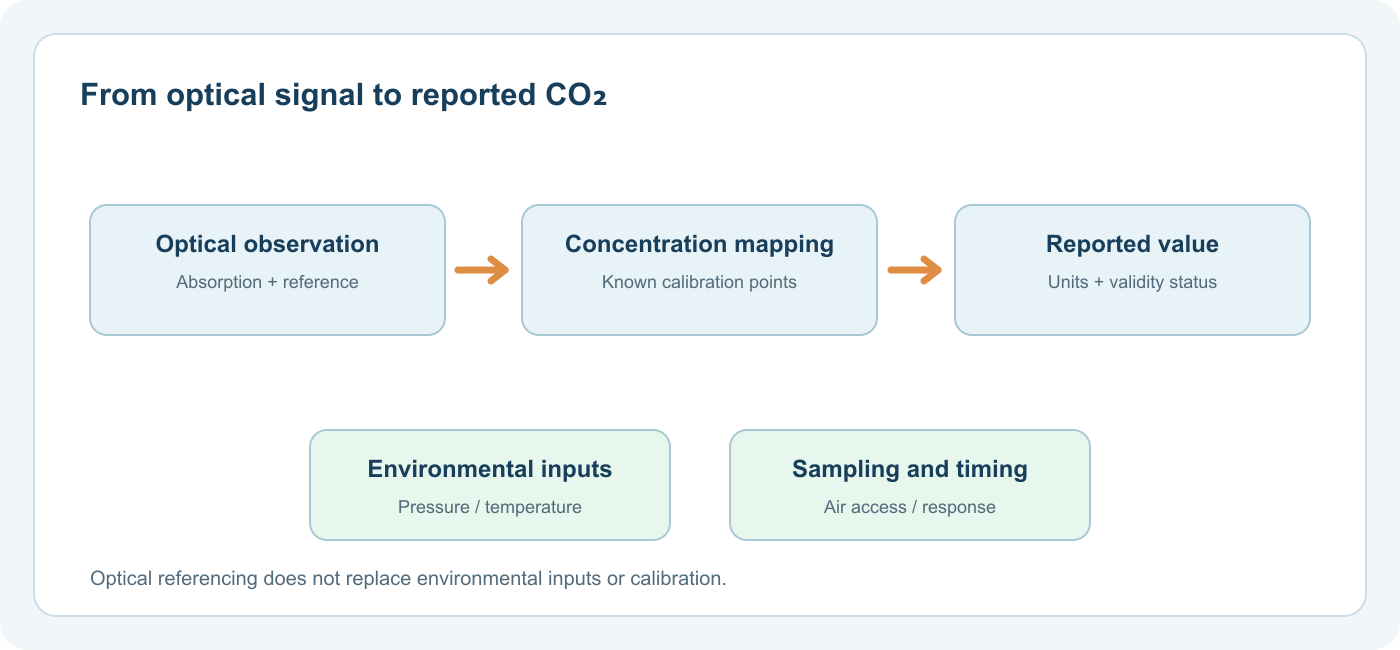
Calibration establishes the relationship between signal and known CO₂ concentration under specified conditions. A reference channel does not replace that relationship. Nor does it automatically correct wrong sample pressure, a heated enclosure or a calibration assumption that the installation never satisfies. We examine these limits in what an NDIR reference channel can compensate.
Why the Reported Value Can Differ from the Gas Fraction
The optical signal responds to the number of absorbing molecules along the path. If temperature or pressure changes, the number density in the cell can change even when the gas mixture's fraction is unchanged. Whether and how a module corrects this depends on its design and configuration. Sensirion's SCD30 interface description provides pressure and altitude compensation inputs for that particular module. Its design-in guidance explains how airflow-induced pressure changes and nearby heat sources can affect installation performance.
Humidity deserves similar care. Some modules integrate relative-humidity and temperature sensing and use those inputs in characterized algorithms. This does not mean water vapor has been universally “removed” from all measurements, or that a display always reports the same dry-gas basis as a laboratory reference. Ask for the manufacturer's reporting basis and specified environmental range when comparing methods.
Time matters as well. Source warm-up, gas exchange in the cell, firmware averaging and display update can all affect the observed response. A short sensor response specification is not necessarily the response of a finished monitor behind a restrictive enclosure or long tube.
How to Read an NDIR CO₂ Specification
Start with measurement range, accuracy range, test conditions e calibration behavior as separate fields. A digital output may represent values outside the interval for which accuracy is specified. The manufacturer's claim should identify the concentration interval and operating environment in which it applies.
O Folha de dados SCD30 illustrates this distinction: its interface output range and calibrated accuracy range are not identical. The stated accuracy is tied to a 400–10,000 ppm interval and documented conditions. Its automatic self-calibration also relies on the sensor being exposed to an appropriate low-CO₂ reference environment. These are SCD30-specific facts, not specifications for NDIR in general.
For any candidate module or finished device, ask:
- Which gas is the filter and calibration intended to measure, and how is cross-sensitivity handled?
- What are the specified accuracy and repeatability intervals, not just the possible display range?
- Which pressure, temperature and humidity inputs are measured or supplied externally?
- What are the calibration, baseline and drift requirements for the actual duty cycle?
- How do air access, tubing, enclosure and data processing affect the assembled device?
Our broader CO₂ measurement guide helps translate these into an instrument selection brief. For a deeper sensor-technology overview, Gasnose's NDIR guide compares optical choices and their limits.
Typical Misreadings of the Technology
“NDIR means a complete CO₂ safety instrument.” NDIR names the sensing principle. A safety application requires a complete device and a documented intended use, including sampling, alarms, installation and applicable requirements.
“A reference channel eliminates calibration.” It can reduce certain optical drifts. It cannot establish concentration from an uncalibrated optical response or repair every form of contamination.
“A longer path is always more accurate.” Longer interaction can increase low-concentration absorption, but high-concentration transmission may become too small and optical losses may reduce signal-to-noise ratio. The usable range is a system property. See optical path length and CO₂ sensor design.
“All gas molecules can be measured by the same IR channel.” A channel is designed for gases with relevant absorption in its selected band. Oxygen and nitrogen, for example, are not measured by an ordinary CO₂ NDIR channel. Carbon monoxide measurement also should not be inferred from a CO₂ sensor's presence; its wavelength selection, calibration and instrument documentation must be specific to CO.
A Working Definition
An NDIR CO₂ result is a calibrated estimate from a defined optical and sampling system. The source, gas path, spectral selection and detector produce a signal; referencing, environmental inputs and calibration turn that signal into a concentration value within stated conditions. Reading the entire chain is the reliable way to compare sensor modules and finished instruments.
Perguntas frequentes
Does an NDIR sensor measure CO₂ directly? It directly measures an optical absorption response attributable to CO₂ in its designed band, then estimates concentration using calibration. It does not count molecules one by one.
Is every dual-channel sensor more accurate than every single-channel sensor? No. Channel architecture can improve stability, but accuracy also depends on optics, calibration, conditions and integration. Compare documented instrument performance.
Can a CO₂ NDIR module measure methane or refrigerants? Not merely by changing software. Those applications require a suitable optical band, calibration and complete instrument design for the target gas.
Why can two CO₂ monitors disagree? They may sample different air, use different averaging or compensation settings, or operate outside their specified conditions. Compare them at the same location and under a controlled procedure before attributing the difference to sensor drift.

Como comparar leituras de CO2 em zonas de escritórios de plano aberto
Compare os registros sincronizados de CO2 da zona de escritório após verificar a concordância do monitor, localização, ocupação e eventos do sistema de ar; aprenda quando uma diferença de zona merece investigação.
consulte Mais informação
Como ler a tendência de CO2 de uma sala de reuniões em relação à ocupação
Leia as tendências de CO2 em salas de reunião com eventos de ocupação e ventilação, distinguindo nível inicial, aumento de ocupação, intervenção e declínio pós-reunião.
consulte Mais informação
Como planejar a colocação do monitor de CO2 em um escritório
Planeje os locais de monitoramento de CO2 do escritório de representação por finalidade de medição, ocupação e rotas aéreas e, em seguida, verifique as posições e registre o contexto antes de usar os dados.
consulte Mais informação
Os purificadores de ar reduzem o CO2? Filtragem separada da troca de ar externo
Os purificadores HEPA comuns capturam partículas, mas não removem significativamente o CO2 gerado pelos ocupantes. Aprenda a separar a recirculação, a ventilação do ar externo e monitorar os efeitos de mistura.
consulte Mais informação
Como ler um registro de CO2 durante a noite no quarto
Interprete um traço noturno de CO2 no quarto usando seu nível inicial, subida, platô e resposta matinal enquanto verifica a qualidade do registrador, trajetórias de ar e noites comparáveis.
consulte Mais informação
Como interpretar tendências de CO2 em casa: leia o padrão, não um número
Aprenda como a ocupação, o ar externo, a mistura da sala e o posicionamento do monitor moldam um traço de CO2 doméstico e use um registro repetível para testar as alterações de ventilação.
consulte Mais informação
Comentários (2)
[…] optical path length, detector and calibration are designed together for the target range. See our NDIR measurement-chain guide and optical path-length explanation for the underlying […]
[…] conditions. The existence of a digital CO₂ output does not imply an independent CO result. Our NDIR measurement-chain guide explains what the optical path, detector and calibration […]