Inteligența artificială poate recunoaște imaginile, înțelege vorbirea și poate analiza cantități enorme de date. Din ce în ce mai mult, mașinile învață, de asemenea, să interpreteze un alt tip de informații pe care oamenii le experimentează în fiecare zi: miros.
Un AI Nose, numit și nas electronic alimentat de AI sau nas electronic inteligent, combină mai mulți senzori chimici sau de gaz cu procesarea semnalului și inteligența artificială pentru a recunoaște modelele în mirosuri, gaze și compuși organici volatili (COV).
În loc să încerce să identifice fiecare moleculă din aer separat, un nas AI se uită de obicei la răspunsurile combinate ale mai multor senzori. Algoritmii de învățare automată compară apoi acel model de răspuns cu datele colectate anterior.
Rezultatul poate fi considerat ca a amprentă digitală chimică.
Acest lucru face ca tehnologia AI Nose să fie deosebit de interesantă pentru aplicațiile în care modelul chimic general contează mai mult decât concentrația unui gaz individual, inclusiv:
- Prospețimea și calitatea alimentelor
- Monitorizarea proceselor industriale
- Monitorizarea mirosurilor de mediu
- Aparate inteligente
- Sisteme de calitate a aerului auto
- Agricultură
- Cercetarea în domeniul sănătății
- Robotică
- Întreținere predictivă
Ce este exact un nas AI?
Un AI Nose este o formă avansată a unui nas electronic, prescurtat în mod obișnuit ca un nas electronic.
Nasurile electronice tradiționale există de zeci de ani. Conceptul lor de bază este de a expune mai mulți senzori chimici la aceeași probă și de a analiza modul în care acești senzori răspund colectiv.
Sistemele moderne AI Nose adaugă algoritmi mai sofisticați de procesare a datelor și de învățare automată.
Un sistem tipic poate conține:
- Un sistem de prelevare a probelor de aer sau gaz
- Elemente multiple de detectare a gazului
- Electronica de conditionare a semnalului
- Compensarea temperaturii și umidității
- Hardware de achiziție de date
- Software de extragere a caracteristicilor
- Modele de învățare automată
- O bază de date cu modele chimice cunoscute
Matricea de senzori acționează oarecum ca un grup de receptori olfactivi biologici, în timp ce modelul AI interpretează semnalele rezultate.
Termenii AI Nose, nas electronic, olfarea mașinii, olfactiv digital și olfactiv artificial sunt strâns legate, deși nu sunt întotdeauna folosite exact în același mod.
Pentru o privire de ansamblu mai profundă asupra tehnologiei, arhitecturii senzorilor și dezvoltării detectării inteligente a mirosurilor, consultați acest ghid pentru Tehnologia AI Nose.
Cum funcționează un nas AI?
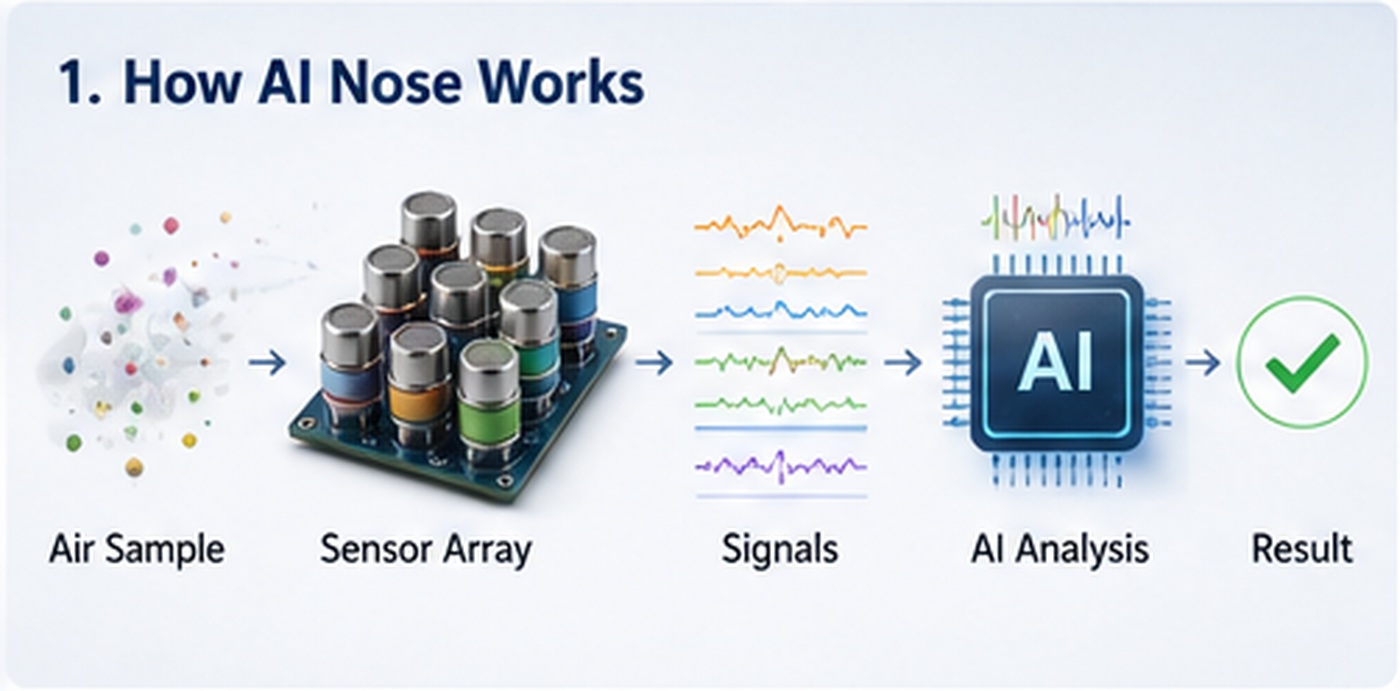
Deși arhitecturile sistemului variază, majoritatea dispozitivelor AI Nose urmează același flux de lucru general:
Probă de aer → Matrice de senzori → Semnale electrice → Procesare semnal → Model AI → Recunoaștere sau predicție
1. Sistemul colectează o probă de aer
Primul pas este aducerea probei de gaz sau miros în contact cu matricea de senzori.
În funcție de dispozitiv, eșantionarea poate utiliza:
- Difuziune naturală
- O pompă în miniatură
- Flux de aer controlat
- Eșantionarea spațiului de cap
- Tubing
- O cameră de probă dedicată
Proiectarea eșantionării este importantă deoarece răspunsurile senzorului se pot schimba în funcție de fluxul de aer, timpul de expunere, concentrația, temperatură și umiditate.
Din acest motiv, un nas AI de încredere este mai mult decât simpli senzori de gaz conectați la un computer.
Întregul mediu de prelevare contează.
2. Mai mulți senzori răspund la eșantion
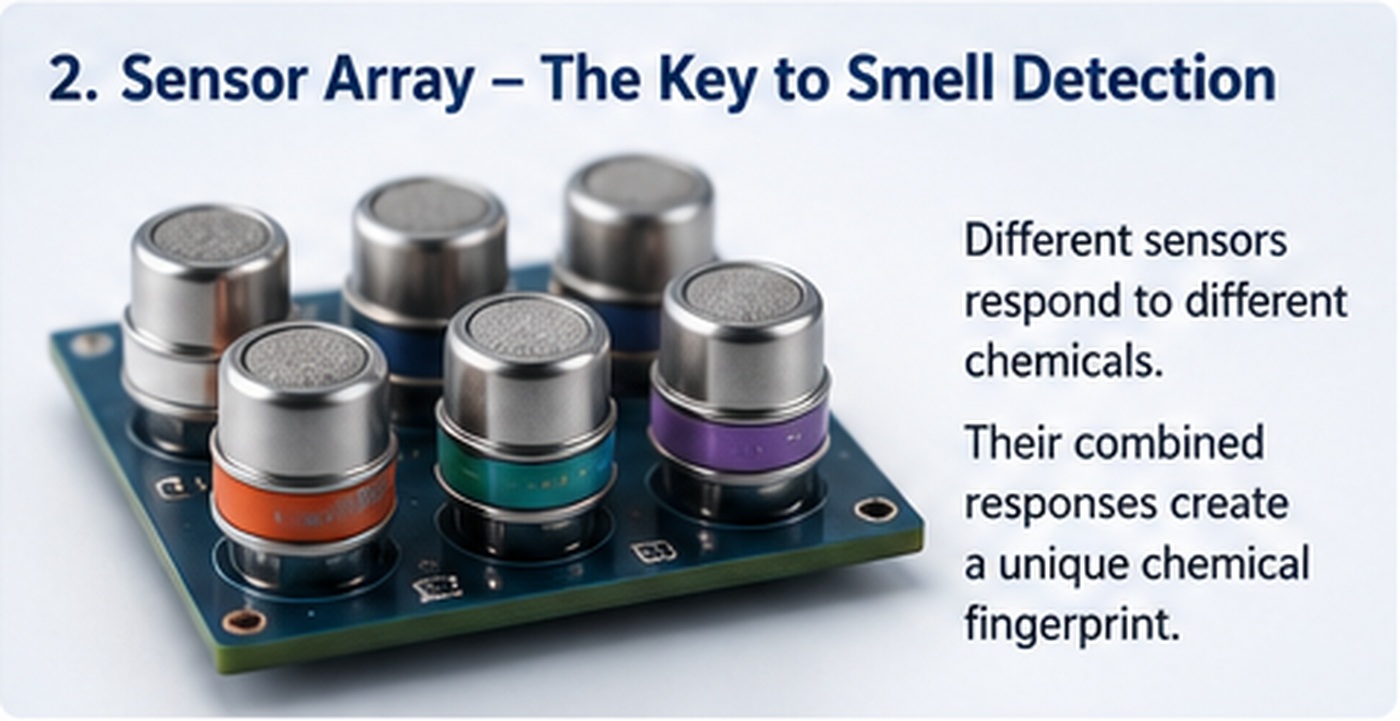
Componenta centrală a unui nas AI este de obicei a matrice de senzori.
În loc să folosească un singur senzor foarte selectiv, sistemul poate conține mai multe elemente de detectare cu sensibilități diferite.
Tehnologiile posibile includ:
- Senzori de gaz MEMS
- Senzori cu semiconductori cu oxid de metal
- Senzori electrochimici
- Senzori polimeri conductivi
- Senzori optici de gaz
- Senzori de microbalanță cu cristal de cuarț
- Senzori de unde acustice de suprafață
- Rețele de senzori colorimetrici
Imaginează-ți că șase senzori sunt expuși la aceeași aromă de cafea.
Răspunsul ar putea arăta cam așa:
- Senzor A: răspuns puternic
- Senzor B: răspuns moderat
- Senzor C: răspuns slab
- Senzor D: răspuns rapid și recuperare
- Senzor E: răspuns lent
- Senzor F: aproape niciun răspuns
Expuneți aceeași matrice de senzori la alimente stricate și combinația poate arăta complet diferit.
Nici un singur senzor nu identifică neapărat mirosul.
In schimb, modelul de pe toți senzorii devine informația utilă.
Ce este o amprentă chimică?
Când mai mulți senzori reacționează diferit la aceeași probă, semnalele lor combinate creează un model multidimensional.
Acest model este adesea descris ca:
- Amprenta chimică
- Miros amprentă
- Amprenta de gaz
- Amprenta VOC
De exemplu:
Cafea → Model A
Suc de portocale → Model B
Carne proaspătă → Model C
Carne stricat → Model D
Sistemul AI poate învăța aceste modele din datele de antrenament.
Mai târziu, când se măsoară o probă necunoscută, software-ul compară noua amprentă cu exemplele învățate anterior.
Acest lucru este similar din punct de vedere conceptual cu modul în care software-ul de recunoaștere a imaginii învață modele vizuale, mai degrabă decât să verifice manual fiecare pixel individual.
Cum AI transformă semnalele senzorilor în sens

Semnalele brute ale senzorilor sunt rareori trimise direct într-un model AI.
În mod normal, au nevoie de procesare mai întâi.
Etapele obișnuite de procesare includ:
- Filtrarea zgomotului
- Corecție de bază
- Normalizarea semnalului
- Compensarea temperaturii
- Compensarea umidității
- Corectarea deplasării senzorului
- Extragerea caracteristicilor
- Reducerea dimensionalității
Odată ce caracteristicile utile au fost extrase, algoritmii de învățare automată pot analiza datele.
Clasificare
Sistemul determină care categorie cunoscută se potrivește cel mai bine cu eșantionul.
Exemple:
- Proaspăt vs răsfățat
- Cafeaua de tip A față de cafea de tip B
- Proces normal vs. proces anormal
- Miros A versus miros B
Regresia
Modelul estimează o valoare continuă, mai degrabă decât să atribuie o categorie.
Exemplele pot include:
- Nivel de prospețime
- Maturitate
- Starea procesului
- Concentrația estimată
Detectarea anomaliilor
Un nas AI nu trebuie să știe întotdeauna exact ce este un miros.
În schimb, poate învăța ce a mediu chimic normal arata ca.
Dacă modelul senzorului se modifică semnificativ, sistemul poate semnala evenimentul ca o anomalie.
Această abordare poate fi deosebit de valoroasă în fabrici, depozite și aplicații de monitorizare a echipamentelor.
Ce algoritmi AI pot fi utilizați?
Diferite sisteme AI Nose utilizează algoritmi diferiți în funcție de complexitatea lor, dimensiunea setului de date și aplicația dorită.
Abordările comune includ:
- Analiza componentelor principale (PCA)
- Analiza liniară discriminantă (LDA)
- Suport Vector Machines (SVM)
- k-Cei mai apropiați vecini (KNN)
- Pădurea aleatorie
- Rețele neuronale artificiale
- Rețele neuronale convoluționale
- Modele de deep-learning
- Metode de învățare prin ansamblu
AI mai sofisticat nu înseamnă automat performanțe mai bune.
Un sistem de succes depinde de combinația dintre:
Calitatea senzorului + proiectarea eșantionării + date de antrenament + compensarea mediului + algoritm adecvat
Un model simplu antrenat cu date reale de înaltă calitate poate depăși o rețea neuronală complexă antrenată pe un set limitat de date de laborator.
Nasul AI versus senzorul de gaz tradițional
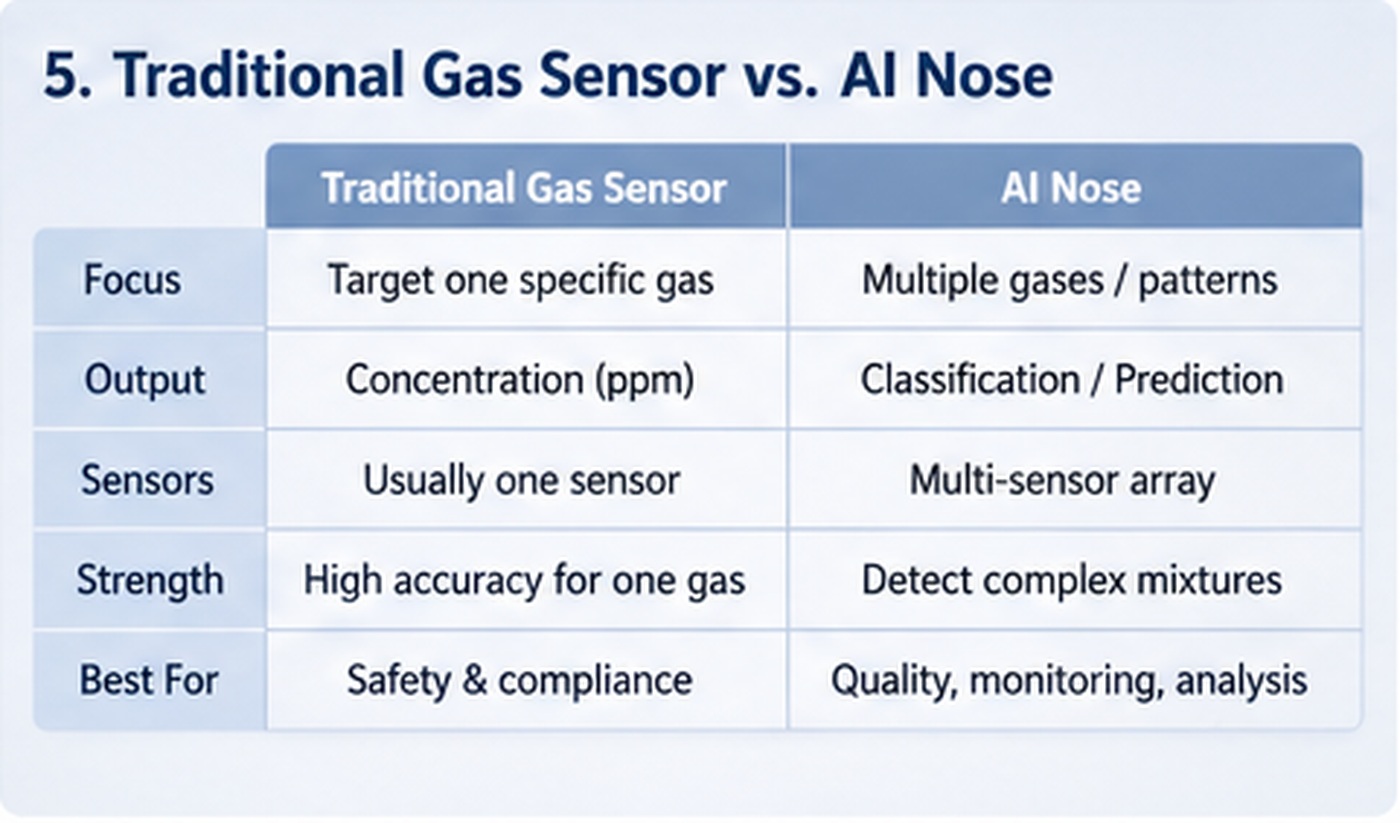
Un nas AI și un senzor de gaz tradițional sunt tehnologii înrudite, dar sunt concepute pentru a răspunde la diferite întrebări.
Senzor de gaz tradițional
Un sistem convențional de detectare a gazului se concentrează de obicei pe un gaz țintă cunoscut.
Exemplele includ:
- monoxid de carbon
- Metan
- Hidrogen
- Hidrogen sulfurat
- Amoniac
- Oxigen
- dioxid de carbon
- Refrigeranti
Întrebarea principală este de obicei:
Cât din acest gaz este prezent?
Rezultatul poate fi exprimat în:
- ppm
- ppb
- %LEL
- % volum
Pentru siguranța industrială și detectarea gazelor de reglementare, această măsurătoare cantitativă rămâne extrem de importantă.
AI Nose
Un nas AI pune de obicei o altă întrebare:
Cu ce seamănă această combinație de semnale chimice?
În loc să se bazeze pe un singur răspuns al senzorului, AI analizează relația dintre semnale multiple.
| Senzor de gaz tradițional | AI Nose |
|---|---|
| Adesea se concentrează pe un singur gaz | Utilizează mai multe canale de senzori |
| Măsoară concentrația | Recunoaște modelele chimice |
| Utilizează de obicei praguri definite | Poate folosi modele de învățare automată |
| Ieșire adesea în ppm sau % | Ieșirea poate fi de clasă, probabilitate sau anomalie |
| Selectivitatea ridicată poate fi importantă | Sensibilitatea încrucișată poate oferi informații utile despre model |
| Cel mai bun pentru gazele țintă cunoscute | Util pentru amestecuri chimice complexe |
Aceste tehnologii nu concurează neapărat.
În multe aplicații se pot completa reciproc.
Un sistem ar putea folosi senzori de siguranță dedicați pentru a măsura concentrațiile de gaze periculoase, în timp ce un nas AI analizează schimbări mai ample în mediul chimic din jur.
Un exemplu de nas AI din lumea reală: Winsen ZM101-A
Tehnologia AI Nose trece din ce în ce mai mult de la prototipuri de cercetare la platforme practice de detectare.
Un exemplu este Winsen ZM101-A AI nas, o matrice de senzori de gaz MEMS concepută pentru a sprijini analiza inteligentă a gazelor multicanal.
ZM101-A încorporează șase canale de detectare a gazului și acceptă selecția flexibilă a 1 până la 6 canale de operare.
Canalele sale de detectare disponibile acoperă:
| Gaz | Interval de detectare |
|---|---|
| NH₃ | 1–100 ppm |
| COV | 1–10 ppm |
| NU₂ | 0.1–10 ppm |
| H₂S | 0.5–10 ppm |
| CO | 5–200 ppm |
| CH₄ | 100–6000 ppm |
Spre deosebire de un element de detectare convențional cu un singur gaz, ZM101-A este proiectat ca un matrice de senzori de gaz MEMS multicanal.
Modulul oferă filtrarea semnalului și compensarea temperaturii/umidității și acceptă integrarea cu modele de algoritm AI.
Acest lucru permite dezvoltatorilor să construiască aplicații în care mai multe răspunsuri de gaz sunt colectate împreună și utilizate pentru următoarele:
- Captarea gazului țintă
- Analiza caracteristicilor
- Clădire model
- Identificarea sarcinii
Specificații cheie ZM101-A
- Tip senzor: Matrice de senzori de gaz MEMS
- Canale de gaz: 6
- Moduri de operare: Selecție flexibilă de 1-6 canale
- Tensiune de alimentare: DC 3,3 V
- Curent de funcționare: ≤150 mA
- Consum de energie: ≤400 mW
- Comunicare: Uart
- Timp de încălzire: ≤120 de secunde
- Temperatura de functionare: -40°C până la 85°C
- Umiditate de funcționare: 5%RH–95%RH, fără condensare
- Suport AI: Suportă integrarea modelelor de algoritm AI
Modulul este destinat domeniilor de aplicare, inclusiv:
- Frigidere inteligente
- Aer conditionat
- Cuptoare cu microunde
- Purificatoare de aer
- Hote
- Monitorizarea calității aerului auto
- Monitorizarea gazelor industriale
- Alarme de scurgere
- Cercetare de detectare legată de asistență medicală
- Monitorizare inteligentă a mediului
ZM101-A ilustrează o dezvoltare importantă în domeniul AI Nose: producătorii oferă din ce în ce mai mult Hardware de detectare multicanal pe care dezvoltatorii îl pot combina cu propriile modele AI și cu datele aplicației.
Acest lucru face posibilă proiectarea sistemelor electronice cu nas specifice aplicației, mai degrabă decât pornind de la elementele de detectare individuale.
Unde poate fi folosită tehnologia AI Nose?
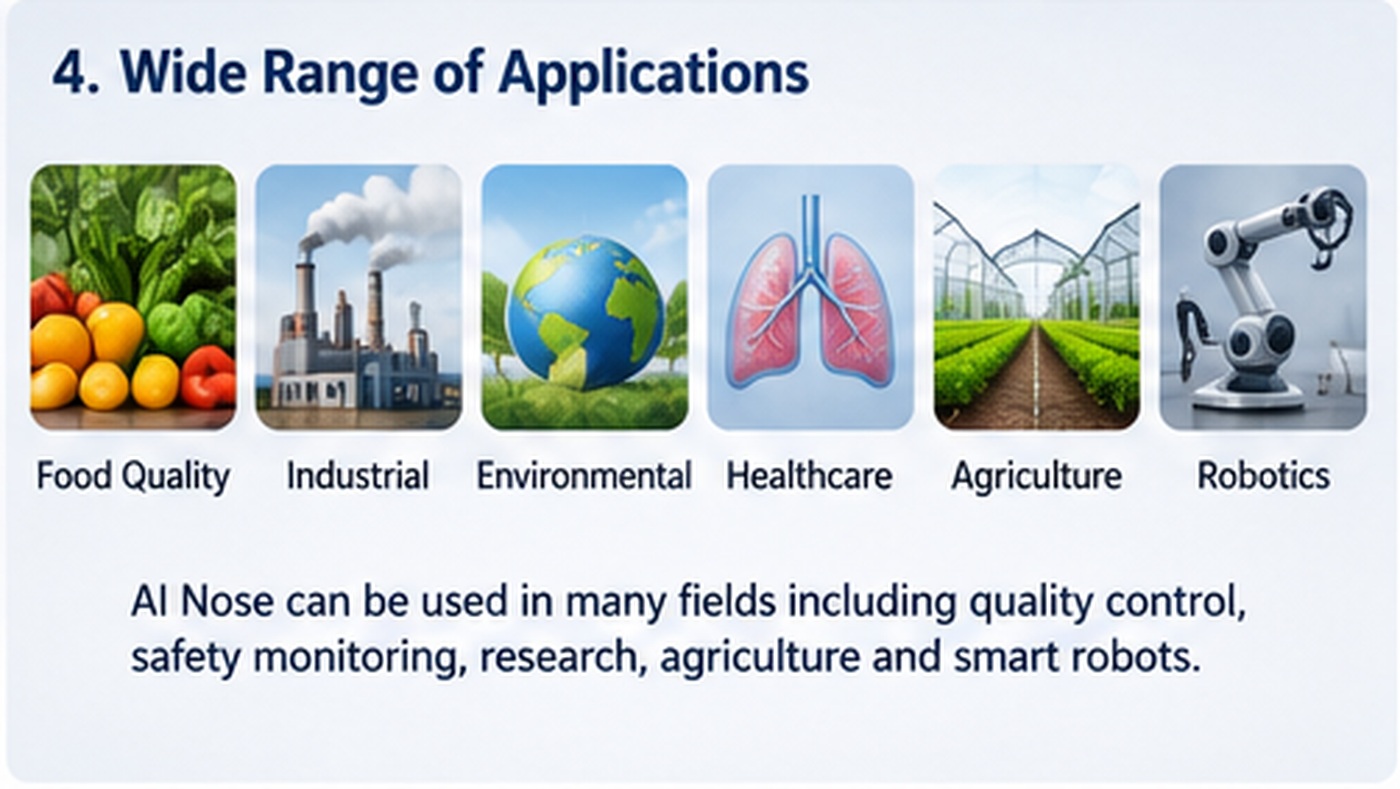
Aplicațiile potențiale ale tehnologiei AI Nose se extind în multe industrii, deoarece aproape fiecare proces biologic, chimic sau de fabricație produce un anumit tip de semnătură chimică volatilă.
1. Calitatea și prospețimea alimentelor
Alimentele eliberează amestecuri schimbătoare de COV, deoarece:
- Se coace
- Fermentează
- Se oxidează
- Se degradează
- Prada
Un nas AI poate analiza acele modele în schimbare pentru a ajuta la evaluarea:
- Prospeţime
- Alterarea
- Maturitate
- Starea fermentației
- Consecvența produsului
- Origine
- Alterare
Produsele posibile includ:
- Carne
- Fructe de mare
- Fructe
- Legume
- Cafea
- Ceai
- Vin
- Produse lactate
De exemplu, un AI Nose nu trebuie neapărat să identifice fiecare COV produs de carnea stricat.
Poate afla pur și simplu că amprenta senzorului cărnii stricate diferă constant de amprenta cărnii proaspete.
2. Monitorizarea proceselor industriale
Fabricile produc adesea semnături chimice caracteristice în timpul funcționării normale.
Modificările acestor semnături pot indica:
- Anomalii de proces
- Contaminarea materialului
- Probleme de echipamente
- Scurgeri
- Supraîncălzire
- Degradare chimică
În loc să aștepte până când un gaz atinge un prag de alarmă fix, un nas AI poate identifica că mediul chimic general s-a schimbat.
Acest lucru face ca olfația artificială să fie deosebit de interesantă pentru monitorizarea industrială continuă.
3. Monitorizarea mediului
Multe probleme de miros de mediu implică mai degrabă amestecuri complexe decât un singur gaz.
Aplicațiile potențiale includ:
- Stații de ape uzate
- Instalatii de tratare a deseurilor
- Ferme
- Parcuri industriale
- Instalatii chimice
- Monitorizarea aerului din interior
- Identificarea sursei de miros
Senzorii de gaz convenționali rămân importanți atunci când trebuie măsurate concentrațiile individuale de poluanți.
Sistemele AI Nose pot adăuga un alt strat recunoscând miros general sau semnătură VOC.
4. Electrocasnice inteligente
Olfactivul artificial poate fi integrat și în aparatele de consum.
Aplicațiile potențiale includ:
Frigidere
Detectați modificările asociate cu prospețimea alimentelor sau mirosurile anormale.
Hote
Recunoașteți modelele de gaz și mirosuri legate de gătit și reglați automat ventilația.
Purificatoare de aer
Evaluați schimbările din mediile chimice interioare în loc să vă bazați doar pe o singură valoare VOC.
Aer conditionat
Combinați senzorul chimic cu măsurarea temperaturii, umidității și particulelor pentru o gestionare mai inteligentă a calității aerului.
Acesta este un domeniu în care matricele MEMS compacte, cum ar fi ZM101-A, pot fi deosebit de atractive, deoarece producătorii de aparate au nevoie de platforme de detectare mici, cu putere redusă.
5. Aplicații auto
Vehiculele moderne conțin deja senzori de mediu din ce în ce mai sofisticați.
Tehnologia AI Nose ar putea adăuga recunoaștere a modelelor chimice pentru:
- Monitorizarea aerului din cabină
- Detectarea poluării exterioare
- Mirosuri neobișnuite
- Controlul calității aerului
- Ventilatie personalizata
- Control automat de recirculare
Viitoarele vehicule inteligente pot combina olfactiv artificial cu camere, microfoane, senzori de temperatură și alți senzori de mediu.
6. Agricultura
Plantele, solul, fructele și procesele biologice eliberează mulți compuși volatili.
Prin urmare, sistemele AI Nose pot suporta:
- Monitorizarea coacerii fructelor
- Cercetarea bolilor culturilor
- Evaluarea calității produsului
- Monitorizarea stocării
- Monitorizarea serelor
- Analiza zootehnie-mediu
Unul dintre avantajele potențiale majore este detectarea modificărilor chimice înainte ca o problemă să devină evidentă vizual.
7. Cercetare în domeniul sănătății
Respirația umană conține mulți compuși volatili asociați cu procesele metabolice.
Prin urmare, cercetătorii explorează nasurile electronice pentru a analiza tiparele de respirație.
Domeniile potențiale de cercetare includ:
- Analiza respirației
- Monitorizarea pacientului
- Monitorizare medico-mediu
- Studii VOC legate de boli
Cu toate acestea, trebuie făcută o distincție importantă.
Un rezultat al cercetării care arată că un nas electronic poate distinge anumite modele de respirație nu înseamnă automat că dispozitivul este un instrument de diagnostic medical aprobat.
Validarea clinică, reproductibilitatea, aprobarea de reglementare și seturi mari de date reprezentative sunt necesare înainte ca astfel de sisteme să poată fi utilizate pentru diagnosticul medical.
8. Robotică și inteligență încorporată
Roboții folosesc deja mai multe simțuri artificiale:
- Camerele oferă viziune
- Microfoanele asigură auzul
- Senzorii de forță oferă atingere
- LiDAR oferă conștientizare spațială
Olfactiv artificial ar putea oferi un alt sens important.
Un robot echipat cu un nas AI ar putea identifica:
- Scurgeri de gaz
- Deversări chimice
- Modificări legate de fumat
- Mancare stricata
- Medii periculoase
- Surse de miros
Acest lucru ar putea fi util în special pentru:
- Roboți de inspecție industrială
- Roboți de stingere a incendiilor
- Inspecție subterană
- Roboti de mediu periculos
- Roboți de serviciu de uz casnic
Pe măsură ce IA se dezvoltă, detectarea chimică ar putea deveni o altă sursă importantă de informații despre mediu.
Nas AI pentru întreținere predictivă
O aplicație industrială deosebit de interesantă este întreținerea predictivă.
Echipamentul poate elibera uneori COV caracteristici înainte de apariția unei defecțiuni vizibile.
Sursele posibile includ:
- Componente supraîncălzite
- Lubrifianti degradanti
- Izolație electrică
- Materiale plastice
- baterii
- Scurgeri chimice
În loc să stabilească un prag pentru fiecare compus posibil, un AI Nose poate învăța amprenta chimică normală în jurul unei mașini.
Dacă acea amprentă se schimbă treptat, sistemul poate detecta anomalia înainte să apară o defecțiune majoră.
Această abordare ar putea completa în cele din urmă:
- Monitorizarea vibrațiilor
- Monitorizare acustică
- Imagini termice
- Măsurători electrice
Fuziunea senzorilor poate produce în cele din urmă sisteme de întreținere predictivă mai fiabile decât orice tehnologie de detectare individuală.
De ce este AI utilă pentru detectarea mirosurilor?
Mirosurile complexe constau rareori dintr-un singur gaz.
Luați în considerare șase senzori care răspund simultan:
| Senzor | Răspuns |
|---|---|
| Senzorul A | Creștere moderată |
| Senzorul B | Creștere puternică |
| Senzorul C | Aproape neschimbat |
| Senzorul D | Vârf rapid |
| E-Senzor | Recuperare lenta |
| Senzorul F | Scădere mică |
Un sistem convențional de prag ar putea avea dificultăți să interpreteze această combinație.
Algoritmii de învățare automată sunt proiectați pentru a identifica relațiile între mai multe variabile.
Acesta este motivul pentru care inteligența artificială este deosebit de potrivită pentru nasurile electronice.
Informațiile valoroase adesea nu sunt:
„Senzorul A a măsurat 2,8.”
Este:
„Relația combinată dintre senzorii A–F se potrivește îndeaproape cu modelul X.”
Care sunt principalele provocări ale tehnologiei AI Nose?
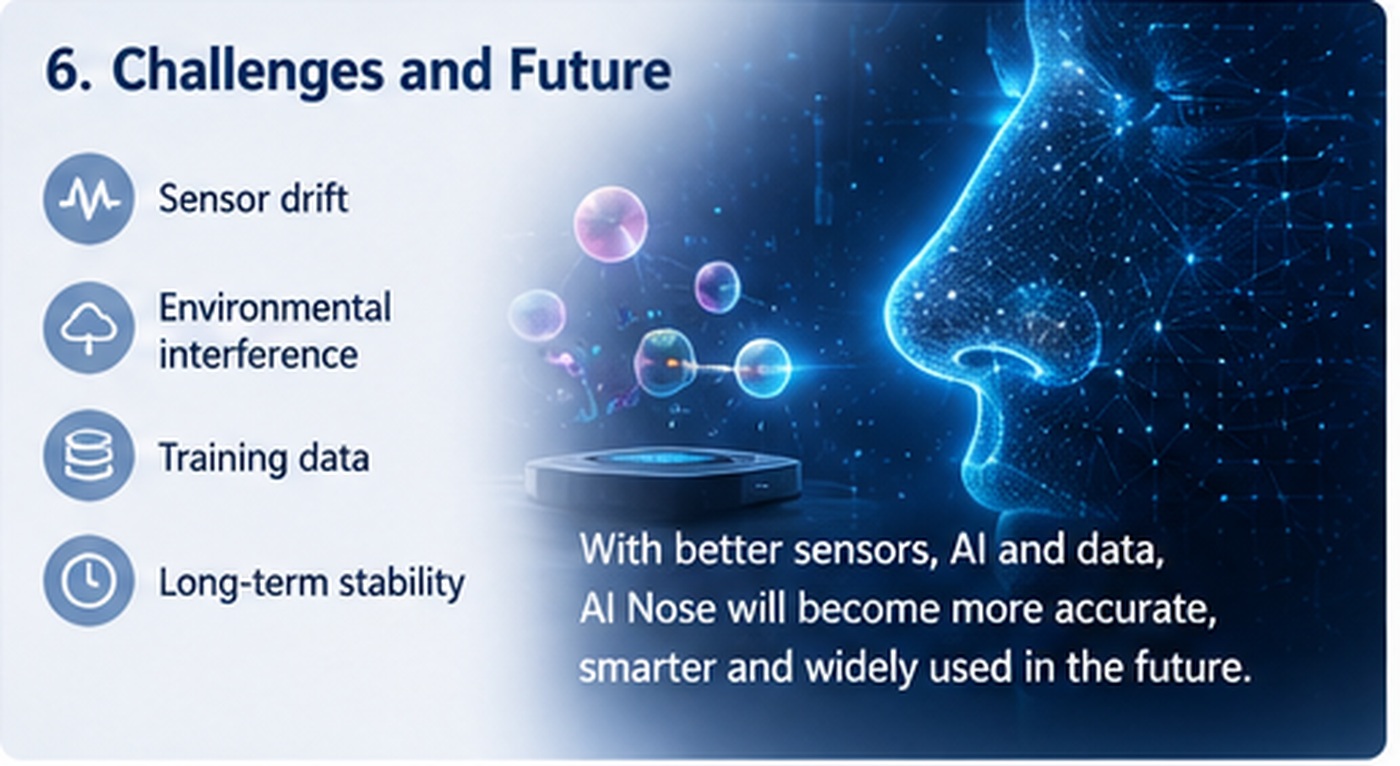
Tehnologia AI Nose este promițătoare, dar implementarea practică rămâne o provocare.
Senzor derivă
Senzorii de gaz își pot schimba treptat caracteristicile din cauza:
- Îmbătrânire
- Contaminare
- Expunere pe termen lung la substanțe chimice
- Condiții de mediu
- Modificări materiale
Un model antrenat atunci când o matrice de senzori este nouă poate deveni mai puțin precis după luni sau ani.
Compensarea derivei este, prin urmare, o parte importantă a dezvoltării pe termen lung a AI Nose.
Temperatura și umiditatea
Mulți senzori chimici sunt afectați de condițiile de mediu.
Dacă umiditatea se schimbă de la 30%RH la 80%RH, unele semnale ale senzorului se pot schimba chiar dacă mirosul în sine nu s-a întâmplat.
Un sistem de încredere trebuie să distingă:
Schimbare chimică reală
din
Interferența mediului
Compensarea temperaturii și umidității sunt, prin urmare, caracteristici importante în matricele practice de senzori.
Date de instruire
Un model AI este la fel de util ca și datele folosite pentru a-l antrena.
Un sistem antrenat în condiții ideale de laborator poate funcționa diferit într-o fabrică.
Seturile de date din lumea reală ar trebui să conțină variații în:
- Temperatura
- Umiditate
- Gaze de fond
- Îmbătrânirea senzorului
- Loturi de produse
- Concentraţie
- Flux de aer
- Condiții sezoniere
Contaminarea senzorului
Unele gaze sau substanțe chimice pot modifica temporar sau permanent materialele de detectare.
Prin urmare, sistemele de eșantionare pot necesita:
- Filtre
- Expunere controlată
- Proceduri de curățare
- Calibrare
- Strategii de înlocuire a senzorilor
Generalizare
Un nas electronic antrenat pentru un mediu nu poate fi de așteptat să funcționeze la fel de bine peste tot.
De exemplu:
Un model AI instruit folosind mostre de cafea de la o unitate de prăjire poate să nu recunoască imediat fiecare cafea din fiecare țară, proces de prăjire sau mediu de depozitare.
Formarea și validarea specifice aplicației rămân extrem de importante.
Este AI Nose la fel cu Digital Olfaction?
Terminologia se suprapune considerabil.
Nas electronic
De obicei, se referă la un sistem de matrice de senzori fizici conceput pentru a imita aspecte ale detecției biologice a mirosului.
AI Nose
Subliniază integrarea învățării automate sau a inteligenței artificiale cu datele matricei de senzori.
Olfactiv Mașină
Un termen mai larg pentru a permite mașinilor să interpreteze informațiile chimice din aer.
Olfactiv digital
Poate include procesul complet de:
- Captarea informațiilor legate de miros
- Digitalizarea acestuia
- Analizând-o
- Transmiterea acestuia
- Potenţial reproducându-l
Deoarece acest domeniu este încă în curs de dezvoltare, terminologia variază între cercetători și producători.
Nasurile AI vor înlocui senzorii tradiționali de gaz?
Nu.
Cel puțin nu în viitorul previzibil.
Senzorii de gaz dedicati rămân esențiali pentru aplicațiile care necesită măsurarea precisă a gazelor specifice.
Exemplele includ:
- Alarme de siguranță CO
- Detectoare de gaze combustibile
- Monitorizarea oxigenului
- Detectarea gazelor toxice
- Detectarea scurgerilor de agent frigorific
Un nas AI este mai potrivit atunci când problema implică:
- Amestecuri complexe
- Recunoașterea mirosului
- Clasificare
- Schimbări de tipar
- Detectarea anomaliilor
Prin urmare, este posibil ca viitorul să implice ambele tehnologii.
Un sistem sofisticat de monitorizare industrială poate conține:
Senzori specifici de gaz + AI Nose + senzori de temperatură/umiditate + senzori de particule + camere + software de predicție
Împreună, aceste tehnologii pot oferi o înțelegere mult mai bogată a unui mediu decât orice singur senzor.
Viitorul tehnologiei AI Nose
Mai multe evoluții accelerează progresul în domeniul olfacției artificiale.
Senzori MEMS mai mici
Fabricarea MEMS face matricele de senzori multicanal din ce în ce mai compacte și potrivite pentru integrarea în:
- Aparate
- Vehicule
- Roboți
- Dispozitive portabile
- Echipamente IoT
Edge AI
Modelele de învățare automată pot funcționa din ce în ce mai mult direct pe procesoarele locale.
Beneficiile includ:
- Răspuns mai rapid
- Lățimea de bandă a rețelei mai mică
- Operare offline
- Intimitate mai bună
- Procesare în timp real
Seturi de date mai mari din lumea reală
Pe măsură ce sunt implementate mai multe nasuri electronice, inginerii pot colecta seturi de date mai mari care acoperă:
- Îmbătrânirea senzorului
- Variație sezonieră
- Interferența mediului
- Diferențele de produse
- Evenimente anormale
Aceste seturi de date ar trebui să contribuie la îmbunătățirea robusteței modelului.
Fuziunea senzorilor
Viitoarele sisteme AI pot combina mirosul cu alte tehnologii de detectare.
De exemplu:
Nas AI + Cameră + Temperatura + Umiditate + Particule + Presiune + Sunet
În loc să ofere mașinilor doar miros artificial, inginerii pot dezvolta sisteme complete multi-senzoriale.
Întrebări frecvente
Ce detectează un nas AI?
Un nas AI detectează modele produse de gaze, COV și mirosuri folosind mai mulți senzori chimici. În funcție de pregătirea sa, poate clasifica mirosurile, poate detecta condiții anormale sau poate estima proprietăți specifice.
Este un nas AI la fel cu un nas electronic?
Un nas AI este, în general, un tip de nas electronic care pune un accent mai mare pe inteligența artificială și pe învățarea automată pentru interpretarea datelor din matricea de senzori.
Poate AI să identifice mirosurile?
AI poate clasifica modele chimice atunci când are date adecvate ale senzorilor și exemple reprezentative de antrenament. Sistemul nu „miroase” exact ca un om, dar poate învăța să recunoască amprentele chimice repetabile.
Un AI Nose măsoară concentrația de gaz?
Se poate, în funcție de senzori și model, dar măsurarea concentrației nu este întotdeauna scopul său principal. Multe sisteme AI Nose se concentrează pe clasificare, recunoaștere sau detectarea anomaliilor.
Ce senzori sunt utilizați într-un nas AI?
Tehnologiile de detectare posibile includ senzori MEMS cu oxid de metal, senzori semiconductori, senzori electrochimici, senzori optici, polimeri conductivi și alte tehnologii de detectare chimică.
Poate un nas AI detecta mai multe gaze?
Da. Sistemele AI Nose multicanal pot combina răspunsurile de la mai multe elemente de detectare. De exemplu, Winsen ZM101-A oferă șase canale de gaz MEMS care acoperă NH3, VOC, NO2, H2S, CO și CH4.
Un nas AI poate fi integrat într-un produs?
Da. Matricele de senzori MEMS compacte pot fi integrate în aparate, vehicule, echipamente industriale și dispozitive IoT. Interfețele de comunicație precum UART pot permite hardware-ului senzorului să facă schimb de date cu controlere încorporate sau sisteme de procesare AI.
Concluzie
Un AI Nose combină mai mulți senzori chimici cu inteligența artificială pentru a recunoaște modelele în gaze, COV și mirosuri.
Cel mai important avantaj al său nu este neapărat identificarea fiecărei molecule chimice separat.
În schimb, matricea de senzori creează o amprentă chimică unică, iar algoritmii de învățare automată învață să asocieze acea amprentă cu o afecțiune cunoscută.
Această abordare creează noi oportunități în:
- Calitatea alimentelor
- Monitorizare industrială
- Sentirea mediului
- Aparate inteligente
- Sisteme auto
- Agricultură
- Robotică
- Cercetarea în domeniul sănătății
- Întreținere predictivă
Produse precum Winsen ZM101-A AI nas să demonstreze, de asemenea, modul în care matricele de senzori MEMS multicanal devin platforme hardware practice pentru dezvoltatorii care construiesc aplicații reale de olfactiv AI.
Cu toate acestea, sistemele de succes AI Nose depind de mult mai mult decât simpla combinare a senzorilor cu un algoritm AI.
Selectarea senzorilor, proiectarea eșantionării, compensarea temperaturii și umidității, seturi de date reprezentative de antrenament, managementul derivei și validarea în lumea reală, toate determină dacă un sistem olfactiv artificial poate trece cu succes de la o demonstrație de laborator la o aplicație comercială de încredere.
Pe măsură ce senzorii de gaz devin mai mici și inteligența artificială devine mai capabilă, capacitatea mașinilor de a înțelege lumea chimică din jurul lor este probabil să devină o parte din ce în ce mai importantă a detectării inteligente.