
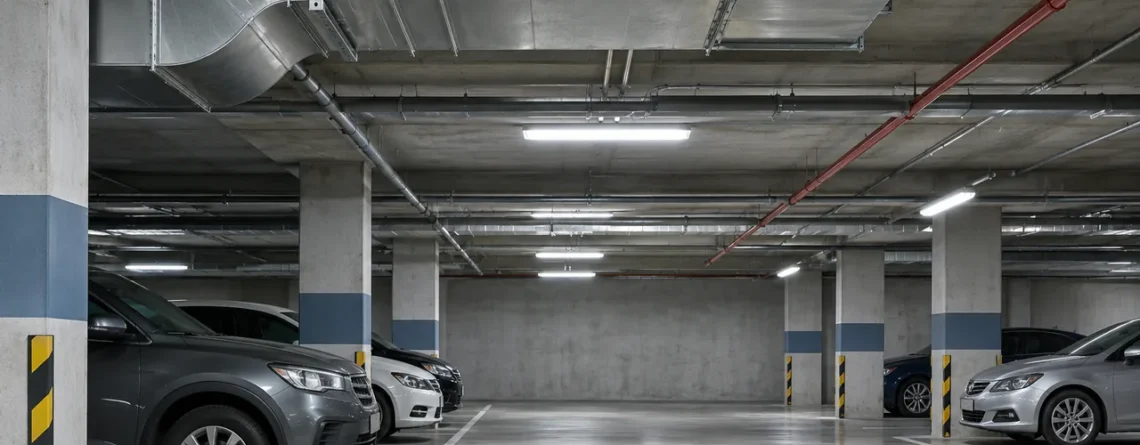
Parking garage CO monitoring requirements depend on the jurisdiction, the adopted code edition and the type of garage and ventilation system. An applicable rule can require carbon monoxide monitoring to control exhaust ventilation. It can also require another gas channel, a detector listing, coverage in separate zones, fault handling or formal acceptance testing. A reading used to stage a fan, a trouble alarm sent to facilities staff and a signal that tells occupants to take protective action are separate functions. Each needs its own authority and sequence.
Start with the garage classification, permit scope and mechanical design. Locate the adopted mechanical and energy requirements and any applicable fire or workplace provisions. Then put gas coverage, control thresholds, time behavior, minimum airflow, detector faults and notification responsibilities on separate rows. That separation keeps one published number from being reused for a different decision.
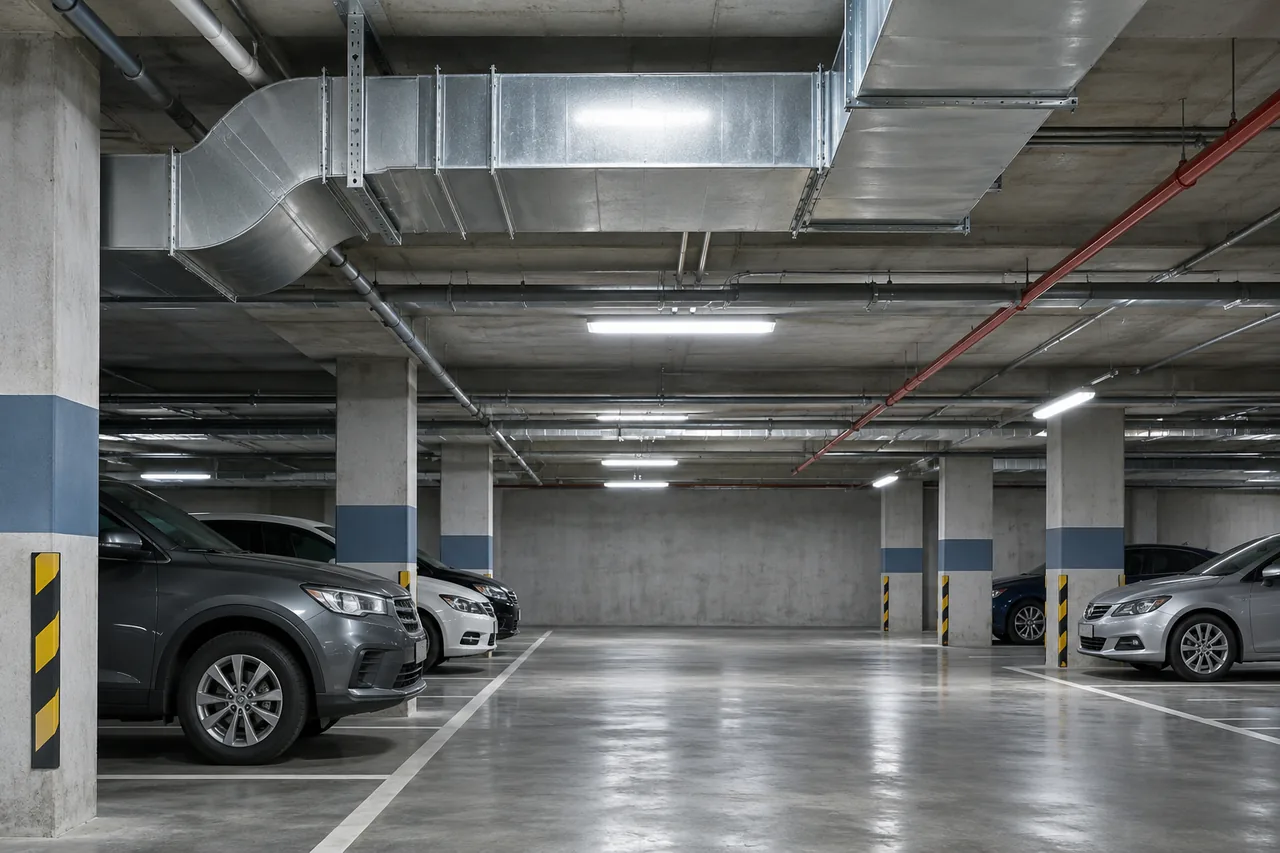
Enclosed garage ventilation is a mechanical system with jurisdiction-specific requirements.
Determine which garage provisions apply
“Enclosed,” “open,” “existing,” and “altered” are regulatory terms or project conditions, as well as ordinary descriptions. An above-grade garage with openings can still need classification under the adopted building or mechanical code. A ramp open to the street does not by itself establish the classification of the level it serves. Check whether separate portions have different requirements and whether a permit, alteration or change in use changes the applicable edition or the work included.
Identify the total design exhaust rate, expected vehicle mix, occupied schedule and whether the system also serves a smoke-control or another emergency function. Those details can affect whether an energy provision applies and what sequences need coordination. If a garage system is used for more than one purpose, the design documents should state which function has priority in each condition and how independent systems exchange status. Do not assume a CO control point is also authorized to alter a fire-mode sequence.
A jurisdiction may adopt a model code with amendments, apply a separate energy code, or have local rules that change the result. Obtain the actual text controlling the job. Keep the project’s scope and adopted edition with the section number. A contractor using a prior project specification can otherwise import a number without knowing whether it applied to that earlier garage’s permit, exhaust rate or fleet.
California example for a specific 2025 Energy Code provision
The California Energy Commission’s 2025 Energy Code page identifies January 1, 2026 as the relevant permit application date for the 2025 code. Its 2025 Building Energy Efficiency Standards, Section 120.6(c) address mechanical ventilation systems for enclosed parking garages with a total design exhaust rate of at least 10,000 cfm, subject to stated exceptions. The section includes staging or modulation, CO monitoring and coverage, a scheduled-occupancy airflow minimum, and a pressure relationship relative to other occupiable space.
Under that subsection, CO must be monitored at a minimum of one sensor per 5,000 square feet, with at least two sensors per proximity zone and placement in areas expected to experience the highest concentrations. A proximity zone is separated by a floor or another impenetrable obstruction as defined by the provision. The rule specifies that the CO concentration at all sensors be maintained at no more than 25 ppm. Treat the number as part of a scoped energy and ventilation control requirement, with its associated design, sensor performance and fault provisions.
Among the listed exceptions are certain portions where more than 20 percent of the vehicles expected to be stored have non-gasoline combustion engines, and certain additions or alterations below the stated threshold for new exhaust capacity. Review the complete language with the project authority. Whether an energy subsection applies does not answer the separate question of which other mechanical or safety provisions govern the project. Section 120.6(c) also refers to Reference Nonresidential Appendix NA7.12 for required acceptance evidence on systems in scope.
Minnesota example for a state mechanical amendment
Minnesota Rules 1346.0404, subpart 1 amends IMC Section 404.1 for enclosed parking garages. Its text requires CO and nitrogen dioxide detection and automatic mechanical ventilation activation when CO reaches at least 25 ppm, NO₂ reaches at least 3 ppm, or both. It also calls for detectors listed to UL 2075 and installed under their listing and manufacturer instructions. This is Minnesota’s published amendment. The figures describe the ventilation actuation in that text.
Notice what changes between these examples. California’s cited energy provision has a design capacity trigger, a CO maintenance condition and its own density and failure rules. Minnesota’s cited mechanical amendment expressly names two pollutants and defines a ventilation activation condition. A coincident CO value does not make the provisions interchangeable. A project subject to multiple rules needs a sequence that satisfies each applicable requirement and documents how those requirements interact.
| Requirement question | Доказательства для запроса |
|---|---|
| Is the garage or portion in scope? | Permit, classification basis, adopted edition, local amendments and exception analysis |
| Which gases and detection products apply? | Controlling mechanical and energy provisions, listing and exact model or channel data |
| What must the fans do? | Approved sequence, design airflow and required minimum, with occupancy and priority conditions |
| Which signals go to people? | Project notification matrix, applicable fire or safety basis and operator instructions |
| What proves acceptance? | Required acceptance form, tested states, detector and fan evidence and signed disposition |
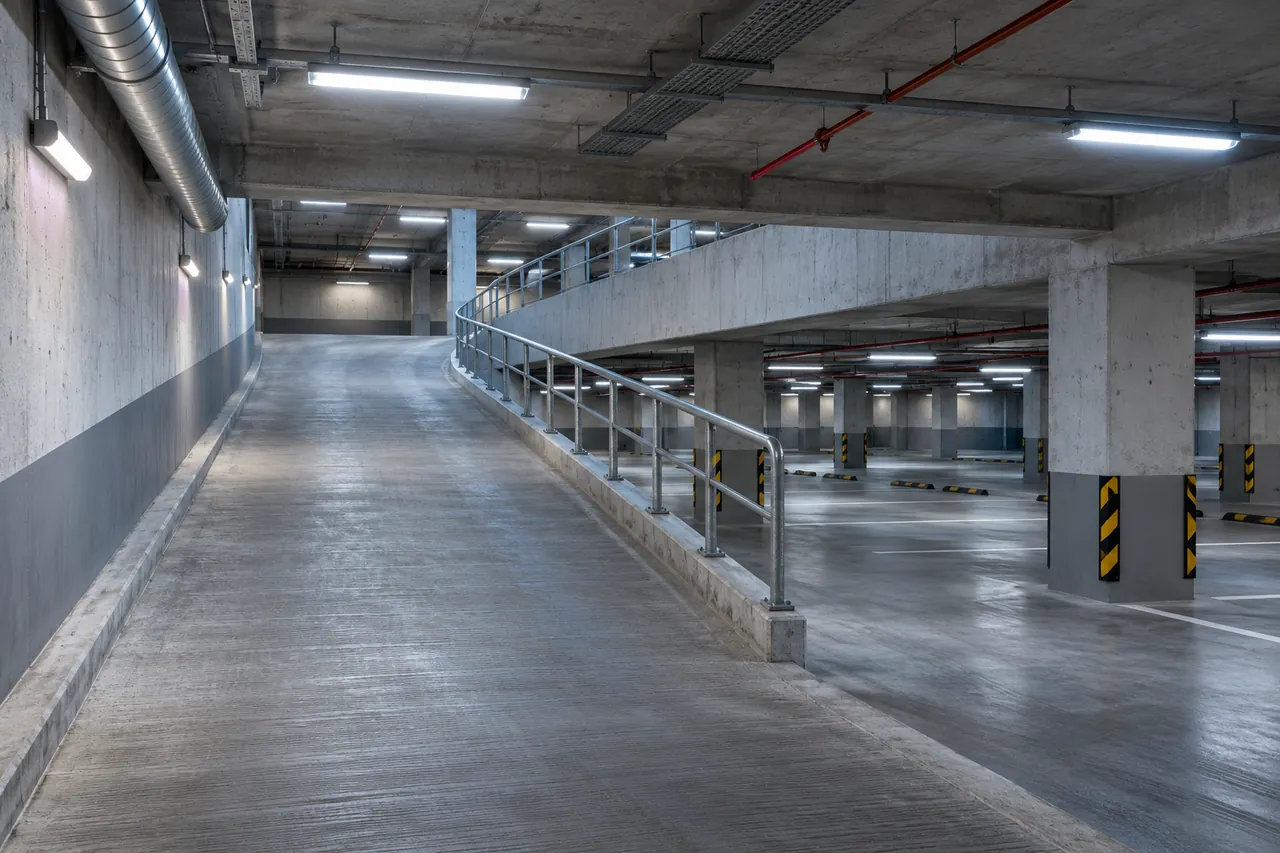
Physical separation and ventilation help define a garage coverage review.
Separate a ventilation decision from an alarm decision
Demand-controlled ventilation uses gas measurements to change the rate or operation of exhaust within the applicable limits. The sequence may also use an occupied schedule and a minimum airflow setting. It should define which channels and zones affect each fan group and what prevents the plant from dropping below a required operating state. A ventilation output can be active during an ordinary control event without any occupant alarm being required by that event.
A detector trouble event is different. It can occur because a channel has failed, communications are stale, power has been lost or another condition has made the data unavailable or invalid. The system needs a documented state for this condition. Under the cited California subsection, detected sensor failure requires design ventilation rates and an alarm to facility operators. The rule specifies failure checks, including calibration status and consistency comparisons during occupied and unoccupied periods. Read the detailed conditions in the edition that applies. A displayed zero from a missing sensor is a misleading representation of a fault.
An occupant warning, where required by the relevant rule or design, serves a protective response and needs its own criteria, recipients and authorized actions. It can use independent equipment or an approved interface. Confirm the authority responsible for the notification arrangement, how affected areas are identified and who authorizes recovery. A facilities trouble message and an occupant hazard signal can be two separate outputs from the same project. Their names, priorities and response documentation should make that evident.
An occupational exposure assessment is another decision. OSHA’s Table Z-1 gives federal US workplace air-contaminant provisions, including CO, within its applicable scope. Time-weighted exposure and a mechanical ventilation actuation point describe different things. A fixed garage monitor is useful information about where and when the gas reached that point. A workplace assessment requires a strategy appropriate to the workers, tasks and exposure metric under review.
Use a sequence table that operators can interpret
| Input or situation | Control question | Evidence or notification question |
|---|---|---|
| Valid gas reading rises | Which fan stage or airflow is required, for which zone and delay? | Which point, value, unit and validity are logged? |
| Concentration recovers | What release condition and minimum airflow apply? | What records distinguish recovery from a bypass or sensor reset? |
| Sensor fails or data become stale | What fallback does the approved sequence require? | Who sees trouble and how quickly does the indication reach them? |
| Fan command is present and proof is absent | What equipment fault or alternative state applies? | Does the operator see command and actual proof separately? |
| Separate emergency mode is active | Which approved function has priority? | Which controller owns the decision and what is logged? |
| Authorized service mode is enabled | What temporary controls protect the affected area? | Who authorized it, when does it expire and how is normal service restored? |
A command is an instruction to equipment. A proof can show that a motor is running or another monitored condition has been achieved. Even a run signal may have a different evidentiary meaning from measured airflow. Keep the distinctions in the controls drawing and acceptance report. The fact that a fan icon changes color can show that a graphic received a state. It does not by itself establish the required air movement.
Translate the rules into gas coverage
A detector samples gas arriving at its sensing element or inlet. Source location and gas movement determine the usefulness of that sample. Common design questions include how vehicles queue at barriers, where ramps meet parking levels, whether a partition or floor isolates a region, and how supply and exhaust affect the movement of emissions. Conditions can change when fans stage, gates open or vehicles occupy particular parts of a level. Mark the scenarios and their assumptions on the same drawings used to review coverage.
CO can be produced by incomplete combustion, and vehicle exhaust composition depends on fuel and operating state. NO₂ can be a separate concern and may be required as a separate channel. An electrochemical CO sensor is designed and calibrated for CO under specified conditions. An NO₂ sensor has its own response, range and interference behavior. Combining the channels in one enclosure does not make their readings interchangeable. The Honeywell GSTC transmitter page provides a manufacturer example of CO and NO₂ gas transmitter configurations. Check the exact product and supporting data rather than inferring coverage from a family name.
A design review should check the sensing location against the exact product’s instructions and the governing rule. A single height or radius copied from an unrelated installation does not describe coverage. Walls, vehicle movements, recesses and ventilation can affect transport. Equipment exposed to washing, condensation, temperature swings or physical impacts needs suitable protection and service access. A guard, splash cover or enclosure can also change diffusion or response if it was not approved for the assembly.
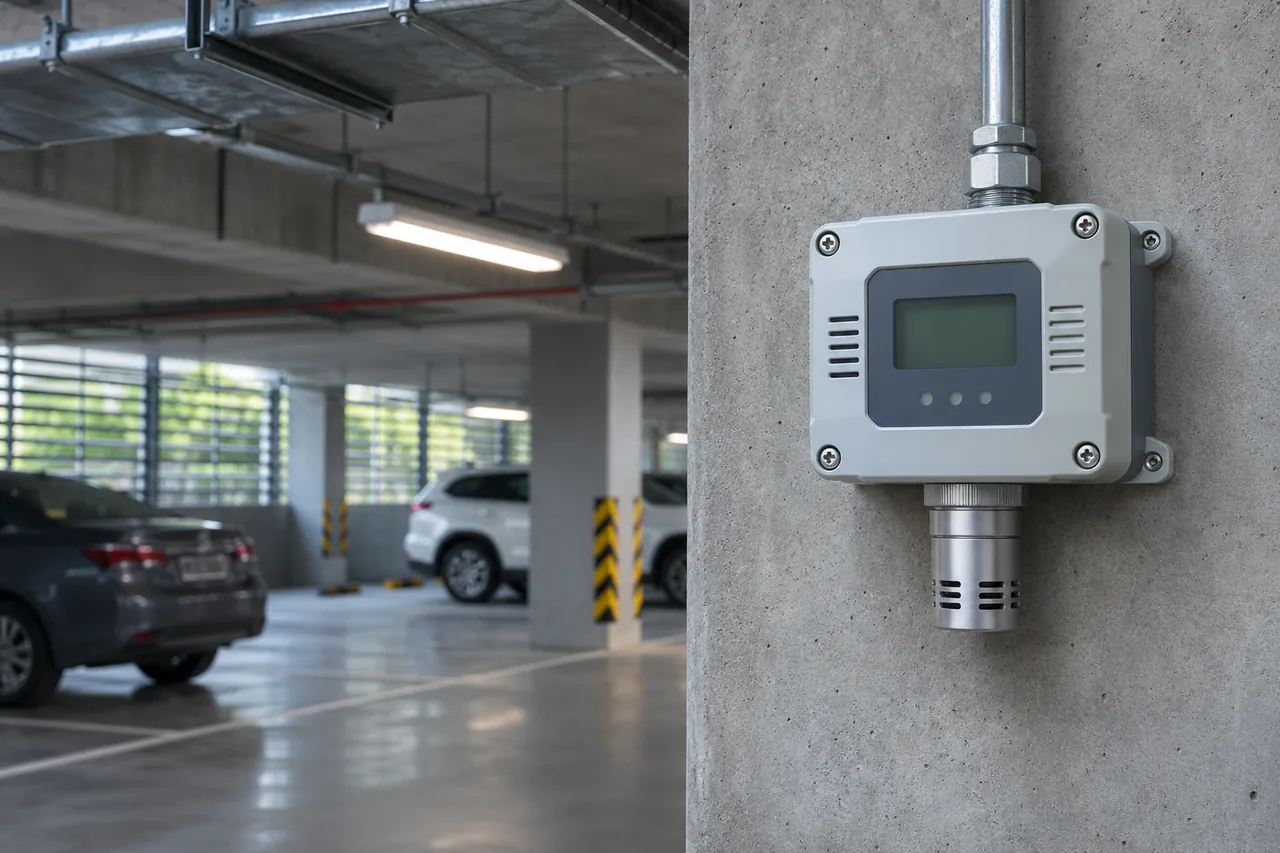
A fixed transmitter samples at its own location. The image does not define placement.
Hypothetical zoning under the cited California rule
Consider a qualifying project with two proximity zones isolated by floors or another impenetrable obstruction under the California definition. Suppose one zone is 11,000 square feet and the other is 4,000 square feet. Applying the area ratio to each zone for this design illustration gives three sensors for the larger zone because two would cover only 10,000 square feet at the stated ratio. The smaller zone’s area calculation gives one, but the two-per-zone minimum brings it to two. The example layout therefore starts with five CO sensors, before considering expected high concentrations, product instructions or other applicable provisions.
| Hypothetical zone | Area | Whole sensors from area ratio | Zone minimum | Starting count |
|---|---|---|---|---|
| Larger zone | 11,000 ft² | 3 | 2 | 3 |
| Smaller zone | 4,000 ft² | 1 | 2 | 2 |
| Combined | 15,000 ft² | 4 from separate zone calculations | 4 across two zones | 5 |
Counting sensors for the combined floor area alone would give three and would miss the separate zone review. The arithmetic does not choose coordinates or prove that the detectors see the worst expected conditions. The project team still needs the approved proximity zones and placement rationale. In a garage with different openings, connected levels or exhaust arrangements, the actual zones and review outcome may differ.
Identify where the controls use local or grouped values
A controls design should describe when it uses individual readings and when it uses any derived value, such as a comparison for sensor fault detection. If a requirement applies at all sensor points, a floor average can hide a locally elevated measurement. Conversely, comparison logic intended to diagnose anomalous sensors may legitimately compare values or rolling averages under its applicable rule and conditions. Label those calculations by purpose so a diagnostic comparison is never mistaken for the controlling concentration.
For each zone, draw the relationship from the detector and its local reading to the controller, fan group, fault path and operator display. Identify which controller handles data quality and which part of the sequence continues if the building network is unavailable. The project may use analog, relay or networked inputs. The design should state where unit conversion occurs, how signal failure is represented and which recorded values are authoritative for review.
Review detector performance around the decisions it supports
Request the exact model, gas channel and range. Evaluate error, resolution, response and environmental limits near the relevant decision levels. A detector that can display a small increment is not necessarily accurate to that increment. Calibration drift, long averaging, filters and sample-path delays can matter near a decision threshold even if the nominal range covers it. Evaluate those effects under the actual detector documentation and retain the model-specific evidence.
Listing claims must match the product and installation in the applicable project. A sensor component and a complete detector can have different approval boundaries. This Canadian gas detector certification overview explains why the scope of the exact listed product matters. The cited US garage requirements have their own applicable listing provisions. A vendor letter for one channel or model suffix may not cover the submitted configuration. Ask which assembly the listing covers, any permitted accessories or controller configurations, and whether field configuration changes the use covered by the documentation.
Where the cited California subsection applies, check the manufacturer’s certification of accuracy and drift, factory calibration and calibration interval characteristics alongside the specified system monitoring logic. Verify the exact conditions of the product evidence. A certification of annual drift does not tell the reviewer whether a particular device remained in calibration after maintenance or a local incident. The record needs the asset identity and actual service date.
A fixed instrument is also a maintained point. Review expected service life, supported replacements, access for check gas under the manufacturer procedure and how the BAS distinguishes calibration or service mode. Service activities can interrupt coverage or produce readings that should be flagged. Assign who handles maintenance, temporary impairment and subsequent release. Any maintenance frequency belongs to the applicable documentation and approved program.
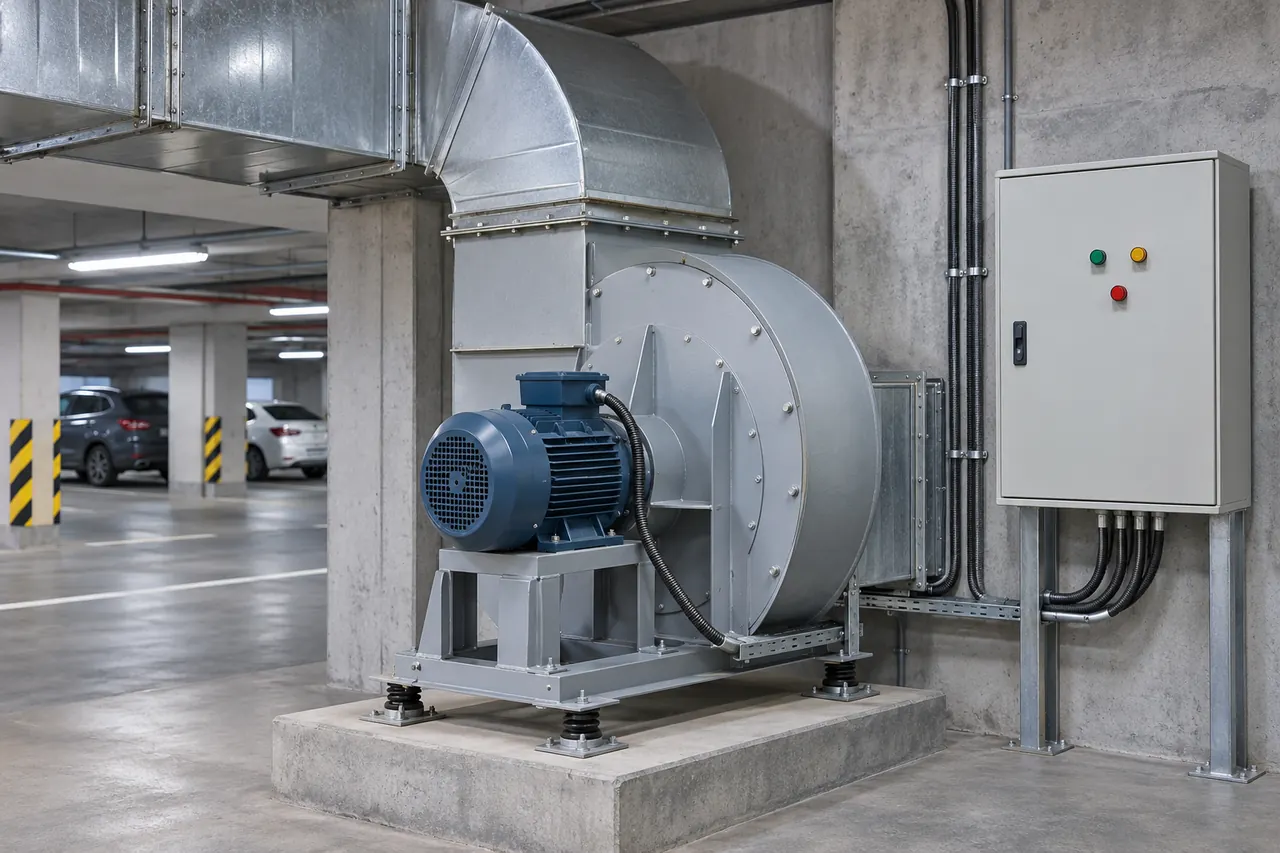
Ventilation control includes both the signal path and a physical response.
Review each evidence layer through to the physical response
The exact commissioning and acceptance requirements come from the authority, project and manufacturer documents. A practical record separates detector response, signal transfer, controller action and physical ventilation response. A test at the detector can show that the sensing channel responds under the stated conditions. A controller simulation can verify logic paths. Equipment feedback or measured airflow can verify a different boundary. Record which boundaries each approved test exercised.
| Evidence layer | What the record should identify |
|---|---|
| Detector response | Gas and channel identity, reference and procedure, result and validity |
| Signal path | Input or network object, engineering units, data status and receiving controller |
| Sequence | Conditions simulated or observed, affected fan group, timing and priority |
| Physical response | Fan or damper state, proof point and airflow evidence as required |
| Fault handling | Fault type, fallback response, operator notification and recovery |
| Closeout | Authority requirements, accepted record, deviations and service responsibilities |
A field test involving equipment actions belongs under the authorized project procedure. When a test uses a substitution or simulation, say so in the report. If physical fan response was outside the test scope, retain the separate record that establishes it. Verify the system after changes to device configuration, controller logic, garage partitions or fan equipment as required by the applicable project process.
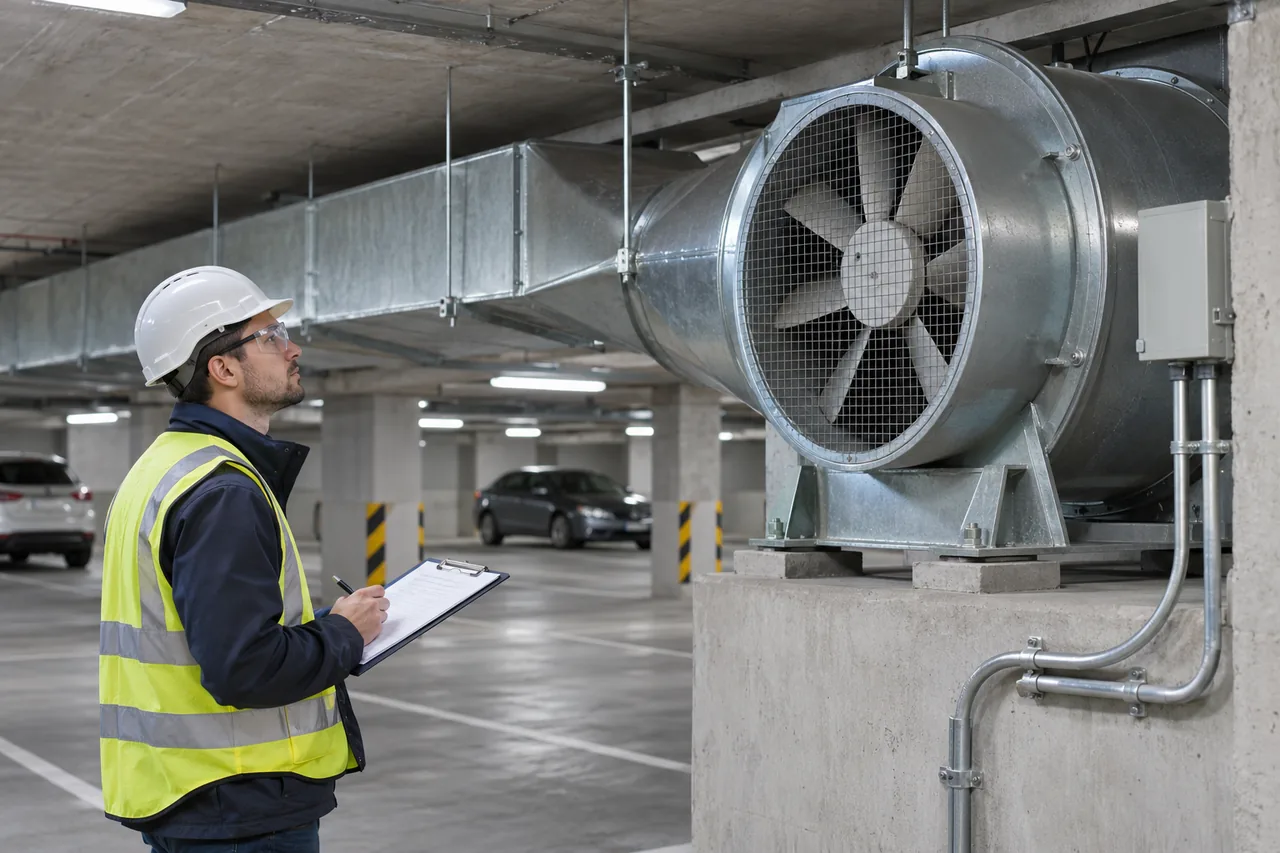
Acceptance evidence depends on the scoped installation and applicable procedure.
Hypothetical controls handover after a detector failure
A facilities operator sees a high garage airflow command and a detector fault at one parking level. The trend still shows the last valid CO number next to the fault. If the approved fallback is design airflow, the increase can be explained by a trouble condition even though the final valid sample was low. The event record should display stale status beside that sample and identify when the failure was detected. The operator can then follow the assigned trouble response and verify the ventilation state through the designated proof.
If a later event shows a valid increase in NO₂ in a garage governed by the cited Minnesota amendment, the ventilation actuation may be required even when CO is below its actuation level. A combined point list that only displays “garage gas alarm” can obscure which event drove the action. At handover, demonstrate the individual channels, their zone mapping and how the controls and notifications distinguish a genuine gas event from loss of valid data.
One additional check can prevent ambiguity after servicing. The record should link the replaced detector’s configuration and final checks to the physical tag, controls point and current drawing. A replacement can report the correct units on its own display while the receiving controller applies an obsolete range. Linking the device to the complete signal path makes that discrepancy reviewable. Preserve both the work performed and the final approved state.
Manage modes that change the garage after design
Drawings show a particular set of openings, barriers and fan systems. Operations can depart from those assumptions. A payment queue can move after entry hardware is replaced. A section can be fenced for construction, or the operator can dedicate one area to a different vehicle fleet. A temporary obstruction can change airflow through an opening that previously linked two regions. Evaluate whether changes affect the permitted design or coverage basis before treating the existing point count and zone map as current.
Capture changed use separately from detector service. A new sensor at the same tag can preserve coverage while changing configuration evidence. A new parking partition can change coverage with every detector still calibrated and reporting normally. A fan scheduling change can affect contaminant movement without any physical construction. The owner’s change process should identify which condition calls for design review, updates to the controlled drawings or renewed acceptance evidence.
For a site with mixed operating modes, record which schedules and ventilation priorities the analysis assumed. Consider a garage that is generally closed at night but opens for a late event. Occupied and unoccupied control logic can be different under the approved sequence, including the applicable sensor comparison logic. The facilities team needs a clear way to tell which mode was active during an event. A manually overridden schedule should appear as an authorized state with a start and end, not as an unexplained shift in fan behavior.
A historical trend is most useful when the log preserves individual readings, measured units, instrument health, ventilation mode, command and feedback. With those fields, an operator can tell the difference between an elevated value, a failed sensor that drove fallback and an independent fan fault. A review can also account for suppression or delay in the recording system. When records show only an average or an unnamed alarm, save whatever supporting event, service and equipment records remain available before drawing a conclusion about the cause.
Hand over a rule and a record together
Write the actual clause beside the associated design evidence. For a coverage requirement, retain the approved plan and the rationale for high-concentration locations. For a concentration control requirement, retain the signed sequence and the test evidence appropriate to that requirement. For a trouble response, retain the observed operator message and ventilation evidence. Make the handover usable when a detector is replaced or a facility operator changes. A schedule that explains both the design authority and where to find the current evidence is easier to maintain than a collection of isolated controller settings.
An archived acceptance record should also explain changes made during testing. For instance, a commissioning team might correct a zone assignment before repeating an approved test. Keep the original observation, the controlled revision and the successful retest together. An operator later reviewing the history should be able to identify which version of the sequence was accepted and which sensors drove each fan group. If the design relies on a required minimum airflow, record the state that was verified and how the evidence applies to the affected area. This makes the test useful after a maintenance or controls change.
Часто задаваемые вопросы
Is 25 ppm the alarm setpoint for every garage?
The two cited US examples give that number a specific ventilation or concentration-control role within their respective scopes. A warning for occupants, a facilities fault alarm and an exposure criterion each need their own applicable basis. Use the adopted requirements and approved sequence for the actual garage.
Do garages need nitrogen dioxide detection as well as CO?
Some governing provisions expressly require both, as Minnesota’s cited amendment does. Check the adopted local requirements and equipment instructions. A CO measurement cannot stand in for an NO₂ channel.
Can the number of detectors be determined by floor area alone?
Area can be one rule input. The cited California provision also has a zone minimum and an expected-concentration location requirement. Review physical separation, airflow, expected sources, instructions and the requirements that apply to the site.
Can a dashboard provide proof that the garage ventilation worked?
A dashboard may show the input and the commanded response. Determine which status points represent independent equipment feedback and what airflow evidence the acceptance requirements call for. The system’s documented test boundary tells the reviewer what was actually demonstrated.
Why do two sensors in the same level sometimes disagree?
Different locations can see different emissions or airflow. Instrument response, drift, interference and service state can also affect the comparison. Preserve location, time and status first, then evaluate the difference under the approved sequence and service procedure.






оставьте ответ