

Gas concentration monitoring tells you what an instrument measured at a particular sample point. A safety alarm adds a defined protective purpose: recognize a specified condition, communicate it, and support an agreed response while handling faults and loss of availability. A concentration display, a relay contact, or a sensor component alone does not establish that the complete arrangement is suitable for that purpose.
The useful selection question is therefore: what decision depends on this measurement, and what evidence connects the sample to that decision? An analyzer used to trend a process can be excellent at its assigned job without being the right device to warn people about a room release. A safety detector can be appropriate for warning without providing the selectivity or uncertainty needed for a process analysis. Some instruments serve both roles, but each role needs its own documented scope.
This article concerns equipment selection and document review. Requirements differ between industrial flammable-gas detection, workplace exposure assessment, household alarms and engineered safety functions. In Great Britain, HSE's industrial flammable-detector guidance explicitly excludes domestic detectors, mining and offshore applications, and detailed confined-space advice. Its useful general lesson is that detection belongs alongside measures that prevent and manage releases. HSE industrial flammable-gas guidance.

Monitoring and warning serve different duties. The translucent shapes are conceptual, not validated sensing footprints.
Start with the decision, sample and operating mode
Write a purpose statement before comparing equipment. “Monitor carbon monoxide” leaves the sample, location and consequence unclear. “Measure carbon monoxide in the exhaust sample used for combustion adjustment” and “warn occupants of a specified room-air CO condition” are different assignments. The first may require a conditioned exhaust sample, an analytical range and a defined reporting basis. The second requires an appropriate room-air instrument and a warning arrangement understood by the people concerned. Sharing the same gas name and concentration unit does not make the two assignments equivalent.
Add the operating mode. Does the function apply while the process runs, while it is unattended, during cleaning, during maintenance, or during an interruption of normal ventilation? A document that discusses normal production only cannot establish what happens during a temporary work task. A diagram showing a room detector does not show whether a contractor working inside equipment is adequately covered. Draw separate boundaries for equipment, occupied spaces and tasks.
Then distinguish the recipient of the information. A historian may accept a reading for later analysis. An operator display may support an investigation. A local sounder may direct an immediate response. An automatic interlock may initiate a designed protective action. These recipients have different expectations about timing, validity and availability. Recording all of them as “alarm output” conceals the decisions that must be made.
For an initial specification, use a sentence with six fields: sample, gas, measurement basis, operating modes, recipient, and required decision. Leave unresolved fields visibly unresolved. It is better to write “fault response to be specified by the safety review” than to assume that loss of signal means a safe atmosphere. The purpose statement becomes a useful test of every later drawing, software screen and acceptance record.
Compare the evidence required for each role
| Обзор вопроса | Concentration monitoring role | Safety alarm role |
|---|---|---|
| What must be observed? | The defined process or environmental sample | The relevant hazardous condition within the defined protection scope |
| What makes a reading useful? | Suitable range, selectivity, uncertainty and reporting basis | Suitable response plus valid status and the required warning or protective action |
| Who receives it? | Analyst, operator, controller or historian | Named people or equipment with an agreed response |
| What happens during a fault? | Data becomes invalid or unavailable according to the monitoring task | A specified impairment response applies; silence must not imply availability |
| What is tested? | Measurement performance for the intended analytical task | Relevant sensing, communication, logic, annunciation and action interfaces |
| What closes the review? | Accepted measurement specification and verification | Accepted application, system behavior and lifecycle arrangements |
This comparison is a review framework, not a certification test. The required evidence depends on the application and the rules adopted for the site. A sophisticated analyzer may offer diagnostics and alarms. A compact detector may provide logged readings. Those features deserve evaluation on their actual implementation rather than their names. The device description should identify which outputs are intended for the claimed function and which are informational.
Ask the supplier to connect each important claim to a document. A measuring range belongs to the relevant sensor and gas. An approval belongs to a named configuration and its conditions. A safety claim belongs to a defined function and supporting documentation. A product-family brochure may combine options that cannot all be fitted together. Copying a family-level feature list into a project schedule can accidentally describe an instrument that does not exist.
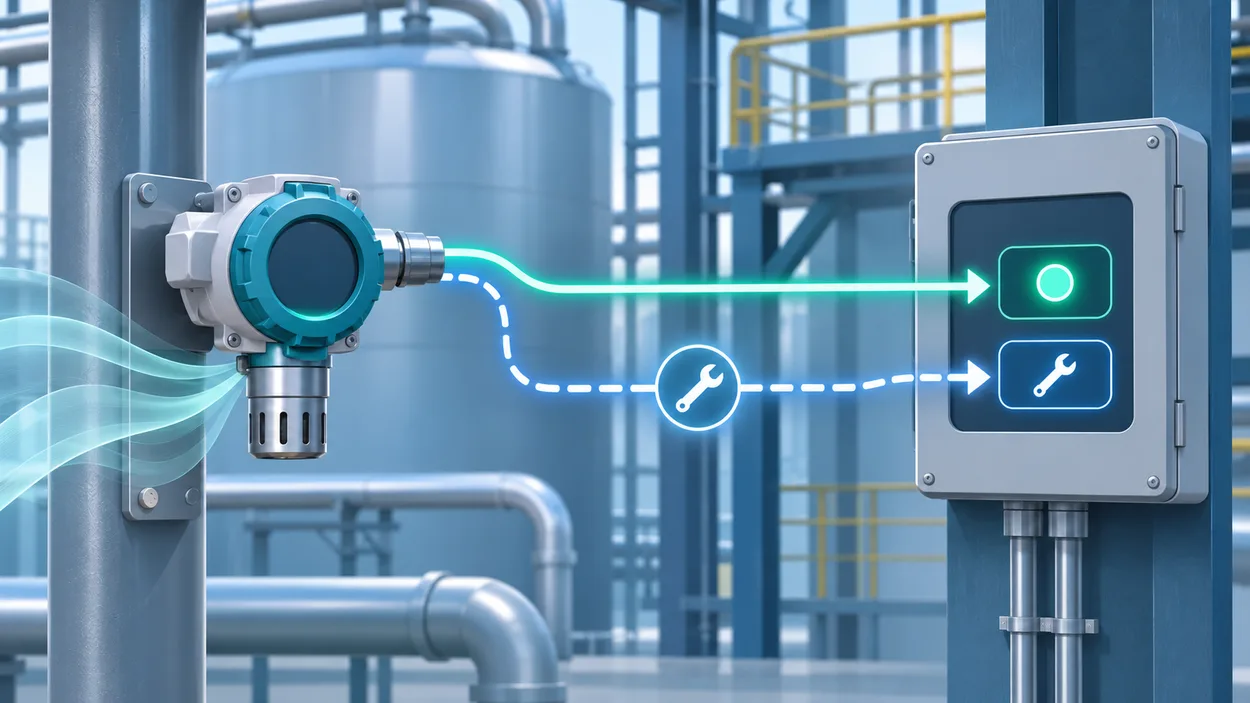
A measurement interface needs a defined interpretation of equipment status as well as concentration.
Carry measurement status alongside the number
A number without status is incomplete information. Consider an instrument that normally sends a concentration value to a control system. During warm-up, calibration, sensor failure or communications loss, the control system needs an explicit interpretation. Holding the last good number can be convenient for a trend, but a held value is no longer a current observation. A display should make that distinction visible wherever the value is used to support a decision.
Do not assume every analog output has identical fault conventions. Obtain the exact output mapping for the installed transmitter, controller input and software configuration. Record normal measurement, overrange, underrange, fault, inhibit and any maintenance states that the equipment supports. If the receiving system converts these to a single generic error, determine whether the intended response still remains clear. A fault indicator on the transmitter is useful only to someone who can see and interpret it.
Digital communications introduce comparable questions. What identifies the source? How is the age of the value handled? Which status bits are passed through gateways? Does a network interruption produce a fault, a stale value or an apparently normal zero? These are interface questions, not reasons to reject digital systems. A complete interface schedule makes the intended behavior reviewable and testable.
Likewise, a gas alarm and an instrument fault should be distinguishable to the people responsible for responding. They may require different technical investigations, but either can affect the availability of the protection arrangement. The project should specify the necessary response without teaching operators to ignore one category. The appropriate action belongs in the site's approved arrangements; a generic article cannot assign it for an unknown installation.
Separate thresholds from the reasoning behind them
An alarm threshold is one part of an alarm philosophy. The same schedule should explain the gas and measurement basis, the hazard being addressed, the intended response, the responsible people, and the requirements governing reset or restart. If the only surviving justification is “factory setting,” the review has not established why that setting suits the application.
Avoid equating an occupational exposure limit with every possible instantaneous alarm. An exposure limit, an instrument's averaging function and a rapid release warning address different questions. The applicable jurisdiction, exposure assessment and instrument implementation matter. The specification should identify whether a channel supports an instantaneous warning, a time-related exposure function, a process decision, or several separately defined functions. Do not silently substitute one for another because the display units match.
A setpoint also interacts with the instrument's usable range, response to the target gas, uncertainty, environmental conditions and system timing. A proposed threshold near an unsuitable part of the measuring range needs technical review. Changing the number on a controller cannot correct a gas that the fitted technology does not adequately detect, a blocked inlet, or a location that the relevant release does not reach.
Nuisance alarms deserve investigation, with event records and operating conditions retained. The possible explanations include a real release, interfering gas, environmental effects, equipment fault or an unsuitable installation. Repeatedly increasing a threshold to stop complaints can remove a warning without resolving its cause. Record the investigation and the authorized change decision as part of the system history.

Warning arrangements need defined recipients and responses; connections shown here are conceptual.
Follow the complete protective chain
In a system review, trace the path from the atmosphere to the final response. For a diffusion detector, gas must reach the inlet. For a sampled arrangement, the sample path must deliver a representative sample. The sensing element must respond within its specified conditions. The transmitter must communicate a valid result or status. The controller must evaluate the intended condition. The alarm or final equipment must then perform the action required by the design.

Gas must reach a suitable sensing inlet. This illustrated path is not a prediction of an actual release.
The weakest documented boundary is often an interface between contractors. One supplier may test a detector output, another may test the building management screen, and a third may confirm that a fan runs. Those separate checks do not automatically demonstrate the intended sequence between a gas condition and the fan. Ask which record connects the stages and which party accepts the resulting behavior. Keep the test boundaries explicit rather than describing every record as a “system test.”
An automatic protective function introduces questions beyond the sensing device. What is the accepted safe state? What happens if power is lost? What confirms the final equipment's state where confirmation is required? Which overrides exist, who controls them, and how is normal protection restored? These questions should be addressed by the applicable engineering and safety process, not improvised while a system is impaired.
HSE's functional-safety overview describes safety instrumented systems through sensors, logic and final elements and places them within a managed lifecycle. It does not make every gas alarm a safety instrumented system or assign a required integrity level to an unknown application. A component carrying a safety-related claim does not establish the integrity of the whole installation. HSE functional safety.
Use a state review to expose ambiguous behavior
The following worksheet is intended for a desk review of project documents. It does not prescribe testing methods or actions in a gas emergency. For each row, identify the equipment document, the configured behavior and the person who owns the remaining question. If a state cannot occur in the selected system, record why rather than leaving a blank that looks overlooked.
| State or event | Вопрос, который нужно решить | Record that should answer it |
|---|---|---|
| Valid normal reading | Can the recipient distinguish a current observation from a historical value? | Point list, display description and data validity rules |
| Defined gas condition | Which local and remote indications operate and which response is expected? | Alarm philosophy and cause-and-effect schedule |
| Sensor warm-up | Is the channel unavailable, and how is that communicated? | Exact instrument manual and configured startup behavior |
| Sensor or transmitter fault | Which system recognizes the impairment? | Output mapping and input fault configuration |
| Lost communications | Does the last number remain visible and how is its age indicated? | Interface and stale-data specification |
| Maintenance inhibit | What is inhibited, for how long, under whose control? | Approved impairment and restoration record |
| Overrange indication | How does the instrument represent a condition outside its supported display range? | Model-specific instructions and event handling |
| Power interruption | Which parts remain available and which require recovery? | Power design and accepted sequence |
| Alarm acknowledgement | Does acknowledgement change sound, indication, protective output or none of these? | Approved alarm behavior specification |
| Return toward normal | What permits reset and any equipment restart? | Recovery and restart arrangements |
Review acknowledgement particularly carefully. A button marked “reset” can mean different things in different devices. A user may assume it only quiets a sounder while a programmer assumes it also clears a latched output. The approved description should use explicit verbs: silence, acknowledge, reset, release, or restart, as applicable. The documentation should identify which of those actions is permitted from each interface.
Hypothetical example: a solvent-handling room
Consider a hypothetical facility with an analyzer used to follow solvent concentration in a process sample and a proposed wall display showing that value. The purchasing request describes the display as a room safety alarm. No test results or actual customer installation are implied here. The example illustrates how a document review can discover an unsupported change of purpose.
The analyzer's sample is taken from equipment, not from the room. Its reporting basis and range were selected for that process. The data path passes through a process control system that may hold the last reading during maintenance. A room sounder has been added to the same system, but the specification does not define room-air coverage, sensor fault handling or the response expected from room occupants. The presence of a sounder does not bridge those gaps.
The review separates the two assignments. The process analyzer retains its analytical purpose. The room protection requirement is returned to the hazard and engineering review with a clearly stated sample boundary and intended response. The team requests evidence for the gas profile, appropriate room detection technology, locations, controller behavior, warning arrangements, power and impairment management. No alarm number or mounting distance is selected by analogy with the process reading.
The resulting deliverable is a revised task schedule and a list of evidence needed for acceptance. It is not a claim that the room is now protected. That distinction matters: recognizing a gap is progress, but the gap remains open until the selected arrangement is designed, verified and accepted by the responsible parties. A specification should make that remaining work visible to purchasing, controls and operations alike.
Distinguish tests by the question they answer
A calibration concerns the relationship between an instrument response and a known reference under specified conditions. A function check demonstrates a response within the scope of that check. An interface test may demonstrate that an electrical signal produces a controller state. An end-to-end test may include further stages, depending on its defined start and endpoint. None of these names, used alone, tells a reviewer the full extent of the evidence.
For portable direct-reading monitors, OSHA's current information bulletin distinguishes a bump test from a calibration check and full calibration and emphasizes following manufacturer recommendations. Its page is identified as SHIB 11-26-2024 even though the URL retains an older number. The bulletin is US guidance rather than a universal fixed-system commissioning standard. OSHA calibrating and testing direct-reading monitors.
Request records that state the channel, gas, equipment configuration, conditions, acceptance criterion and result. Where a record excludes a controller, sample line or final device, make that exclusion visible. A certificate that identifies only the sensing unit cannot establish what happened in an untested external interface. Conversely, testing an input by electrical simulation cannot establish that gas reaches and activates the actual sensor.
Evidence also ages. A successful acceptance test describes the configuration and conditions tested at that time. Changes to software, sample tubing, ventilation, sensor type or alarm logic can affect its continuing relevance. The change record should identify which requirements and checks need reconsideration. Treating a file as permanently valid because it carries a signature can disconnect the evidence from the installed system.
Keep the purchasing specification bounded and reviewable
Ask for the exact instrument designation and configuration, named gases, ranges and units, intended environment, output definitions, accessory restrictions, applicable approvals and instructions. Include the required documents and the party responsible for their review. If a claim depends on a special option, make the option part of the order definition rather than a note in correspondence.
The overview of gas detector types is useful background on instrument categories. For an actual project, move from categories to an identified configuration and its evidence. A sensor component, an assembled detector and a completed installation have different boundaries. For example, the Winsen ZE07-CO module page identifies a CO sensing module with electrical outputs; those component details do not establish acceptance of a completed room alarm arrangement. A component datasheet can support an engineering selection, but it does not authorize a finished alarm system or establish compliance for the completed application.
Keep commercial acceptance separate from unresolved technical acceptance. Delivery of the ordered equipment does not necessarily close installation, configuration or response questions. A useful handover list identifies the owner of each open item and the condition under which it can be closed. This helps prevent a collection of individually plausible products from being mistaken for an accepted protection arrangement.

Equipment configuration and system documentation support different parts of an acceptance review.
Review a proposed alarm as a complete information contract
A useful way to review an interface is to treat it as an agreement between the equipment providing information and the person or system using it. The provider identifies the gas, sample, units, validity and limitations. The recipient identifies the decisions it will make, the states it must recognize and the response it requires. When either side assumes information that the other does not provide, the interface has a gap.
For example, a display designer may expect every incoming concentration to be a current, valid measurement. The transmitter documentation may instead define several states in which the output is unavailable or represents an instrument condition. The discrepancy should be resolved in the point definition and software behavior before acceptance. The same reasoning applies when an operator expects an alarm to identify a location, but the screen combines several inputs under one generic message.
Review the wording of messages as carefully as the wiring. A message such as 'gas normal' can suggest a broader conclusion than the instrument supports. A point-specific description, current value and explicit status can communicate a narrower and more accurate observation. The approved wording should help the recipient identify the required response without requiring them to interpret a raw engineering code during an event.
Another useful question is whether the system can distinguish an acknowledged alarm from a restored function. A person may have seen the message while the hazardous condition or equipment impairment remains. Acknowledgement records attention; it should not be assumed to establish correction. The exact distinction belongs in the approved sequence and interface description. A reviewer should be able to follow it across the local device, controller and remote screen.
Use purchasing alternatives to test the requirement
When comparing two proposals, ask each supplier to answer the same purpose statement. One proposal may include a measuring transmitter only, while another includes a controller and warning equipment. Comparing their prices without adjusting the scope can create a false equivalence. Break the proposal into supported measurement, status handling, warning, protective interfaces, documentation and service responsibilities.
An unresolved item should remain visible in the comparison. If a supplier has not provided target-gas response information, write that the response is unconfirmed rather than assigning a favorable score from a generic brochure. If an external control interface is excluded, identify who will engineer and verify it. This turns a product comparison into a review of how the required function will actually be delivered.
The same approach helps when an existing instrument is proposed for a new role. Reuse can be sensible, but the earlier acceptance concerned a defined purpose and configuration. Identify what the new role adds: a different sample, range, operating mode, warning recipient or protective consequence. Then request the evidence needed for those differences. Familiar equipment deserves the same clear scope as a new purchase.
Finally, separate a missing document from an unfavorable technical finding. A missing manual means suitability has not been established; it does not prove that the equipment is unsuitable. Conversely, a documented restriction that conflicts with the task is a substantive selection issue. Keeping those outcomes distinct makes the next action clear: obtain evidence for the first, reconsider the configuration or duty for the second. Neither should disappear into a general statement that the package is 'under review.'
Часто задаваемые вопросы
Is any gas detector with a display a safety alarm?
The display establishes only that the device can present information. Review the intended use, gas response, operating conditions, alarm behavior, approvals where applicable and complete response arrangement. A number on a screen cannot by itself show that the right atmosphere was sampled or that the intended people and equipment will respond. An instrument may be appropriate for a defined warning role, but that conclusion requires evidence for its actual configuration and installation.
Can the same measurement support process control and protection?
It may be possible where the engineering and safety assessment accepts the arrangement. Document both roles, their requirements and the consequences of shared equipment or interfaces. If one failure can disable both functions, that dependency should be understood in the risk assessment. The answer cannot be inferred from the number of outputs or from a marketing description that lists both process and safety applications.
Does a low reading prove that an area is safe?
A valid reading concerns the measured gas and sample point within the instrument's supported conditions. It does not address gases outside the channel's capability, unobserved locations, future releases or unrelated hazards. The wording used in operating records should preserve those boundaries. A low reading can be one input to an authorized decision; it is not a general declaration that all conditions in an area are acceptable.
Does a safety-related approval cover the whole system?
Read the certificate and associated instructions for the precise equipment and claim. A device-level approval has a defined scope. Wiring, placement, settings, power, external logic, final equipment and operating arrangements may require separate design and acceptance. The project should state how component evidence contributes to the completed function rather than treating a logo as a substitute for the system review.
What should a reviewer request first?
Request the purpose statement, sample definition, equipment configuration and cause-and-effect schedule. Those documents establish what the arrangement is meant to do and where its boundaries lie. Then compare the supporting manuals, interface descriptions and verification records with that definition. Starting with a threshold or a product price can obscure an unresolved question about the task itself.
Sources and scope
- HSE: The selection and use of flammable gas detectors, Great Britain, industrial flammable-gas guidance; exclusions stated above.
- HSE: Leak/gas detection, COMAH technical measures and system management considerations.
- HSE: Functional safety, safety lifecycle overview; no application-specific integrity level inferred.
- OSHA: Calibrating and Testing Direct-Reading Monitors, US SHIB 11-26-2024; guidance, not a replacement for the applicable standard or exact equipment instructions.







оставьте ответ