
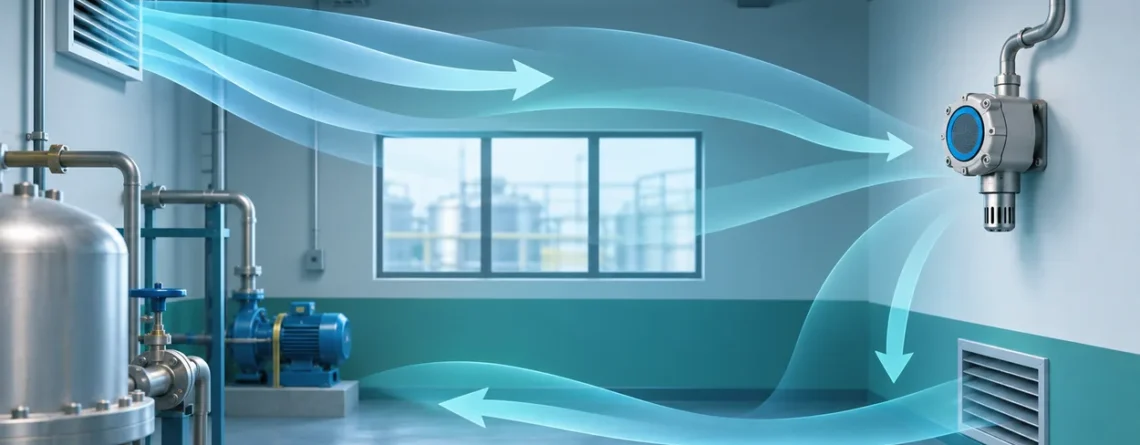
Gas detector mounting height cannot be selected from gas density alone. Density helps explain whether a released gas may tend upward or downward under particular conditions, but the detector must observe the atmosphere relevant to its purpose. The release location and direction, temperature, ventilation, barriers, room geometry, operating modes and exact equipment instructions all affect whether that atmosphere reaches the inlet.
The practical starting point is a source-to-inlet review. Identify the release scenarios and protection objective, examine the possible transport paths for the relevant operating modes, and document why each proposed location is suitable. A generic instruction to place a light-gas detector high or a heavy-gas detector low leaves too many of those questions unresolved. This article provides a framework for reviewing design documents, not installation dimensions or a field placement procedure.
HSE's Great Britain guidance on industrial flammable-gas detectors includes plant, sensing technology, gas dispersion, ventilation and protection objectives in the placement review. It excludes domestic detectors, mining and offshore applications and does not provide detailed confined-space advice. Other gases and applications need their own relevant requirements and exact manufacturer instructions. HSE flammable-detector guidance.
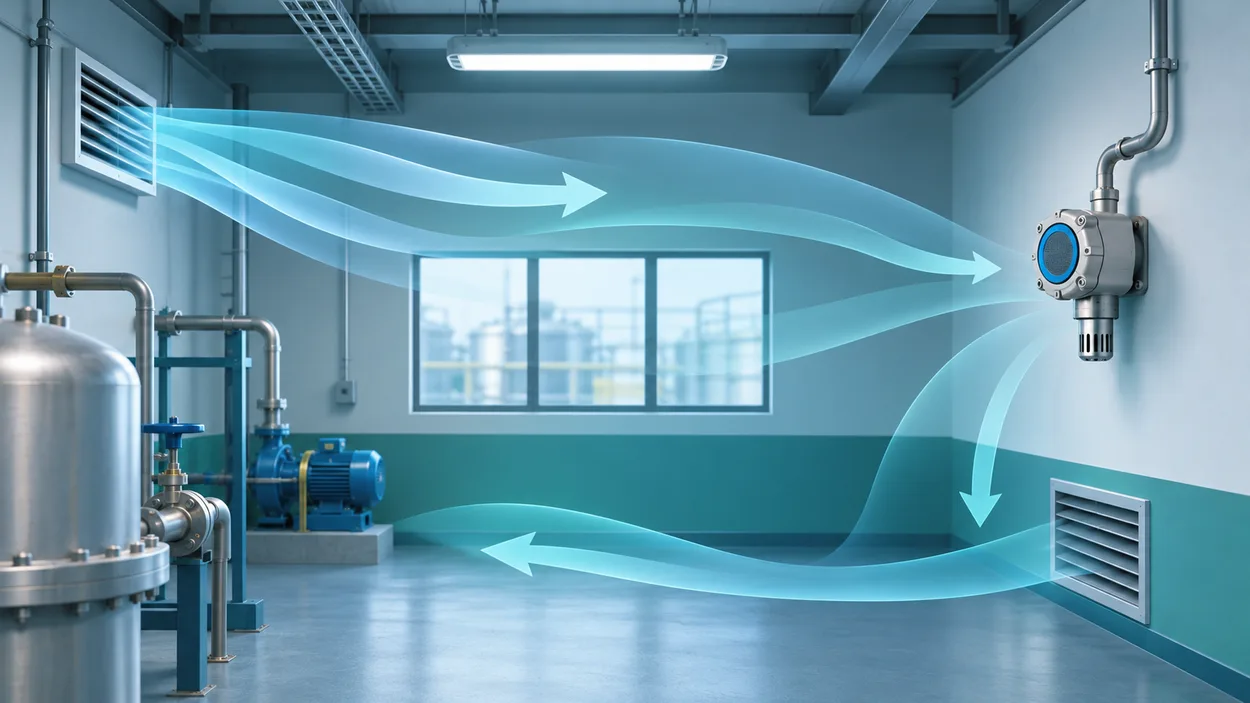
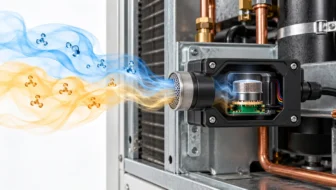
Room airflow is one part of a location assessment. The ribbons are conceptual paths, not installation guidance.
State what the detector is supposed to observe
“Install gas detection in the room” is an incomplete objective. The design might need early observation of a release near equipment, observation of a defined accumulation region, warning at an ingress route, or another documented duty. Each objective can lead to a different location review. A fixed point intended for one duty should not silently inherit all the others because it sits in the same room.
Begin the location record with the gas or mixture, source, operating condition and intended response. Include the physical boundary: equipment enclosure, occupied room, pit, duct, outdoor process area or another defined volume. A point on a floor plan is not a complete description if the relevant source and airflow are at different elevations or behind obstructions.
Distinguish a local room-air point from a remote sample inlet. In a sampled arrangement, the inlet location and the instrument housing are different design questions. The inlet must obtain the intended sample; the path must deliver it appropriately; the housing must meet its own environmental, access and installation conditions. Placing the housing at a convenient height does not resolve the inlet's coverage.
Also separate leak detection from individual exposure observation. A fixed point may be assigned to an accepted release scenario, while a moving person's task involves a different position and time. The design should state which question it addresses. Calling a location “representative” without identifying what it represents can conceal a change from area detection to personal exposure inference.
Use density as a conditional input
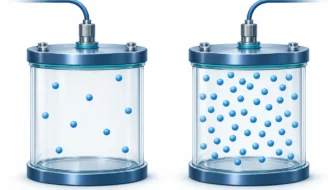
Relative density compares gases under stated conditions. It provides a useful tendency when considering buoyancy, but an actual release is mixed with surrounding air and influenced by the circumstances of release. The gas name alone is therefore insufficient to define the path from a connection to a sensing inlet.
Record the physical form and condition of the potential release. A warm release, a cold release, a directed jet and a slowly evaporating vapour source are different scenarios even if a later sample contains the same substance. A mixture's properties depend on its composition. A table of pure-gas densities cannot establish the behavior of every mixture or transient condition in a process room.
Avoid turning qualitative tendencies into a universal installation rule. “This gas is lighter than air” does not establish that every upper wall location provides adequate warning. A ceiling may include beams, isolated voids or ventilation features that change transport. A low position for a dense gas may be outside the relevant release path or exposed to contamination that the selected detector cannot tolerate.
The useful design question is not whether density matters. It is how density contributes to the particular release and transport scenario alongside the other factors. Ask the designer to identify the conditions under which the proposed reasoning applies and which changed conditions require review. That produces a location justification that can be maintained as the facility changes.
Describe the source before drawing a mounting point
List credible sources from the relevant hazard assessment and equipment information. Examples can include connections, valves, seals, process openings or identified ingress routes, depending on the facility. The article does not establish which sources are credible at an unknown site. The purpose of the source list is to make the design basis traceable rather than treating all floor area as equally informative.
For each source, record location, elevation, release orientation where relevant, operating mode and any enclosure. Identify whether the release can occur when equipment is stopped or when normal ventilation is unavailable. A source that exists during maintenance may be absent from normal-production drawings. A door opened for access can also change the physical boundary used in the original assessment.
Release momentum and interaction with equipment can influence the initial path. A directed release may travel before buoyancy becomes the dominant influence. A nearby surface or obstruction can redirect it. These are reasons to obtain an appropriate engineering assessment, not to calculate a mounting distance from a generic sketch. A simple plan can help identify questions; it is not itself a dispersion analysis.
Separate source identification from sensor suitability. A proposed location near a source is useful only if the detector supports the target gas, concentration basis and environment. The closest physically possible point may be unsuitable for temperature, contamination, water exposure or access. A defensible arrangement resolves those constraints together rather than accepting an easy location and leaving gas access unexplained.

Release direction and momentum can affect the source-to-inlet relationship; no measured plume is depicted.
Review ventilation by operating mode
Ventilation can transport, mix or dilute released gas. Its effect depends on where air enters and leaves, equipment arrangement, opening positions and operating state. A detector selected only for the normal fan condition may have a different observation boundary when that fan is off or when another opening changes the path.
Ask for the relevant ventilation drawings and mode descriptions. Identify supply and extract locations, doors, louvers, ducts and openings that affect the assessed space. Include normal production, reduced operation, shutdown and credible failure modes as defined by the responsible assessment. A single arrow on a room plan cannot represent every relevant state.
The following table is a document-review aid. It identifies questions to discuss with the design and safety team, not actions to perform in an occupied hazardous area. No release, smoke test or ventilation alteration should be improvised from this table.
| Mode or feature | Question for the location review | Доказательства для запроса |
|---|---|---|
| Normal supply and extract | What transport paths are expected between the source and candidate inlet? | Ventilation design and applicable assessment |
| Reduced fan operation | Does the original location reasoning still apply? | Mode description and design review |
| Loss of a ventilation function | What atmosphere and detection duties remain relevant? | Hazard assessment and impairment response |
| Open access door | Does the opening redirect flow or connect another volume? | Defined door states and relevant layout |
| Equipment heat load | Could thermal conditions alter the assessed movement? | Operating conditions and engineering basis |
| Outdoor wind exposure | Which directions and sheltering conditions matter? | Site-specific assessment |
| New partition or stored equipment | Is the assumed path obstructed or rerouted? | Updated geometry and change review |
| Extract duct or enclosure | Is the objective local room observation or a separate sampled stream? | Explicit measurement boundary |
Do not assume that an extract location is automatically the best detector location. It may be relevant to a defined purpose, but gas could affect another region before reaching it or be diluted along the route. Likewise, a supply stream may expose a sensor to air that poorly represents the intended release scenario. The project should explain the selected relationship rather than rely on a simple rule about fans.
For a changed ventilation arrangement, revisit the location justification even when the detector itself has not moved. A new diffuser, fan setting, enclosure or duct can change the conditions behind an accepted drawing. The change owner should identify whether the detection assessment and verification records remain applicable. The physical stability of the detector is not evidence that its observation boundary stayed the same.
Geometry creates separate questions at the same height
A mounting height describes only one coordinate. Two points at the same elevation can have very different relationships to a source. Equipment, shelving, partitions, beams, pits and ceiling voids may separate paths or accumulation regions. The layout should identify features relevant to the assessed scenarios rather than present an uncluttered architectural outline that omits process obstacles.
Ask whether the candidate point is exposed to the intended atmosphere or sheltered from it. A convenient wall recess might keep a detector out of traffic while also isolating it from the relevant path. A protective cover may reduce accidental contact while changing gas access. Any accessory that affects exposure of the inlet needs review against the manufacturer's instructions and design basis.
Check vertical as well as horizontal relationships. A plan view can hide the fact that a source sits inside a cabinet or below a platform. A section view can reveal a ceiling pocket or an opening connecting another space. The amount of detail should match the decision; the objective is not a decorative model but enough geometry to evaluate the actual observation claim.
Avoid assigning a generic coverage radius to every point. A circle on a drawing may be a useful graphic for a particular assessment method, but it is not a physical boundary that applies to all gases, releases and ventilation conditions. Ask what the circle means, what assumptions support it and what it excludes. If those questions have no answer, the drawing should not be used as proof of coverage.
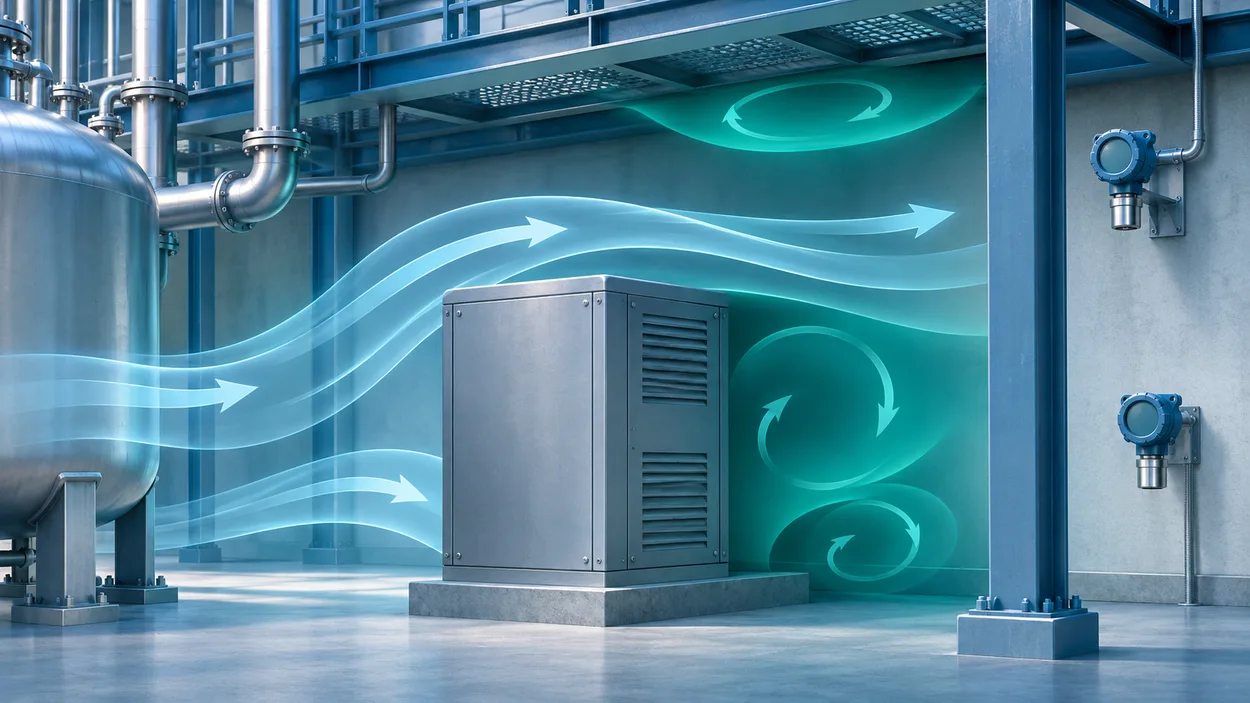
Obstructions can change relevant transport paths. The illustrated pockets are conceptual.
Environmental suitability and maintenance access belong in the same review
A candidate location must satisfy both the observation duty and the equipment's operating and installation conditions. Review relevant temperature, humidity, condensation, dust, water, corrosive substances and mechanical exposure against the exact detector documentation. An enclosure rating alone does not establish chemical compatibility or preserve response under every kind of contamination.
Service access matters because the function has to remain verifiable and maintainable. A difficult location can create pressure to skip checks or use unreviewed accessories. Conversely, moving a detector solely to make it easy to reach can weaken the observation duty. The design should resolve access and coverage together, with accepted equipment or access arrangements where appropriate.
For a sampled system, the sample line may offer a way to separate inlet and housing locations, but it introduces its own suitability and response questions. HSE's sample-tube alert shows why a functioning sensor does not establish delivery through an unsuitable tube. Do not treat remote sampling as a cost-free solution to a placement difficulty. HSE sample-tube safety alert.
Also review the visibility and interpretation of local indications. A technically suitable sensing location may not be the right place for the only warning indication. Sensors, controllers and annunciators can have different location purposes. The accepted design should identify how people receive the required warning without assuming they will be standing beside the sensing unit when an event occurs.
Keep a location justification for every sensing point
The following worksheet records the reasoning behind a point. It is useful during design, handover and later change review. The entries should identify actual documents and decisions, with open questions assigned to the responsible people. A generic sentence copied to every detector record is unlikely to preserve the distinctions that made the original arrangement suitable.
| Поле записи | Content to retain | Обзор вопроса |
|---|---|---|
| Point identity | Unique tag and physical location | Can this record be matched to the installed inlet? |
| Measurement duty | Gas, sample and intended response | What decision does the point support? |
| Source basis | Relevant assessed sources and operating modes | Why is this point related to those scenarios? |
| Transport basis | Density contribution, ventilation and geometry | What path or accumulation is being considered? |
| Equipment configuration | Exact detector, sensor and accessories | Does the documentation support the duty and environment? |
| Installation constraints | Orientation, protection and other manufacturer conditions | Are these conditions reflected in the design? |
| Access arrangement | Accepted service and verification access | Can the function be maintained without changing its basis? |
| Evidence boundaries | Assessment, inspection and functional records | What has been shown and what remains assumed? |
| Exclusions | Scenarios or spaces not represented | What must users avoid inferring? |
| Change triggers | Source, airflow, layout or configuration changes | When must the justification be revisited? |
The source-to-inlet reasoning should be understandable without relying on the memory of one engineer. A drawing revision, an equipment change and a ventilation mode should have traceable identities. If the assessment uses modelling, retain the relevant assumptions and scope with the result. If a question remains unresolved, keep it as an open item rather than replacing it with a confident arrow.
Hypothetical example: a room with changing air paths
Consider a hypothetical equipment room containing a documented gas release source, a supply diffuser, an extract opening and a large access door. A proposed detector is placed high on a convenient wall because the gas is described as lighter than air. This is a fictional review example, not a validated layout or a recommended mounting position.
The first review question is the detector's duty. The project identifies a particular release scenario and warning objective. The designer then compares the source with the candidate inlet under normal ventilation and the other modes required by the assessment. The access door is sometimes open during maintenance, and equipment occupies part of the route shown on the original simple plan. Those details may affect the location reasoning even though the gas's density description has not changed.
The environmental review identifies additional questions about heat and service access. The team requests the exact detector instructions and considers the inlet, housing and indication arrangements separately. It does not solve the problem by prescribing a generic distance below the ceiling. Nor does it declare the original location wrong solely because another point is easier to service. The competing constraints need a documented engineering decision.
The outcome is an updated assessment and a location record that states the duty, relevant modes, constraints and verification requirements. Any final placement and acceptance belong to the responsible design process. The example shows why density remains useful but incomplete: it supplies one part of the physical reasoning, while the observation claim depends on the actual room and function.
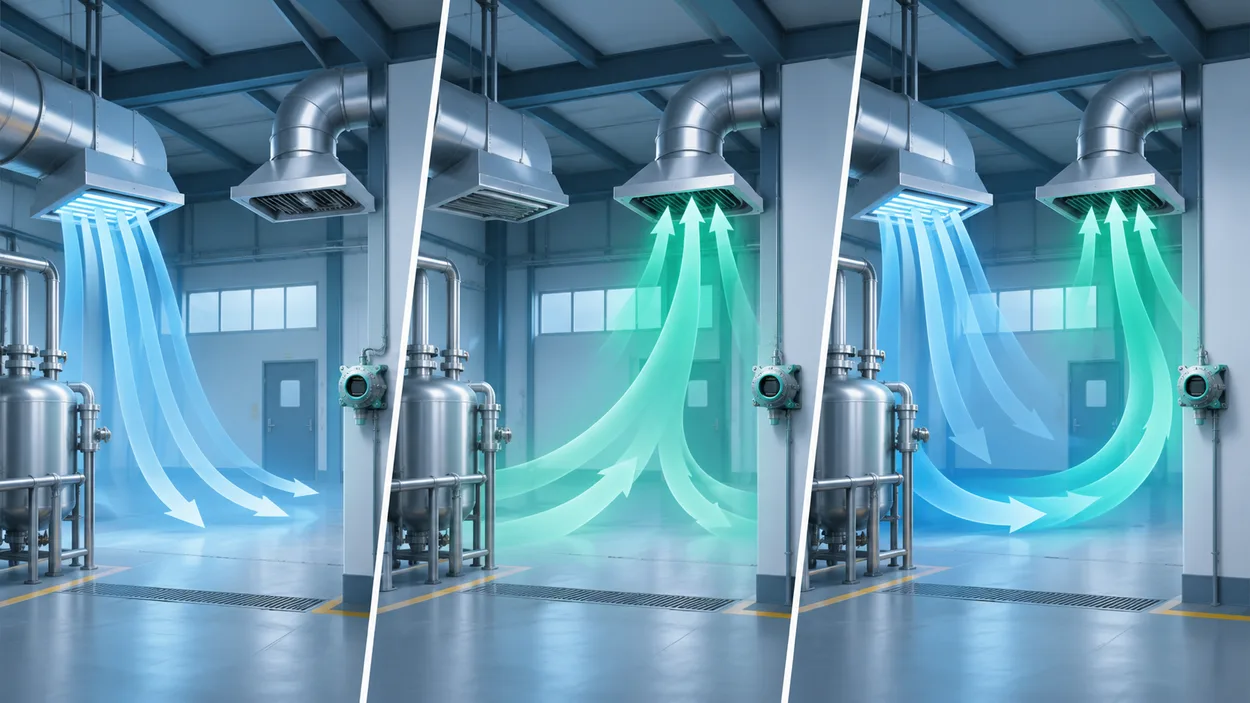
Ventilation operating modes belong in the assessment; these panels are not validated room-flow results.
Verification should address the right uncertainty
A gas-response check at a detector can establish aspects of its function under the check conditions. It does not alone show that a release elsewhere will reach the inlet in time. A location inspection can establish that the detector matches a drawing, but the drawing still needs a defensible design basis. A modelling result can support a scenario assessment, but its assumptions need comparison with the installed arrangement.
HSE's COMAH technical-measures page identifies detector positioning, dispersion, dilution, reliability and response among the considerations for leak and gas detection. Its context is major-accident assessment, not a universal instruction for every building. The useful review principle is to connect the evidence to the claimed function rather than accept one certificate as proof of every aspect of detection. HSE leak/gas detection.
If the team needs additional evidence about airflow or dispersion, let the responsible specialists define a suitable and authorized assessment method. This article does not direct readers to release gas, generate smoke, switch ventilation or enter a potentially hazardous space. A selection guide can identify missing evidence without becoming an uncontrolled experiment plan.
During handover, separate confirmed installation details, demonstrated functions and remaining assumptions. That separation helps operations understand the boundary of the accepted arrangement. It also makes future changes easier to review: a new partition may affect geometry evidence, while a sensor replacement may affect equipment configuration. The required reevaluation follows from the part of the original reasoning that changed.
Keep the accepted location relevant over time
Detection locations can become less representative without an obvious instrument failure. Equipment can move, storage can accumulate, ventilation can change and a process can use a different substance. Include relevant detection implications in the site's change process. A valid calibration record does not answer whether the old source-to-inlet relationship still applies.
An accessible point record helps maintenance staff recognize changes worth reporting. It should explain the purpose in plain language and identify the drawings and assessment that support it. Users do not need to become dispersion specialists to know that a new barrier has appeared between an assessed source and an inlet. They do need a clear route to the responsible reviewer.
For background on the instrument categories involved, the Sensor1stop guide to gas detector types explains several common technologies. Selection of a technology and selection of an observation point are connected but separate decisions. An excellent sensor cannot measure gas that does not reach its sensing path, while a plausible location cannot compensate for unsuitable gas response.

A point-location record connects the installed inlet with the sources, modes and constraints considered.
Review candidate locations with explicit counterquestions
For every proposed inlet, ask what would prevent the relevant atmosphere from reaching it. Possible questions include an opening that redirects flow, an enclosure that isolates the source, a barrier added after design or a ventilation mode absent from the assessment. These are prompts for the responsible review, not a claim that any one feature necessarily invalidates a location. The point is to make the observation assumption explicit.
Then ask the converse: what atmosphere might reach the point that does not represent the intended scenario? A supply stream, a nearby process emission or a local environmental condition may influence the observation. The assessment should decide whether those influences matter for the duty. A location can be exposed to gas and still be a poor answer to the specific question the system is intended to address.
A good location record explains why the selected point is preferable to plausible alternatives within the design constraints. It need not describe every rejected position, but it should identify the decisive considerations. For example, the source relationship, relevant airflow mode and equipment restrictions can explain the choice more effectively than a bare note reading 'as manufacturer recommends.' The instructions and site reasoning should be connected.
Distinguish a compliance dimension from a design assumption
Some applications have specific location requirements in the applicable code or exact equipment instructions. Those requirements must be identified and followed within their scope. Other dimensions on a drawing may be project decisions supported by engineering assessment. The record should distinguish these sources so that a later reviewer knows whether a proposed change affects a mandatory condition, an equipment restriction or the site's own design basis.
Do not claim a universal requirement from a dimension found in an unrelated installation guide. The gas, application, model, jurisdiction and edition may differ. If a supplier provides a location drawing, ask which instructions and assumptions support it. Retain enough document identity to resolve the question later. A copied sketch with no source is difficult to maintain when the project changes.
Make the handover useful to operations
Operations staff need a practical description of what the point observes and what changes should be referred for review. They do not need an unexplained bundle of model files. Include the point identity, duty, relevant sources and modes, important exclusions and the owner of the design basis. Connect those descriptions to the as-built drawings and equipment instructions.
For maintenance staff, identify the accepted access and accessory arrangement. If a service task requires removing a guard or changing a sample component, the restoration record should confirm the intended configuration. A detector returned to an altered orientation or fitted with a different protective attachment may no longer match the location evidence. The appropriate review depends on the actual change and manufacturer conditions.
For project teams, include detection in reviews of new equipment, storage and building services. A change that seems unrelated to instrumentation can still alter a source, barrier or air path. The original point record provides a starting question: does the change affect any condition used to justify this inlet? That is more precise than asking whether the detector itself has been touched.
Finally, keep unresolved uncertainty visible. A location supported by a preliminary layout should be identified as preliminary until the relevant installed details and acceptance evidence are confirmed. A confident label cannot compensate for missing geometry or an undefined operating mode. The purpose of the record is to support a defensible decision and later maintenance, not to make every drawing appear finished before its assumptions have been checked.
Часто задаваемые вопросы
Should a light-gas detector always be near the ceiling?
Buoyancy is relevant, but the actual position depends on the duty, release, ventilation, geometry and equipment instructions. A ceiling description does not identify a complete observation boundary. Review the scenario and document why the inlet is expected to encounter the relevant atmosphere. Do not convert a general tendency into a universal mounting dimension.
Is breathing height the correct choice for every toxic gas?
The objective matters. A fixed point assigned to leak detection and an instrument used for personal exposure observation are different arrangements. Relevant application requirements and manufacturer instructions must govern the location. A single height cannot establish that every worker's atmosphere is represented throughout a task or that every source scenario is covered.
Can one point cover an entire room?
That requires a defensible assessment for the defined scenarios and conditions. Room area alone is insufficient. Sources, barriers, ventilation modes and the required response influence the observation arrangement. Avoid promising a universal radius or number of detectors. If a supplier proposes one point, request the basis and its limits rather than accepting the equipment count as evidence.
Can an inconvenient sensor simply be moved lower?
Moving it changes the observation point and may change the design basis. Review the duty and alternatives through the responsible process. Maintenance access is important, but it must be resolved alongside gas access, environmental suitability and instructions. Record the approved change and any verification needed before treating the altered arrangement as accepted.
Does calibration prove placement is correct?
Calibration concerns the instrument's response to a reference under specified conditions. It does not demonstrate the full transport path from a release source. Placement needs separate evidence tied to the scenario and installed geometry. Both instrument performance and an appropriate location matter; neither replaces the other.
Источники и объем
- HSE: Выбор и использование детекторов горючих газов, industrial flammable-gas scope, Great Britain; positioning discussion and stated exclusions.
- HSE: Обнаружение утечек/газа, COMAH technical-measures considerations.
- HSE: Sample-tube safety alert, CEMHD1-2020, 10 September 2020.
- NIOSH: Components for Evaluation of Direct-Reading Monitors, DHHS (NIOSH) Publication 2012-162; instrument performance evaluation, distinct from site-specific placement design.






оставьте ответ