

A CO₂ monitor near a supply diffuser can measure a disproportionate share of newly delivered air before it mixes with the air people occupy. When the supplied air has less CO₂ than the room, the monitor can read lower than a representative occupied location. The instrument may be responding correctly to air at its inlet. The error arises when that local reading is assigned to the whole room.
A better location samples ordinary air at the occupied height for the question being asked. Avoid direct discharge, air entering from openings and direct exhalation. Where the room is large, has multiple activity areas or uses stratified distribution, compare several locations. A synchronized test that swaps two instruments between positions can help distinguish a location effect from sensor disagreement.

The air at the outlet and the air around occupied seats are different sampling targets.
A diffuser reading describes the local mixture
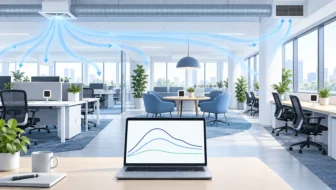
The air leaving a supply diffuser may be outdoor air, a mixture of outdoor and recirculated air, or air supplied by equipment that mainly recirculates indoor air. The diffuser spreads the jet and entrains surrounding room air. Near the outlet or along a concentrated jet, a monitor can see a greater fraction of the supply stream. Further along the path, more room air may be entrained. The actual path depends on the outlet, operating flow, temperature and room geometry.
Take an illustrative room at 1,050 ppm away from the supply path and supply air at 700 ppm. A local sample composed of 70% supply and 30% representative room air would be about 805 ppm. A point receiving 20% supply and 80% room air would read about 980 ppm under the same simple mixing assumption. The example shows how two points can differ while both instruments correctly report their local samples. These percentages are constructed, and the calculation does not tell where to mount a sensor.
| Example local mixture | Supply at 700 ppm | Room air at 1,050 ppm | Calculated local value |
|---|---|---|---|
| Directly supplied air before room entrainment | 100% | 0% | 700 ppm |
| Supply-dominated observation | 70% | 30% | 805 ppm |
| More strongly mixed observation | 20% | 80% | 980 ppm |
| Reference occupied air in the example | 0% | 100% | 1,050 ppm |
A low reading is common when the supply concentration is lower, but the direction depends on the two air streams. A recirculating system can deliver air with little difference from the room. A central system may transfer the influence of a densely occupied area to another room through its shared supply. The useful rule is to identify which air dominates the inlet rather than assume the reading is low whenever an outlet is nearby.
CDC/NIOSH's ventilation FAQ highlights the risk of artificially low values when a current from HVAC or make-up air passes directly over a room monitor. The Исполнительный директор по охране труда и технике безопасности Великобритании advises monitoring at head height away from air supply openings, doors and windows. These recommendations address whether the air sample represents the room or people area. The mounting instructions for a permanent control point and the requirements for the specific project also apply.
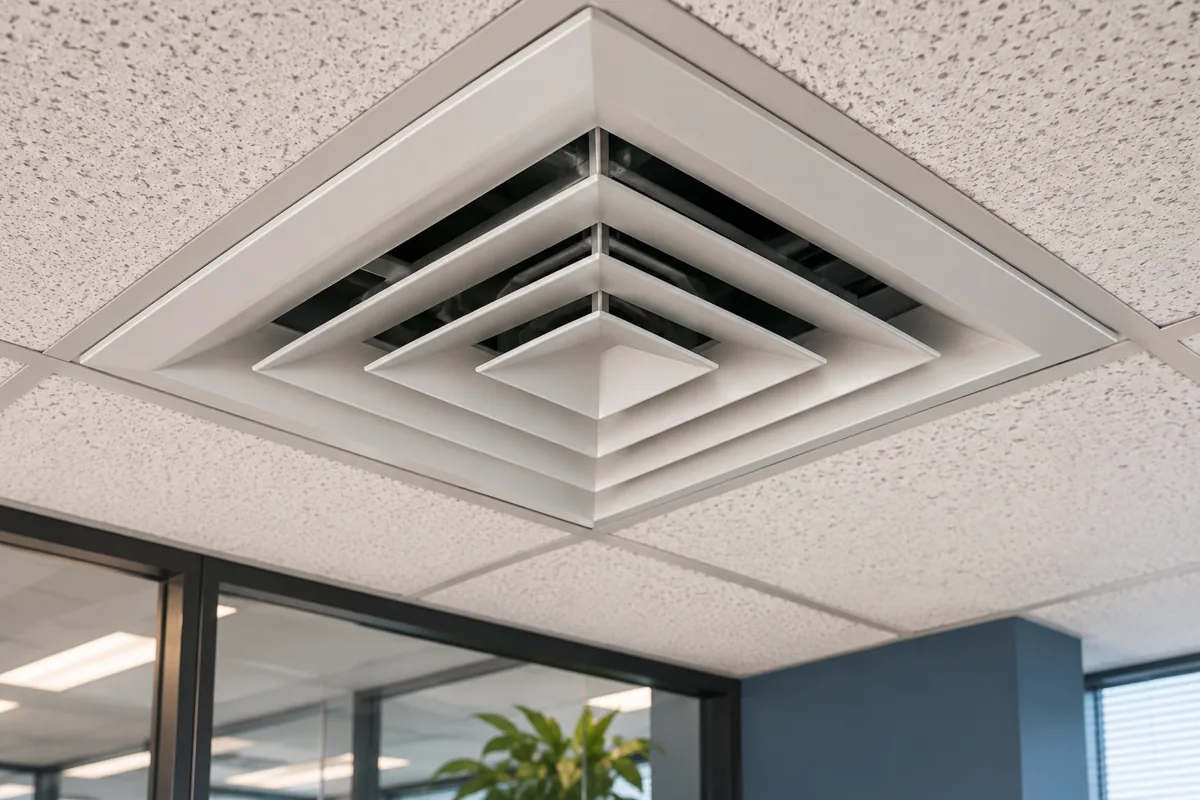
Diffuser geometry and discharge direction matter. An outlet can influence a location along its throw even when the sensor is offset from the grille.
Distance alone cannot identify a representative spot
Some ceiling outlets distribute air close to the ceiling before the jet spreads or drops. A wall can redirect the flow. A floor or wall supply can affect a monitor at occupant level. Furniture or partitions can block circulation or create an area with a distinct pattern. The nearest measurement point by straight-line distance may be outside the main discharge, while a farther wall point may lie in the path.
Compare locations under the fan speeds and thermal modes that matter. When supply flow changes, the throw and the degree of entrainment can change. A cooling jet can behave differently from warmer supply. An acceptable wall point in one season can experience direct air in another. If a portable logger is used to test the location, document exactly where its inlet sits relative to the permanent transmitter's inlet and how the device is oriented.
Supply air often lowers the room concentration over time. A real decrease at representative occupied points after outdoor airflow rises is meaningful. A sudden drop only at the candidate location can indicate a local supply influence. A useful test distinguishes those two patterns rather than classifying every response to the HVAC system as bias.
Separate a supply jet from vertical stratification
Mixing ventilation aims to distribute conditioned air and reduce concentration gradients in the occupied space. Real mixed rooms can still have uneven concentrations due to partitions, thermal plumes, source locations or low airflow. Displacement and some underfloor systems intentionally produce stratification. Air introduced low in the room interacts with heat sources and occupant plumes, and the ceiling return can sample a different layer from occupied height. These are different mechanisms from a narrow supply jet passing over a sensor.
The ASHRAE Handbook chapter on space air diffusion distinguishes fully mixed, partially mixed and stratified distribution strategies. In an intentionally stratified space, a vertical difference may be a feature of air distribution even when neither monitor is near a discharge. Determine which height and region represent the people or control function being evaluated. Do not average an upper-layer reading into an occupied-zone estimate merely to reduce apparent variation.
The field question can be separated into two comparisons. First, compare points at the same occupied height, one in the suspected supply path and one outside it. Second, where stratification is suspected, compare heights at positions away from direct flow and immediate exhalation. A discrepancy that mainly follows horizontal exposure to a jet differs from a height-dependent pattern repeated across the room. Both effects can occur together.

In low-level supply systems, compare air at the occupied heights of interest. A high return can represent a different layer.
A comparison at three points can help separate the patterns. For a tall room, compare two locations at the same seated height and an upper position above one of them, away from direct supply. If the two seated points agree while the upper point differs consistently, a height-related difference is plausible. If only the point along the supply path differs from the other seated point, test the horizontal air path first. Repeat in another mode before using one result to characterize year-round operation.
A high mounting location is a different question from being in a jet
Research on ceiling sensors has found useful results in selected well-mixed conditions. For example, Heemstra and colleagues examined ceiling-mounted sensing and noted the importance of adequately mixed air and avoiding fast supply-to-return paths and stagnant or stratified locations. Their findings cannot establish equivalence for every ceiling or diffuser location. Treat them as evidence that sample air matters alongside mounting height.
A ceiling-mounted sensor might be approved for a specific building and control design. A portable investigation at occupied height asks what people generally experience. Keep those datasets identified separately. Compare the fixed point against the reference chosen for its intended use and the installed operating modes.
Compare instruments and locations without changing both at once
Start with two stable, suitable CO₂ instruments and synchronize their clocks. Run them together in the same air long enough to compare offsets, response and variation under stable conditions. Use a relevant concentration range if possible and follow manufacturer instructions for warm-up and maintenance. A single agreement check gives a limited result, especially if the test later spans much higher concentrations or different environments.
Place one instrument at the suspected point and the other at a representative occupied point, at the same height where practical. Keep the comparison clear of direct breath and record the relation to furniture and openings. Note supply and return grille locations, room use, occupancy and activity, fan mode, time of day, door and window events, and any material operational changes. Choose sampling and averaging intervals that can capture the expected changes without making individual breath spikes dominate the interpretation.
Observe the points concurrently under normal use. Where possible, swap instrument positions during a comparable operating window, allow the moved instruments to settle, and repeat. If the lower result follows the location, a location effect becomes more plausible. If the lower result follows the device, investigate instrument disagreement. If the relationship changes after the swap while the occupancy or fan mode also changed, repeat with better matching or retain the result as indeterminate.

Conceptual candidate and reference locations. Match inlet heights for a horizontal comparison and swap synchronized devices under comparable conditions.
Choose a test statistic before collecting the data
For a steady occupied interval, compare the paired difference for each valid time window and retain the direction of the difference. Summarizing the two devices independently can compare values from different minutes if one logger has a gap. A graph with both traces and a line for the paired difference makes this visible. A single unusually large difference deserves review of the time record before it is treated as characteristic.
For a fan-mode transition, look at the order of changes. The candidate may respond immediately to the new supply stream while the reference changes as room air exchanges. Use the same time window and describe the response times of both devices. If the devices filter differently, the observed difference may partly reflect their response rather than the room. The Руководство по точности монитора CO₂ explains how to evaluate the separate specification terms involved in interpreting two devices.
Worked comparison across two matched windows
Suppose two devices agree within roughly 20 ppm in a stable collocation check. During the first occupied window, device A reads 820 ppm at the candidate spot and device B reads 990 ppm at the occupied reference. During a comparable second window after swapping, device B reads 840 ppm at the candidate and device A reads 1,010 ppm at the reference. The occupied reference is 170 ppm higher in both windows. This constructed pattern supports a location effect larger than the disagreement observed during collocation.
| Этап | Candidate position | Occupied reference | Difference from reference | Интерпретация |
|---|---|---|---|---|
| First matched window | Device A, 820 ppm | Device B, 990 ppm | −170 ppm | Candidate lower with A |
| Second matched window, instruments swapped | Device B, 840 ppm | Device A, 1,010 ppm | −170 ppm | Candidate lower with B |
| Comparison under a different fan mode | Repeat with settled devices | Repeat at the same reference | Record observed gap | Check whether the effect depends on mode |
The test establishes a repeatable difference in the example. It does not identify the mechanism on its own. To check whether the supply jet drives it, look for changes tied to supply mode and compare additional points along and outside the suspected path. Include a similar occupied period with different fan conditions when practical. Confirm that the candidate is not also near a door, an exhaust short path, or a colder surface that affects the instrument.
If the fixed building sensor cannot be moved, move two portable loggers between the same candidate and reference positions and compare the fixed sensor with the portable unit located beside it. Keep the measurement inlets close enough to sample similar air without blocking each other. This lets the location comparison and the fixed transmitter's agreement check remain separate. A portable unit on a desk below a wall transmitter may sample a different layer.
Recognize patterns that require a different diagnosis
A monitor beside an exterior door may show repeated downward spikes when the door opens. A sensor near a person's seat can show sharp upward pulses during conversation. A unit hidden behind a cabinet can respond slowly to room changes. A wall-mounted transmitter can be affected by air coming through an unsealed backplate opening. These effects require different corrections from a supply jet even if their average readings happen to be similar.
| Pattern during a comparison | Возможное объяснение | A way to discriminate |
|---|---|---|
| Candidate drops promptly after the supply fan changes, while other points respond more slowly | Candidate samples a concentrated supply path | Compare same-height points across the suspected path |
| Several points show a similar difference by height | Stratification or persistent vertical distribution | Repeat at occupied and upper heights away from direct discharge |
| Short high pulses follow conversation near the sensor | Direct exhalation | Move the reference beyond the immediate breath plume |
| Candidate drops with exterior door events | Incoming air path near the opening | Log opening times and compare a point out of that path |
| Gap follows the device after a swap | Offset, response difference or a fault | Repeat same-air comparison and follow the instrument procedure |
| Only one interior region stays high across devices | Uneven distribution, localized sources or different occupancy | Sample the region and check air paths and activity |
Use trends from representative occupied intervals rather than one-minute maxima and minima alone. A useful record can include a stable-period median or mean, the distribution or range, and notable transitions. Keep original time series so a reviewer can distinguish sustained differences from short events. Use an explicit policy for missing or invalid readings.
Choose and verify a representative location
Start with the people and the purpose. A seated group, standing workers and mixed activities may call for different occupied-height sampling. A portable diagnostic location should represent the region of interest. A permanent control point must also satisfy the project requirements and the manufacturer's installation instructions. Keep the inlet exposed to normal room circulation, away from direct supply, exterior openings and immediate exhalation.
Choose the reference location before looking for the desired numeric result. If several positions could work, record why they were considered. An interior wall near the main occupied area is often a practical candidate, but placement next to a door or behind furniture may defeat the purpose. A location at a convenient power outlet can be poorly representative. A repeatable method starts with the room geometry and confirms the sample with observations.
The EPA air sensor siting guide recommends documenting installation surroundings and avoiding conditions that make readings unrepresentative. A useful placement record includes a sketch or photo, monitor inlet height, occupied area, distance and direction to supply and return, instrument ID, and the operating states compared. If furniture or airflow changes, the record explains whether rechecking the site is warranted.

Several points at the same occupied height help identify horizontal variation. Add height comparisons separately if stratification is suspected.
Treat a large room as several candidate sampling regions
A wide training room can have a front area used for instruction, a central seating zone and a perimeter affected by exterior walls or supply outlets. A single monitor near the return may respond to air from much of the room, while a central logger describes the air around the main seating area. First decide whether one value is adequate for the intended use. If the room remains heterogeneous, retain the individual locations and their results.
Avoid averaging a known nonrepresentative point into a representative estimate. The near-diffuser point is useful for diagnosing the local effect. The occupied points are useful for characterizing the people area. If a design calls for combining several control points, the weighting or selection should follow the approved sequence. A casual arithmetic mean can conceal the area that needs a response.
Some rooms have atypical events, such as temporary partitions, portable fans or an open sliding divider during a larger gathering. Include the events that matter for ordinary operation. When a change is unusual but may recur, record it as a separate condition. A placement decision valid only for one room configuration should identify that boundary.
Recommission any affected automatic control
If a permanent CO₂ sensor drives demand-controlled ventilation, moving it changes the feedback signal. Confirm the governing placement criteria and review the new point under representative modes. Check the controller's raw input, filtering, response and fault handling. Verify that the minimum outdoor air and demand response still operate as required. Avoid silently altering the control logic to compensate for a known sampling problem.
An apparent improvement after moving a sensor can reflect more representative data without any change in actual airflow. Conversely, if the old control point was exposed to supply dilution, relocation may make the controller request more air. Record the change date and location in trend records. Compare service under the new configuration rather than expecting continuity in the plotted concentration.
If disagreement remains among representative points, investigate air distribution, airflow delivery and sources. The CO₂ logs can show where and when to look. Assess required outdoor air delivery with the appropriate airflow evidence, and consider additional measurements if the question involves other pollutants or ventilation effectiveness.
Match the sampling plan to the room and the decision
In a room with changing seating, mark the normal occupied area and identify positions with a reasonable spread of typical activities. A logger right beside a lecturer can be useful for studying that local event, while several central or perimeter points describe whether the occupied region is similar. State the role of each point. A sample collected close to a supply diffuser is valuable if the goal is to understand that air path.
If an existing trend looks implausibly low, reconstruct the physical scene before changing the controller. Check the sensor's mounted orientation, the active supply outlets, furniture, and the position of nearby doors. Photograph the existing location and note whether louvers have been adjusted or equipment has been replaced. An apparent sensor change can be a change in airflow distribution around a sensor that has stayed in the same place.
Decide what a relevant test would need to reproduce. For a fan that cycles, compare multiple cycles with the room in similar use. For a variable system, collect observations across the modes expected to have different throw or supply composition. If only one mode is available on the day of testing, report that limit and avoid treating the result as a year-round placement decision. Changes in supply temperature can affect whether the jet stays attached to a ceiling or reaches occupied height.
A diagnostic comparison without disrupting service
Many placement questions can be answered while leaving building settings in normal operation. Use naturally occurring changes in the supply state as context. Log the occupied trend concurrently with fan or terminal data where available. If the candidate responds to each cycle faster or more strongly than the reference, repeat the comparison with another instrument and at an intermediate position. A position at the same height but outside the probable path can help separate source and height effects.
Keep any temporary instruments and stands clear of walkways and active equipment. Avoid placing a device where occupants will habitually breathe directly onto it or move it. When a working area cannot accommodate several loggers for a long period, perform repeated short paired observations and record the limitation. A permanent monitoring decision should consider whether the site can remain representative during ordinary use, beyond the test day.
Report the observed gap with its conditions
A useful finding says where the instruments were, when the difference occurred, and whether it followed the site or the instrument during the swap. For example, a record might describe a lower candidate reading during high-flow cooling with a stable difference across both devices, and comparable results at the two positions during low flow. That identifies a mode-dependent placement concern. A daily average that combines those conditions could conceal it.
Keep a separate note for observations that contradict the suspected mechanism. If the sensor remains low when the supply is off, check whether nearby openings or wall air still reach the inlet, and repeat the instrument comparison. If a group of occupied points all fall after outdoor flow rises, the broader ventilation effect may be real. Distinguish the immediate local response from the subsequent occupied-room trend and retain both traces for review.
Часто задаваемые вопросы
How far from a supply diffuser should a CO₂ sensor be?
There is no generally applicable distance that guarantees representative air. Diffuser type, throw, fan state, nearby surfaces and room layout determine the local stream. Follow the project and manufacturer requirements and verify the candidate under the conditions it will encounter.
Can a sensor on the ceiling represent occupied air?
It can in selected validated conditions, particularly where the sampled air is adequately mixed. A ceiling point in a discharge jet, a stagnant pocket or a stratified upper layer can report different air. Compare it with the intended reference and check the project's placement requirements.
If a diffuser-side reading is low, does that show good ventilation?
It shows the concentration at that point. When newly supplied air dominates the sample, the result can be lower than the air occupants experience. Compare representative occupied locations and verify ventilation flow if that is the decision.
What if the room has no mechanical supply diffuser?
Apply the same reasoning to an open window, door or air transfer path. A logger in an incoming stream can describe the incoming air more closely than the occupied region. Record opening events and compare several positions during typical use.
Can I add a fixed correction to the reading near the outlet?
A fixed correction requires a stable relationship across the modes of interest. Supply composition, throw and room mixing can change, so a one-time gap is usually a weak basis for correction. Use a representative location or retain the outlet-adjacent reading for the distinct diagnostic question it answers.




оставьте ответ