
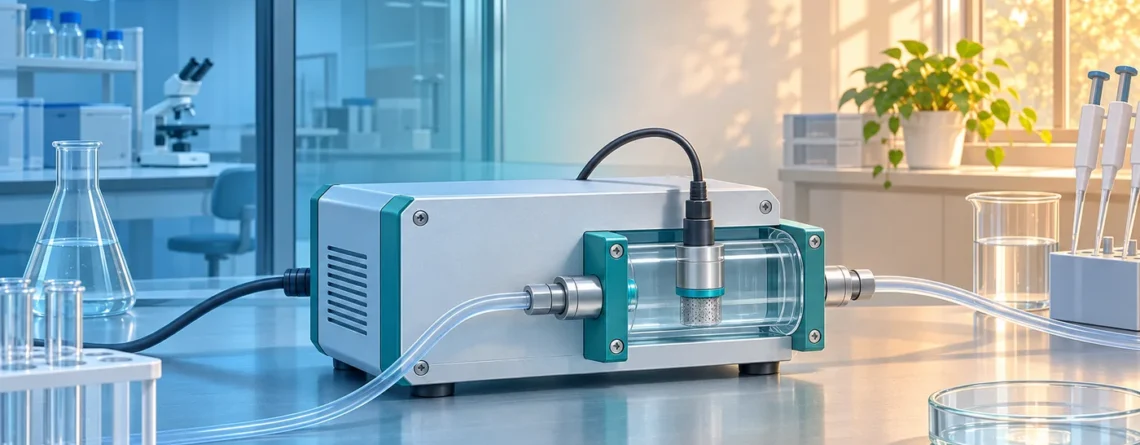
Temperature can change an oxygen sensor's sensitivity, the behavior of its compensation system and the condition of the sample reaching it. During a rapid temperature change, unequal thermal response can also create a temporary reading error that does not follow the steady-state correction curve. The direction, magnitude and recovery depend on the technology, model and installation.
A warmer gas sample does not automatically contain a lower oxygen fraction. Composition, partial pressure and molecular density describe different quantities. Heating can change one while leaving another unchanged, depending on whether the gas is sealed, pressure-controlled, humidified or chemically reacting. Before calling a changing oxygen reading a temperature error, identify which quantity the instrument reports and whether the gas itself has changed.
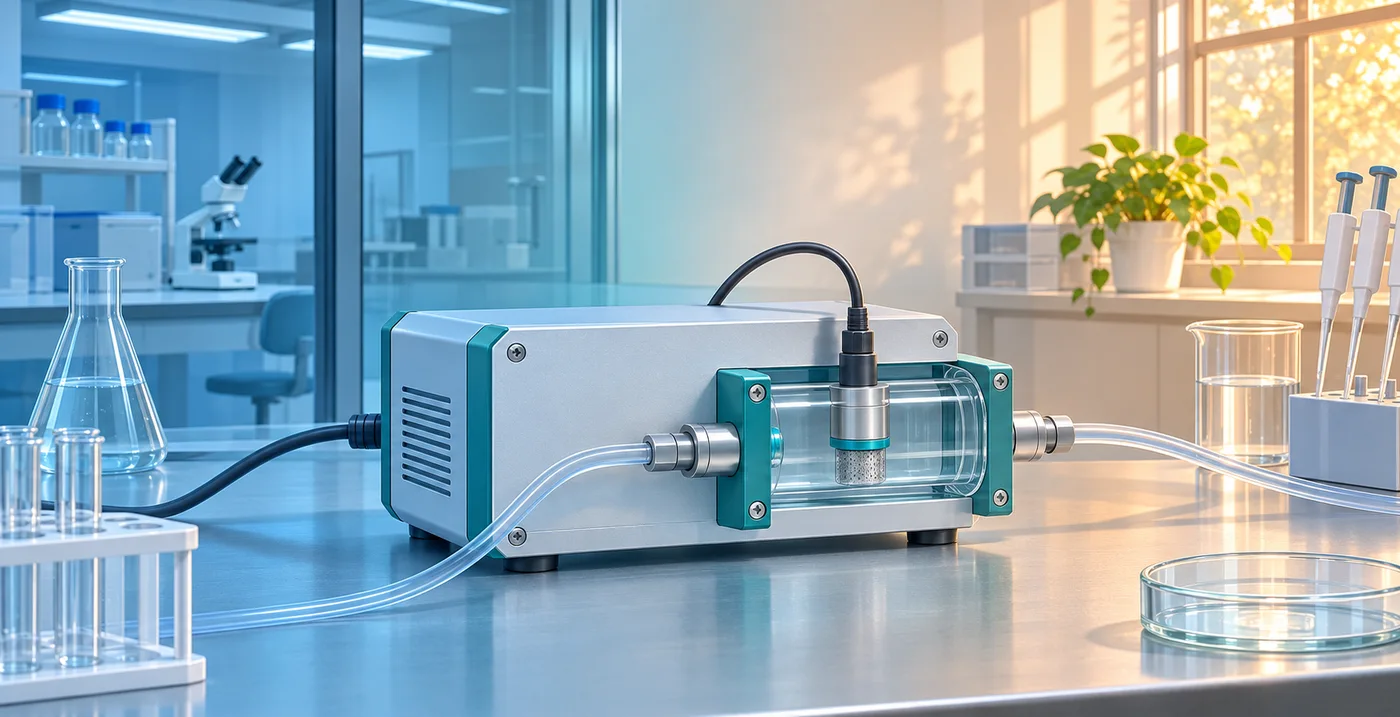
Conceptual thermal transition: the air, housing, sensing element and compensation thermometer need not reach their new temperatures together.
Separate four temperatures before interpreting the reading
An oxygen measurement can involve at least four relevant temperatures: the source gas, the gas at the sensing element, the sensing element itself and the temperature used by compensation. They may be nearly equal in a settled installation. They can differ substantially during a transition.
Source temperature describes the process or room being sampled. Cell gas temperature describes the gas after transport through tubing, filters and a chamber. A hot source sample can cool before reaching the sensor. A cold sample can warm in a cabinet. That difference matters for condensation and, in some systems, chemical behavior.
Sensor temperature describes the physical state that affects its response. A housing can retain heat after the surrounding air cools, and an internally heated sensor deliberately operates above the incoming gas temperature. The value needed for compensation is therefore not necessarily the source temperature.
Compensation temperature is the number used in an algorithm or circuit. It may come from an internal element, a nearby thermistor or a host-provided measurement. If it follows a different thermal path from the sensing mechanism, a correction that works after equilibrium can be wrong during movement between environments.
A useful diagnostic record names all four rather than storing a single field called temperature. Where only one is measurable, state its location. This avoids treating a cabinet thermometer as proof that an oxygen cell has stabilized.
Does heating change the actual oxygen concentration?
For a nonreacting mixture with no additions, removals or leaks, its oxygen mole fraction remains the same when temperature changes. The gas state can still change. At fixed pressure, warmer gas has lower molecular density. In a sealed rigid volume, heating instead raises total pressure.
Oxygen partial pressure is the oxygen fraction multiplied by total pressure. A partial-pressure sensor can therefore respond to a pressure change even when the oxygen fraction is unchanged. An instrument that converts partial pressure into percent oxygen must use an appropriate total-pressure basis.
Water creates another route to a real composition change. Adding water vapor at a maintained total pressure reduces the fraction occupied by the original dry gases. Removing water changes the basis again. Heating that simply lowers relative humidity is different from humidification that adds water molecules.
This distinction is especially useful when a process sample is cooled. If cooling causes water to condense and be removed, the remaining gas no longer has the original wet-basis composition. The oxygen fraction can increase without any sensor gain error. If the target gas is also lost or reaction occurs, a simple moisture conversion may be inadequate.
The SST zirconia operating-principle guide explicitly distinguishes oxygen partial pressure from oxygen percentage for the sensors it covers. That distinction should be resolved before applying any generic temperature correction.
Why electrochemical oxygen sensors need model-specific treatment
Electrochemical is a broad technology label. In some designs, oxygen transfer through a membrane strongly influences the response. Other designs use a small capillary as the controlling transport path. Those arrangements do not have interchangeable temperature behavior.
Alphasense application note AAN 005 contrasts these mechanisms. It relates the capillary-controlled family's response to gas transport and provides family-specific compensation information. It also explains that fast thermal changes can produce temporary currents and that compensation temperature should be sensed near the appropriate part of the cell.
The design implication is broader than any single coefficient: determine what limits oxygen transport and how the manufacturer characterizes the complete sensor. A coefficient from a membrane-controlled cell should not be applied to a capillary-controlled product because both happen to generate a current.
Also distinguish a raw cell from a complete detector. A detector may already correct the cell output using temperature measurements, factory characterization or additional diagnostics. Adding a host correction to the displayed percentage can duplicate a correction that belongs inside the instrument.
Long-term environmental effects are a separate question. A temporary peak after a temperature step does not by itself establish permanent damage, and a stable reading after recovery does not prove that an exposure outside the rated conditions was harmless. Use the exact model's operating, storage and recovery instructions.
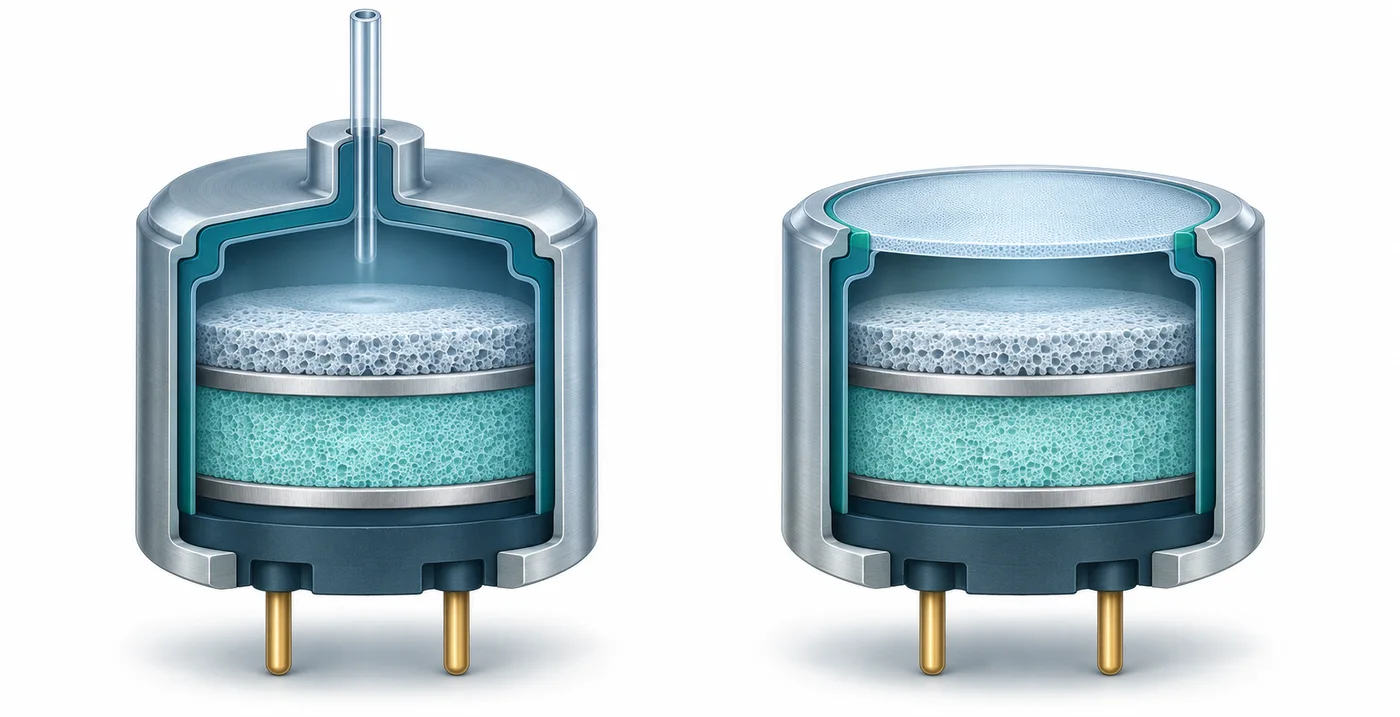
Conceptual transport paths: a capillary-controlled cell and a membrane-controlled cell can respond differently to temperature. The illustration is not a construction drawing for a specific product.
Optical oxygen sensing still has thermal conditions
Luminescence-based oxygen sensing uses an oxygen-sensitive optical material and a measured optical response. The material response and its interaction with oxygen depend on temperature. A module can compensate those effects internally, but that does not eliminate installation requirements.
The LuminOx product description identifies onboard temperature and barometric-pressure compensation for the named module. For an integrator, the first question is whether the received output is already corrected. A second correction based on an external room temperature can introduce an error.
Read the exact part and document revision. Different housings, gas interfaces and product generations can carry different permitted conditions. The LOX-02 revision 17 datasheet gives separate operating and storage conditions, identifies noncondensing humidity and distinguishes oxygen, pressure and temperature output specifications.
A temperature field from a gas sensor is also not automatically a calibrated process-temperature measurement. Some datasheets describe that output as indication only. It can be useful for observing trends without supporting a claim about the true source temperature or a small temperature difference.
For diagnostics, ask whether the optical sensing material, internal thermometer and sampled gas share the thermal condition assumed by the module's calibration. An internally compensated instrument can still be affected by a strong gradient or operation outside its specified envelope.
Heated zirconia and paramagnetic analyzers pose different questions
A zirconia oxygen sensor deliberately uses a heated element. Its internal working temperature and permissible incoming-gas temperature are different specifications. Confusing them can lead to the mistaken conclusion that a hot sensing element permits any hot sample.
Heater control, electrical supply and the manufacturer's interface form part of the measurement chain. A heater being powered does not by itself establish that the sensor is ready to meet its full specification. Use the supported readiness and stabilization criteria rather than an assumed universal waiting period.
Paramagnetic oxygen analyzers use a different physical principle. Their sample temperature, pressure, flow and background-gas requirements should be read from the complete analyzer documentation. A general statement that oxygen is paramagnetic does not provide those installation limits.
The SERVOPRO 4900 manual, for example, lists sample-gas conditions separately from instrument ambient conditions and distinguishes requirements for installed transducers. This separation is useful even when choosing another analyzer: ambient tolerance and sample tolerance answer different questions.
| Technology or device level | Thermal question to resolve | Incorrect shortcut |
|---|---|---|
| Membrane-controlled electrochemical cell | How does membrane transport vary, and where is compensation sensed? | Borrow a coefficient from another oxygen cell |
| Capillary-controlled electrochemical cell | What family correction and transient behavior are documented? | Assume raw current is temperature independent |
| Compensated optical module | Which outputs are corrected and under which conditions? | Correct its digital oxygen output again |
| Heated zirconia sensor | Is the element controlled and ready, and is the sample permitted? | Equate heater temperature with sample rating |
| Paramagnetic analyzer | Are cell and sample conditions within the specified envelope? | Use cabinet temperature as the only check |
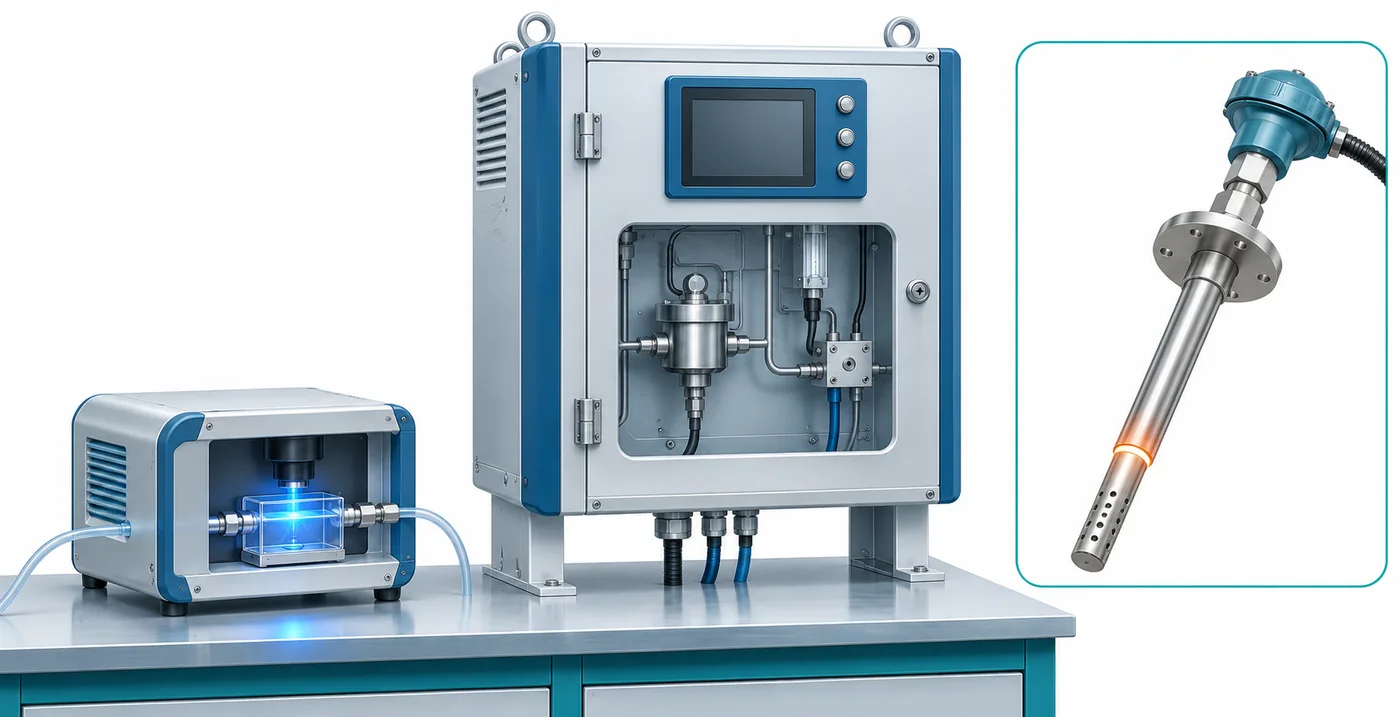
Different oxygen technologies place different demands on temperature control. Hardware shown is conceptual and unbranded.
Why a steady-state correction cannot solve every transition
A steady-state correction relates a settled sensor response to a settled temperature. During a fast environmental change, the cell, housing, electronics and thermometer can be at different temperatures. A single correction value may no longer represent the condition controlling the oxygen signal.
Imagine a sensor moved from a cool room into a warm enclosure while the gas composition remains unchanged. The compensation thermometer may warm rapidly while the sensing structure warms more slowly. Applying the final warm-temperature correction too early can create an apparent oxygen excursion.
The reverse ordering is possible in another design. The sensing face may warm before a thermometer buried in the electronics. There is therefore no universal rule that a warming sensor reads high or reads low. The thermal paths and response mechanisms decide the sign.
AAN 005 discusses transient behavior separately from the equilibrium dependence. That separation matters in practice: a temporary signal should not automatically be interpreted using a table intended for settled operation. It also explains why an apparently accurate steady-state calibration can coexist with poor behavior during movement.
Filtering the displayed oxygen value can reduce visible peaks but adds delay. It cannot establish whether the gas actually changed. In an application requiring a rapid response, extra smoothing may obscure relevant events. Evaluate transient performance as a system property rather than treating smoothing as proof of correction.
Where should the compensation thermometer be?
Follow the sensor manufacturer's placement guidance. In a custom cell interface, the useful temperature is the one that best represents the temperature controlling the cell's response. It may require close physical placement and a thermal response matched to the cell.
A thermometer on a host board can be convenient but misleading. Nearby regulators, processors and displays may heat it differently from the gas-facing oxygen element. The two measurements can track each other in a stable room while separating after a power change or airflow change.
Distance alone is insufficient. A thermometer attached through a highly conducting bracket can respond differently from one separated by an air gap. Housing material, mounting, insulation and gas flow all affect the thermal path.
For an already compensated module, additional temperature measurements are often most useful diagnostically. Compare them to understand gradients, rather than using them to override the internal correction. Any alternative compensation scheme requires model-specific evidence and validation.
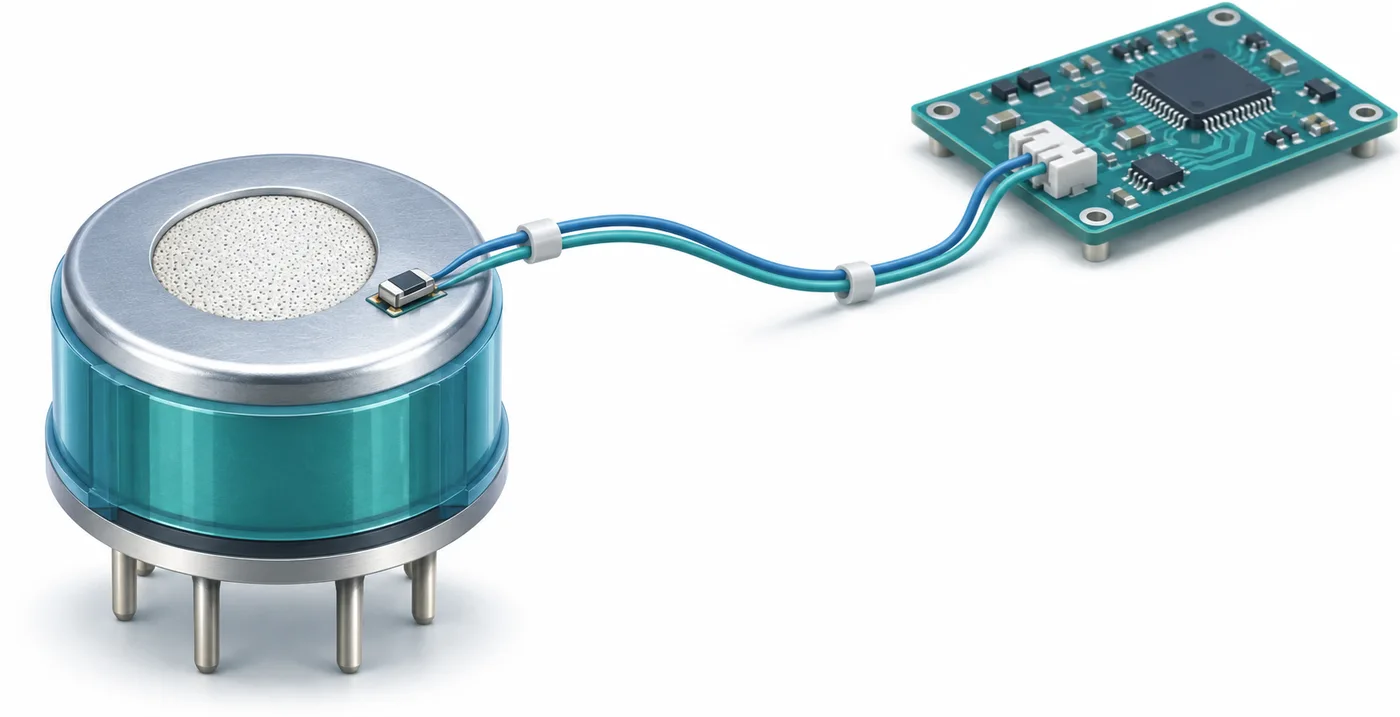
Conceptual placement: a local probe and a remote circuit-board thermometer may follow different thermal histories.
A checked example: percent of reading is not percentage points
Suppose a hypothetical oxygen instrument indicates 20.00% oxygen at one settled temperature. Its relevant specification states an additional temperature-related effect of 1% of reading across a stated change. This is an invented arithmetic example, not a specification for any named model.
One percent of the 20.00% reading is:
20.00 × 0.01 = 0.20 percentage points of oxygen.
The corresponding interval from that contribution alone would be 19.80% to 20.20% oxygen. It would not be 19.00% to 21.00%. A specification of one percentage point would be five times larger at this reading.
Now suppose a temporary peak of 20.60% occurs during movement between environments. It is not valid to claim that the instrument violated the hypothetical settled-temperature term solely from that observation. First determine whether the specification includes thermal transitions, whether composition stayed constant, and whether pressure and moisture changed.
Conversely, a return to 20.00% does not prove the transient is acceptable. If the application uses the reading during movement, the transient behavior itself needs an appropriate requirement and evidence. A settled accuracy figure cannot answer a dynamic performance question.
When comparing sensors, translate each temperature specification into the same quantity and conditions. Percent of reading, percent of full scale, percentage points, maximum error and typical behavior are different. The guide to reading accuracy specifications uses CO2 examples, but its distinction between error terms and conditions is also useful here.
Warm wet source gas can change before measurement
A warm humid sample may cool through its transport path. If the gas reaches a surface below its dew point, condensation can form. The resulting problem is not only a wet sensor: water removal can change concentration basis, and liquid can restrict flow.
A source thermometer cannot prove that every tube fitting remains warm enough. The coldest relevant surface may be a bulkhead, unheated connector or filter housing. Local ambient airflow can make that surface cooler than the cabinet average.
If the sampling system intentionally dries the gas, record the reported oxygen basis. A dry-basis result should not be compared directly with a wet-basis reference. The moisture condition at the reference and at the cell must be related consistently.
Likewise, lower relative humidity after heating does not necessarily mean water was removed. Relative humidity depends on temperature. A gas stream can have the same water content while its relative humidity changes during warming.
The Alphasense FAQ separates oxygen dilution by water vapor from transient humidity effects. That distinction helps identify whether a changing result represents a real wet-basis composition change, a temporary sensor response, or both.
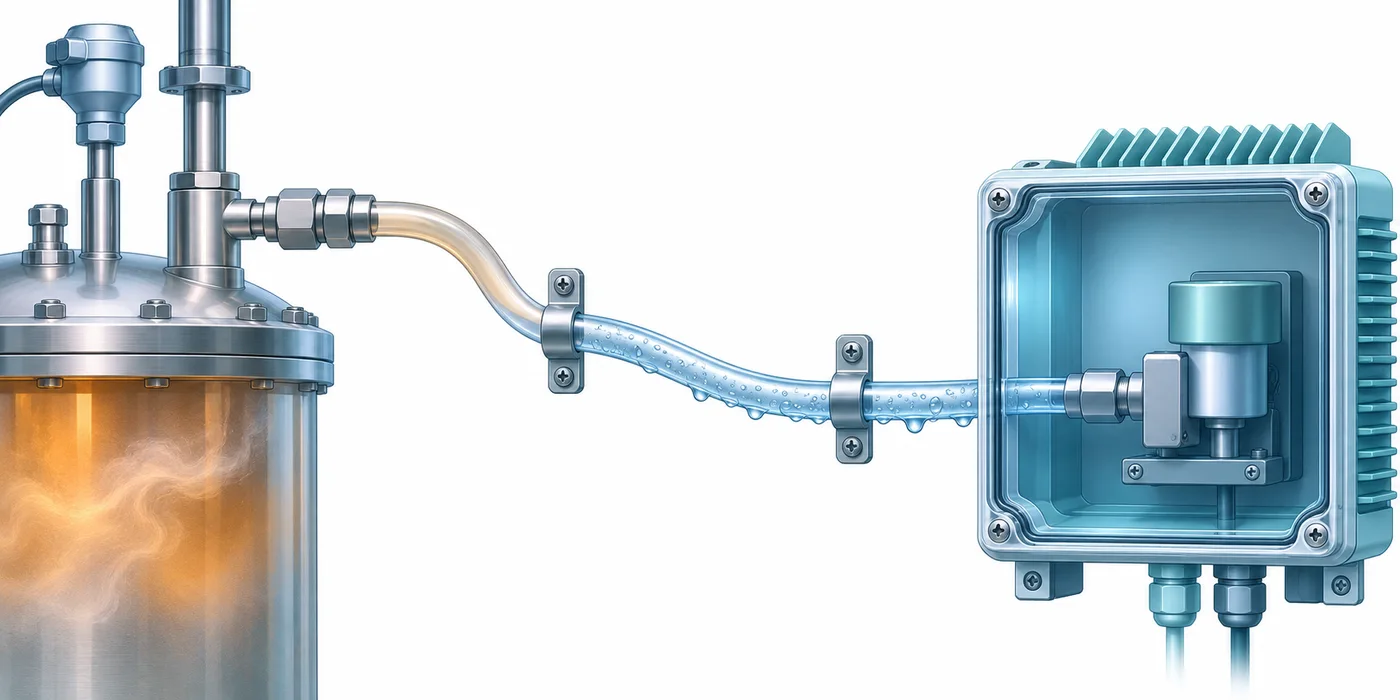
Conceptual sample path: a cooler downstream fitting can alter a warm wet sample before it reaches an oxygen sensor.
Read the exact specification before designing a correction
Collect the part number, housing variant, revision and interface details first. A family name may cover raw cells, diffusion modules, sealed modules and flow-through assemblies. Their installation conditions can differ even if the sensing principle is shared.
Separate operating temperature from the temperature range over which full accuracy is specified. A device may function over a broad range while a particular accuracy term applies over a narrower range. Storage survival provides still another type of information.
Look for stated test conditions. Pressure, humidity, gas background, flow and calibration temperature can influence the result. If a temperature curve was measured in a defined gas mixture, it should not automatically be extended to an unrelated process background.
Inspect the axis labels on graphs. A normalized output curve is not necessarily an oxygen-percentage error curve. A curve relative to a calibration temperature must be interpreted against that normalization, and typical data do not establish a maximum guaranteed error.
Determine whether the specification covers the raw sensing element or the final instrument. A compensated transmitter's environmental performance cannot be inferred simply by adding a cell coefficient to an electronic component coefficient. The complete chain may include characterization, control and diagnostic behavior.
Where documents disagree, preserve the narrower confirmed claim and seek the current specification for the exact part. Legacy optical datasheets and current product summaries can differ. Choosing the most favorable number from each document creates a fictional product that no manufacturer has specified.
Diagnose temperature-related oxygen changes with synchronized evidence
Start by describing the symptom precisely. Does the oxygen value change only during movement, remain offset after equilibrium, or track a repeating operating cycle? Those patterns point to different questions and should not be combined into a single drift label.
Record oxygen, the relevant temperatures, pressure, humidity or dew point, flow state and instrument status on a common time basis. Include state changes such as pump start, enclosure opening or heater operation. A short event log can be more informative than a long oxygen-only trend.
If the result settles back after a thermal transition while gas conditions are independently stable, thermal mismatch becomes a plausible explanation. That is an inference to investigate, not proof that the gas stayed constant. A simultaneous moisture or pressure change can produce similar timing.
If the error remains after temperatures settle, review calibration conditions, active compensation, source composition and gas-path changes. A persistent offset may be unrelated to temperature even if it first appeared during a warm-up period.
If the reading changes with flow, inspect both heat transfer and pressure effects. Flow can cool or warm the sensing region while also changing the cell pressure. Distinguishing those mechanisms requires measurements of the relevant conditions, not simply repeating the same flow adjustment.
If the temperature output itself seems wrong, check whether it is a process measurement, internal indication or corrected ambient estimate. Comparing two temperature fields with different meanings can create a false diagnosis.
What should a useful qualification record contain?
Define the intended operating envelope before collecting comparison results. Include the temperature range, expected rates of change, source-gas moisture condition, pressure state, sample interface and required output basis. This makes the qualification relevant to actual use.
Use a documented oxygen reference suitable for the instrument and application. Record its uncertainty and gas basis along with the device output. An unknown room-air sample may support limited observations, but it does not independently establish every accuracy contribution.
Distinguish equilibrium checks from transition checks. For equilibrium, record how stable conditions were established according to the applicable procedure. For transitions, record the actual temperature history and the period during which readings are intended to be used.
Keep model-specific readiness indicators and error flags with the readings. Deleting invalid-status intervals from a plot without documenting them can make a system appear continuously available when it was not.
A useful acceptance statement names the conditions actually examined. “Agreement within the stated criterion after stabilization at the documented conditions” is meaningful. “Temperature compensated” alone says little about the behavior during movement, condensation or an untested thermal gradient.
For broader context, Gasnose's discussion of temperature effects on gas sensors separates several environmental mechanisms. Oxygen-specific coefficients and limits should still come from the exact oxygen sensor's manufacturer.
An application example: moving a portable oxygen instrument
Consider a hypothetical portable instrument carried from a cool equipment room into a warmer process area. Its first oxygen change could reflect actual gas composition, a pressure change, humidity dilution, a thermal transient or several of these together. A room-temperature reading taken before the move cannot separate them.
The useful investigation begins with the instrument's intended use. If readings are only used after the supported stabilization condition, document that condition and assess the settled comparison. If readings are required throughout movement, the qualification must include the transition itself. These are different measurement requirements.
Next identify the sample interface. A diffusion inlet exposed to surrounding air and a pumped line connected to a process do not experience the same thermal history. In the pumped case, the gas can cool in the line while the instrument housing continues warming. In the diffusion case, the inlet and body may follow separate air currents.
Preserve status and timing before changing compensation. If the instrument reports an invalid or warming state, that state is part of the result. If it reports valid readings throughout, compare the observed transition against the documented dynamic conditions rather than assuming validity implies full equilibrium.
Finally evaluate the settled state independently. A transient followed by a persistent offset may involve two problems. Correcting the final offset does not establish that the temporary excursion has been explained, and reducing the temporary excursion does not establish the final calibration.
Часто задаваемые вопросы
Does a higher temperature always make an oxygen reading lower?
No. The result depends on the sensing technology, compensation, pressure, gas composition and thermal state. A universal direction of error is not defensible.
Can I correct every oxygen sensor with the ideal gas law?
No. Gas-state relationships help distinguish density, pressure and fraction. They do not replace a model-specific correction for membrane transport, optical response, thermal gradients or heated-cell operation.
Is a compensated sensor reliable immediately after a temperature change?
Only if its specification and validated installation support that use. Steady-state compensation alone does not establish transient performance.
Can the onboard temperature output measure my process?
Check its stated purpose and accuracy. Some gas modules provide temperature for indication or internal compensation rather than as a calibrated process-temperature channel.
Should I recalibrate after every transient?
A temporary excursion is not, by itself, a reason to recalibrate. Diagnose the conditions and follow the instrument's calibration and recovery requirements. An exposure outside rated conditions needs its own assessment.
What should I investigate first?
Identify the reported oxygen quantity and the temperatures at source, cell and compensation point. Then separate a real gas change from sensor response and transport effects.




оставьте ответ