

Automatic baseline correction (ABC) is a reasonable choice for a CO₂ sensor only when its installed environment periodically gives the instrument a known, sufficiently low reference condition and the sensor's algorithm is designed for that use. In a typical intermittently occupied, outdoor-air-ventilated room, the lowest readings over a model-defined interval may approach the reference that the manufacturer assumes. In a continuously occupied space, a greenhouse, a sealed enclosure or another space with a persistent CO₂ source, the minimum can remain elevated. An algorithm that treats that elevated minimum as fresh air can quietly move the displayed values downward. The correct decision depends on the device's instructions, the air path and measured operating history—not on “NDIR” printed on a product page.

This article explains the selection and verification decision for building CO₂ measurement. It does not prescribe a setting for every sensor, a universal outdoor concentration or a substitute for a reference check. If you are comparing measurement principles first, see our NDIR technology guide. Here the question is narrower: when may software use the low end of a CO₂ trend as its long-term reference?
What ABC is trying to correct
An NDIR CO₂ instrument estimates concentration from infrared absorption through a sample path. Source aging, optical changes, electronics and contamination can shift the relationship between the measured optical signal and the concentration shown to a user. Different instruments control those influences in different ways. Some use an internal reference channel; others offer a background or automatic self-calibration routine. ABC is an algorithmic correction based on a presumed environmental condition. It is not a new independent measurement of a reference gas.
Senseair's explanation of its ABC algorithm describes following the lowest reading across a configured time window and gradually correcting long-term drift relative to an expected fresh-air level. The details—history window, correction size, required continuous operation and stored settings—are product-specific. Siemens' QPA2821.EU data sheet is a concrete example: that model uses an eight-day interval and a specified 400 ppm baseline, and Siemens says its ABC function suits rooms that are not continuously occupied and exchange air with outdoors. Those numbers and rules belong to that model, not to all CO₂ sensors or all buildings.
Winsen's MH-Z14A module manual gives another model-specific illustration: it describes a 24-hour ABC cycle and explicitly excludes greenhouse, farm and refrigeration environments from that default method. The contrast with Siemens is the point—two NDIR products can use different cycles and operating assumptions, so procurement must start with the exact revision and application rather than a category label.
It helps to separate three terms that are often blurred in product descriptions:
| Term | Что он делает | What it cannot establish on its own |
|---|---|---|
| Factory calibration | Sets the initial relationship between sensor signal and known reference conditions | Does not prove that installation or later use remains correct |
| Automatic baseline correction | Adjusts the long-term baseline under a specified environmental assumption | Does not measure whether the assumed low condition actually occurred |
| Field reference check or adjustment | Compares the installed instrument with a known reference; may lead to an authorized adjustment | One point does not necessarily verify the whole measurement range |
The Sensor1stop zero-and-span guide explains why a baseline/zero check and a span check answer different questions. ABC is neither a universal zero-gas test nor a span verification. A sensor can show a plausible low reading while its slope, sampling location or controller scaling is wrong.
The hidden assumption is about the room, not the sensor
To use a low-reading algorithm, the installed sensor must experience the same kind of low CO₂ condition that its firmware expects. A nominally empty room is not enough. Outdoor-air dampers may close overnight, recirculation may continue, a sensor may sit in a return-air path from another occupied zone, or a room may contain a persistent source. Conversely, a real outdoor-air flush might occur during cleaning or at a different time than the expected occupancy schedule. The baseline assumption is therefore a building operation claim that needs evidence.

Ask four questions before enabling or leaving ABC enabled:
- Will the sampled air approach the manufacturer's reference condition? Review the actual outdoor-air route, damper schedule, mixing and recirculation. A window on a plan is not evidence that outside air reaches a wall sensor.
- Will it happen often enough for this model's algorithm? A weekend vacancy, nightly purge and sporadic room use are different patterns. Compare the real low events with the model's documented time window.
- Will the sensor be powered and measuring through the relevant periods? A controller that shuts a sensor off every evening may prevent it from observing the room's lowest condition or retaining the intended history. Sensirion's SCD30 field-calibration note specifically connects its automatic self-calibration to regular reference exposure and continuous measurement mode. Other devices may handle power cycles differently.
- Is the assumed reference appropriate for this site and sensor? “Fresh air” is an engineering reference defined in a particular product. It is not proof that every outdoor intake always measures an exact fixed number. Local intake location, combustion sources, building effects and sensor design can matter.
If one of these conditions is unknown, leave the setting decision open until the history or an independent comparison is available. A vendor's default ABC setting is useful configuration information, but it does not certify that a particular room meets the assumption.
Fit the method to the application
The table is a selection prompt, not an automatic approve/reject rule. Actual sensor instructions and a site check govern the final configuration.
| Приложение | What could make ABC reasonable | What could break the assumption | Evidence to collect |
|---|---|---|---|
| Intermittently occupied office or classroom | Regular vacancy plus actual outdoor-air exchange at the sensor | Night setback without outdoor air; neighboring zones still occupied | Several representative weeks of CO₂ trend, ventilation schedule, reference comparison |
| Twenty-four-hour control room, ward or dormitory | A verified recurring low-air condition despite continuous use | Persistent human source keeps minima elevated | Independent reference checks across occupied and low-load periods |
| Warehouse with occasional workers | Long low periods may exist | Combustion equipment, charging activity or uneven air mixing | Location-specific trend and intake/recirculation review |
| Greenhouse, cultivation space or process enclosure | A controlled reference purge might be documented | Intentional CO₂ enrichment or persistent process generation | Process schedule, gas-source status and reference method |
| Refrigeration or CO₂ leak-monitoring location | A detector may have its own model-specific self-calibration scheme | Safety-detection function and response requirements differ from comfort ventilation | Detector listing, target range, alarm function and manufacturer maintenance instructions |
Do not transfer a room-air CO₂ rule to a safety-related leak detector. The target range, response objective and permitted automatic compensation may be different. Even among devices that use the words automatic self-calibration, the internal mechanism may differ. For example, a sensor intended to detect a gas that is absent most of the time can use a different reference assumption from a room-air sensor expecting periodic outdoor-air exposure. The name of the feature alone is not a specification.
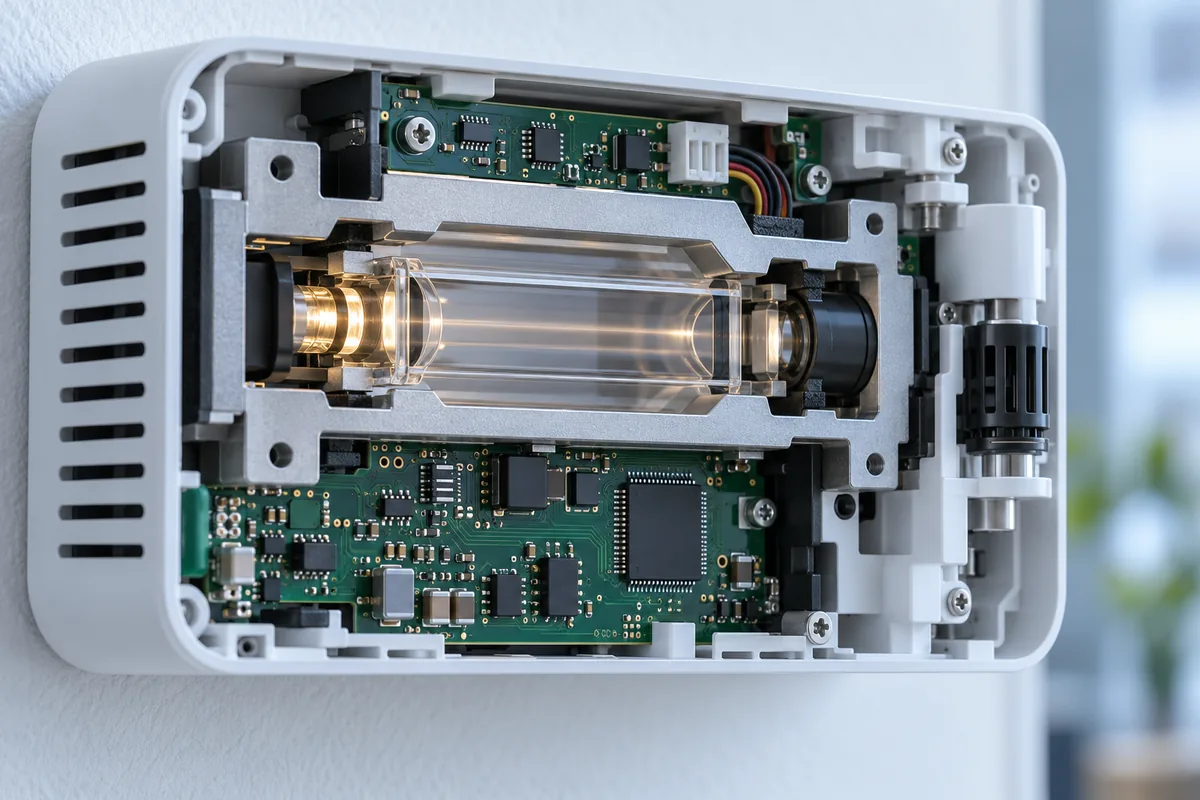
How a false baseline changes a useful-looking trend
Suppose a room sensor records a recurring minimum, but that minimum is not the true low reference because the room is never fully ventilated or never empty. An algorithm can interpret the persistent elevation as sensor drift. Later values may then be shifted toward the assumed baseline. The resulting plot can remain smooth, repeatable and internally consistent. That smoothness is precisely why a bad baseline can escape casual inspection.
The reverse problem is also possible. A temporary sample of unusually low-concentration air at the sensor—perhaps caused by a local draft or an unsealed wall cavity—may not represent occupied breathing-zone air. Some algorithms reject transients; others use a longer minimum history. The installed air path still has to be examined. Vaisala's wall-sensor installation discussion points out that air leaking through a wiring hole can bias a wall-mounted CO₂ sensor. An algorithm cannot decide from one low value whether it observed the room, the wall cavity or a genuine reference condition.
The practical consequence depends on what consumes the value. A ventilation controller may open an outdoor-air damper too late if the displayed CO₂ is biased low. A dashboard may report an apparently reassuring weekly peak. A facilities team may compare rooms and incorrectly attribute the difference to occupancy rather than sensor configuration. Conversely, an overly conservative reading can increase ventilation demand without solving the measurement problem. The correction history and actual control response are both relevant to a diagnosis.
Validate ABC as an installed measurement system
Begin with an inventory: exact model and firmware, ABC or ASC status, configuration parameters, installation point, controller scaling, normal power schedule and historical trend interval. Record when occupancy and outdoor-air delivery actually change. Compare the sensor's lowest readings with periods when a real low condition should have reached its inlet. A trend that bottoms out at nearly the same value every cycle may be expected, or it may show algorithmic anchoring. You need an independent reference to distinguish them.

Use a reference instrument or controlled reference procedure permitted by the manufacturer. Let both instruments stabilize in the same air sample and record their position, time, temperature and ventilation state. Compare more than one operating condition if the application depends on a broad CO₂ range. A single reading near the low end can reveal a gross offset, but it cannot by itself verify the response at occupied-room concentrations. If the reading fails the acceptance criterion for that instrument and application, investigate sampling, configuration and sensor condition before changing a calibration value.
An effective site record includes:
| Record item | Почему это важно |
|---|---|
| Instrument model, serial and firmware | ABC behavior and settings can change by product or revision |
| ABC/ASC enabled state and date changed | Makes a before/after trend interpretable |
| Location and air path | Confirms whether the sensor sees the air whose concentration matters |
| Occupancy, fan and outdoor-air schedule | Tests the presumed return to a low reference |
| Power/reset history | Establishes whether the algorithm observed the entire interval |
| Reference instrument and comparison conditions | Separates a plausible trend from measured agreement |
| Corrective action and later verification | Shows that a changed setting produced a defensible result |
Do not simply disable ABC because one comparison differs. A mismatch could be caused by probe placement, transient exhaled air, controller unit conversion, warm-up, temperature/pressure compensation or the reference instrument. Equally, do not keep ABC enabled because one check happens to agree at a single concentration. Decide from the complete measurement task and the documented algorithm requirements.
If the baseline assumption fails
An office commissioning example
Consider an office whose CO₂ sensor is mounted near a return grille. The occupancy schedule says the room is empty overnight, yet the air handler recirculates air from an adjacent occupied space while the outdoor-air damper is closed. A weekly minimum on the sensor trend therefore does not prove the room reached the module's assumed fresh-air condition. Before accepting ABC, the engineer would check damper and fan trends, the actual return-air route and the sensor's reading against an independent reference during both occupied and nominally empty periods. If the measured low period remains elevated, the remedy is not to label the minimum “fresh air” or to choose a shorter ABC window. It is to resolve the air-path and measurement strategy.
The same office could have a different result after an operating-schedule change. If outdoor air reaches the sensor during a documented nightly flush and reference comparisons remain within the instrument's acceptance criteria, ABC may fit that installed application. Both outcomes depend on evidence from the building, not on a generic statement that offices are suitable. Save the ABC state and reference checks before and after any operating change so later trend shifts can be interpreted.
Where a valid low condition does not occur, select a device and maintenance plan that do not depend on it, or use the manufacturer's supported manual/reference procedure. Options may include an instrument with a different drift-control design, a controlled reference check and periodic adjustment, or moving the measuring location if the current inlet is unrepresentative. These are design choices, not interchangeable software switches. Some products allow ABC to be disabled; others use an automatic method as an integral part of their measurement design. Check the manual before procurement, then test the installed system.
If a sensor has already been correcting against a suspect minimum, preserve its current settings and trend before adjustment. Review historical control actions that relied on its values. After an authorized change, compare the instrument with a known reference and monitor the trend through representative operating cycles. The aim is a value that supports the building decision, not merely a graph that looks smooth.

Questions to ask when buying a CO₂ sensor
Ask the supplier to state the algorithm's reference assumption, learning interval, power/uptime needs, default state, disable/reset options and how a field check is performed for the exact model. Request a data sheet or application note that describes behavior after a long power interruption, a module replacement or operation in persistent elevated CO₂. Confirm whether the advertised accuracy applies with ABC enabled, disabled, or under particular test conditions. A marketing claim of “maintenance free” is not a substitute for those details.
For an HVAC control project, also define the decision: demand-controlled ventilation, a room display, trend analytics or a safety function. The same module may be unsuitable for one of those tasks even if its numerical measurement range appears broad enough. Put its sampling location and maintenance access in the design review alongside its measurement specification.
For a broader selection discussion covering IAQ, process and safety ranges, GasNose's CO₂ sensor guide is a useful companion; the ABC decision here still has to be tested against the chosen model's own instructions.
Часто задаваемые вопросы
Does every NDIR CO₂ sensor use automatic baseline correction?
No. NDIR describes the optical sensing principle, not the long-term calibration strategy. Products vary in reference design, firmware and maintenance approach. Read the exact model's data sheet and configuration guide.
Is the outdoor CO₂ concentration always the same as a sensor's programmed baseline?
No. A programmed baseline is a device assumption. Actual outdoor air can vary by location and conditions. The site question is whether the sampled low condition satisfies that model's documented method, not whether a display repeats one nominal number.
Does opening a window once reset ABC correctly?
Not necessarily. The sensor must experience the appropriate reference for the required duration and within the algorithm's operating schedule. A brief local draft may not represent the room. Follow the manufacturer's method for reference exposure or forced adjustment.
Can ABC replace a field reference check?
No. ABC can manage a particular type of slow baseline drift when its assumptions hold. A separate reference comparison checks the installed reading and can reveal placement, configuration, response or algorithm problems. The needed check interval depends on the device and application.
What if a room never becomes unoccupied?
Do not presume its nightly minimum is fresh air. Review outdoor-air delivery and the measured trend, compare with an independent reference, and choose a sensor configuration or maintenance method supported for continuous occupancy. A different room type in the same building may need a different setting.






Комментарий (1)
[…] Twitter LinkedIn Google + Email 2026-10-27 No Comments Sensor One […]