
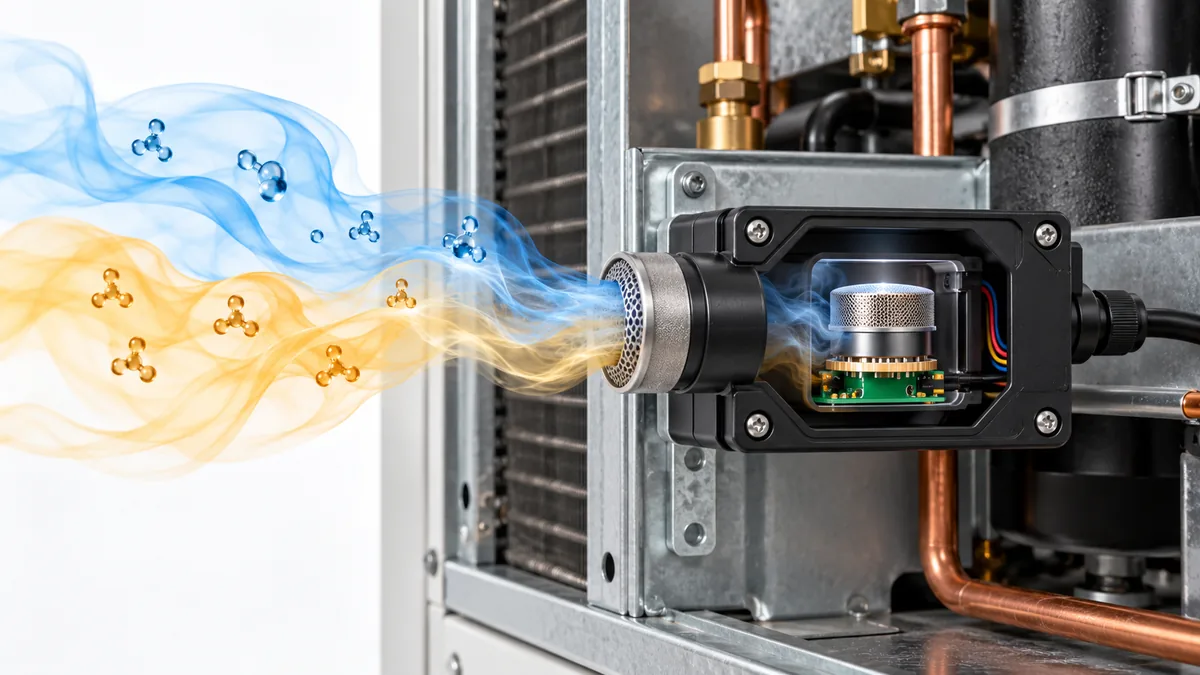
Yes. A refrigerant detector can respond to a substance other than its intended target, but the response belongs to a particular detector, gas profile, interferent, concentration, exposure and test method. A label such as “NDIR,” “semiconductor” or “refrigerant compatible” is not a complete selectivity claim. A different gas can also suppress or delay a response rather than produce a positive one. When a detector alarms, suspected cross-sensitivity is a question to investigate under the site's safety procedure, not a reason to dismiss the indication.
This guide is for HVAC equipment integrators, facilities engineers, product buyers and qualified service teams comparing refrigerant detection systems. It explains what cross-sensitivity means, why test conditions matter and how to request useful evidence from a supplier. It does not identify a particular site's alarm as false or provide a field method for releasing refrigerant. The installed detector's manual, applicable standard and approved response plan govern an actual event.
What does “cross-sensitive” mean in a detector specification?
A detector is calibrated or configured to interpret a signal as a concentration or alarm condition for one target gas or a defined refrigerant profile. Çapraz duyarlılık means another substance changes the signal in a way relevant to that interpretation. The result might be a displayed reading, an alarm, a biased zero, a reduced response to the target gas, a fault or a delayed recovery. The word alone does not tell you which outcome occurred.
Selectivity is the narrower claim that a device responds sufficiently to its target while responding less to specified alternatives under defined test conditions. “No false alarms” is incomplete without knowing the alternate substances, their concentrations, exposure time, environmental conditions, acceptance criterion, sample size and device state. A device might pass one set of interfering-gas tests while remaining vulnerable to a chemical that was never tested. A laboratory result for a module also does not automatically establish the installed system's ventilation or notification performance.
There are at least three broad sources of an unexpected signal:
- Another refrigerant or refrigerant blend. The sensor's optical band or sensing surface may respond to more than one refrigerant. A multi-gas profile can be intentional, but the displayed number may not have the same meaning for each gas.
- An unrelated vapor or process gas. Cleaning products, solvents, fuels or other airborne substances may affect some technologies. Which ones matter depends on the exact device and exposure, not a generic workshop-chemical list.
- An environmental or equipment effect. Temperature, humidity, condensation, airflow, contamination, power issues or a damaged sensor can change the output without being a true response to an alternate gas.
These possibilities can coexist with a real refrigerant release. A technician may notice a cleaning activity near the detector at the same time that a seal is leaking. The presence of a plausible interferent does not prove the absence of target gas. Investigate the alarm as the site procedure requires, then use event records, equipment condition and manufacturer-approved checks to identify the cause.
| Term in a supplier claim | What it could mean | Evidence to request |
|---|---|---|
| “Detects multiple refrigerants” | A profile or algorithm supports specified gases | Gas-by-gas response, units, threshold basis and exact configuration |
| “Selective” | Limited response to a listed set of alternatives | The interferent list, exposure and pass criteria |
| “Low cross-sensitivity” | A small response under one test method | Actual response magnitude, timing and recovery for each test |
| “No false alarm” | No alarm under tested exposures | Which exposures, device state and whether target sensitivity was checked afterward |
| “Self-monitoring” | A fault is generated for some internal failures | Fault coverage, response behavior and how the controller handles the signal |
The distinction between a gas alarm and a fault is especially important. A faulted instrument cannot be treated as a detector that has reliably measured zero gas. Our guide to refrigerant-sensor measurement tasks discusses how the target gas, unit and installation role affect a selection decision.
Separate five explanations that sound similar in an incident report
True target-gas release. The intended refrigerant reaches the sensing point. The indicated concentration still depends on the detector's position, airflow, calibration and response time. A low reading elsewhere in the room does not erase a local high reading.
Response to another gas. A different substance reaches the detector and produces a signal that resembles target-gas response. Its direction and magnitude are device-specific. A cross-sensitivity table can help interpret this possibility, but the table must match the exact installed model and profile.
Calibration or profile mismatch. The sensor may produce a legitimate physical response while the displayed units or alarm threshold are interpreted using the wrong refrigerant profile. A percentage of the lower flammability limit, or %LFL, depends on the particular gas's reference value. A ppm reading for one gas cannot be relabeled as the same %LFL for another without the correct basis and validated conversion. A blend can further complicate the interpretation.
Temporary inhibition or poisoning. An interferent may reduce the sensor's later response to the target gas, even if it did not cause an immediate alarm. Recovery may occur or service may be required, depending on technology and exposure. In a Purdue conference study of tested metal-oxide-semiconductor refrigerant sensors, contaminant exposures did not produce false alarms under that protocol, yet temporary poisoning was observed. That result applies to the tested samples and conditions; it is not a clean bill of health for every MOS detector.
Instrument or installation fault. Water at an inlet, a blocked diffusion path, damaged cable, supply-voltage problem or failed module can create a misleading value or fault. It may be tempting to label an alarm “cross-sensitivity” when the actual issue is a wet enclosure or a configuration change. The event record should preserve the detector's health status and maintenance history so these explanations can be compared.
This framework prevents two opposite mistakes: assuming every alarm is an actual leak without examining the instrument, and assuming a chemical exposure makes an alarm harmless. The first can waste effort; the second can be dangerous. An alarm should trigger the approved response while qualified personnel establish the cause.
Why sensor technology changes the question, but never settles it alone
Optical or NDIR refrigerant detection
An infrared detector measures absorption at selected wavelengths through an optical path. Some designs use a reference path or channel to compensate for source and environmental changes. The gas's absorption spectrum, filter selection, path length, optical condition and interpretation algorithm determine which substances can affect the measurement. A broad category label such as NDIR does not disclose the filter bands or provide a tested interference matrix.

Texas Instruments' A2L detection application brief describes an example optical approach and its design considerations. It is useful for understanding the signal chain, but an example electronic design is not a certification of every finished detector. A supplier should provide the exact product's target-gas response, environmental limits, diagnostics and relevant qualification report. The optical inlet and path also remain vulnerable to physical contamination or condensation where the design does not tolerate them.
Metal-oxide-semiconductor detection
A MOS element changes an electrical property as surface reactions occur. Heater operation, humidity and prior exposure can influence response and recovery. The material can respond to multiple reducing or oxidizing vapors, so a model's gas profile and interference evidence matter. A general claim that MOS is always “bad” at selectivity would be as unsupported as a claim that every MOS sensor responds identically. The Purdue results above demonstrate why a product-level exposure and post-exposure sensitivity check is more informative than a technology stereotype.

Portable leak-finding instruments
Portable service detectors are often optimized to help a technician locate a suspected leak, while a fixed refrigerant detection system monitors an area and can drive alarms or mitigation functions. The instruments may use different sensing principles, settings and acceptance criteria. A service instrument's known-interference list is useful for that instrument's use; it should not be copied into the fixed system's specification. For example, the JB Industries LD-5000 operating manual discusses its own operating environment and possible sources of interference. Its statements do not establish the behavior of another fixed detector.
The practical comparison is therefore model against model, in its installed role. Ask for the exact part number, firmware or gas-profile revision, test standard edition and controller integration before using a test result to make a procurement or maintenance decision.
How to read a cross-sensitivity or interference matrix
A vendor matrix is helpful only if its rows and columns preserve the conditions behind each result. Start with the tested gas's chemical identity. A refrigerant blend designation is not the same thing as a pure component; concentration and mixture composition matter. Then read the exposure unit. A result in ppm of the test gas cannot automatically be compared with %LFL of the target refrigerant. If the table reports “equivalent target-gas ppm,” ask how that equivalence was obtained and whether it applies across the range or only at one point.

For each interferent, request:
- Exposure level and duration. A one-minute challenge can miss slow accumulation or delayed recovery; a very high concentration can cause behavior unlike normal background conditions.
- Temperature and humidity. Environmental extremes and condensation can change both the sensor and the delivery of the test gas.
- Device age and conditioning. A new sensor may behave differently after months of operation or after an earlier chemical exposure.
- Response criterion. Was the reported number a peak display, steady-state reading, alarm occurrence, fault, or percentage change in sensitivity?
- Time to response and recovery. A detector that avoids a false alarm but takes much longer to detect target gas after an exposure still raises a performance question.
- Post-exposure target test. Did the device retain the required response to its intended refrigerant after the interferent was removed?
- Profile and software version. A firmware or profile update may change thresholds and signal processing without changing the housing or marketing name.
A blank cell should mean “not provided,” not “zero response.” An explicit “not tested” cell is much more useful than a blank. If a vendor gives a single generic cross-sensitivity percentage, ask for the underlying gas, concentration and procedure. If the result comes from a component test, ask what is known about the completed system, including fault handling and controller outputs.
Intertek's explanation of refrigerant detection system testing shows that evaluation can cover intended detection, unwanted output and susceptibility to physical or chemical damage. A certification claim should identify the actual product, scope and standard edition. It should not be expanded to untested gases or installation conditions.
What about R-32 and R-454B multi-gas claims?
The transition to lower-GWP refrigerants makes multi-refrigerant detector claims attractive. The right question is not merely “Can it detect both?” but “How is each gas represented in this exact model and profile?” If a module is intended for both R-32 and R-454B, request the target-gas response and alarm basis for each, the selected profile, the units sent to the controller and the behavior when the wrong profile is configured. Clarify whether one device is approved for a space containing either refrigerant at different times or for concurrent equipment with different refrigerants. Those are different use cases.
The Winsen ZRT512E product information is an example of a model-level document listing R-32/R-454B applications, its own range and environmental limits. It does Olumsuz prove that all optical detectors share those specifications, or that this module is suitable for every enclosure and control system. Its “no condensation” operating qualification also matters when a detector sits near cold HVAC equipment. The exact product data sheet and certification package should be checked against the proposed installation.
For a blend, ask how the response and displayed value relate to the refrigerant's mixture behavior. A sensor may respond to one or more components differently. It is unsafe to infer a blend's response from a pure-gas result without supporting test evidence. Likewise, a controller setpoint expressed in %LFL must be tied to the applicable gas basis and the approved system design; it is not a free-floating percentage that can be copied from one application to another.
Investigating an alarm without prejudging it
First preserve the event. The detector's original reading, status, gas profile, alarm transition and timestamp are more valuable than a later screenshot after the alarm has been reset. Follow the site's response procedure for personnel safety and equipment action. A suspected cleaning solvent or service activity can be recorded as context, but it does not override the alarm response.

When the approved procedure allows qualified investigation, compare the detector's status and trend with other independent evidence: equipment operating state, nearby fixed channels, ventilation operation, recent work, and a suitable portable measurement where the procedure calls for it. Record the portable instrument's gas setting, unit, location and condition. Different locations and technologies are not expected to show identical numbers; a disagreement calls for analysis rather than an automatic choice of the lower reading.
Next check the installed model and configuration against the claimed interference evidence. Was the sensor exposed to the substance that the supplier actually tested? Was the concentration or duration remotely comparable? Has the sensor been serviced, replaced or updated since the relevant test? Were humidity or condensation conditions outside the model's specification? If these questions cannot be answered, the cause remains uncertain. The maintenance plan should state how the device is evaluated and returned to service after a suspected interfering or poisoning exposure.
Avoid casual resets or sensor substitutions. A cleared display can erase useful event context, and an unapproved substitute may change gas response, fault behavior or controller mapping. If a qualified team finds a recurring nuisance source, it can consider controls at the source, an approved placement change, a different qualified detector or revised work practices. Any design change should be evaluated against target-gas detection performance, not only its ability to reduce nuisance alarms.
Questions to ask before buying or integrating a detector
An integrator can request a compact evidence pack rather than relying on a broad brochure claim:
- Which exact refrigerants, concentrations and units are supported by each selectable profile?
- What interfering gases or vapors were tested, at what levels and for how long?
- Was the reported outcome a false alarm, indicated concentration, fault, sensitivity loss or recovery time?
- Was target-gas sensitivity checked after each interfering exposure?
- What temperature, humidity, condensation and contamination limits apply to the actual assembly and inlet?
- Which firmware, sensor module, calibration state and standard edition produced the evidence?
- How are alarm, trouble, loss of communication and end-of-life states sent to the controller?
- What installation and maintenance procedure preserves the tested performance?
These questions expose the difference between a scientifically meaningful product qualification and a blanket adjective such as “highly selective.” They also help a purchaser compare complete detection systems rather than bare sensor elements. For a broader explanation of gas-sensor interference mechanisms, GasNose's cross-sensitivity guide is useful background; the refrigerant-specific decision still requires the selected product's evidence.
Work through one supplier claim without overreading it
Imagine a supplier states that its detector “showed no false alarms during solvent exposure.” That sentence is a starting point, not a complete suitability decision. First ask which solvent was tested, at what concentration, in what carrier air and for how long. The solvent in a plant-room cleaning product may be different, and the amount reaching a wall-mounted detector may depend on ventilation and distance. Next ask whether the alarm threshold and refrigerant profile were the same as those proposed for the site. A test at one configuration does not validate every menu option.
Then ask what the test observed. “No false alarm” may mean that the relay did not trip, while the display still drifted upward. It may also mean that the sensor entered a fault state rather than an alarm. Request the raw trace or at least the maximum indicated value, timing, fault history and recovery period. Most importantly, ask whether the device was challenged with the target refrigerant after the solvent exposure. A detector that avoids a nuisance alarm but temporarily loses target sensitivity presents a different risk from a detector that returns immediately to its prior response.
Finally identify the boundary of the report. Was a bare sensing module tested, a complete detector with enclosure and inlet, or the integrated detector-plus-controller system? Were temperature and humidity controlled? Was the sample a new unit or a conditioned device? Does the report identify the part number and firmware revision being purchased? If an independent certification is cited, confirm that the certificate actually covers the model, gas profile and standard edition in question. This sequence turns a broad marketing statement into a specific evidence request without assuming the product will fail.
The same discipline applies to a “zero cross-sensitivity” table. Zero may mean below the display resolution or below an alarm threshold under one set of conditions; it rarely means a physical response of exactly zero for every concentration and temperature. A blank cell may be untested. A negative response can be as significant as a positive one if it masks a later target-gas event. The procurement decision should be based on the test method, the intended installation and the consequence of a missed or nuisance alarm, not on the shortest claim in a brochure.
Sık sorulan sorular
Does NDIR mean a refrigerant detector cannot react to another gas?
No. Optical selectivity depends on the chosen wavelengths, optics, algorithm and tested gas set. An exact product may be highly selective for its intended application, but the NDIR label alone does not provide an interference matrix.
If a cleaning product was used, can the alarm be called false?
Not from that fact alone. Preserve the alarm, follow the site procedure and investigate the actual refrigerant system and detector evidence. The cleaning product might have interfered, but a real release can occur at the same time.
Are all refrigerants interchangeable in a %LFL setting?
No. The percentage is relative to the lower flammability limit of a defined gas under a defined basis. Different refrigerants and blends require their own supported profile and approved system configuration. A ppm display and a %LFL alarm are not interchangeable labels.
Can an interferent cause no alarm yet still matter?
Yes. It may temporarily reduce later response, alter the baseline or produce a fault. A complete test should check target-gas performance after the interferent exposure, not only whether a false alarm occurred during it.
Can a portable leak detector verify a fixed alarm is wrong?
It can contribute evidence when used by a qualified person under the site procedure, but it samples a particular place and time with its own gas setting and limitations. It cannot by itself prove that a fixed alarm was false or that the whole plant room is clear.
Cross-sensitivity is best treated as a measured, model-specific performance question. Ask what was tested, preserve the gas and profile context, and keep alarm, fault and real-leak possibilities open until the approved investigation resolves them. That approach yields better detector choices and more defensible event reviews than either blanket trust or blanket dismissal of an alarm.

Soğutma Tesisi-Odası Gaz İzleme Log Kaydı Ne Olmalı?
Dedektör kimliğini, konfigürasyonunu, alarmlarını, arızalarını, havalandırma tepkisini ve bakım kanıtlarını kaydederek kullanışlı bir tesis odası gaz kaydı oluşturun.
Devamını oku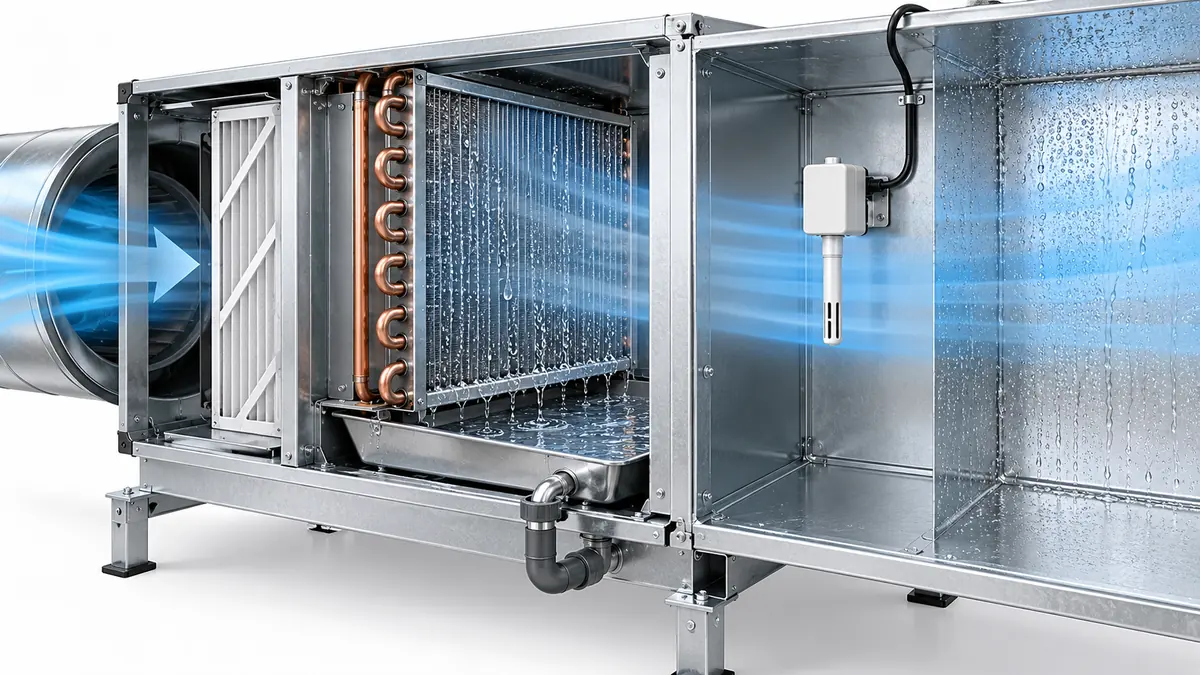
Yoğuşma HVAC Sensörünü Ne Zaman Yanıltır?
HVAC bobinleri, probları ve muhafazalarındaki yoğuşmanın sensör okumasını ne zaman değiştirdiğini ve beklenen drenajı istenmeyen ıslanmadan nasıl ayırt edebileceğinizi öğrenin.
Devamını oku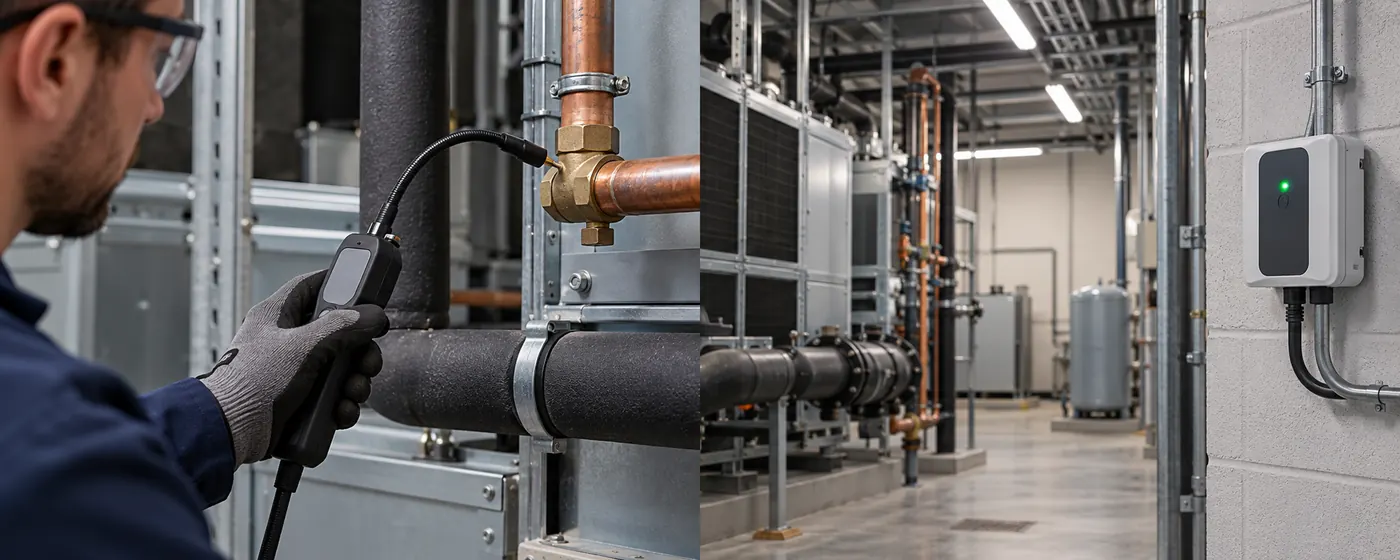
Taşınabilir ve Sabit Soğutucu Akışkan Algılama: İşleri Ne Kadar Farklı?
El tipi sızıntı tespit cihazlarını, sabit nokta monitörlerini ve emme sistemlerini numune konumu, müdahale zinciri ve devreye alma gereksinimlerine göre karşılaştırın.
Devamını oku
Soğutucu Akışkan Tanımlaması ve Konsantrasyon Ölçümü: Hangi Teste İhtiyacınız Var?
Yalıtılmış şarj tanımlayıcıyı ortam konsantrasyonu izleme, elde taşınan sızıntı konumu ve resmi soğutucu akışkan saflık testinden ayırın.
Devamını oku
Nem Optik PM2.5 Sensör Okumalarını Nasıl Etkiler?
Nem, su alımı, sis ve yoğuşmanın neden optik PM2.5 tahminlerini etkileyebileceğini ve nemli havadaki ani artışın nasıl araştırılıp doğrulanacağını öğrenin.
Devamını oku
Araç Kabinindeki CO2 Okumaları Nasıl Yorumlanır?
Havalandırma ipuçlarını parçacık ve egzoz güvenliği sorularından ayırırken yolcular, HVAC modu ve rota koşullarının yanı sıra araç kabini CO2 trendlerini de okuyun.
Devamını oku