
A gas sensor is ready for a particular measurement only when its startup sequence, specified warmup, relevant environmental stabilization and data-validity checks have all been satisfied. A display that lights up or a digital register that returns a number proves that part of the electronics is working. It does not, by itself, establish that the number meets the accuracy specification. The right waiting period comes from the exact instrument documentation and the conditions of use, rather than a universal rule for all gas sensors.
Output availability and full-specification readiness are separate milestones.
The practical question is therefore: ready for what, under which conditions, and according to which evidence? A preliminary trend, a quantitative reference comparison and an action that depends on an alarm system are different uses. This article explains how to read the timing terms, handle transitions and preserve enough information to decide whether a measurement is usable. It focuses on gas and indoor-air instruments; an individual detector's safety functions and operating instructions must be assessed at the complete equipment level.
Which clock are you actually waiting for?
Several processes can happen at once after power is applied. The processor boots, communication becomes available, the sensing element moves toward its intended operating condition, gas reaches the measurement volume, and filters or algorithms establish their output. The slowest relevant condition governs readiness for the intended result. These processes need not start at the same moment and should not be treated as interchangeable time specifications.
| Term in documentation | What it can establish | What it does not establish alone |
|---|---|---|
| Startup or boot time | Electronics and outputs become available | Full measurement accuracy |
| First measurement | A new sample can be returned | Suitability across every stated environmental condition |
| Warmup for full specification | A specified operating condition is reached after powering | Recovery from every storage or contamination event |
| Response time, such as T90 | Response to a change in gas under stated test conditions | Power-on readiness or complete sample-line transit |
| Environmental equilibration | Instrument and surrounding conditions settle | Correct calibration or reference identity |
| Calibration or baseline learning | A correction process has sufficient information | That every early reading is invalid or every later reading correct |
Read the document's definitions rather than interpreting a word in isolation. A short specification table may list only one warmup value, while the operating section distinguishes initial operation from a tighter accuracy condition. If the meaning remains ambiguous, the missing information is the relationship between the timing value and the claimed result. An arbitrary extra delay may reduce a transient, but it does not resolve an undefined specification.
A clock should also have an explicit start event. Is it measured from application of rated supply voltage, release of reset, start of periodic measurement, or exposure to the new sample? For a networked instrument, the controller may reconnect long after the sensor powered up. Restarting the controller's timer at connection can be conservative but misleading for diagnostics. Starting a readiness timer at the last successful communication can be unsafe if the sensor actually reset after that event.
What do real manufacturer specifications show?
Vaisala's GMP252 specification in document M212450EN-H lists startup at +25 °C below 12 seconds and warmup for full specification below two minutes. The same table separately gives response times for different sample interfaces, including the standard filter and spray shield. Those are three different claims about one documented probe; using the startup number as its full-accuracy waiting time would discard an explicit distinction in the source.
A different instrument makes the distinction differently. The XMW85 datasheet B212996EN-D lists a one-minute warmup and ten minutes for full specification for its CO₂ measurement. That does not mean the XMW85 is generally inferior to the GMP252, nor that ten minutes applies to every Vaisala product. It shows why a comparison must preserve model, parameter and specification conditions.
The Sensirion SCD30 product documentation provides another useful reading discipline: measurement range, accuracy and response time are separate characteristics. When integrating a sensor module, use the associated datasheet and interface description for its actual operating mode. A host's fast polling rate does not shorten the module's physical response or convert repeated reads of one sample into independent measurements.
Do not copy timing values across product families because the devices share an NDIR, photoacoustic, electrochemical or metal-oxide label. Construction, heating, compensation, enclosure and software affect the delivered instrument behavior. Even two products using a related sensing element can have different interfaces and readiness requirements. The public table is a starting point; the exact model and manual revision define the engineering assumption.
Why can a number appear before the measurement settles?
Electronics can calculate a result from an evolving physical signal. An infrared source, detector and surrounding structure may not all reach their intended thermal conditions instantly. A sensor with a heater may require a particular operating state. An electrochemical sensing system may need its documented initialization or recovery process. These examples explain why warmup can matter; they do not establish the same mechanism or duration for every technology.
There is also a distinction between a sensor's internal compensation and the environment it is supposed to represent. A compensated output may account for measured temperature or an entered pressure value. It cannot automatically correct a stale pressure input, a sample that has not arrived, an inappropriate gas matrix, or a temperature probe that represents the circuit board rather than the sample. A stable compensated number can still be based on the wrong conditions.
Vaisala's application note on CO₂ instrument self-heating explains why electronics and output circuitry can influence colocated temperature and relative-humidity measurements. For combined instruments, assess each reported quantity separately. The CO₂ channel, temperature channel and RH channel need not establish useful performance simultaneously. A timer attached to the instrument as a whole can hide these channel-specific differences.
A useful diagnostic log therefore records the measured value together with the channels used for compensation and the current status. If a CO₂ result changes while the instrument temperature is settling, the relationship may help frame an investigation. Correlation alone does not prove a defective compensation algorithm; room concentration or airflow may be changing at the same time. Avoid recalibrating solely to force an early transient to agree with another display.
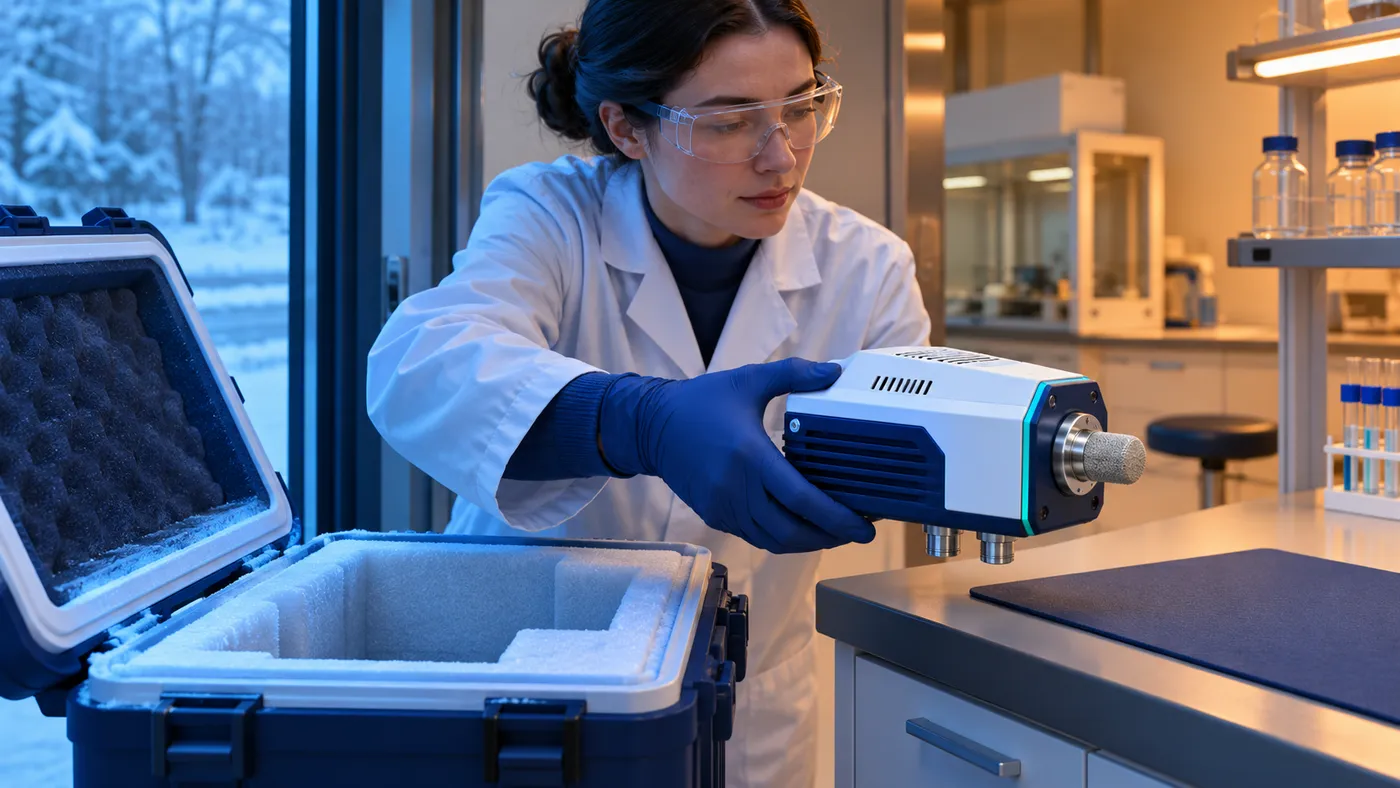
Environmental transfer can introduce stabilization needs beyond an electrical restart.
Does a temperature change restart the warmup requirement?
Moving an instrument from cold storage into a warm room changes a different set of conditions from an ordinary power-on at room temperature. The housing, sample path, sensing structure and surrounding air can approach equilibrium at different rates. If the manufacturer specifies a storage recovery period or an acclimatization procedure, that requirement applies in addition to the ordinary measurement timing conditions.
A sensor that remains powered can still experience an environmental transient. For example, a portable monitor moved from one location to another may have no electronic restart, but the gas, temperature and humidity at its inlet have changed. Conversely, a brief host communication interruption may not change the sensor environment or power state at all. Treat the triggering event explicitly rather than assuming every discontinuity has the same recovery rule.
Condensation deserves its own assessment. A non-condensing humidity rating does not permit liquid water on the sensing surface simply because the nominal RH number is within a table's range. The GMP252 documentation explicitly distinguishes its non-condensing operating condition and powered sensor-head heating. That feature is model-specific. It should not be interpreted as permission to use any gas sensor while wet or to accelerate recovery with an improvised heat source.
An acclimatization log can be simple: previous location or storage condition, new ambient conditions, power state during transfer, transfer time, any visible moisture, and the manufacturer's applicable instruction. If the instrument remains unstable beyond its expected conditions, the next question is what changed in the measurement chain. Extending a timer indefinitely can conceal a blocked inlet, wrong compensation value, damaged sensor or unsuitable environment.
How do you distinguish warmup from gas response?
Warmup concerns the instrument's operating state after the relevant start event. Response time concerns how the output follows a change in input gas under a defined setup. A warmed instrument does not report a remote gas change before the sample reaches it. A cold instrument does not become fully accurate merely because it has been exposed to the same gas for one published response time.
Bir numune alma sistemi taşıma ve karıştırmayı ekler. Giriş konumu, hat hacmi, akış, filtreler ve dahili ölçüm hacmi, gazın algılama elemanına ulaşmasını geciktirebilir veya değiştirebilir. Bir difüzyon enstrümanının kendi bariyerleri ve muhafaza değişimi vardır. Çıplak bir modülün yanıt değeri, özellikle ek bir koruma veya filtre takıldığında, monte edilen ürünü otomatik olarak tanımlayamaz. Belgelenen aksesuara özel yanıt değerleri tahminlerden daha faydalıdır.
olarak varsayımsal taşıma hesaplaması, a line containing 120 mL of gas at an actual flow of 240 mL/min has a nominal volume/flow time of 0.5 minutes, or 30 seconds. That arithmetic describes one volume turnover under the stated flow assumption. It does not prove complete replacement, represent adsorption, include dead volumes or establish a safe alarm response. It also says nothing about the sensor's warmup. A measured installed-system response is needed for claims about that system.
| Gözlem | Plausible question to investigate | Evidence that would help |
|---|---|---|
| Values change after power-on in stable shared air | Is this a startup transient? | Power/reset timestamps and documented warmup |
| Values lag after moving the inlet | Has the new sample arrived? | Inlet event, flow status and installed response evidence |
| Only temperature or RH drifts | Is enclosure thermal settling involved? | Independent ambient measurement and mounting conditions |
| Output freezes while communication continues | Is the sample fresh? | Data-ready behavior, sample counter or timestamp |
| Repeated restarts prevent useful readings | Is supply integrity adequate? | Reset cause and supply measurements from qualified investigation |
Do not add published timing values mechanically unless the system model supports that calculation. Some processes overlap; others begin sequentially. A sample may already be present before electronic warmup finishes, or a line may begin purging only after the pump starts. A timing diagram for the actual equipment is clearer than a blanket sum of unrelated maximum values.
A fresh value, its validity status and its age answer different questions.
What should the data-validity state mean?
A useful measurement record separates value, status and age. Value is the concentration or other quantity. Status says whether the device or host currently considers it usable and why. Age indicates when the underlying measurement was acquired, rather than when the application last displayed it. Keeping these fields separate prevents a cached result from looking like a new valid sample after a reboot or disconnection.
Read the manufacturer's meaning for data-ready, busy, warmup, fault and out-of-range indications. A data-ready bit often answers a narrower question than “all measurement uncertainty requirements have been met.” Equally, the absence of a dedicated warmup bit does not remove a stated warmup requirement. Host software may need to apply the documented time and condition checks in addition to the device's status.
For a quantitative logger, possible states include initializing, waiting for required conditions, valid, stale, and fault. These are an example design vocabulary, not a universal protocol. The transition into valid should identify the evidence required by the application: a fresh sample, completion of model-specific timing, acceptable device status and relevant environmental conditions. The transition out of valid should occur when that evidence is no longer present.
For equipment with a safety function, the required behavior while measurements are unavailable belongs in the manufacturer's instructions and the site's engineered protection strategy. Replacing an unavailable value with zero can falsely imply an absence of gas. Holding the previous reading without an age or invalid marker can falsely imply continuous measurement. The treatment of alarms, faults and control actions must be established for the complete system, not improvised from this example vocabulary.
Can a steady display prove full accuracy?
No. Stability is useful evidence that a transient may have subsided, but a stable result can have an offset, wrong scaling or incorrect compensation. Resolution and smoothing can also hide movement. A display that holds 800 ppm might represent a steady raw signal, a heavily averaged changing signal, a rounded result or a stale sample. Its appearance alone cannot distinguish these cases.
Quantitative verification requires an appropriate reference and a defined comparison. The reference has its own uncertainty, response and environmental requirements. Two instruments placed near each other may sample different air, especially near people, vents or a gas source. Their agreement is more informative when the measurand, location, timing and averaging are genuinely comparable. Agreement between two unknown instruments is not equivalent to traceable verification.
The distinction between traceability and a convenient comparison is explained by NIST's metrological traceability guidance. Traceability concerns the measurement result and its documented chain, including uncertainty. For a warmup investigation, record the reference identity and comparison conditions rather than describing any second monitor as a ground truth. A portable reference can be useful without supporting an unlimited accuracy claim.
A reference check should not erase the startup question. If an adjustment is made during warmup, the resulting correction may compensate for a temporary state and become wrong after equilibrium. Capture the original response, wait according to the documented conditions, and separate any authorized adjustment from the independent check afterward. These are evidence-management principles; the actual procedure and allowable adjustment commands remain instrument-specific.
How can you build a readiness worksheet?
The following worksheet turns scattered specifications into a single reviewable decision. It can be attached to an integration requirement, commissioning record or troubleshooting log. Fill in explicit values only when the source supplies them; “not specified” is more useful than an invented duration.
| Worksheet field | Record this | Review question |
|---|---|---|
| Cihaz kimliği | Manufacturer, model, serial, firmware and accessories | Is this the configuration covered by the source? |
| Kaynak | Datasheet/manual title, revision and section | Does the timing apply to this mode? |
| Power event | Actual power-on/reset timestamp and cause | What started this clock? |
| Output availability | First fresh sample and communication status | Is the host reading new data? |
| Full-spec requirement | Stated warmup and qualifying conditions | Is output availability being confused with accuracy? |
| Çevre | Relevant temperature, humidity, pressure and transitions | Are the specification conditions satisfied? |
| Örnek yol | Inlet, filter/shield, flow status and sampling mode | Does installed response differ from module response? |
| Tazminat | Enabled inputs, values, units and update age | Are assumed conditions still correct? |
| Release decision | Intended use, evidence, decision time and reviewer | What claim does readiness actually support? |
A practical implementation should preserve the source revision with the worksheet. Future firmware or accessory changes can alter the relevant assumptions. If a replacement sensor has the same commercial family name but a different revision or measurement mode, review the worksheet instead of inheriting the old timer automatically. A simple configuration change can otherwise create a persistent mismatch between the code and the documentation.
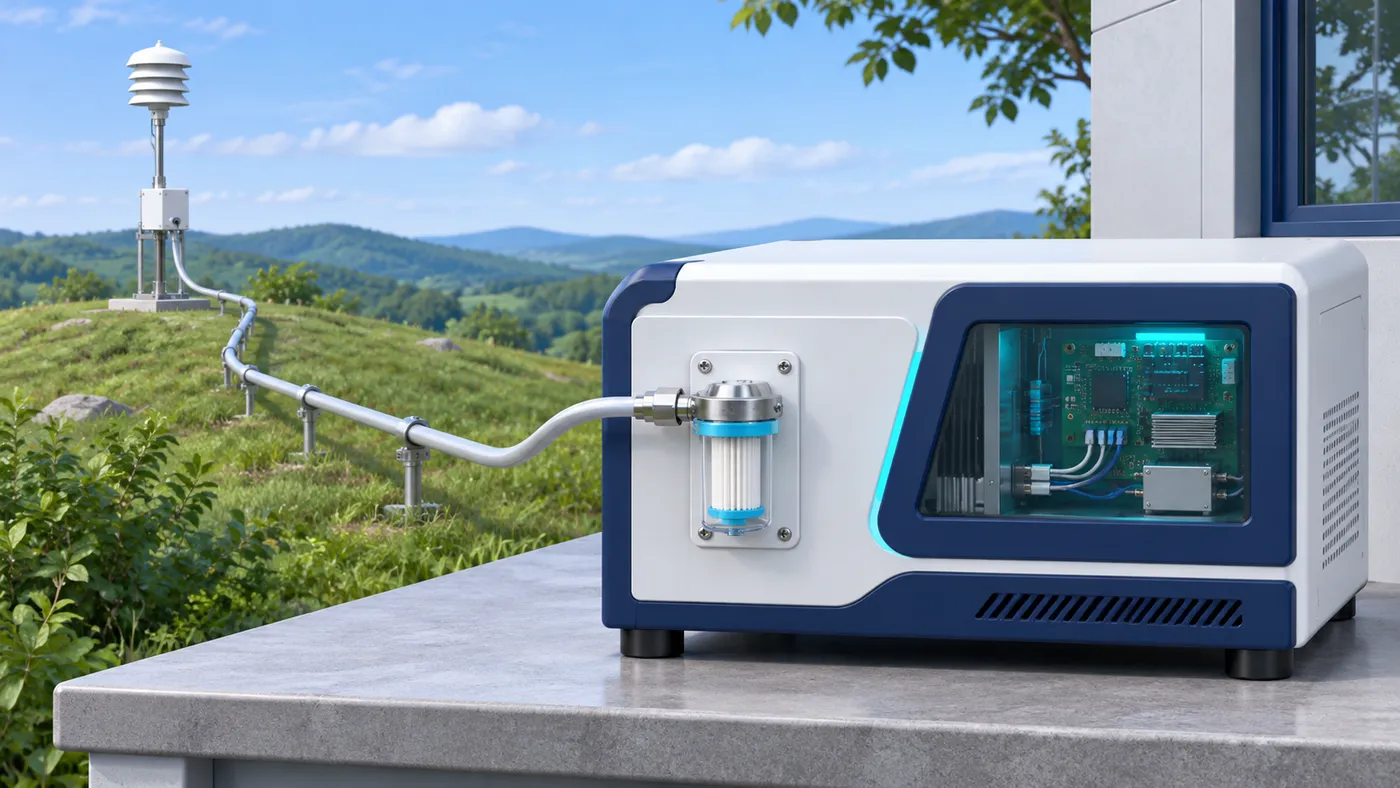
The sample must reach the measurement volume before the instrument can represent a remote inlet.
What does a checked startup example look like?
Consider a fictional integration example using a documentation requirement of two minutes for full-spec warmup, with the instrument already acclimatized and sampling stable room air. The sensor is powered at 09:00:00. Communication begins at 09:00:08. A fresh concentration sample arrives at 09:00:10. At 09:01:00 the output appears steady. At 09:02:00 the host confirms the required timing, a fresh sample and acceptable device status.
The elapsed time from power-on to the first sample is ten seconds. The elapsed time from power-on to the release review is 120 seconds. The first sample therefore appeared 110 seconds before the warmup review. That arithmetic is the only quantitative conclusion supplied by the fictional timeline. It does not assert a particular error at ten seconds or prove that all real instruments become accurate at exactly two minutes.
Şimdi bir varsayımı değiştirin: Sensör soğuk depodan 08:59:50'de taşındı ve ilgili talimatlar henüz kanıtlanmamış çevresel stabilizasyon gerektiriyor. Elektronik zaman çizelgesi değişmez ancak yayın kararı değişir. Ev sahibi, yalnızca geçen elektriksel ısınmadan bu çevresel gereksinimin karşılandığını çıkaramaz. Kayıt, okumayı tamamen geçerli olarak sessizce etiketlemek yerine sınırlayıcı koşulu korumalıdır.
Change another assumption: power is interrupted at 09:01:30 and the sensor restarts. The original two-minute clock no longer describes uninterrupted operation. If the model's instructions require the warmup after that restart, the timer follows the new power event. A persistent application process must not retain its old ready flag merely because the application itself never rebooted.
What should you troubleshoot before adding more waiting time?
First confirm that the instrument is actually remaining powered and that the host is receiving fresh samples. Then review configuration, compensation and the sample path. Look for a recent change in mounting, enclosure ventilation, filter, flow, measurement mode or surrounding environment. Preserve the original evidence before resetting, adjusting or replacing the device, because those interventions can remove the symptom without explaining it.
A useful troubleshooting comparison changes one relevant condition at a time under an approved method. For example, documenting the same installed instrument before and after a filter service can distinguish a sample-path concern from a generic startup claim, provided all other important conditions are recorded. It is less useful to change the sensor, firmware, reference, location and averaging simultaneously and attribute the result to warmup.
If documentation offers only a vague timing term, ask the manufacturer which specification is met after that interval, at what ambient conditions, from what initial state and with which accessories. Those four questions narrow the uncertainty more effectively than asking whether the sensor needs “a few minutes.” For purchasing, require the answer in a controlled technical document so that it remains reviewable after staff or suppliers change.
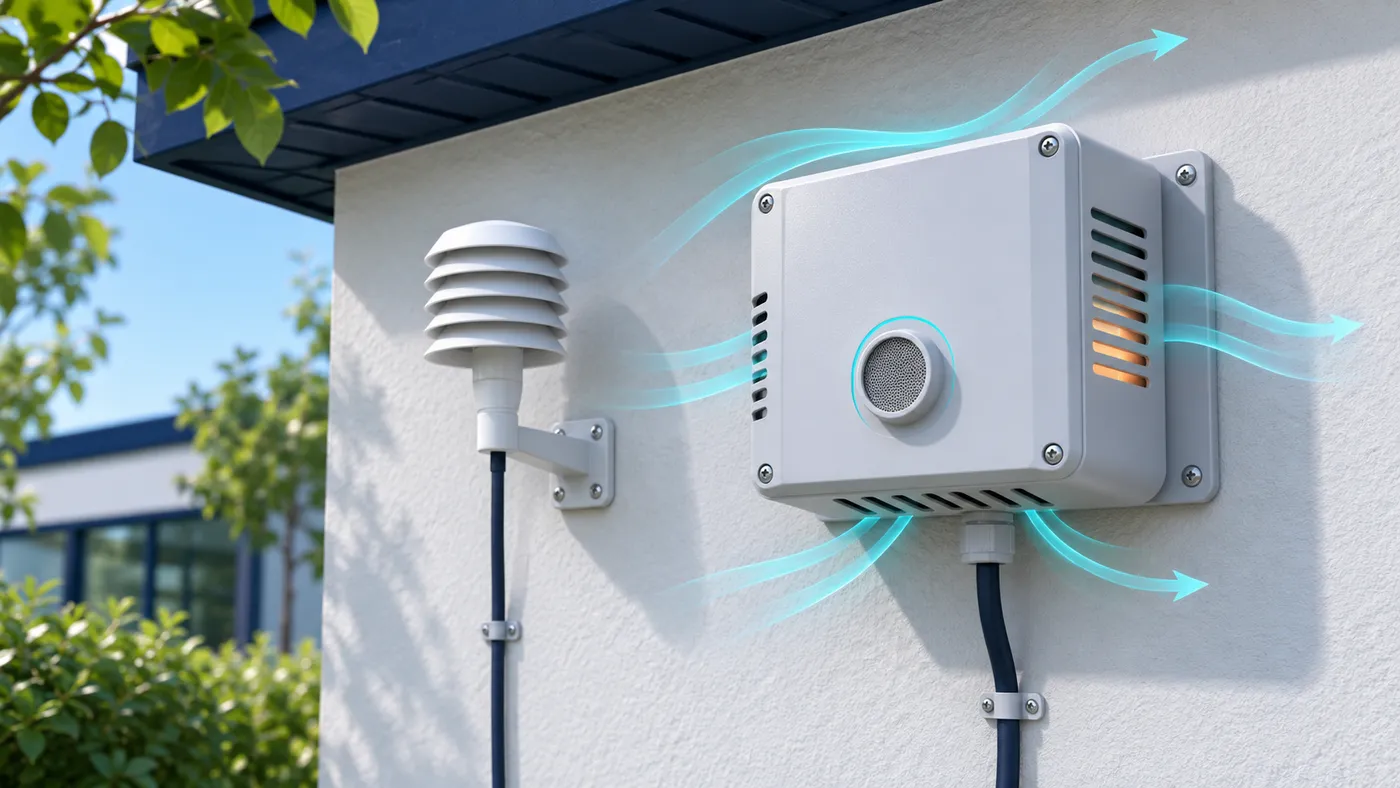
Different channels can settle differently in the same enclosure; airflow symbols are conceptual.
How should you document a restart policy for an integrated product?
A restart policy should specify which events invalidate the measurement and which evidence restores it. Distinguish sensor power loss, sensor reset, host reset, communication loss and a user request to change measurement mode. These events may look identical on a dashboard while requiring different actions. The integration requirement should identify which device supplies the authoritative reset or sample-age information.
Consider a host that reboots while the sensor stays continuously powered. If the host can reliably recover sensor status and sample age, it may establish readiness without pretending the sensor just powered on. If that information is unavailable, the application must follow its documented conservative recovery behavior. Either approach needs an explicit rationale; silently inheriting a cached green indicator is not evidence.
Now consider a sensor that browns out while its host continues running. A timer measured only from host startup will be wrong. The product needs a way to detect the relevant sensor event, whether through diagnostics, a reset indication, acquisition behavior or another supported mechanism. Choose the mechanism from the actual interface documentation and verify its behavior during integration.
The readiness specification should also define what appears in exported data. Preserve an unavailable or initializing interval as such, with timestamps and reason codes where possible. Removing it entirely can make a system appear continuously available. Replacing it with a plausible concentration can corrupt averages and later investigations. A record can contain an early numerical output for diagnostics while clearly withholding the claim that it is a qualified measurement.
Finally, keep the restart policy linked to the product configuration. A new measurement interval, power-saving mode, enclosure or firmware revision may invalidate old assumptions. Review the policy when those changes are introduced. The useful deliverable is a reproducible decision about data status under defined events, rather than a delay constant whose original purpose has been forgotten.
Sık sorulan sorular
Can I use startup readings for a trend?
Possibly, if the purpose tolerates their limitations and they are clearly marked. Retaining initializing data for diagnosis can be valuable. Combining it with fully qualified data without status markers can distort statistics and conceal availability. The intended decision determines whether preliminary data have any useful role.
Should I always wait the longest warmup time I can find online?
No. A value for another model does not define your instrument. Use the exact model, revision, operating mode and conditions. A longer arbitrary wait may be conservative in one respect but still fail to address condensation, wrong compensation or missing sample flow.
Does continuous power eliminate every stabilization issue?
No. Continuous operation can avoid repeated electrical startup, but environmental transitions and changes in the sampled gas still occur. It also does not establish calibration quality or prevent inlet blockage. The relevant evidence depends on the event being investigated.
Is T90 the time to full accuracy?
No. T90 normally describes reaching 90% of a response change under stated conditions. It is a dynamic-response measure. Full accuracy after startup is a different claim, and a sample system can introduce additional delay. Read both definitions in the applicable documentation.
Can automatic baseline correction fix a warmup problem?
Do not assume so. A baseline algorithm and a startup transient are different processes. Whether baseline correction is appropriate depends on the sensor design and exposure assumptions. Changing that setting to hide an early reading can create a separate long-term error.
What is the most useful single readiness record?
A timestamped entry linking the fresh value, device status, power/reset history and relevant conditions to the exact timing requirement. It should say what use was authorized. That makes a readiness decision reconstructable instead of relying on the appearance of a steady display.










Cevap bırakın